Rationalism 
The Geometry of the Mind
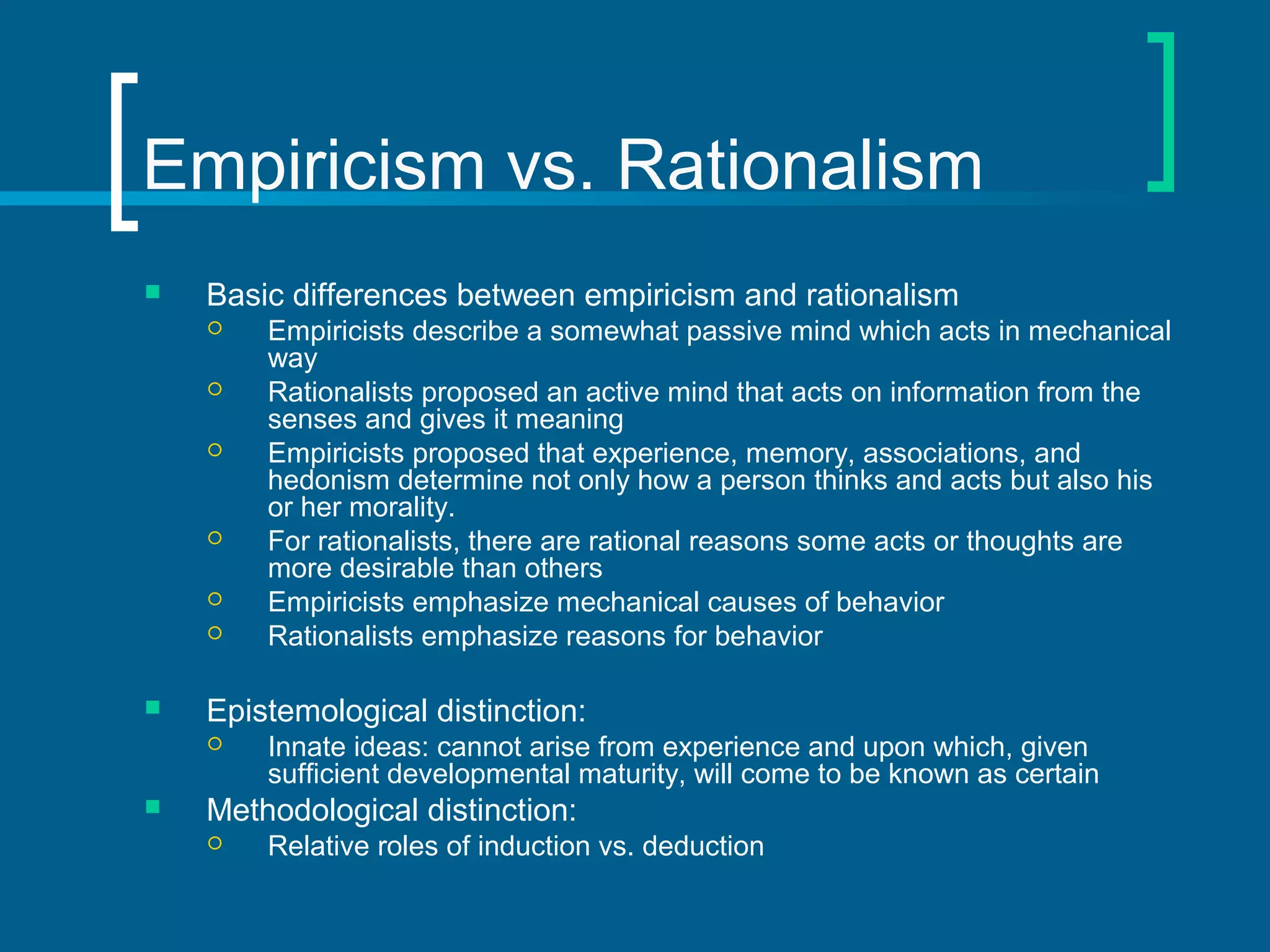
Empiricism vs. Rationalism 
 Basic differences between empiricism and rationalism 
 Empiricists describe a somewhat passive mind which acts in mechanical 
way 
 Rationalists proposed an active mind that acts on information from the 
senses and gives it meaning 
 Empiricists proposed that experience, memory, associations, and 
hedonism determine not only how a person thinks and acts but also his 
or her morality. 
 For rationalists, there are rational reasons some acts or thoughts are 
more desirable than others 
 Empiricists emphasize mechanical causes of behavior 
 Rationalists emphasize reasons for behavior 
 Epistemological distinction: 
 Innate ideas: cannot arise from experience and upon which, given 
sufficient developmental maturity, will come to be known as certain 
 Methodological distinction: 
 Relative roles of induction vs. deduction
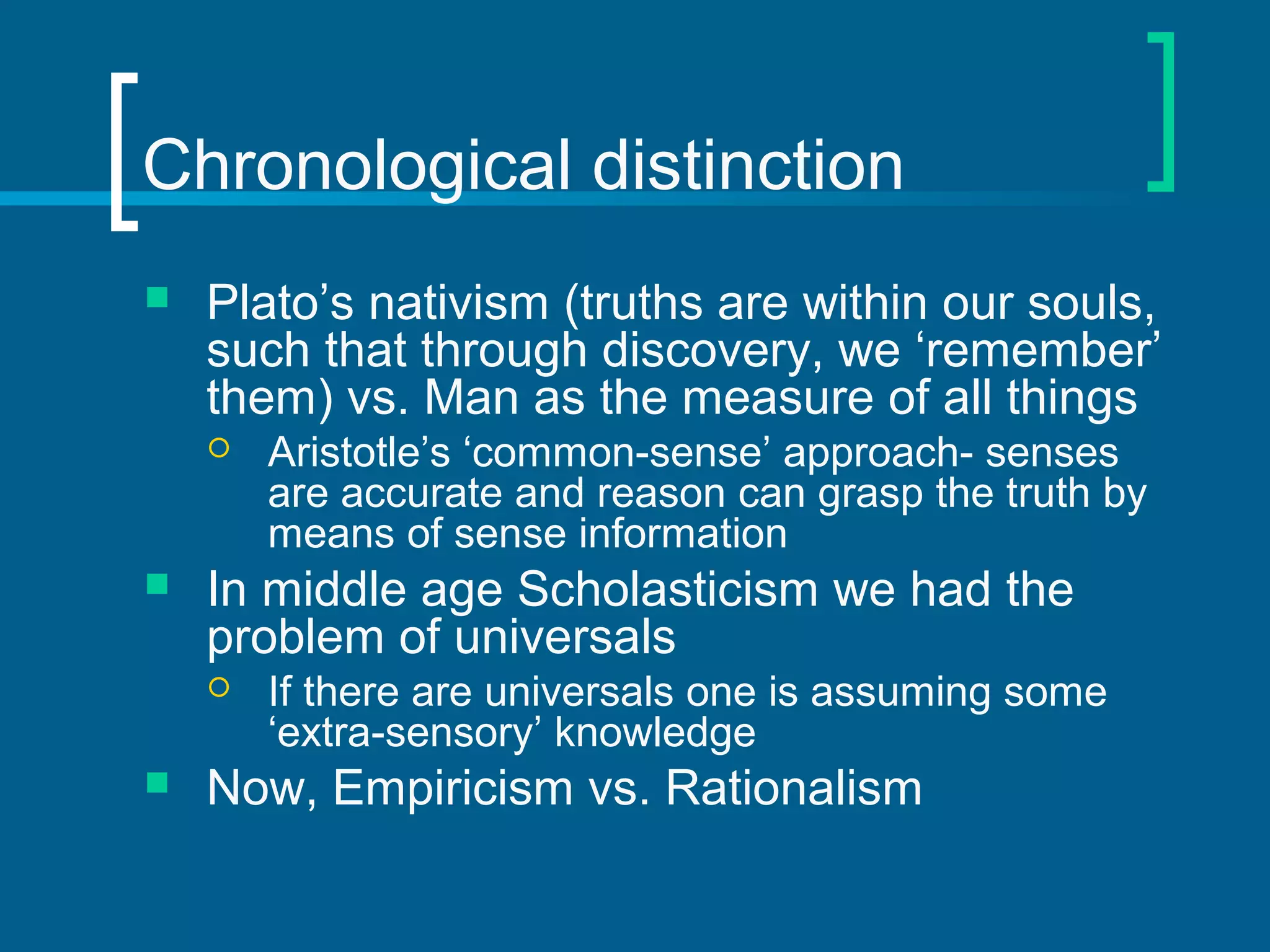
Chronological distinction 
 Plato’s nativism (truths are within our souls, 
such that through discovery, we ‘remember’ 
them) vs. Man as the measure of all things 
 Aristotle’s ‘common-sense’ approach- senses 
are accurate and reason can grasp the truth by 
means of sense information 
 In middle age Scholasticism we had the 
problem of universals 
 If there are universals one is assuming some 
‘extra-sensory’ knowledge 
 Now, Empiricism vs. Rationalism
Rene Descartes 
 1596-1650 
 Discourse on Method, Meditations 
 Descartes sought to devise a 
system of explanation of the 
universe that could not be 
questioned and developed by self-exploration 
and observation. 
 Method was to determine that 
which was certain and then 
deduce other certainties 
(deductive method) 
 Like Bacon, the enemy for Descartes 
was Renaissance skepticism, though 
is going about his battle in opposing 
fashion
Rene Descartes 
 Method: 
 Accept nothing as true but that which is so 
clear no uncertainty regarding it remains 
 Divide a problem into more simple elements 
 Solve the smallest problems first and work 
your way up 
 Make sure that the conclusion is general 
enough to have no exception
Rene Descartes 
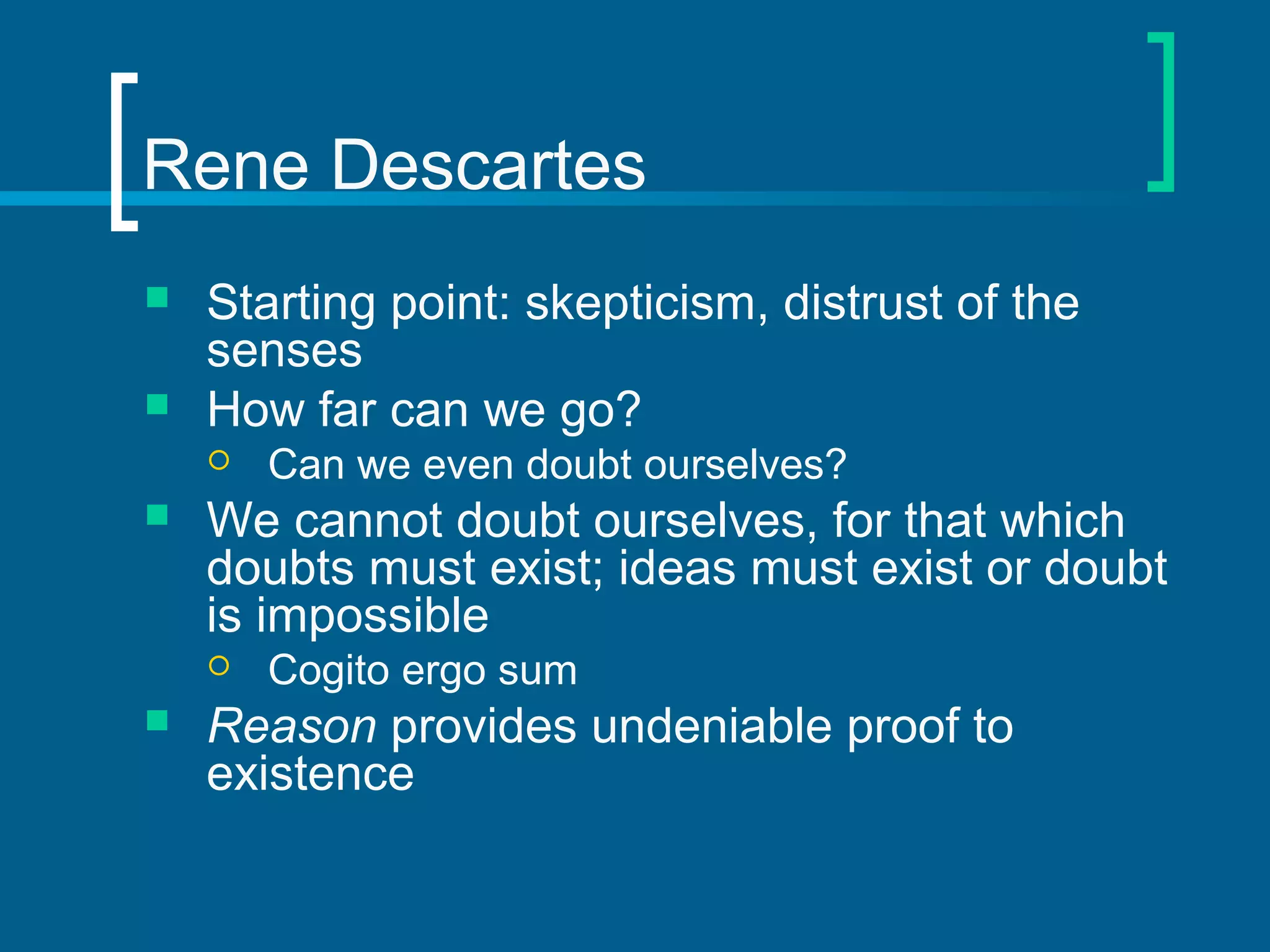
 Starting point: skepticism, distrust of the 
senses 
 How far can we go? 
 Can we even doubt ourselves? 
 We cannot doubt ourselves, for that which 
doubts must exist; ideas must exist or doubt 
is impossible 
 Cogito ergo sum 
 Reason provides undeniable proof to 
existence
Rene Descartes 
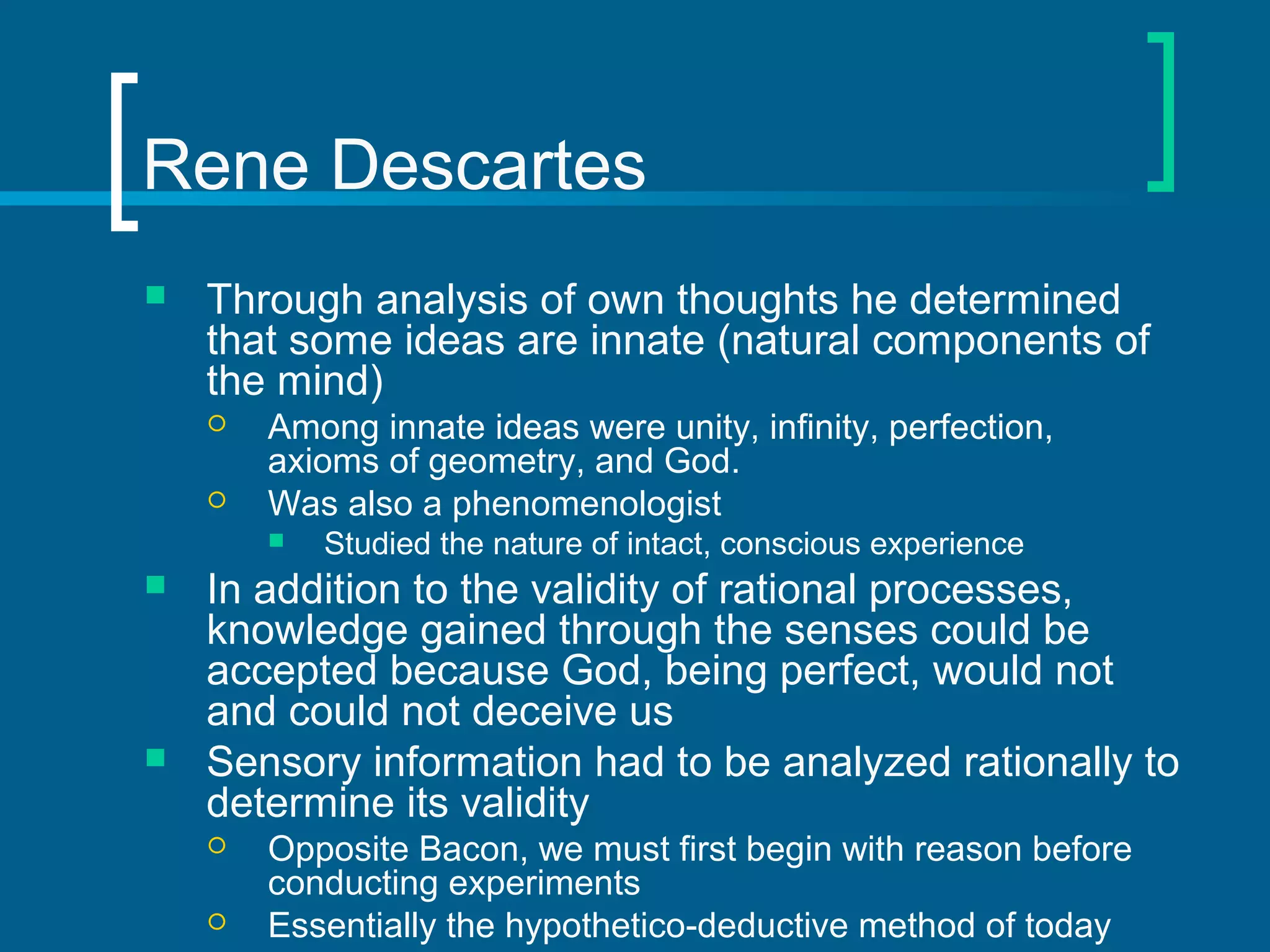
 Through analysis of own thoughts he determined 
that some ideas are innate (natural components of 
the mind) 
 Among innate ideas were unity, infinity, perfection, 
axioms of geometry, and God. 
 Was also a phenomenologist 
 Studied the nature of intact, conscious experience 
 In addition to the validity of rational processes, 
knowledge gained through the senses could be 
accepted because God, being perfect, would not 
and could not deceive us 
 Sensory information had to be analyzed rationally to 
determine its validity 
 Opposite Bacon, we must first begin with reason before 
conducting experiments 
 Essentially the hypothetico-deductive method of today
Rene Descartes 
 Descartes explained the behavior of animals 
including humans employing mechanical 
principles 
 The nervous system was a set of hollow tubes 
connecting the sense receptors with cavities in 
the brain (the ventricles) 
 The system contained animal spirits which flow 
through the nerves resulting in sensation and 
movement 
 By explaining both animal and human 
behavior in terms of mechanistic principles 
and reflexes he made comparative 
psychology legitimate
Rene Descartes 
 For Descartes an important difference between animals and 
humans was that only humans have a mind which provided 
consciousness, free will, and rationality 
 The mind, however, was nonphysical and the body was 
physical 
 Mind consists thought, which is that which compels us to act or is 
that which is responsible for feeling 
 The nonphysical mind and the physical body can influence 
each other, thus, regarding the mind-body issue he was a 
dualist and an interactionist 
 Having no real way of showing how this could be, he 
determined that the mind/soul influenced the body at the 
pineal gland in the brain as it was not duplicated like all other 
brain structures 
 We now know it to have its own hemispheres
Rene Descartes 
 Among Descartes’ contributions to psychology are: 
 1. The mechanistic explanations of behavior and 
many bodily functions which could be said to have 
led to stimulus-response explanations and 
behaviorism. 
 2. The focus on the brain as an important mediator 
of behavior. 
 3. His description of the mind-body relationship 
which provided others the opportunity to support or 
refute it. 
 4. His study of the bodies of animals as a means to 
understand the functioning of human bodies led to 
physiological and comparative psychology. 
 5. He paved the way for the scientific study of 
consciousness.
Blaise Pascal 
 1623-1662 
 Pensees 
 Although accomplishments more of the science and 
mathematical nature, was also staunchly against the 
rationalism of Descartes 
 "I cannot forgive Descartes; in all his philosophy he did his best to 
dispense with God. But he could not avoid making Him set the 
world in motion with a flip of His thumb; after that he had no more 
use for God." 
 “Experiments are the true teachers which one must follow in 
physics." 
 Pascal’s wager 
 Believe in God just in case. What do you have to lose? 
 Note that although we might put Pascal as anti-Cartesianism, 
he was in general anti-reason, whether a priori (rationalism) or 
based on sense (empiricism) 
 Sense argument as usual, but the a priori ‘truths’ assume others, 
which assume other truths and so on, such that we can’t really get 
to the original truths 
 Tweener
Spinoza 
 1632 – 1677 
 Descartes had clearly separated mind, 
matter and God and Spinoza, while 
being placed in the rationalist camp, 
offers what would be a much different 
take on matters 
 For him he saw no experiential or 
rational reason for that distinction 
 The ‘new’ science must in some way 
take on God or remove him completely
Spinoza 
 Proposed that God, nature, and mind were aspects 
of the same substance (inseparable). 
 “Things which have nothing in common cannot be one the 
cause of the other” 
 If God is the author of all things, His presence must be in 
all 
 God was nature, to understand nature is to 
understand God. 
 Pantheism- God is present everywhere and in everything. 
 The mind-body issue was dealt with by assuming 
that the mind and body were two aspects of the 
same thing (double aspectism) 
 Upon death, one survives as the idea of their 
essence is retained in the mind of God
Spinoza 
 As God is the cause of all things we do not have 
free will. 
 Nature (God) is lawful, humans are part of nature, thus 
thoughts and behavior are lawfully determined. 
 “The mind is determined to wish this or that by a cause, 
which has also been determined by another cause… and 
so on to infinity.” 
 Man’s idea of free will is due to ignorance regarding 
possible causes 
 Our “freedom” is realizing that everything that is 
must necessarily be and everything that happens 
must necessarily happen - because everything 
results from God. 
 Stoic
Spinoza 
 Categories of Spinoza’s psychology 
 Passion 
 A feeling about which we have no idea attached (blind rage) 
 Emotion 
 Shaped by a distinct idea (love for fellow man) 
 Reason 
 Intuition 
 Learning and memory 
 Memory is enhanced or degraded based on the contextual 
details of the material to be memorized 
 Interference from learning similar material 
 Memory is a brain process 
 Every idea has a correlate in the real world 
 Distinguishes sensation from perception
Spinoza 
 In terms of good and evil, they are ‘nothing 
else but the emotions of pleasure and pain’ 
 Pleasure and pain as the mind’s recognition of 
its strengths and weaknesses 
 Ordinary folk go about seeking for pleasure 
without the application of reason (a clear idea) 
 The goal of human psychology is self-actualization 
 Driven to create pleasure in the mind and work toward 
our essence, pain arising due to its denial
Nicolas de Malebranche 
 1638 - 1715 
 "We must follow reason despite the caresses, 
the threats and the insults of the body to which 
we are conjoined, despite the action of the 
objects that surround us....I exhort you to 
recognize the difference there is between 
knowing and feeling, between our clear ideas, 
and our sensations always obscure and 
confused." 
 God mediated mind – body interaction. 
 When a person has a desire to move a part of 
the body, God is aware of this and moves the 
body part (occasionalism).
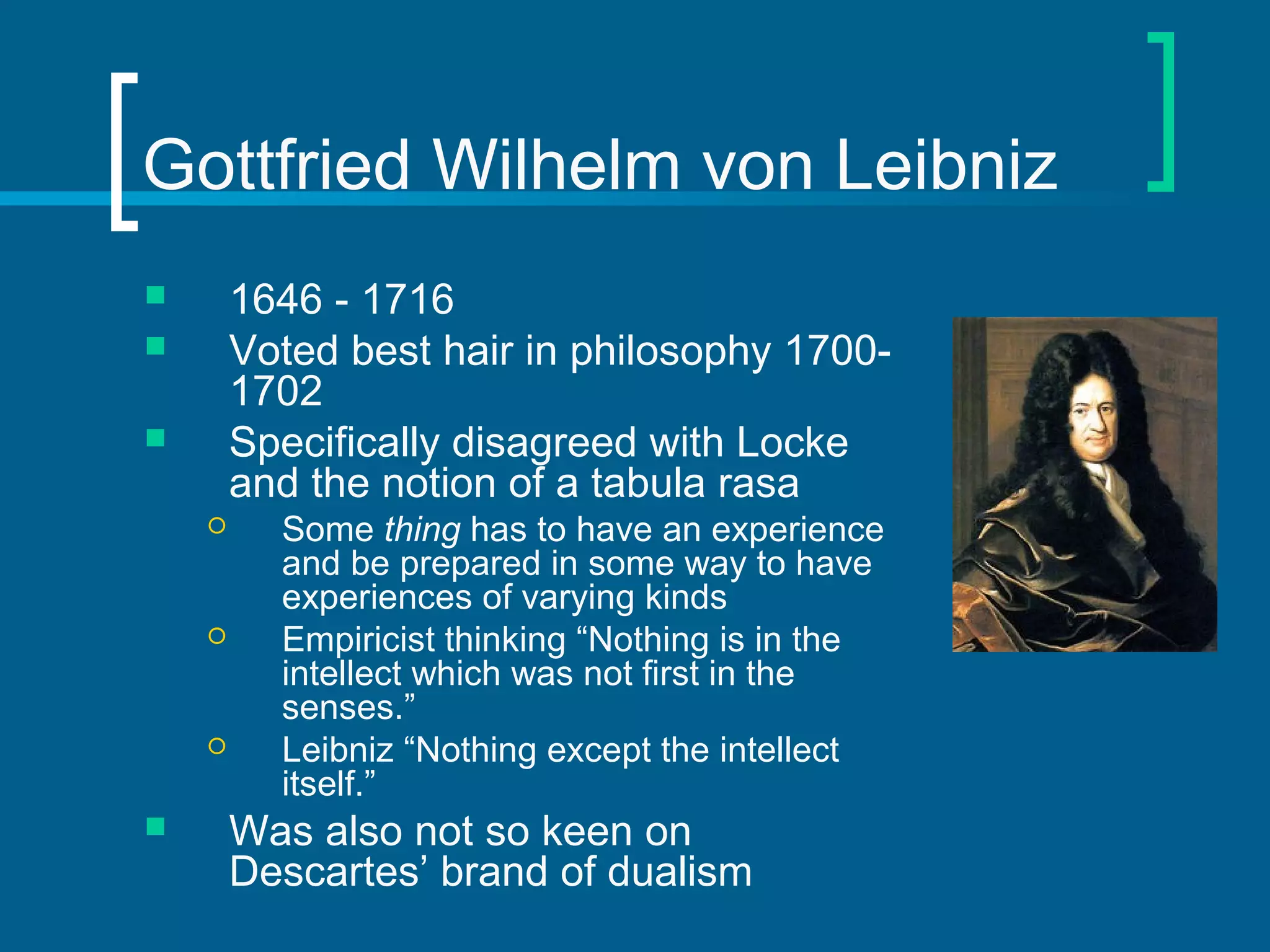
Gottfried Wilhelm von Leibniz 
 1646 - 1716 
 Voted best hair in philosophy 1700- 
1702 
 Specifically disagreed with Locke 
and the notion of a tabula rasa 
 Some thing has to have an experience 
and be prepared in some way to have 
experiences of varying kinds 
 Empiricist thinking “Nothing is in the 
intellect which was not first in the 
senses.” 
 Leibniz “Nothing except the intellect 
itself.” 
 Was also not so keen on 
Descartes’ brand of dualism
Leibniz 
 Ideas, being immaterial, cannot be caused by the senses 
 Nonreductionist- ideas/perception cannot be reduced to 
sensations 
 Experience allows us to discover or take notice of ideas that 
are in us 
 Provides a context for thought 
 Regarding the mind-body issue, he proposed a 
psychophysical parallelism with a preestablished harmony 
 Parallelism 
 The mind and body appear to influence each other but they do 
not, work in parallel 
 Work in harmony established by God 
 There are perceptions (which are purely psychological events 
driven by reason) which are conscious and those which are 
below consciousness 
 Reach a threshold and become conscious 
 Note that this is not in any way a precursor to Freud’s 
unconscious as there is no talk of motivation or psychopathology
Leibniz 
 For Leibniz, the universe consisted of an 
infinite number of simple/irreducible/ 
dimensionless units called monads 
 Can be seen as a ‘living atom’, active and 
conscious 
 Mind as monad 
 Monads differ in clarity of consciousness in 
a hierarchy 
 In general the hierarchy goes from God, the 
highest, to humans, followed by animals, plants, 
and nonliving matter
Immanuel Kant 
 1724 – 1804 
 One of the most influential 
philosophers of all time 
 Critique of Pure Reason 
 Had done much philosophical and 
scientific work up until age 46 when 
realized that he hadn’t really 
addressed the argument of the 
senses vs. the intellect 
 Spent 10 years on the Critique in 
an attempt to solve the problem
Immanuel Kant 
 Initial distinction 
 Analytical statements 
 Predicate is contained within the subject, the proposition adds nothing to the 
subject 
 Cars are motorized vehicles 
 Synthetic statements 
 Do add something 
 Milk does a body good 
 The empiricists (Hume in particular) suggest analytical statements 
are 
 Logically necessary (if true are necessarily so) 
 Certain as opposed to probable 
 A priori as opposed to experiential 
 Synthetic statements are 
 Contingently, not necessarily, true 
 Probable, never certain 
 A posteriori 
 Kant was to suggest that some synthetic statements can be a priori 
truths
Immanuel Kant 
 Kant agrees with the Empiricists as we have 
presented them (e.g. sense as starting 
point, judgments of experience are 
synthetical etc.), however wants to 
determine the limits of empiricism 
 Causality- how do we get to it? 
 Recall Hume’s stance: 
 There is no necessity to an assessment of 
causation 
 Causality (including moral law derived from it) is 
a result of experience only, and we can never 
prove a causal relationship
Immanuel Kant 
 Starting point 
 ‘Experience is possible only through the 
representation of a necessary connection of 
perceptions’ 
 ‘Everything that happens, that is, begins to be, 
presupposes something upon which it follows 
according to a rule’ 
 Recall that Hume suggested causality is 
derived from things like contiguity in space 
and time 
 B always follows A 
 Kant asks, From whence time?
Immanuel Kant 
 The argument: 
 A. An object must exist in time to have any real existence 
(following our second starting point, it follows something else in 
time necessarily) 
 B. We can distinguish an event from an enduring state of affairs 
in serial fashion, and such a change has a cause 
 C. Hume states that for a cause and effect relation to be 
determined, C & E must be contiguous in time (and space), 
and through repetition we can inductively conclude the relation. 
 However time is not given to our experience by the object 
itself, but rather permanence is understood a priori such that 
we can see it as existing in time 
 The reply: Unless there was some a priori category of 
understanding (time) how would we make the association in 
time to begin with? 
 Hume’s stance (B&C) implies Kant’s (A), i.e. an a priori 
understanding must be available in order to experience a causal 
event psychologically
Immanuel Kant 
 Kant proposed that the mind must add something to sensory 
data before knowledge could be attained, that something was 
provided by a priori categories of thought 
 Empirical knowledge, though granted, is not sufficient to explain 
the attainment of all knowledge without reference to an a priori 
understanding 
 These categories contain the possibility of all experience in 
general 
Concept of Quantity Concept of Quality 
Unity 
Reality 
Plurality 
Negation 
Totality 
Limitation 
Concept of Relation Concept of Modality 
Inherence & Subsistence 
Cause and Effect 
Community 
Possibility-Impossibility 
Existence-Nonexistence 
Necessity-Contingency
Immanuel Kant 
 Our mental experience is always structured 
by the categories of thought 
 Thus our phenomenological experience 
(subjective mental experience) is an 
interaction of sensations and the categories 
of thought 
 We can never know the true physical, 
objective reality (noumena), just 
appearances (phenomena) that are 
controlled by the categories of thought
Immanuel Kant 
 A basis is now provided to move away from the 
‘pleasure principle’ stance of the Empiricists 
 Laws of experience are authored by those of reason 
 Not enough to judge good and evil based on feeling 
unless can explain how the feeling attaches to the 
act 
 The attachment assumes a rule, a rational principle 
which governs or should govern moral behavior 
 The Categorical Imperative: 
 Act in such a way that the maxim of your action could 
serve as a universal law
Immanuel Kant 
 Such ideas had wide ranging influence on later 
psychologists 
 The concepts of innate logical structure to language and 
thought, a priori principles of perceptual organization etc. 
affect every branch save perhaps physio and strict 
behaviorism 
 However while giving us back mind (over the 
senses), he did to some extent stall the study of it 
 Not too sure about a true science of the mind 
 Provided the Psychological Uncertainty Principal 
 Merely observing the contents of mind alters it 
 Furthermore, the a priori categories are not amenable to 
empirical investigation by definition
The Rationalist Legacy 
 Science would initially draw upon both rationalistic 
and empiricist tenets while not strictly adhering to 
either, though empiricism would in a sense win out 
 In fact, much of psychology implicitly assumes a 
materialistic stance 
 However we do see it’s resurgence in current 
developmental psychology and our understanding 
of language 
 Furthermore cognitive psychology as a whole 
explicitly assumes the Kantian contribution of 
having both bottom-up (sense-driven) and top-down 
affects on experience and understanding

Rationalism and Empiricism

  • 1.
  • 2.
    Empiricism vs. Rationalism  Basic differences between empiricism and rationalism  Empiricists describe a somewhat passive mind which acts in mechanical way  Rationalists proposed an active mind that acts on information from the senses and gives it meaning  Empiricists proposed that experience, memory, associations, and hedonism determine not only how a person thinks and acts but also his or her morality.  For rationalists, there are rational reasons some acts or thoughts are more desirable than others  Empiricists emphasize mechanical causes of behavior  Rationalists emphasize reasons for behavior  Epistemological distinction:  Innate ideas: cannot arise from experience and upon which, given sufficient developmental maturity, will come to be known as certain  Methodological distinction:  Relative roles of induction vs. deduction
  • 3.
    Chronological distinction Plato’s nativism (truths are within our souls, such that through discovery, we ‘remember’ them) vs. Man as the measure of all things  Aristotle’s ‘common-sense’ approach- senses are accurate and reason can grasp the truth by means of sense information  In middle age Scholasticism we had the problem of universals  If there are universals one is assuming some ‘extra-sensory’ knowledge  Now, Empiricism vs. Rationalism
  • 4.
    Rene Descartes 1596-1650  Discourse on Method, Meditations  Descartes sought to devise a system of explanation of the universe that could not be questioned and developed by self-exploration and observation.  Method was to determine that which was certain and then deduce other certainties (deductive method)  Like Bacon, the enemy for Descartes was Renaissance skepticism, though is going about his battle in opposing fashion
  • 5.
    Rene Descartes Method:  Accept nothing as true but that which is so clear no uncertainty regarding it remains  Divide a problem into more simple elements  Solve the smallest problems first and work your way up  Make sure that the conclusion is general enough to have no exception
  • 6.
    Rene Descartes Starting point: skepticism, distrust of the senses  How far can we go?  Can we even doubt ourselves?  We cannot doubt ourselves, for that which doubts must exist; ideas must exist or doubt is impossible  Cogito ergo sum  Reason provides undeniable proof to existence
  • 7.
    Rene Descartes Through analysis of own thoughts he determined that some ideas are innate (natural components of the mind)  Among innate ideas were unity, infinity, perfection, axioms of geometry, and God.  Was also a phenomenologist  Studied the nature of intact, conscious experience  In addition to the validity of rational processes, knowledge gained through the senses could be accepted because God, being perfect, would not and could not deceive us  Sensory information had to be analyzed rationally to determine its validity  Opposite Bacon, we must first begin with reason before conducting experiments  Essentially the hypothetico-deductive method of today
  • 8.
    Rene Descartes Descartes explained the behavior of animals including humans employing mechanical principles  The nervous system was a set of hollow tubes connecting the sense receptors with cavities in the brain (the ventricles)  The system contained animal spirits which flow through the nerves resulting in sensation and movement  By explaining both animal and human behavior in terms of mechanistic principles and reflexes he made comparative psychology legitimate
  • 9.
    Rene Descartes For Descartes an important difference between animals and humans was that only humans have a mind which provided consciousness, free will, and rationality  The mind, however, was nonphysical and the body was physical  Mind consists thought, which is that which compels us to act or is that which is responsible for feeling  The nonphysical mind and the physical body can influence each other, thus, regarding the mind-body issue he was a dualist and an interactionist  Having no real way of showing how this could be, he determined that the mind/soul influenced the body at the pineal gland in the brain as it was not duplicated like all other brain structures  We now know it to have its own hemispheres
  • 10.
    Rene Descartes Among Descartes’ contributions to psychology are:  1. The mechanistic explanations of behavior and many bodily functions which could be said to have led to stimulus-response explanations and behaviorism.  2. The focus on the brain as an important mediator of behavior.  3. His description of the mind-body relationship which provided others the opportunity to support or refute it.  4. His study of the bodies of animals as a means to understand the functioning of human bodies led to physiological and comparative psychology.  5. He paved the way for the scientific study of consciousness.
  • 11.
    Blaise Pascal 1623-1662  Pensees  Although accomplishments more of the science and mathematical nature, was also staunchly against the rationalism of Descartes  "I cannot forgive Descartes; in all his philosophy he did his best to dispense with God. But he could not avoid making Him set the world in motion with a flip of His thumb; after that he had no more use for God."  “Experiments are the true teachers which one must follow in physics."  Pascal’s wager  Believe in God just in case. What do you have to lose?  Note that although we might put Pascal as anti-Cartesianism, he was in general anti-reason, whether a priori (rationalism) or based on sense (empiricism)  Sense argument as usual, but the a priori ‘truths’ assume others, which assume other truths and so on, such that we can’t really get to the original truths  Tweener
  • 12.
    Spinoza  1632– 1677  Descartes had clearly separated mind, matter and God and Spinoza, while being placed in the rationalist camp, offers what would be a much different take on matters  For him he saw no experiential or rational reason for that distinction  The ‘new’ science must in some way take on God or remove him completely
  • 13.
    Spinoza  Proposedthat God, nature, and mind were aspects of the same substance (inseparable).  “Things which have nothing in common cannot be one the cause of the other”  If God is the author of all things, His presence must be in all  God was nature, to understand nature is to understand God.  Pantheism- God is present everywhere and in everything.  The mind-body issue was dealt with by assuming that the mind and body were two aspects of the same thing (double aspectism)  Upon death, one survives as the idea of their essence is retained in the mind of God
  • 14.
    Spinoza  AsGod is the cause of all things we do not have free will.  Nature (God) is lawful, humans are part of nature, thus thoughts and behavior are lawfully determined.  “The mind is determined to wish this or that by a cause, which has also been determined by another cause… and so on to infinity.”  Man’s idea of free will is due to ignorance regarding possible causes  Our “freedom” is realizing that everything that is must necessarily be and everything that happens must necessarily happen - because everything results from God.  Stoic
  • 15.
    Spinoza  Categoriesof Spinoza’s psychology  Passion  A feeling about which we have no idea attached (blind rage)  Emotion  Shaped by a distinct idea (love for fellow man)  Reason  Intuition  Learning and memory  Memory is enhanced or degraded based on the contextual details of the material to be memorized  Interference from learning similar material  Memory is a brain process  Every idea has a correlate in the real world  Distinguishes sensation from perception
  • 16.
    Spinoza  Interms of good and evil, they are ‘nothing else but the emotions of pleasure and pain’  Pleasure and pain as the mind’s recognition of its strengths and weaknesses  Ordinary folk go about seeking for pleasure without the application of reason (a clear idea)  The goal of human psychology is self-actualization  Driven to create pleasure in the mind and work toward our essence, pain arising due to its denial
  • 17.
    Nicolas de Malebranche  1638 - 1715  "We must follow reason despite the caresses, the threats and the insults of the body to which we are conjoined, despite the action of the objects that surround us....I exhort you to recognize the difference there is between knowing and feeling, between our clear ideas, and our sensations always obscure and confused."  God mediated mind – body interaction.  When a person has a desire to move a part of the body, God is aware of this and moves the body part (occasionalism).
  • 18.
    Gottfried Wilhelm vonLeibniz  1646 - 1716  Voted best hair in philosophy 1700- 1702  Specifically disagreed with Locke and the notion of a tabula rasa  Some thing has to have an experience and be prepared in some way to have experiences of varying kinds  Empiricist thinking “Nothing is in the intellect which was not first in the senses.”  Leibniz “Nothing except the intellect itself.”  Was also not so keen on Descartes’ brand of dualism
  • 19.
    Leibniz  Ideas,being immaterial, cannot be caused by the senses  Nonreductionist- ideas/perception cannot be reduced to sensations  Experience allows us to discover or take notice of ideas that are in us  Provides a context for thought  Regarding the mind-body issue, he proposed a psychophysical parallelism with a preestablished harmony  Parallelism  The mind and body appear to influence each other but they do not, work in parallel  Work in harmony established by God  There are perceptions (which are purely psychological events driven by reason) which are conscious and those which are below consciousness  Reach a threshold and become conscious  Note that this is not in any way a precursor to Freud’s unconscious as there is no talk of motivation or psychopathology
  • 20.
    Leibniz  ForLeibniz, the universe consisted of an infinite number of simple/irreducible/ dimensionless units called monads  Can be seen as a ‘living atom’, active and conscious  Mind as monad  Monads differ in clarity of consciousness in a hierarchy  In general the hierarchy goes from God, the highest, to humans, followed by animals, plants, and nonliving matter
  • 21.
    Immanuel Kant 1724 – 1804  One of the most influential philosophers of all time  Critique of Pure Reason  Had done much philosophical and scientific work up until age 46 when realized that he hadn’t really addressed the argument of the senses vs. the intellect  Spent 10 years on the Critique in an attempt to solve the problem
  • 22.
    Immanuel Kant Initial distinction  Analytical statements  Predicate is contained within the subject, the proposition adds nothing to the subject  Cars are motorized vehicles  Synthetic statements  Do add something  Milk does a body good  The empiricists (Hume in particular) suggest analytical statements are  Logically necessary (if true are necessarily so)  Certain as opposed to probable  A priori as opposed to experiential  Synthetic statements are  Contingently, not necessarily, true  Probable, never certain  A posteriori  Kant was to suggest that some synthetic statements can be a priori truths
  • 23.
    Immanuel Kant Kant agrees with the Empiricists as we have presented them (e.g. sense as starting point, judgments of experience are synthetical etc.), however wants to determine the limits of empiricism  Causality- how do we get to it?  Recall Hume’s stance:  There is no necessity to an assessment of causation  Causality (including moral law derived from it) is a result of experience only, and we can never prove a causal relationship
  • 24.
    Immanuel Kant Starting point  ‘Experience is possible only through the representation of a necessary connection of perceptions’  ‘Everything that happens, that is, begins to be, presupposes something upon which it follows according to a rule’  Recall that Hume suggested causality is derived from things like contiguity in space and time  B always follows A  Kant asks, From whence time?
  • 25.
    Immanuel Kant The argument:  A. An object must exist in time to have any real existence (following our second starting point, it follows something else in time necessarily)  B. We can distinguish an event from an enduring state of affairs in serial fashion, and such a change has a cause  C. Hume states that for a cause and effect relation to be determined, C & E must be contiguous in time (and space), and through repetition we can inductively conclude the relation.  However time is not given to our experience by the object itself, but rather permanence is understood a priori such that we can see it as existing in time  The reply: Unless there was some a priori category of understanding (time) how would we make the association in time to begin with?  Hume’s stance (B&C) implies Kant’s (A), i.e. an a priori understanding must be available in order to experience a causal event psychologically
  • 26.
    Immanuel Kant Kant proposed that the mind must add something to sensory data before knowledge could be attained, that something was provided by a priori categories of thought  Empirical knowledge, though granted, is not sufficient to explain the attainment of all knowledge without reference to an a priori understanding  These categories contain the possibility of all experience in general Concept of Quantity Concept of Quality Unity Reality Plurality Negation Totality Limitation Concept of Relation Concept of Modality Inherence & Subsistence Cause and Effect Community Possibility-Impossibility Existence-Nonexistence Necessity-Contingency
  • 27.
    Immanuel Kant Our mental experience is always structured by the categories of thought  Thus our phenomenological experience (subjective mental experience) is an interaction of sensations and the categories of thought  We can never know the true physical, objective reality (noumena), just appearances (phenomena) that are controlled by the categories of thought
  • 28.
    Immanuel Kant A basis is now provided to move away from the ‘pleasure principle’ stance of the Empiricists  Laws of experience are authored by those of reason  Not enough to judge good and evil based on feeling unless can explain how the feeling attaches to the act  The attachment assumes a rule, a rational principle which governs or should govern moral behavior  The Categorical Imperative:  Act in such a way that the maxim of your action could serve as a universal law
  • 29.
    Immanuel Kant Such ideas had wide ranging influence on later psychologists  The concepts of innate logical structure to language and thought, a priori principles of perceptual organization etc. affect every branch save perhaps physio and strict behaviorism  However while giving us back mind (over the senses), he did to some extent stall the study of it  Not too sure about a true science of the mind  Provided the Psychological Uncertainty Principal  Merely observing the contents of mind alters it  Furthermore, the a priori categories are not amenable to empirical investigation by definition
  • 30.
    The Rationalist Legacy  Science would initially draw upon both rationalistic and empiricist tenets while not strictly adhering to either, though empiricism would in a sense win out  In fact, much of psychology implicitly assumes a materialistic stance  However we do see it’s resurgence in current developmental psychology and our understanding of language  Furthermore cognitive psychology as a whole explicitly assumes the Kantian contribution of having both bottom-up (sense-driven) and top-down affects on experience and understanding