+
Diffusion phenomena, Drug
release and dissolution
Aseel Samaro
+
Importance of diffusion in pharmaceutical
sciences
1. Drug release Dissolution of drugs from its dosage form.
2. Passage of gasses, moisture, and additives through the packaging
material of the container.
3. Permeation of drug molecules in living tissue.
4. Drug absorption and drug elimination
+ Diffusion
 Diffusion: is a process of mass transfer of individual molecules of
a substance as a result of random molecular motion.
 The driving force for diffusion is usually the concentration
gradient.
+
Define Diffusion
The movement of molecules from a area in which they are highly
concentrated to a area in which they are less concentrated.
+
Diffusion
The passage of matter through a solid barrier can occur by:
1. Simple molecular permeation or
2. By movement through pores and channels
+
+
 Molecular diffusion or permeation through nonporous media depends
on the solubility of the permeating molecules in the bulk membrane
 The passage of a substance through solvent-filled pores of a membrane
and is influenced by the relative size of the penetrating molecules and
the diameter and shape of the pores
 Diffusion or permeation through polymer strands with branching and
intersecting channels. Depending on the size and shape of the diffusing
molecules, they may pass through the tortuous pores formed by the
overlapping strands of polymer. If it is too large for such channel
transport, the diffusant may dissolve in the polymer matrix and pass
through the film by simple diffusion.
+ Pharmacokinetics of drugs
(ADME)
Are studies of
 Absorption
 Distribution
 Metabolism
 Excretion of drugs
+ Drug Absorption and Elimination
Passage of Drugs Through Membranes
 Passive diffusion
 Transcellular diffusion (through the lipoidal bilayer of cells)
 Paracellular diffusion (passage through aqueous channels)
 Using membrane transporters
 Facilitated diffusion (energy independent)
 Active transport (energy dependent)
+
+
+ How to get other molecules across
membranes??
There are three ways that the molecules typically move through the membrane:
1. Facilitated transport
2. Passive transport
3. Active transport
• Active transport requires that the cell use energy that it has obtained from food to move
the molecules (or larger particles) through the cell membrane.
• Facilitated and Passive transport does not require such an energy expenditure, and occur
spontaneously.
+
Membrane Transport Mechanisms
I. Passive Transport
 Diffusion- simple movement from regions of high concentration to low
concentration
 Osmosis- diffusion of water across a semi-permeable membrane
 Facilitated diffusion- protein transporters which assist in diffusion
+
Membrane Transport Mechanisms
II. Active Transport
 Active transport- proteins which transport against concentration
gradient.
 Requires energy input
+
Elementary Drug Release
+ Osmosis
The diffusion of water across a selectively permeable membrane.
Water moves from a high concentration of water (less salt or sugar dissolved in it) to
a low concentration of water (more salt or sugar dissolved in it).
This means that water would cross a selectively permeable membrane from a dilute
solution (less dissolved in it) to a concentrated solution (more dissolved in it).
+
Ultrafiltration and Dialysis
 Ultrafiltration is used to separate colloidal
particles and macromolecules by the use of a
membrane.
 Hydraulic pressure is used to force the solvent
through the membrane, whereas the
microporous membrane prevents the passage
of large solute molecules
+ Dialysis
Separation process based on unequal rates of passage of solute and
solvent through microporous membrane, carried out in batch or
continuous mode.
Hemodialysis
Used in treating kidney malfunction to rid the blood of metabolic waste
products (small molecules) while preserving the high molecular weight
components of the blood
+
Hemodialyzer
+ Steady-State Diffusion
Thermodynamic Basis
+
Fick’s laws of diffusion
 Fick’s first law: The amount, M, of material flowing through a
unit cross section, S, of a barrier in unit time, t, is known as the
flux, J:
dtS
dM
J


dx
dC
DJ Where: J is flux (g/cm2.sec)
M is the amount of material flowing (g)
S is cross sectional area of flow (cm2)
t is time (sec)
D is the diffusion coefficient of the drug in cm2/sec
dC/ dx is the concentration gradient
C concentration in (g/cm3)
X distance in cm of movement perpendicular to the surface of the barrier
The flux, in turn, is proportional to the
concentration gradient, dC/dx:
equation (1)
equation (2)
Fick’s first law
• The negative sign of equation signifies that diffusion occurs in a
direction opposite to that of increasing concentration.
• That is, diffusion occurs in the direction of decreasing concentration
of diffusant; thus, the flux is always a positive quantity.
• The diffusion coefficient, D it does not ordinarily remain constant.
• D is affected by concentration, temperature, pressure, solvent
properties, and the chemical nature of the diffusant.
• Therefore, D is referred to more correctly as a diffusion coefficient
rather than as a constant.
dx
dC
DJ 
dtS
dM
J

 Rate of diffusion through unit area
+One often wants to examine the rate of
change of diffusant concentration at a point in
the system. An equation for mass transport
that emphasizes the change in concentration
with time at a definite location rather than
the mass diffusing across a unit area of barrier
in unit time is known as Fick's second law.
The concentration, C, in a particular volume
element changes only as a result of net flow of
diffusing molecules into or out of the region. A
difference in concentration results from a
difference in input and output.
Fick’s laws of diffusion
dx
dJ
dt
dC
 Where: J is flux (g/cm2.sec)
M is the amount of material
flowing (g)
S is cross sectional area of
flow (cm2)
t is time (sec)
D is the diffusion coefficient of
the drug in cm2/sec
dC/ dx is the concentration
gradient (g/cm4)
C is concentration
The concentration of diffusant in the volume element changes with time, that is, ΔC/Δt,
as the flux or amount diffusing changes with distance, ΔJ/Δx, in the x direction
change in concentration of diffusant with time at any distance
dx
dC
DJ 
2
2
2
2
dx
Cd
D
dt
dC
dx
Cd
D
dx
dJ


Fick’s second law:
Differentiating the equation
Fick’s laws of diffusion
 Flux: is the rate of flow of molecules across a given surface.
 Flux is in the direction of decreasing concentration.
 Flux is always a positive quantity
 Flux equal zero (diffusion stop) when the concentration gradient
equal zero.
Diffusion coefficient also called diffusivity. It is affected by:
 Chemical nature of the diffusant drug.
 Solvent properties.
 Temperature
 Pressure
 Concentration
Fick’s first law
rate of diffusion through unit area
Fick’s second law
change in concentration of diffusant with time at any distance
dx
dC
DJ 
dtS
dM
J


2
2
dx
Cd
D
dt
dC

We want to calculate:
• dMt/dt = release rate
• Mt = amount released after time t
+ Steady state condition
 With time the concentration of the diffusant molecule in the barrier
increases gradually until it reaches a steady state condition.
 At the steady state at each there no change in the concentration of
the diffusant with time inside the barrier.
constant
0
0
2
2
2
2






x
C
dx
dC
dx
Cd
dx
Cd
D
dt
dC
+
Concentration will not be rigidly constant, but rather is likely to vary slightly with
time, and then dC/dt is not exactly zero. The conditions are referred to as a
quasistationary state, and little error is introduced by assuming steady state
under these conditions.
02
2

dx
Cd
D
dt
dC
+ Diffusion Through Membranes
Steady state diffusion through a thin film with thickness =h
h
CC
DJ
dx
dC
DJ
21


02
2

dx
Cd
D
dt
dC
Integrating the equation using the conditions that at z = 0, C= C1 and at z = h,
C = C2 yields the
following equation:
+ Steady state diffusion through a thin film
with thickness =h
R
CC
J
R
D
h
h
CC
DJ
21
21





Where: R is diffusional resistance
dx
dC
DJ 
dtS
dM
J


+
Diffusional release system: Reservoir system
Diffusion
+ Membrane permeability
 The membrane can have a partition
coefficient that affects the concentration of
the diffusant inside it.
 Therefore the concentration inside the
membrane is a function of the
concentration at the boundary and the
partition coefficient of the membrane.
+ Membrane permeability
h
CC
D
dtS
dM
J
21



Sink conditions cr=0
C1 : Conc. in the memb. at the donor sid
C2 : Conc. in the memb. at the receptor side
h
Cd
DSK
dt
dM
Cr
h
CrCd
DSK
dt
dM
Cr
C
Cd
C
K





0
21
Rate of transport
Cumulative amount of drug released through membrane??
+
 Sink Conditions : concentration of Cr is zero
 When? Rate of exit of drug > rate of entry
(no accumulation)
Sink Conditions
h
Cd
DSK
dt
dM
Cr
h
CrCd
DSK
dt
dM




0
Membrane permeability
+ Membrane permeability
PSCd
dt
dM
Rh
DK
P
h
Cd
DSK
dt
dM



1 Where P is the permeability of the
membrane in cm/sec.
R
D
h

Where: R is diffusional resistance
P = permeability coefficient (cm/s)
+ Membrane permeability
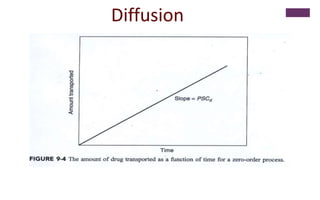
tPSCdM
Cd
PSCd
dt
dM



constant
M: is the amount of diffusant that passes
through the membrane after time t.
Cumulative amount of drug released through membrane
+
Zero-order process
- Amount of drug transported is constant over time
- Only if Cd does not change
- Diffusion of drug from transdermal patch
tPSCdM 
Diffusion
Diffusion
+
Example : To study the oral absorption of paclitaxel(PCT) from an oil-water emulsion
formulation, an inverted closed-loop intestinal model was used.
- surface area for diffusion = 28.4 cm2
- concentration of PCT in intestine = 1.50 mg/ml.
- the permeability coefficient was 4.25 x 10⁻⁶ cm/s
Calculate the amount of PCT that will permeate the intestine in 6 h of study (zero-order transport under sink conditions)
Using the equation M= PSCdt ,
M = (4.25 x 10⁻⁶)(28.4)(1.50)(21,600)
= 3.91 mg
+
First-order transport
 If the donor conc. changes with time,
(Cd)t : donor conc. at any time
(Cd)0 : initial donor conc.
Vd : volume of the donor compartment (mL)
Diffusion
t
Vd
PS
CdCdt
303.2
)0(loglog 
d
d
d
V
M
C
PSCd
dt
dM


t
Vd
PS
CdCdt  )0(lnln
+
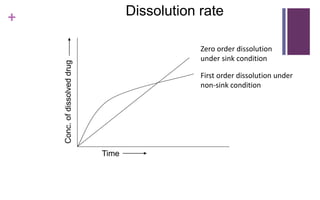
Conc.ofdissolveddrug
Time
First order dissolution under
non-sink condition
Zero order dissolution
under sink condition
Dissolution rate
Fig. Butyl paraben diffusing through guinea pig skin from aqueous
solution. / H. Komatsu and M. Suzuki, J. Pharm. Sci., 68 596 (1979)
+
Burst effect
 In many of the controlled release formulations, immediately upon
placement in the release medium, an initial large bolus of drug is
released before the release rate reaches a stable profile. This
phenomenon is typically referred to as ‘burst release.’
 Initial release of drug into receptor side is at a higher rate than the
steady-state release rate
+
Lag time, Burst effects
+
Lag time, Burst effects
 Lag time : time of molecules saturating the membrane
tL = h2 / 6D
h : membrane thickness (cm)
D : diffusion coefficient (cm2/s)
P
h
tL
6
)( L
d
d
tt
h
DSKC
M
t
h
DSKC
M
h
Cd
DSK
dt
dM


+
Lag time, Burst effect
 Burst effect : time of initial rapid release of drug
tB = h2 / 3D
h : membrane thickness (cm)
D : diffusion coefficient (cm2/s)
P
h
tB
3

)( B
d
d
tt
h
DSKC
M
t
h
DSKC
M
h
Cd
DSK
dt
dM


+
Example
The lag time of methadone, a drug used in the treatment of heroin
addiction, at 25°C (77°F) through a silicone membrane
transdermal patch was calculated to be 4.65 min. The surface
area and thickness of the membrane were 12.53 cm2 and 100 µm,
respectively.
a. Calculate the permeability coefficient of the drug at 25°C (77°F)
(K = 10.5).
b. Calculate the total amount in milligrams of methadone released
from the patch in 12 h if the concentration inside the patch was
6.25 mg/mL.
+
Solution
a. To use the equation P = DK/h , the diffusion coefficient D should be determined.
Therefore, using the lag-time equation tL = h2 / 6D
D= h2 / 6 tL
= (1.00 x 10⁻²)2 / (6)(279)
= 5.97 x 10⁻⁸ cm2/s
Therefore,
P = DK / h
= [(5.97 x 10⁻⁸)(10.5) / (1.00 x 10⁻²)
= 6.27 x 10⁻⁵ cm/s
Diffusion
o The surface area 12.53 cm2
o thickness of the membrane 100 um
o lag time, 4.65 min and K = 10.5
+
Solution
Using the equation M = PSCd(t - tL),
M = [(6.27 x 10⁻⁵)(12.53)(6.25)][(43,200) – (279)]
= 210.8 mg
Diffusion
b. Calculate the total amount in milligrams of methadone released from the
patch in 12 h if the concentration inside the patch was 6.25 mg/mL.
+ Fick’s first law dx
dC
DJ 
dtS
dM
J


Fick’s second law
2
2
dx
Cd
D
dt
dC

Diffusion Through Membranes
with thickness =h h
CC
DJ
21

Sink Conditions h
Cd
DSK
dt
dM
h
CrCd
DSK
dt
dM


Rate of transport
Rh
DK
P
1

Membrane permeability
+
PSCd
dt
dM

 Zero-order process
tPSCdM 
Cd @ constant tconsCd tan
 First-order transport
t
Vd
PS
CdCdt
303.2
)0(loglog 
t
Vd
PS
CdCdt  )0(lnln
+
Lag time Burst effects
tL = h2 / 6D
 M = PSCd(t - tL)
tB = h2 / 3D
 M = PSCd(t + tB)
+ Multilayer Diffusion
 Diffusion across biologic barriers
 The passage of gaseous or liquid solutes through the walls of
containers and plastic packaging materials
 The passage of a topically applied drug from its vehicle through the
lipoidal and lower hydrous layers of the skin.
+
Multilayer Diffusion
+ Multilayer Diffusion
i
ii
i
h
KD
P  
ii
i
i
i
KD
h
P
R
1
The total resistance, R
nRRRR  .......21
nPPPP
1
.....
111
21

The total permeability for the two layers
112221
2211
KDhKDh
KDKD
P


+ Procedures and Apparatus For Assessing Drug Diffusion

Diffusion (Physical Pharmacy)

  • 1.
    + Diffusion phenomena, Drug releaseand dissolution Aseel Samaro
  • 2.
    + Importance of diffusionin pharmaceutical sciences 1. Drug release Dissolution of drugs from its dosage form. 2. Passage of gasses, moisture, and additives through the packaging material of the container. 3. Permeation of drug molecules in living tissue. 4. Drug absorption and drug elimination
  • 3.
    + Diffusion  Diffusion:is a process of mass transfer of individual molecules of a substance as a result of random molecular motion.  The driving force for diffusion is usually the concentration gradient.
  • 4.
    + Define Diffusion The movementof molecules from a area in which they are highly concentrated to a area in which they are less concentrated.
  • 5.
    + Diffusion The passage ofmatter through a solid barrier can occur by: 1. Simple molecular permeation or 2. By movement through pores and channels
  • 6.
  • 7.
    +  Molecular diffusionor permeation through nonporous media depends on the solubility of the permeating molecules in the bulk membrane  The passage of a substance through solvent-filled pores of a membrane and is influenced by the relative size of the penetrating molecules and the diameter and shape of the pores  Diffusion or permeation through polymer strands with branching and intersecting channels. Depending on the size and shape of the diffusing molecules, they may pass through the tortuous pores formed by the overlapping strands of polymer. If it is too large for such channel transport, the diffusant may dissolve in the polymer matrix and pass through the film by simple diffusion.
  • 8.
    + Pharmacokinetics ofdrugs (ADME) Are studies of  Absorption  Distribution  Metabolism  Excretion of drugs
  • 9.
    + Drug Absorptionand Elimination Passage of Drugs Through Membranes  Passive diffusion  Transcellular diffusion (through the lipoidal bilayer of cells)  Paracellular diffusion (passage through aqueous channels)  Using membrane transporters  Facilitated diffusion (energy independent)  Active transport (energy dependent)
  • 10.
  • 11.
  • 12.
    + How toget other molecules across membranes?? There are three ways that the molecules typically move through the membrane: 1. Facilitated transport 2. Passive transport 3. Active transport • Active transport requires that the cell use energy that it has obtained from food to move the molecules (or larger particles) through the cell membrane. • Facilitated and Passive transport does not require such an energy expenditure, and occur spontaneously.
  • 13.
    + Membrane Transport Mechanisms I.Passive Transport  Diffusion- simple movement from regions of high concentration to low concentration  Osmosis- diffusion of water across a semi-permeable membrane  Facilitated diffusion- protein transporters which assist in diffusion
  • 14.
    + Membrane Transport Mechanisms II.Active Transport  Active transport- proteins which transport against concentration gradient.  Requires energy input
  • 15.
  • 16.
    + Osmosis The diffusionof water across a selectively permeable membrane. Water moves from a high concentration of water (less salt or sugar dissolved in it) to a low concentration of water (more salt or sugar dissolved in it). This means that water would cross a selectively permeable membrane from a dilute solution (less dissolved in it) to a concentrated solution (more dissolved in it).
  • 17.
    + Ultrafiltration and Dialysis Ultrafiltration is used to separate colloidal particles and macromolecules by the use of a membrane.  Hydraulic pressure is used to force the solvent through the membrane, whereas the microporous membrane prevents the passage of large solute molecules
  • 18.
    + Dialysis Separation processbased on unequal rates of passage of solute and solvent through microporous membrane, carried out in batch or continuous mode. Hemodialysis Used in treating kidney malfunction to rid the blood of metabolic waste products (small molecules) while preserving the high molecular weight components of the blood
  • 19.
  • 20.
  • 21.
  • 22.
    Fick’s laws ofdiffusion  Fick’s first law: The amount, M, of material flowing through a unit cross section, S, of a barrier in unit time, t, is known as the flux, J: dtS dM J   dx dC DJ Where: J is flux (g/cm2.sec) M is the amount of material flowing (g) S is cross sectional area of flow (cm2) t is time (sec) D is the diffusion coefficient of the drug in cm2/sec dC/ dx is the concentration gradient C concentration in (g/cm3) X distance in cm of movement perpendicular to the surface of the barrier The flux, in turn, is proportional to the concentration gradient, dC/dx: equation (1) equation (2)
  • 23.
    Fick’s first law •The negative sign of equation signifies that diffusion occurs in a direction opposite to that of increasing concentration. • That is, diffusion occurs in the direction of decreasing concentration of diffusant; thus, the flux is always a positive quantity. • The diffusion coefficient, D it does not ordinarily remain constant. • D is affected by concentration, temperature, pressure, solvent properties, and the chemical nature of the diffusant. • Therefore, D is referred to more correctly as a diffusion coefficient rather than as a constant. dx dC DJ  dtS dM J   Rate of diffusion through unit area
  • 25.
    +One often wantsto examine the rate of change of diffusant concentration at a point in the system. An equation for mass transport that emphasizes the change in concentration with time at a definite location rather than the mass diffusing across a unit area of barrier in unit time is known as Fick's second law. The concentration, C, in a particular volume element changes only as a result of net flow of diffusing molecules into or out of the region. A difference in concentration results from a difference in input and output.
  • 26.
    Fick’s laws ofdiffusion dx dJ dt dC  Where: J is flux (g/cm2.sec) M is the amount of material flowing (g) S is cross sectional area of flow (cm2) t is time (sec) D is the diffusion coefficient of the drug in cm2/sec dC/ dx is the concentration gradient (g/cm4) C is concentration The concentration of diffusant in the volume element changes with time, that is, ΔC/Δt, as the flux or amount diffusing changes with distance, ΔJ/Δx, in the x direction change in concentration of diffusant with time at any distance dx dC DJ  2 2 2 2 dx Cd D dt dC dx Cd D dx dJ   Fick’s second law: Differentiating the equation
  • 27.
    Fick’s laws ofdiffusion  Flux: is the rate of flow of molecules across a given surface.  Flux is in the direction of decreasing concentration.  Flux is always a positive quantity  Flux equal zero (diffusion stop) when the concentration gradient equal zero. Diffusion coefficient also called diffusivity. It is affected by:  Chemical nature of the diffusant drug.  Solvent properties.  Temperature  Pressure  Concentration
  • 28.
    Fick’s first law rateof diffusion through unit area Fick’s second law change in concentration of diffusant with time at any distance dx dC DJ  dtS dM J   2 2 dx Cd D dt dC  We want to calculate: • dMt/dt = release rate • Mt = amount released after time t
  • 29.
    + Steady statecondition  With time the concentration of the diffusant molecule in the barrier increases gradually until it reaches a steady state condition.  At the steady state at each there no change in the concentration of the diffusant with time inside the barrier. constant 0 0 2 2 2 2       x C dx dC dx Cd dx Cd D dt dC
  • 30.
    + Concentration will notbe rigidly constant, but rather is likely to vary slightly with time, and then dC/dt is not exactly zero. The conditions are referred to as a quasistationary state, and little error is introduced by assuming steady state under these conditions. 02 2  dx Cd D dt dC
  • 31.
    + Diffusion ThroughMembranes Steady state diffusion through a thin film with thickness =h h CC DJ dx dC DJ 21   02 2  dx Cd D dt dC Integrating the equation using the conditions that at z = 0, C= C1 and at z = h, C = C2 yields the following equation:
  • 32.
    + Steady statediffusion through a thin film with thickness =h R CC J R D h h CC DJ 21 21      Where: R is diffusional resistance dx dC DJ  dtS dM J  
  • 33.
  • 34.
    Diffusional release system:Reservoir system Diffusion
  • 36.
    + Membrane permeability The membrane can have a partition coefficient that affects the concentration of the diffusant inside it.  Therefore the concentration inside the membrane is a function of the concentration at the boundary and the partition coefficient of the membrane.
  • 37.
    + Membrane permeability h CC D dtS dM J 21    Sinkconditions cr=0 C1 : Conc. in the memb. at the donor sid C2 : Conc. in the memb. at the receptor side h Cd DSK dt dM Cr h CrCd DSK dt dM Cr C Cd C K      0 21 Rate of transport Cumulative amount of drug released through membrane??
  • 38.
    +  Sink Conditions: concentration of Cr is zero  When? Rate of exit of drug > rate of entry (no accumulation) Sink Conditions h Cd DSK dt dM Cr h CrCd DSK dt dM     0 Membrane permeability
  • 39.
    + Membrane permeability PSCd dt dM Rh DK P h Cd DSK dt dM    1Where P is the permeability of the membrane in cm/sec. R D h  Where: R is diffusional resistance P = permeability coefficient (cm/s)
  • 40.
    + Membrane permeability tPSCdM Cd PSCd dt dM    constant M:is the amount of diffusant that passes through the membrane after time t. Cumulative amount of drug released through membrane
  • 41.
    + Zero-order process - Amountof drug transported is constant over time - Only if Cd does not change - Diffusion of drug from transdermal patch tPSCdM  Diffusion
  • 42.
  • 43.
    + Example : Tostudy the oral absorption of paclitaxel(PCT) from an oil-water emulsion formulation, an inverted closed-loop intestinal model was used. - surface area for diffusion = 28.4 cm2 - concentration of PCT in intestine = 1.50 mg/ml. - the permeability coefficient was 4.25 x 10⁻⁶ cm/s Calculate the amount of PCT that will permeate the intestine in 6 h of study (zero-order transport under sink conditions) Using the equation M= PSCdt , M = (4.25 x 10⁻⁶)(28.4)(1.50)(21,600) = 3.91 mg
  • 44.
    + First-order transport  Ifthe donor conc. changes with time, (Cd)t : donor conc. at any time (Cd)0 : initial donor conc. Vd : volume of the donor compartment (mL) Diffusion t Vd PS CdCdt 303.2 )0(loglog  d d d V M C PSCd dt dM   t Vd PS CdCdt  )0(lnln
  • 45.
    + Conc.ofdissolveddrug Time First order dissolutionunder non-sink condition Zero order dissolution under sink condition Dissolution rate
  • 47.
    Fig. Butyl parabendiffusing through guinea pig skin from aqueous solution. / H. Komatsu and M. Suzuki, J. Pharm. Sci., 68 596 (1979)
  • 48.
    + Burst effect  Inmany of the controlled release formulations, immediately upon placement in the release medium, an initial large bolus of drug is released before the release rate reaches a stable profile. This phenomenon is typically referred to as ‘burst release.’  Initial release of drug into receptor side is at a higher rate than the steady-state release rate
  • 49.
  • 50.
  • 51.
    + Lag time, Bursteffects  Lag time : time of molecules saturating the membrane tL = h2 / 6D h : membrane thickness (cm) D : diffusion coefficient (cm2/s) P h tL 6 )( L d d tt h DSKC M t h DSKC M h Cd DSK dt dM  
  • 52.
    + Lag time, Bursteffect  Burst effect : time of initial rapid release of drug tB = h2 / 3D h : membrane thickness (cm) D : diffusion coefficient (cm2/s) P h tB 3  )( B d d tt h DSKC M t h DSKC M h Cd DSK dt dM  
  • 53.
    + Example The lag timeof methadone, a drug used in the treatment of heroin addiction, at 25°C (77°F) through a silicone membrane transdermal patch was calculated to be 4.65 min. The surface area and thickness of the membrane were 12.53 cm2 and 100 µm, respectively. a. Calculate the permeability coefficient of the drug at 25°C (77°F) (K = 10.5). b. Calculate the total amount in milligrams of methadone released from the patch in 12 h if the concentration inside the patch was 6.25 mg/mL.
  • 54.
    + Solution a. To usethe equation P = DK/h , the diffusion coefficient D should be determined. Therefore, using the lag-time equation tL = h2 / 6D D= h2 / 6 tL = (1.00 x 10⁻²)2 / (6)(279) = 5.97 x 10⁻⁸ cm2/s Therefore, P = DK / h = [(5.97 x 10⁻⁸)(10.5) / (1.00 x 10⁻²) = 6.27 x 10⁻⁵ cm/s Diffusion o The surface area 12.53 cm2 o thickness of the membrane 100 um o lag time, 4.65 min and K = 10.5
  • 55.
    + Solution Using the equationM = PSCd(t - tL), M = [(6.27 x 10⁻⁵)(12.53)(6.25)][(43,200) – (279)] = 210.8 mg Diffusion b. Calculate the total amount in milligrams of methadone released from the patch in 12 h if the concentration inside the patch was 6.25 mg/mL.
  • 56.
    + Fick’s firstlaw dx dC DJ  dtS dM J   Fick’s second law 2 2 dx Cd D dt dC  Diffusion Through Membranes with thickness =h h CC DJ 21  Sink Conditions h Cd DSK dt dM h CrCd DSK dt dM   Rate of transport Rh DK P 1  Membrane permeability
  • 57.
    + PSCd dt dM   Zero-order process tPSCdM Cd @ constant tconsCd tan  First-order transport t Vd PS CdCdt 303.2 )0(loglog  t Vd PS CdCdt  )0(lnln
  • 58.
    + Lag time Bursteffects tL = h2 / 6D  M = PSCd(t - tL) tB = h2 / 3D  M = PSCd(t + tB)
  • 59.
    + Multilayer Diffusion Diffusion across biologic barriers  The passage of gaseous or liquid solutes through the walls of containers and plastic packaging materials  The passage of a topically applied drug from its vehicle through the lipoidal and lower hydrous layers of the skin.
  • 60.
  • 61.
    + Multilayer Diffusion i ii i h KD P  ii i i i KD h P R 1 The total resistance, R nRRRR  .......21 nPPPP 1 ..... 111 21  The total permeability for the two layers 112221 2211 KDhKDh KDKD P  
  • 62.
    + Procedures andApparatus For Assessing Drug Diffusion