Prepared by: Arianne Lorenzo
STEM 11-23
*
*In composition, the conventions governing the technical aspects
of writing, including spelling, punctuation, capitalization,
and abbreviations.
*"Capitalization and punctuation are the mechanics of writing.
They are not simply rules that we must memorize and follow;
they are specific signals to the reader. These mechanics are used
to determine meaning and to clarify intent. It is possible to
change the connotation of a sentence by altering punctuation
and/or capitalization."
(Maureen Lindner, English Language and Composition. Career
Press, 2005)
*"Mechanics, in theory, includes matters such as usage and
spelling, as well as hyphenation and the use of italics. Essentially,
mechanics refers to a set of conventions--how to abbreviate and
when to capitalize, for example."
(Robert DiYanni and Pat C. Hoy II, The Scribner Handbook for
Writers, 3rd ed. Allyn and Bacon, 2001)
*Capitalization
*The chief reason to capitalize a word is that the word is proper,
not because the word has greater status than other words.
*A proper noun identifies a specific member of a class.
* A common noun, on the other hand, denotes either the whole
class or any random member of the class.
Example:
King Henry VIII (a particular member of a class) was a king of
England (the class itself). Notice the difference between the
following sentences:
*Use a text editor to change the information in your file.
*Use Text Editor to change the information in your file.
* In the first sentence, the article “a” makes clear that the writer is not
pointing to a particular member of the group of text editors. Therefore, “text
editor” is a common noun. But in the second sentence, the absence of an
article or limiting word helps to clarify that the writer is pointing to only one
member of the group. In that case, capitalize the proper noun “Text Editor.”
What to Capitalize Capitalize the
following items:
*■ Proper nouns
*■ The letters of many abbreviations
and acronyms
*■ The first letter of the first word in
numbered or bulleted lists
* ■ The first letter of the first word in
figure callouts
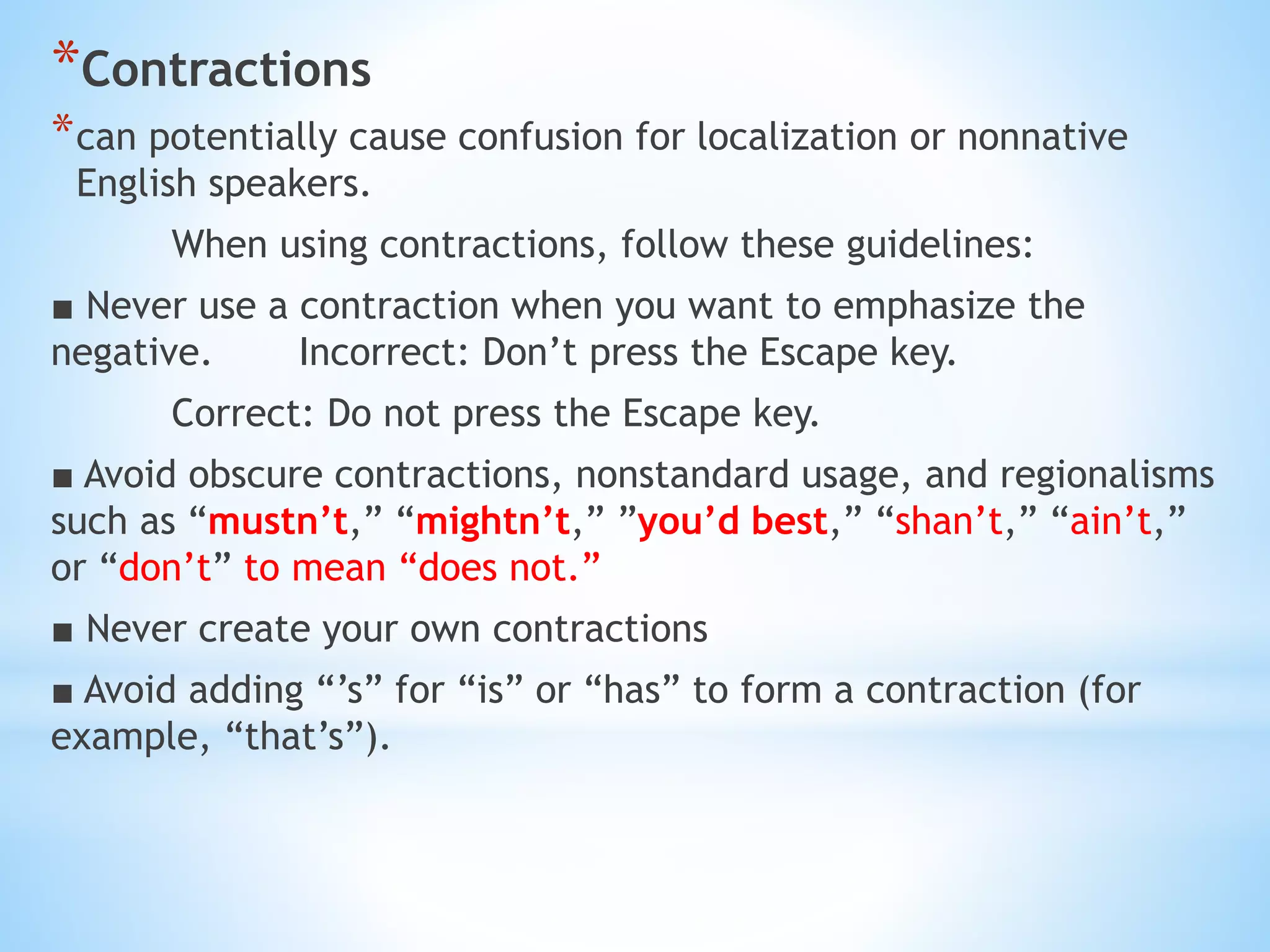
*Contractions
*can potentially cause confusion for localization or nonnative
English speakers.
When using contractions, follow these guidelines:
■ Never use a contraction when you want to emphasize the
negative. Incorrect: Don’t press the Escape key.
Correct: Do not press the Escape key.
■ Avoid obscure contractions, nonstandard usage, and regionalisms
such as “mustn’t,” “mightn’t,” ”you’d best,” “shan’t,” “ain’t,”
or “don’t” to mean “does not.”
■ Never create your own contractions
■ Avoid adding “’s” for “is” or “has” to form a contraction (for
example, “that’s”).
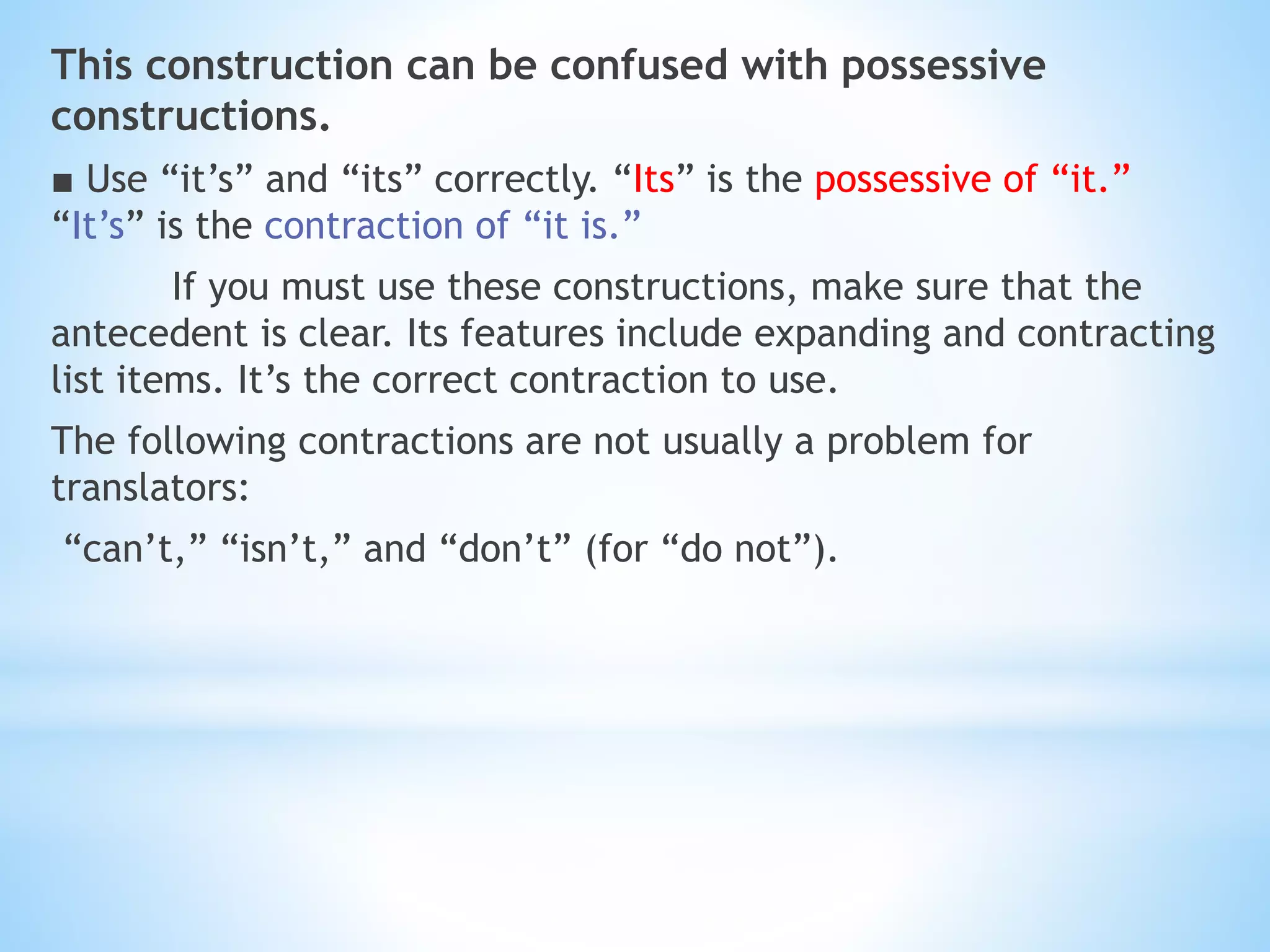
This construction can be confused with possessive
constructions.
■ Use “it’s” and “its” correctly. “Its” is the possessive of “it.”
“It’s” is the contraction of “it is.”
If you must use these constructions, make sure that the
antecedent is clear. Its features include expanding and contracting
list items. It’s the correct contraction to use.
The following contractions are not usually a problem for
translators:
“can’t,” “isn’t,” and “don’t” (for “do not”).
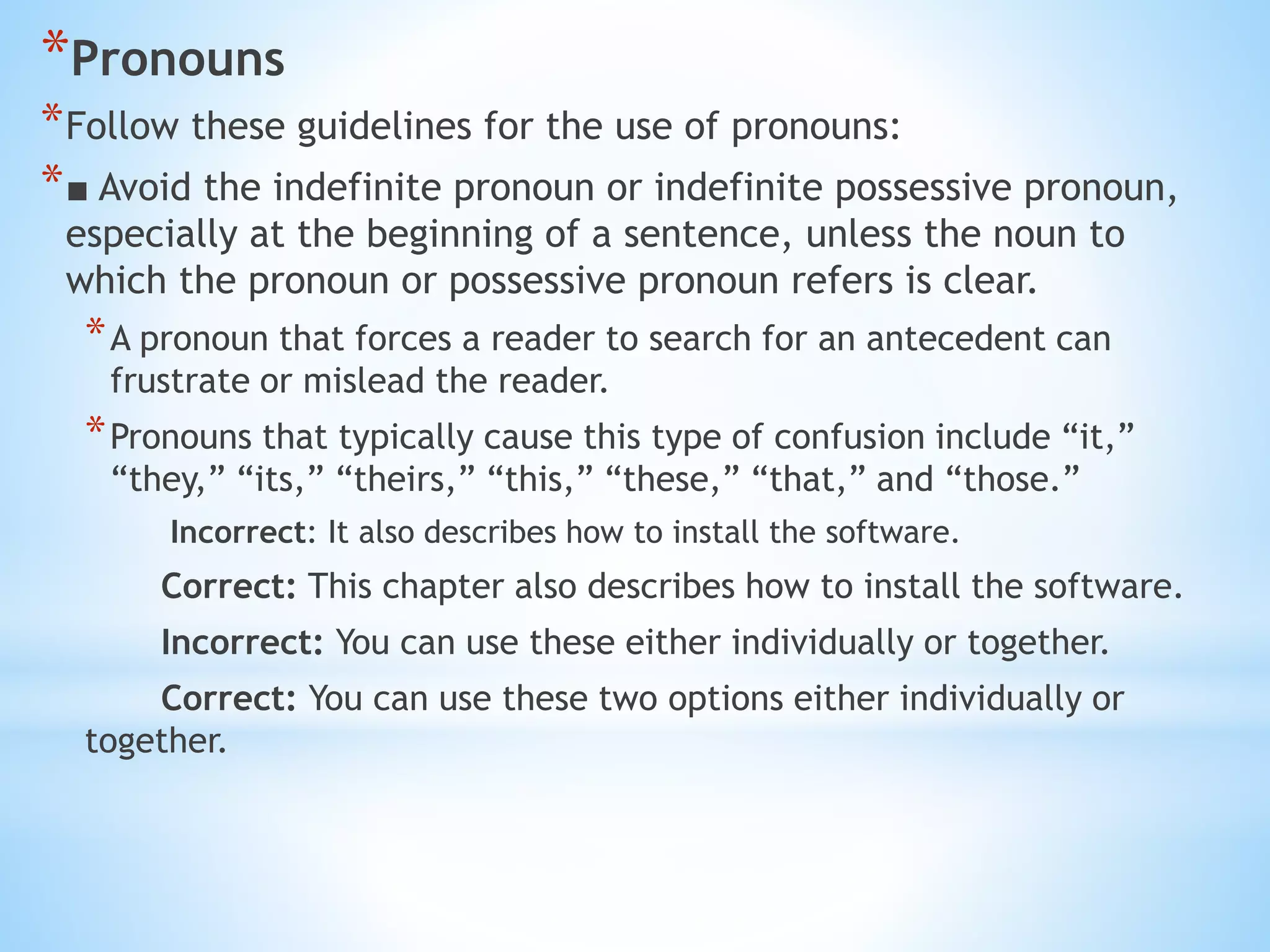
*Pronouns
*Follow these guidelines for the use of pronouns:
*■ Avoid the indefinite pronoun or indefinite possessive pronoun,
especially at the beginning of a sentence, unless the noun to
which the pronoun or possessive pronoun refers is clear.
*A pronoun that forces a reader to search for an antecedent can
frustrate or mislead the reader.
*Pronouns that typically cause this type of confusion include “it,”
“they,” “its,” “theirs,” “this,” “these,” “that,” and “those.”
Incorrect: It also describes how to install the software.
Correct: This chapter also describes how to install the software.
Incorrect: You can use these either individually or together.
Correct: You can use these two options either individually or
together.
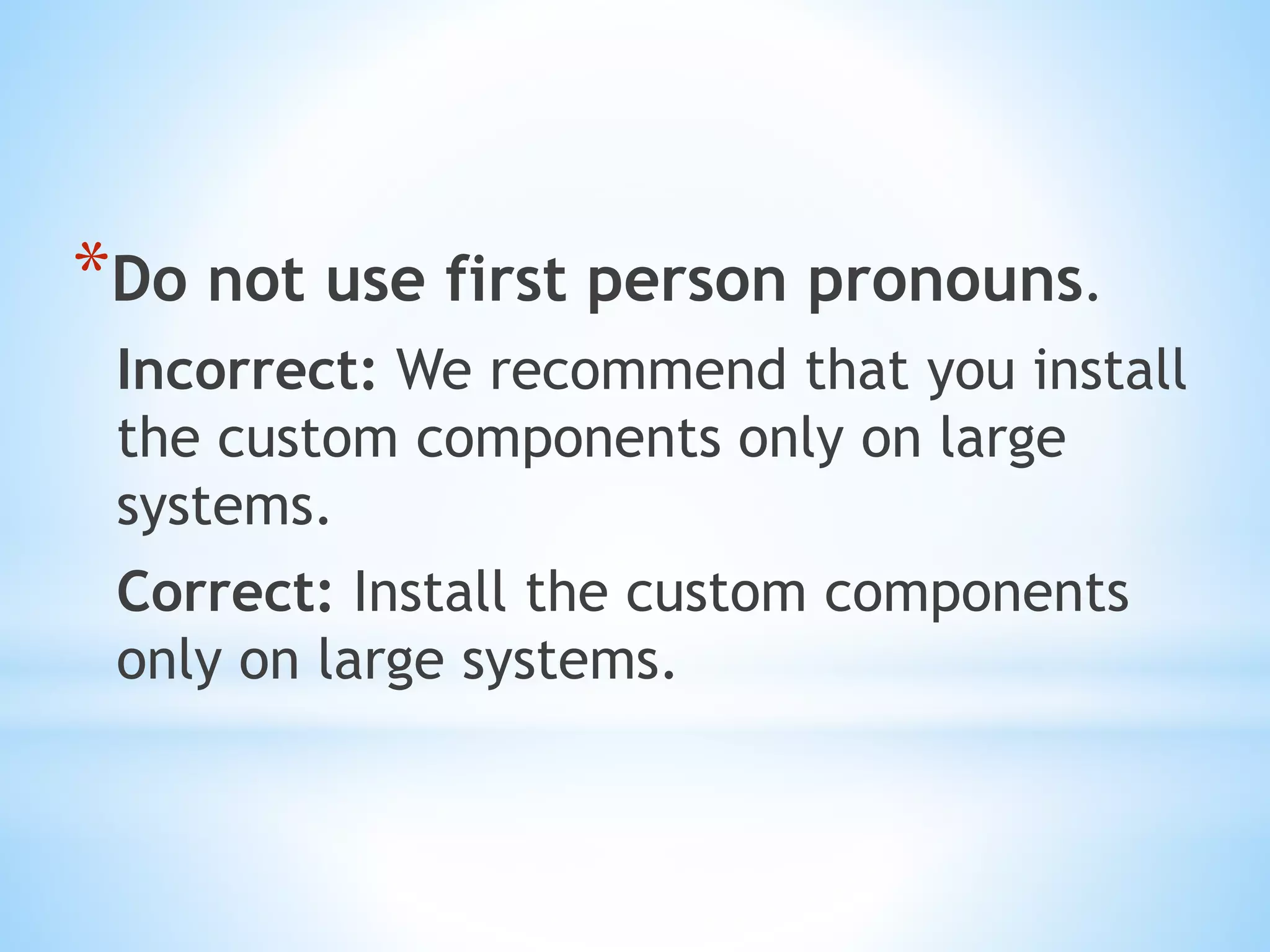
*Do not use first person pronouns.
Incorrect: We recommend that you install
the custom components only on large
systems.
Correct: Install the custom components
only on large systems.
*
*This section reviews basic punctuation rules
and guidelines for American English, notes
exceptions, and suggests alternatives. The
section is organized alphabetically
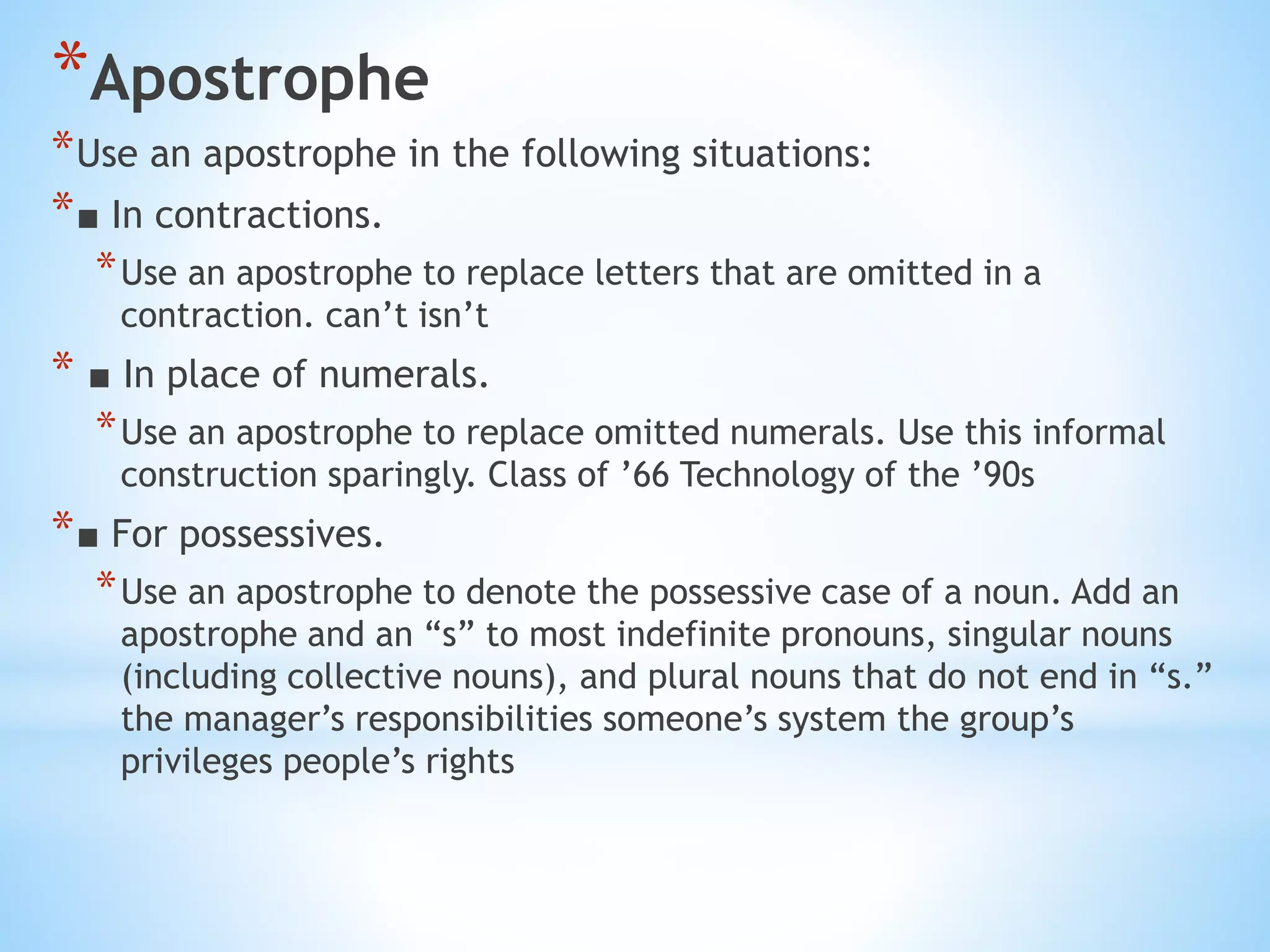
*Apostrophe
*Use an apostrophe in the following situations:
*■ In contractions.
*Use an apostrophe to replace letters that are omitted in a
contraction. can’t isn’t
* ■ In place of numerals.
*Use an apostrophe to replace omitted numerals. Use this informal
construction sparingly. Class of ’66 Technology of the ’90s
*■ For possessives.
*Use an apostrophe to denote the possessive case of a noun. Add an
apostrophe and an “s” to most indefinite pronouns, singular nouns
(including collective nouns), and plural nouns that do not end in “s.”
the manager’s responsibilities someone’s system the group’s
privileges people’s rights
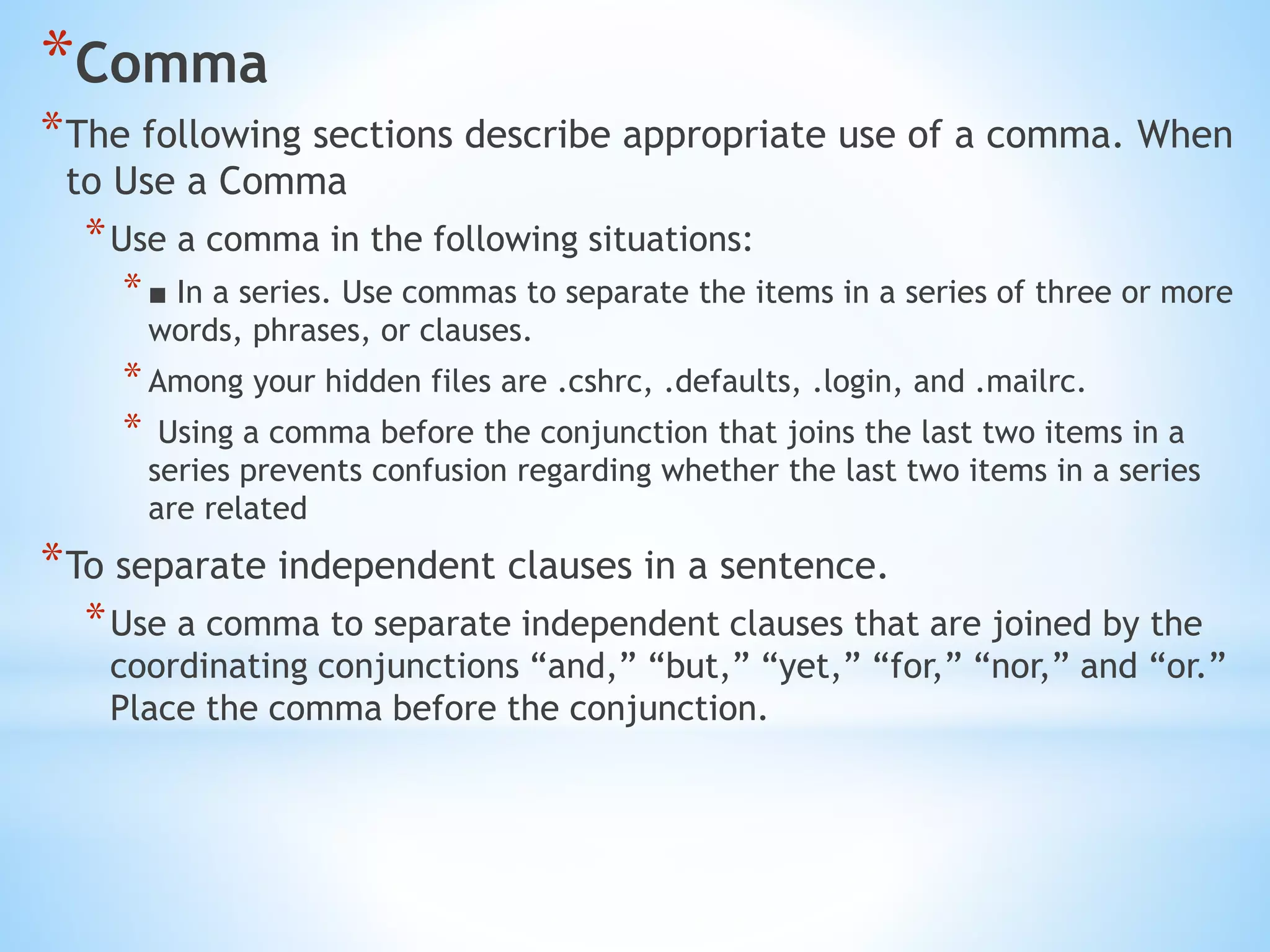
*Comma
*The following sections describe appropriate use of a comma. When
to Use a Comma
*Use a comma in the following situations:
*■ In a series. Use commas to separate the items in a series of three or more
words, phrases, or clauses.
*Among your hidden files are .cshrc, .defaults, .login, and .mailrc.
* Using a comma before the conjunction that joins the last two items in a
series prevents confusion regarding whether the last two items in a series
are related
*To separate independent clauses in a sentence.
*Use a comma to separate independent clauses that are joined by the
coordinating conjunctions “and,” “but,” “yet,” “for,” “nor,” and “or.”
Place the comma before the conjunction.
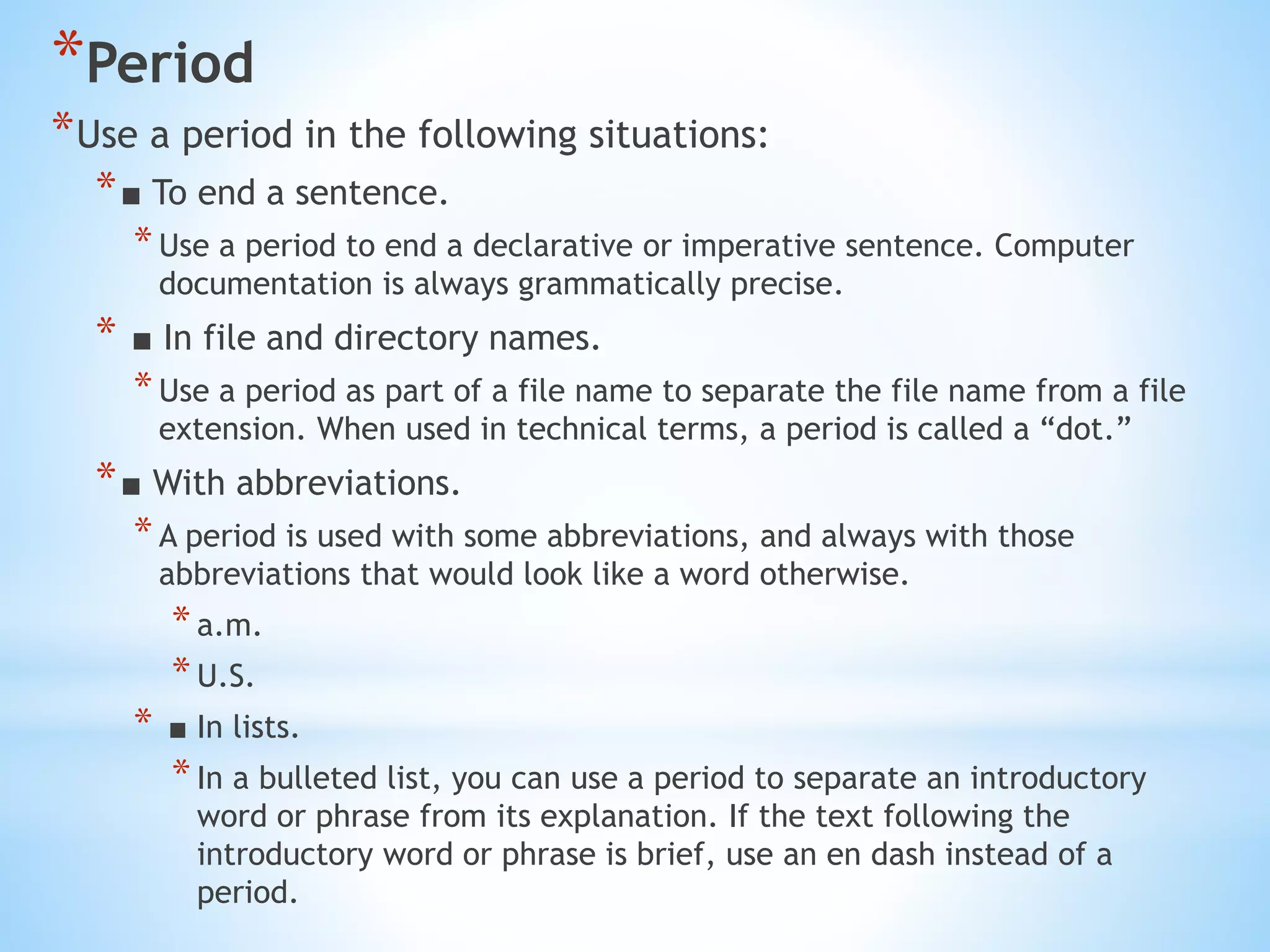
*Period
*Use a period in the following situations:
*■ To end a sentence.
*Use a period to end a declarative or imperative sentence. Computer
documentation is always grammatically precise.
* ■ In file and directory names.
*Use a period as part of a file name to separate the file name from a file
extension. When used in technical terms, a period is called a “dot.”
*■ With abbreviations.
*A period is used with some abbreviations, and always with those
abbreviations that would look like a word otherwise.
*a.m.
*U.S.
* ■ In lists.
*In a bulleted list, you can use a period to separate an introductory
word or phrase from its explanation. If the text following the
introductory word or phrase is brief, use an en dash instead of a
period.
*
*http://catalogue.pearsoned.co.uk/samplechap
ter/0131428993.pdf
*https://www.thoughtco.com/mechanics-
composition-term-1691304

Mechanics in-reading-and-writing

  • 1.
    Prepared by: ArianneLorenzo STEM 11-23 *
  • 2.
    *In composition, theconventions governing the technical aspects of writing, including spelling, punctuation, capitalization, and abbreviations. *"Capitalization and punctuation are the mechanics of writing. They are not simply rules that we must memorize and follow; they are specific signals to the reader. These mechanics are used to determine meaning and to clarify intent. It is possible to change the connotation of a sentence by altering punctuation and/or capitalization." (Maureen Lindner, English Language and Composition. Career Press, 2005) *"Mechanics, in theory, includes matters such as usage and spelling, as well as hyphenation and the use of italics. Essentially, mechanics refers to a set of conventions--how to abbreviate and when to capitalize, for example." (Robert DiYanni and Pat C. Hoy II, The Scribner Handbook for Writers, 3rd ed. Allyn and Bacon, 2001)
  • 3.
    *Capitalization *The chief reasonto capitalize a word is that the word is proper, not because the word has greater status than other words. *A proper noun identifies a specific member of a class. * A common noun, on the other hand, denotes either the whole class or any random member of the class. Example: King Henry VIII (a particular member of a class) was a king of England (the class itself). Notice the difference between the following sentences: *Use a text editor to change the information in your file. *Use Text Editor to change the information in your file. * In the first sentence, the article “a” makes clear that the writer is not pointing to a particular member of the group of text editors. Therefore, “text editor” is a common noun. But in the second sentence, the absence of an article or limiting word helps to clarify that the writer is pointing to only one member of the group. In that case, capitalize the proper noun “Text Editor.”
  • 4.
    What to CapitalizeCapitalize the following items: *■ Proper nouns *■ The letters of many abbreviations and acronyms *■ The first letter of the first word in numbered or bulleted lists * ■ The first letter of the first word in figure callouts
  • 5.
    *Contractions *can potentially causeconfusion for localization or nonnative English speakers. When using contractions, follow these guidelines: ■ Never use a contraction when you want to emphasize the negative. Incorrect: Don’t press the Escape key. Correct: Do not press the Escape key. ■ Avoid obscure contractions, nonstandard usage, and regionalisms such as “mustn’t,” “mightn’t,” ”you’d best,” “shan’t,” “ain’t,” or “don’t” to mean “does not.” ■ Never create your own contractions ■ Avoid adding “’s” for “is” or “has” to form a contraction (for example, “that’s”).
  • 6.
    This construction canbe confused with possessive constructions. ■ Use “it’s” and “its” correctly. “Its” is the possessive of “it.” “It’s” is the contraction of “it is.” If you must use these constructions, make sure that the antecedent is clear. Its features include expanding and contracting list items. It’s the correct contraction to use. The following contractions are not usually a problem for translators: “can’t,” “isn’t,” and “don’t” (for “do not”).
  • 7.
    *Pronouns *Follow these guidelinesfor the use of pronouns: *■ Avoid the indefinite pronoun or indefinite possessive pronoun, especially at the beginning of a sentence, unless the noun to which the pronoun or possessive pronoun refers is clear. *A pronoun that forces a reader to search for an antecedent can frustrate or mislead the reader. *Pronouns that typically cause this type of confusion include “it,” “they,” “its,” “theirs,” “this,” “these,” “that,” and “those.” Incorrect: It also describes how to install the software. Correct: This chapter also describes how to install the software. Incorrect: You can use these either individually or together. Correct: You can use these two options either individually or together.
  • 8.
    *Do not usefirst person pronouns. Incorrect: We recommend that you install the custom components only on large systems. Correct: Install the custom components only on large systems.
  • 9.
    * *This section reviewsbasic punctuation rules and guidelines for American English, notes exceptions, and suggests alternatives. The section is organized alphabetically
  • 10.
    *Apostrophe *Use an apostrophein the following situations: *■ In contractions. *Use an apostrophe to replace letters that are omitted in a contraction. can’t isn’t * ■ In place of numerals. *Use an apostrophe to replace omitted numerals. Use this informal construction sparingly. Class of ’66 Technology of the ’90s *■ For possessives. *Use an apostrophe to denote the possessive case of a noun. Add an apostrophe and an “s” to most indefinite pronouns, singular nouns (including collective nouns), and plural nouns that do not end in “s.” the manager’s responsibilities someone’s system the group’s privileges people’s rights
  • 11.
    *Comma *The following sectionsdescribe appropriate use of a comma. When to Use a Comma *Use a comma in the following situations: *■ In a series. Use commas to separate the items in a series of three or more words, phrases, or clauses. *Among your hidden files are .cshrc, .defaults, .login, and .mailrc. * Using a comma before the conjunction that joins the last two items in a series prevents confusion regarding whether the last two items in a series are related *To separate independent clauses in a sentence. *Use a comma to separate independent clauses that are joined by the coordinating conjunctions “and,” “but,” “yet,” “for,” “nor,” and “or.” Place the comma before the conjunction.
  • 12.
    *Period *Use a periodin the following situations: *■ To end a sentence. *Use a period to end a declarative or imperative sentence. Computer documentation is always grammatically precise. * ■ In file and directory names. *Use a period as part of a file name to separate the file name from a file extension. When used in technical terms, a period is called a “dot.” *■ With abbreviations. *A period is used with some abbreviations, and always with those abbreviations that would look like a word otherwise. *a.m. *U.S. * ■ In lists. *In a bulleted list, you can use a period to separate an introductory word or phrase from its explanation. If the text following the introductory word or phrase is brief, use an en dash instead of a period.
  • 13.