Polytechnic University of the Philippines
Sta. Mesa, Manila Campus
Senior High School Department
SHS 1202: Reading and Writing
LANGUAGE USE
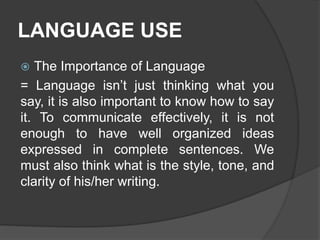
 The Importance of Language
= Language isn’t just thinking what you
say, it is also important to know how to say
it. To communicate effectively, it is not
enough to have well organized ideas
expressed in complete sentences. We
must also think what is the style, tone, and
clarity of his/her writing.
LANGUAGE USE
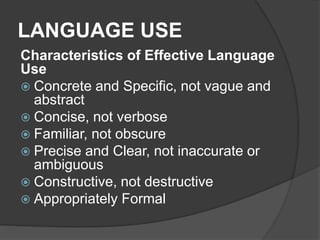
Characteristics of Effective Language
Use
 Concrete and Specific, not vague and
abstract
 Concise, not verbose
 Familiar, not obscure
 Precise and Clear, not inaccurate or
ambiguous
 Constructive, not destructive
 Appropriately Formal
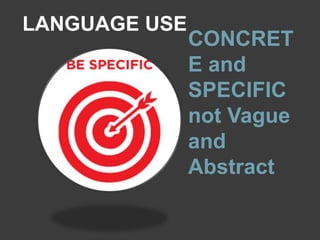
CONCRET
E and
SPECIFIC
not Vague
and
Abstract
LANGUAGE USE
CONCRETE and SPECIFIC
not Vague and Abstract
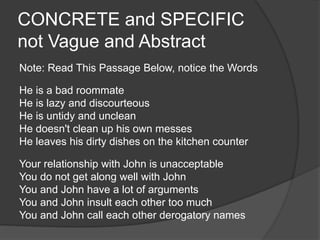
Note: Read This Passage Below, notice the Words
He is a bad roommate
He is lazy and discourteous
He is untidy and unclean
He doesn't clean up his own messes
He leaves his dirty dishes on the kitchen counter
Your relationship with John is unacceptable
You do not get along well with John
You and John have a lot of arguments
You and John insult each other too much
You and John call each other derogatory names
CONCRETE and SPECIFIC
not Vague and Abstract
Notice how much more effective the
statements become as the language
becomes more specific and concrete.
The statements at the top, which are
more abstract, can be interpreted in
many possible ways, and leave many
questions answered. The statements at
the bottom, which are more concrete, are
less open to multiple interpretations.
CONCISE
not,
Verbose
LANGUAGE USE
CONCISE, not Verbose
To have an effective language use, we must express our own words as few words
as possible. Concise means expressing something that is directed to the point of
what the speaker would want to tell.
Consider the Following Example Bellow
(1) It is widely discussed by employees that many of them will be forced to change
jobs and take on new responsibilities when the merger takes place between the
two companies.
One way to reduce wordiness is to eliminate redundant words or phrases.
Consider example one above. The phrases "to change jobs" and "take on new
responsibilities" are redundant, and could be combined into one short phrase to be
expressed more concisely.
Consider example two above. The phrase "...should be sure to carefully think
about, ponder and reflect on..." contains three ways of saying the same thing. This
sentence could be improved by using only one of the key phrases: "...to reflect
on..."
FAMILIAR,
not
Obscure
LANGUAGE USE
FAMILIAR, not Obscure
One of the Effective use of Language is using Familiar language. Because it is
easy to use something what is familiar for audience will understand it quickly.
Consider the following examples below.
A letter sent to high school students warning them of the risks of an unhealthy diet:
"Individuals who maintain a diet of high fat content are exposed to an increased
risk of developing atherosclerosis, which is a buildup of fat deposits on the inner
walls of the arteries. This condition can reduce or cut off the flow of blood in the
arteries serving the major organs of the body. This can lead to poor health."
= As we can see, the example is too obscure and led to difficulty of understanding
the passage because it is not familiar with the audience.
PRECISE
and CLEAR,
not
Inaccurate
or
Ambiguous
LANGUAGE USE
PRECISE and Clear
not, Inaccurate or Ambigious
To have a Language that is very easy to understand, you must always be precise
on whatever your were talking about to have your audience an easy-
understanding. Avoid misconceptions or using vague language that will divert from
your original topic.
Consider the following examples. Note the potential confusion or ambiguity in
these phrases.
(1) Why the student body should continue in this state of apathy is not really
understandable.
(2) Our student body is dull and slack-minded.
(3) The practice and theory of politics are studied in the classroom but political
habits on campus do not seem to benefit from such labor.
PRECISE and Clear
not, Inaccurate or Ambigious
Each of the following are actual headlines printed in newspapers. Notice their
double meaning.
(1) Include your children when Baking Cookies
(2) Safety Experts Say School Buss Passengers should be Belted
(3) Bank Drive-in Window Blocked by Board
(4) Killer Sentenced to Die for Second Time in Ten Years
(5) Eye Drops Off Shelf
In short, it is wise to think carefully about your choice of words and their potential
interpretations. To communicate effectively, precise and clear language is
essential.
CONSTRUCTI
VE not,
Destructive
LANGUAGE USE
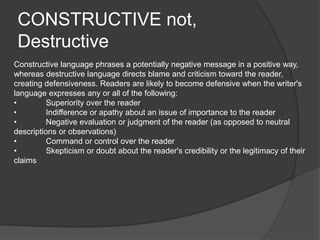
CONSTRUCTIVE not,
Destructive
Constructive language phrases a potentially negative message in a positive way,
whereas destructive language directs blame and criticism toward the reader,
creating defensiveness. Readers are likely to become defensive when the writer's
language expresses any or all of the following:
• Superiority over the reader
• Indifference or apathy about an issue of importance to the reader
• Negative evaluation or judgment of the reader (as opposed to neutral
descriptions or observations)
• Command or control over the reader
• Skepticism or doubt about the reader's credibility or the legitimacy of their
claims
CONSTRUCTIVE not,
Destructive
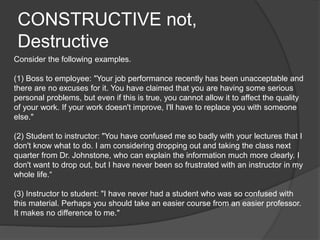
Consider the following examples.
(1) Boss to employee: "Your job performance recently has been unacceptable and
there are no excuses for it. You have claimed that you are having some serious
personal problems, but even if this is true, you cannot allow it to affect the quality
of your work. If your work doesn't improve, I'll have to replace you with someone
else."
(2) Student to instructor: "You have confused me so badly with your lectures that I
don't know what to do. I am considering dropping out and taking the class next
quarter from Dr. Johnstone, who can explain the information much more clearly. I
don't want to drop out, but I have never been so frustrated with an instructor in my
whole life.“
(3) Instructor to student: "I have never had a student who was so confused with
this material. Perhaps you should take an easier course from an easier professor.
It makes no difference to me."
APPROPRIATELY
FORMAL
LANGUAGE USE
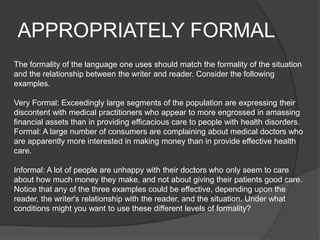
APPROPRIATELY FORMAL
The formality of the language one uses should match the formality of the situation
and the relationship between the writer and reader. Consider the following
examples.
Very Formal: Exceedingly large segments of the population are expressing their
discontent with medical practitioners who appear to more engrossed in amassing
financial assets than in providing efficacious care to people with health disorders.
Formal: A large number of consumers are complaining about medical doctors who
are apparently more interested in making money than in provide effective health
care.
Informal: A lot of people are unhappy with their doctors who only seem to care
about how much money they make, and not about giving their patients good care.
Notice that any of the three examples could be effective, depending upon the
reader, the writer's relationship with the reader, and the situation. Under what
conditions might you want to use these different levels of formality?
Techniques to have an Effective
Language Use
1. Know the Content
2. Remember, It is also important to know how to speak your
presentation.
3. Use words that is recognize by your mind
4. Know the Audience whom you speak of
5. Apply the Six Characteristics for an effective language use.
LANGUAGE USE
EXERCISES
Instruction: Group the Words inside the
box and transfer it to the Column Formal
and Appropriate.
FORMAL WORDS APPROPRIATE
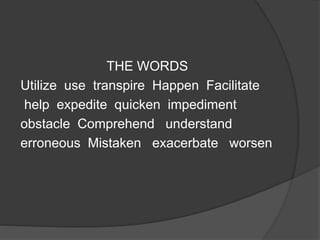
THE WORDS
Utilize use transpire Happen Facilitate
help expedite quicken impediment
obstacle Comprehend understand
erroneous Mistaken exacerbate worsen
FORMAL WORDS APPROPRIATE
-----END OF REPORT-----
Prepared By:
Timothy James H. Doctor
Polytechnic University of the Philippines-Sta. Mesa, Manila
Senior High School Department
Science, Technology, Engineering and Mathematics
Link/URL:
http://faculty.washington.edu/ezent/el.htm

Language use

  • 1.
    Polytechnic University ofthe Philippines Sta. Mesa, Manila Campus Senior High School Department SHS 1202: Reading and Writing
  • 2.
    LANGUAGE USE  TheImportance of Language = Language isn’t just thinking what you say, it is also important to know how to say it. To communicate effectively, it is not enough to have well organized ideas expressed in complete sentences. We must also think what is the style, tone, and clarity of his/her writing.
  • 3.
    LANGUAGE USE Characteristics ofEffective Language Use  Concrete and Specific, not vague and abstract  Concise, not verbose  Familiar, not obscure  Precise and Clear, not inaccurate or ambiguous  Constructive, not destructive  Appropriately Formal
  • 4.
  • 5.
    CONCRETE and SPECIFIC notVague and Abstract Note: Read This Passage Below, notice the Words He is a bad roommate He is lazy and discourteous He is untidy and unclean He doesn't clean up his own messes He leaves his dirty dishes on the kitchen counter Your relationship with John is unacceptable You do not get along well with John You and John have a lot of arguments You and John insult each other too much You and John call each other derogatory names
  • 6.
    CONCRETE and SPECIFIC notVague and Abstract Notice how much more effective the statements become as the language becomes more specific and concrete. The statements at the top, which are more abstract, can be interpreted in many possible ways, and leave many questions answered. The statements at the bottom, which are more concrete, are less open to multiple interpretations.
  • 7.
  • 8.
    CONCISE, not Verbose Tohave an effective language use, we must express our own words as few words as possible. Concise means expressing something that is directed to the point of what the speaker would want to tell. Consider the Following Example Bellow (1) It is widely discussed by employees that many of them will be forced to change jobs and take on new responsibilities when the merger takes place between the two companies. One way to reduce wordiness is to eliminate redundant words or phrases. Consider example one above. The phrases "to change jobs" and "take on new responsibilities" are redundant, and could be combined into one short phrase to be expressed more concisely. Consider example two above. The phrase "...should be sure to carefully think about, ponder and reflect on..." contains three ways of saying the same thing. This sentence could be improved by using only one of the key phrases: "...to reflect on..."
  • 9.
  • 10.
    FAMILIAR, not Obscure Oneof the Effective use of Language is using Familiar language. Because it is easy to use something what is familiar for audience will understand it quickly. Consider the following examples below. A letter sent to high school students warning them of the risks of an unhealthy diet: "Individuals who maintain a diet of high fat content are exposed to an increased risk of developing atherosclerosis, which is a buildup of fat deposits on the inner walls of the arteries. This condition can reduce or cut off the flow of blood in the arteries serving the major organs of the body. This can lead to poor health." = As we can see, the example is too obscure and led to difficulty of understanding the passage because it is not familiar with the audience.
  • 11.
  • 12.
    PRECISE and Clear not,Inaccurate or Ambigious To have a Language that is very easy to understand, you must always be precise on whatever your were talking about to have your audience an easy- understanding. Avoid misconceptions or using vague language that will divert from your original topic. Consider the following examples. Note the potential confusion or ambiguity in these phrases. (1) Why the student body should continue in this state of apathy is not really understandable. (2) Our student body is dull and slack-minded. (3) The practice and theory of politics are studied in the classroom but political habits on campus do not seem to benefit from such labor.
  • 13.
    PRECISE and Clear not,Inaccurate or Ambigious Each of the following are actual headlines printed in newspapers. Notice their double meaning. (1) Include your children when Baking Cookies (2) Safety Experts Say School Buss Passengers should be Belted (3) Bank Drive-in Window Blocked by Board (4) Killer Sentenced to Die for Second Time in Ten Years (5) Eye Drops Off Shelf In short, it is wise to think carefully about your choice of words and their potential interpretations. To communicate effectively, precise and clear language is essential.
  • 14.
  • 15.
    CONSTRUCTIVE not, Destructive Constructive languagephrases a potentially negative message in a positive way, whereas destructive language directs blame and criticism toward the reader, creating defensiveness. Readers are likely to become defensive when the writer's language expresses any or all of the following: • Superiority over the reader • Indifference or apathy about an issue of importance to the reader • Negative evaluation or judgment of the reader (as opposed to neutral descriptions or observations) • Command or control over the reader • Skepticism or doubt about the reader's credibility or the legitimacy of their claims
  • 16.
    CONSTRUCTIVE not, Destructive Consider thefollowing examples. (1) Boss to employee: "Your job performance recently has been unacceptable and there are no excuses for it. You have claimed that you are having some serious personal problems, but even if this is true, you cannot allow it to affect the quality of your work. If your work doesn't improve, I'll have to replace you with someone else." (2) Student to instructor: "You have confused me so badly with your lectures that I don't know what to do. I am considering dropping out and taking the class next quarter from Dr. Johnstone, who can explain the information much more clearly. I don't want to drop out, but I have never been so frustrated with an instructor in my whole life.“ (3) Instructor to student: "I have never had a student who was so confused with this material. Perhaps you should take an easier course from an easier professor. It makes no difference to me."
  • 17.
  • 18.
    APPROPRIATELY FORMAL The formalityof the language one uses should match the formality of the situation and the relationship between the writer and reader. Consider the following examples. Very Formal: Exceedingly large segments of the population are expressing their discontent with medical practitioners who appear to more engrossed in amassing financial assets than in providing efficacious care to people with health disorders. Formal: A large number of consumers are complaining about medical doctors who are apparently more interested in making money than in provide effective health care. Informal: A lot of people are unhappy with their doctors who only seem to care about how much money they make, and not about giving their patients good care. Notice that any of the three examples could be effective, depending upon the reader, the writer's relationship with the reader, and the situation. Under what conditions might you want to use these different levels of formality?
  • 19.
    Techniques to havean Effective Language Use 1. Know the Content 2. Remember, It is also important to know how to speak your presentation. 3. Use words that is recognize by your mind 4. Know the Audience whom you speak of 5. Apply the Six Characteristics for an effective language use.
  • 20.
  • 21.
    EXERCISES Instruction: Group theWords inside the box and transfer it to the Column Formal and Appropriate. FORMAL WORDS APPROPRIATE
  • 22.
    THE WORDS Utilize usetranspire Happen Facilitate help expedite quicken impediment obstacle Comprehend understand erroneous Mistaken exacerbate worsen
  • 23.
  • 24.
    -----END OF REPORT----- PreparedBy: Timothy James H. Doctor Polytechnic University of the Philippines-Sta. Mesa, Manila Senior High School Department Science, Technology, Engineering and Mathematics Link/URL: http://faculty.washington.edu/ezent/el.htm