Learning Objectives:
To be able to:
- Label and give the function of each part
of the microscope.
- Use the microscope correctly to view
slides and work out magnification.
The Microscope
What do all the organisms below
have in common?
Red Blood Cells
E. Coli Bacteria
Dust Particles
Ebola Virus
Daphnia
Water Bear
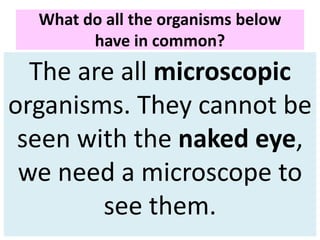
The are all microscopic
organisms. They cannot be
seen with the naked eye,
we need a microscope to
see them.
Microscopy
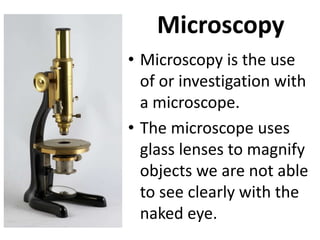
• Microscopy is the use
of or investigation with
a microscope.
• The microscope uses
glass lenses to magnify
objects we are not able
to see clearly with the
naked eye.
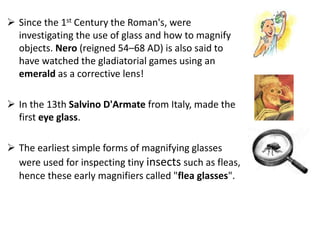
 Since the 1st Century the Roman's, were
investigating the use of glass and how to magnify
objects. Nero (reigned 54–68 AD) is also said to
have watched the gladiatorial games using an
emerald as a corrective lens!
 In the 13th Salvino D'Armate from Italy, made the
first eye glass.
 The earliest simple forms of magnifying glasses
were used for inspecting tiny insects such as fleas,
hence these early magnifiers called "flea glasses".
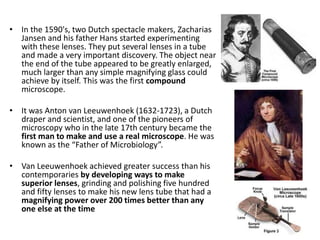
• In the 1590's, two Dutch spectacle makers, Zacharias
Jansen and his father Hans started experimenting
with these lenses. They put several lenses in a tube
and made a very important discovery. The object near
the end of the tube appeared to be greatly enlarged,
much larger than any simple magnifying glass could
achieve by itself. This was the first compound
microscope.
• It was Anton van Leeuwenhoek (1632-1723), a Dutch
draper and scientist, and one of the pioneers of
microscopy who in the late 17th century became the
first man to make and use a real microscope. He was
known as the “Father of Microbiology”.
• Van Leeuwenhoek achieved greater success than his
contemporaries by developing ways to make
superior lenses, grinding and polishing five hundred
and fifty lenses to make his new lens tube that had a
magnifying power over 200 times better than any
one else at the time
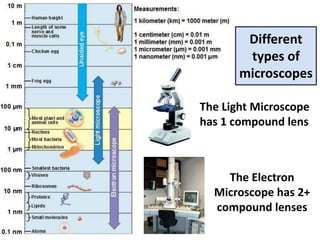
• Light
• A
compoun
d
microscop
e uses
more than
one lenses
• Electron
microscop
e uses
Different
types of
microscopes
The Light Microscope
has 1 compound lens
The Electron
Microscope has 2+
compound lenses
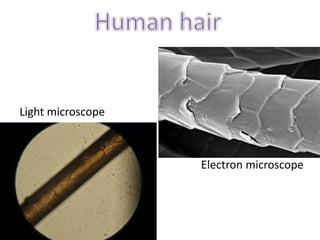
Light microscope
Electron microscope
Using the Microscope
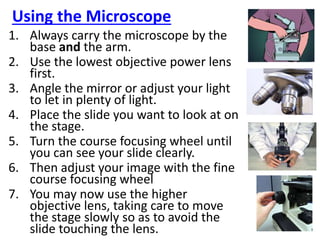
1. Always carry the microscope by the
base and the arm.
2. Use the lowest objective power lens
first.
3. Angle the mirror or adjust your light
to let in plenty of light.
4. Place the slide you want to look at on
the stage.
5. Turn the course focusing wheel until
you can see your slide clearly.
6. Then adjust your image with the fine
course focusing wheel
7. You may now use the higher
objective lens, taking care to move
the stage slowly so as to avoid the
slide touching the lens.
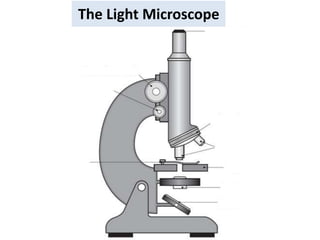
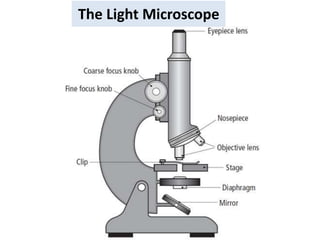
The Light Microscope
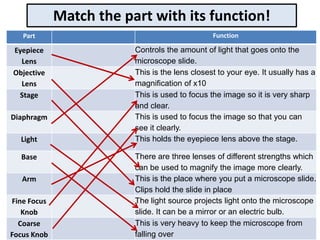
Match the part with its function!
Part Function
Eyepiece
Lens
Controls the amount of light that goes onto the
microscope slide.
Objective
Lens
This is the lens closest to your eye. It usually has a
magnification of x10
Stage This is used to focus the image so it is very sharp
and clear.
Diaphragm This is used to focus the image so that you can
see it clearly.
Light This holds the eyepiece lens above the stage.
Base There are three lenses of different strengths which
can be used to magnify the image more clearly.
Arm This is the place where you put a microscope slide.
Clips hold the slide in place
Fine Focus
Knob
The light source projects light onto the microscope
slide. It can be a mirror or an electric bulb.
Coarse
Focus Knob
This is very heavy to keep the microscope from
falling over
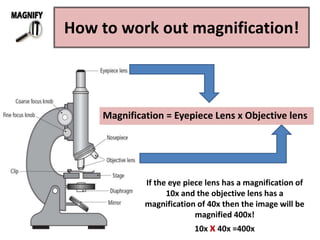
How to work out magnification!
Magnification = Eyepiece Lens x Objective lens
If the eye piece lens has a magnification of
10x and the objective lens has a
magnification of 40x then the image will be
magnified 400x!
10x x 40x =400x
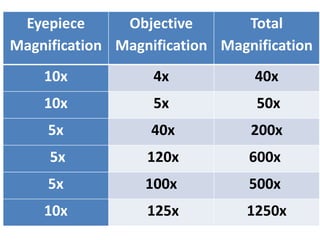
Eyepiece
Magnification
Objective
Magnification
Total
Magnification
10x 4x 40x
10x 5x 50x
5x 40x 200x
5x 120x 600x
5x 100x 500x
10x 125x 1250x
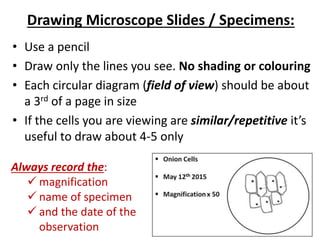
Drawing Microscope Slides / Specimens:
• Use a pencil
• Draw only the lines you see. No shading or colouring
• Each circular diagram (field of view) should be about
a 3rd of a page in size
• If the cells you are viewing are similar/repetitive it’s
useful to draw about 4-5 only
Always record the:
 magnification
 name of specimen
 and the date of the
observation
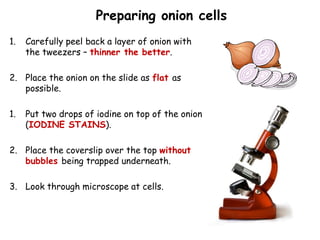
1. Carefully peel back a layer of onion with
the tweezers – thinner the better.
2. Place the onion on the slide as flat as
possible.
1. Put two drops of iodine on top of the onion
(IODINE STAINS).
2. Place the coverslip over the top without
bubbles being trapped underneath.
3. Look through microscope at cells.
Preparing onion cells

The microscope

  • 1.
    Learning Objectives: To beable to: - Label and give the function of each part of the microscope. - Use the microscope correctly to view slides and work out magnification. The Microscope
  • 2.
    What do allthe organisms below have in common? Red Blood Cells E. Coli Bacteria Dust Particles Ebola Virus Daphnia Water Bear The are all microscopic organisms. They cannot be seen with the naked eye, we need a microscope to see them.
  • 3.
    Microscopy • Microscopy isthe use of or investigation with a microscope. • The microscope uses glass lenses to magnify objects we are not able to see clearly with the naked eye.
  • 4.
     Since the1st Century the Roman's, were investigating the use of glass and how to magnify objects. Nero (reigned 54–68 AD) is also said to have watched the gladiatorial games using an emerald as a corrective lens!  In the 13th Salvino D'Armate from Italy, made the first eye glass.  The earliest simple forms of magnifying glasses were used for inspecting tiny insects such as fleas, hence these early magnifiers called "flea glasses".
  • 5.
    • In the1590's, two Dutch spectacle makers, Zacharias Jansen and his father Hans started experimenting with these lenses. They put several lenses in a tube and made a very important discovery. The object near the end of the tube appeared to be greatly enlarged, much larger than any simple magnifying glass could achieve by itself. This was the first compound microscope. • It was Anton van Leeuwenhoek (1632-1723), a Dutch draper and scientist, and one of the pioneers of microscopy who in the late 17th century became the first man to make and use a real microscope. He was known as the “Father of Microbiology”. • Van Leeuwenhoek achieved greater success than his contemporaries by developing ways to make superior lenses, grinding and polishing five hundred and fifty lenses to make his new lens tube that had a magnifying power over 200 times better than any one else at the time
  • 6.
    • Light • A compoun d microscop euses more than one lenses • Electron microscop e uses Different types of microscopes The Light Microscope has 1 compound lens The Electron Microscope has 2+ compound lenses
  • 7.
  • 8.
    Using the Microscope 1.Always carry the microscope by the base and the arm. 2. Use the lowest objective power lens first. 3. Angle the mirror or adjust your light to let in plenty of light. 4. Place the slide you want to look at on the stage. 5. Turn the course focusing wheel until you can see your slide clearly. 6. Then adjust your image with the fine course focusing wheel 7. You may now use the higher objective lens, taking care to move the stage slowly so as to avoid the slide touching the lens.
  • 9.
  • 10.
  • 11.
    Match the partwith its function! Part Function Eyepiece Lens Controls the amount of light that goes onto the microscope slide. Objective Lens This is the lens closest to your eye. It usually has a magnification of x10 Stage This is used to focus the image so it is very sharp and clear. Diaphragm This is used to focus the image so that you can see it clearly. Light This holds the eyepiece lens above the stage. Base There are three lenses of different strengths which can be used to magnify the image more clearly. Arm This is the place where you put a microscope slide. Clips hold the slide in place Fine Focus Knob The light source projects light onto the microscope slide. It can be a mirror or an electric bulb. Coarse Focus Knob This is very heavy to keep the microscope from falling over
  • 12.
    How to workout magnification! Magnification = Eyepiece Lens x Objective lens If the eye piece lens has a magnification of 10x and the objective lens has a magnification of 40x then the image will be magnified 400x! 10x x 40x =400x
  • 13.
    Eyepiece Magnification Objective Magnification Total Magnification 10x 4x 40x 10x5x 50x 5x 40x 200x 5x 120x 600x 5x 100x 500x 10x 125x 1250x
  • 14.
    Drawing Microscope Slides/ Specimens: • Use a pencil • Draw only the lines you see. No shading or colouring • Each circular diagram (field of view) should be about a 3rd of a page in size • If the cells you are viewing are similar/repetitive it’s useful to draw about 4-5 only Always record the:  magnification  name of specimen  and the date of the observation
  • 15.
    1. Carefully peelback a layer of onion with the tweezers – thinner the better. 2. Place the onion on the slide as flat as possible. 1. Put two drops of iodine on top of the onion (IODINE STAINS). 2. Place the coverslip over the top without bubbles being trapped underneath. 3. Look through microscope at cells. Preparing onion cells