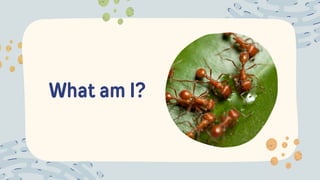
What am I?
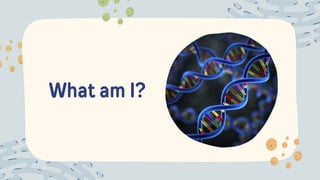
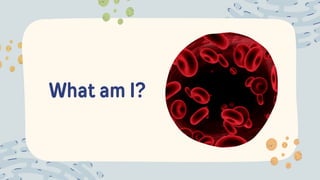
What am I?
What am I?
What am I?
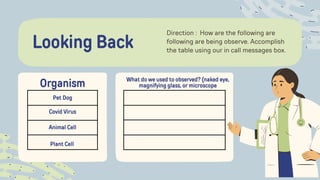
Direction : How are the following are
following are being observe. Accomplish
the table using our in call messages box.
Looking Back
Organism What do we used to observed? (naked eye,
magnifying glass, or microscope
Pet Dog
Covid Virus
Animal Cell
Plant Cell
Today, you will...
Describe microscope
Identify the parts of a compound
microscope
Give the function of each part of
microscope
Exploring
Compound
Microscope
Lesson 1
A tool that can help you see tiny
objects and organism.
What is
Microscope?
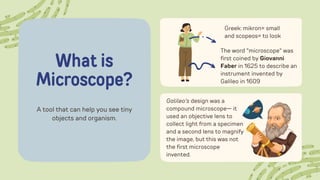
Greek: mikron= small
and scopeos= to look
The word "microscope" was
first coined by Giovanni
Faber in 1625 to describe an
instrument invented by
Galileo in 1609
Galileo's design was a
compound microscope— it
used an objective lens to
collect light from a specimen
and a second lens to magnify
the image, but this was not
the first microscope
invented.
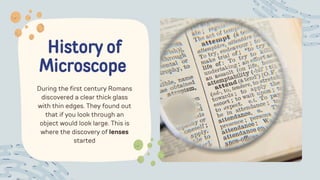
During the first century Romans
discovered a clear thick glass
with thin edges. They found out
that if you look through an
object would look large. This is
where the discovery of lenses
started
History of
Microscope
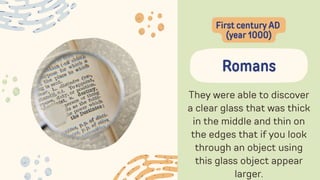
They were able to discover
a clear glass that was thick
in the middle and thin on
the edges that if you look
through an object using
this glass object appear
larger.
Romans
First century AD
(year 1000)
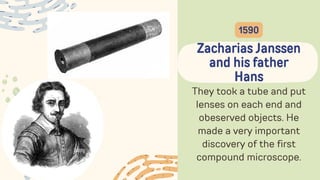
They took a tube and put
lenses on each end and
obeserved objects. He
made a very important
discovery of the first
compound microscope.
Zacharias Janssen
and his father
Hans
1590
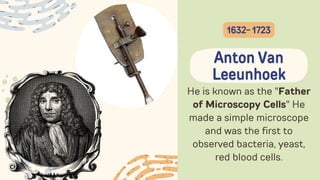
He is known as the "Father
of Microscopy Cells" He
made a simple microscope
and was the first to
observed bacteria, yeast,
red blood cells.
Anton Van
Leeunhoek
1632- 1723
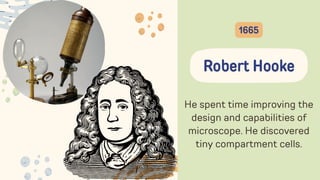
He spent time improving the
design and capabilities of
microscope. He discovered
tiny compartment cells.
Robert Hooke
1665
Parts and
Function of
Compound
Microscope
Lesson 1
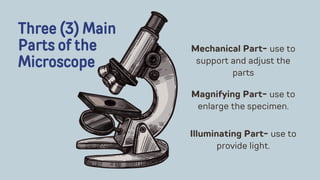
Three (3) Main
Parts of the
Microscope
Mechanical Part- use to
support and adjust the
parts
Magnifying Part- use to
enlarge the specimen.
Illuminating Part- use to
provide light.
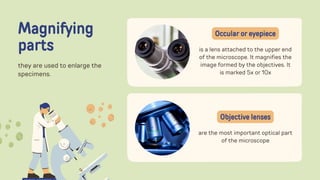
Magnifying
parts
they are used to enlarge the
specimens.
is a lens attached to the upper end
of the microscope. It magnifies the
image formed by the objectives. It
is marked 5x or 10x
Occular or eyepiece
are the most important optical part
of the microscope
Objective lenses
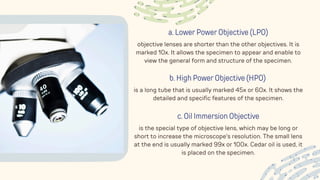
a. Lower Power Objective (LPO)
objective lenses are shorter than the other objectives. It is
marked 10x. It allows the specimen to appear and enable to
view the general form and structure of the specimen.
b. High Power Objective (HPO)
is a long tube that is usually marked 45x or 60x. It shows the
detailed and specific features of the specimen.
c. Oil Immersion Objective
is the special type of objective lens, which may be long or
short to increase the microscope's resolution. The small lens
at the end is usually marked 99x or 100x. Cedar oil is used, it
is placed on the specimen.
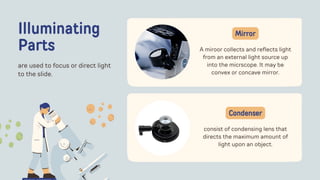
Illuminating
Parts
are used to focus or direct light
to the slide.
A miroor collects and reflects light
from an external light source up
into the micrscope. It may be
convex or concave mirror.
Mirror
consist of condensing lens that
directs the maximum amount of
light upon an object.
Condenser
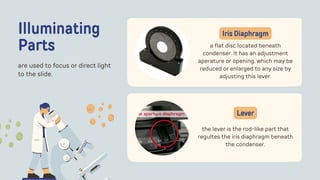
Illuminating
Parts
are used to focus or direct light
to the slide.
a flat disc located beneath
condenser. It has an adjustment
aperature or opening, which may be
reduced or enlarged to any size by
adjusting this lever.
Iris Diaphragm
the lever is the rod-like part that
regultes the iris diaphragm beneath
the condenser.
Lever
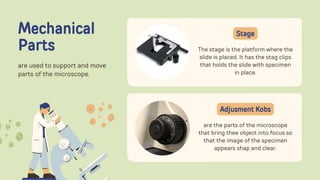
Mechanical
Parts
are used to support and move
parts of the microscope.
The stage is the platform where the
slide is placed. It has the stag clips
that holds the slide with specimen
in place.
Stage
are the parts of the microscope
that bring thee object into focus so
that the image of the specimen
appears shap and clear.
Adjusment Kobs
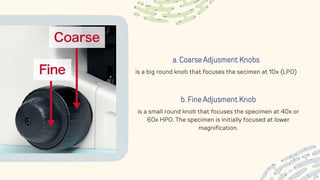
a. Coarse Adjusment Knobs
is a big round knob that focuses the secimen at 10x (LPO)
b. Fine Adjusment Knob
is a small round knob that focuses the specimen at 40x or
60x HPO. The specimen is initially focused at lower
magnification.
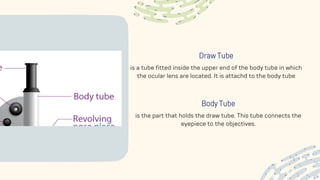
Draw Tube
is a tube fitted inside the upper end of the body tube in which
the ocular lens are located. It is attachd to the body tube
Body Tube
is the part that holds the draw tube. This tube connects the
eyepiece to the objectives.
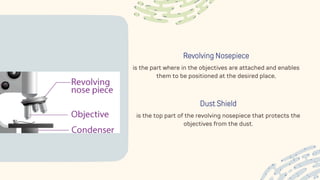
Revolving Nosepiece
is the part where in the objectives are attached and enables
them to be positioned at the desired place,
Dust Shield
is the top part of the revolving nosepiece that protects the
objectives from the dust.
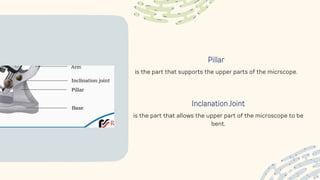
Pillar
is the part that supports the upper parts of the micrscope.
Inclanation Joint
is the part that allows the upper part of the microscope to be
bent.
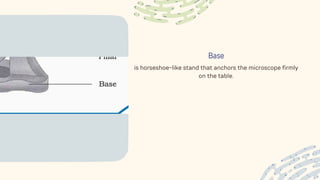
Base
is horseshoe-like stand that anchors the microscope firmly
on the table.
Quiz 2.1
For those who have their book, you can see this on page 305.
Fot those who doesn't have a book, kindly answer this on
your notebook.
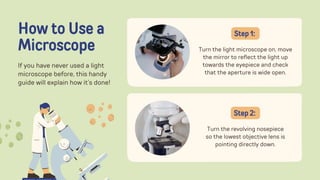
How to Use a
Microscope
If you have never used a light
microscope before, this handy
guide will explain how it’s done!
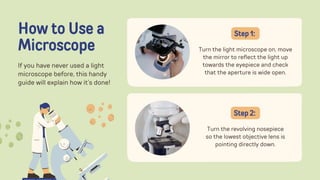
Turn the light microscope on, move
the mirror to reflect the light up
towards the eyepiece and check
that the aperture is wide open.
Step 1:
Turn the revolving nosepiece
so the lowest objective lens is
pointing directly down.
Step 2:
How to Use a
Microscope
If you have never used a light
microscope before, this handy
guide will explain how it’s done!
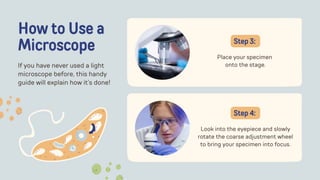
Place your specimen
onto the stage.
Step 3:
Look into the eyepiece and slowly
rotate the coarse adjustment wheel
to bring your specimen into focus.
Step 4:
How to Use a
Microscope
If you have never used a light
microscope before, this handy
guide will explain how it’s done!
Turn the light microscope on, move
the mirror to reflect the light up
towards the eyepiece and check
that the aperture is wide open.
Step 1:
Turn the revolving nosepiece
so the lowest objective lens is
pointing directly down.
Step 2:
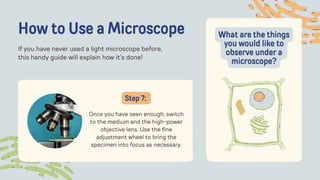
How to Use a Microscope
If you have never used a light microscope before,
this handy guide will explain how it’s done!
Once you have seen enough, switch
to the medium and the high-power
objective lens. Use the fine
adjustment wheel to bring the
specimen into focus as necessary.
Step 7:
What are the things
you would like to
observe under a
microscope?
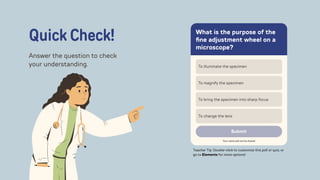
What is the purpose of the
fine adjustment wheel on a
microscope?‌
To illuminate the specimen‌
To magnify the specimen‌
To bring the specimen into sharp focus‌
To change the lens‌
Submit‌
Your name will not be shared‌
Quick Check!
Answer the question to check
your understanding.
Teacher Tip: Double-click to customize this poll or quiz, or
go to Elements for more options!
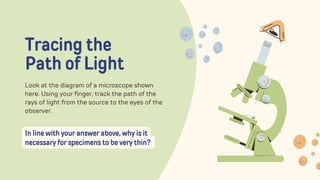
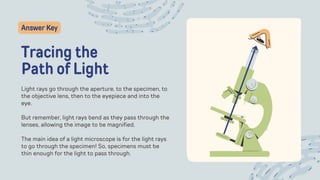
Tracing the
Path of Light
Look at the diagram of a microscope shown
here. Using your finger, track the path of the
rays of light from the source to the eyes of the
observer.
In line with your answer above, why is it
necessary for specimens to be very thin?
Tracing the
Path of Light
Light rays go through the aperture, to the specimen, to
the objective lens, then to the eyepiece and into the
eye.
But remember, light rays bend as they pass through the
lenses, allowing the image to be magnified.
The main idea of a light microscope is for the light rays
to go through the specimen! So, specimens must be
thin enough for the light to pass through.
Answer Key
Summary
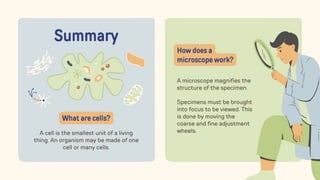
A cell is the smallest unit of a living
thing. An organism may be made of one
cell or many cells.
What are cells?
A microscope magnifies the
structure of the specimen.
Specimens must be brought
into focus to be viewed. This
is done by moving the
coarse and fine adjustment
wheels.
How does a
microscope work?
Assignment: Preparing the Specimen
Use the internet or resources in your
library to find the answer to this
question. Then, get ready to collect
and prepare the specimen the
following day.
How do you prepare
mounts of both cheek cells
and onion epidermis?
Resource
Page
Use these icons and
illustrations in your Canva
Presentation. Happy designing!
Don't forget to delete this page
before presenting.
Try this background for online class.
*Please delete this section before downloading.
Press
these keys
while on
Present
mode!
Any number from
0-9 for a timer
Q for quiet
M for mic drop
C for confetti
U for unveil
O for bubbles
D for a drumroll
B for blur

Lesson 1Exploring-Compound-Microscope (1).pdf

  • 1.
  • 2.
  • 3.
  • 4.
  • 5.
    Direction : Howare the following are following are being observe. Accomplish the table using our in call messages box. Looking Back Organism What do we used to observed? (naked eye, magnifying glass, or microscope Pet Dog Covid Virus Animal Cell Plant Cell
  • 6.
    Today, you will... Describemicroscope Identify the parts of a compound microscope Give the function of each part of microscope
  • 7.
  • 8.
    A tool thatcan help you see tiny objects and organism. What is Microscope? Greek: mikron= small and scopeos= to look The word "microscope" was first coined by Giovanni Faber in 1625 to describe an instrument invented by Galileo in 1609 Galileo's design was a compound microscope— it used an objective lens to collect light from a specimen and a second lens to magnify the image, but this was not the first microscope invented.
  • 9.
    During the firstcentury Romans discovered a clear thick glass with thin edges. They found out that if you look through an object would look large. This is where the discovery of lenses started History of Microscope
  • 10.
    They were ableto discover a clear glass that was thick in the middle and thin on the edges that if you look through an object using this glass object appear larger. Romans First century AD (year 1000)
  • 11.
    They took atube and put lenses on each end and obeserved objects. He made a very important discovery of the first compound microscope. Zacharias Janssen and his father Hans 1590
  • 12.
    He is knownas the "Father of Microscopy Cells" He made a simple microscope and was the first to observed bacteria, yeast, red blood cells. Anton Van Leeunhoek 1632- 1723
  • 13.
    He spent timeimproving the design and capabilities of microscope. He discovered tiny compartment cells. Robert Hooke 1665
  • 14.
  • 15.
    Three (3) Main Partsof the Microscope Mechanical Part- use to support and adjust the parts Magnifying Part- use to enlarge the specimen. Illuminating Part- use to provide light.
  • 16.
    Magnifying parts they are usedto enlarge the specimens. is a lens attached to the upper end of the microscope. It magnifies the image formed by the objectives. It is marked 5x or 10x Occular or eyepiece are the most important optical part of the microscope Objective lenses
  • 17.
    a. Lower PowerObjective (LPO) objective lenses are shorter than the other objectives. It is marked 10x. It allows the specimen to appear and enable to view the general form and structure of the specimen. b. High Power Objective (HPO) is a long tube that is usually marked 45x or 60x. It shows the detailed and specific features of the specimen. c. Oil Immersion Objective is the special type of objective lens, which may be long or short to increase the microscope's resolution. The small lens at the end is usually marked 99x or 100x. Cedar oil is used, it is placed on the specimen.
  • 18.
    Illuminating Parts are used tofocus or direct light to the slide. A miroor collects and reflects light from an external light source up into the micrscope. It may be convex or concave mirror. Mirror consist of condensing lens that directs the maximum amount of light upon an object. Condenser
  • 19.
    Illuminating Parts are used tofocus or direct light to the slide. a flat disc located beneath condenser. It has an adjustment aperature or opening, which may be reduced or enlarged to any size by adjusting this lever. Iris Diaphragm the lever is the rod-like part that regultes the iris diaphragm beneath the condenser. Lever
  • 20.
    Mechanical Parts are used tosupport and move parts of the microscope. The stage is the platform where the slide is placed. It has the stag clips that holds the slide with specimen in place. Stage are the parts of the microscope that bring thee object into focus so that the image of the specimen appears shap and clear. Adjusment Kobs
  • 21.
    a. Coarse AdjusmentKnobs is a big round knob that focuses the secimen at 10x (LPO) b. Fine Adjusment Knob is a small round knob that focuses the specimen at 40x or 60x HPO. The specimen is initially focused at lower magnification.
  • 22.
    Draw Tube is atube fitted inside the upper end of the body tube in which the ocular lens are located. It is attachd to the body tube Body Tube is the part that holds the draw tube. This tube connects the eyepiece to the objectives.
  • 23.
    Revolving Nosepiece is thepart where in the objectives are attached and enables them to be positioned at the desired place, Dust Shield is the top part of the revolving nosepiece that protects the objectives from the dust.
  • 24.
    Pillar is the partthat supports the upper parts of the micrscope. Inclanation Joint is the part that allows the upper part of the microscope to be bent.
  • 25.
    Base is horseshoe-like standthat anchors the microscope firmly on the table.
  • 26.
    Quiz 2.1 For thosewho have their book, you can see this on page 305. Fot those who doesn't have a book, kindly answer this on your notebook.
  • 27.
    How to Usea Microscope If you have never used a light microscope before, this handy guide will explain how it’s done! Turn the light microscope on, move the mirror to reflect the light up towards the eyepiece and check that the aperture is wide open. Step 1: Turn the revolving nosepiece so the lowest objective lens is pointing directly down. Step 2:
  • 28.
    How to Usea Microscope If you have never used a light microscope before, this handy guide will explain how it’s done! Place your specimen onto the stage. Step 3: Look into the eyepiece and slowly rotate the coarse adjustment wheel to bring your specimen into focus. Step 4:
  • 29.
    How to Usea Microscope If you have never used a light microscope before, this handy guide will explain how it’s done! Turn the light microscope on, move the mirror to reflect the light up towards the eyepiece and check that the aperture is wide open. Step 1: Turn the revolving nosepiece so the lowest objective lens is pointing directly down. Step 2:
  • 30.
    How to Usea Microscope If you have never used a light microscope before, this handy guide will explain how it’s done! Once you have seen enough, switch to the medium and the high-power objective lens. Use the fine adjustment wheel to bring the specimen into focus as necessary. Step 7: What are the things you would like to observe under a microscope?
  • 31.
    What is thepurpose of the fine adjustment wheel on a microscope?‌ To illuminate the specimen‌ To magnify the specimen‌ To bring the specimen into sharp focus‌ To change the lens‌ Submit‌ Your name will not be shared‌ Quick Check! Answer the question to check your understanding. Teacher Tip: Double-click to customize this poll or quiz, or go to Elements for more options!
  • 32.
    Tracing the Path ofLight Look at the diagram of a microscope shown here. Using your finger, track the path of the rays of light from the source to the eyes of the observer. In line with your answer above, why is it necessary for specimens to be very thin?
  • 33.
    Tracing the Path ofLight Light rays go through the aperture, to the specimen, to the objective lens, then to the eyepiece and into the eye. But remember, light rays bend as they pass through the lenses, allowing the image to be magnified. The main idea of a light microscope is for the light rays to go through the specimen! So, specimens must be thin enough for the light to pass through. Answer Key
  • 34.
    Summary A cell isthe smallest unit of a living thing. An organism may be made of one cell or many cells. What are cells? A microscope magnifies the structure of the specimen. Specimens must be brought into focus to be viewed. This is done by moving the coarse and fine adjustment wheels. How does a microscope work?
  • 35.
    Assignment: Preparing theSpecimen Use the internet or resources in your library to find the answer to this question. Then, get ready to collect and prepare the specimen the following day. How do you prepare mounts of both cheek cells and onion epidermis?
  • 36.
    Resource Page Use these iconsand illustrations in your Canva Presentation. Happy designing! Don't forget to delete this page before presenting.
  • 37.
    Try this backgroundfor online class. *Please delete this section before downloading.
  • 38.
    Press these keys while on Present mode! Anynumber from 0-9 for a timer Q for quiet M for mic drop C for confetti U for unveil O for bubbles D for a drumroll B for blur