+
Genetics Recap
+
Objectives
To be able to:
 Explain how characteristics are inherited from parents and how
genetic variations occur.
 Demonstrate the characteristics that will be inherited by
offspring using punnett squares.
 Differentiate between a monohybrid cross & a dihybrid cross.
+
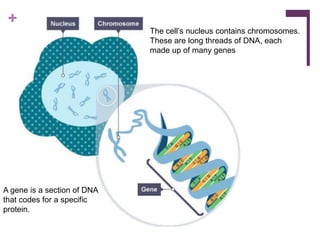
The cell’s nucleus contains chromosomes.
These are long threads of DNA, each
made up of many genes
A gene is a section of DNA
that codes for a specific
protein.
+
Some characteristics, such as eye colour and
the shape of the earlobe, are controlled by a
single gene. These genes may have different
forms.
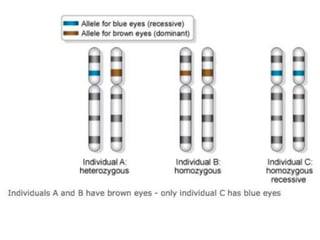
Different forms of the same gene are called
alleles. The gene for eye colour has an allele
for blue eye colour and an allele for brown eye
colour.
+
Alleles
Alleles are dominant or recessive:
• the characteristic controlled by a dominant allele
develops if the allele is present on one or both
chromosomes in a pair
• the characteristic controlled by a recessive allele
develops only if the allele is present on both
chromosomes in a pair
+
A monohybrid cross shows the inheritance of one
characteristic. In the genetic diagrams for these crosses:
• the recessive allele is represented by a lower case
letter
• the dominant allele is represented by an upper case
letter
• someone with two identical copies of an allele is
homozygous for that particular gene
• someone with two different alleles for a particular gene
is heterozygous for that gene
+
+
Mendel’s experiment
Gregor Mendel (1822-1884) studied the inheritance of
different characteristics in pea plants. He found that
when he bred purple-flowered plants with white-flowered
plants, all the offspring produced purple flowers.
If he bred these plants with each other, most of the
offspring had purple flowers, but some had white. This
was because the allele for purple flowers is dominant,
and the allele for white flowers is recessive.
+
Punnett Squares
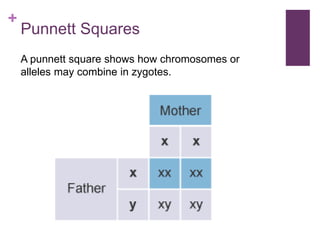
A punnett square shows how chromosomes or
alleles may combine in zygotes.
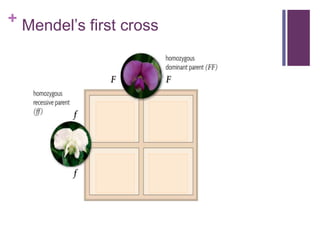
+ Mendel’s first cross
+
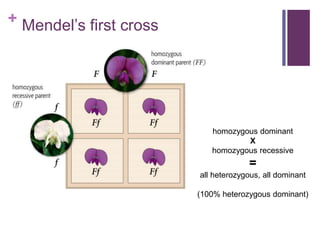
homozygous dominant
X
homozygous recessive
=
all heterozygous, all dominant
(100% heterozygous dominant)
Mendel’s first cross
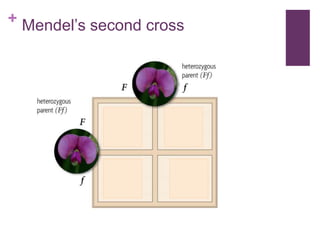
+ Mendel’s second cross
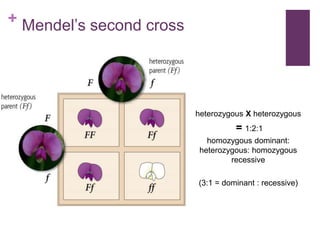
heterozygous X heterozygous
= 1:2:1
homozygous dominant:
heterozygous: homozygous
recessive
(3:1 = dominant : recessive)
+
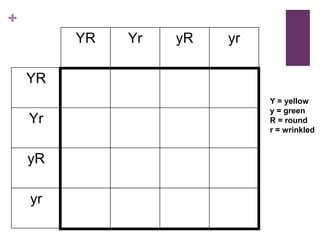
A dihybrid cross shows the inheritance of two
characteristics.
In a dihybrid cross the genes that determine the two
characteristics are located on different pairs of homologous
chromosomes. Each of these genes can have two or more
alleles.
+
YR Yr yR yr
YR
Yr
yR
yr
Y = yellow
y = green
R = round
r = wrinkled
+
+
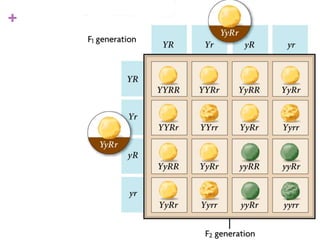
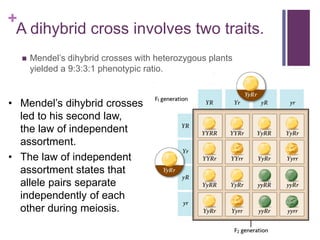
A dihybrid cross involves two traits.
 Mendel’s dihybrid crosses with heterozygous plants
yielded a 9:3:3:1 phenotypic ratio.
• Mendel’s dihybrid crosses
led to his second law,
the law of independent
assortment.
• The law of independent
assortment states that
allele pairs separate
independently of each
other during meiosis.
+Heredity patterns can be calculated
with probability.
 Probability is the likelihood that something will happen.
 Probability predicts an average number of occurrences, not an exact number of
occurrences.
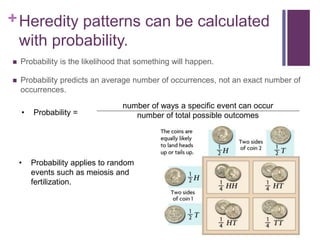
• Probability =
number of ways a specific event can occur
number of total possible outcomes
• Probability applies to random
events such as meiosis and
fertilization.
+ Sexual reproduction creates
unique combinations of genes.
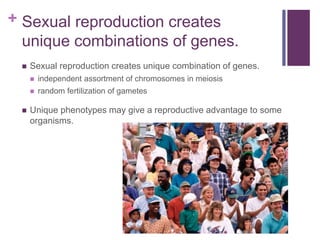
 Sexual reproduction creates unique combination of genes.
 independent assortment of chromosomes in meiosis
 random fertilization of gametes
 Unique phenotypes may give a reproductive advantage to some
organisms.
+ Crossing over during meiosis
increases genetic diversity.
 Crossing over is the exchange of chromosome segments between
homologous chromosomes.
 occurs during prophase I of meiosis I
 results in new combinations of genes
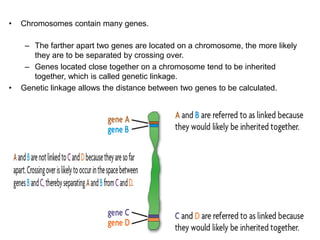
• Chromosomes contain many genes.
– The farther apart two genes are located on a chromosome, the more likely
they are to be separated by crossing over.
– Genes located close together on a chromosome tend to be inherited
together, which is called genetic linkage.
• Genetic linkage allows the distance between two genes to be calculated.

Genetics

  • 1.
  • 2.
    + Objectives To be ableto:  Explain how characteristics are inherited from parents and how genetic variations occur.  Demonstrate the characteristics that will be inherited by offspring using punnett squares.  Differentiate between a monohybrid cross & a dihybrid cross.
  • 3.
    + The cell’s nucleuscontains chromosomes. These are long threads of DNA, each made up of many genes A gene is a section of DNA that codes for a specific protein.
  • 4.
    + Some characteristics, suchas eye colour and the shape of the earlobe, are controlled by a single gene. These genes may have different forms. Different forms of the same gene are called alleles. The gene for eye colour has an allele for blue eye colour and an allele for brown eye colour.
  • 5.
    + Alleles Alleles are dominantor recessive: • the characteristic controlled by a dominant allele develops if the allele is present on one or both chromosomes in a pair • the characteristic controlled by a recessive allele develops only if the allele is present on both chromosomes in a pair
  • 6.
    + A monohybrid crossshows the inheritance of one characteristic. In the genetic diagrams for these crosses: • the recessive allele is represented by a lower case letter • the dominant allele is represented by an upper case letter • someone with two identical copies of an allele is homozygous for that particular gene • someone with two different alleles for a particular gene is heterozygous for that gene
  • 7.
  • 8.
    + Mendel’s experiment Gregor Mendel(1822-1884) studied the inheritance of different characteristics in pea plants. He found that when he bred purple-flowered plants with white-flowered plants, all the offspring produced purple flowers. If he bred these plants with each other, most of the offspring had purple flowers, but some had white. This was because the allele for purple flowers is dominant, and the allele for white flowers is recessive.
  • 9.
    + Punnett Squares A punnettsquare shows how chromosomes or alleles may combine in zygotes.
  • 10.
  • 11.
    + homozygous dominant X homozygous recessive = allheterozygous, all dominant (100% heterozygous dominant) Mendel’s first cross
  • 12.
  • 13.
    + Mendel’s secondcross heterozygous X heterozygous = 1:2:1 homozygous dominant: heterozygous: homozygous recessive (3:1 = dominant : recessive)
  • 14.
    + A dihybrid crossshows the inheritance of two characteristics. In a dihybrid cross the genes that determine the two characteristics are located on different pairs of homologous chromosomes. Each of these genes can have two or more alleles.
  • 15.
    + YR Yr yRyr YR Yr yR yr Y = yellow y = green R = round r = wrinkled
  • 16.
  • 17.
    + A dihybrid crossinvolves two traits.  Mendel’s dihybrid crosses with heterozygous plants yielded a 9:3:3:1 phenotypic ratio. • Mendel’s dihybrid crosses led to his second law, the law of independent assortment. • The law of independent assortment states that allele pairs separate independently of each other during meiosis.
  • 18.
    +Heredity patterns canbe calculated with probability.  Probability is the likelihood that something will happen.  Probability predicts an average number of occurrences, not an exact number of occurrences. • Probability = number of ways a specific event can occur number of total possible outcomes • Probability applies to random events such as meiosis and fertilization.
  • 19.
    + Sexual reproductioncreates unique combinations of genes.  Sexual reproduction creates unique combination of genes.  independent assortment of chromosomes in meiosis  random fertilization of gametes  Unique phenotypes may give a reproductive advantage to some organisms.
  • 20.
    + Crossing overduring meiosis increases genetic diversity.  Crossing over is the exchange of chromosome segments between homologous chromosomes.  occurs during prophase I of meiosis I  results in new combinations of genes
  • 21.
    • Chromosomes containmany genes. – The farther apart two genes are located on a chromosome, the more likely they are to be separated by crossing over. – Genes located close together on a chromosome tend to be inherited together, which is called genetic linkage. • Genetic linkage allows the distance between two genes to be calculated.

Editor's Notes

  • #8 Point out genotype as the genetic make up of a specific set of genes & phenotype as the physical characteristics, or traits, of an organism (in this case the eye colours)
  • #16 Mendel