The document summarizes the key characteristics of five groups of vertebrate animals: mammals, birds, reptiles, amphibians, and fish. It describes their defining features such as how they reproduce, breathe, and are covered (e.g. hair, feathers, scales). Interactive elements like a presentation, videos and a game were used to teach about the different vertebrate groups. Review questions are provided to test comprehension.
Overview of vertebrate animals, exemplified by the chameleon.
Focus on learning about vertebrates' characteristics, including mammals, birds, reptiles, amphibians, and fish.
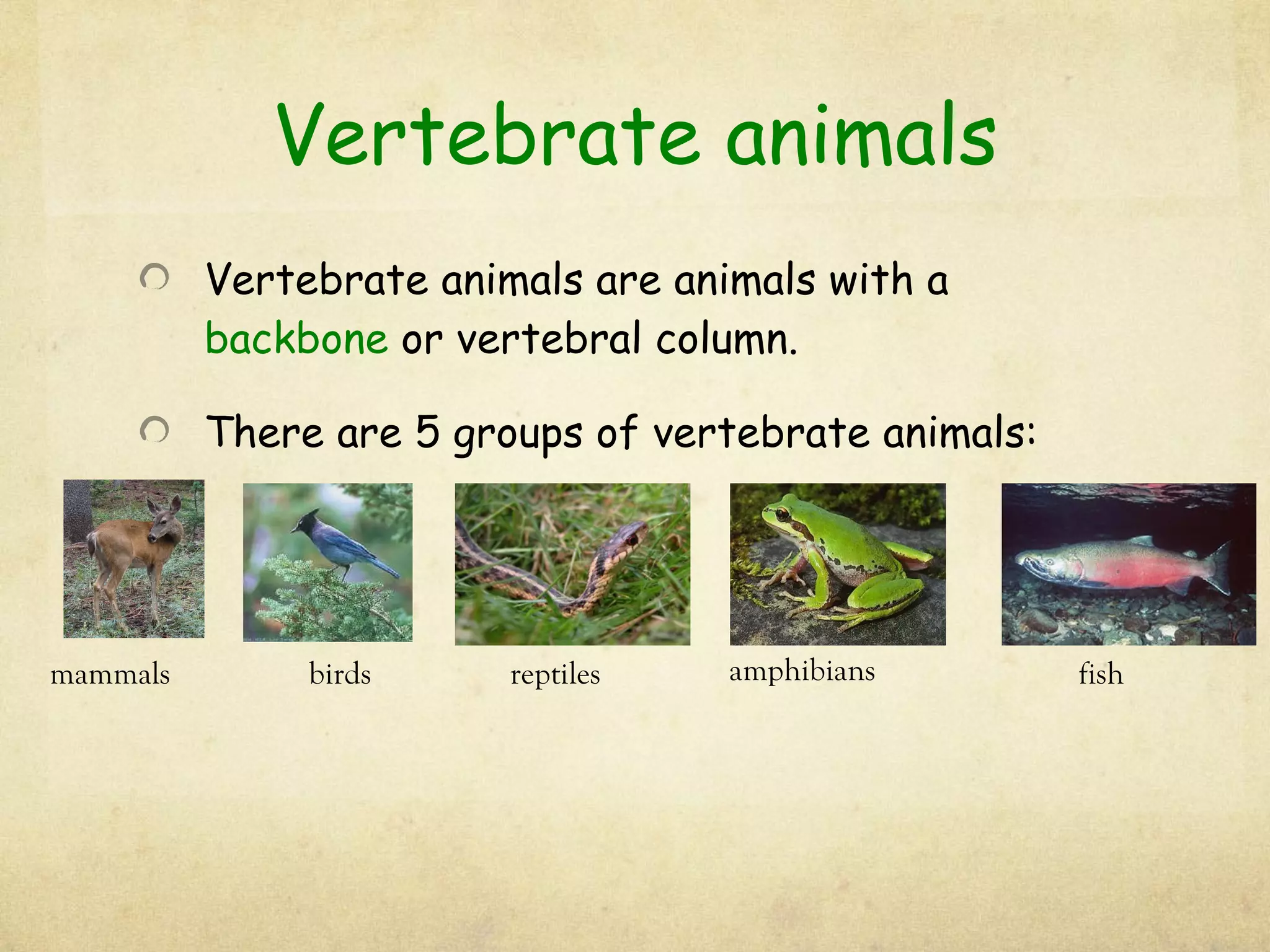
Definition of vertebrate animals, highlighting the 5 groups: mammals, birds, reptiles, amphibians, fish.
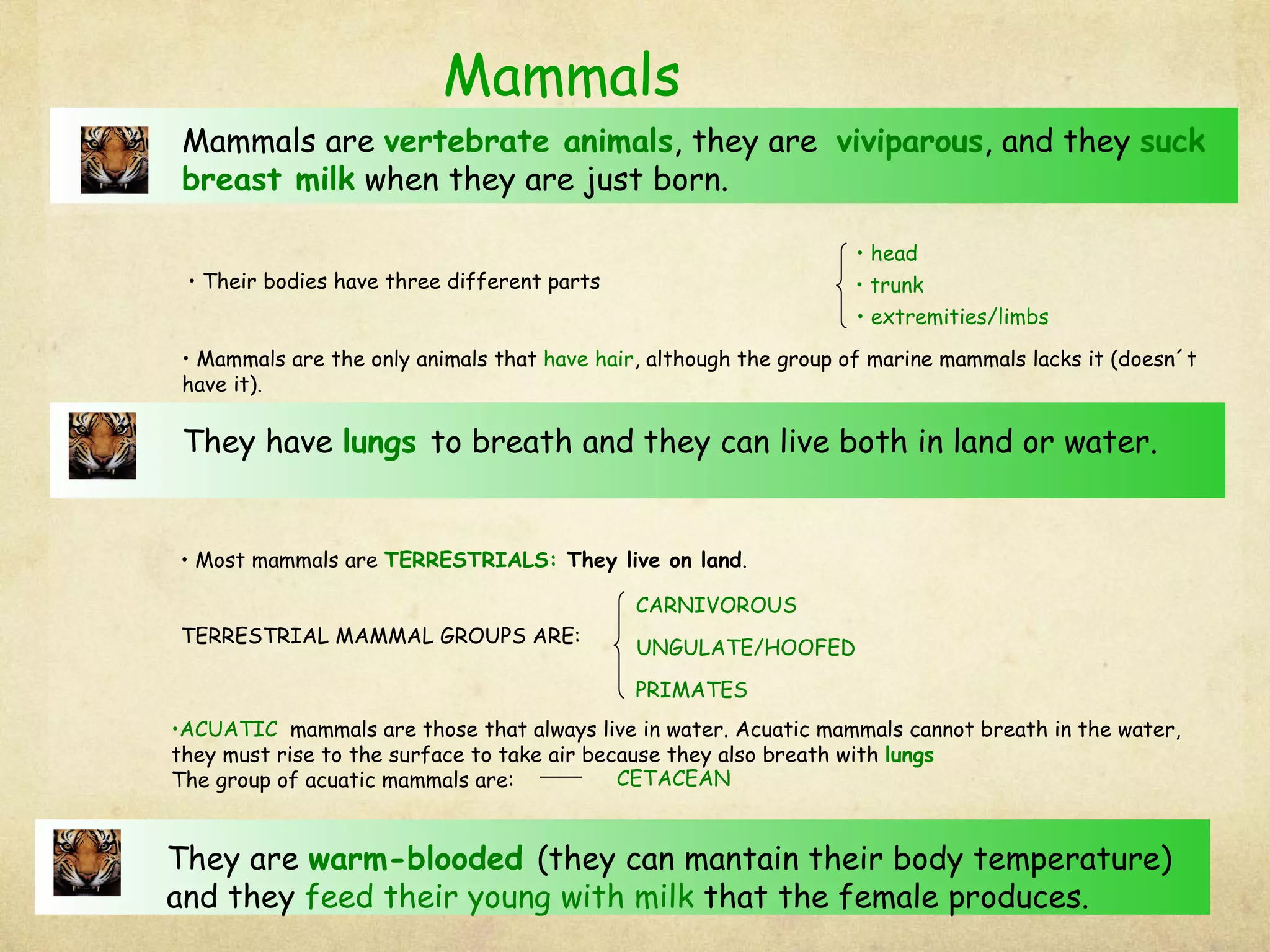
In-depth look at mammals, their viviparous nature, body structure, classifications, and unique features.
Interactive review of mammal characteristics and vocabulary related to their birthing and anatomical features.
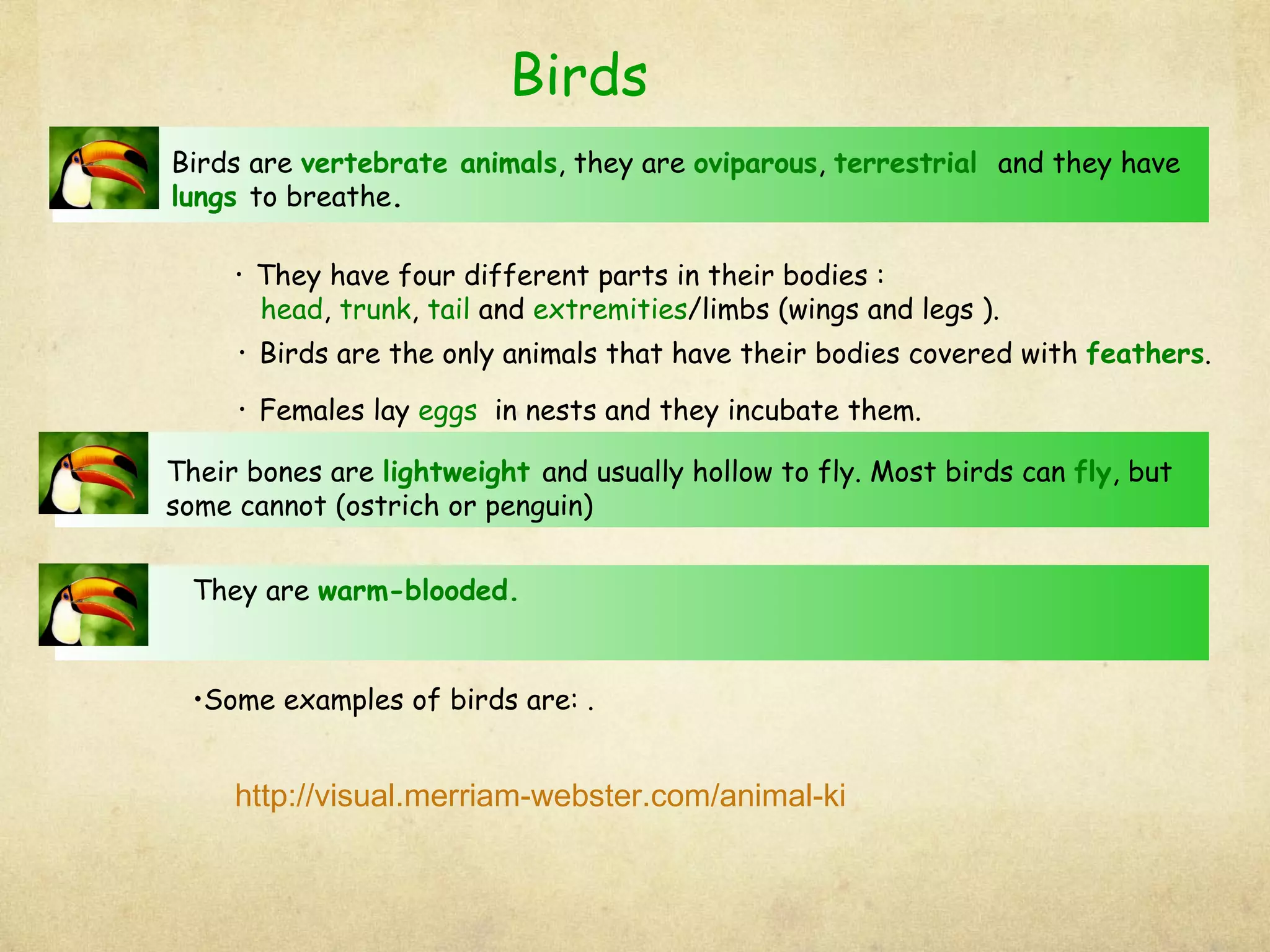
Birds as vertebrates, emphasizing their oviparous nature, body structure, and unique features like feathers.
Comparative characteristics of reptiles, amphibians, and fish, including breathing methods and body structure.Engaging questions about vertebrate classifications, focusing on features like gills and metamorphosis.
Providing a link for an interactive game to enhance understanding of vertebrate animal classifications.
VERTEBRATE ANIMALS Leaftale chameleon http://www.davidlnelson.md/Cazadero/FiveVertebrates.htm BY ANA RUPEREZ
2.
Title: vertebrates Objective:to learn about vertebrates and its characteristics. Materials: Presentation, book. Procedure: we watch a presentation, internet videos and played a game. Results: these are the characteristics of vertebrates: Mammals: picture and characteristics Birds: picture and characterisctis Reptiles: picture and characteristics Amphibians: picture and characteristics. Fish: picture and characteristics. Glossary:
Vertebrate animals Vertebrateanimals are animals with a backbone or vertebral column. There are 5 groups of vertebrate animals: mammals birds reptiles amphibians fish
5.
Mammals Mammals are vertebrate animals , they are viviparous , and they suck breast milk when they are just born. Their bodies have three different parts Mammals are the only animals that have hair , although the group of marine mammals lacks it (doesn´t have it). They have lungs to breath and they can live both in land or water. Most mammals are TERRESTRIALS: They live on land . TERRESTRIAL MAMMAL GROUPS ARE: CARNIVOROUS UNGULATE/HOOFED PRIMATES CETACEAN head trunk extremities/limbs ACUATIC mammals are those that always live in water. Acuatic mammals cannot breath in the water, they must rise to the surface to take air because they also breath with lungs The group of acuatic mammals are: They are warm-blooded (they can mantain their body temperature) and they feed their young with milk that the female produces.
Vocabulary questions… Mammalsgive birth to live young, so they are: Viviparous. Oviparous. Ovoviviparous. The ungulates are a type of terrestrial animals that have: Hooves. Foot with fingers. Many gulates. Marine mammals don’t have ______ like other mammals but they have ______ to breath and they need to rise to the _______ to do it. Mammals have ___ extremities or limbs, one____ and one ____. Mammal mothers nurse their young with ______.
9.
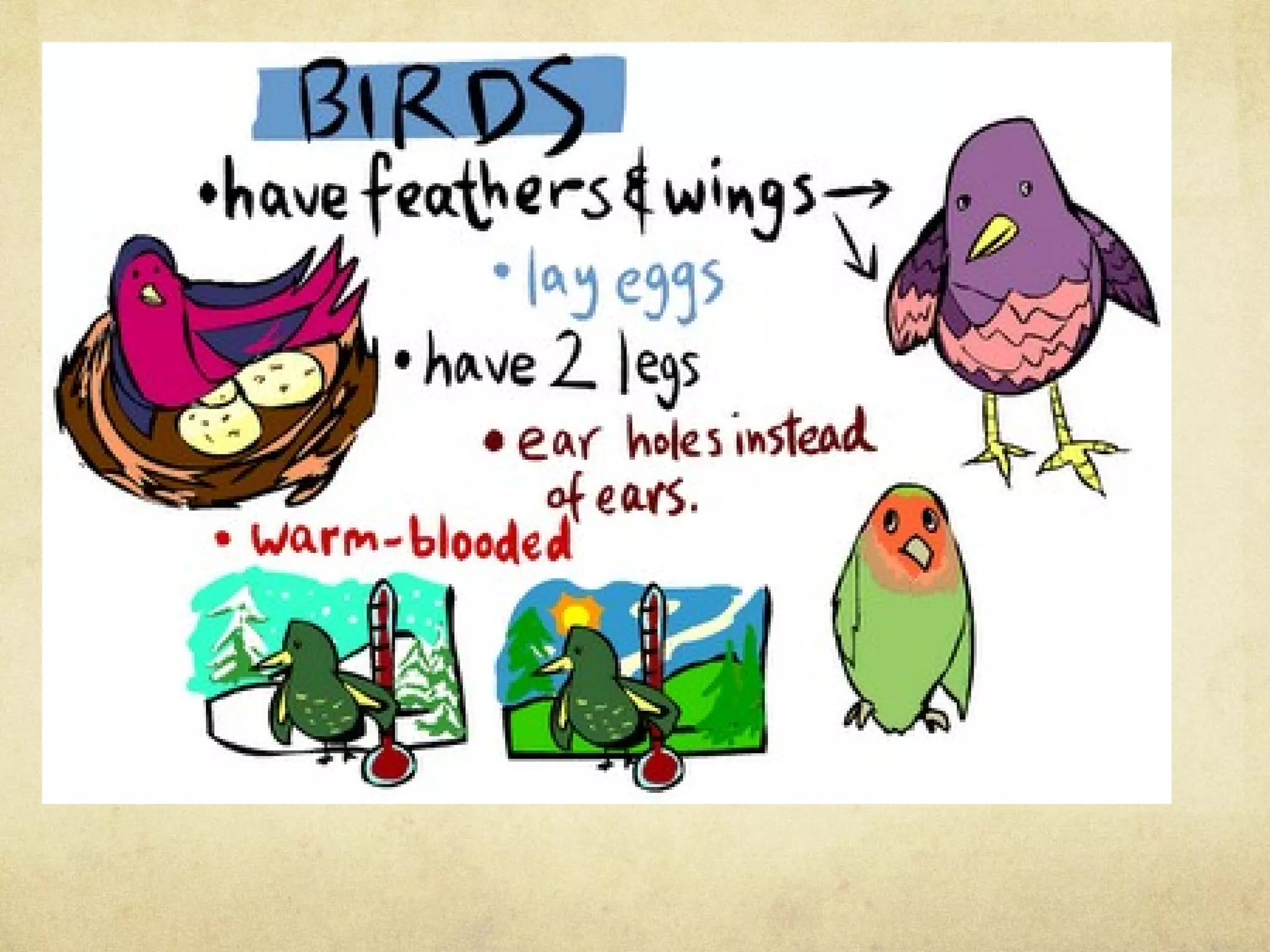
Birds Birds are vertebrate animals , they are oviparous , terrestrial and they have lungs to breathe . They have four different parts in their bodies : head , trunk , tail and extremities /limbs (wings and legs ). Birds are the only animals that have their bodies covered with feathers . Their bones are lightweight and usually hollow to fly. Most birds can fly , but some cannot (ostrich or penguin) Females lay eggs in nests and they incubate them. They are warm-blooded. Some examples of birds are: . http://visual.merriam-webster.com/animal-kingdom/birds/examples-birds_4.php
10.
Some questions…. Arebirds viviparous or oviparous? What does it mean? Draw a feather. How are their bones like? What is a nest? Do all birds fly? Give examples of birds that cannot fly. What is the meaning of warm-blooded? http://animals.nationalgeographic.com/animals/birds/
11.
12.
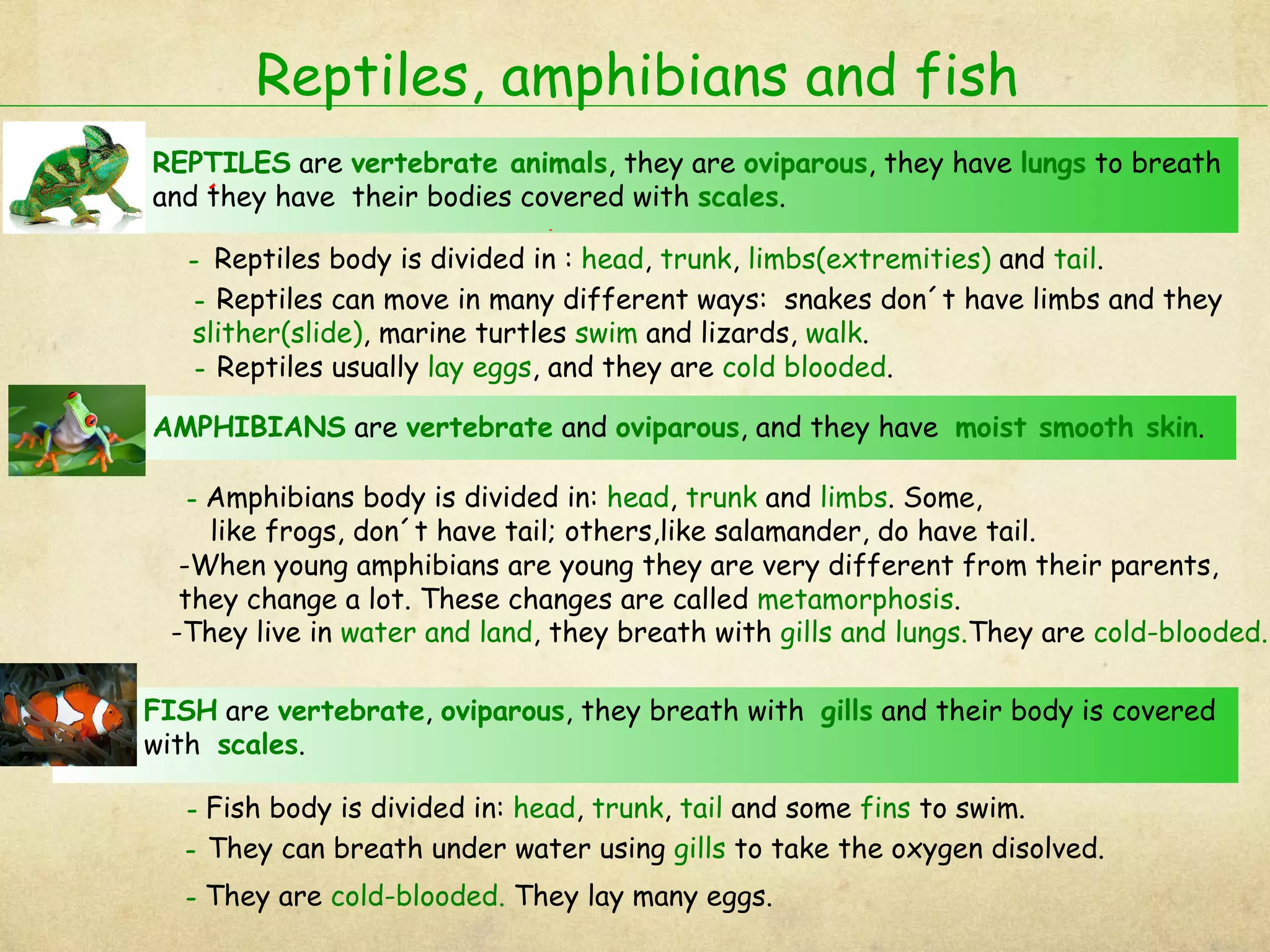
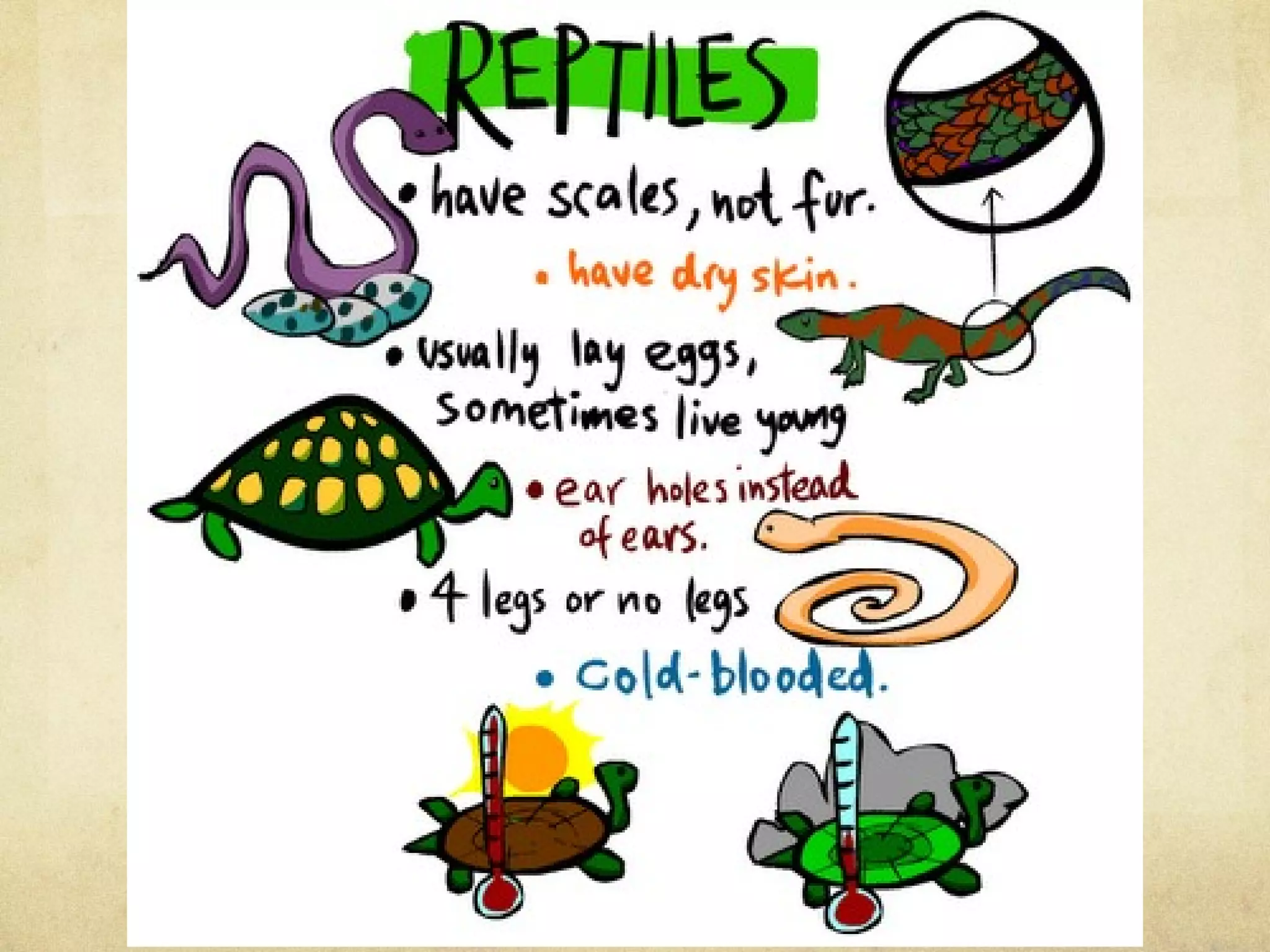
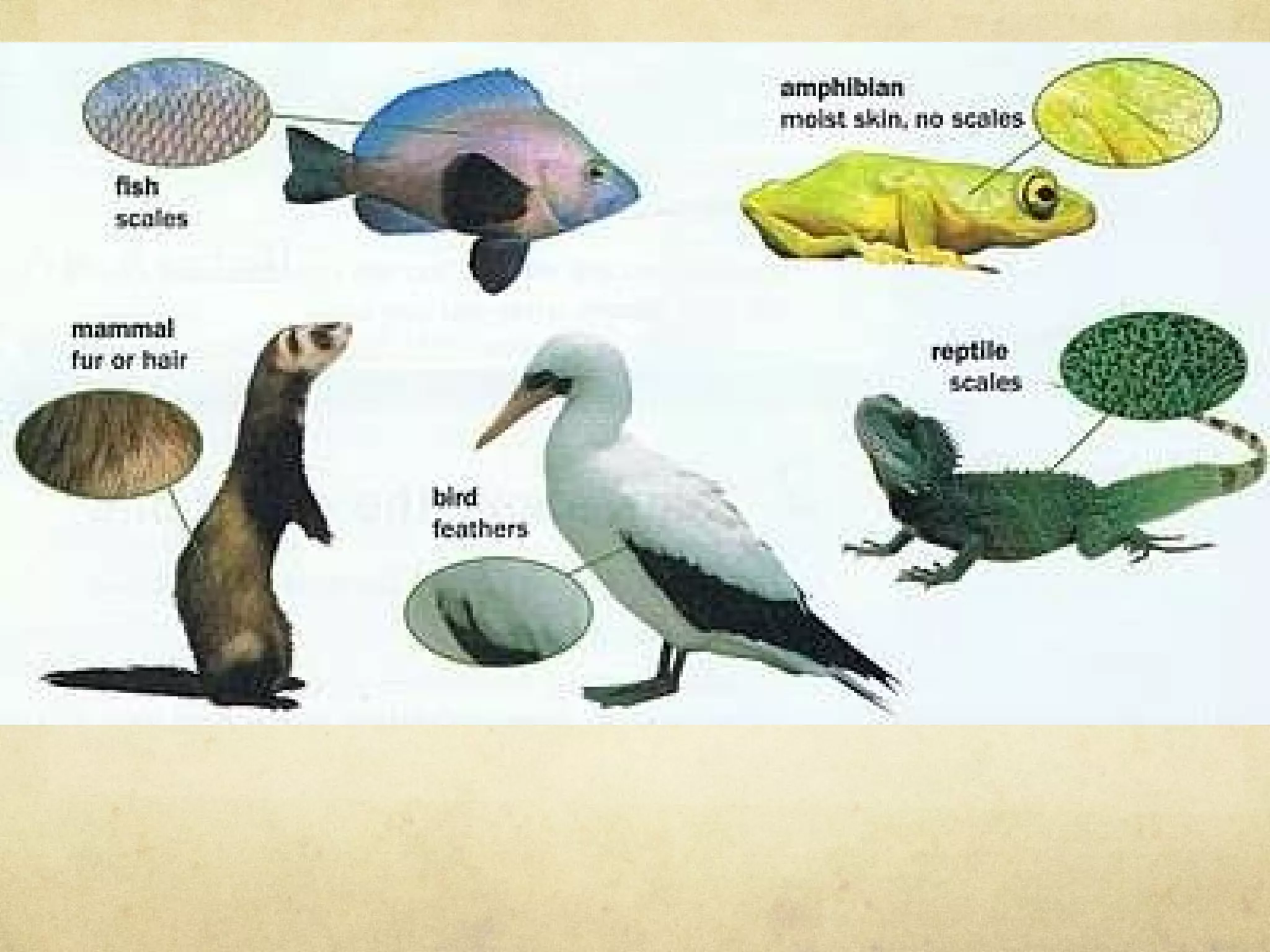
Reptiles, amphibians andfish REPTILES are vertebrate animals , they are oviparous , they have lungs to breath and they have their bodies covered with scales . - Reptiles body is divided in : head , trunk , limbs(extremities) and tail . - Reptiles can move in many different ways: snakes don´t have limbs and they slither(slide) , marine turtles swim and lizards, walk . AMPHIBIANS are vertebrate and oviparous , and they have moist smooth skin . - Amphibians body is divided in: head , trunk and limbs . Some, like frogs, don´t have tail; others,like salamander, do have tail. When young amphibians are young they are very different from their parents, they change a lot. These changes are called metamorphosis . FISH are vertebrate , oviparous , they breath with gills and their body is covered with scales . - Fish body is divided in: head , trunk , tail and some fins to swim. - They can breath under water using gills to take the oxygen disolved. - Reptiles usually lay eggs , and they are cold blooded . They live in water and land , they breath with gills and lungs. They are cold-blooded. - They are cold-blooded. They lay many eggs.
13.
14.
15.
16.
Some questions…. Circlewhich of them have gills… Mammals Reptiles Amphibians Fish Birds What are gills? Ennumerate the vertebrates that have scales. What is metamorphosis? Complete: (fin, gill, lung, scales, eggs) Reptiles and fish have their skin covered with_______. Young amphibians and fish use______ to breath. Reptiles, fish, amphibians and birds lay______. Mammals, birds and amphibians have______ to breath. Marine mammals and fish have _____ to help them to swim.










![Typesofanimals 100430110153-phpapp02[1]](https://cdn.slidesharecdn.com/ss_thumbnails/typesofanimals-100430110153-phpapp021-120307134929-phpapp01-thumbnail.jpg?width=640&height=640&fit=bounds)


