
Presented by: ALI HASSAN
Department of Library & Information Science
University of Sargodha
 Definition
Collection, Library Collection, Development, Library
Collection Development, Collection Management
 Historical Background
 Function of Collection Development
 Types of Collection Development
 Process of Collection Development
 Process of Traditional Collection Development
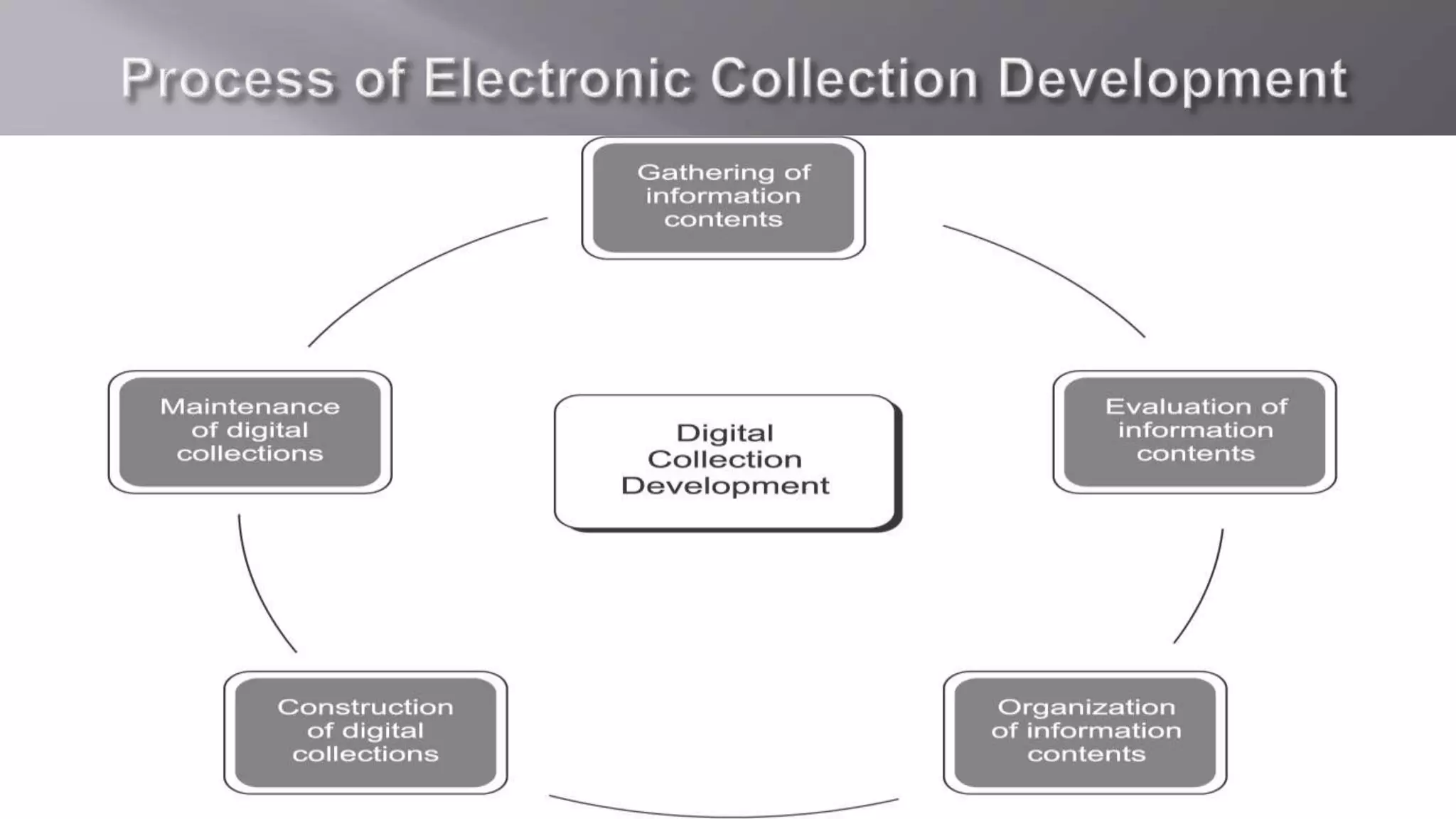
 Process of Electronic Collection Development
 Components of Collection Development
I. Over view of Collection Development
II. Collection Development Polices
III. Community Needs Assessment
IV. Selection of Library resources
V. Donations
VI. Weeding
VII. Collection Assessment
VIII. Acquisition
 Responsibilities of Collection Development Librarian
I. Selecting
II. Budgeting
III. Planning and Organizing
IV. Communication and Reporting
Conclusion
 The action or process of collecting someone or something for
specific purpose
 Something that is collected; a group of objects or an amount
of material accumulated in one location, especially for some
purpose or as a result of some process.
 Several things that are collected or considered as a group or
whole
 Multiple related objects associated as a group
 The act of gathering something together
 Selecting, gathering and keeping of objects of subjective
value.
 Examples:
our memory, stamp collection, coin collection, art
collection, book collection, group of people, assembly, card
collection, etc
 The total accumulation of books and other materials owned
by a library, cataloged and arranged for ease of access, often
consisting of several smaller collection.
 Examples:
reference, circulation books, Periodicals, newspapers,
Academic thesis, dissertations,
conference proceedings, pamphlets, standards, trade
literature, paintings, maps, atlas, globes, photographs,
illustrations, audio-visual aids, computer disk, computer tapes
and DVD.
 The process in which someone or something grows or changes
and becomes more advanced.
 Development is a process that creates growth, progress, positive
change or the addition of physical, economic, environmental,
social and demographic components.
 As Collection Development is very important activity in
Library and Information Center
 Collection Development is a term representing the process
of systematically building library collection to serve study,
teaching, research and other needs of library users.
 Collection Development is the process of building or
improving a collection of library materials. It is a process
whereby each purchase, and each candidate for discard, is
carefully evaluated in terms of needs it meets and its place
in the Collection. It is an on-going process that changes as
the community changes.
In 1980 the term “Collection Management” was proposed as an umbrella
term . The primary goal of CM is ensuring the long-term safety and
sustainability of the collection. Collection Development is considered
as sub part of CM.CM includes,
Development of Collection
Managing and Organizing
Storage
Preservation
Care of Collection
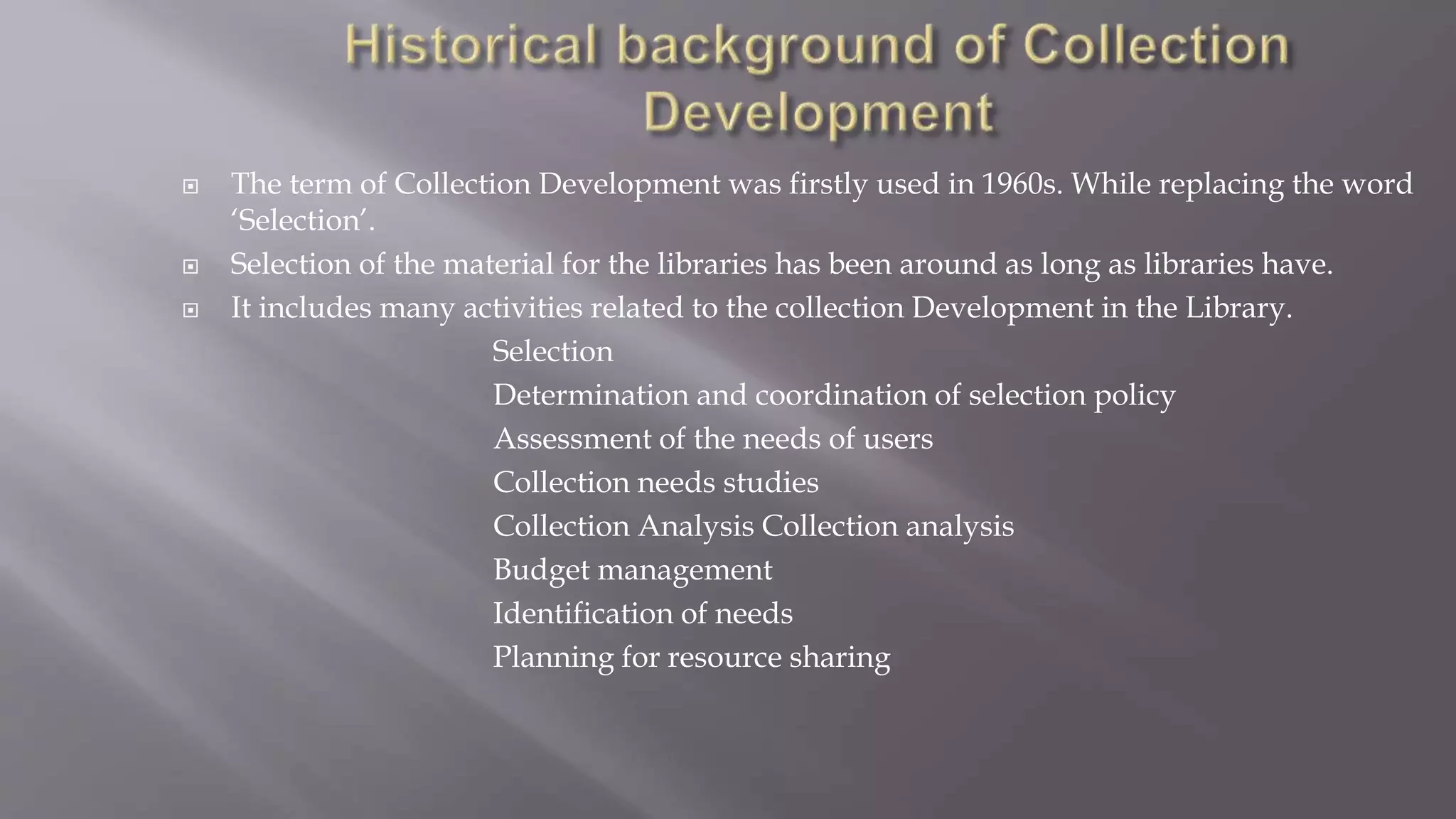
 The term of Collection Development was firstly used in 1960s. While replacing the word
‘Selection’.
 Selection of the material for the libraries has been around as long as libraries have.
 It includes many activities related to the collection Development in the Library.
Selection
Determination and coordination of selection policy
Assessment of the needs of users
Collection needs studies
Collection Analysis Collection analysis
Budget management
Identification of needs
Planning for resource sharing
Library
staff
Academic
staff
User’s Analysis
Selection Policies
Acquisition Policies
Resource Sharing
Weeding
Collection Evaluation
Collection
Development
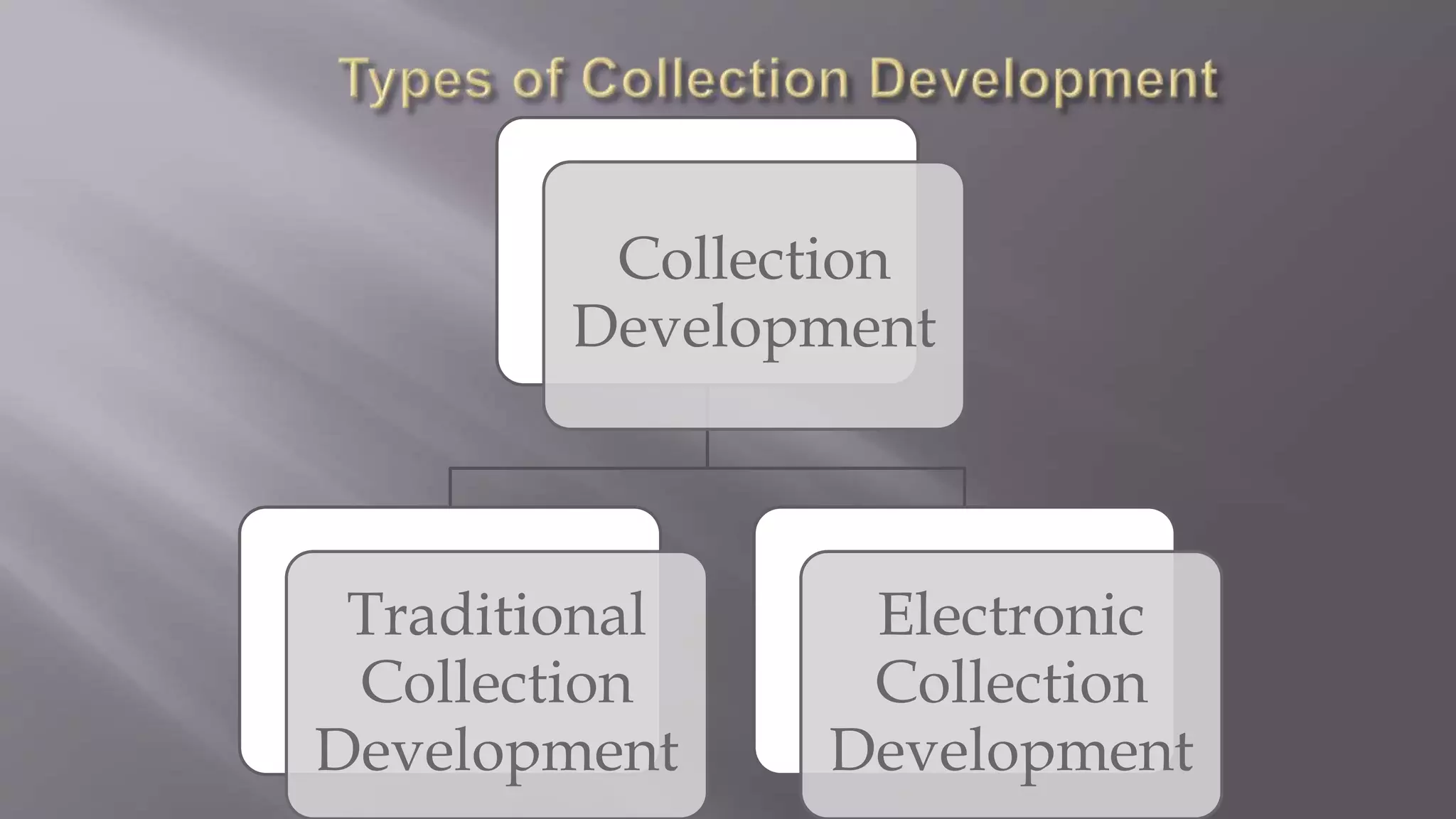
Traditional
Collection
Development
Electronic
Collection
Development
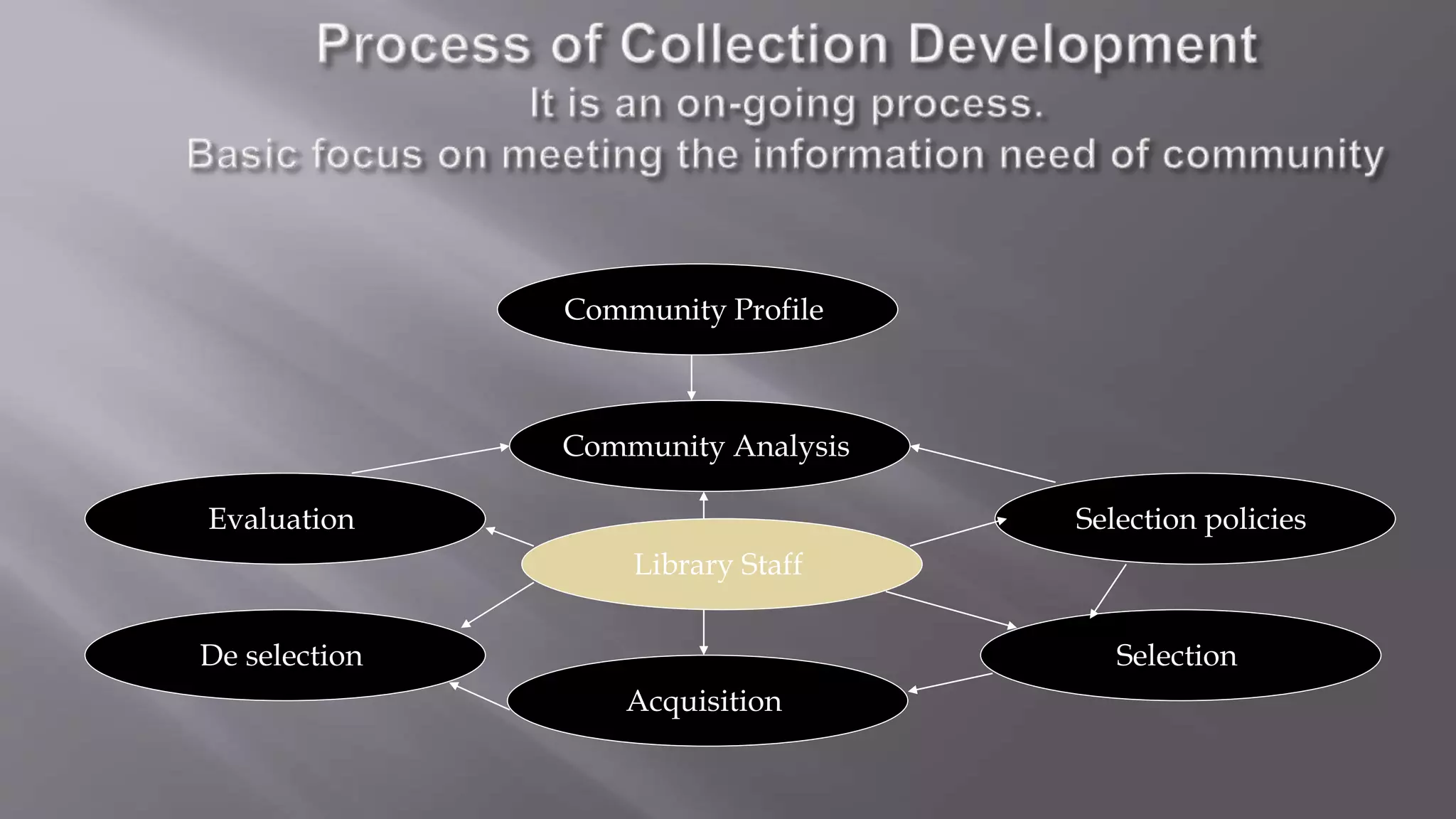
Community Profile
Community Analysis
Evaluation
De selection
Library Staff
Acquisition
Selection policies
Selection
Material Request
Bibliographic verification
from Database
If not availableIf not available
Inform to the patronBibliographic
information
Approval
Yes
No
Order
Receive Material
Check titles prices &
Condition of MaterialAccessioning
Send Bill/Voucher
Account Office
Receive Check
(Payment)
File in Record
 Overview of Collection Development
 Collection Development Policies
 Community Needs Assessment
 Selection of Library Resources
 Donations
 Weeding
 Collection Assessment
 Acquisition
 Basic Functions
These functions are performed by every library includes:
• Selection of library materials
• Weeding
• Donations
 Umbrella Functions
These functions serve to inform about the library collection
development policy itself includes:
• Collection Development Policy
• Community Needs Assessment
• Collection Assessment
 Policy
A set of ideas or a plan of what to do in particular situations that
has been agreed to officially by a group of people, a business
organization, a government, or a political party.
A course or principal of action adopted or proposed by an
organization or individual.
Standards or plans that are set for the Development of Collection in
a library.
 It identifies responsibilities for developing collection
 Provides point of reference for staff in Collection
Development work
 Save the time of staff
 Serves as source of reinforcement when challenged by a
patron
 Provide framework in which the collection can meet
community needs
 Identify the strengths and weakness of the collection
 Establish standards for a healthy collection
 Helps minimize personal bias by selectors and to highlight
imbalances in selection criteria
 Helps set standard for the selection and weeding of materials
 Serves an in-service training tool for new staff
 Provides a means of staff self-evaluation by outsiders
 Provides Information to assist in budget allocations
 To determine how well the collection meets the
needs of community
 To identify the types of resources and services that
your library can provide in future
Performing a Needs Assessment
• Who will conduct the study?
• What kind of information will be collected?
• How will the information be collected?
• How will the information be used?
 Selection of Books (general, text, reference)
 What is Book?
Evaluation Criteria for Book Selection
Based on factors such as authority, currency, scope, interest, organization ,
format, special features, cost, accuracy.
 Selection Tools
• Book Reviews
• Subject Lists
• Publisher Sources
• Online Bookstores
• Directory of books
• National Bibliographies
 What is Periodical?
Such publications published at regular interval
 Selection Criteria
Purpose, scope, audience, Accuracy, Local Interest, Format
issues, Indexing, Cost, Demand, Availability
Selection Tools:
Directories of periodicals and newspapers
Publisher catalogues
Periodicals list
 Audiovisual Materials
Audio medium: audio cassettes, audio books, CDs (a.i.o.u)
Video medium: video cassettes, VCDs & DVDs,
 Selection Criteria
Involve primary users in the selection
Budget allocated
Durability
Visual and Audio quality
 Selection Criteria
Content Consideration
Access Consideration
Technical Support Considerations
Cost considerations
 Selection Tools
Visit or talk to librarians who have the resource in their library
online databases
 Criteria
Conditions for accepting gifts
Possible uses of donations
Apply same objective selection criteria as purchasing new books
Library reserves the right to accept, reject, sell or otherwise dispose of
donated materials
Gift to encourage
Others ways to involve the public
 Types of materials
Local / Historical materials
Problematic materials
 What is weeding
Wedding is a process to remove resources from a library that are
no longer useful for users based on selected criteria.
 Why weeding is necessary? (importance)
A weeding policy will provide guidelines to library staff in making
decision to retain or remove items from the collection.
Make the collection up-to-date and most relevant
Remove out dated materials , making space for new material,
making the collection more visually attractive and inviting to users.
Time saving of users.
 How Collection are measured?
Quantitative & Qualitative
 Assessment Techniques
 Direct examination of Collection
 Examination of shelf-list data
 Evaluation by an outside expert
 After the consideration of assessment and evaluation of
collection a librarian take decision for purchasing, selecting
and rejecting materials.
 After the selection of materials acquisition department refers
to the process of ordering and acquiring library collection,
that is close to the collection development.
 Methods that are used to acquire the library material
o Firm orders
o Standing Orders
o Approvals Plans
o Blanket Orders
o Subscriptions
o Leases
o Gifts
o Exchange
o Interlibrary loan
 Selecting
 Budgeting
 Planning and organizing
 Communication and Reporting
Selecting:
Choosing current materials in one or more for acquisition and access.
Selecting access methods for Digital Resources
Choosing which gift material to be accepted
Selecting materials to withdraw, store, preserve, digitize and cancel
Requesting and justifying budget allocations
Manage Budget
Working with donors ( Cash & Gifts)
Grant proposal writing and grant management
Planning and Organizing:
Coordinating collection development and management activities with others
within library.
Monitoring and reviewing proposal plans
Evaluating, accessing collection & related services
Writing and revising CD polices
Serving an internal and external committees dealing with collection
issues
Promoting, marketing and interpreting collections and resources
Acting as Liaison with other libraries and librarians
Collection Development (that based on the five laws of
S.R.Ranghanathan) is very important part of Collection
Management. If we don’t adopt advanced technologies,
collection then we can never fulfill the need of advanced
users and libraries will become freeze, this is against the 5th
law of Ranghanathan that “ Library is a growing organism”.
Collection development

Collection development

  • 1.
    Presented by: ALIHASSAN Department of Library & Information Science University of Sargodha
  • 2.
     Definition Collection, LibraryCollection, Development, Library Collection Development, Collection Management  Historical Background  Function of Collection Development  Types of Collection Development  Process of Collection Development  Process of Traditional Collection Development  Process of Electronic Collection Development
  • 3.
     Components ofCollection Development I. Over view of Collection Development II. Collection Development Polices III. Community Needs Assessment IV. Selection of Library resources V. Donations VI. Weeding VII. Collection Assessment VIII. Acquisition
  • 4.
     Responsibilities ofCollection Development Librarian I. Selecting II. Budgeting III. Planning and Organizing IV. Communication and Reporting Conclusion
  • 5.
     The actionor process of collecting someone or something for specific purpose  Something that is collected; a group of objects or an amount of material accumulated in one location, especially for some purpose or as a result of some process.  Several things that are collected or considered as a group or whole  Multiple related objects associated as a group  The act of gathering something together  Selecting, gathering and keeping of objects of subjective value.  Examples: our memory, stamp collection, coin collection, art collection, book collection, group of people, assembly, card collection, etc
  • 6.
     The totalaccumulation of books and other materials owned by a library, cataloged and arranged for ease of access, often consisting of several smaller collection.  Examples: reference, circulation books, Periodicals, newspapers, Academic thesis, dissertations, conference proceedings, pamphlets, standards, trade literature, paintings, maps, atlas, globes, photographs, illustrations, audio-visual aids, computer disk, computer tapes and DVD.
  • 7.
     The processin which someone or something grows or changes and becomes more advanced.  Development is a process that creates growth, progress, positive change or the addition of physical, economic, environmental, social and demographic components.
  • 8.
     As CollectionDevelopment is very important activity in Library and Information Center  Collection Development is a term representing the process of systematically building library collection to serve study, teaching, research and other needs of library users.  Collection Development is the process of building or improving a collection of library materials. It is a process whereby each purchase, and each candidate for discard, is carefully evaluated in terms of needs it meets and its place in the Collection. It is an on-going process that changes as the community changes.
  • 9.
    In 1980 theterm “Collection Management” was proposed as an umbrella term . The primary goal of CM is ensuring the long-term safety and sustainability of the collection. Collection Development is considered as sub part of CM.CM includes, Development of Collection Managing and Organizing Storage Preservation Care of Collection
  • 10.
     The termof Collection Development was firstly used in 1960s. While replacing the word ‘Selection’.  Selection of the material for the libraries has been around as long as libraries have.  It includes many activities related to the collection Development in the Library. Selection Determination and coordination of selection policy Assessment of the needs of users Collection needs studies Collection Analysis Collection analysis Budget management Identification of needs Planning for resource sharing
  • 11.
    Library staff Academic staff User’s Analysis Selection Policies AcquisitionPolicies Resource Sharing Weeding Collection Evaluation
  • 12.
  • 13.
    Community Profile Community Analysis Evaluation Deselection Library Staff Acquisition Selection policies Selection
  • 14.
    Material Request Bibliographic verification fromDatabase If not availableIf not available Inform to the patronBibliographic information Approval Yes No Order Receive Material Check titles prices & Condition of MaterialAccessioning Send Bill/Voucher Account Office Receive Check (Payment) File in Record
  • 16.
     Overview ofCollection Development  Collection Development Policies  Community Needs Assessment  Selection of Library Resources  Donations  Weeding  Collection Assessment  Acquisition
  • 17.
     Basic Functions Thesefunctions are performed by every library includes: • Selection of library materials • Weeding • Donations  Umbrella Functions These functions serve to inform about the library collection development policy itself includes: • Collection Development Policy • Community Needs Assessment • Collection Assessment
  • 18.
     Policy A setof ideas or a plan of what to do in particular situations that has been agreed to officially by a group of people, a business organization, a government, or a political party. A course or principal of action adopted or proposed by an organization or individual. Standards or plans that are set for the Development of Collection in a library.
  • 19.
     It identifiesresponsibilities for developing collection  Provides point of reference for staff in Collection Development work  Save the time of staff  Serves as source of reinforcement when challenged by a patron  Provide framework in which the collection can meet community needs  Identify the strengths and weakness of the collection  Establish standards for a healthy collection  Helps minimize personal bias by selectors and to highlight imbalances in selection criteria
  • 20.
     Helps setstandard for the selection and weeding of materials  Serves an in-service training tool for new staff  Provides a means of staff self-evaluation by outsiders  Provides Information to assist in budget allocations
  • 21.
     To determinehow well the collection meets the needs of community  To identify the types of resources and services that your library can provide in future Performing a Needs Assessment • Who will conduct the study? • What kind of information will be collected? • How will the information be collected? • How will the information be used?
  • 22.
     Selection ofBooks (general, text, reference)  What is Book? Evaluation Criteria for Book Selection Based on factors such as authority, currency, scope, interest, organization , format, special features, cost, accuracy.  Selection Tools • Book Reviews • Subject Lists • Publisher Sources • Online Bookstores • Directory of books • National Bibliographies
  • 23.
     What isPeriodical? Such publications published at regular interval  Selection Criteria Purpose, scope, audience, Accuracy, Local Interest, Format issues, Indexing, Cost, Demand, Availability Selection Tools: Directories of periodicals and newspapers Publisher catalogues Periodicals list
  • 24.
     Audiovisual Materials Audiomedium: audio cassettes, audio books, CDs (a.i.o.u) Video medium: video cassettes, VCDs & DVDs,  Selection Criteria Involve primary users in the selection Budget allocated Durability Visual and Audio quality
  • 25.
     Selection Criteria ContentConsideration Access Consideration Technical Support Considerations Cost considerations  Selection Tools Visit or talk to librarians who have the resource in their library online databases
  • 26.
     Criteria Conditions foraccepting gifts Possible uses of donations Apply same objective selection criteria as purchasing new books Library reserves the right to accept, reject, sell or otherwise dispose of donated materials Gift to encourage Others ways to involve the public  Types of materials Local / Historical materials Problematic materials
  • 27.
     What isweeding Wedding is a process to remove resources from a library that are no longer useful for users based on selected criteria.  Why weeding is necessary? (importance) A weeding policy will provide guidelines to library staff in making decision to retain or remove items from the collection. Make the collection up-to-date and most relevant Remove out dated materials , making space for new material, making the collection more visually attractive and inviting to users. Time saving of users.
  • 28.
     How Collectionare measured? Quantitative & Qualitative  Assessment Techniques  Direct examination of Collection  Examination of shelf-list data  Evaluation by an outside expert
  • 29.
     After theconsideration of assessment and evaluation of collection a librarian take decision for purchasing, selecting and rejecting materials.  After the selection of materials acquisition department refers to the process of ordering and acquiring library collection, that is close to the collection development.
  • 30.
     Methods thatare used to acquire the library material o Firm orders o Standing Orders o Approvals Plans o Blanket Orders o Subscriptions o Leases o Gifts o Exchange o Interlibrary loan
  • 31.
     Selecting  Budgeting Planning and organizing  Communication and Reporting Selecting: Choosing current materials in one or more for acquisition and access. Selecting access methods for Digital Resources Choosing which gift material to be accepted Selecting materials to withdraw, store, preserve, digitize and cancel
  • 32.
    Requesting and justifyingbudget allocations Manage Budget Working with donors ( Cash & Gifts) Grant proposal writing and grant management Planning and Organizing: Coordinating collection development and management activities with others within library. Monitoring and reviewing proposal plans Evaluating, accessing collection & related services Writing and revising CD polices
  • 33.
    Serving an internaland external committees dealing with collection issues Promoting, marketing and interpreting collections and resources Acting as Liaison with other libraries and librarians
  • 34.
    Collection Development (thatbased on the five laws of S.R.Ranghanathan) is very important part of Collection Management. If we don’t adopt advanced technologies, collection then we can never fulfill the need of advanced users and libraries will become freeze, this is against the 5th law of Ranghanathan that “ Library is a growing organism”.