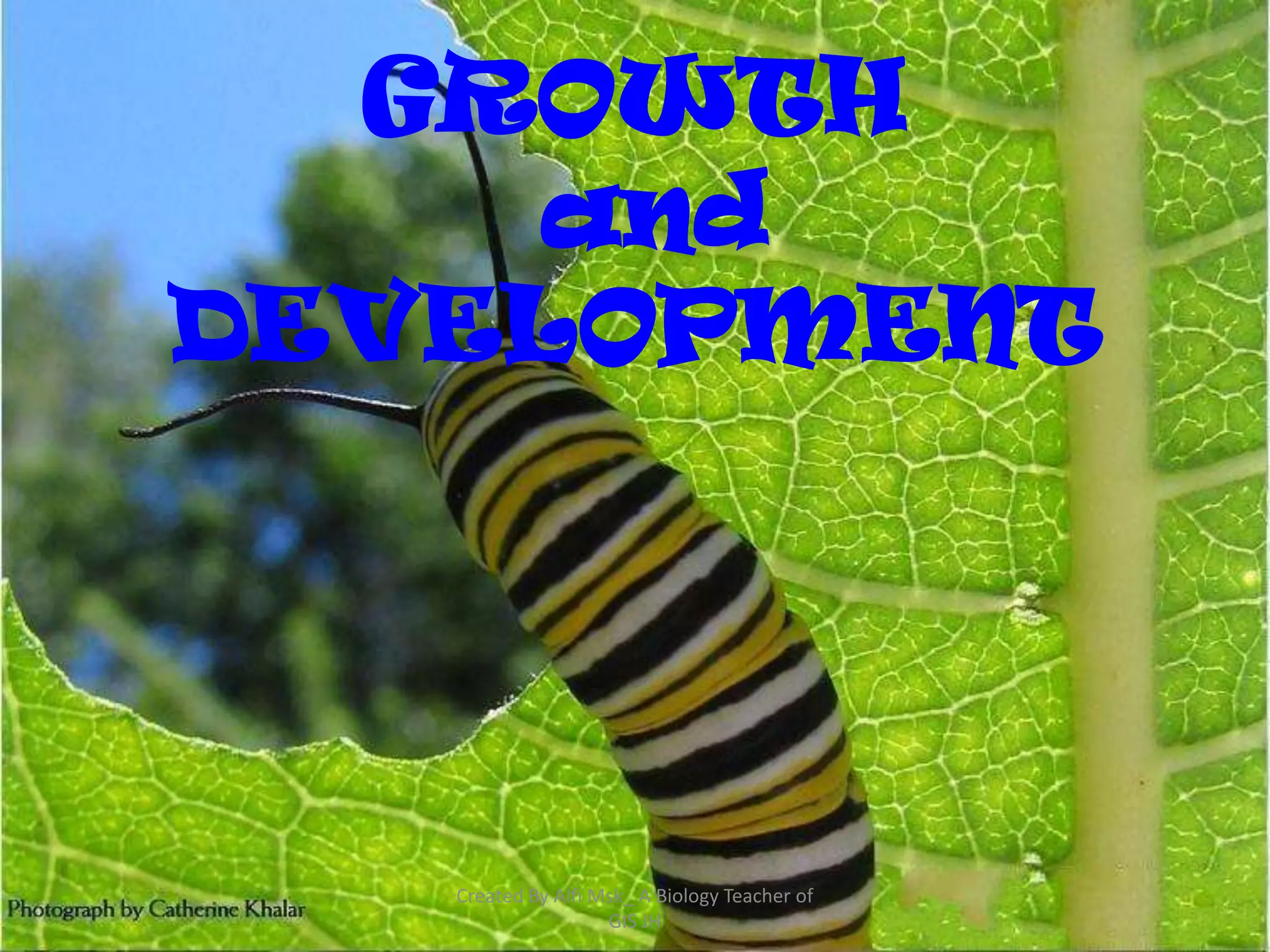
GROWTH
     and
DEVELOPMENT


   Created By Alfi Msk_ A Biology Teacher of
                    GIS JH
a. The Definition
• Growth constitutes an increase process in
  size including increases in height, and
  weight. Growth is quantitative and
  irreversible in nature

• Development is a process towards
  maturity. Development is qualitative in
  nature, meaning that it is immeasurable

              Created By Alfi Msk_ A Biology Teacher of
                               GIS JH
b. GROWTH and DEVELOPMENT in
            THE PLANTS
• Plant growth occurs because of the size increase
  which is caused by the increase in the number
  of cells through cell division (mitosis) in the
  growing points and enlargement in each cell

• Cell division mostly occurs in the meristem
  tissue, that mostly found in the root tip and
  stem tip which are called apical meristem

                 Created By Alfi Msk_ A Biology Teacher of
                                  GIS JH
• When the young plants grow, the root and
  the stem grow longer, this growth is called
  primary growth

• Some plants, such as wooden plants, have
  stems and roots which become thicker, this
  growth is called secondary growth

• To measure the speed growth of plants, we
  use the auxanometer
               Created By Alfi Msk_ A Biology Teacher of
                                GIS JH
• The development of seed plants which reproduce
  through the generative method starts with a zygote

• The zygote grows into embryo then become an
  individual which posseses roots, stems, and leaves.

• After reaching a certain age, the plants will produce
  flowers and seeds

• The changes of shape and function from one zygote
  until the plant is forming root, stem and leaf organ is
  called the development process of plants

                    Created By Alfi Msk_ A Biology Teacher of
                                     GIS JH
Factors Which Affect Plants Growth
           And Development
• Internal Factors
  a. Genes
     - the size and shape of plants are affected by
     the genes inside the chromosomes
     - Chromosomes are found in the nucleus
     - Genes are derived from the parents
     - Genes control the growth pattern of the
     plants
                 Created By Alfi Msk_ A Biology Teacher of
                                  GIS JH
b. Hormones
  - A hormones is a chemical subtance which
  is produced by plants, are often called
  growth subtances

  - Its function is to control the growth
  process

  - the common growth hormones are auxin,
  cytokinin, and gibberellin

             Created By Alfi Msk_ A Biology Teacher of
                              GIS JH
1. Auxin
- Auxin is produced in the stem tip (bud), young leaves,
flowers, fruit, and root tip
- Auxin which found in the stem tip can inhibit the
growth of branches, this condition is called apical
dominance. Therefore the plants can grow tall and
straight.
- The effects of auxin are :
 to stimulate the lateral roots and fibrous roots growth
 to stimulate the growth of stem cells and inhibit the
growth of root cells
 to stimulate the forming of flowers and fruit
 to speed up the cell division in Teacher of
                      Created By Alfi Msk_ A Biology
                                                     growing points
                                GIS JH
2. Cytokinin

- Cytokinin is produced by plants in the root
  and then transported to the other organs
- The role of cytokinin are :
 influencing the growth of the root
 stimulating cell division
 retarding the aging of plant organs (leaf,
  flower, and fruit)
 controlling the forming of flowers and fruit
               Created By Alfi Msk_ A Biology Teacher of
                                GIS JH
3. Gibberellin
- Gibberellin is produced by the plants in the
  root meristem tissue, stem meristem, and
  young leaves
- The role of gibberellin are :
 stimulating the growth and development of
  embryos and sprouts
 causing massive growth in plants
Producing       big    and     seedless  fruit
  (parthenocarpy)
 stimulating the forming of flowers
               Created By Alfi Msk_ A Biology Teacher of
                                GIS JH
• External Factors
a. Water and Minerals
   - water and minerals are absorbed from the soil
   by the roots.

   - the minerals required by plants are carbon,
   oxygen,     hydrogen,      nitrogen,  sulphur,
   phosporus, calcium, potassium,            and
   magnesium. They are absorbed in form of ions
   that dissolved in the water.

   - water not only serves as a solvent but is also
   required for photosynthesis

                 Created By Alfi Msk_ A Biology Teacher of
                                  GIS JH
b. Temperatures
     - temperatures influences the work of enzymes

    - a temperatures which is too low or too high will disrupt the work of
    enzymes, so it will inhibit plant growth and development

    - Every plant has the minimun, optimum, and maximum temperature to
    grow

    - the lowest temperature that still enables plants to grow and develop is
    called the minimum temperature

    - the most suitable temperature for plant growth and development is called
    the optimum temperature

    - the highest temperature that still enables the plants to grow and develop is
    called the maximum temperature
                            Created By Alfi Msk_ A Biology Teacher of
                                             GIS JH
c. Humidity
   - an environment with low humidity will
   increase the evaporation (transpiration) of
   plant so that the water and mineral
   absorption from the soil will become more
   frequent, this will increase the speed of
   plant growth


               Created By Alfi Msk_ A Biology Teacher of
                                GIS JH
d. Light Intensity
  - sunlight is highly required by plants for
  photosynthesis, this process produces food that
  is required for growth

  - the light can also influence auxin hormone, it
  will break down if it is exposed to sunlight

  - for example, a sprout that is exposed to light
  will slowly grow, while the sprout which put in a
  dark place will grow faster

  - the faster growth in darkness is called
  etiolation
                 Created By Alfi Msk_ A Biology Teacher of
                                  GIS JH
c. GROWTH and DEVELOPMENT in
            ANIMALS and HUMANS
• Growth and development in animals and humans occurs in all
  parts of the body, different from those of plants which only
  occur in certain parts.

• Growth and development in animals and humans begin at the
  formation of the zygote

• One zygote will grow and develop until an embryo is formed

• In that particular stage, the embryo cells will differentiate to
  form various tissues and develop into fetus

• The fetus will be born as a baby which then grow and develop
  into a toddler, adolescent, and then a adult
                       Created By Alfi Msk_ A Biology Teacher of
                                        GIS JH
2 phases in animals/humans’ growth
          and development
• Embryonic phase
      Is phase started with the establishing of
  zygote up to embryo.
      Fertilization is a process in which a fusion
  of the sperm and ovum gamete occurs.
• Post-embryonic phase
      Is phase after the embryo is formed. in
  animals, post embryonic is only a change in
  size, namely an increase in size of body parts.
                 Created By Alfi Msk_ A Biology Teacher of
                                  GIS JH
Factors that Affect Animals Growth
             and Development
a. Genes
   - a gene is a hereditary factor inherited by the parents

   - genes will determine and control the basic patterns of
   growth and development of an organism

b. Hormones
    - hormones are secreted by endocrine glands

   - the hormone which has the main role in human or animal
   growth is the growth hormone (GH/Somatotropin)

   - people who are lacking somatotropin will undergo stunted
   growth, while those with an excessive amount of
   somatotropin will undergo GIS A Biology Teacher of
                     Created By Alfi Msk_
                                       gigantic growth
                                          JH
c. Food
   - one of characteristics of living organism is the need for
   food

   - the most important roles of food is to construct the
   body and as a source of energy.

   - the food subtance which has the biggest role in growth
   is protein

d. Water
   - water is a solvent and a media for chemical reactions in
   the body

   - the chemical reactions will produce energy, help the
   forming of new cells, and repair damaged body tissues
                     Created By Alfi Msk_ A Biology Teacher of
                                      GIS JH
e. Activity
   - physical activity which is done for years will affect the
   structures of bones and muscles

   - for example, body builders or runners, they possess
   good body posture and muscles.

   - people who do less physical activity wil possess weaker
   muscles and they will not properly develop.

f. Sunlight
   - sunlight can alter provitamin D in the body into
   vitamin D which is needed in the growth of bone

   - lack of vitamin DCreated By Alfi Msk_ A Biology Teacher of can cause rickets
                        during childhood
                                        GIS JH
d. THE STAGE of HUMAN GROWTH
• Human growth and develoment begin from a very small ovum
  cell

• The ovum is fertilized by sperm and the two nuclei will then
  fuse to form a zygote

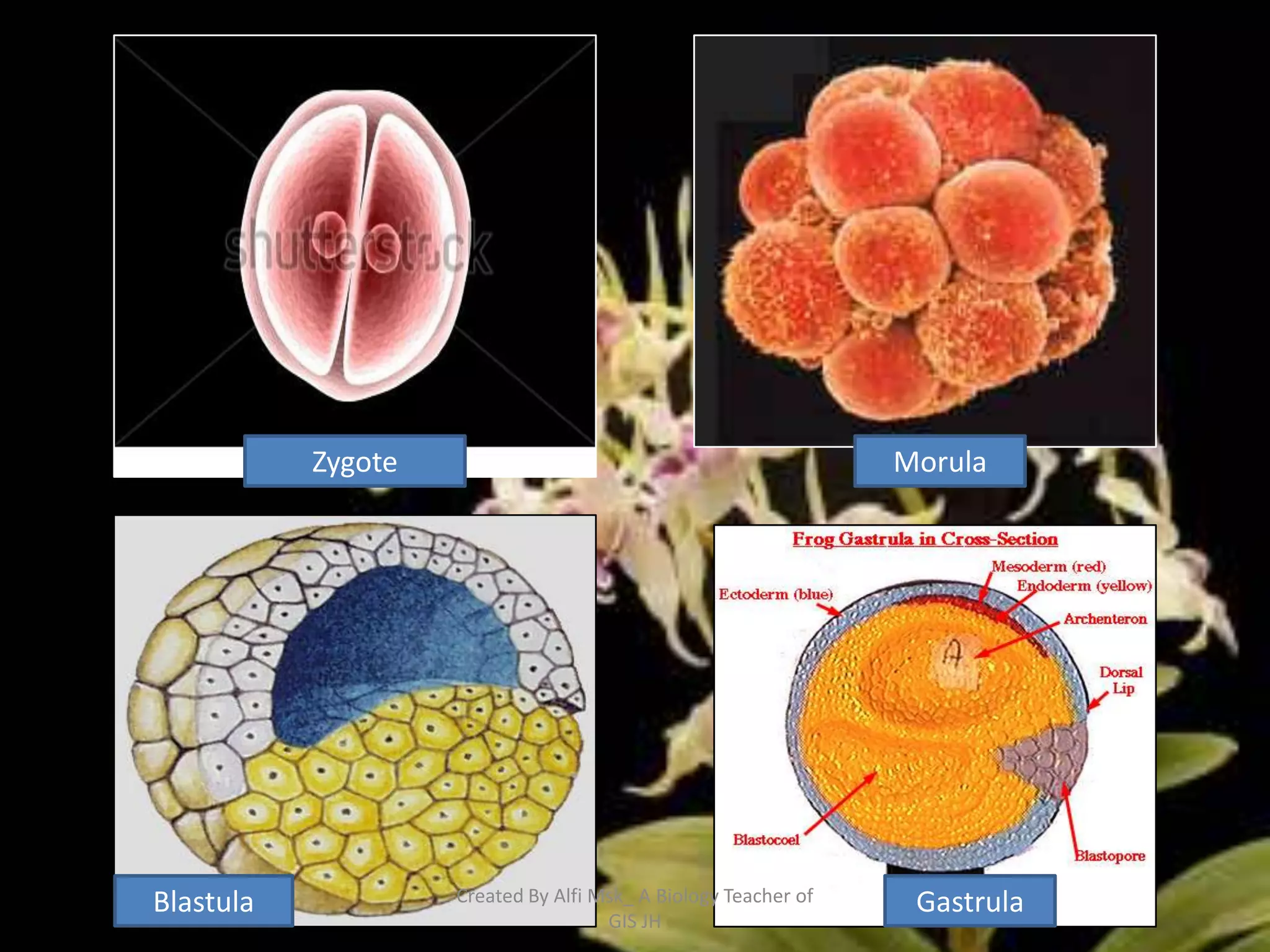
• A zygote will cleavage and become morulla

• A morulla is developed become blastula through blastulation

• A blastula is developed become gastrula through gastrulation

• A gastrula has 3 embrionic layer : ectoderm, mesoderm, and
  endoderm
                      Created By Alfi Msk_ A Biology Teacher of
                                       GIS JH
• Ectoderm will diffrentiate become skin,
  hair, nervous system, and sense organ

• Mesoderm will differentiate become
  muscles, skeleton, reproductive organ,
  transportation system, and excretion
  system

• Endoderm will differentiate become
  digestive system, and respiratory system
              Created By Alfi Msk_ A Biology Teacher of
                               GIS JH
Zygote                                               Morula


Blastula            Created By Alfi Msk_ A Biology Teacher of    Gastrula
                                     GIS JH
1. Baby Birth
• After about 9 months of growing and developing inside the uterus, the
  baby is ready to be born

• The baby, which has come out of the uterus is still connected to her
  mother by umbilical cord and the placenta

• The umbilical cord and the placenta are then cut by the doctor or the
  midwife

• At this stage, the physical connection between the mother and the
  baby is broken, so that the baby can no longer obtain food and oxygen
  from the mother

• When the umbilical cord and the placenta are cut, the breathing organs
  will soon function, so that the baby can inhale the air, and usually it is
  marked by the first cry

• The cry is also a sign that the baby is able to pump the respiratory air
  from the lungs to the heart By Alfi Msk_ A Biology Teacher of
                           Created
                                       GIS JH
2. THE TODDLER and CHILDREN
• The neonatal period is the first day of a
  baby’s life until the age of four weeks

• In this period, the baby is able to adapt to life
  outside the uterus, can start suckling at its
  mother’s breast, and organs like lungs, heart,
  and also excretion organs are already well
  functioning


                 Created By Alfi Msk_ A Biology Teacher of
                                  GIS JH
3. PUBERTY
• Puberty begins at about age 9 to 14, this
  is the stage you are going through now

• Girls’ puberty characteristics are shown
  in some physical changes ;
  - the developing of hip and breasts
  - the appearance of pubic hair
  - the developing of reproductive organs,
  is marked by the first menstruation
  (menarche)   Created By Alfi Msk_ A Biology Teacher of
                                GIS JH
• boys’ puberty characteristics are shown
  in some physical changes ;
  - the chest looks wider
  - facial hair and pubic hair appears
  - the voice change
  - the deloping of reproductive organs, is
  marked by the wet dream


              Created By Alfi Msk_ A Biology Teacher of
                               GIS JH
4. ADULT STAGE
• In this stage, the growth of bones and
  muscles begin to stop so adults cannot
  grow taller

• Human psychological condition becomes
  more stable than during adolescence

• People start to think about getting married
  and producing offspring
               Created By Alfi Msk_ A Biology Teacher of
                                GIS JH
5. OLD AGE
• The cell ability starts degenerating, this
  causes some physical changes

• Like weaker bones, degenerating ability to
  breath, degenerating elasticity of veins,
  and also causes skin to wrinkle

• But sufficient nutrients and regular
  exercise can inhibit aging
               Created By Alfi Msk_ A Biology Teacher of
                                GIS JH
e. METAGENESIS and
 METAMORPHOSIS


   Created By Alfi Msk_ A Biology Teacher of
                    GIS JH
METAGENESIS
• Moss and         ferns experience two
  development stage in hteir life span, the
  spore producing stage (sporophyte
  generation, asexual) and the gamete
  producing stage (gametophyte generation,
  sexual)

• The alternation from sporophye to
  gametophyte or vice-versa is called
  metagenesis  Created By Alfi Msk_ A Biology Teacher of
                                GIS JH
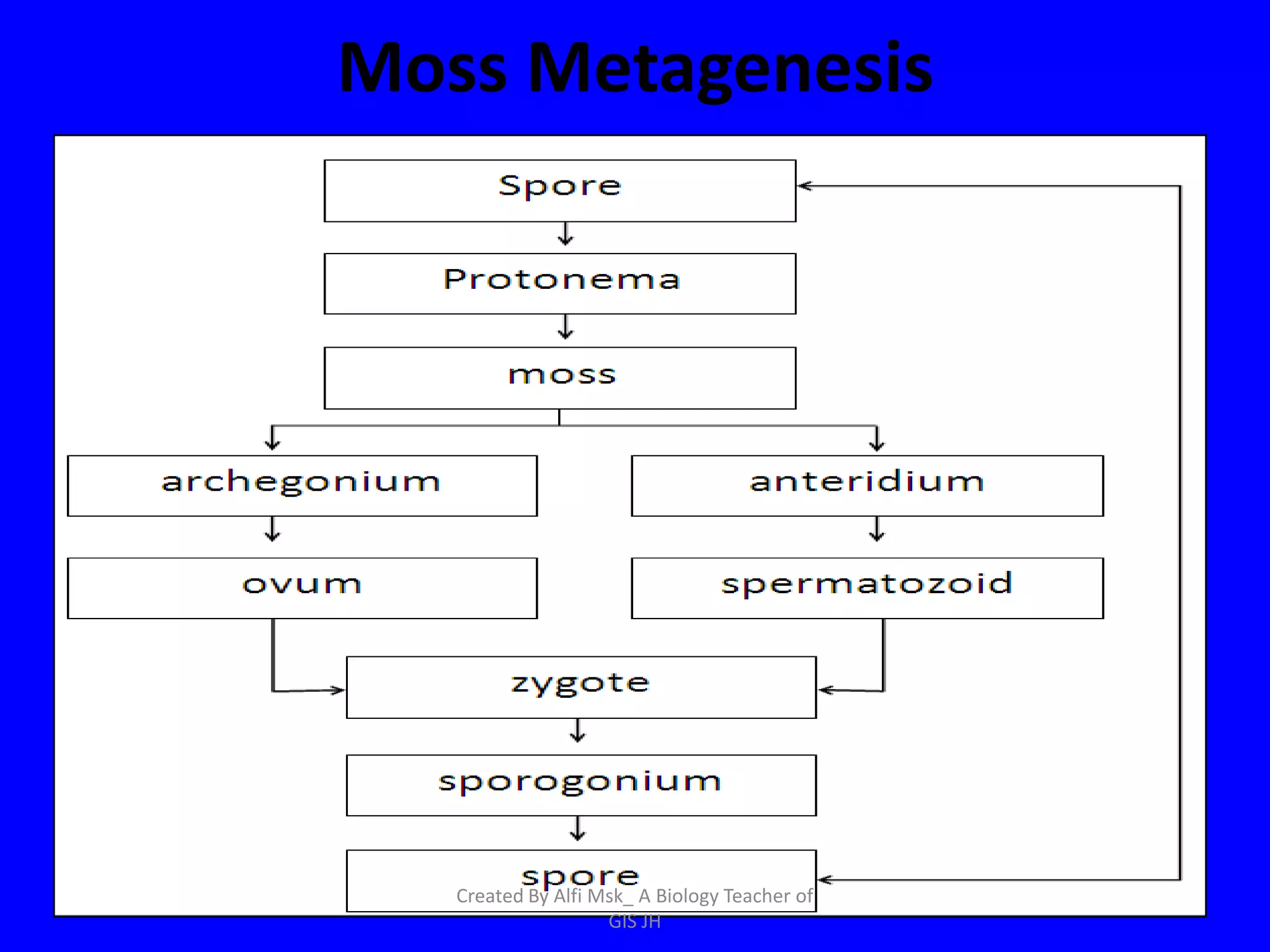
Moss Metagenesis


   Created By Alfi Msk_ A Biology Teacher of
                    GIS JH
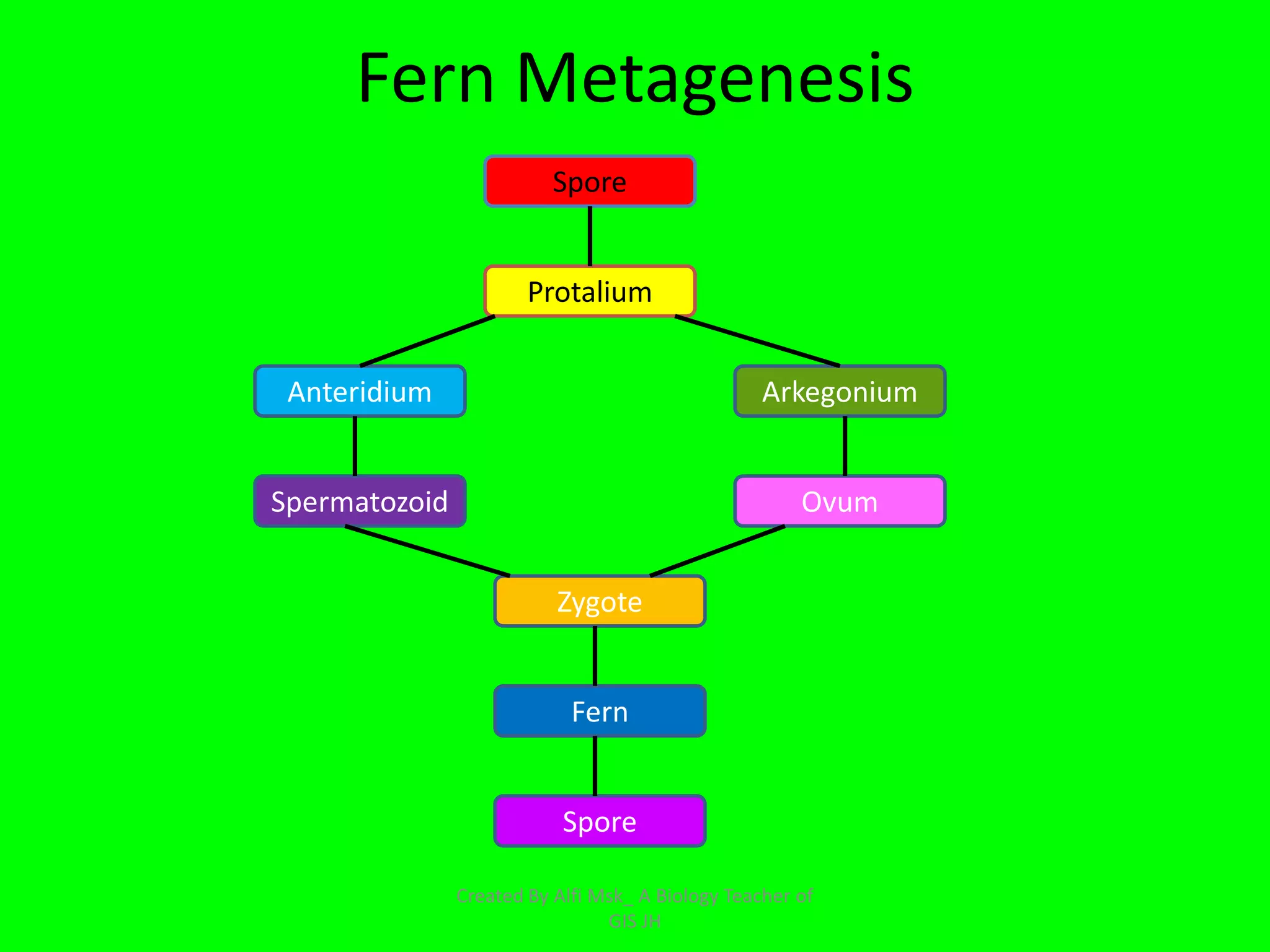
Fern Metagenesis
                          Spore


                       Protalium


 Anteridium                                       Arkegonium


Spermatozoid                                          Ovum


                          Zygote


                            Fern


                           Spore

               Created By Alfi Msk_ A Biology Teacher of
                                GIS JH
Metamorphosis
• Is the shape and structural alternation
  which occurs in animals, starting from the
  embryo stage to adult

• Animal which undergo metamorphosis
  are insects and frogs

• Metamorphosis is differentiated into two
  types ; the complete metamorphosis and
  the incomplete metamorphosis
               Created By Alfi Msk_ A Biology Teacher of
                                GIS JH
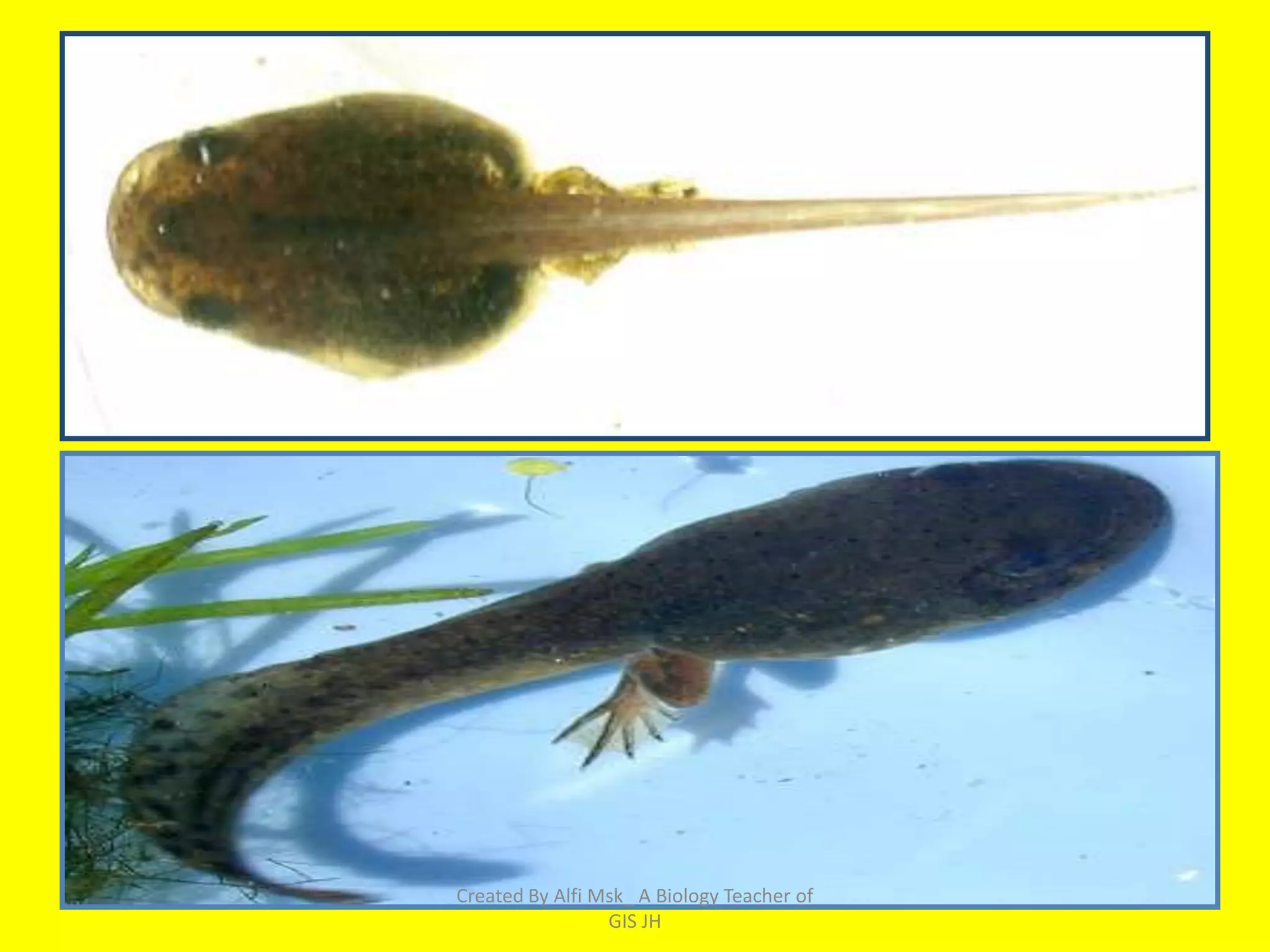
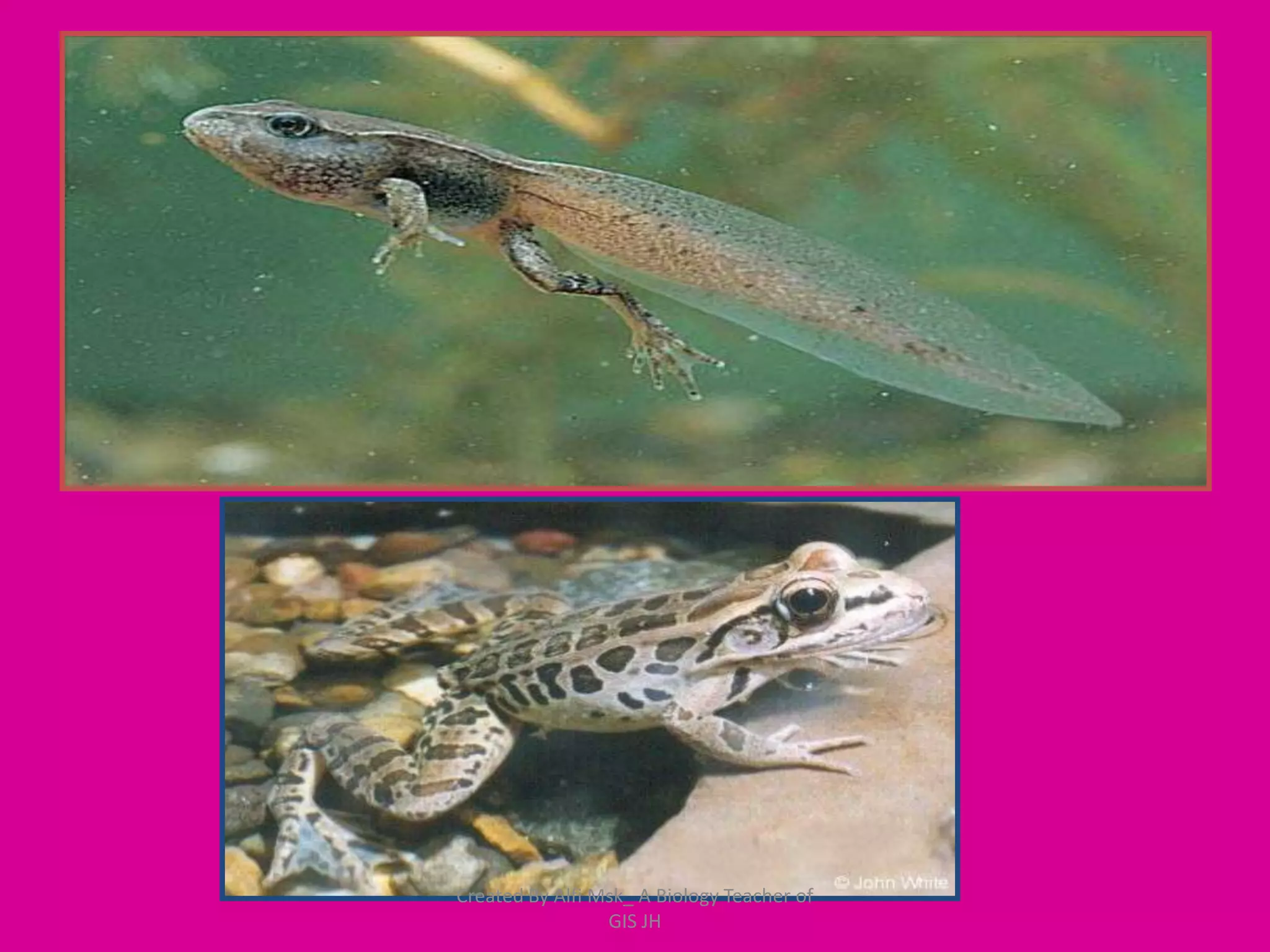
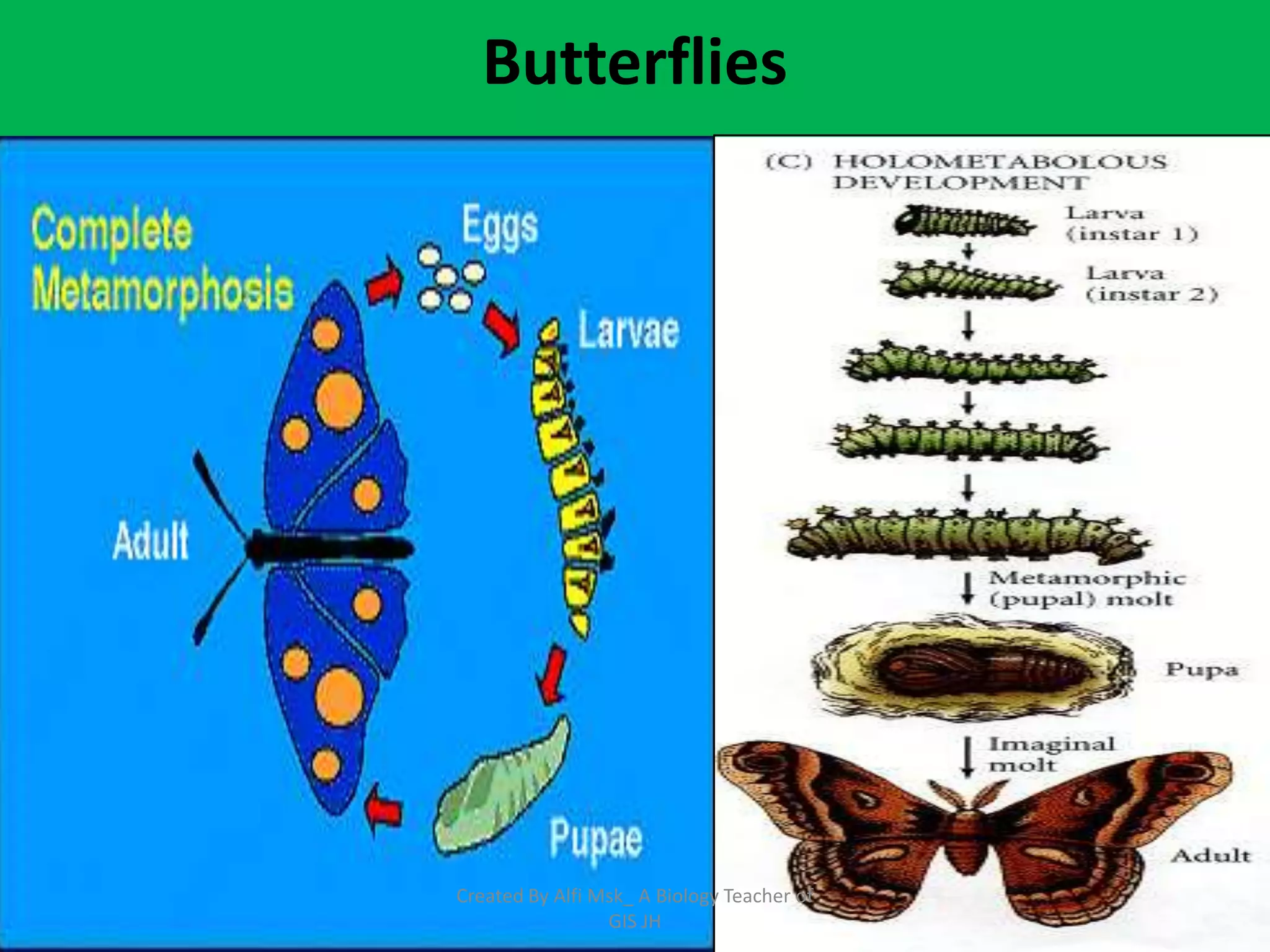
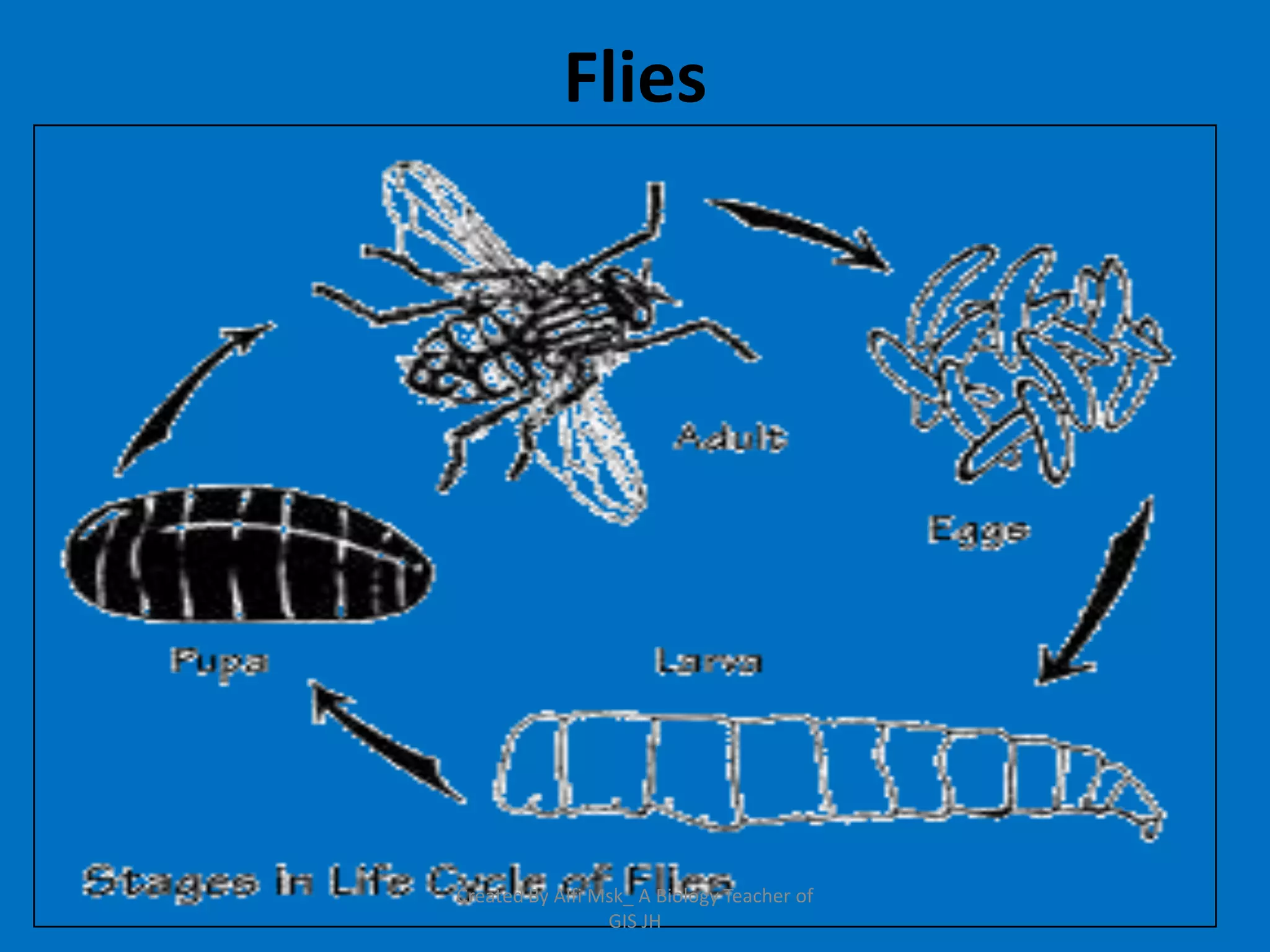
Complete metamorphosis
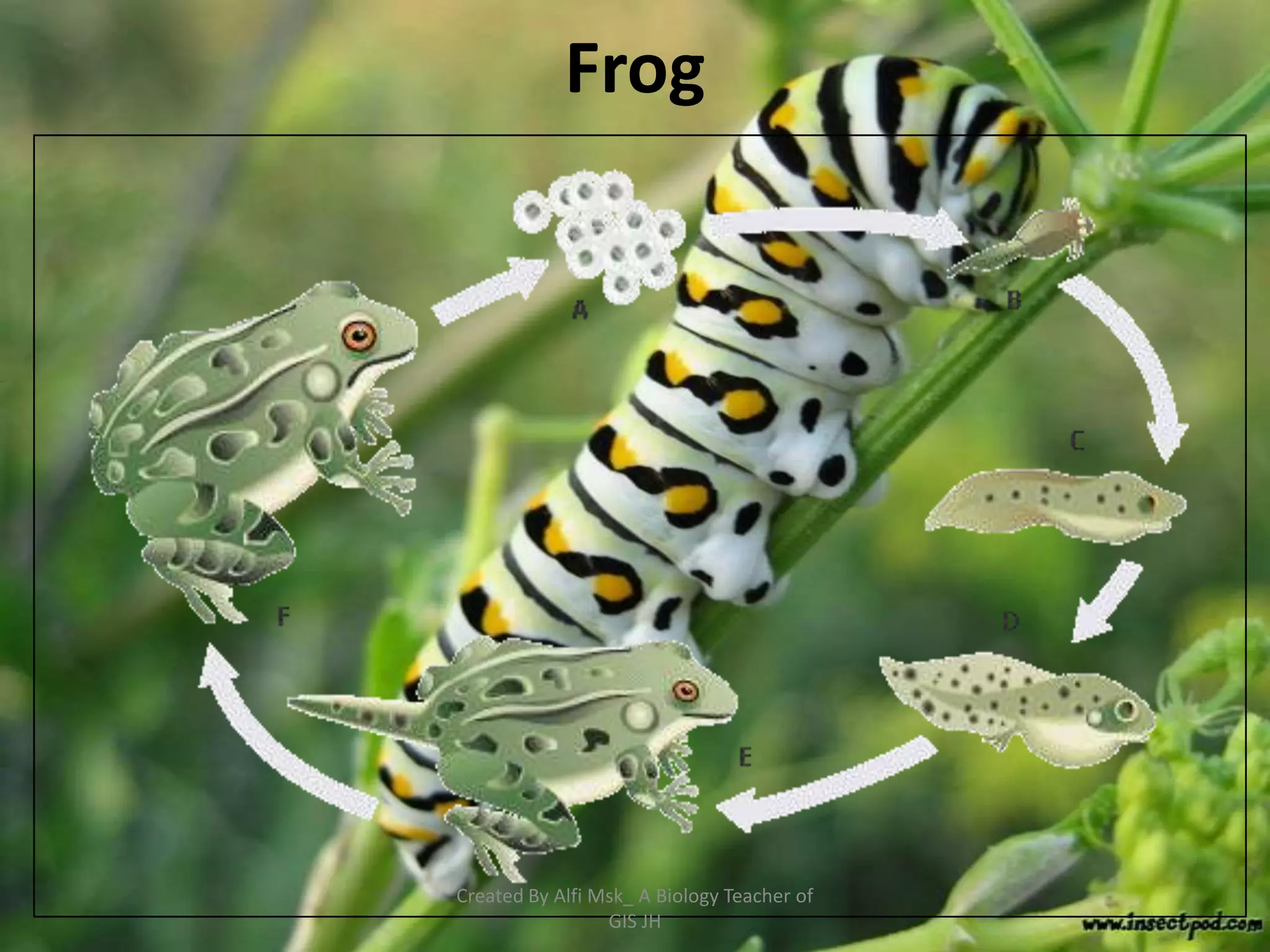
• The metamorphosis which passes the
  stages egg, larva, pupa, and adult (imago)

• In metamorphosis, the increase of body
  size is a growth process, while the change
  of the body shape from egg to adult is
  development process

• For example, butterflies and frogs
                Created By Alfi Msk_ A Biology Teacher of
                                 GIS JH
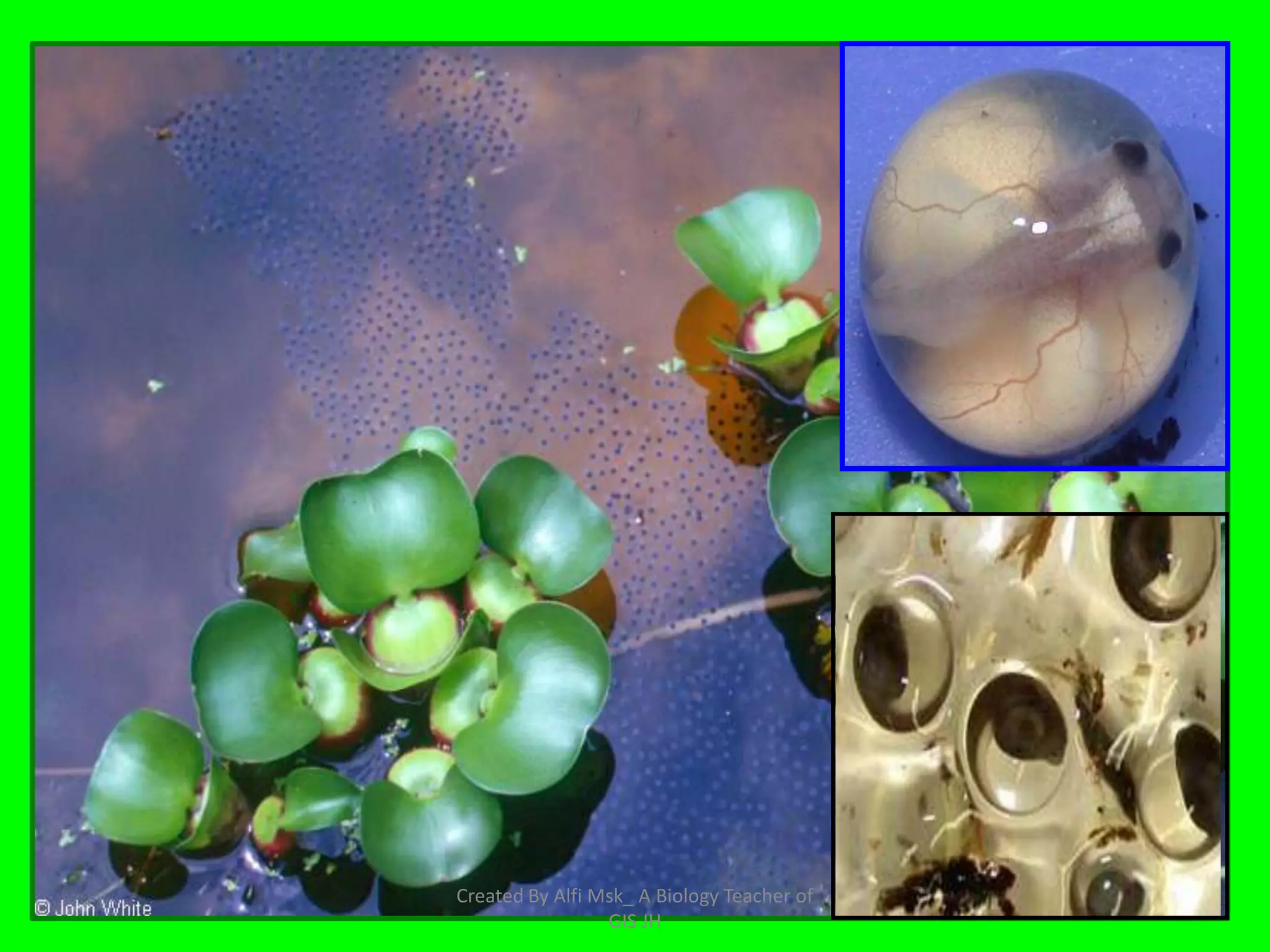
Frog


Created By Alfi Msk_ A Biology Teacher of
                 GIS JH
Created By Alfi Msk_ A Biology Teacher of
                 GIS JH
Created By Alfi Msk_ A Biology Teacher of
                 GIS JH
Created By Alfi Msk_ A Biology Teacher of
                 GIS JH
Butterflies


Created By Alfi Msk_ A Biology Teacher of
                 GIS JH
Flies


Created By Alfi Msk_ A Biology Teacher of
                 GIS JH
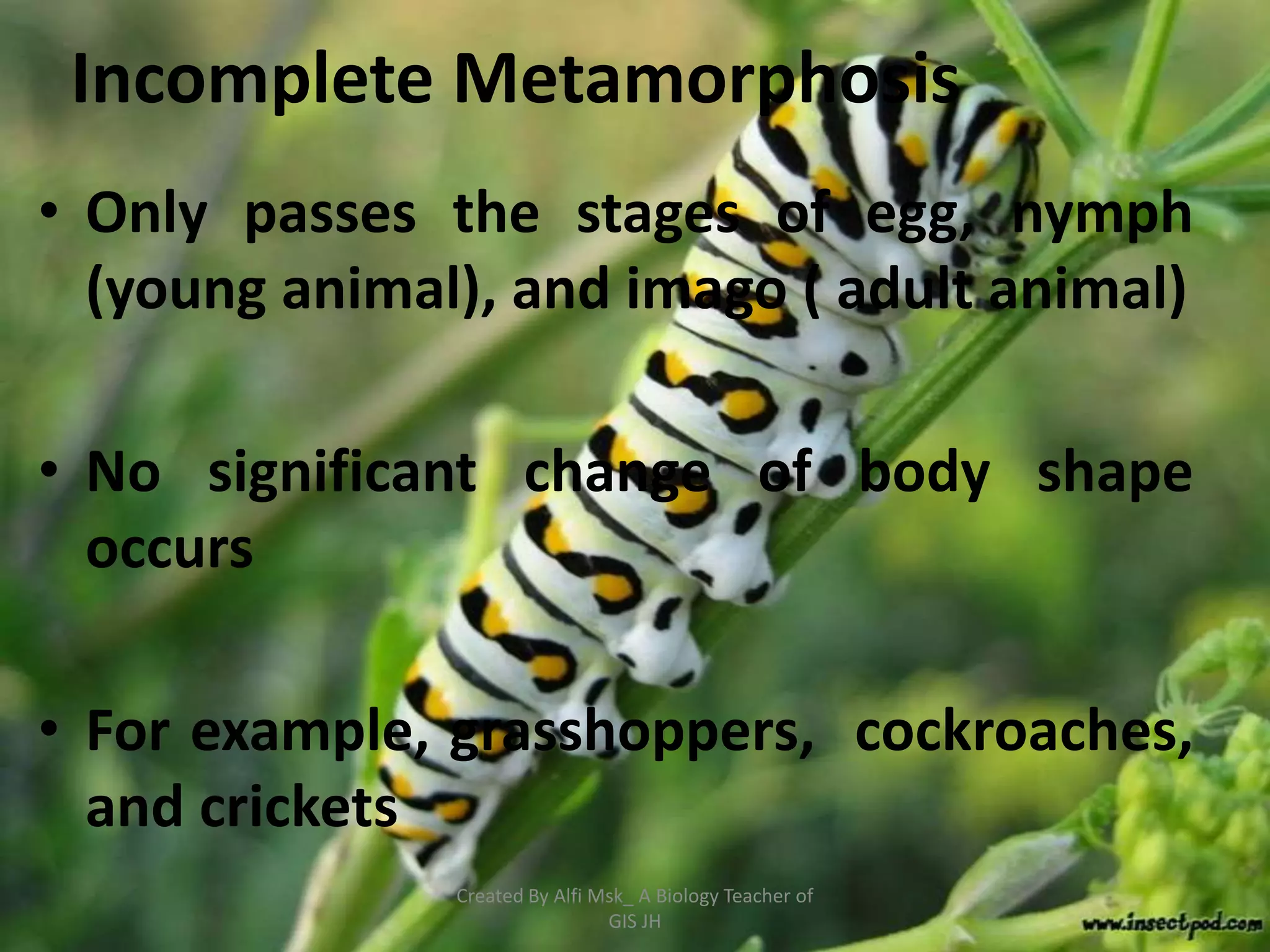
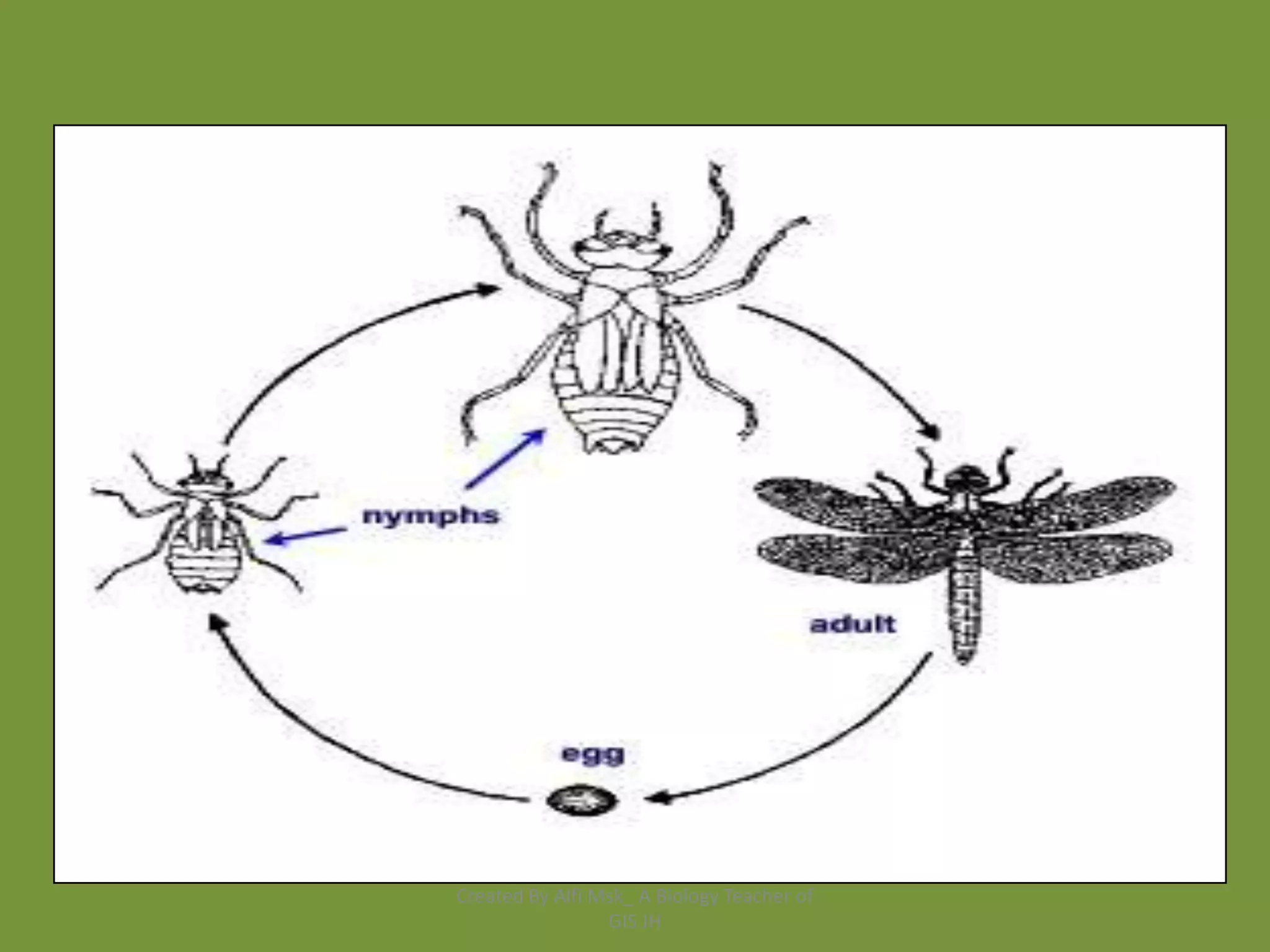
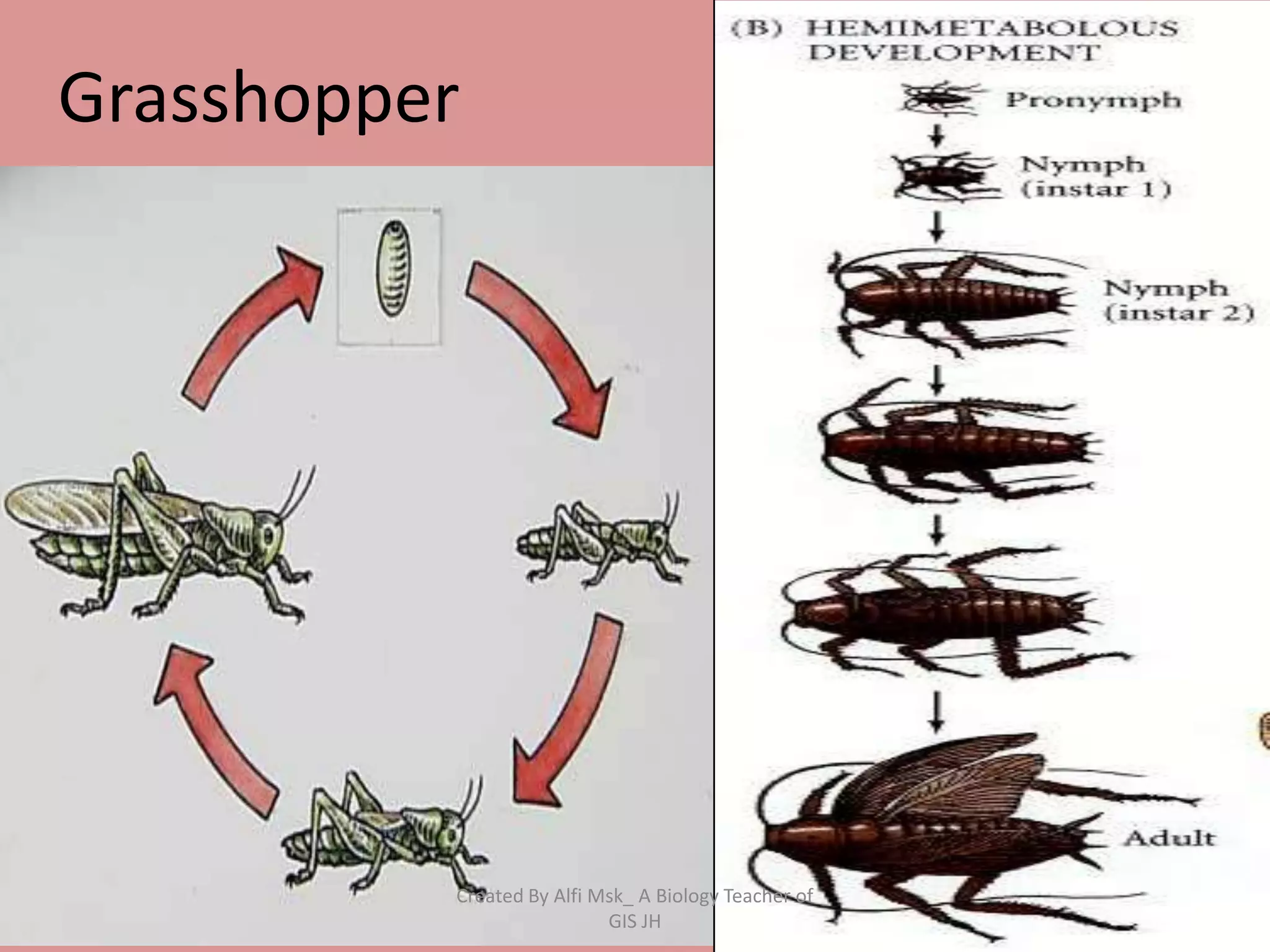
Incomplete Metamorphosis
• Only passes the stages of egg, nymph
  (young animal), and imago ( adult animal)

• No significant change of body shape
  occurs

• For example, grasshoppers, cockroaches,
  and crickets
               Created By Alfi Msk_ A Biology Teacher of
                                GIS JH
Created By Alfi Msk_ A Biology Teacher of
                 GIS JH
Grasshopper


          Created By Alfi Msk_ A Biology Teacher of
                           GIS JH
Created By Alfi Msk_ A Biology Teacher of
                 GIS JH

8-1.Growth and development

  • 1.
    GROWTH and DEVELOPMENT Created By Alfi Msk_ A Biology Teacher of GIS JH
  • 2.
    a. The Definition •Growth constitutes an increase process in size including increases in height, and weight. Growth is quantitative and irreversible in nature • Development is a process towards maturity. Development is qualitative in nature, meaning that it is immeasurable Created By Alfi Msk_ A Biology Teacher of GIS JH
  • 3.
    b. GROWTH andDEVELOPMENT in THE PLANTS • Plant growth occurs because of the size increase which is caused by the increase in the number of cells through cell division (mitosis) in the growing points and enlargement in each cell • Cell division mostly occurs in the meristem tissue, that mostly found in the root tip and stem tip which are called apical meristem Created By Alfi Msk_ A Biology Teacher of GIS JH
  • 4.
    • When theyoung plants grow, the root and the stem grow longer, this growth is called primary growth • Some plants, such as wooden plants, have stems and roots which become thicker, this growth is called secondary growth • To measure the speed growth of plants, we use the auxanometer Created By Alfi Msk_ A Biology Teacher of GIS JH
  • 5.
    • The developmentof seed plants which reproduce through the generative method starts with a zygote • The zygote grows into embryo then become an individual which posseses roots, stems, and leaves. • After reaching a certain age, the plants will produce flowers and seeds • The changes of shape and function from one zygote until the plant is forming root, stem and leaf organ is called the development process of plants Created By Alfi Msk_ A Biology Teacher of GIS JH
  • 6.
    Factors Which AffectPlants Growth And Development • Internal Factors a. Genes - the size and shape of plants are affected by the genes inside the chromosomes - Chromosomes are found in the nucleus - Genes are derived from the parents - Genes control the growth pattern of the plants Created By Alfi Msk_ A Biology Teacher of GIS JH
  • 7.
    b. Hormones - A hormones is a chemical subtance which is produced by plants, are often called growth subtances - Its function is to control the growth process - the common growth hormones are auxin, cytokinin, and gibberellin Created By Alfi Msk_ A Biology Teacher of GIS JH
  • 8.
    1. Auxin - Auxinis produced in the stem tip (bud), young leaves, flowers, fruit, and root tip - Auxin which found in the stem tip can inhibit the growth of branches, this condition is called apical dominance. Therefore the plants can grow tall and straight. - The effects of auxin are :  to stimulate the lateral roots and fibrous roots growth  to stimulate the growth of stem cells and inhibit the growth of root cells  to stimulate the forming of flowers and fruit  to speed up the cell division in Teacher of Created By Alfi Msk_ A Biology growing points GIS JH
  • 9.
    2. Cytokinin - Cytokininis produced by plants in the root and then transported to the other organs - The role of cytokinin are :  influencing the growth of the root  stimulating cell division  retarding the aging of plant organs (leaf, flower, and fruit)  controlling the forming of flowers and fruit Created By Alfi Msk_ A Biology Teacher of GIS JH
  • 10.
    3. Gibberellin - Gibberellinis produced by the plants in the root meristem tissue, stem meristem, and young leaves - The role of gibberellin are :  stimulating the growth and development of embryos and sprouts  causing massive growth in plants Producing big and seedless fruit (parthenocarpy)  stimulating the forming of flowers Created By Alfi Msk_ A Biology Teacher of GIS JH
  • 11.
    • External Factors a.Water and Minerals - water and minerals are absorbed from the soil by the roots. - the minerals required by plants are carbon, oxygen, hydrogen, nitrogen, sulphur, phosporus, calcium, potassium, and magnesium. They are absorbed in form of ions that dissolved in the water. - water not only serves as a solvent but is also required for photosynthesis Created By Alfi Msk_ A Biology Teacher of GIS JH
  • 12.
    b. Temperatures - temperatures influences the work of enzymes - a temperatures which is too low or too high will disrupt the work of enzymes, so it will inhibit plant growth and development - Every plant has the minimun, optimum, and maximum temperature to grow - the lowest temperature that still enables plants to grow and develop is called the minimum temperature - the most suitable temperature for plant growth and development is called the optimum temperature - the highest temperature that still enables the plants to grow and develop is called the maximum temperature Created By Alfi Msk_ A Biology Teacher of GIS JH
  • 13.
    c. Humidity - an environment with low humidity will increase the evaporation (transpiration) of plant so that the water and mineral absorption from the soil will become more frequent, this will increase the speed of plant growth Created By Alfi Msk_ A Biology Teacher of GIS JH
  • 14.
    d. Light Intensity - sunlight is highly required by plants for photosynthesis, this process produces food that is required for growth - the light can also influence auxin hormone, it will break down if it is exposed to sunlight - for example, a sprout that is exposed to light will slowly grow, while the sprout which put in a dark place will grow faster - the faster growth in darkness is called etiolation Created By Alfi Msk_ A Biology Teacher of GIS JH
  • 15.
    c. GROWTH andDEVELOPMENT in ANIMALS and HUMANS • Growth and development in animals and humans occurs in all parts of the body, different from those of plants which only occur in certain parts. • Growth and development in animals and humans begin at the formation of the zygote • One zygote will grow and develop until an embryo is formed • In that particular stage, the embryo cells will differentiate to form various tissues and develop into fetus • The fetus will be born as a baby which then grow and develop into a toddler, adolescent, and then a adult Created By Alfi Msk_ A Biology Teacher of GIS JH
  • 16.
    2 phases inanimals/humans’ growth and development • Embryonic phase Is phase started with the establishing of zygote up to embryo. Fertilization is a process in which a fusion of the sperm and ovum gamete occurs. • Post-embryonic phase Is phase after the embryo is formed. in animals, post embryonic is only a change in size, namely an increase in size of body parts. Created By Alfi Msk_ A Biology Teacher of GIS JH
  • 17.
    Factors that AffectAnimals Growth and Development a. Genes - a gene is a hereditary factor inherited by the parents - genes will determine and control the basic patterns of growth and development of an organism b. Hormones - hormones are secreted by endocrine glands - the hormone which has the main role in human or animal growth is the growth hormone (GH/Somatotropin) - people who are lacking somatotropin will undergo stunted growth, while those with an excessive amount of somatotropin will undergo GIS A Biology Teacher of Created By Alfi Msk_ gigantic growth JH
  • 18.
    c. Food - one of characteristics of living organism is the need for food - the most important roles of food is to construct the body and as a source of energy. - the food subtance which has the biggest role in growth is protein d. Water - water is a solvent and a media for chemical reactions in the body - the chemical reactions will produce energy, help the forming of new cells, and repair damaged body tissues Created By Alfi Msk_ A Biology Teacher of GIS JH
  • 19.
    e. Activity - physical activity which is done for years will affect the structures of bones and muscles - for example, body builders or runners, they possess good body posture and muscles. - people who do less physical activity wil possess weaker muscles and they will not properly develop. f. Sunlight - sunlight can alter provitamin D in the body into vitamin D which is needed in the growth of bone - lack of vitamin DCreated By Alfi Msk_ A Biology Teacher of can cause rickets during childhood GIS JH
  • 20.
    d. THE STAGEof HUMAN GROWTH • Human growth and develoment begin from a very small ovum cell • The ovum is fertilized by sperm and the two nuclei will then fuse to form a zygote • A zygote will cleavage and become morulla • A morulla is developed become blastula through blastulation • A blastula is developed become gastrula through gastrulation • A gastrula has 3 embrionic layer : ectoderm, mesoderm, and endoderm Created By Alfi Msk_ A Biology Teacher of GIS JH
  • 21.
    • Ectoderm willdiffrentiate become skin, hair, nervous system, and sense organ • Mesoderm will differentiate become muscles, skeleton, reproductive organ, transportation system, and excretion system • Endoderm will differentiate become digestive system, and respiratory system Created By Alfi Msk_ A Biology Teacher of GIS JH
  • 22.
    Zygote Morula Blastula Created By Alfi Msk_ A Biology Teacher of Gastrula GIS JH
  • 23.
    1. Baby Birth •After about 9 months of growing and developing inside the uterus, the baby is ready to be born • The baby, which has come out of the uterus is still connected to her mother by umbilical cord and the placenta • The umbilical cord and the placenta are then cut by the doctor or the midwife • At this stage, the physical connection between the mother and the baby is broken, so that the baby can no longer obtain food and oxygen from the mother • When the umbilical cord and the placenta are cut, the breathing organs will soon function, so that the baby can inhale the air, and usually it is marked by the first cry • The cry is also a sign that the baby is able to pump the respiratory air from the lungs to the heart By Alfi Msk_ A Biology Teacher of Created GIS JH
  • 24.
    2. THE TODDLERand CHILDREN • The neonatal period is the first day of a baby’s life until the age of four weeks • In this period, the baby is able to adapt to life outside the uterus, can start suckling at its mother’s breast, and organs like lungs, heart, and also excretion organs are already well functioning Created By Alfi Msk_ A Biology Teacher of GIS JH
  • 25.
    3. PUBERTY • Pubertybegins at about age 9 to 14, this is the stage you are going through now • Girls’ puberty characteristics are shown in some physical changes ; - the developing of hip and breasts - the appearance of pubic hair - the developing of reproductive organs, is marked by the first menstruation (menarche) Created By Alfi Msk_ A Biology Teacher of GIS JH
  • 26.
    • boys’ pubertycharacteristics are shown in some physical changes ; - the chest looks wider - facial hair and pubic hair appears - the voice change - the deloping of reproductive organs, is marked by the wet dream Created By Alfi Msk_ A Biology Teacher of GIS JH
  • 27.
    4. ADULT STAGE •In this stage, the growth of bones and muscles begin to stop so adults cannot grow taller • Human psychological condition becomes more stable than during adolescence • People start to think about getting married and producing offspring Created By Alfi Msk_ A Biology Teacher of GIS JH
  • 28.
    5. OLD AGE •The cell ability starts degenerating, this causes some physical changes • Like weaker bones, degenerating ability to breath, degenerating elasticity of veins, and also causes skin to wrinkle • But sufficient nutrients and regular exercise can inhibit aging Created By Alfi Msk_ A Biology Teacher of GIS JH
  • 29.
    e. METAGENESIS and METAMORPHOSIS Created By Alfi Msk_ A Biology Teacher of GIS JH
  • 30.
    METAGENESIS • Moss and ferns experience two development stage in hteir life span, the spore producing stage (sporophyte generation, asexual) and the gamete producing stage (gametophyte generation, sexual) • The alternation from sporophye to gametophyte or vice-versa is called metagenesis Created By Alfi Msk_ A Biology Teacher of GIS JH
  • 31.
    Moss Metagenesis Created By Alfi Msk_ A Biology Teacher of GIS JH
  • 32.
    Fern Metagenesis Spore Protalium Anteridium Arkegonium Spermatozoid Ovum Zygote Fern Spore Created By Alfi Msk_ A Biology Teacher of GIS JH
  • 33.
    Metamorphosis • Is theshape and structural alternation which occurs in animals, starting from the embryo stage to adult • Animal which undergo metamorphosis are insects and frogs • Metamorphosis is differentiated into two types ; the complete metamorphosis and the incomplete metamorphosis Created By Alfi Msk_ A Biology Teacher of GIS JH
  • 34.
    Complete metamorphosis • Themetamorphosis which passes the stages egg, larva, pupa, and adult (imago) • In metamorphosis, the increase of body size is a growth process, while the change of the body shape from egg to adult is development process • For example, butterflies and frogs Created By Alfi Msk_ A Biology Teacher of GIS JH
  • 35.
    Frog Created By AlfiMsk_ A Biology Teacher of GIS JH
  • 36.
    Created By AlfiMsk_ A Biology Teacher of GIS JH
  • 37.
    Created By AlfiMsk_ A Biology Teacher of GIS JH
  • 38.
    Created By AlfiMsk_ A Biology Teacher of GIS JH
  • 39.
    Butterflies Created By AlfiMsk_ A Biology Teacher of GIS JH
  • 40.
    Flies Created By AlfiMsk_ A Biology Teacher of GIS JH
  • 41.
    Incomplete Metamorphosis • Onlypasses the stages of egg, nymph (young animal), and imago ( adult animal) • No significant change of body shape occurs • For example, grasshoppers, cockroaches, and crickets Created By Alfi Msk_ A Biology Teacher of GIS JH
  • 42.
    Created By AlfiMsk_ A Biology Teacher of GIS JH
  • 43.
    Grasshopper Created By Alfi Msk_ A Biology Teacher of GIS JH
  • 44.
    Created By AlfiMsk_ A Biology Teacher of GIS JH