Gene Interactions
Presented by:
Sanjay Kr. Vishwakarma
Gene Interactions
• Gene interactions occur when two or more different genes influence the
outcome of a single trait
• Interaction between allelic or nonallelic genes of the same genotype in the
production of particular phenotypic characters
• There may be more than two alleles for a given locus within the population.
• Dominance of one allele over another may not be complete
• The expression of a trait may be dependent on the interaction of two or
more genes, on the interaction of genes with non genetic factors, or both
Epistasis
• An allele of one gene masks the expression of alleles of another gene and
expresses its own phenotype
• Gene that masks = epistatic gene
• Gene that is masked = hypostatic gene
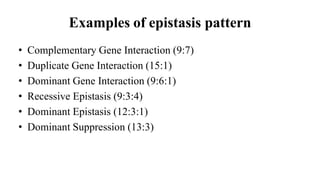
Examples of epistasis pattern
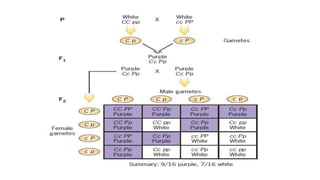
• Complementary Gene Interaction (9:7)
• Duplicate Gene Interaction (15:1)
• Dominant Gene Interaction (9:6:1)
• Recessive Epistasis (9:3:4)
• Dominant Epistasis (12:3:1)
• Dominant Suppression (13:3)
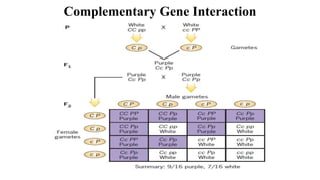
Complementary Gene Interaction
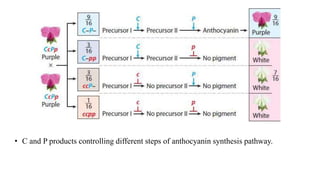
• C and P products controlling different steps of anthocyanin synthesis pathway.
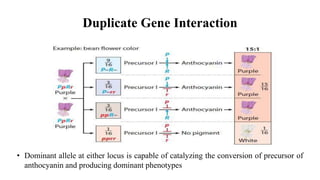
Duplicate Gene Interaction
• Dominant allele at either locus is capable of catalyzing the conversion of precursor of
anthocyanin and producing dominant phenotypes
Dominant Gene Interaction
• Plant at least one dominant at each locus (A-B-) have disc shaped fruit
Recessive Epistasis
Dominant Epistasis
Dominant Suppression
• Product of allele C converts colorless precursors into pigment and product of I prevent the
pigment production in chicken
Multiple Choice Question
1) In sweet pea a white substance is first converted to a ___________ substance by 1st gene
and that to a ______________ substance by 2nd gene to give a purple flower.
a) Yellow, purple
b) Green, purple
c) Purple, yellow
d) White, yellow
Answer: d
2) In mouse agouti locus is hypostatic to pigment development locus. If C is for pigment
development, and A is for agouti, and recessive alleles in agouti locus gives black color and
recessive in pigment locus gives white color, what will be the phenotype of A/- c/c and a/a c/c.
a) Agouti, white
b) Black, agouti
c) Black, black
d) White, white
Answer: d
3) Coat color in Labrador retriever is controlled by epistasis. B specifies black pigment, b is
for brown pigment (recessive) and E locus determines the expression of B locus. Which one of
the following is wrong?
a) bb EE gives yellow
b) Bb EE gives black
c) bb Ee gives brown
d) BB EE gives black
Answer: a
Thank You

Gene interactions

  • 1.
  • 2.
    Gene Interactions • Geneinteractions occur when two or more different genes influence the outcome of a single trait • Interaction between allelic or nonallelic genes of the same genotype in the production of particular phenotypic characters • There may be more than two alleles for a given locus within the population.
  • 3.
    • Dominance ofone allele over another may not be complete • The expression of a trait may be dependent on the interaction of two or more genes, on the interaction of genes with non genetic factors, or both
  • 4.
    Epistasis • An alleleof one gene masks the expression of alleles of another gene and expresses its own phenotype • Gene that masks = epistatic gene • Gene that is masked = hypostatic gene
  • 7.
    Examples of epistasispattern • Complementary Gene Interaction (9:7) • Duplicate Gene Interaction (15:1) • Dominant Gene Interaction (9:6:1) • Recessive Epistasis (9:3:4) • Dominant Epistasis (12:3:1) • Dominant Suppression (13:3)
  • 8.
  • 9.
    • C andP products controlling different steps of anthocyanin synthesis pathway.
  • 10.
    Duplicate Gene Interaction •Dominant allele at either locus is capable of catalyzing the conversion of precursor of anthocyanin and producing dominant phenotypes
  • 11.
    Dominant Gene Interaction •Plant at least one dominant at each locus (A-B-) have disc shaped fruit
  • 12.
  • 13.
  • 14.
    Dominant Suppression • Productof allele C converts colorless precursors into pigment and product of I prevent the pigment production in chicken
  • 15.
  • 16.
    1) In sweetpea a white substance is first converted to a ___________ substance by 1st gene and that to a ______________ substance by 2nd gene to give a purple flower. a) Yellow, purple b) Green, purple c) Purple, yellow d) White, yellow Answer: d
  • 17.
    2) In mouseagouti locus is hypostatic to pigment development locus. If C is for pigment development, and A is for agouti, and recessive alleles in agouti locus gives black color and recessive in pigment locus gives white color, what will be the phenotype of A/- c/c and a/a c/c. a) Agouti, white b) Black, agouti c) Black, black d) White, white Answer: d
  • 18.
    3) Coat colorin Labrador retriever is controlled by epistasis. B specifies black pigment, b is for brown pigment (recessive) and E locus determines the expression of B locus. Which one of the following is wrong? a) bb EE gives yellow b) Bb EE gives black c) bb Ee gives brown d) BB EE gives black Answer: a
  • 19.

Editor's Notes

  • #10 Since anthocyanin production requires the action of the product of C as well as the product of P, both step must be successfully completed for anthocyanin production and deposition in flower petals
  • #11 If recessive homozygous allele are present at both loci no functional gene product is produced and synthesis pathway does not completed
  • #12 Plant with recessive allele at each locus (aabb) produces long fruit and plant are homozygous recessive at either of the loci (A-bb or aaB- ) produce spherical fruit
  • #13 B gene is TYRP1 gene that controls melanin distribution . The wild type allele B produces full melanin distribution , mutant allele b reduced distribution .Gene E IS MCIR that controls eumelanin synthesis. Gene E permit synthesis but mutant allele e does not
  • #14 Wild-type allele d produces a light red pigment seen in flowers and a mutant allele D produces a dark red flower pigment . At another gene allele w is wild type allele that distribute pigment throughout the flower. A mutant allele W restrict the pigment to the flower
  • #15 Product of allele C converts colorless precursors into pigment, whereas the allele c product is inactive and fails to convert to the precursors, resulting in white feather color for cc genotype. Dominant suppression of C by the product of I prevent the pigment production in chicken with C-I- genotype
  • #17  It is expected that in case of duplicate recessive epistasis of sweet pea plant a white substance is 1st converted to another white substance that is converted to purple substance in case of presence of two dominant genes. If any of these genes are absent this would give white flower.
  • #18 In this case the C gene is epistatic, so unless colour is developed due to C/- there will be no expression of A locus. In both of these cases, C locus has c/c/ alleles, so both the mice are white.
  • #19 According to the rules of recessive epistasis, at least one dominant allele at the E locus is needed for expression at the b locus. As in option bb EE gives yellow the E locus is dominant so b locus is expressed to give chocolate or brown colour not yellow.