MMiiccrroobbiiaall FFuueell CCeellllss PPoowweerreedd bbyy 
GGeeoobbaacctteerr ssuullffuurrrreedduucceennss 
IIhhssaann TTrriiaa PPrraammaannddaa 
1100660055110033 
BBMM 33220044 BBaacctteerriioollooggyy
Introduction 
• The development of processes to generate biofuels 
and bioenergy has been of special interest lately 
• Microbial Fuel Cells (MFCs)  collects the electricity 
generated by microbes when they metabolize 
substrates 
• Considered to be one of the most efficient energy 
sources: 
– No burning is required to produce energy 
– The only raw materials needed to power fuel cells are 
simple organic compounds or even waste materials from 
other reactions 
Ihsan Tria Pramanda - 10605103 2
Principles of the MFCs 
Ihsan Tria Pramanda - 10605103 3
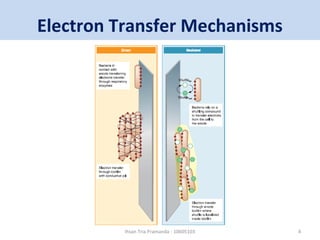
Electron Transfer Mechanisms 
Ihsan Tria Pramanda - 10605103 4
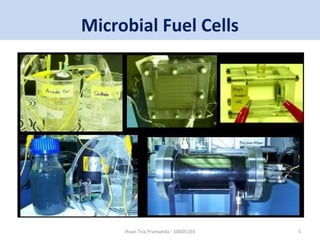
Microbial Fuel Cells 
Ihsan Tria Pramanda - 10605103 5
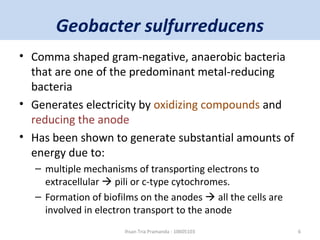
Geobacter sulfurreducens 
• Comma shaped gram-negative, anaerobic bacteria 
that are one of the predominant metal-reducing 
bacteria 
• Generates electricity by oxidizing compounds and 
reducing the anode 
• Has been shown to generate substantial amounts of 
energy due to: 
– multiple mechanisms of transporting electrons to 
extracellular  pili or c-type cytochromes. 
– Formation of biofilms on the anodes  all the cells are 
involved in electron transport to the anode 
Ihsan Tria Pramanda - 10605103 6
Simplified Microbial Anatomy 
Ihsan Tria Pramanda - 10605103 7
C-type Cytochromes 
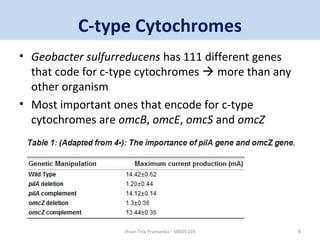
• Geobacter sulfurreducens has 111 different genes 
that code for c-type cytochromes  more than any 
other organism 
• Most important ones that encode for c-type 
cytochromes are omcB, omcE, omcS and omcZ 
Ihsan Tria Pramanda - 10605103 8
Biofilms 
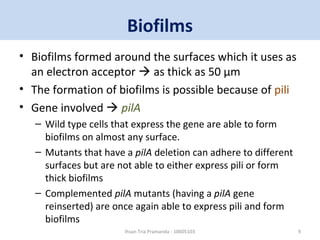
• Biofilms formed around the surfaces which it uses as 
an electron acceptor  as thick as 50 μm 
• The formation of biofilms is possible because of pili 
• Gene involved  pilA 
– Wild type cells that express the gene are able to form 
biofilms on almost any surface. 
– Mutants that have a pilA deletion can adhere to different 
surfaces but are not able to either express pili or form 
thick biofilms 
– Complemented pilA mutants (having a pilA gene 
reinserted) are once again able to express pili and form 
biofilms 
Ihsan Tria Pramanda - 10605103 9
Biofilm of Geobacter sulfurreducens 
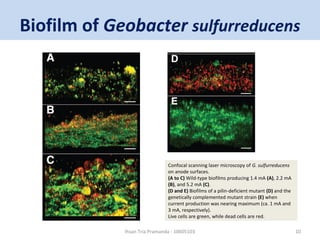
Confocal scanning laser microscopy of G. sulfurreducens 
on anode surfaces. 
(A to C) Wild-type biofilms producing 1.4 mA (A), 2.2 mA 
(B), and 5.2 mA (C). 
(D and E) Biofilms of a pilin-deficient mutant (D) and the 
genetically complemented mutant strain (E) when 
current production was nearing maximum (ca. 1 mA and 
3 mA, respectively). 
Live cells are green, while dead cells are red. 
Ihsan Tria Pramanda - 10605103 10
Why do Strains that Form Biofilms are Able to 
Produce More Energy? 
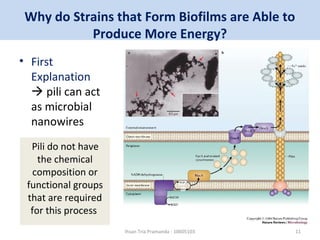
• First 
Explanation 
 pili can act 
as microbial 
nanowires 
Pili do not have 
the chemical 
composition or 
functional groups 
that are required 
for this process 
Ihsan Tria Pramanda - 10605103 11
Why do Strains that Form Biofilms are Able to 
Produce More Energy? (2) 
• Second Explanation  c-type cytochromes 
• c-type cytochromes can interact with the same 
proteins from other cells and electrons can be 
passed from one cell to another. 
• In cases where there are no electrons acceptors near 
the cell  c-type cytochromes can even act as 
electron sinks and store electrons until a source to 
which they can be transferred is available. 
Ihsan Tria Pramanda - 10605103 12
Gene Manipulation 
• Engineered strains with higher expression of: 
– pilA, OmcZ, OmcB, OmcE, and OmcS genes. 
– More pili  allowing the formation of thicker biofilms and 
more nanowires for electrons to be transferred 
– More c-type cytochromes  enabling the transfer of 
electrons to anode surfaces 
• A modelling exercise predicted the effects of 
specific gene deletions in Geobacter 
sulfurreducens on the rate of respiration  
Optknock strain design methodology 
Ihsan Tria Pramanda - 10605103 13
Spontaneous Mutant 
• Produced pili much more efficiently 
than the wild type strain  the pilA 
gene was over expressed. 
• The expression of c-type 
cytochromes was equal to the 
control strain  genes like omcZ, 
omcS, omcB and omcE were not up 
regulated. 
• This strain was also motile through 
the action of flagella  cells could 
move to the anode much more 
quickly before biofilms were formed. 
• Directed most of its net electron 
flow to the anode rather than to cell 
synthesis 
Strains selected in anaerobic environment 
• placed on a different MFC 
• current production methods of 
different MFCs were compared 
One strain showed higher 
current yields than the initial 
Geobacter sulfurreducens 
strain 
Ihsan Tria Pramanda - 10605103 14
Limits and Applications 
• At this moment, the biggest concern is trying to 
obtain higher current levels which could actually 
generate enough power to drive complex 
mechanisms 
• Up to now, current levels are around 14 mA which 
means they could be used to power very simple 
components 
• Because this technology is still relatively new, the 
actual current densities that could be generated are 
still unknown 
Ihsan Tria Pramanda - 10605103 15
Conclusions 
• Geobacter sulfurreducens has a promising future in 
the field of MFCs because of the ability of this 
organism to transfer electrons to the anode through 
c-type cytochromes and pili allow it to generate 
relatively high levels of current. 
• More research is required to determine how the 
microorganism could be engineered to create strains 
which are able to generate more current in MFCs. So 
that it will have higher electricity outputs and will 
eventually be available in the market. 
Ihsan Tria Pramanda - 10605103 16
TTHHAANNKK YYOOUU!!!!!!
References 
• Reguera, G., Nevin, K.P., Nicoll, J.S., Covalla S.F. Biofilm and 
Nanowire Production Leads to Increased Current in 
Geobacter sulfurreducens Fuel Cells. Appl Environ Microbiol 
2006; 72:7345-7348. 
• Salgado, Carlos Andres. Microbial fuel cells powered by 
Geobacter sulfurreducens. MMG 445 Basic Biotech. 2009 5:1 
• Yi, H., Nevin, K.P., Kim, B., Franks, A.E., Klimes, A., Tender, 
L.M. Lovley, D.R. Selection of a variant of Geobacter 
sulfurreducens with enhanced capacity for current 
production in microbial fuel cells. Biosens Bioelectron 2009; 
24:3498-3503 
Ihsan Tria Pramanda - 10605103 18

Microbial fuel cell

  • 1.
    MMiiccrroobbiiaall FFuueell CCeellllssPPoowweerreedd bbyy GGeeoobbaacctteerr ssuullffuurrrreedduucceennss IIhhssaann TTrriiaa PPrraammaannddaa 1100660055110033 BBMM 33220044 BBaacctteerriioollooggyy
  • 2.
    Introduction • Thedevelopment of processes to generate biofuels and bioenergy has been of special interest lately • Microbial Fuel Cells (MFCs)  collects the electricity generated by microbes when they metabolize substrates • Considered to be one of the most efficient energy sources: – No burning is required to produce energy – The only raw materials needed to power fuel cells are simple organic compounds or even waste materials from other reactions Ihsan Tria Pramanda - 10605103 2
  • 3.
    Principles of theMFCs Ihsan Tria Pramanda - 10605103 3
  • 4.
    Electron Transfer Mechanisms Ihsan Tria Pramanda - 10605103 4
  • 5.
    Microbial Fuel Cells Ihsan Tria Pramanda - 10605103 5
  • 6.
    Geobacter sulfurreducens •Comma shaped gram-negative, anaerobic bacteria that are one of the predominant metal-reducing bacteria • Generates electricity by oxidizing compounds and reducing the anode • Has been shown to generate substantial amounts of energy due to: – multiple mechanisms of transporting electrons to extracellular  pili or c-type cytochromes. – Formation of biofilms on the anodes  all the cells are involved in electron transport to the anode Ihsan Tria Pramanda - 10605103 6
  • 7.
    Simplified Microbial Anatomy Ihsan Tria Pramanda - 10605103 7
  • 8.
    C-type Cytochromes •Geobacter sulfurreducens has 111 different genes that code for c-type cytochromes  more than any other organism • Most important ones that encode for c-type cytochromes are omcB, omcE, omcS and omcZ Ihsan Tria Pramanda - 10605103 8
  • 9.
    Biofilms • Biofilmsformed around the surfaces which it uses as an electron acceptor  as thick as 50 μm • The formation of biofilms is possible because of pili • Gene involved  pilA – Wild type cells that express the gene are able to form biofilms on almost any surface. – Mutants that have a pilA deletion can adhere to different surfaces but are not able to either express pili or form thick biofilms – Complemented pilA mutants (having a pilA gene reinserted) are once again able to express pili and form biofilms Ihsan Tria Pramanda - 10605103 9
  • 10.
    Biofilm of Geobactersulfurreducens Confocal scanning laser microscopy of G. sulfurreducens on anode surfaces. (A to C) Wild-type biofilms producing 1.4 mA (A), 2.2 mA (B), and 5.2 mA (C). (D and E) Biofilms of a pilin-deficient mutant (D) and the genetically complemented mutant strain (E) when current production was nearing maximum (ca. 1 mA and 3 mA, respectively). Live cells are green, while dead cells are red. Ihsan Tria Pramanda - 10605103 10
  • 11.
    Why do Strainsthat Form Biofilms are Able to Produce More Energy? • First Explanation  pili can act as microbial nanowires Pili do not have the chemical composition or functional groups that are required for this process Ihsan Tria Pramanda - 10605103 11
  • 12.
    Why do Strainsthat Form Biofilms are Able to Produce More Energy? (2) • Second Explanation  c-type cytochromes • c-type cytochromes can interact with the same proteins from other cells and electrons can be passed from one cell to another. • In cases where there are no electrons acceptors near the cell  c-type cytochromes can even act as electron sinks and store electrons until a source to which they can be transferred is available. Ihsan Tria Pramanda - 10605103 12
  • 13.
    Gene Manipulation •Engineered strains with higher expression of: – pilA, OmcZ, OmcB, OmcE, and OmcS genes. – More pili  allowing the formation of thicker biofilms and more nanowires for electrons to be transferred – More c-type cytochromes  enabling the transfer of electrons to anode surfaces • A modelling exercise predicted the effects of specific gene deletions in Geobacter sulfurreducens on the rate of respiration  Optknock strain design methodology Ihsan Tria Pramanda - 10605103 13
  • 14.
    Spontaneous Mutant •Produced pili much more efficiently than the wild type strain  the pilA gene was over expressed. • The expression of c-type cytochromes was equal to the control strain  genes like omcZ, omcS, omcB and omcE were not up regulated. • This strain was also motile through the action of flagella  cells could move to the anode much more quickly before biofilms were formed. • Directed most of its net electron flow to the anode rather than to cell synthesis Strains selected in anaerobic environment • placed on a different MFC • current production methods of different MFCs were compared One strain showed higher current yields than the initial Geobacter sulfurreducens strain Ihsan Tria Pramanda - 10605103 14
  • 15.
    Limits and Applications • At this moment, the biggest concern is trying to obtain higher current levels which could actually generate enough power to drive complex mechanisms • Up to now, current levels are around 14 mA which means they could be used to power very simple components • Because this technology is still relatively new, the actual current densities that could be generated are still unknown Ihsan Tria Pramanda - 10605103 15
  • 16.
    Conclusions • Geobactersulfurreducens has a promising future in the field of MFCs because of the ability of this organism to transfer electrons to the anode through c-type cytochromes and pili allow it to generate relatively high levels of current. • More research is required to determine how the microorganism could be engineered to create strains which are able to generate more current in MFCs. So that it will have higher electricity outputs and will eventually be available in the market. Ihsan Tria Pramanda - 10605103 16
  • 17.
  • 18.
    References • Reguera,G., Nevin, K.P., Nicoll, J.S., Covalla S.F. Biofilm and Nanowire Production Leads to Increased Current in Geobacter sulfurreducens Fuel Cells. Appl Environ Microbiol 2006; 72:7345-7348. • Salgado, Carlos Andres. Microbial fuel cells powered by Geobacter sulfurreducens. MMG 445 Basic Biotech. 2009 5:1 • Yi, H., Nevin, K.P., Kim, B., Franks, A.E., Klimes, A., Tender, L.M. Lovley, D.R. Selection of a variant of Geobacter sulfurreducens with enhanced capacity for current production in microbial fuel cells. Biosens Bioelectron 2009; 24:3498-3503 Ihsan Tria Pramanda - 10605103 18