Biofilm
Meherunnesha (Nishat)
Sungjun Bae
Amnorzahira
Environmental Biotechnology
08/11/25
Contents
General information1
Application (Positive parts)2
3 Problems (Negative parts)
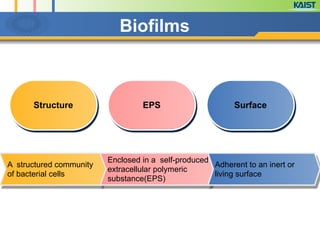
A structured community
of bacterial cells
Enclosed in a self-produced
extracellular polymeric
substance(EPS)
Structure EPS Surface
Adherent to an inert or
living surface
Biofilms
Environmental Biotechnology
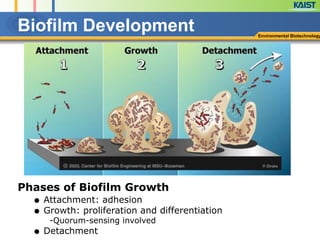
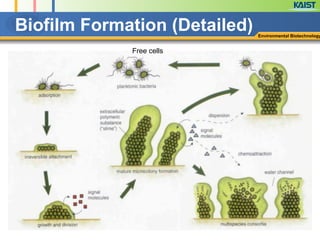
Biofilm Development
Phases of Biofilm Growth
● Attachment: adhesion
● Growth: proliferation and differentiation
-Quorum-sensing involved
● Detachment
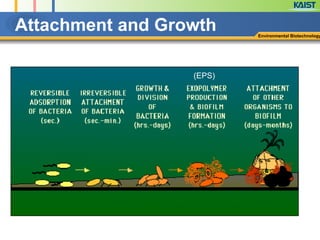
Attachment and Growth Environmental Biotechnology
(EPS)
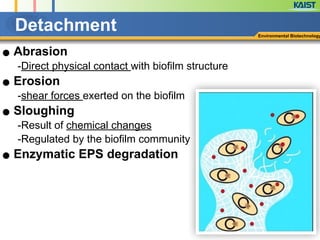
Detachment Environmental Biotechnology
● Abrasion
-Direct physical contact with biofilm structure
● Erosion
-shear forces exerted on the biofilm
● Sloughing
-Result of chemical changes
-Regulated by the biofilm community
● Enzymatic EPS degradation
Biofilm Formation (Detailed) Environmental Biotechnology
Free cells
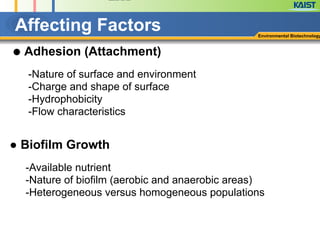
Affecting Factors Environmental Biotechnology
● Adhesion (Attachment)
!
-Nature of surface and environment
-Charge and shape of surface
-Hydrophobicity
-Flow characteristics
● Biofilm Growth
!
-Available nutrient
-Nature of biofilm (aerobic and anaerobic areas)
-Heterogeneous versus homogeneous populations
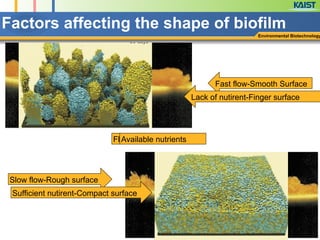
Factors affecting the shape of biofilm
Environmental Biotechnology
Slow flow-Rough surface
Flow Characteristic
Fast flow-Smooth Surface
Lack of nutirent-Finger surface
Sufficient nutirent-Compact surface
Available nutrients
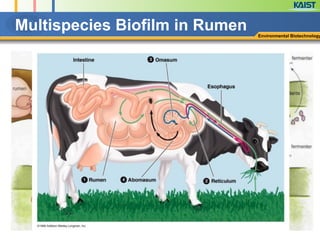
Multispecies Biofilm in Rumen Environmental Biotechnology
Biofilms – The social life of microorganism
More than 99 % of all microorganisms on earth
prefer to live in biofilms
WHY ?
!
7 secrets of the Good Life in Biofilms
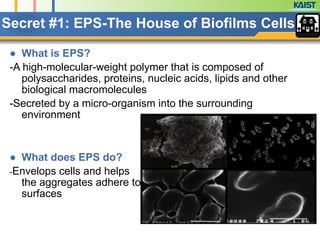
Secret #1: EPS-The House of Biofilms Cells
● What is EPS?
-A high-molecular-weight polymer that is composed of
polysaccharides, proteins, nucleic acids, lipids and other
biological macromolecules
-Secreted by a micro-organism into the surrounding
environment
!
!
● What does EPS do?
-Envelops cells and helps
the aggregates adhere to
surfaces
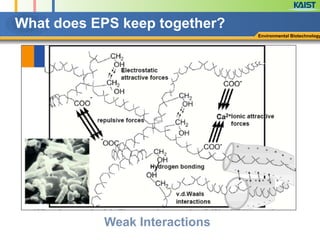
What does EPS keep together?
Environmental Biotechnology
Weak Interactions
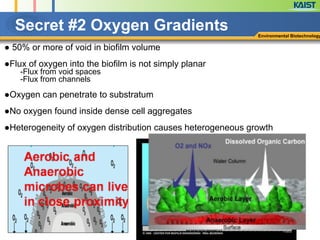
● 50% or more of void in biofilm volume
!
●Flux of oxygen into the biofilm is not simply planar
-Flux from void spaces
-Flux from channels
!
●Oxygen can penetrate to substratum
!
●No oxygen found inside dense cell aggregates
!
●Heterogeneity of oxygen distribution causes heterogeneous growth
Secret #2 Oxygen Gradients Environmental Biotechnology
Water
channels
Substratum
Secret #3 Microconsortia 

!
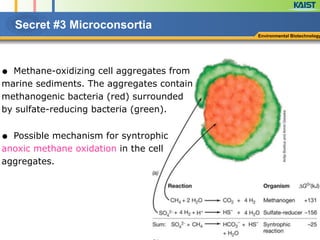
● Methane-oxidizing cell aggregates from
marine sediments. The aggregates contain
methanogenic bacteria (red) surrounded
by sulfate-reducing bacteria (green).
!
● Possible mechanism for syntrophic
anoxic methane oxidation in the cell
aggregates.
Environmental Biotechnology
Secret #4 Resistant to Antimicrobial Compounds
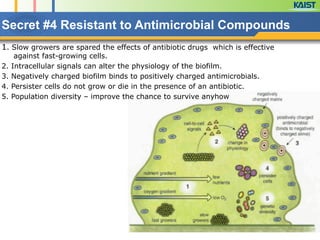
1. Slow growers are spared the effects of antibiotic drugs which is effective
against fast-growing cells.
2. Intracellular signals can alter the physiology of the biofilm.
3. Negatively charged biofilm binds to positively charged antimicrobials.
4. Persister cells do not grow or die in the presence of an antibiotic.
5. Population diversity – improve the chance to survive anyhow
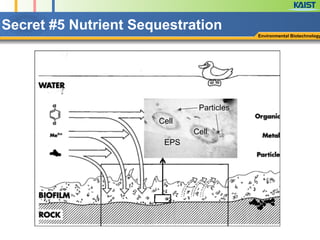
Secret #5 Nutrient Sequestration
Environmental Biotechnology
Cell
Cell
Particles
EPS
Secret #6 Density dependent communicationEnvironmental Biotechnology
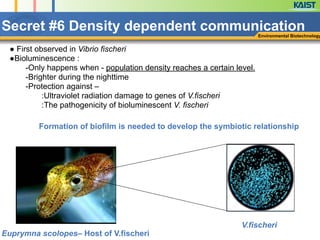
● First observed in Vibrio fischeri
●Bioluminescence :
-Only happens when - population density reaches a certain level.
-Brighter during the nighttime
-Protection against –
:Ultraviolet radiation damage to genes of V.fischeri
:The pathogenicity of bioluminescent V. fischeri
Euprymna scolopes– Host of V.fischeri
V.fischeri
Formation of biofilm is needed to develop the symbiotic relationship
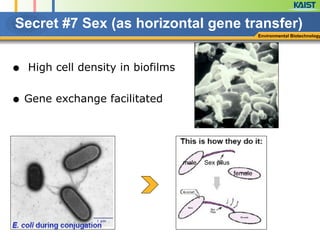
Secret #7 Sex (as horizontal gene transfer)
● High cell density in biofilms
!
● Gene exchange facilitated
Environmental Biotechnology
male
female
Sex pilus
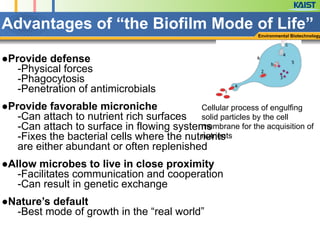
Advantages of “the Biofilm Mode of Life”
Environmental Biotechnology
●Provide defense
-Physical forces
-Phagocytosis
-Penetration of antimicrobials
!
●Provide favorable microniche
-Can attach to nutrient rich surfaces
-Can attach to surface in flowing systems
-Fixes the bacterial cells where the nutrients
are either abundant or often replenished
!
●Allow microbes to live in close proximity
-Facilitates communication and cooperation
-Can result in genetic exchange
!
●Nature’s default
-Best mode of growth in the “real world”
Cellular process of engulfing
solid particles by the cell
membrane for the acquisition of
nutrients
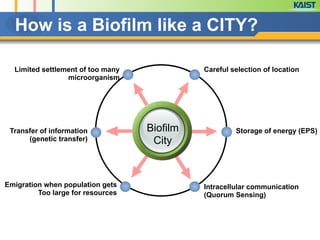
How is a Biofilm like a CITY?
Careful selection of locationLimited settlement of too many
microorganism
Storage of energy (EPS)
Intracellular communication
(Quorum Sensing)
Transfer of information
(genetic transfer)
Emigration when population gets
Too large for resources
Biofilm
City
Contents
General information1
Application (Positive parts)2
3 Problems (Negative parts)
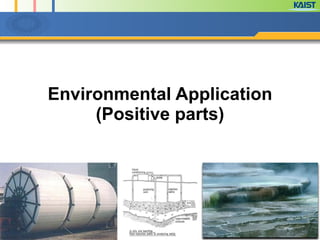
Environmental Application
(Positive parts)
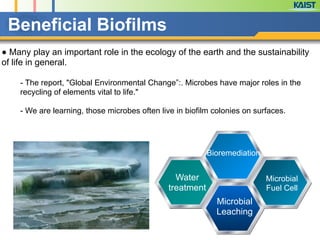
Beneficial Biofilms
● Many play an important role in the ecology of the earth and the sustainability
of life in general.
- The report, "Global Environmental Change”:. Microbes have major roles in the
recycling of elements vital to life."
!
- We are learning, those microbes often live in biofilm colonies on surfaces.

Bioremediation
Water
treatment
Microbial
Fuel Cell
Microbial
Leaching
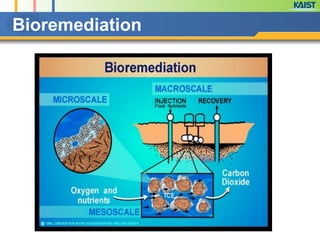
Bioremediation
Bioremediation
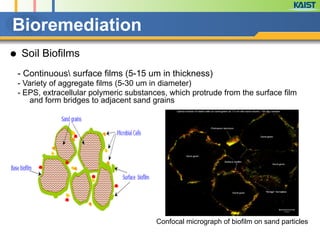
● Soil Biofilms
- Continuous surface films (5-15 um in thickness)
- Variety of aggregate films (5-30 um in diameter)
- EPS, extracellular polymeric substances, which protrude from the surface film
and form bridges to adjacent sand grains
Confocal micrograph of biofilm on sand particles
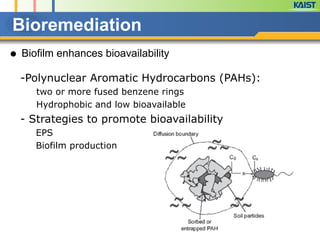
● Biofilm enhances bioavailability
-Polynuclear Aromatic Hydrocarbons (PAHs):
two or more fused benzene rings
Hydrophobic and low bioavailable
- Strategies to promote bioavailability
EPS
Biofilm production
Bioremediation
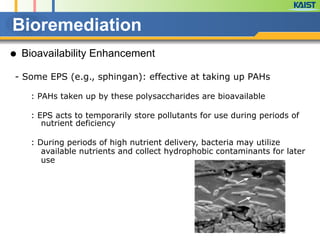
● Bioavailability Enhancement
- Some EPS (e.g., sphingan): effective at taking up PAHs
!
: PAHs taken up by these polysaccharides are bioavailable
!
: EPS acts to temporarily store pollutants for use during periods of
nutrient deficiency
!
: During periods of high nutrient delivery, bacteria may utilize
available nutrients and collect hydrophobic contaminants for later
use
Bioremediation
Bioremediation
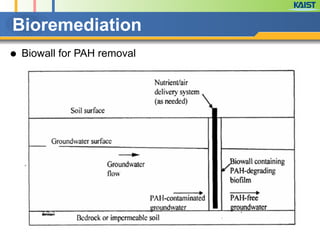
● Biowall for PAH removal
Water Treatment
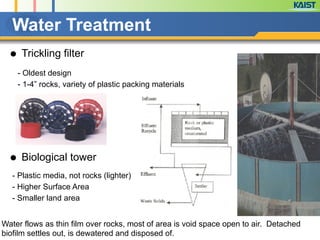
- Oldest design
- 1-4” rocks, variety of plastic packing materials
Water flows as thin film over rocks, most of area is void space open to air. Detached
biofilm settles out, is dewatered and disposed of.
● Trickling filter
● Biological tower
- Plastic media, not rocks (lighter)
- Higher Surface Area
- Smaller land area
Water Treatment
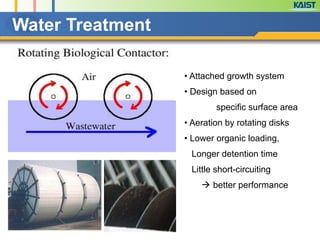
• Attached growth system
• Design based on
specific surface area
• Aeration by rotating disks
• Lower organic loading,
Longer detention time
Little short-circuiting
! better performance
Water Treatment
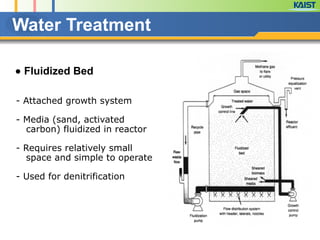
● Fluidized Bed
- Attached growth system
!
- Media (sand, activated
carbon) fluidized in reactor
!
- Requires relatively small
space and simple to operate
!
- Used for denitrification
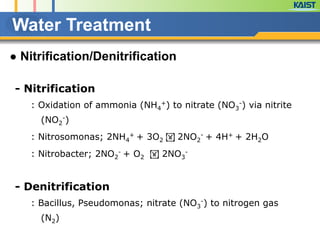
● Nitrification/Denitrification
- Nitrification
: Oxidation of ammonia (NH4
+) to nitrate (NO3
-) via nitrite
(NO2
-)
: Nitrosomonas; 2NH4
+ + 3O2 ! 2NO2
- + 4H+ + 2H2O
: Nitrobacter; 2NO2
- + O2 ! 2NO3
-
!
- Denitrification
: Bacillus, Pseudomonas; nitrate (NO3
-) to nitrogen gas
(N2)
Water Treatment
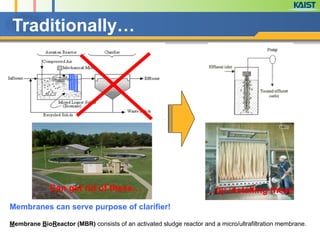
Traditionally…
Membranes can serve purpose of clarifier!
Can get rid of these… …by installing these
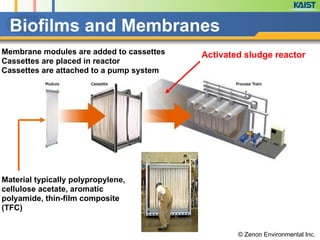
Membrane BioReactor (MBR) consists of an activated sludge reactor and a micro/ultrafiltration membrane.
Biofilms and Membranes
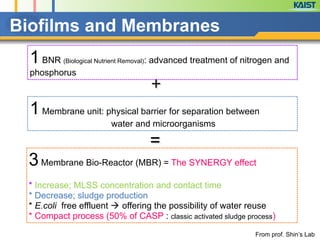
1BNR (Biological Nutrient Removal): advanced treatment of nitrogen and
phosphorus
1Membrane unit: physical barrier for separation between
water and microorganisms
3Membrane Bio-Reactor (MBR) = The SYNERGY effect
!
* Increase; MLSS concentration and contact time
* Decrease; sludge production
* E.coli free effluent ! offering the possibility of water reuse
* Compact process (50% of CASP : classic activated sludge process)
+
=
From prof. Shin’s Lab
Activated sludge reactorMembrane modules are added to cassettes
Cassettes are placed in reactor
Cassettes are attached to a pump system
© Zenon Environmental Inc.
Material typically polypropylene,
cellulose acetate, aromatic
polyamide, thin-film composite
(TFC)
Biofilms and Membranes
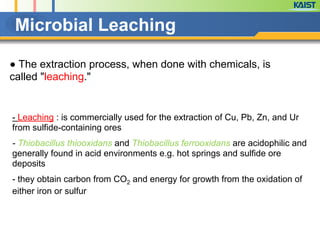
● The extraction process, when done with chemicals, is
called "leaching."
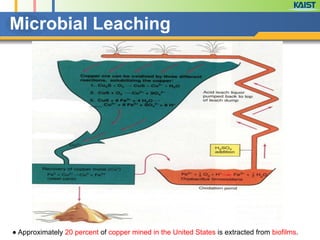
Microbial Leaching
- Leaching : is commercially used for the extraction of Cu, Pb, Zn, and Ur
from sulfide-containing ores
- Thiobacillus thiooxidans and Thiobacillus ferrooxidans are acidophilic and
generally found in acid environments e.g. hot springs and sulfide ore
deposits
- they obtain carbon from CO2 and energy for growth from the oxidation of
either iron or sulfur
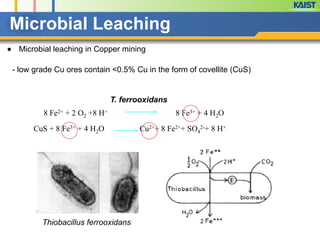
- low grade Cu ores contain <0.5% Cu in the form of covellite (CuS)
8 Fe2+ + 2 O2 +8 H+ 8 Fe3+ + 4 H2O
CuS + 8 Fe3+ + 4 H2O Cu2++ 8 Fe2++ SO4
2-+ 8 H+
T. ferrooxidans
● Microbial leaching in Copper mining
Microbial Leaching
Thiobacillus ferrooxidans
Microbial Leaching
● Approximately 20 percent of copper mined in the United States is extracted from biofilms. 

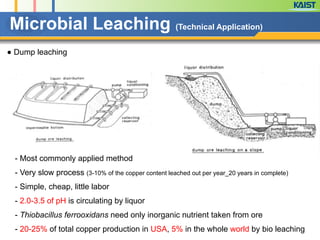
● Dump leaching
Microbial Leaching (Technical Application)
- Most commonly applied method
- Very slow process (3-10% of the copper content leached out per year_20 years in complete)
- Simple, cheap, little labor
- 2.0-3.5 of pH is circulating by liquor
- Thiobacillus ferrooxidans need only inorganic nutrient taken from ore
- 20-25% of total copper production in USA, 5% in the whole world by bio leaching
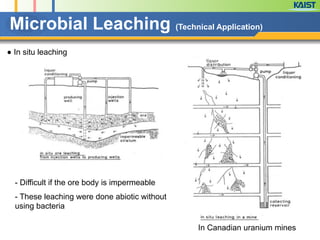
● In situ leaching
Microbial Leaching (Technical Application)
- Difficult if the ore body is impermeable
- These leaching were done abiotic without
using bacteria
In Canadian uranium mines
Elect
ron
trans
port
chai
n of
cell
CO2
Mox
Mred
An
od
e
Sol
id
ele
ctr
oly
te
Ca
tho
de
V
O2
H2O
H+
Organics
Electron
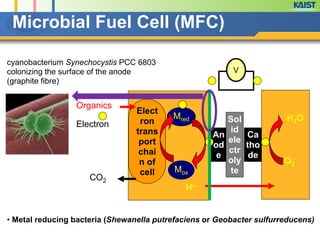
• Metal reducing bacteria (Shewanella putrefaciens or Geobacter sulfurreducens)
Microbial Fuel Cell (MFC)
cyanobacterium Synechocystis PCC 6803
colonizing the surface of the anode
(graphite fibre)
Contents
General information1
Application (Positive parts)2
3 Problems (Negative parts)
Environmental Application
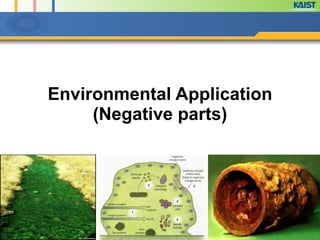
(Negative parts)
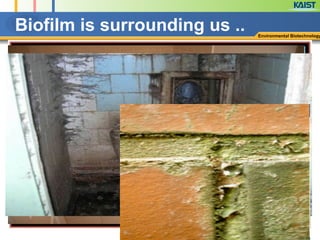
Biofilm is surrounding us .. Environmental Biotechnology
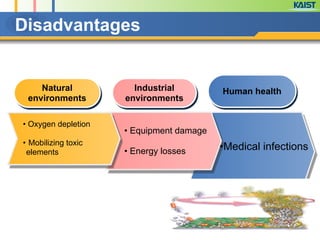
Disadvantages
Natural
environments
Industrial
environments
Human health
• Oxygen depletion
!
• Mobilizing toxic
elements
!
• Equipment damage
!
• Energy losses •Medical infections
In natural environments
● Biofilms grow virtually everywhere
● Moisture
● Nutrients
● Surface
!
!
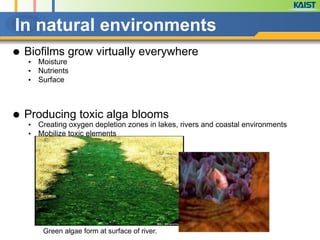
● Producing toxic alga blooms
● Creating oxygen depletion zones in lakes, rivers and coastal environments
● Mobilize toxic elements
Green algae form at surface of river.
Mobilizing toxic elements
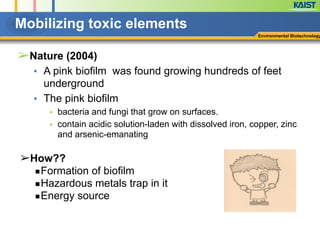
➢Nature (2004)
■ A pink biofilm was found growing hundreds of feet
underground
■ The pink biofilm
■ bacteria and fungi that grow on surfaces.
■ contain acidic solution-laden with dissolved iron, copper, zinc
and arsenic-emanating
Environmental Biotechnology
➢How??
▪Formation of biofilm
▪Hazardous metals trap in it
▪Energy source
!
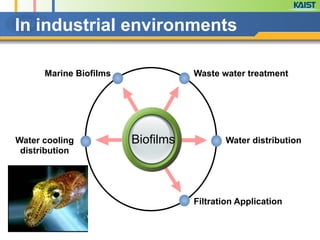
In industrial environments
Waste water treatmentMarine Biofilms
Water distribution
Filtration Application
Water cooling
distribution
Biofilms
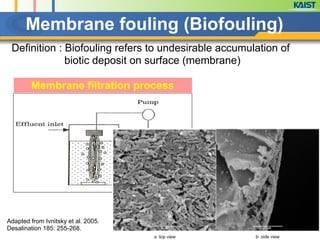
Membrane fouling (Biofouling)
Definition : Biofouling refers to undesirable accumulation of
biotic deposit on surface (membrane)
Membrane filtration process
Adapted from Ivnitsky et al. 2005.
Desalination 185: 255-268.
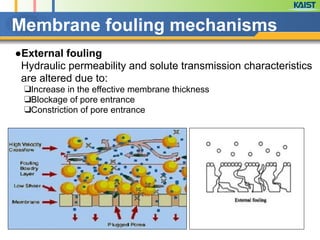
Membrane fouling mechanisms
●External fouling
Hydraulic permeability and solute transmission characteristics
are altered due to:
❑Increase in the effective membrane thickness
❑Blockage of pore entrance
❑Constriction of pore entrance
Environmental Biotechnology
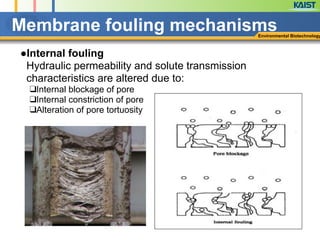
Membrane fouling mechanisms
●Internal fouling
Hydraulic permeability and solute transmission
characteristics are altered due to:
❑Internal blockage of pore
❑Internal constriction of pore
❑Alteration of pore tortuosity
!
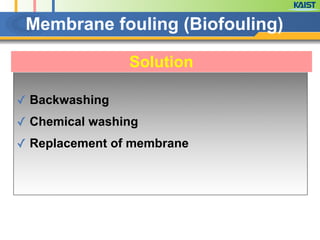
Membrane fouling (Biofouling)
Solution
✓ Backwashing
✓ Chemical washing
✓ Replacement of membrane
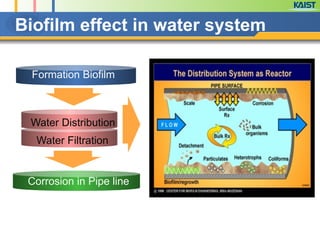
Biofilm effect in water system
Water Distribution
Water Filtration
Formation Biofilm
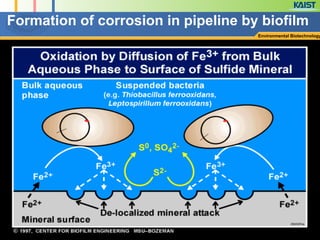
Corrosion in Pipe line
Environmental Biotechnology
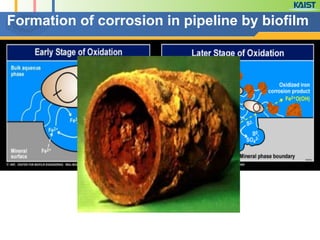
Formation of corrosion in pipeline by biofilm


Formation of corrosion in pipeline by biofilm


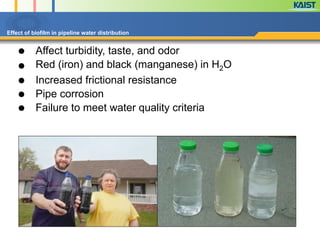
● Affect turbidity, taste, and odor
● Red (iron) and black (manganese) in H2O
● Increased frictional resistance
● Pipe corrosion
● Failure to meet water quality criteria


Effect of biofilm in pipeline water distribution

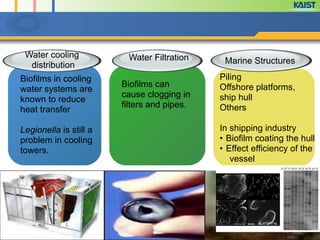
Water cooling
distribution
Biofilms in cooling
water systems are
known to reduce
heat transfer
!
Legionella is still a
problem in cooling
towers.
!
Biofilms can
cause clogging in
filters and pipes.
!
!
!
Piling
Offshore platforms,
ship hull
Others
!
In shipping industry
• Biofilm coating the hull
• Effect efficiency of the
vessel
!
!
Marine StructuresWater Filtration
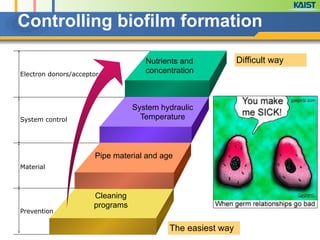
Electron donors/acceptor
System control
Material
Prevention
Controlling biofilm formation
System hydraulic
Temperature
Cleaning
programs
Nutrients and
concentration
Pipe material and age
Difficult way
The easiest way
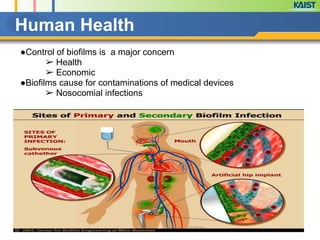
Human Health
●Control of biofilms is a major concern
➢ Health
➢ Economic
●Biofilms cause for contaminations of medical devices
➢ Nosocomial infections
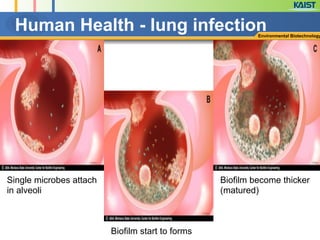
Human Health - lung infectionEnvironmental Biotechnology
Single microbes attach
in alveoli
Biofilm start to forms
Biofilm become thicker
(matured)
Environmental Biotechnology
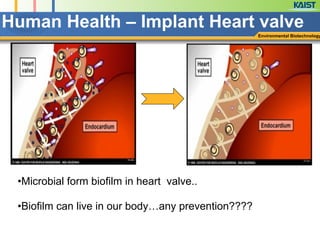
Human Health – Implant Heart valve
•Microbial form biofilm in heart valve..
!
•Biofilm can live in our body…any prevention????
Environmental Biotechnology
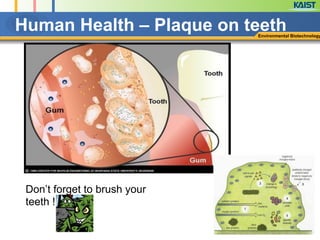
Human Health – Plaque on teeth
Don’t forget to brush your
teeth !!!!!
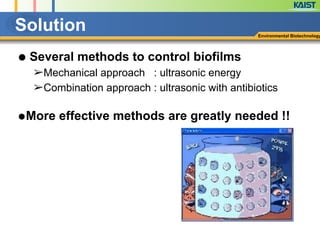
Solution
● Several methods to control biofilms
➢Mechanical approach : ultrasonic energy
➢Combination approach : ultrasonic with antibiotics
!
●More effective methods are greatly needed !!
Environmental Biotechnology
!
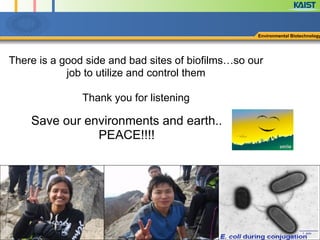
There is a good side and bad sites of biofilms…so our
job to utilize and control them
!
Thank you for listening
Save our environments and earth..
PEACE!!!!
Thank You !
Any questions and comments???

Biofilm

  • 1.
  • 2.
    Contents General information1 Application (Positiveparts)2 3 Problems (Negative parts)
  • 3.
    A structured community ofbacterial cells Enclosed in a self-produced extracellular polymeric substance(EPS) Structure EPS Surface Adherent to an inert or living surface Biofilms
  • 4.
  • 5.
    Environmental Biotechnology Biofilm Development Phasesof Biofilm Growth ● Attachment: adhesion ● Growth: proliferation and differentiation -Quorum-sensing involved ● Detachment
  • 6.
    Attachment and GrowthEnvironmental Biotechnology (EPS)
  • 7.
    Detachment Environmental Biotechnology ●Abrasion -Direct physical contact with biofilm structure ● Erosion -shear forces exerted on the biofilm ● Sloughing -Result of chemical changes -Regulated by the biofilm community ● Enzymatic EPS degradation
  • 8.
    Biofilm Formation (Detailed)Environmental Biotechnology Free cells
  • 9.
    Affecting Factors EnvironmentalBiotechnology ● Adhesion (Attachment) ! -Nature of surface and environment -Charge and shape of surface -Hydrophobicity -Flow characteristics ● Biofilm Growth ! -Available nutrient -Nature of biofilm (aerobic and anaerobic areas) -Heterogeneous versus homogeneous populations
  • 10.
    Factors affecting theshape of biofilm Environmental Biotechnology Slow flow-Rough surface Flow Characteristic Fast flow-Smooth Surface Lack of nutirent-Finger surface Sufficient nutirent-Compact surface Available nutrients
  • 11.
    Multispecies Biofilm inRumen Environmental Biotechnology
  • 12.
    Biofilms – Thesocial life of microorganism More than 99 % of all microorganisms on earth prefer to live in biofilms WHY ? ! 7 secrets of the Good Life in Biofilms
  • 13.
    Secret #1: EPS-TheHouse of Biofilms Cells ● What is EPS? -A high-molecular-weight polymer that is composed of polysaccharides, proteins, nucleic acids, lipids and other biological macromolecules -Secreted by a micro-organism into the surrounding environment ! ! ● What does EPS do? -Envelops cells and helps the aggregates adhere to surfaces
  • 14.
    What does EPSkeep together? Environmental Biotechnology Weak Interactions
  • 15.
    ● 50% ormore of void in biofilm volume ! ●Flux of oxygen into the biofilm is not simply planar -Flux from void spaces -Flux from channels ! ●Oxygen can penetrate to substratum ! ●No oxygen found inside dense cell aggregates ! ●Heterogeneity of oxygen distribution causes heterogeneous growth Secret #2 Oxygen Gradients Environmental Biotechnology Water channels Substratum
  • 16.
    Secret #3 Microconsortia
 ! ● Methane-oxidizing cell aggregates from marine sediments. The aggregates contain methanogenic bacteria (red) surrounded by sulfate-reducing bacteria (green). ! ● Possible mechanism for syntrophic anoxic methane oxidation in the cell aggregates. Environmental Biotechnology
  • 17.
    Secret #4 Resistantto Antimicrobial Compounds 1. Slow growers are spared the effects of antibiotic drugs which is effective against fast-growing cells. 2. Intracellular signals can alter the physiology of the biofilm. 3. Negatively charged biofilm binds to positively charged antimicrobials. 4. Persister cells do not grow or die in the presence of an antibiotic. 5. Population diversity – improve the chance to survive anyhow
  • 18.
    Secret #5 NutrientSequestration Environmental Biotechnology Cell Cell Particles EPS
  • 19.
    Secret #6 Densitydependent communicationEnvironmental Biotechnology ● First observed in Vibrio fischeri ●Bioluminescence : -Only happens when - population density reaches a certain level. -Brighter during the nighttime -Protection against – :Ultraviolet radiation damage to genes of V.fischeri :The pathogenicity of bioluminescent V. fischeri Euprymna scolopes– Host of V.fischeri V.fischeri Formation of biofilm is needed to develop the symbiotic relationship
  • 20.
    Secret #7 Sex(as horizontal gene transfer) ● High cell density in biofilms ! ● Gene exchange facilitated Environmental Biotechnology male female Sex pilus
  • 21.
    Advantages of “theBiofilm Mode of Life” Environmental Biotechnology ●Provide defense -Physical forces -Phagocytosis -Penetration of antimicrobials ! ●Provide favorable microniche -Can attach to nutrient rich surfaces -Can attach to surface in flowing systems -Fixes the bacterial cells where the nutrients are either abundant or often replenished ! ●Allow microbes to live in close proximity -Facilitates communication and cooperation -Can result in genetic exchange ! ●Nature’s default -Best mode of growth in the “real world” Cellular process of engulfing solid particles by the cell membrane for the acquisition of nutrients
  • 22.
    How is aBiofilm like a CITY? Careful selection of locationLimited settlement of too many microorganism Storage of energy (EPS) Intracellular communication (Quorum Sensing) Transfer of information (genetic transfer) Emigration when population gets Too large for resources Biofilm City
  • 23.
    Contents General information1 Application (Positiveparts)2 3 Problems (Negative parts)
  • 24.
  • 25.
    Beneficial Biofilms ● Manyplay an important role in the ecology of the earth and the sustainability of life in general. - The report, "Global Environmental Change”:. Microbes have major roles in the recycling of elements vital to life." ! - We are learning, those microbes often live in biofilm colonies on surfaces.
 Bioremediation Water treatment Microbial Fuel Cell Microbial Leaching
  • 26.
  • 27.
    Bioremediation ● Soil Biofilms -Continuous surface films (5-15 um in thickness) - Variety of aggregate films (5-30 um in diameter) - EPS, extracellular polymeric substances, which protrude from the surface film and form bridges to adjacent sand grains Confocal micrograph of biofilm on sand particles
  • 28.
    ● Biofilm enhancesbioavailability -Polynuclear Aromatic Hydrocarbons (PAHs): two or more fused benzene rings Hydrophobic and low bioavailable - Strategies to promote bioavailability EPS Biofilm production Bioremediation
  • 29.
    ● Bioavailability Enhancement -Some EPS (e.g., sphingan): effective at taking up PAHs ! : PAHs taken up by these polysaccharides are bioavailable ! : EPS acts to temporarily store pollutants for use during periods of nutrient deficiency ! : During periods of high nutrient delivery, bacteria may utilize available nutrients and collect hydrophobic contaminants for later use Bioremediation
  • 30.
  • 31.
    Water Treatment - Oldestdesign - 1-4” rocks, variety of plastic packing materials Water flows as thin film over rocks, most of area is void space open to air. Detached biofilm settles out, is dewatered and disposed of. ● Trickling filter ● Biological tower - Plastic media, not rocks (lighter) - Higher Surface Area - Smaller land area
  • 32.
    Water Treatment • Attachedgrowth system • Design based on specific surface area • Aeration by rotating disks • Lower organic loading, Longer detention time Little short-circuiting ! better performance
  • 33.
    Water Treatment ● FluidizedBed - Attached growth system ! - Media (sand, activated carbon) fluidized in reactor ! - Requires relatively small space and simple to operate ! - Used for denitrification
  • 34.
    ● Nitrification/Denitrification - Nitrification :Oxidation of ammonia (NH4 +) to nitrate (NO3 -) via nitrite (NO2 -) : Nitrosomonas; 2NH4 + + 3O2 ! 2NO2 - + 4H+ + 2H2O : Nitrobacter; 2NO2 - + O2 ! 2NO3 - ! - Denitrification : Bacillus, Pseudomonas; nitrate (NO3 -) to nitrogen gas (N2) Water Treatment
  • 35.
    Traditionally… Membranes can servepurpose of clarifier! Can get rid of these… …by installing these Membrane BioReactor (MBR) consists of an activated sludge reactor and a micro/ultrafiltration membrane.
  • 36.
    Biofilms and Membranes 1BNR(Biological Nutrient Removal): advanced treatment of nitrogen and phosphorus 1Membrane unit: physical barrier for separation between water and microorganisms 3Membrane Bio-Reactor (MBR) = The SYNERGY effect ! * Increase; MLSS concentration and contact time * Decrease; sludge production * E.coli free effluent ! offering the possibility of water reuse * Compact process (50% of CASP : classic activated sludge process) + = From prof. Shin’s Lab
  • 37.
    Activated sludge reactorMembranemodules are added to cassettes Cassettes are placed in reactor Cassettes are attached to a pump system © Zenon Environmental Inc. Material typically polypropylene, cellulose acetate, aromatic polyamide, thin-film composite (TFC) Biofilms and Membranes
  • 38.
    ● The extractionprocess, when done with chemicals, is called "leaching." Microbial Leaching - Leaching : is commercially used for the extraction of Cu, Pb, Zn, and Ur from sulfide-containing ores - Thiobacillus thiooxidans and Thiobacillus ferrooxidans are acidophilic and generally found in acid environments e.g. hot springs and sulfide ore deposits - they obtain carbon from CO2 and energy for growth from the oxidation of either iron or sulfur
  • 39.
    - low gradeCu ores contain <0.5% Cu in the form of covellite (CuS) 8 Fe2+ + 2 O2 +8 H+ 8 Fe3+ + 4 H2O CuS + 8 Fe3+ + 4 H2O Cu2++ 8 Fe2++ SO4 2-+ 8 H+ T. ferrooxidans ● Microbial leaching in Copper mining Microbial Leaching Thiobacillus ferrooxidans
  • 40.
    Microbial Leaching ● Approximately20 percent of copper mined in the United States is extracted from biofilms. 

  • 41.
    ● Dump leaching MicrobialLeaching (Technical Application) - Most commonly applied method - Very slow process (3-10% of the copper content leached out per year_20 years in complete) - Simple, cheap, little labor - 2.0-3.5 of pH is circulating by liquor - Thiobacillus ferrooxidans need only inorganic nutrient taken from ore - 20-25% of total copper production in USA, 5% in the whole world by bio leaching
  • 42.
    ● In situleaching Microbial Leaching (Technical Application) - Difficult if the ore body is impermeable - These leaching were done abiotic without using bacteria In Canadian uranium mines
  • 43.
    Elect ron trans port chai n of cell CO2 Mox Mred An od e Sol id ele ctr oly te Ca tho de V O2 H2O H+ Organics Electron • Metalreducing bacteria (Shewanella putrefaciens or Geobacter sulfurreducens) Microbial Fuel Cell (MFC) cyanobacterium Synechocystis PCC 6803 colonizing the surface of the anode (graphite fibre)
  • 44.
    Contents General information1 Application (Positiveparts)2 3 Problems (Negative parts)
  • 45.
  • 46.
    Biofilm is surroundingus .. Environmental Biotechnology
  • 47.
    Disadvantages Natural environments Industrial environments Human health • Oxygendepletion ! • Mobilizing toxic elements ! • Equipment damage ! • Energy losses •Medical infections
  • 48.
    In natural environments ●Biofilms grow virtually everywhere ● Moisture ● Nutrients ● Surface ! ! ● Producing toxic alga blooms ● Creating oxygen depletion zones in lakes, rivers and coastal environments ● Mobilize toxic elements Green algae form at surface of river.
  • 49.
    Mobilizing toxic elements ➢Nature(2004) ■ A pink biofilm was found growing hundreds of feet underground ■ The pink biofilm ■ bacteria and fungi that grow on surfaces. ■ contain acidic solution-laden with dissolved iron, copper, zinc and arsenic-emanating Environmental Biotechnology ➢How?? ▪Formation of biofilm ▪Hazardous metals trap in it ▪Energy source !
  • 50.
    In industrial environments Wastewater treatmentMarine Biofilms Water distribution Filtration Application Water cooling distribution Biofilms
  • 51.
    Membrane fouling (Biofouling) Definition: Biofouling refers to undesirable accumulation of biotic deposit on surface (membrane) Membrane filtration process Adapted from Ivnitsky et al. 2005. Desalination 185: 255-268.
  • 52.
    Membrane fouling mechanisms ●Externalfouling Hydraulic permeability and solute transmission characteristics are altered due to: ❑Increase in the effective membrane thickness ❑Blockage of pore entrance ❑Constriction of pore entrance
  • 53.
    Environmental Biotechnology Membrane foulingmechanisms ●Internal fouling Hydraulic permeability and solute transmission characteristics are altered due to: ❑Internal blockage of pore ❑Internal constriction of pore ❑Alteration of pore tortuosity !
  • 54.
    Membrane fouling (Biofouling) Solution ✓Backwashing ✓ Chemical washing ✓ Replacement of membrane
  • 55.
    Biofilm effect inwater system Water Distribution Water Filtration Formation Biofilm Corrosion in Pipe line
  • 56.
    Environmental Biotechnology Formation ofcorrosion in pipeline by biofilm
 

  • 57.
    Formation of corrosionin pipeline by biofilm
 

  • 58.
    ● Affect turbidity,taste, and odor ● Red (iron) and black (manganese) in H2O ● Increased frictional resistance ● Pipe corrosion ● Failure to meet water quality criteria 
 
 Effect of biofilm in pipeline water distribution

  • 59.
    Water cooling distribution Biofilms incooling water systems are known to reduce heat transfer ! Legionella is still a problem in cooling towers. ! Biofilms can cause clogging in filters and pipes. ! ! ! Piling Offshore platforms, ship hull Others ! In shipping industry • Biofilm coating the hull • Effect efficiency of the vessel ! ! Marine StructuresWater Filtration
  • 60.
    Electron donors/acceptor System control Material Prevention Controllingbiofilm formation System hydraulic Temperature Cleaning programs Nutrients and concentration Pipe material and age Difficult way The easiest way
  • 61.
    Human Health ●Control ofbiofilms is a major concern ➢ Health ➢ Economic ●Biofilms cause for contaminations of medical devices ➢ Nosocomial infections
  • 62.
    Human Health -lung infectionEnvironmental Biotechnology Single microbes attach in alveoli Biofilm start to forms Biofilm become thicker (matured)
  • 63.
    Environmental Biotechnology Human Health– Implant Heart valve •Microbial form biofilm in heart valve.. ! •Biofilm can live in our body…any prevention????
  • 64.
    Environmental Biotechnology Human Health– Plaque on teeth Don’t forget to brush your teeth !!!!!
  • 65.
    Solution ● Several methodsto control biofilms ➢Mechanical approach : ultrasonic energy ➢Combination approach : ultrasonic with antibiotics ! ●More effective methods are greatly needed !! Environmental Biotechnology
  • 66.
    Environmental Biotechnology ! There isa good side and bad sites of biofilms…so our job to utilize and control them ! Thank you for listening Save our environments and earth.. PEACE!!!!
  • 67.
    Thank You ! Anyquestions and comments???