





“Microbial fuel cells prepared with Rio
de la Plata river freshwater sediments.
Current production and its relationship
with the change of anodophilic microbial
community.”
Sacco, Natalia; Pataccini, Gabriela; Bonetto, Maria Celina; Figuerola, Eva;
Cortón, Eduardo
E-mail nsacco@qb.fcen.uba.ar
Biosensors and Bioanalysis GroupBiosensors and Bioanalysis Group
Biochemistry Department-School of Sciences
UBA-Ciudad Universitaria
Ciudad Autónoma de Buenos Aires-Argentina
What are 
Microbial Fuel Cells ?
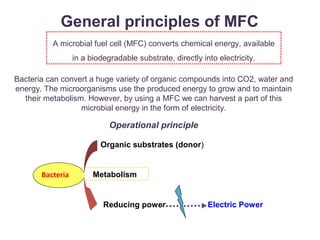
Bacteria
Reducing power
Metabolism
Organic substrates (donor)
Electric Power
Operational principle
A microbial fuel cell (MFC) converts chemical energy, available
in a biodegradable substrate, directly into electricity.
Bacteria can convert a huge variety of organic compounds into CO2, water and
energy. The microorganisms use the produced energy to grow and to maintain
their metabolism. However, by using a MFC we can harvest a part of this
microbial energy in the form of electricity.
General principles of MFC
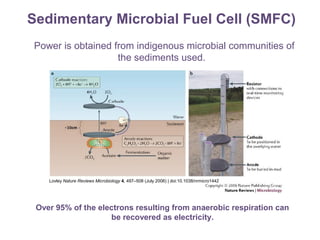
Sedimentary Microbial Fuel Cell (SMFC)
Power is obtained from indigenous microbial communities of
the sediments used.
Over 95% of the electrons resulting from anaerobic respiration can
be recovered as electricity.
Lovley Nature Reviews Microbiology 4, 497–508 (July 2006) | doi:10.1038/nrmicro1442
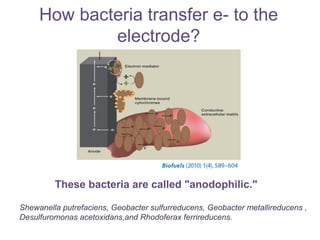
How bacteria transfer e- to the
electrode?
These bacteria are called "anodophilic."
Shewanella putrefaciens, Geobacter sulfurreducens, Geobacter metallireducens ,
Desulfuromonas acetoxidans,and Rhodoferax ferrireducens.
Work Protocol
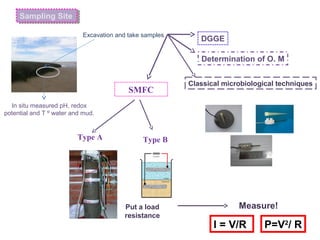
Sampling SiteSampling Site
Excavation and take samples
SMFC
In situ measured pH, redox
potential and T º water and mud.
Put a load
resistance
Type BType A
Measure!
Sampling SiteSampling Site
DGGE
Determination of O. M
P=V2
/ RI = V/R
Classical microbiological techniques
Results
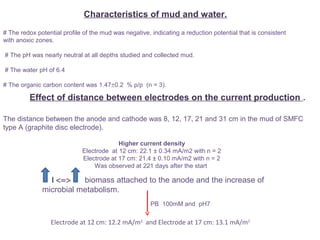
Effect of distance between electrodes on the current production .
The distance between the anode and cathode was 8, 12, 17, 21 and 31 cm in the mud of SMFC
type A (graphite disc electrode).
Higher current density
Electrode at 12 cm: 22.1 ± 0.34 mA/m2 with n = 2
Electrode at 17 cm: 21.4 ± 0.10 mA/m2 with n = 2
Was observed at 221 days after the start
I <=> biomass attached to the anode and the increase of
microbial metabolism.
PB 100mM and pH7
Electrode at 12 cm: 12.2 mA/m2
and Electrode at 17 cm: 13.1 mA/m2
Characteristics of mud and water.
# The redox potential profile of the mud was negative, indicating a reduction potential that is consistent
with anoxic zones.
# The pH was nearly neutral at all depths studied and collected mud.
# The water pH of 6.4
# The organic carbon content was 1.47±0.2 % p/p (n = 3).
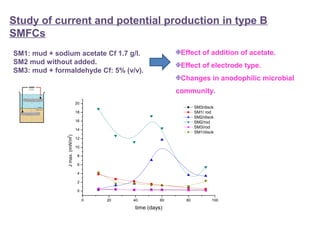
Study of current and potential production in type B 
SMFCs
SM1: mud + sodium acetate Cf 1.7 g/l. 
SM2 mud without added.
SM3: mud + formaldehyde Cf: 5% (v/v). 
Effect of addition of acetate.
Effect of electrode type.
Changes in anodophilic microbial 
community.
SM3/disck
SM1/ rod
SM2/disck
SM2/rod
SM3/rod
SM1/disck
0 20 40 60 80 100
0
2
4
6
8
10
12
14
16
18
20
Jmax.(mW/m
2
)
time (days)
A) SM1 (with acetate)
    
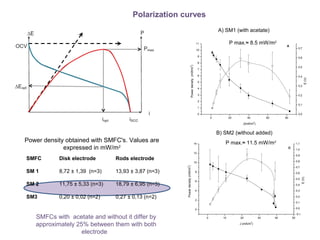
Polarization curves
Power density obtained with SMFC's. Values are
expressed in mW/m2
SMFCs with acetate and without it differ by
approximately 25% between them with both
electrode
0 20 40 60 80
0
1
2
3
4
5
6
7
8
9
10
11
J(mA/m
2
)
Powerdensity(mW/m
2
)
A
0,0
0,1
0,2
0,3
0,4
0,5
0,6
0,7
E(V)
0 10 20 30 40 50
0
2
4
6
8
10
12
14
J (mA/m
2
)
Powerdensity(mW/m
2
)
-0,1
0,0
0,1
0,2
0,3
0,4
0,5
0,6
0,7
0,8
0,9
1,0
1,1
E(V)
B
SMFC Disk electrode  Rods electrode 
SM 1 8,72 ± 1,39 (n=3) 13,93 ± 3,87 (n=3)
SM 2 11,75 ± 5,33 (n=3) 18,79 ± 6,95 (n=3)
SM3 0,20 ± 0,02 (n=2) 0,27 ± 0,13 (n=2)
P max.≈ 8.5 mW/m2
P max.≈ 11.5 mW/m2
B) SM2 (without added)
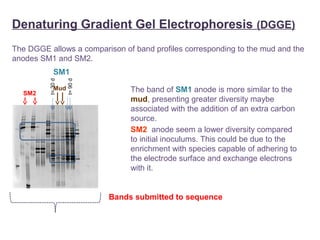
Denaturing Gradient Gel Electrophoresis (DGGE)
The DGGE allows a comparison of band profiles corresponding to the mud and the
anodes SM1 and SM2.
The band of SM1 anode is more similar to the
mud, presenting greater diversity maybe
associated with the addition of an extra carbon
source.
t=30d
t=90d
SM2  anode seem a lower diversity compared
to initial inoculums. This could be due to the
enrichment with species capable of adhering to
the electrode surface and exchange electrons
with it.
Bands submitted to sequence
SM2
SM1
Mud
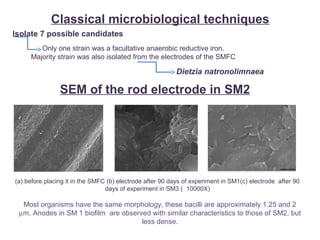
SEM of the rod electrode in SM2
(a) before placing it in the SMFC (b) electrode after 90 days of experiment in SM1(c) electrode after 90
days of experiment in SM3 ( 10000X)
Most organisms have the same morphology, these bacilli are approximately 1.25 and 2
µm. Anodes in SM 1 biofilm are observed with similar characteristics to those of SM2, but
less dense.
Classical microbiological techniques
Isolate 7 possible candidates
Only one strain was a facultative anaerobic reductive iron.
Majority strain was also isolated from the electrodes of the SMFC
Dietzia natronolimnaea
Conclusions
 Compared the power densities obtained with both electrode (rod and disk),
the maximum power was observed with rod electrodes, a very cheap and accessible
material.
 The addition of acetate to the sedimentary pile did not have a positive
effect on power generation.
 Our set-up shows a small portion of the potential of the mud of the river “Rio de La
Plata”, because the organic matter in SMFC was never renewed.
 We had a first approximation of the change in the anodophilic microbial community.
Our results with our SMFC, based on freshwater sediments have show
a performance comparable to the values obtained with SMFC in the marine​​
environment. Note that this is the first study of a SMFC with Rio de La Plata
river freshwater sediments.
THANK YOU FOR YOUR
ATTENTION!
I´m Willing to Hear your Suggestions
and Answer your Questions
Integrantes
Dra. Abrevaya Ximena
Lic. Bonetto Maria Celina
Sr. Figueredo Federico
Lic. Forte Giacobone Ana
Lic. Hilding Ohlsson Astrid
Srta Gabriela Pataccini
Sr. Nuñez Pablo
Lic. Rithner Liliana
Lic. Sacco Natalia
Director: Dr. Cortón Eduardo
Study the production of energy
from mud from the river “ Rio de La
Plata” throught the use of
sedimentary microbial fuel cell and
their relationship to changes at
anodophilic microbial community
Types of microbial fuel cells
First generation: using soluble mediators (neutral red,
methylene blue, etc..) to transfer electrons from cells to the
electrode.
Second generation: the electrons are transfered through
the reduction and oxidation of sulfur compounds.
Third generation: electron transfer is made directly to
the electrodes.

Microbial fuel cell

  • 1.
    “Microbial fuel cellsprepared with Rio de la Plata river freshwater sediments. Current production and its relationship with the change of anodophilic microbial community.” Sacco, Natalia; Pataccini, Gabriela; Bonetto, Maria Celina; Figuerola, Eva; Cortón, Eduardo E-mail nsacco@qb.fcen.uba.ar Biosensors and Bioanalysis GroupBiosensors and Bioanalysis Group Biochemistry Department-School of Sciences UBA-Ciudad Universitaria Ciudad Autónoma de Buenos Aires-Argentina
  • 2.
  • 3.
    Bacteria Reducing power Metabolism Organic substrates(donor) Electric Power Operational principle A microbial fuel cell (MFC) converts chemical energy, available in a biodegradable substrate, directly into electricity. Bacteria can convert a huge variety of organic compounds into CO2, water and energy. The microorganisms use the produced energy to grow and to maintain their metabolism. However, by using a MFC we can harvest a part of this microbial energy in the form of electricity. General principles of MFC
  • 4.
    Sedimentary Microbial FuelCell (SMFC) Power is obtained from indigenous microbial communities of the sediments used. Over 95% of the electrons resulting from anaerobic respiration can be recovered as electricity. Lovley Nature Reviews Microbiology 4, 497–508 (July 2006) | doi:10.1038/nrmicro1442
  • 5.
    How bacteria transfere- to the electrode? These bacteria are called "anodophilic." Shewanella putrefaciens, Geobacter sulfurreducens, Geobacter metallireducens , Desulfuromonas acetoxidans,and Rhodoferax ferrireducens.
  • 6.
  • 7.
  • 8.
    Excavation and takesamples SMFC In situ measured pH, redox potential and T º water and mud. Put a load resistance Type BType A Measure! Sampling SiteSampling Site DGGE Determination of O. M P=V2 / RI = V/R Classical microbiological techniques
  • 9.
  • 10.
    Effect of distancebetween electrodes on the current production . The distance between the anode and cathode was 8, 12, 17, 21 and 31 cm in the mud of SMFC type A (graphite disc electrode). Higher current density Electrode at 12 cm: 22.1 ± 0.34 mA/m2 with n = 2 Electrode at 17 cm: 21.4 ± 0.10 mA/m2 with n = 2 Was observed at 221 days after the start I <=> biomass attached to the anode and the increase of microbial metabolism. PB 100mM and pH7 Electrode at 12 cm: 12.2 mA/m2 and Electrode at 17 cm: 13.1 mA/m2 Characteristics of mud and water. # The redox potential profile of the mud was negative, indicating a reduction potential that is consistent with anoxic zones. # The pH was nearly neutral at all depths studied and collected mud. # The water pH of 6.4 # The organic carbon content was 1.47±0.2 % p/p (n = 3).
  • 11.
  • 12.
    A) SM1 (withacetate)      Polarization curves Power density obtained with SMFC's. Values are expressed in mW/m2 SMFCs with acetate and without it differ by approximately 25% between them with both electrode 0 20 40 60 80 0 1 2 3 4 5 6 7 8 9 10 11 J(mA/m 2 ) Powerdensity(mW/m 2 ) A 0,0 0,1 0,2 0,3 0,4 0,5 0,6 0,7 E(V) 0 10 20 30 40 50 0 2 4 6 8 10 12 14 J (mA/m 2 ) Powerdensity(mW/m 2 ) -0,1 0,0 0,1 0,2 0,3 0,4 0,5 0,6 0,7 0,8 0,9 1,0 1,1 E(V) B SMFC Disk electrode  Rods electrode  SM 1 8,72 ± 1,39 (n=3) 13,93 ± 3,87 (n=3) SM 2 11,75 ± 5,33 (n=3) 18,79 ± 6,95 (n=3) SM3 0,20 ± 0,02 (n=2) 0,27 ± 0,13 (n=2) P max.≈ 8.5 mW/m2 P max.≈ 11.5 mW/m2 B) SM2 (without added)
  • 13.
    Denaturing Gradient Gel Electrophoresis (DGGE) The DGGE allowsa comparison of band profiles corresponding to the mud and the anodes SM1 and SM2. The band of SM1 anode is more similar to the mud, presenting greater diversity maybe associated with the addition of an extra carbon source. t=30d t=90d SM2  anode seem a lower diversity compared to initial inoculums. This could be due to the enrichment with species capable of adhering to the electrode surface and exchange electrons with it. Bands submitted to sequence SM2 SM1 Mud
  • 14.
    SEM of the rod electrode in SM2 (a) before placingit in the SMFC (b) electrode after 90 days of experiment in SM1(c) electrode after 90 days of experiment in SM3 ( 10000X) Most organisms have the same morphology, these bacilli are approximately 1.25 and 2 µm. Anodes in SM 1 biofilm are observed with similar characteristics to those of SM2, but less dense. Classical microbiological techniques Isolate 7 possible candidates Only one strain was a facultative anaerobic reductive iron. Majority strain was also isolated from the electrodes of the SMFC Dietzia natronolimnaea
  • 15.
  • 16.
     Compared thepower densities obtained with both electrode (rod and disk), the maximum power was observed with rod electrodes, a very cheap and accessible material.  The addition of acetate to the sedimentary pile did not have a positive effect on power generation.  Our set-up shows a small portion of the potential of the mud of the river “Rio de La Plata”, because the organic matter in SMFC was never renewed.  We had a first approximation of the change in the anodophilic microbial community. Our results with our SMFC, based on freshwater sediments have show a performance comparable to the values obtained with SMFC in the marine​​ environment. Note that this is the first study of a SMFC with Rio de La Plata river freshwater sediments.
  • 17.
    THANK YOU FORYOUR ATTENTION! I´m Willing to Hear your Suggestions and Answer your Questions Integrantes Dra. Abrevaya Ximena Lic. Bonetto Maria Celina Sr. Figueredo Federico Lic. Forte Giacobone Ana Lic. Hilding Ohlsson Astrid Srta Gabriela Pataccini Sr. Nuñez Pablo Lic. Rithner Liliana Lic. Sacco Natalia Director: Dr. Cortón Eduardo
  • 18.
    Study the productionof energy from mud from the river “ Rio de La Plata” throught the use of sedimentary microbial fuel cell and their relationship to changes at anodophilic microbial community
  • 19.
    Types of microbialfuel cells First generation: using soluble mediators (neutral red, methylene blue, etc..) to transfer electrons from cells to the electrode. Second generation: the electrons are transfered through the reduction and oxidation of sulfur compounds. Third generation: electron transfer is made directly to the electrodes.