Volhard’s Method
A Type Of Argentometric Titration
ARGENTOMETRIC TITRATION:
                 Argentometry is derived from a Latin word
Argentum, which means Silver. Argentometry is a type of
titration involving the Silver ion.

METHODS OF ARGENTOMETRIC TITRATIONS:
 Argentometric methods involving precipitation titrimetry.

    Mohr’s Method
    Fajan’s Method
    Volhard’s Method
VOLHARD’S METHOD
           The Volhard’s method was first
described by the Jacob Volhard, a German
Chemist, in 1874.
           This is an indirect titration procedure,
used for determining the anions that precipitate
with silver.
STEPS OF VOLHARD’S METHOD:
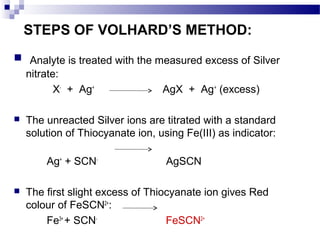
 Analyte is treated with the measured excess of Silver
 nitrate:
        X- + Ag+               AgX + Ag + (excess)

   The unreacted Silver ions are titrated with a standard
    solution of Thiocyanate ion, using Fe(III) as indicator:

        Ag+ + SCN-                 AgSCN

   The first slight excess of Thiocyanate ion gives Red
    colour of FeSCN2+:
        Fe3+ + SCN-                FeSCN2+
Indicators:
   Indicator     End Point Colour

   Ferric alum     Red colour


   Tartrazine     Bright lemon-
                   yellow colour
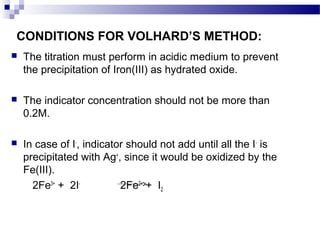
CONDITIONS FOR VOLHARD’S METHOD:
   The titration must perform in acidic medium to prevent
    the precipitation of Iron(III) as hydrated oxide.

   The indicator concentration should not be more than
    0.2M.

   In case of I-, indicator should not add until all the I- is
    precipitated with Ag+, since it would be oxidized by the
    Fe(III).
      2Fe3+ + 2I-          2Fe2+ + I2
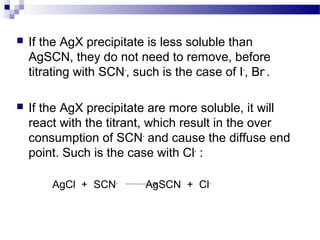
   If the AgX precipitate is less soluble than
    AgSCN, they do not need to remove, before
    titrating with SCN-, such is the case of I-, Br- .

   If the AgX precipitate are more soluble, it will
    react with the titrant, which result in the over
    consumption of SCN- and cause the diffuse end
    point. Such is the case with Cl- :

        AgCl + SCN-         AgSCN + Cl-
To prevent this error the precipitate must be
filtered off, before titrating with SCN-
                    OR
 Add some volume of organic liquid (like
Nitrobenzene, Chloroform), which form a film
around the precipitates.
                     OR
  Use tartrazine as indicator.
DETERMINATION OF ANIONS:
                            Anions whose Silver salts are
    soluble in nitric acid like PO43-, C2O42-, AsO43-, CrO42-, S2-
    are precipitated in neutral solution with excess of Ag+.

    The precipitate is filtered off , dissolve in Nitric acid and
    the Ag+ titrated with SCN-.
                                 OR
    The residual AgNO3 in the filtrate is titrated with SCN-
    after acidification with dilute Nitric acid.



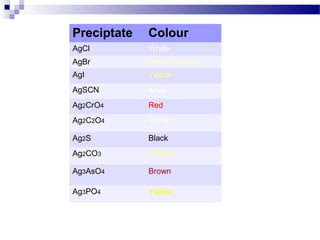
Preciptate   Colour
AgCl         White
AgBr         White(creamy)
AgI          Yellow
AgSCN        white
Ag2CrO4      Red
Ag2C2O4      White

Ag2S         Black
Ag2CO3       Yellow

Ag3AsO4      Brown

Ag3PO4       Yellow
APPLICATIONS OF VOLHARD’S METHOD
    Volhard’s method can be used for the
    determination of :
    Halides (Cl-, Br-,I-).
   Anions like Phosphate, Arsenate, Chromate,
    Sulphide, Carbonate and Oxalate.
   Potassium as Potassium tetraphenyl borate.
   Flouride as Leadchloroflouride.
ADVANTAGES OF VOLHARD’S METHOD

   This method is useful where the titrations have to be
    performed at low pH.

   The strong acidic environment give advantage for halide
    analysis because ions like carbonate, oxalate and
    arsenate do not interfere.

   Give accurate results due to back titration.
LIMITATIONS OF VOLHARD’S METHOD
   Can not be used where the solution has
    to be neutral.

   Time consuming.

   Sometimes adsorption of Ag+ may give false end
    point.
REFERENCES
   D.A. Skoog, D.M. West, F.J. Holler, “Fundamentals
    of Analytical Chemistry” Saunders Philadelphia.

   A.I. Vogel “A Textbook of Quantitative Chemical Analysis”.

   Gary D. Christian “Analytical Chemistry”.
Volhard`s Method

Volhard`s Method

  • 1.
    Volhard’s Method A TypeOf Argentometric Titration
  • 2.
    ARGENTOMETRIC TITRATION: Argentometry is derived from a Latin word Argentum, which means Silver. Argentometry is a type of titration involving the Silver ion. METHODS OF ARGENTOMETRIC TITRATIONS: Argentometric methods involving precipitation titrimetry.  Mohr’s Method  Fajan’s Method  Volhard’s Method
  • 3.
    VOLHARD’S METHOD The Volhard’s method was first described by the Jacob Volhard, a German Chemist, in 1874. This is an indirect titration procedure, used for determining the anions that precipitate with silver.
  • 4.
    STEPS OF VOLHARD’SMETHOD:  Analyte is treated with the measured excess of Silver nitrate: X- + Ag+ AgX + Ag + (excess)  The unreacted Silver ions are titrated with a standard solution of Thiocyanate ion, using Fe(III) as indicator: Ag+ + SCN- AgSCN  The first slight excess of Thiocyanate ion gives Red colour of FeSCN2+: Fe3+ + SCN- FeSCN2+
  • 5.
    Indicators: Indicator End Point Colour Ferric alum Red colour Tartrazine Bright lemon- yellow colour
  • 6.
    CONDITIONS FOR VOLHARD’SMETHOD:  The titration must perform in acidic medium to prevent the precipitation of Iron(III) as hydrated oxide.  The indicator concentration should not be more than 0.2M.  In case of I-, indicator should not add until all the I- is precipitated with Ag+, since it would be oxidized by the Fe(III). 2Fe3+ + 2I- 2Fe2+ + I2
  • 7.
    If the AgX precipitate is less soluble than AgSCN, they do not need to remove, before titrating with SCN-, such is the case of I-, Br- .  If the AgX precipitate are more soluble, it will react with the titrant, which result in the over consumption of SCN- and cause the diffuse end point. Such is the case with Cl- : AgCl + SCN- AgSCN + Cl-
  • 8.
    To prevent thiserror the precipitate must be filtered off, before titrating with SCN- OR Add some volume of organic liquid (like Nitrobenzene, Chloroform), which form a film around the precipitates. OR Use tartrazine as indicator.
  • 9.
    DETERMINATION OF ANIONS: Anions whose Silver salts are soluble in nitric acid like PO43-, C2O42-, AsO43-, CrO42-, S2- are precipitated in neutral solution with excess of Ag+. The precipitate is filtered off , dissolve in Nitric acid and the Ag+ titrated with SCN-. OR The residual AgNO3 in the filtrate is titrated with SCN- after acidification with dilute Nitric acid. 
  • 10.
    Preciptate Colour AgCl White AgBr White(creamy) AgI Yellow AgSCN white Ag2CrO4 Red Ag2C2O4 White Ag2S Black Ag2CO3 Yellow Ag3AsO4 Brown Ag3PO4 Yellow
  • 11.
    APPLICATIONS OF VOLHARD’SMETHOD Volhard’s method can be used for the determination of :  Halides (Cl-, Br-,I-).  Anions like Phosphate, Arsenate, Chromate, Sulphide, Carbonate and Oxalate.  Potassium as Potassium tetraphenyl borate.  Flouride as Leadchloroflouride.
  • 12.
    ADVANTAGES OF VOLHARD’SMETHOD  This method is useful where the titrations have to be performed at low pH.  The strong acidic environment give advantage for halide analysis because ions like carbonate, oxalate and arsenate do not interfere.  Give accurate results due to back titration.
  • 13.
    LIMITATIONS OF VOLHARD’SMETHOD  Can not be used where the solution has to be neutral.  Time consuming.  Sometimes adsorption of Ag+ may give false end point.
  • 14.
    REFERENCES  D.A. Skoog, D.M. West, F.J. Holler, “Fundamentals of Analytical Chemistry” Saunders Philadelphia.  A.I. Vogel “A Textbook of Quantitative Chemical Analysis”.  Gary D. Christian “Analytical Chemistry”.