ABDULHAMID MOHAMED
17.03.2016
 Biopolymers introduction
 Types of biopolymers
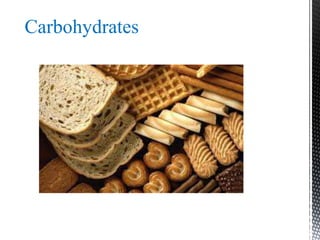
Carbohydrates
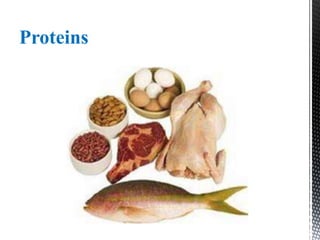
Proteins
Lipids
Nucleic acids
Contents
Biopolymers
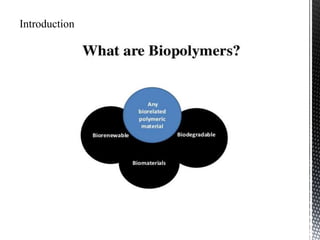
are polymers produced by living
organisms; in other words, they are
polymeric biomolecules.
Since they are polymers, biopolymers
contain monomeric units that are
covalently bonded to form larger
structures.
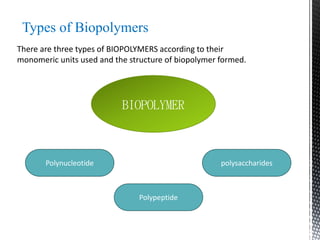
Types of Biopolymers
BIOPOLYMER
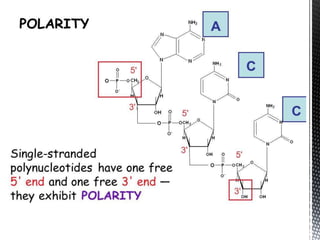
Polynucleotide
Polypeptide
polysaccharides
There are three types of BIOPOLYMERS according to their
monomeric units used and the structure of biopolymer formed.
Biorenewable biopolymers
• Polymers of biological origin
Carbohydrates…..starch
Proteins……haemoglobin
Nucleic acids….DNA
Lipids…..
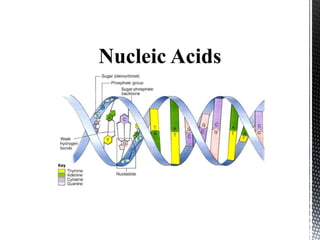
Nucleic Acids
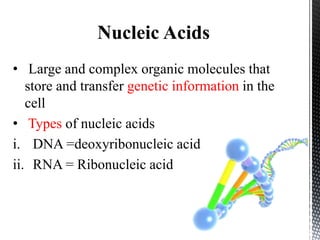
Nucleic Acids
• Large and complex organic molecules that
store and transfer genetic information in the
cell
• Types of nucleic acids
i. DNA =deoxyribonucleic acid
ii. RNA = Ribonucleic acid
Building blocks of Nucleic Acids
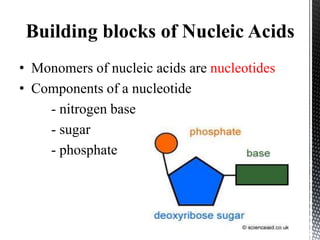
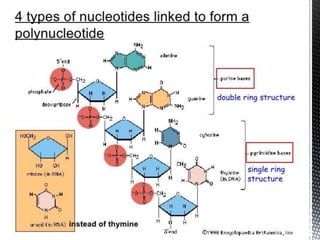
• Monomers of nucleic acids are nucleotides
• Components of a nucleotide
- nitrogen base
- sugar
- phosphate
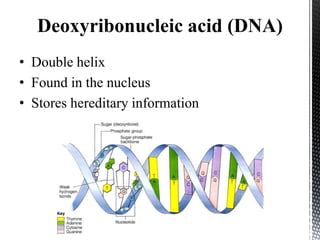
Deoxyribonucleic acid (DNA)
• Double helix
• Found in the nucleus
• Stores hereditary information
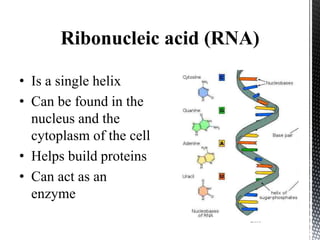
Ribonucleic acid (RNA)
• Is a single helix
• Can be found in the
nucleus and the
cytoplasm of the cell
• Helps build proteins
• Can act as an
enzyme
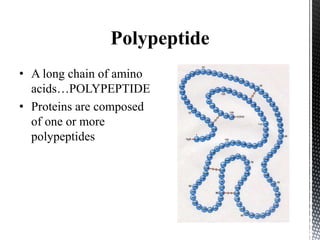
Polypeptide
• A long chain of amino
acids…POLYPEPTIDE
• Proteins are composed
of one or more
polypeptides
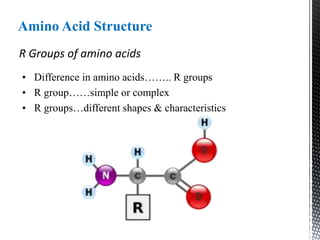
Amino Acid Structure
R Groups of amino acids
• Difference in amino acids…….. R groups
• R group……simple or complex
• R groups…different shapes & characteristics
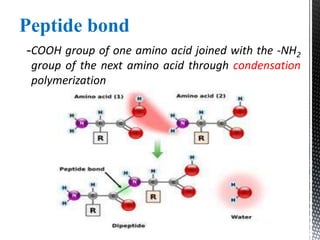
Peptide bond
-COOH group of one amino acid joined with the -NH2
group of the next amino acid through condensation
polymerization
Proteins
Proteins
• Polymers of amino acids covalently linked
through peptide bonds
• Natural organic molecules….C, H, O, N
• Monomers…….amino acids
Building blocks of proteins
• There are 20 different amino acids
• All 20 amino acids share the same basic structure
• Every amino acid contains
- an amino group
- a carboxyl group
- a hydrogen atom
- a central carbon atom
- R (alkyl/aryl) group
Role of Proteins
• Structural roles…….cytoskeleton
• Catalysts……enzymes
• Transporter………ions and molecules
• Hormones
• Many enzymes are proteins
• Biological catalysts
• Lower the activation energy of chemical
reactions
• Increase the rate of chemical reactions
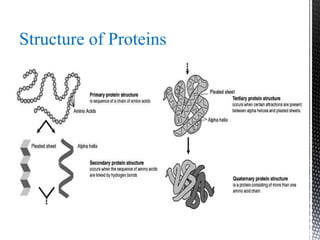
Structure of Proteins
Sensitivity of Proteins
• Temperature
• pH
• Denature proteins
LIPIDS
Lipids
• Large, nonpolar organic molecules
• LIPIDS do NOT Dissolve in Water!
• Have a higher ratio of carbon and hydrogen
atoms to oxygen atoms than carbohydrates
• Lipids store more energy per gram than other
organic compounds
Categories of Lipids
• Fatty Acids
• Triglycerides
• Phospholipids
• Waxes and Oils
• Steroids
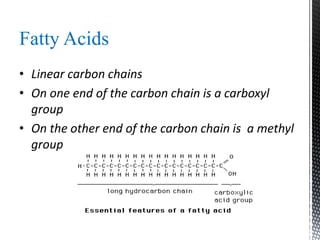
Fatty Acids
• Linear carbon chains
• On one end of the carbon chain is a carboxyl
group
• On the other end of the carbon chain is a methyl
group
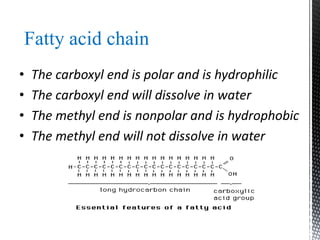
Fatty acid chain
• The carboxyl end is polar and is hydrophilic
• The carboxyl end will dissolve in water
• The methyl end is nonpolar and is hydrophobic
• The methyl end will not dissolve in water
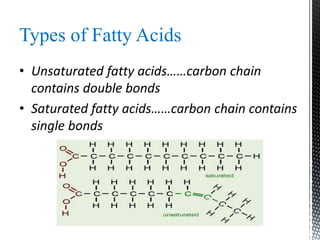
Types of Fatty Acids
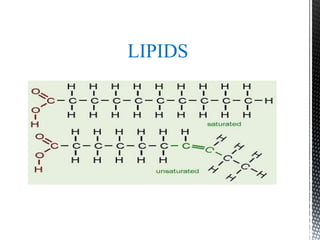
• Unsaturated fatty acids……carbon chain
contains double bonds
• Saturated fatty acids……carbon chain contains
single bonds
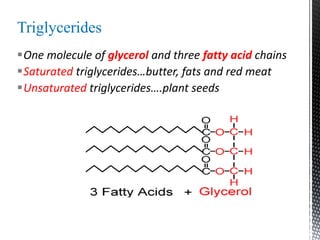
Triglycerides
One molecule of glycerol and three fatty acid chains
Saturated triglycerides…butter, fats and red meat
Unsaturated triglycerides….plant seeds
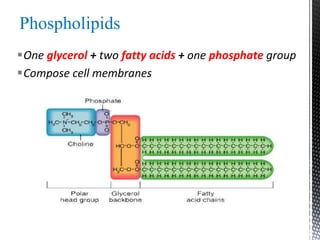
Phospholipids
One glycerol + two fatty acids + one phosphate group
Compose cell membranes
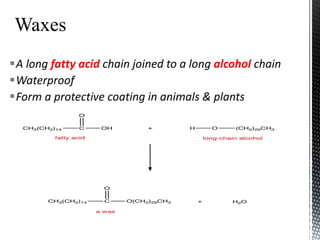
A long fatty acid chain joined to a long alcohol chain
Waterproof
Form a protective coating in animals & plants
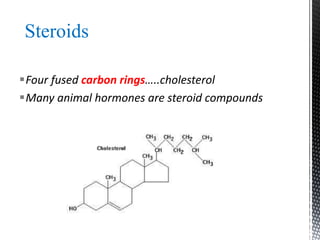
Steroids
Four fused carbon rings…..cholesterol
Many animal hormones are steroid compounds
Carbohydrates
 Carbohydrates are organic compounds
1C:2H:1O
Source of energy……..sugars
Store of energy………..starch
 Structural materials….polysaccharides
 Components of other molecules e.g. DNA, RNA,
glycolipids, glycoproteins
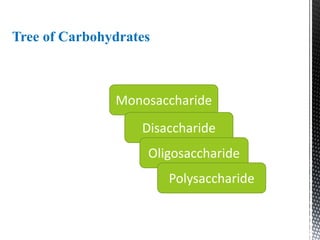
Tree of Carbohydrates
Monosaccharide
Disaccharide
Oligosaccharide
Polysaccharide
Monosaccharide
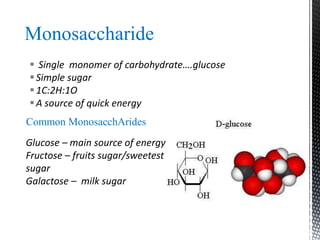
 Single monomer of carbohydrate….glucose
Simple sugar
1C:2H:1O
A source of quick energy
Glucose – main source of energy
Fructose – fruits sugar/sweetest
sugar
Galactose – milk sugar
Common MonosacchArides
Glucose
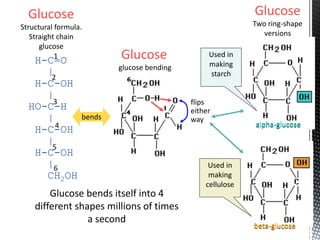
Structural formula.
Straight chain
glucose
H-C=O
|
H-C-OH
|
HO-C-H
|
H-C-OH
|
H-C-OH
|
CH2OH
Glucose
glucose bending
Glucose
Two ring-shape
versions
alpha-glucose
beta-glucose
Glucose bends itself into 4
different shapes millions of times
a second
1
4
6
2
3
5
Used in
making
cellulose
Used in
making
starch
flips
either
waybends
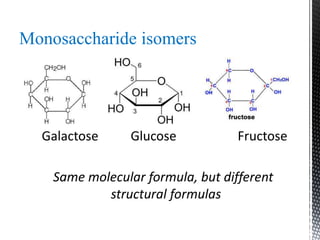
Monosaccharide isomers
Galactose Glucose Fructose
Same molecular formula, but different
structural formulas
Disaccharides
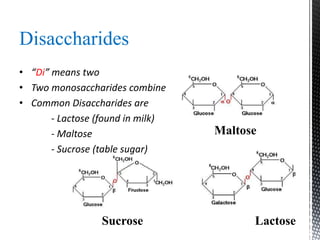
• “Di” means two
• Two monosaccharides combine
• Common Disaccharides are
- Lactose (found in milk)
- Maltose
- Sucrose (table sugar)
Maltose
Sucrose Lactose
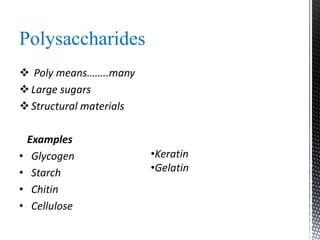
Polysaccharides
 Poly means……..many
Large sugars
Structural materials
Examples
• Glycogen
• Starch
• Chitin
• Cellulose
•Keratin
•Gelatin
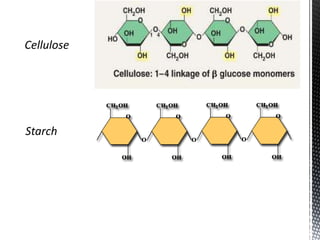
Cellulose
Starch
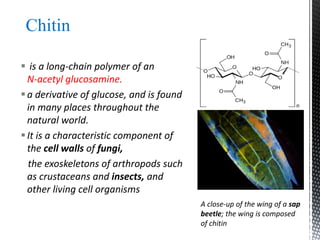
 is a long-chain polymer of an
N-acetyl glucosamine.
a derivative of glucose, and is found
in many places throughout the
natural world.
It is a characteristic component of
the cell walls of fungi,
the exoskeletons of arthropods such
as crustaceans and insects, and
other living cell organisms
Chitin
A close-up of the wing of a sap
beetle; the wing is composed
of chitin
 Chitin is a modified polysaccharide that contains nitrogen
 it is synthesized from units of N-acetylglucosamine
(to be precise, 2-(acetylamino)-2-deoxy-D-glucose).
 These units form covalent β-1,4 linkages, (similar to the linkages
between glucose units forming cellulose).
 Therefore, chitin may be described as cellulose with
one hydroxyl group on each monomer replaced with
an acetyl amine group.
 This allows for increased hydrogen bonding between
adjacent polymers, giving the chitin-polymer matrix increased
strength.
 In its pure, unmodified form, chitin is translucent, pliable, resilient,
and quite tough.
 In most arthropods, however, it is often modified, occurring largely
as a component of composite materials, such as in sclerotin, a
tanned proteinaceous matrix, which forms much of the
exoskeleton of insects.
 Combined with calcium carbonate, as in the shells
of crustaceans and molluscs, chitin produces a much stronger
composite. This composite material is much harder and stiffer than
pure chitin, and is tougher and less brittle than pure calcium
carbonate.
 Another difference between pure and composite forms can be seen by
comparing the flexible body wall of a caterpillar to the stiff,
light elytron of a beetle (containing a large proportion of sclerotin ).
•USES
Chitin can be used in many different branches of:
•Agriculture
•Medicine
•Industry
•Biomedical researchs
Keratin filaments are abundant in keratinocytes in
the cornified layer of the epidermis; these are proteins which
have undergone keratinization.
In addition, keratin filaments are present in epithelial cells in
general. For example, mouse thymic epithelial cells (TECs)
are known to react with antibodies for keratin 5, keratin 8,
and keratin 14. These antibodies are used as fluorescent
markers to distinguish subsets of TECs in genetic studies of
the thymus.
Silk fibroin, considered a β-keratin( glycine and alanine 75–
80% of the total, with 10–15% serine, with the rest having
bulky side groups) The chains are antiparallel , with an
alternating C → N orientation
Keratın
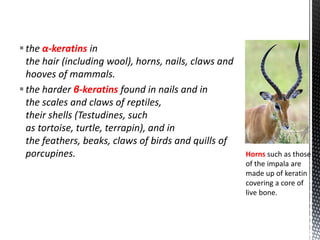
the α-keratins in
the hair (including wool), horns, nails, claws and
hooves of mammals.
the harder β-keratins found in nails and in
the scales and claws of reptiles,
their shells (Testudines, such
as tortoise, turtle, terrapin), and in
the feathers, beaks, claws of birds and quills of
porcupines. Horns such as those
of the impala are
made up of keratin
covering a core of
live bone.
 a translucent, colorless, brittle flavorless food derived
from collagen obtained from various animal by-products.
 Gelatin is an irreversibly hydrolyzed form of collagen.
 Substances containing gelatin or functioning in a similar way
are called "gelatinous".
 Gelatin is a mixture of peptides and proteins produced by
partial hydrolysis of collagen extracted from the skin, bones,
and connective tissues of animals such as domesticated
cattle, chicken, pigs, horses, and fish.
 Gelatin readily dissolves in hot water, and sets to a gel on
cooling and in most polar solvent.
 The mechanical properties of gelatin gels are very sensitive to
temperature variations.
 The upper melting point is below human body temperature.
gelatıne
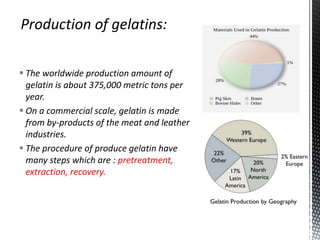
 The worldwide production amount of
gelatin is about 375,000 metric tons per
year.
 On a commercial scale, gelatin is made
from by-products of the meat and leather
industries.
 The procedure of produce gelatin have
many steps which are : pretreatment,
extraction, recovery.
 Culinary uses : different types and
grades of gelatin are used in a wide
range of food and nonfood products
( gelatin desserts).
 Technical uses :
•Hide silver halides.
•Gelatin is closely related to bone glue and is used as a
binder in match heads and sandpaper.
•Cosmetics may contain a nongelling variant of gelatin
under the name hydrolyzed collagen.
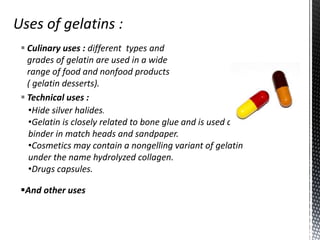
•Drugs capsules.
And other uses
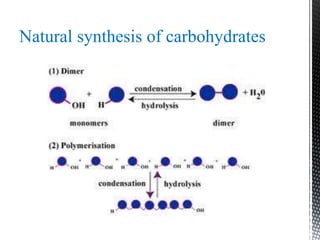
Natural synthesis of carbohydrates
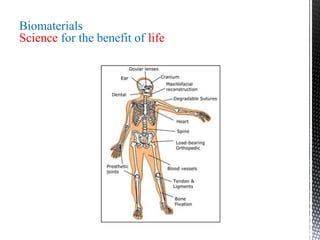
Biomaterials
Science for the benefit of life
Biomaterials
Any material used to make devices to replace a part or a
function of the living body in a safe, reliable, economic
& physiologically acceptable manner
OR
Any material used to replace part of a living system or to
function in intimate contact with living tissue
OR
A pharmacologically inert substance designed for
implantation within or incorporation with living system
Natural/synthetic/blend
e.g. sutures, tooth fillings, bone replacements, artificial
eyes etc.
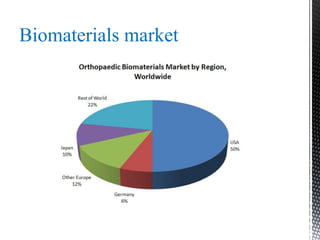
Biomaterials market
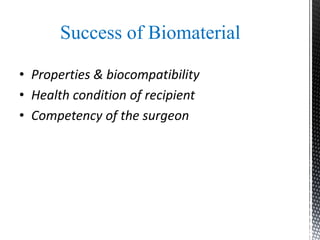
Success of Biomaterial
• Properties & biocompatibility
• Health condition of recipient
• Competency of the surgeon
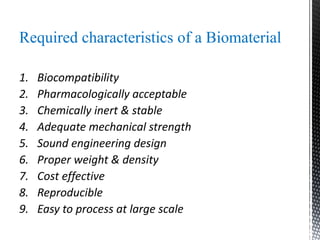
Required characteristics of a Biomaterial
1. Biocompatibility
2. Pharmacologically acceptable
3. Chemically inert & stable
4. Adequate mechanical strength
5. Sound engineering design
6. Proper weight & density
7. Cost effective
8. Reproducible
9. Easy to process at large scale
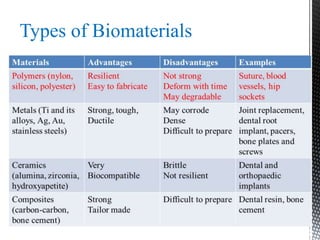
Types of Biomaterials
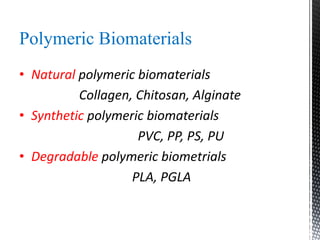
Polymeric Biomaterials
• Natural polymeric biomaterials
Collagen, Chitosan, Alginate
• Synthetic polymeric biomaterials
PVC, PP, PS, PU
• Degradable polymeric biometrials
PLA, PGLA
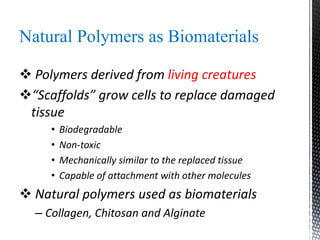
Natural Polymers as Biomaterials
 Polymers derived from living creatures
“Scaffolds” grow cells to replace damaged
tissue
• Biodegradable
• Non-toxic
• Mechanically similar to the replaced tissue
• Capable of attachment with other molecules
 Natural polymers used as biomaterials
– Collagen, Chitosan and Alginate
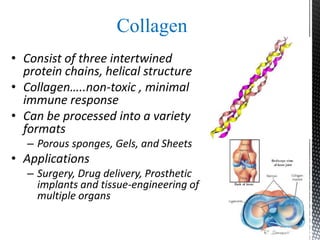
Collagen
• Consist of three intertwined
protein chains, helical structure
• Collagen…..non-toxic , minimal
immune response
• Can be processed into a variety
formats
– Porous sponges, Gels, and Sheets
• Applications
– Surgery, Drug delivery, Prosthetic
implants and tissue-engineering of
multiple organs
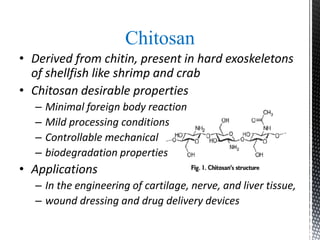
Chitosan
• Derived from chitin, present in hard exoskeletons
of shellfish like shrimp and crab
• Chitosan desirable properties
– Minimal foreign body reaction
– Mild processing conditions
– Controllable mechanical
– biodegradation properties
• Applications
– In the engineering of cartilage, nerve, and liver tissue,
– wound dressing and drug delivery devices
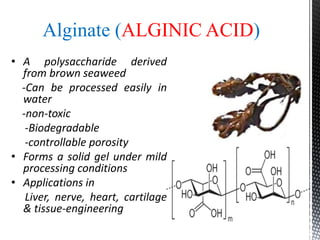
Alginate (ALGINIC ACID)
• A polysaccharide derived
from brown seaweed
-Can be processed easily in
water
-non-toxic
-Biodegradable
-controllable porosity
• Forms a solid gel under mild
processing conditions
• Applications in
Liver, nerve, heart, cartilage
& tissue-engineering
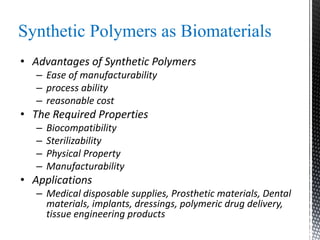
Synthetic Polymers as Biomaterials
• Advantages of Synthetic Polymers
– Ease of manufacturability
– process ability
– reasonable cost
• The Required Properties
– Biocompatibility
– Sterilizability
– Physical Property
– Manufacturability
• Applications
– Medical disposable supplies, Prosthetic materials, Dental
materials, implants, dressings, polymeric drug delivery,
tissue engineering products
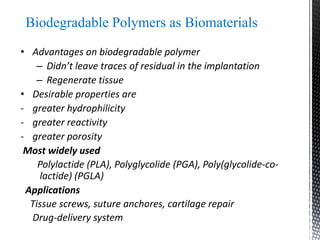
Biodegradable Polymers as Biomaterials
• Advantages on biodegradable polymer
– Didn’t leave traces of residual in the implantation
– Regenerate tissue
• Desirable properties are
- greater hydrophilicity
- greater reactivity
- greater porosity
Most widely used
Polylactide (PLA), Polyglycolide (PGA), Poly(glycolide-co-
lactide) (PGLA)
Applications
Tissue screws, suture anchores, cartilage repair
Drug-delivery system
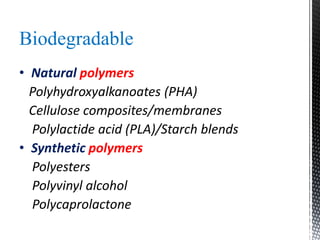
Biodegradable
• Natural polymers
Polyhydroxyalkanoates (PHA)
Cellulose composites/membranes
Polylactide acid (PLA)/Starch blends
• Synthetic polymers
Polyesters
Polyvinyl alcohol
Polycaprolactone
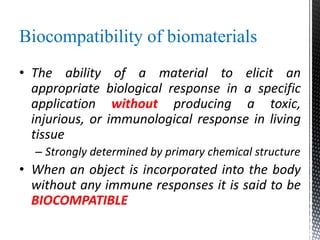
Biocompatibility of biomaterials
• The ability of a material to elicit an
appropriate biological response in a specific
application without producing a toxic,
injurious, or immunological response in living
tissue
– Strongly determined by primary chemical structure
• When an object is incorporated into the body
without any immune responses it is said to be
BIOCOMPATIBLE
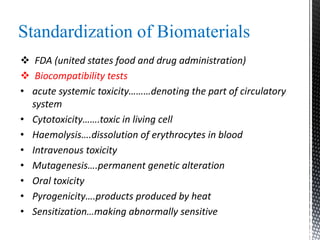
Standardization of Biomaterials
 FDA (united states food and drug administration)
 Biocompatibility tests
• acute systemic toxicity………denoting the part of circulatory
system
• Cytotoxicity…….toxic in living cell
• Haemolysis….dissolution of erythrocytes in blood
• Intravenous toxicity
• Mutagenesis….permanent genetic alteration
• Oral toxicity
• Pyrogenicity….products produced by heat
• Sensitization…making abnormally sensitive
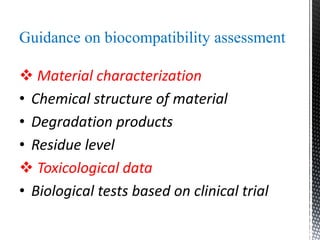
Guidance on biocompatibility assessment
 Material characterization
• Chemical structure of material
• Degradation products
• Residue level
 Toxicological data
• Biological tests based on clinical trial
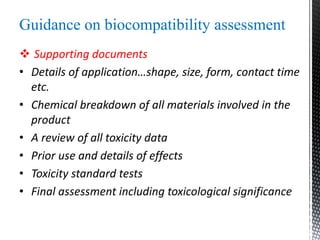
Guidance on biocompatibility assessment
 Supporting documents
• Details of application…shape, size, form, contact time
etc.
• Chemical breakdown of all materials involved in the
product
• A review of all toxicity data
• Prior use and details of effects
• Toxicity standard tests
• Final assessment including toxicological significance
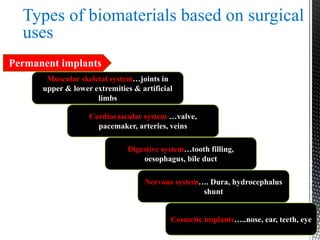
Types of biomaterials based on surgical
uses
Muscular skeletal system…joints in
upper & lower extremities & artificial
limbs
Permanent implants
Cardiovascular system …valve,
pacemaker, arteries, veins
Digestive system…tooth filling,
oesophagus, bile duct
Nervous system…. Dura, hydrocephalus
shunt
Cosmetic implants…..nose, ear, teeth, eye
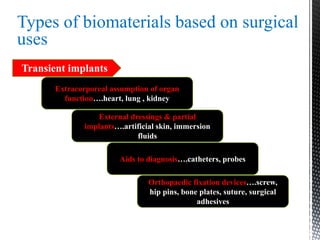
Types of biomaterials based on surgical
uses
Transient implants
Extracorporeal assumption of organ
function….heart, lung , kidney
Orthopaedic fixation devices….screw,
hip pins, bone plates, suture, surgical
adhesives
External dressings & partial
implants….artificial skin, immersion
fluids
Aids to diagnosis….catheters, probes
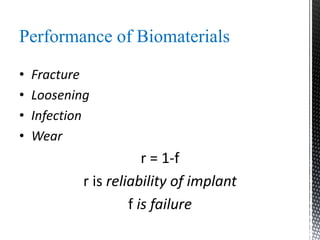
Performance of Biomaterials
• Fracture
• Loosening
• Infection
• Wear
r = 1-f
r is reliability of implant
f is failure
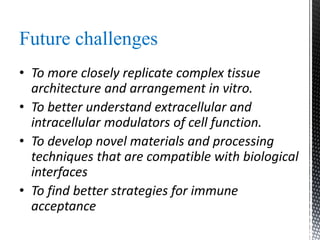
Future challenges
• To more closely replicate complex tissue
architecture and arrangement in vitro.
• To better understand extracellular and
intracellular modulators of cell function.
• To develop novel materials and processing
techniques that are compatible with biological
interfaces
• To find better strategies for immune
acceptance
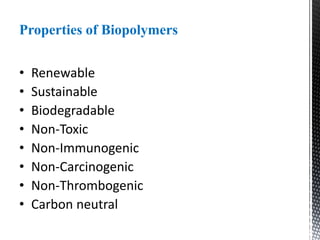
Properties of Biopolymers
• Renewable
• Sustainable
• Biodegradable
• Non-Toxic
• Non-Immunogenic
• Non-Carcinogenic
• Non-Thrombogenic
• Carbon neutral
Applications of Biopolymers
• Coatings
• Fibers
• Plastics
• Adhesives
• Cosmetics
• Oil Industry
• Paper
• Textiles/clothing
• Water treatment
• Biomedical
• Pharmaceutical
• Automotive
• Rubber
REFERENCES :
•https://en.wikipedia.org/wiki/Chitin
•https://en.wikipedia.org/wiki/Keratin
•https://en.wikipedia.org/wiki/Gelatin
•https://www.o2.org > ideas > cases > biopolymers
Thank you for your
attention!!!!

Biopolymer

  • 1.
  • 2.
     Biopolymers introduction Types of biopolymers Carbohydrates Proteins Lipids Nucleic acids Contents
  • 4.
    Biopolymers are polymers producedby living organisms; in other words, they are polymeric biomolecules. Since they are polymers, biopolymers contain monomeric units that are covalently bonded to form larger structures.
  • 5.
    Types of Biopolymers BIOPOLYMER Polynucleotide Polypeptide polysaccharides Thereare three types of BIOPOLYMERS according to their monomeric units used and the structure of biopolymer formed.
  • 6.
    Biorenewable biopolymers • Polymersof biological origin Carbohydrates…..starch Proteins……haemoglobin Nucleic acids….DNA Lipids…..
  • 7.
  • 8.
    Nucleic Acids • Largeand complex organic molecules that store and transfer genetic information in the cell • Types of nucleic acids i. DNA =deoxyribonucleic acid ii. RNA = Ribonucleic acid
  • 9.
    Building blocks ofNucleic Acids • Monomers of nucleic acids are nucleotides • Components of a nucleotide - nitrogen base - sugar - phosphate
  • 10.
    Deoxyribonucleic acid (DNA) •Double helix • Found in the nucleus • Stores hereditary information
  • 11.
    Ribonucleic acid (RNA) •Is a single helix • Can be found in the nucleus and the cytoplasm of the cell • Helps build proteins • Can act as an enzyme
  • 14.
    Polypeptide • A longchain of amino acids…POLYPEPTIDE • Proteins are composed of one or more polypeptides
  • 15.
    Amino Acid Structure RGroups of amino acids • Difference in amino acids…….. R groups • R group……simple or complex • R groups…different shapes & characteristics
  • 16.
    Peptide bond -COOH groupof one amino acid joined with the -NH2 group of the next amino acid through condensation polymerization
  • 17.
  • 18.
    Proteins • Polymers ofamino acids covalently linked through peptide bonds • Natural organic molecules….C, H, O, N • Monomers…….amino acids
  • 19.
    Building blocks ofproteins • There are 20 different amino acids • All 20 amino acids share the same basic structure • Every amino acid contains - an amino group - a carboxyl group - a hydrogen atom - a central carbon atom - R (alkyl/aryl) group
  • 20.
    Role of Proteins •Structural roles…….cytoskeleton • Catalysts……enzymes • Transporter………ions and molecules • Hormones • Many enzymes are proteins • Biological catalysts • Lower the activation energy of chemical reactions • Increase the rate of chemical reactions
  • 21.
  • 22.
    Sensitivity of Proteins •Temperature • pH • Denature proteins
  • 23.
  • 24.
    Lipids • Large, nonpolarorganic molecules • LIPIDS do NOT Dissolve in Water! • Have a higher ratio of carbon and hydrogen atoms to oxygen atoms than carbohydrates • Lipids store more energy per gram than other organic compounds
  • 25.
    Categories of Lipids •Fatty Acids • Triglycerides • Phospholipids • Waxes and Oils • Steroids
  • 26.
    Fatty Acids • Linearcarbon chains • On one end of the carbon chain is a carboxyl group • On the other end of the carbon chain is a methyl group
  • 27.
    Fatty acid chain •The carboxyl end is polar and is hydrophilic • The carboxyl end will dissolve in water • The methyl end is nonpolar and is hydrophobic • The methyl end will not dissolve in water
  • 28.
    Types of FattyAcids • Unsaturated fatty acids……carbon chain contains double bonds • Saturated fatty acids……carbon chain contains single bonds
  • 29.
    Triglycerides One molecule ofglycerol and three fatty acid chains Saturated triglycerides…butter, fats and red meat Unsaturated triglycerides….plant seeds
  • 30.
    Phospholipids One glycerol +two fatty acids + one phosphate group Compose cell membranes
  • 31.
    A long fattyacid chain joined to a long alcohol chain Waterproof Form a protective coating in animals & plants
  • 32.
    Steroids Four fused carbonrings…..cholesterol Many animal hormones are steroid compounds
  • 33.
  • 34.
     Carbohydrates areorganic compounds 1C:2H:1O Source of energy……..sugars Store of energy………..starch  Structural materials….polysaccharides  Components of other molecules e.g. DNA, RNA, glycolipids, glycoproteins
  • 35.
  • 36.
    Monosaccharide  Single monomerof carbohydrate….glucose Simple sugar 1C:2H:1O A source of quick energy Glucose – main source of energy Fructose – fruits sugar/sweetest sugar Galactose – milk sugar Common MonosacchArides
  • 37.
    Glucose Structural formula. Straight chain glucose H-C=O | H-C-OH | HO-C-H | H-C-OH | H-C-OH | CH2OH Glucose glucosebending Glucose Two ring-shape versions alpha-glucose beta-glucose Glucose bends itself into 4 different shapes millions of times a second 1 4 6 2 3 5 Used in making cellulose Used in making starch flips either waybends
  • 38.
    Monosaccharide isomers Galactose GlucoseFructose Same molecular formula, but different structural formulas
  • 39.
    Disaccharides • “Di” meanstwo • Two monosaccharides combine • Common Disaccharides are - Lactose (found in milk) - Maltose - Sucrose (table sugar) Maltose Sucrose Lactose
  • 40.
    Polysaccharides  Poly means……..many Largesugars Structural materials Examples • Glycogen • Starch • Chitin • Cellulose •Keratin •Gelatin
  • 41.
  • 42.
     is along-chain polymer of an N-acetyl glucosamine. a derivative of glucose, and is found in many places throughout the natural world. It is a characteristic component of the cell walls of fungi, the exoskeletons of arthropods such as crustaceans and insects, and other living cell organisms Chitin A close-up of the wing of a sap beetle; the wing is composed of chitin
  • 43.
     Chitin isa modified polysaccharide that contains nitrogen  it is synthesized from units of N-acetylglucosamine (to be precise, 2-(acetylamino)-2-deoxy-D-glucose).  These units form covalent β-1,4 linkages, (similar to the linkages between glucose units forming cellulose).  Therefore, chitin may be described as cellulose with one hydroxyl group on each monomer replaced with an acetyl amine group.  This allows for increased hydrogen bonding between adjacent polymers, giving the chitin-polymer matrix increased strength.  In its pure, unmodified form, chitin is translucent, pliable, resilient, and quite tough.  In most arthropods, however, it is often modified, occurring largely as a component of composite materials, such as in sclerotin, a tanned proteinaceous matrix, which forms much of the exoskeleton of insects.
  • 44.
     Combined withcalcium carbonate, as in the shells of crustaceans and molluscs, chitin produces a much stronger composite. This composite material is much harder and stiffer than pure chitin, and is tougher and less brittle than pure calcium carbonate.  Another difference between pure and composite forms can be seen by comparing the flexible body wall of a caterpillar to the stiff, light elytron of a beetle (containing a large proportion of sclerotin ). •USES Chitin can be used in many different branches of: •Agriculture •Medicine •Industry •Biomedical researchs
  • 45.
    Keratin filaments areabundant in keratinocytes in the cornified layer of the epidermis; these are proteins which have undergone keratinization. In addition, keratin filaments are present in epithelial cells in general. For example, mouse thymic epithelial cells (TECs) are known to react with antibodies for keratin 5, keratin 8, and keratin 14. These antibodies are used as fluorescent markers to distinguish subsets of TECs in genetic studies of the thymus. Silk fibroin, considered a β-keratin( glycine and alanine 75– 80% of the total, with 10–15% serine, with the rest having bulky side groups) The chains are antiparallel , with an alternating C → N orientation Keratın
  • 46.
    the α-keratins in thehair (including wool), horns, nails, claws and hooves of mammals. the harder β-keratins found in nails and in the scales and claws of reptiles, their shells (Testudines, such as tortoise, turtle, terrapin), and in the feathers, beaks, claws of birds and quills of porcupines. Horns such as those of the impala are made up of keratin covering a core of live bone.
  • 47.
     a translucent,colorless, brittle flavorless food derived from collagen obtained from various animal by-products.  Gelatin is an irreversibly hydrolyzed form of collagen.  Substances containing gelatin or functioning in a similar way are called "gelatinous".  Gelatin is a mixture of peptides and proteins produced by partial hydrolysis of collagen extracted from the skin, bones, and connective tissues of animals such as domesticated cattle, chicken, pigs, horses, and fish.  Gelatin readily dissolves in hot water, and sets to a gel on cooling and in most polar solvent.  The mechanical properties of gelatin gels are very sensitive to temperature variations.  The upper melting point is below human body temperature. gelatıne
  • 48.
     The worldwideproduction amount of gelatin is about 375,000 metric tons per year.  On a commercial scale, gelatin is made from by-products of the meat and leather industries.  The procedure of produce gelatin have many steps which are : pretreatment, extraction, recovery.
  • 49.
     Culinary uses: different types and grades of gelatin are used in a wide range of food and nonfood products ( gelatin desserts).  Technical uses : •Hide silver halides. •Gelatin is closely related to bone glue and is used as a binder in match heads and sandpaper. •Cosmetics may contain a nongelling variant of gelatin under the name hydrolyzed collagen. •Drugs capsules. And other uses
  • 50.
    Natural synthesis ofcarbohydrates
  • 51.
  • 52.
    Biomaterials Any material usedto make devices to replace a part or a function of the living body in a safe, reliable, economic & physiologically acceptable manner OR Any material used to replace part of a living system or to function in intimate contact with living tissue OR A pharmacologically inert substance designed for implantation within or incorporation with living system Natural/synthetic/blend e.g. sutures, tooth fillings, bone replacements, artificial eyes etc.
  • 53.
  • 54.
    Success of Biomaterial •Properties & biocompatibility • Health condition of recipient • Competency of the surgeon
  • 55.
    Required characteristics ofa Biomaterial 1. Biocompatibility 2. Pharmacologically acceptable 3. Chemically inert & stable 4. Adequate mechanical strength 5. Sound engineering design 6. Proper weight & density 7. Cost effective 8. Reproducible 9. Easy to process at large scale
  • 56.
  • 57.
    Polymeric Biomaterials • Naturalpolymeric biomaterials Collagen, Chitosan, Alginate • Synthetic polymeric biomaterials PVC, PP, PS, PU • Degradable polymeric biometrials PLA, PGLA
  • 58.
    Natural Polymers asBiomaterials  Polymers derived from living creatures “Scaffolds” grow cells to replace damaged tissue • Biodegradable • Non-toxic • Mechanically similar to the replaced tissue • Capable of attachment with other molecules  Natural polymers used as biomaterials – Collagen, Chitosan and Alginate
  • 59.
    Collagen • Consist ofthree intertwined protein chains, helical structure • Collagen…..non-toxic , minimal immune response • Can be processed into a variety formats – Porous sponges, Gels, and Sheets • Applications – Surgery, Drug delivery, Prosthetic implants and tissue-engineering of multiple organs
  • 60.
    Chitosan • Derived fromchitin, present in hard exoskeletons of shellfish like shrimp and crab • Chitosan desirable properties – Minimal foreign body reaction – Mild processing conditions – Controllable mechanical – biodegradation properties • Applications – In the engineering of cartilage, nerve, and liver tissue, – wound dressing and drug delivery devices
  • 61.
    Alginate (ALGINIC ACID) •A polysaccharide derived from brown seaweed -Can be processed easily in water -non-toxic -Biodegradable -controllable porosity • Forms a solid gel under mild processing conditions • Applications in Liver, nerve, heart, cartilage & tissue-engineering
  • 62.
    Synthetic Polymers asBiomaterials • Advantages of Synthetic Polymers – Ease of manufacturability – process ability – reasonable cost • The Required Properties – Biocompatibility – Sterilizability – Physical Property – Manufacturability • Applications – Medical disposable supplies, Prosthetic materials, Dental materials, implants, dressings, polymeric drug delivery, tissue engineering products
  • 63.
    Biodegradable Polymers asBiomaterials • Advantages on biodegradable polymer – Didn’t leave traces of residual in the implantation – Regenerate tissue • Desirable properties are - greater hydrophilicity - greater reactivity - greater porosity Most widely used Polylactide (PLA), Polyglycolide (PGA), Poly(glycolide-co- lactide) (PGLA) Applications Tissue screws, suture anchores, cartilage repair Drug-delivery system
  • 64.
    Biodegradable • Natural polymers Polyhydroxyalkanoates(PHA) Cellulose composites/membranes Polylactide acid (PLA)/Starch blends • Synthetic polymers Polyesters Polyvinyl alcohol Polycaprolactone
  • 65.
    Biocompatibility of biomaterials •The ability of a material to elicit an appropriate biological response in a specific application without producing a toxic, injurious, or immunological response in living tissue – Strongly determined by primary chemical structure • When an object is incorporated into the body without any immune responses it is said to be BIOCOMPATIBLE
  • 66.
    Standardization of Biomaterials FDA (united states food and drug administration)  Biocompatibility tests • acute systemic toxicity………denoting the part of circulatory system • Cytotoxicity…….toxic in living cell • Haemolysis….dissolution of erythrocytes in blood • Intravenous toxicity • Mutagenesis….permanent genetic alteration • Oral toxicity • Pyrogenicity….products produced by heat • Sensitization…making abnormally sensitive
  • 67.
    Guidance on biocompatibilityassessment  Material characterization • Chemical structure of material • Degradation products • Residue level  Toxicological data • Biological tests based on clinical trial
  • 68.
    Guidance on biocompatibilityassessment  Supporting documents • Details of application…shape, size, form, contact time etc. • Chemical breakdown of all materials involved in the product • A review of all toxicity data • Prior use and details of effects • Toxicity standard tests • Final assessment including toxicological significance
  • 69.
    Types of biomaterialsbased on surgical uses Muscular skeletal system…joints in upper & lower extremities & artificial limbs Permanent implants Cardiovascular system …valve, pacemaker, arteries, veins Digestive system…tooth filling, oesophagus, bile duct Nervous system…. Dura, hydrocephalus shunt Cosmetic implants…..nose, ear, teeth, eye
  • 70.
    Types of biomaterialsbased on surgical uses Transient implants Extracorporeal assumption of organ function….heart, lung , kidney Orthopaedic fixation devices….screw, hip pins, bone plates, suture, surgical adhesives External dressings & partial implants….artificial skin, immersion fluids Aids to diagnosis….catheters, probes
  • 71.
    Performance of Biomaterials •Fracture • Loosening • Infection • Wear r = 1-f r is reliability of implant f is failure
  • 72.
    Future challenges • Tomore closely replicate complex tissue architecture and arrangement in vitro. • To better understand extracellular and intracellular modulators of cell function. • To develop novel materials and processing techniques that are compatible with biological interfaces • To find better strategies for immune acceptance
  • 73.
    Properties of Biopolymers •Renewable • Sustainable • Biodegradable • Non-Toxic • Non-Immunogenic • Non-Carcinogenic • Non-Thrombogenic • Carbon neutral
  • 74.
    Applications of Biopolymers •Coatings • Fibers • Plastics • Adhesives • Cosmetics • Oil Industry • Paper • Textiles/clothing • Water treatment • Biomedical • Pharmaceutical • Automotive • Rubber
  • 75.
  • 76.
    Thank you foryour attention!!!!