Introduction
To be able to communicate in the
target language
 To be able to use the language
spontaneously and orally
 Develop the ability to think in the
target language






Use the target language only
Rules of grammar are taught inductively
Speaking begin with systematic
attention to pronunciation
Only everyday vocabulary and
sentences are taught





New teaching points are
taught through modeling and
practice
Both speech and listening
comprehension are taught
Correct pronunciation and
grammar are emphasized




Use the target language
communicatively
Use the realia to enhance
students’ leaning motivation








Less attention on the grammatical
accuracy and reading skill
Students can’t apply the language
communicatively in real-life situations
Teacher may not be proficient in native
language
Teacher need to spend much time to
prepare teaching materials







Reading Aloud
Question and Answer Exercise
Student Self-Correction
Conversation Practice
Fill-in-the-blank Exercise
Dictation


This approach is selected for practical and
academic reasons.



For specific uses of the language in graduate
or scientific studies.



The approach is for people who do not travel
abroad for whom reading is the one usable
skill in a foreign language.


One of the most influential models of reading
in recent years has been the Psycholinguistic
Model described by Goodman and drawing
heavily on top-down processing.



It is based on a consideration of schema
theory which says that comprehension
depends on the activation of schemata.



These are pictures or frameworks of a
situation which help us to understand the
situation.


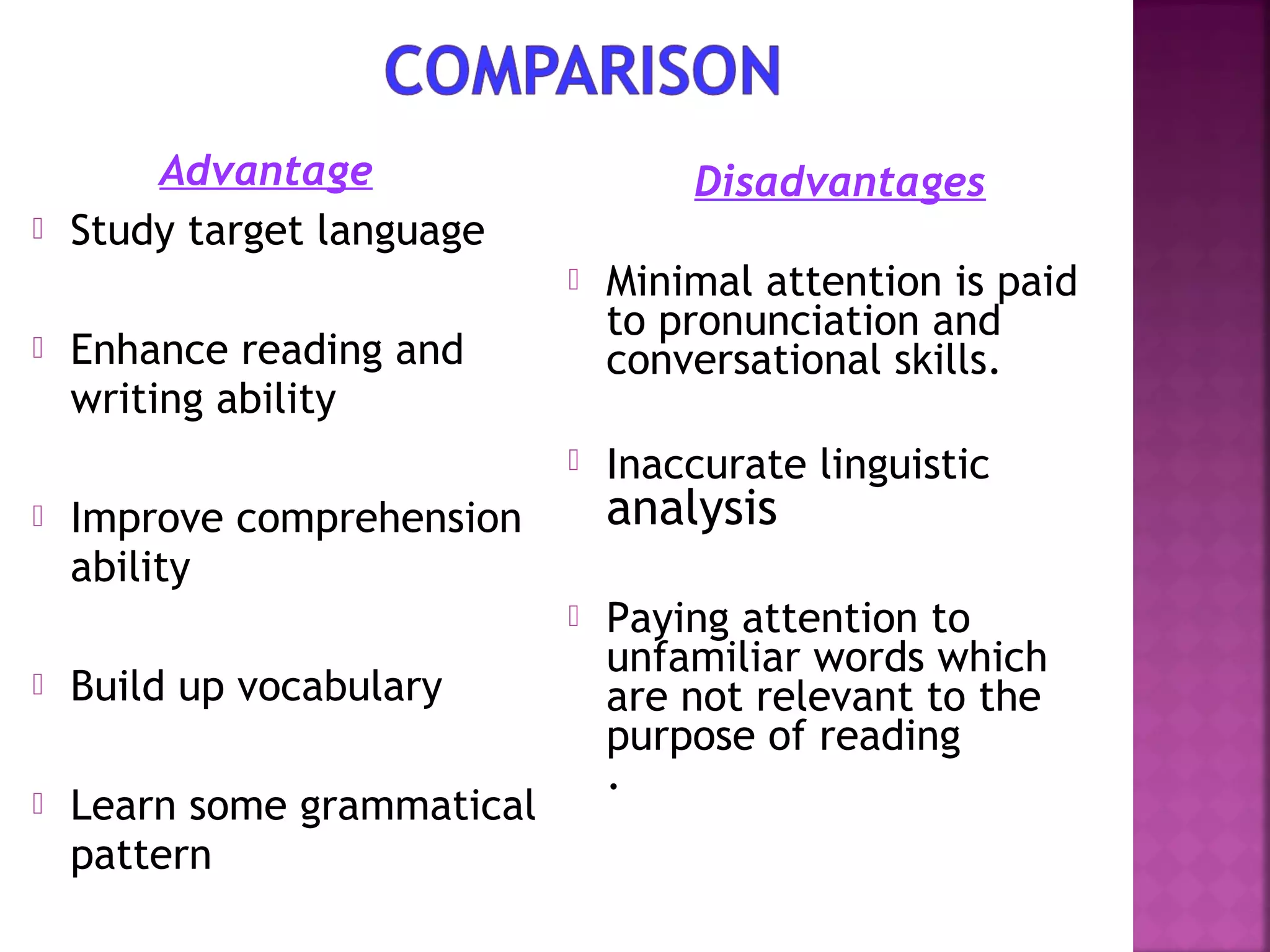
Advantage
Study target language

Disadvantages








Minimal attention is paid
to pronunciation and
conversational skills.
Inaccurate linguistic

Enhance reading and
writing ability

analysis

Improve comprehension
ability




Build up vocabulary



Learn some grammatical
pattern

Paying attention to
unfamiliar words which
are not relevant to the
purpose of reading
.


It is based on behaviorist theory -- From early
psychology in the 19th century , proposed by
John B Watson.
---Based on the proposition that all things which
organisms do -- including acting, thinking and
feeling—can and should be regarded as
behaviors.


Language learning is a habit-formation.



This method aims at using the target
language communicatively by intensive oral
drilling of basic sentence.



Spoken language comes before written
language.



Mistakes should be avoided.


Structures are sequenced and taught one at a
time.



Structural patterns are taught using
repetitive drills.



Little or no grammatical explanations are
provide.



Vocabulary is strictly limited and learned in
context.



Everything is simply memorized and recite in
form.
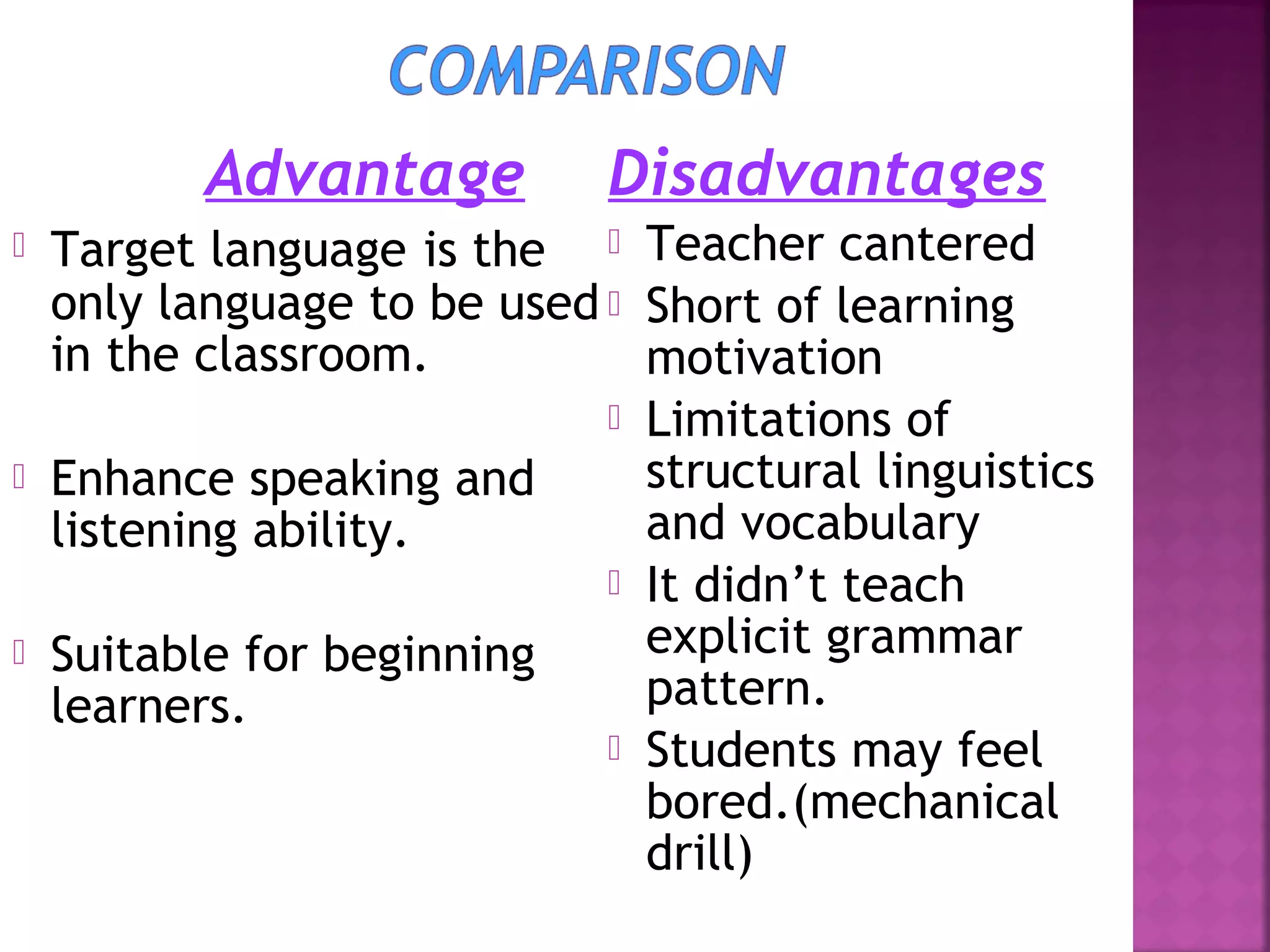
Advantage






Disadvantages

Target language is the  Teacher cantered
only language to be used  Short of learning
in the classroom.
motivation
 Limitations of
structural linguistics
Enhance speaking and
and vocabulary
listening ability.
 It didn’t teach
explicit grammar
Suitable for beginning
pattern.
learners.
 Students may feel
bored.(mechanical
drill)
Introduction
a

practical command of the four
basic skills of a language
accuracy in both pronunciation
and grammar
ability to respond quickly and
accurately in speech situations
Language teaching begins with the
spoken language. Material is taught
orally before it is presented in
written form
 The target language is the language
of the classroom
 New language points are introduced
and practiced situationally

Choose

the vocabulary
Grammar are taught from
simple to complex
Reading and writing are
introduced once a sufficient
lexical and grammatical basis
is established


Bring the reality situation in
the classroom


Hard to teach the grammar rules
from simple to complex



Turn students into parrots



Boring and reduce motivation


Teacher-centered

Demonstrate with teaching
aids





Key word changed


Instruction is often individualized



Vocabulary



Grammar-taught in either deductively or
inductively way.



Language skills



Demands on teachers


Grammar teaching should be planned and
systematic



Necessary grammar instruction



Extensive exposure to instructed grammar
points



Production activities



Group work and task performance
Advantages



Independent
thinking.



Teacher provide
teaching
materials.



Teacher center.





Learning step by
step.

Disadvantages

Neglect students
interest and need.
Developed by Charles Curran and his
associates in 1970s


The teacher can successfully
transfer his or her knowledge
and proficiency in the L2 to the
students; Specific purposes are
not mentioned.





S stands for security
A stands for attention and
aggression
R stands for retention and
reflection
D represents discrimination




Whole person learning
Learning is dynamic and
creative
Client-counselor and learnerknower relationships









Translation
Group work
Recording
Transcription
Analysis
Reflection and observation
Listening
Free conversation








Help students overcome their negative
feeling
Build good relationship with students
Wants students to be responsible for their
learning
Provide free-pressure
Emphasis of classroom interaction in
cooperation, not competition




Hard to control the learning
process if students are too
passive in learning
Hard to run the class for the
relaxing environment









Small group and make sentences with the new
forms
Students take turns reading the transcript
Teacher puts a picture of a person on the
blackboard and students ask questions of
that person as if they have just met him
Students reconstruct the conversation they
have created
Students create a new dialog using words they
have learned to say during their conversation


It was developed by James Asher, a
professor of psychology at San Jose State
University, California.



Based on the coordination of speech and
action.



It is linked to the trace theory of memory,
which holds that the more often or
intensively a memory connection is traced,
the stronger the memory will be.


Second language learning is parallel to first
language learning and should reflect the same
naturalistic processes.



Listening should develop before speaking.



Children respond physically to spoken
language, and adult learners learn better if they
do that too.


Once listening comprehension has been
developed, speech develops naturally and
effortlessly out of it.



Adults should use right-brain motor activities,
while the left hemisphere watches and learns .



Delaying speech reduces stress.
Pros







Suitable for
beginner
Pressure free
Develop listening
ability first
Comprehension
Action feedback
Interest

Cons




Time consuming
Energy costly
Lack of reading and
writing


The Natural Approach was developed by Tracy
Terrell and Stephen Krashen, starting in 1977.



Natural Approach there is an emphasis on
exposure, or input, rather than practice .



Natural approach as an example of
communicative approach.


Optimizing emotional preparedness for learning
.



A prolonged period of attention to what the
language learners hear before they try to
produce language .



Willingness to use written and other materials as
a source of comprehensible input.
Advantages






Minimize stress
Useful for beginning
learners.
Enhance listening
ability.
Use visual aids and
realia.
Depend on learner
needs.

Disadvantages



Hard to learn
correct forms.
Feedback of errors.
Introduction


The goal of language teaching
is learner ability to
communicate in the target
language










Students regular work in groups or pairs to
transfer meaning in situations
Students often engage in role play or
dramatization
Classroom materials and activities are often
authentic
Teacher’s role is primarily to facilitate
communication and secondarily to correct errors
Teacher should be able to use the target language
fluently and appropriately




For real communication,
students should know knowledge
of linguistic forms, background
information
Produce real language in daily
life





No environment of ESL
Ignore the training of reading and
writing
Difficulty in evaluating students’
performance
Hard for beginning level students to
express target language with foreigner






Authentic materials
scrambled sentences
Language games
Picture strip story
Role play


TBLL was popularized by N.Prabhu while
working in Bangalore,India.



Prabhu figured out that his students could
learn language just as easily with a nonlinguistic problem as when they are
concentrating on linguistic questions.


The main focus of this approach is the task
while language is the means with which they
complete it.



It focuses on the use of authentic language,
and to students doing meaningful tasks using
the target language .



The main idea of the task should be
completing a problem-solving aspect.



Assessment is primarily based on task
outcome .
Disadvantages

Advantages


Student-centered



Hard for beginning learners.



Meaning
communication



Focus on meaning instead
of form.



More interaction



Students may feel stress.



More interesting



Occupy too much time in
the class.



Learn how to cooperate
with others.



Hard to manage the class.



Independent thinking



Difficult to prepare the
materials.

Language teaching approaches

  • 2.
  • 3.
    To be ableto communicate in the target language  To be able to use the language spontaneously and orally  Develop the ability to think in the target language 
  • 4.
        Use the targetlanguage only Rules of grammar are taught inductively Speaking begin with systematic attention to pronunciation Only everyday vocabulary and sentences are taught
  • 5.
       New teaching pointsare taught through modeling and practice Both speech and listening comprehension are taught Correct pronunciation and grammar are emphasized
  • 6.
      Use the targetlanguage communicatively Use the realia to enhance students’ leaning motivation
  • 7.
        Less attention onthe grammatical accuracy and reading skill Students can’t apply the language communicatively in real-life situations Teacher may not be proficient in native language Teacher need to spend much time to prepare teaching materials
  • 8.
          Reading Aloud Question andAnswer Exercise Student Self-Correction Conversation Practice Fill-in-the-blank Exercise Dictation
  • 9.
     This approach isselected for practical and academic reasons.  For specific uses of the language in graduate or scientific studies.  The approach is for people who do not travel abroad for whom reading is the one usable skill in a foreign language.
  • 10.
     One of themost influential models of reading in recent years has been the Psycholinguistic Model described by Goodman and drawing heavily on top-down processing.  It is based on a consideration of schema theory which says that comprehension depends on the activation of schemata.  These are pictures or frameworks of a situation which help us to understand the situation.
  • 11.
     Advantage Study target language Disadvantages     Minimalattention is paid to pronunciation and conversational skills. Inaccurate linguistic Enhance reading and writing ability analysis Improve comprehension ability   Build up vocabulary  Learn some grammatical pattern Paying attention to unfamiliar words which are not relevant to the purpose of reading .
  • 12.
     It is basedon behaviorist theory -- From early psychology in the 19th century , proposed by John B Watson. ---Based on the proposition that all things which organisms do -- including acting, thinking and feeling—can and should be regarded as behaviors.
  • 13.
     Language learning isa habit-formation.  This method aims at using the target language communicatively by intensive oral drilling of basic sentence.  Spoken language comes before written language.  Mistakes should be avoided.
  • 14.
     Structures are sequencedand taught one at a time.  Structural patterns are taught using repetitive drills.  Little or no grammatical explanations are provide.  Vocabulary is strictly limited and learned in context.  Everything is simply memorized and recite in form.
  • 15.
    Advantage    Disadvantages Target language isthe  Teacher cantered only language to be used  Short of learning in the classroom. motivation  Limitations of structural linguistics Enhance speaking and and vocabulary listening ability.  It didn’t teach explicit grammar Suitable for beginning pattern. learners.  Students may feel bored.(mechanical drill)
  • 16.
  • 17.
    a practical command ofthe four basic skills of a language accuracy in both pronunciation and grammar ability to respond quickly and accurately in speech situations
  • 18.
    Language teaching beginswith the spoken language. Material is taught orally before it is presented in written form  The target language is the language of the classroom  New language points are introduced and practiced situationally 
  • 19.
    Choose the vocabulary Grammar aretaught from simple to complex Reading and writing are introduced once a sufficient lexical and grammatical basis is established
  • 20.
     Bring the realitysituation in the classroom
  • 21.
     Hard to teachthe grammar rules from simple to complex  Turn students into parrots  Boring and reduce motivation
  • 22.
  • 23.
     Instruction is oftenindividualized  Vocabulary  Grammar-taught in either deductively or inductively way.  Language skills  Demands on teachers
  • 24.
     Grammar teaching shouldbe planned and systematic  Necessary grammar instruction  Extensive exposure to instructed grammar points  Production activities  Group work and task performance
  • 25.
  • 26.
    Developed by CharlesCurran and his associates in 1970s
  • 27.
     The teacher cansuccessfully transfer his or her knowledge and proficiency in the L2 to the students; Specific purposes are not mentioned.
  • 28.
        S stands forsecurity A stands for attention and aggression R stands for retention and reflection D represents discrimination
  • 29.
       Whole person learning Learningis dynamic and creative Client-counselor and learnerknower relationships
  • 30.
  • 31.
         Help students overcometheir negative feeling Build good relationship with students Wants students to be responsible for their learning Provide free-pressure Emphasis of classroom interaction in cooperation, not competition
  • 32.
      Hard to controlthe learning process if students are too passive in learning Hard to run the class for the relaxing environment
  • 33.
         Small group andmake sentences with the new forms Students take turns reading the transcript Teacher puts a picture of a person on the blackboard and students ask questions of that person as if they have just met him Students reconstruct the conversation they have created Students create a new dialog using words they have learned to say during their conversation
  • 34.
     It was developedby James Asher, a professor of psychology at San Jose State University, California.  Based on the coordination of speech and action.  It is linked to the trace theory of memory, which holds that the more often or intensively a memory connection is traced, the stronger the memory will be.
  • 35.
     Second language learningis parallel to first language learning and should reflect the same naturalistic processes.  Listening should develop before speaking.  Children respond physically to spoken language, and adult learners learn better if they do that too.
  • 36.
     Once listening comprehensionhas been developed, speech develops naturally and effortlessly out of it.  Adults should use right-brain motor activities, while the left hemisphere watches and learns .  Delaying speech reduces stress.
  • 37.
    Pros       Suitable for beginner Pressure free Developlistening ability first Comprehension Action feedback Interest Cons    Time consuming Energy costly Lack of reading and writing
  • 38.
     The Natural Approachwas developed by Tracy Terrell and Stephen Krashen, starting in 1977.  Natural Approach there is an emphasis on exposure, or input, rather than practice .  Natural approach as an example of communicative approach.
  • 39.
     Optimizing emotional preparednessfor learning .  A prolonged period of attention to what the language learners hear before they try to produce language .  Willingness to use written and other materials as a source of comprehensible input.
  • 40.
    Advantages      Minimize stress Useful forbeginning learners. Enhance listening ability. Use visual aids and realia. Depend on learner needs. Disadvantages   Hard to learn correct forms. Feedback of errors.
  • 41.
  • 42.
     The goal oflanguage teaching is learner ability to communicate in the target language
  • 43.
         Students regular workin groups or pairs to transfer meaning in situations Students often engage in role play or dramatization Classroom materials and activities are often authentic Teacher’s role is primarily to facilitate communication and secondarily to correct errors Teacher should be able to use the target language fluently and appropriately
  • 44.
      For real communication, studentsshould know knowledge of linguistic forms, background information Produce real language in daily life
  • 45.
        No environment ofESL Ignore the training of reading and writing Difficulty in evaluating students’ performance Hard for beginning level students to express target language with foreigner
  • 46.
  • 47.
     TBLL was popularizedby N.Prabhu while working in Bangalore,India.  Prabhu figured out that his students could learn language just as easily with a nonlinguistic problem as when they are concentrating on linguistic questions.
  • 48.
     The main focusof this approach is the task while language is the means with which they complete it.  It focuses on the use of authentic language, and to students doing meaningful tasks using the target language .  The main idea of the task should be completing a problem-solving aspect.  Assessment is primarily based on task outcome .
  • 49.
    Disadvantages Advantages  Student-centered  Hard for beginninglearners.  Meaning communication  Focus on meaning instead of form.  More interaction  Students may feel stress.  More interesting  Occupy too much time in the class.  Learn how to cooperate with others.  Hard to manage the class.  Independent thinking  Difficult to prepare the materials.