History of Language
Teaching Methodology
Fiorella Cetani, Lucía Pereyra, Sebastián Ruiz, Lorena Suárez
1º B I.P.A Introducción a la Didáctica Prof. Alicia Correa
Many theories about the learning and
teaching of languages have been
proposed. These theories, normally
influenced by developments in the
fields of linguistics and psychology,
have inspired many approaches to the
teaching of second and foreign
languages.
This presentation will try to explain in
an easy and simple way most of these
approaches.
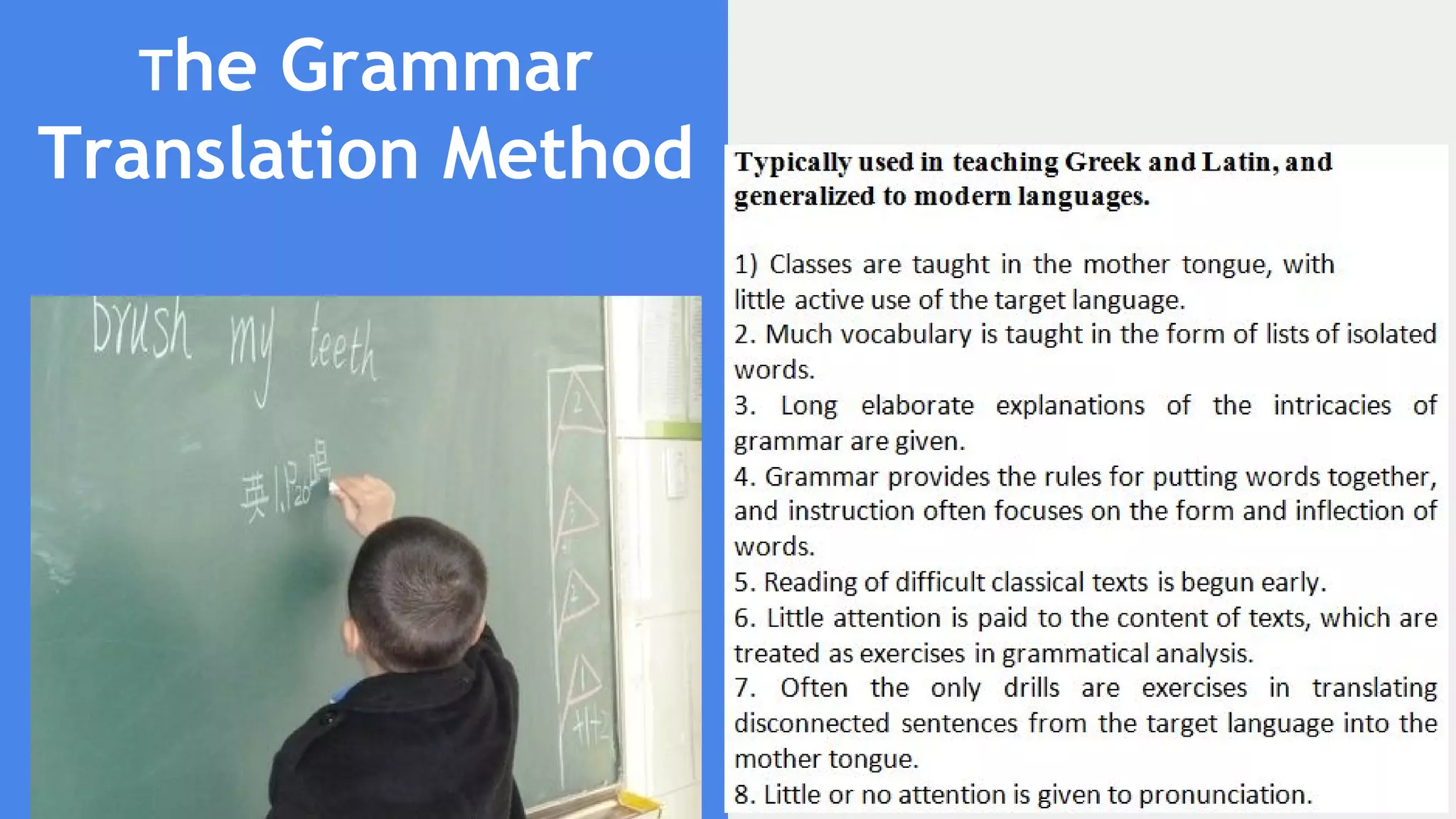
The Grammar
Translation Method
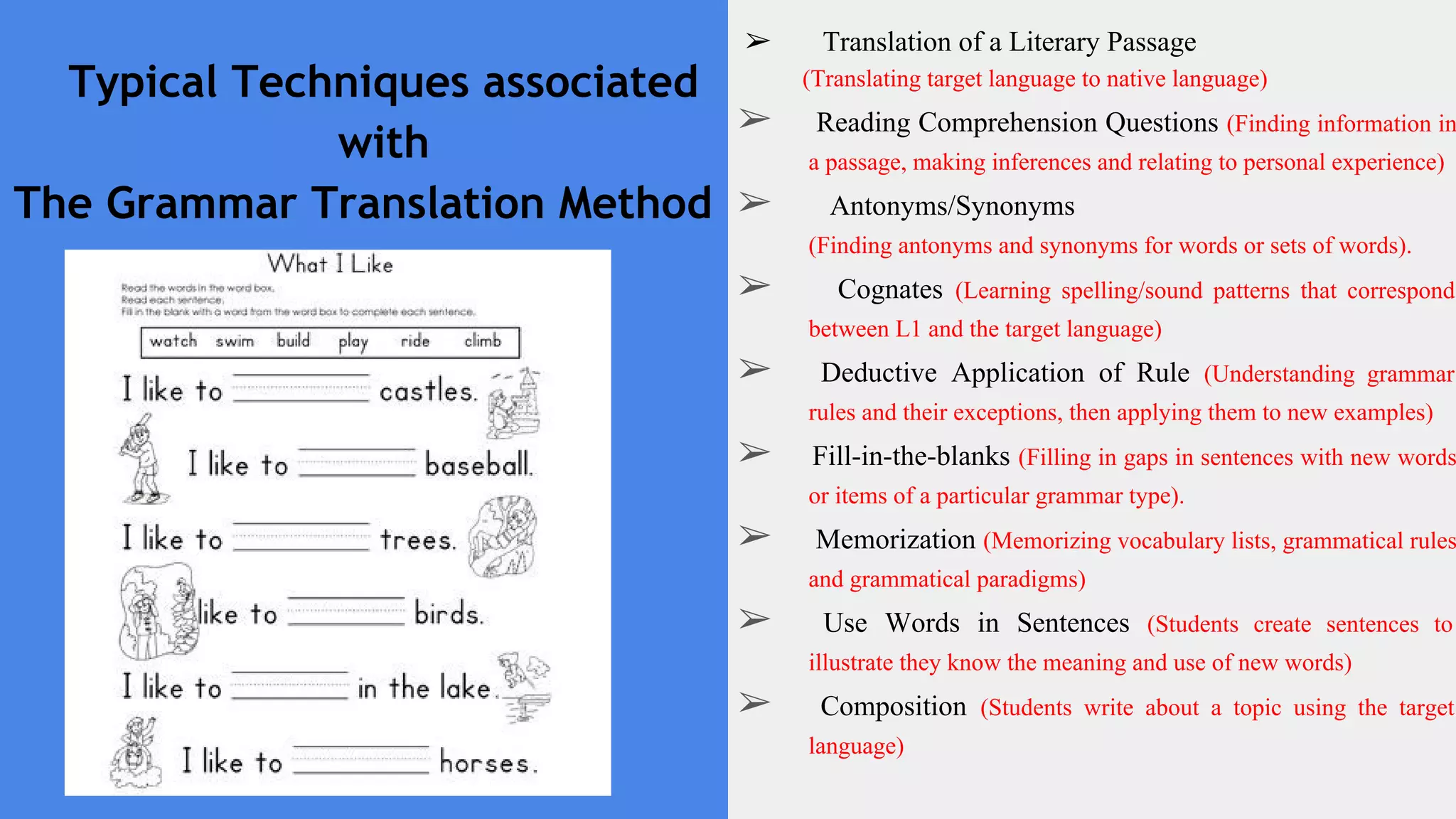
Typical Techniques associated
with
The Grammar Translation Method
➢ Translation of a Literary Passage
(Translating target language to native language)
➢ Reading Comprehension Questions (Finding information in
a passage, making inferences and relating to personal experience)
➢ Antonyms/Synonyms
(Finding antonyms and synonyms for words or sets of words).
➢ Cognates (Learning spelling/sound patterns that correspond
between L1 and the target language)
➢ Deductive Application of Rule (Understanding grammar
rules and their exceptions, then applying them to new examples)
➢ Fill-in-the-blanks (Filling in gaps in sentences with new words
or items of a particular grammar type).
➢ Memorization (Memorizing vocabulary lists, grammatical rules
and grammatical paradigms)
➢ Use Words in Sentences (Students create sentences to
illustrate they know the meaning and use of new words)
➢ Composition (Students write about a topic using the target
language)
The Direct
Method
The Direct Method aims at establishing
the direct bond between thought and
expressions and between experience and
language. It is based on the assumption
that the learner should experience the
new language in the same way as he
experienced his mother tongue.
Pupils are taught new words by actually
showing them the objects for which they
stand or performing actions or by suitable
illustration in context. This enables them
to think in English and respond directly in
English.
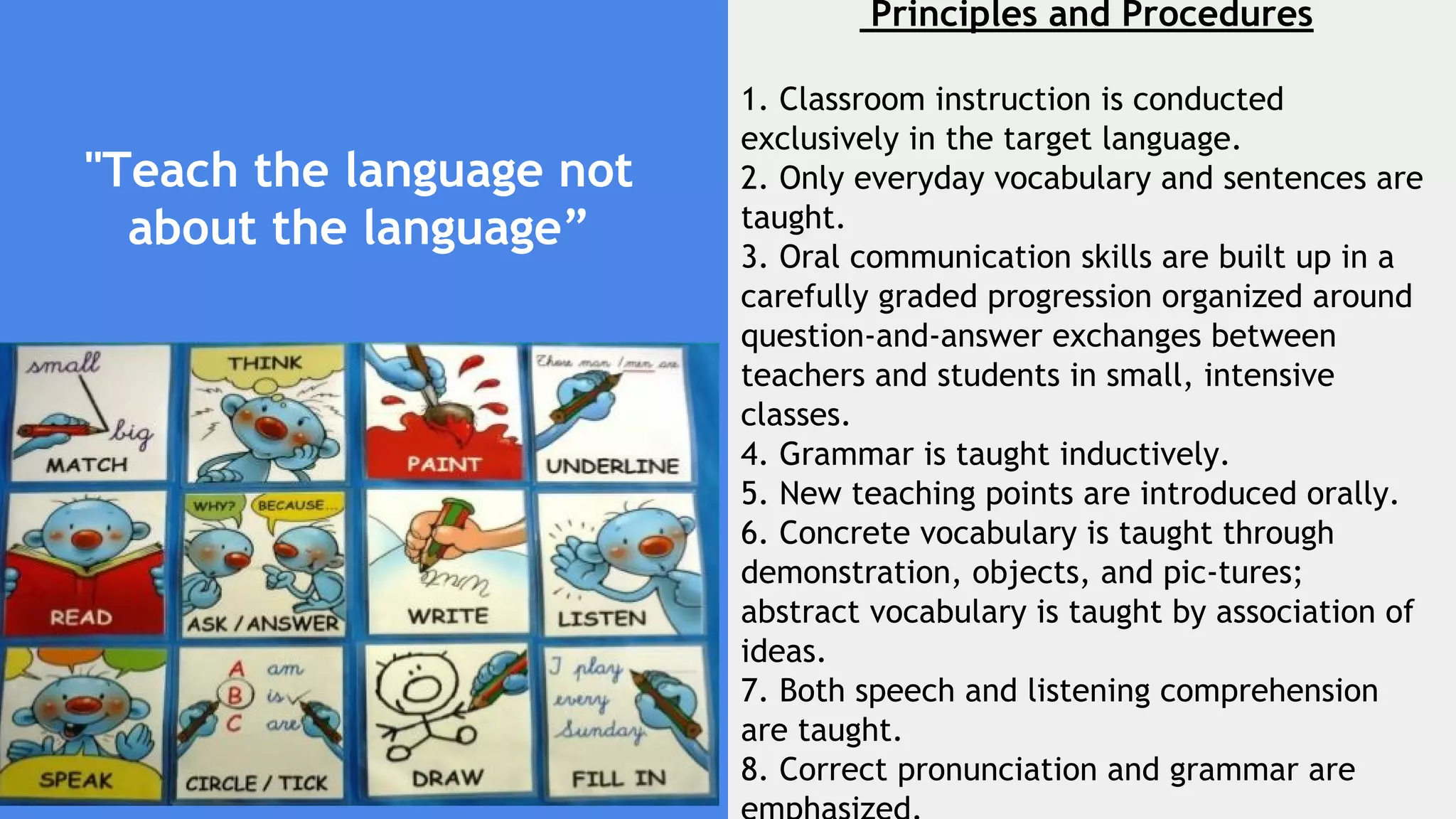
"Teach the language not
about the language”
Principles and Procedures
1. Classroom instruction is conducted
exclusively in the target language.
2. Only everyday vocabulary and sentences are
taught.
3. Oral communication skills are built up in a
carefully graded progression organized around
question-and-answer exchanges between
teachers and students in small, intensive
classes.
4. Grammar is taught inductively.
5. New teaching points are introduced orally.
6. Concrete vocabulary is taught through
demonstration, objects, and pic­tures;
abstract vocabulary is taught by association of
ideas.
7. Both speech and listening comprehension
are taught.
8. Correct pronunciation and grammar are
The Reading
Method
Used specially in scientific studies.
Help teachers to perform their
reading.
In this method the capacity of
reading , involving the knowledge of
the country of the language
spoken,are important components.
The translation is a valid resource
and the acquisition of vocabulary is
better than grammar skills.
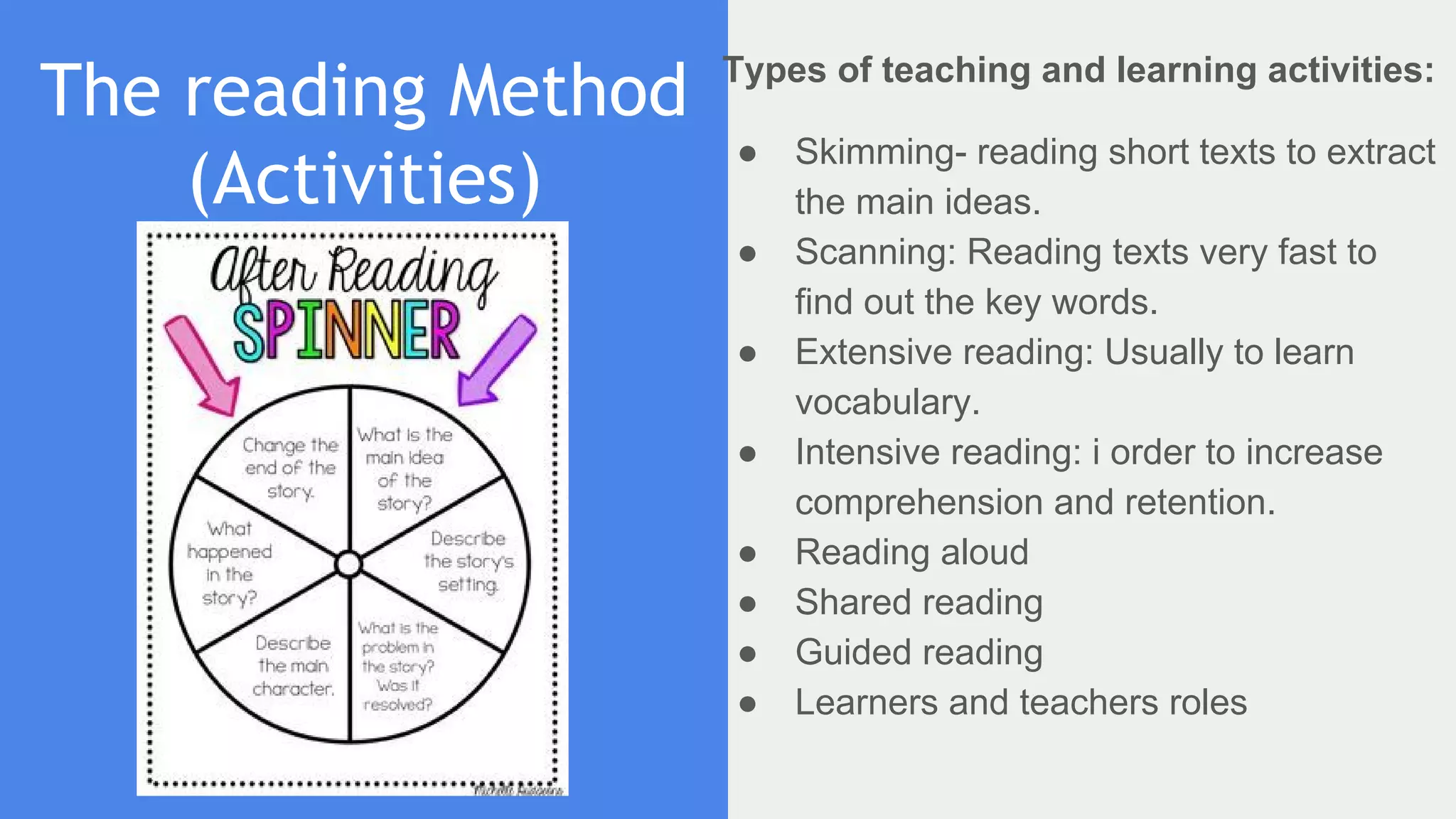
The reading Method
(Activities)
Types of teaching and learning activities:
● Skimming- reading short texts to extract
the main ideas.
● Scanning: Reading texts very fast to
find out the key words.
● Extensive reading: Usually to learn
vocabulary.
● Intensive reading: i order to increase
comprehension and retention.
● Reading aloud
● Shared reading
● Guided reading
● Learners and teachers roles
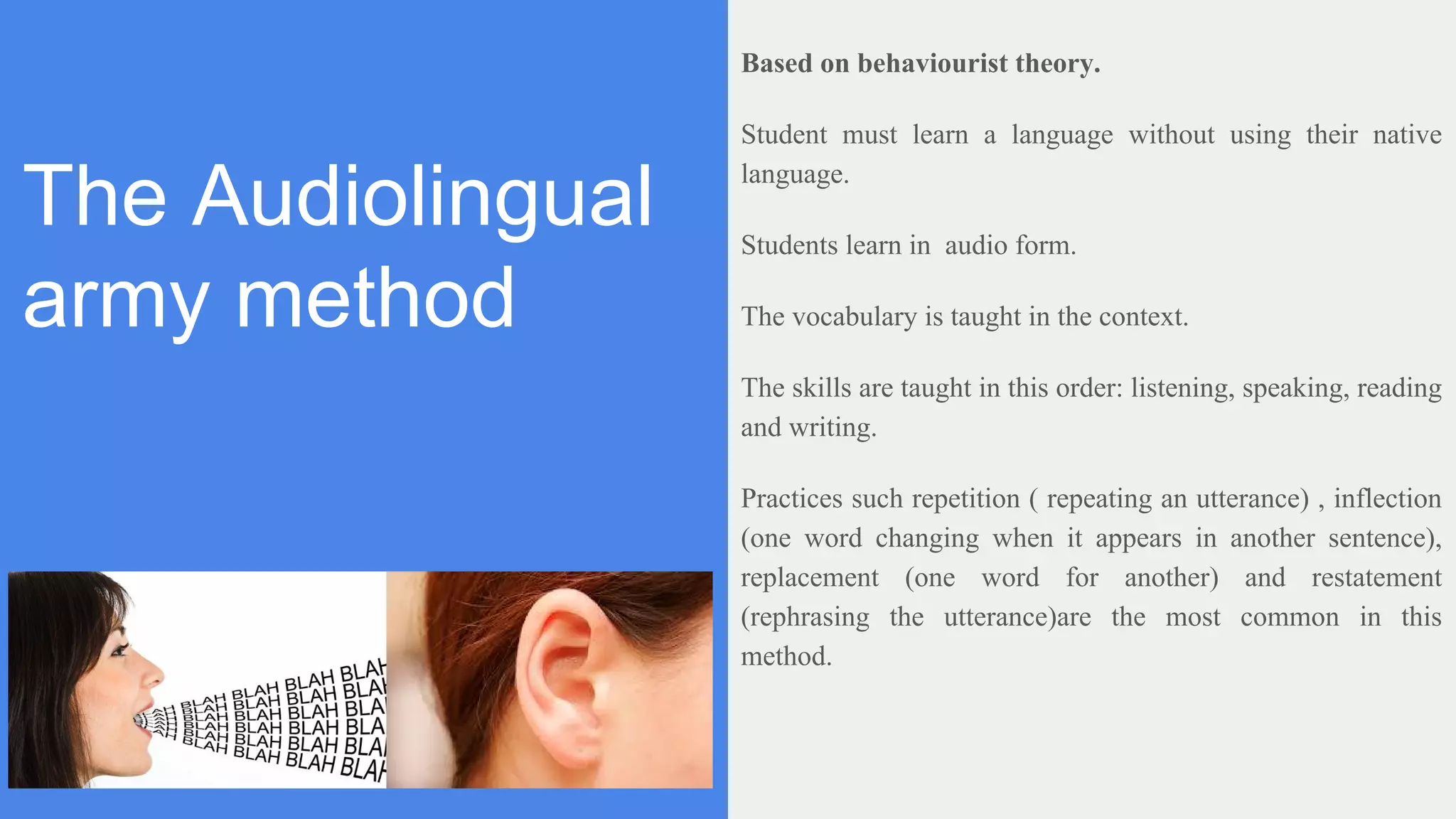
The Audiolingual
army method
Based on behaviourist theory.
Student must learn a language without using their native
language.
Students learn in audio form.
The vocabulary is taught in the context.
The skills are taught in this order: listening, speaking, reading
and writing.
Practices such repetition ( repeating an utterance) , inflection
(one word changing when it appears in another sentence),
replacement (one word for another) and restatement
(rephrasing the utterance)are the most common in this
method.
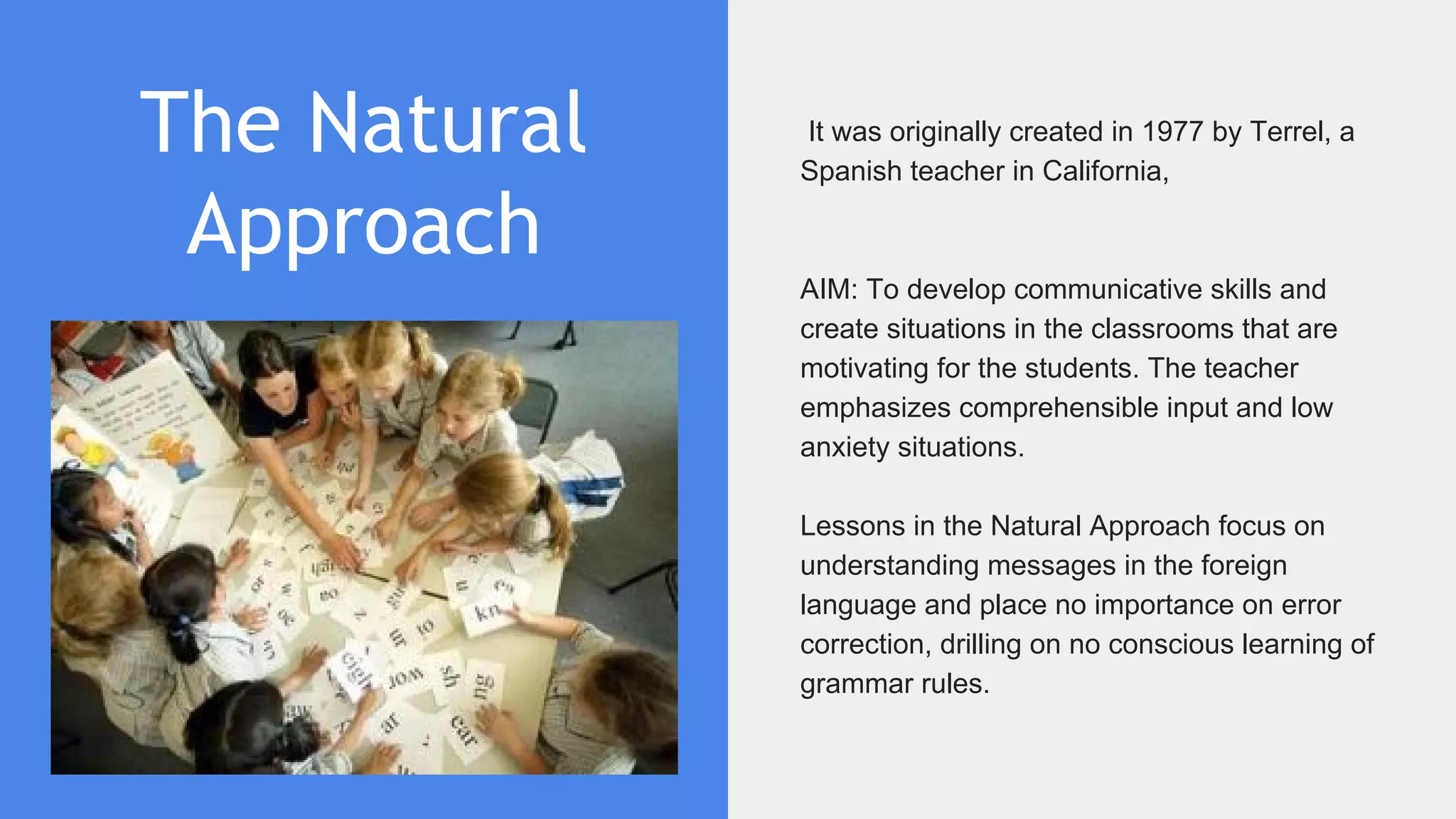
The Natural
Approach
It was originally created in 1977 by Terrel, a
Spanish teacher in California,
AIM: To develop communicative skills and
create situations in the classrooms that are
motivating for the students. The teacher
emphasizes comprehensible input and low
anxiety situations.
Lessons in the Natural Approach focus on
understanding messages in the foreign
language and place no importance on error
correction, drilling on no conscious learning of
grammar rules.
Principles of the
Natural Approach
➢ Focus of instruction is on communication rather
than its form.
➢ Speech production comes slowly and is never
forced.
➢ Early speech goes through natural stages (yes
on no responses, one- word answers, lists of
words, short phrases, complete sentences).
➢ Teaching according to the Natural approach
focuses on communicative abilities.
➢ One of its objectives is to help beginners
become intermediate.
➢ Vocabulary is considered prior to syntactic
structures.
➢ A lot of comprehensible input must be
provided.
➢ Use of visual aids to help comprehension.
➢ Focus is on listening and reading. Speaking
emerges later.
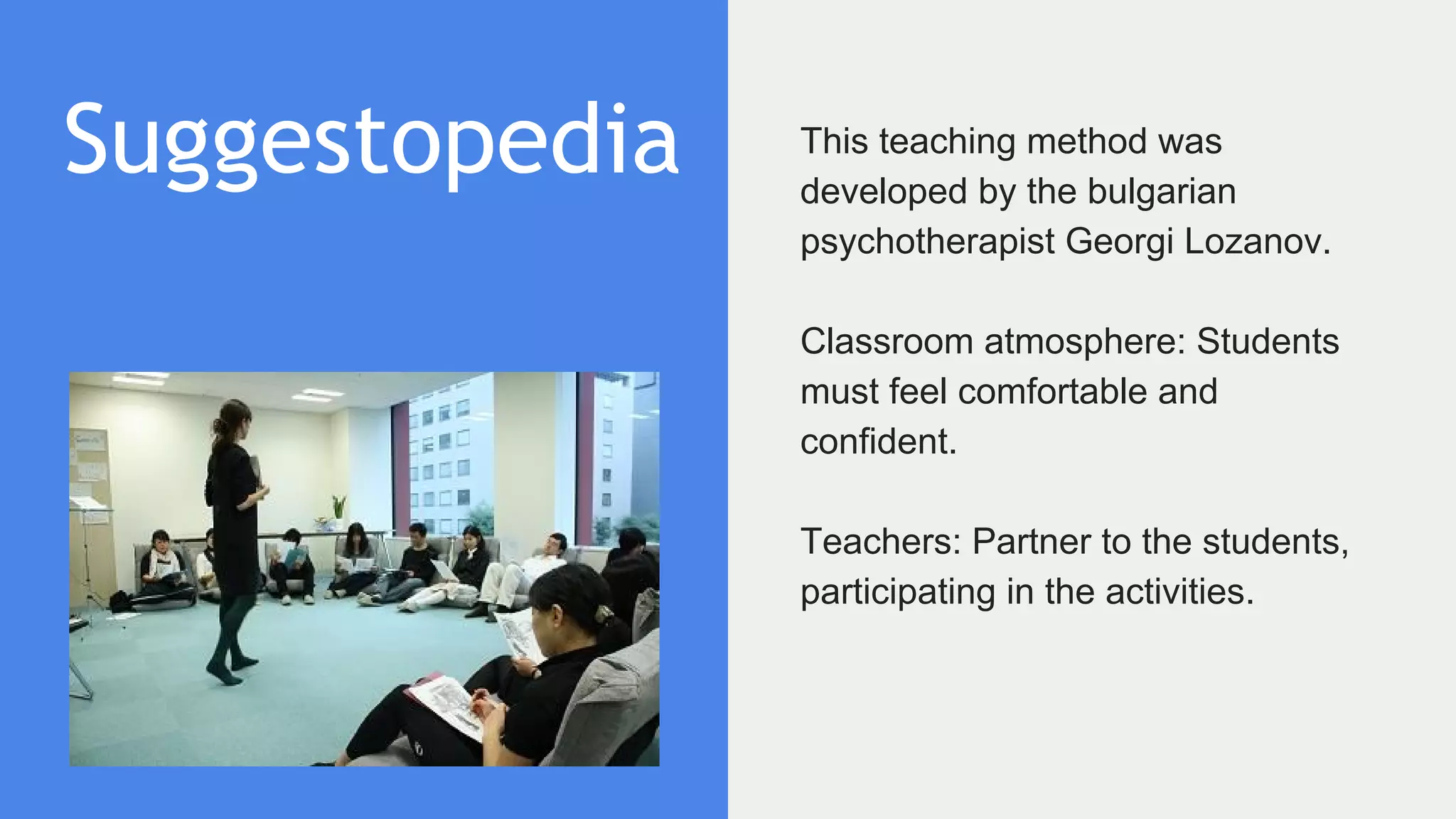
Suggestopedia This teaching method was
developed by the bulgarian
psychotherapist Georgi Lozanov.
Classroom atmosphere: Students
must feel comfortable and
confident.
Teachers: Partner to the students,
participating in the activities.
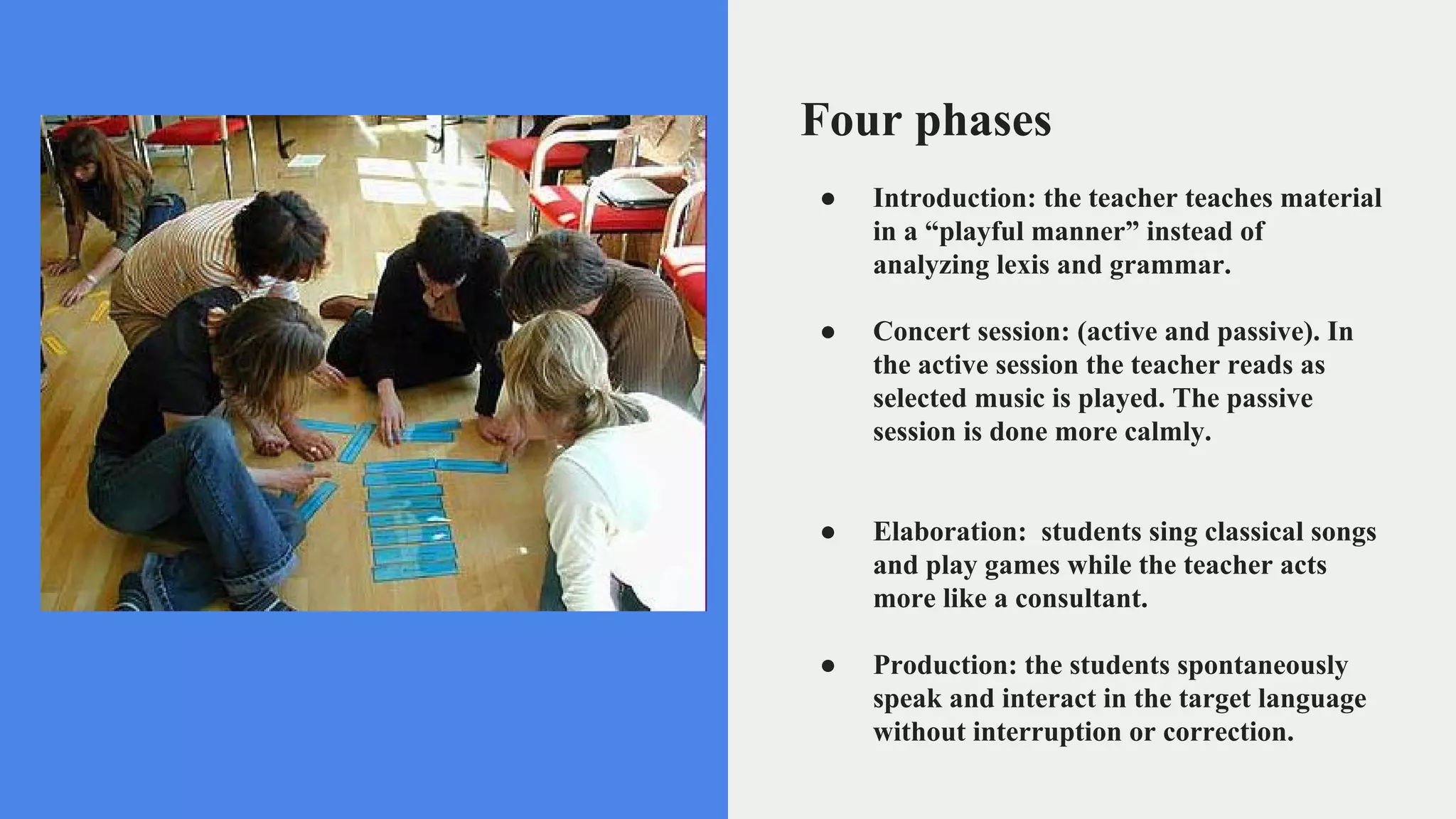
Four phases
● Introduction: the teacher teaches material
in a “playful manner” instead of
analyzing lexis and grammar.
● Concert session: (active and passive). In
the active session the teacher reads as
selected music is played. The passive
session is done more calmly.
● Elaboration: students sing classical songs
and play games while the teacher acts
more like a consultant.
● Production: the students spontaneously
speak and interact in the target language
without interruption or correction.
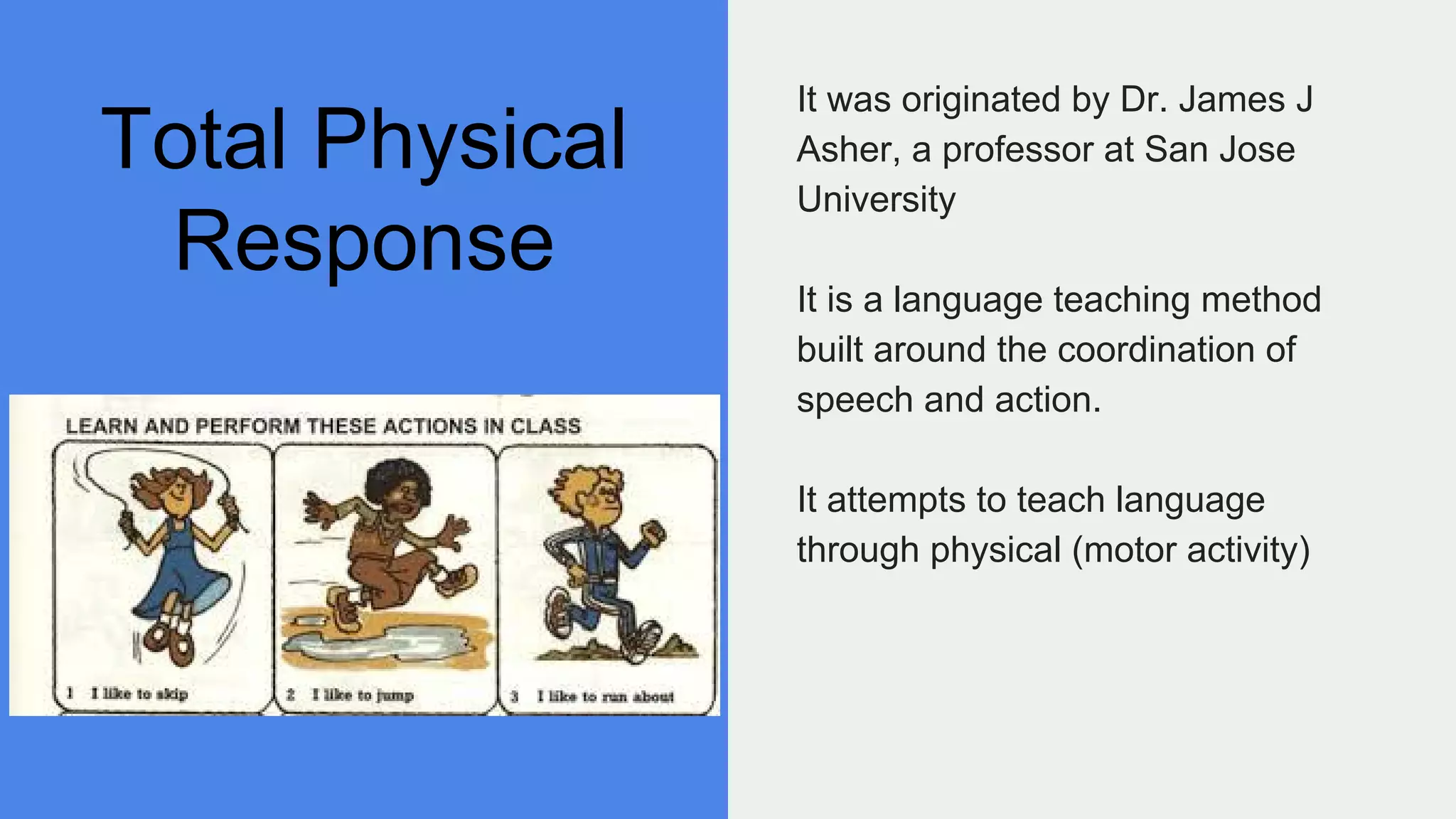
Total Physical
Response
It was originated by Dr. James J
Asher, a professor at San Jose
University
It is a language teaching method
built around the coordination of
speech and action.
It attempts to teach language
through physical (motor activity)
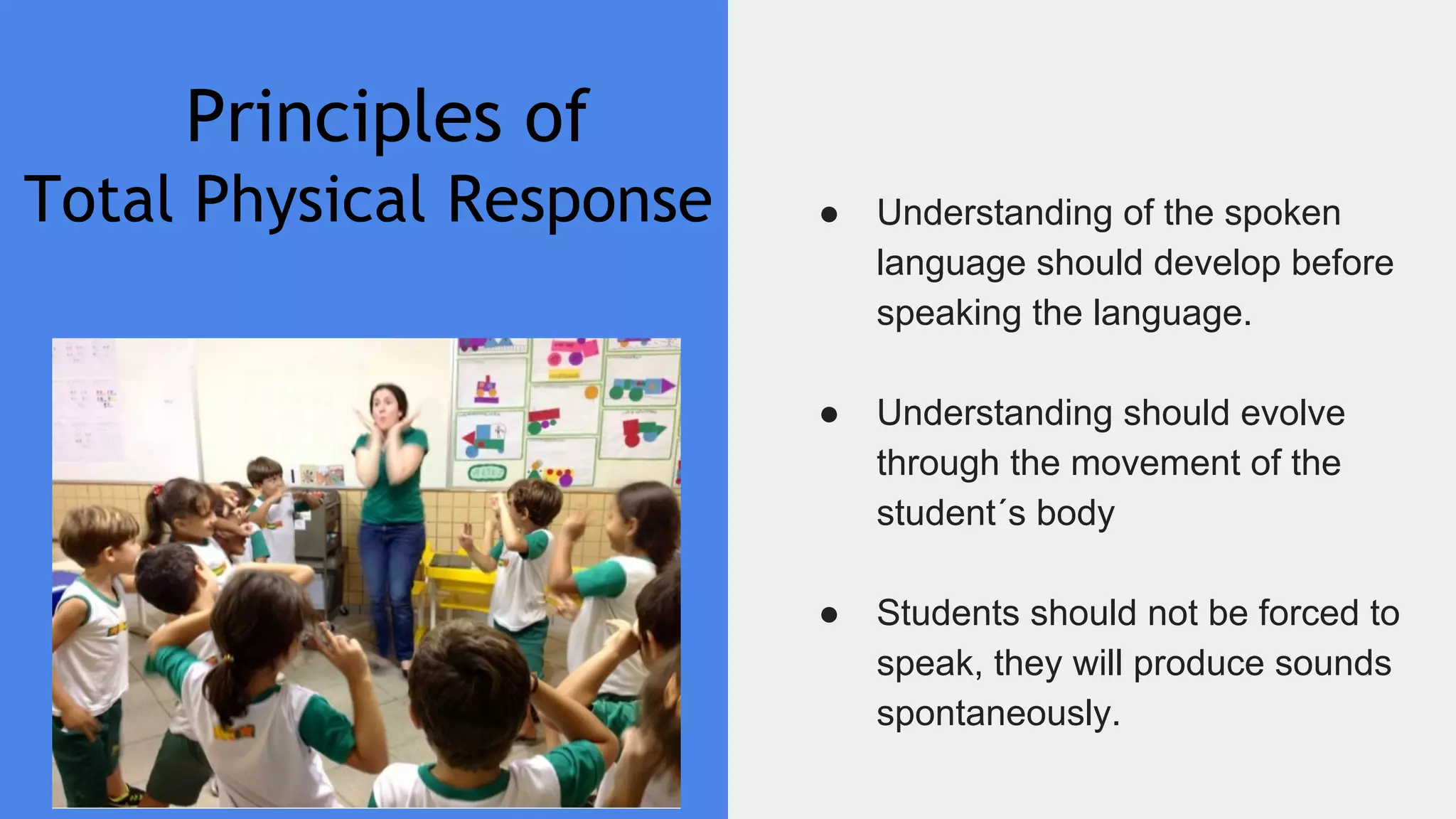
Principles of
Total Physical Response ● Understanding of the spoken
language should develop before
speaking the language.
● Understanding should evolve
through the movement of the
student´s body
● Students should not be forced to
speak, they will produce sounds
spontaneously.
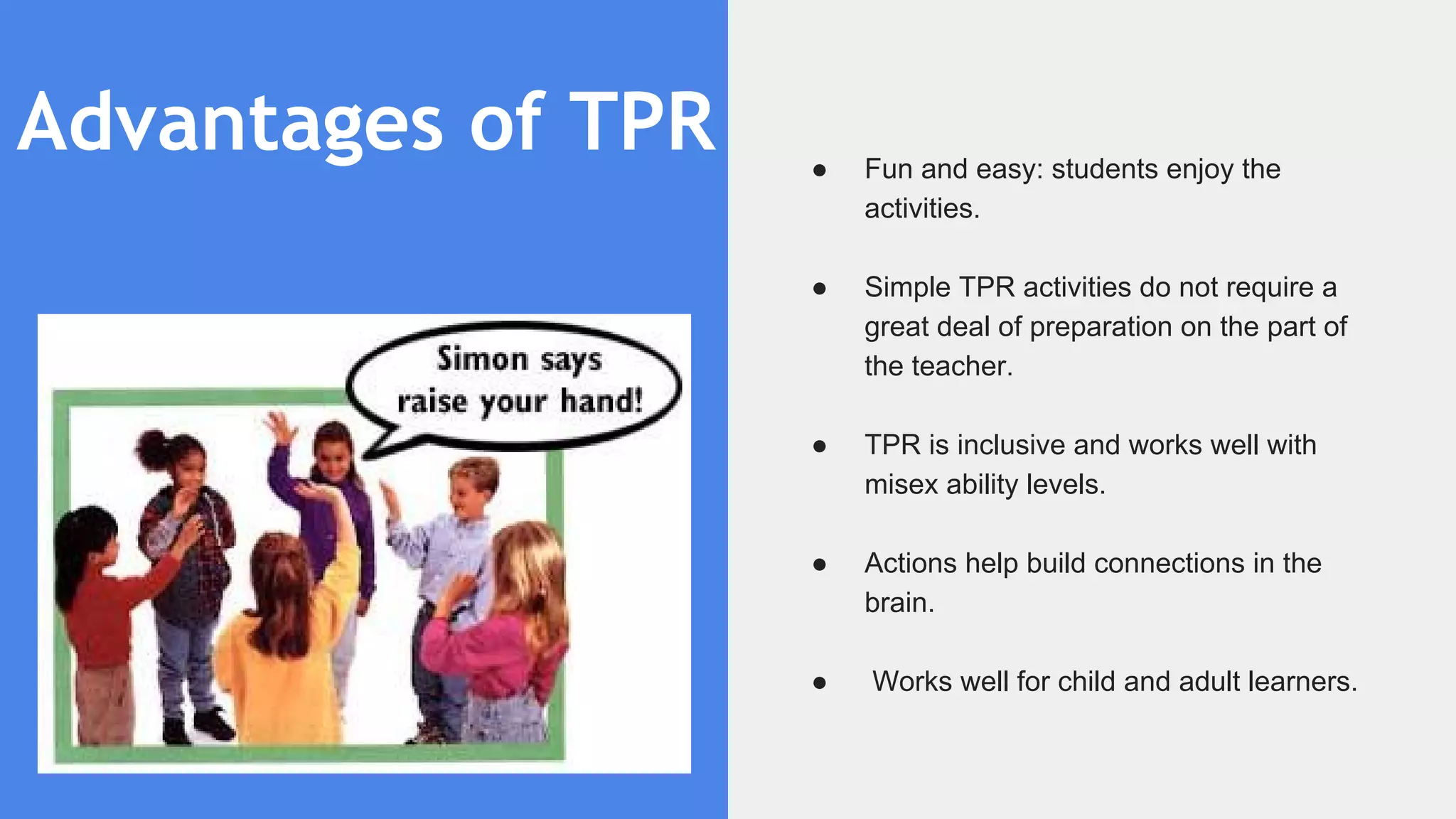
Advantages of TPR ● Fun and easy: students enjoy the
activities.
● Simple TPR activities do not require a
great deal of preparation on the part of
the teacher.
● TPR is inclusive and works well with
misex ability levels.
● Actions help build connections in the
brain.
● Works well for child and adult learners.
The Silent Way
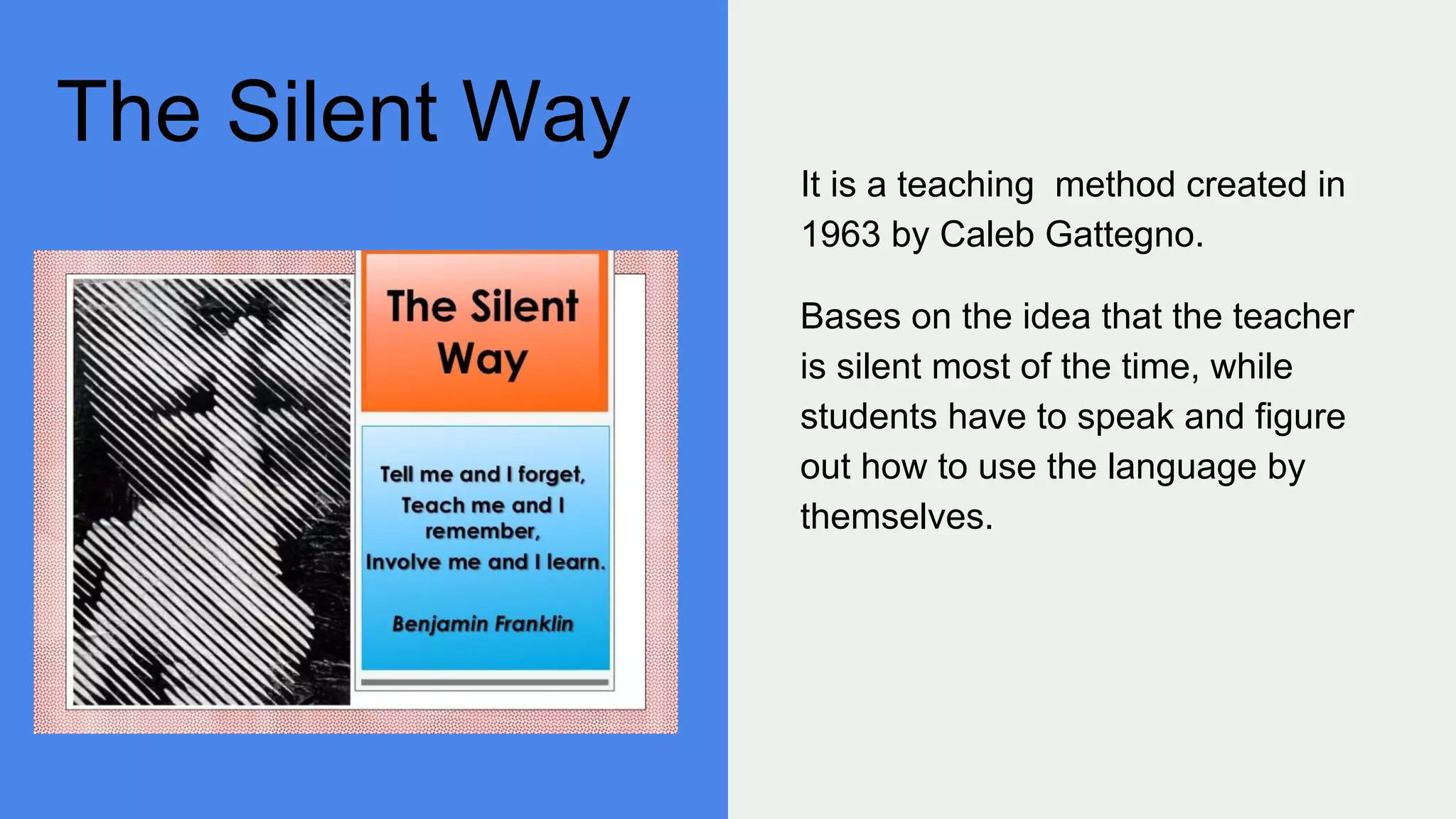
It is a teaching method created in
1963 by Caleb Gattegno.
Bases on the idea that the teacher
is silent most of the time, while
students have to speak and figure
out how to use the language by
themselves.
Principles of the
Silent Way
-The learner needs to discover or
create.
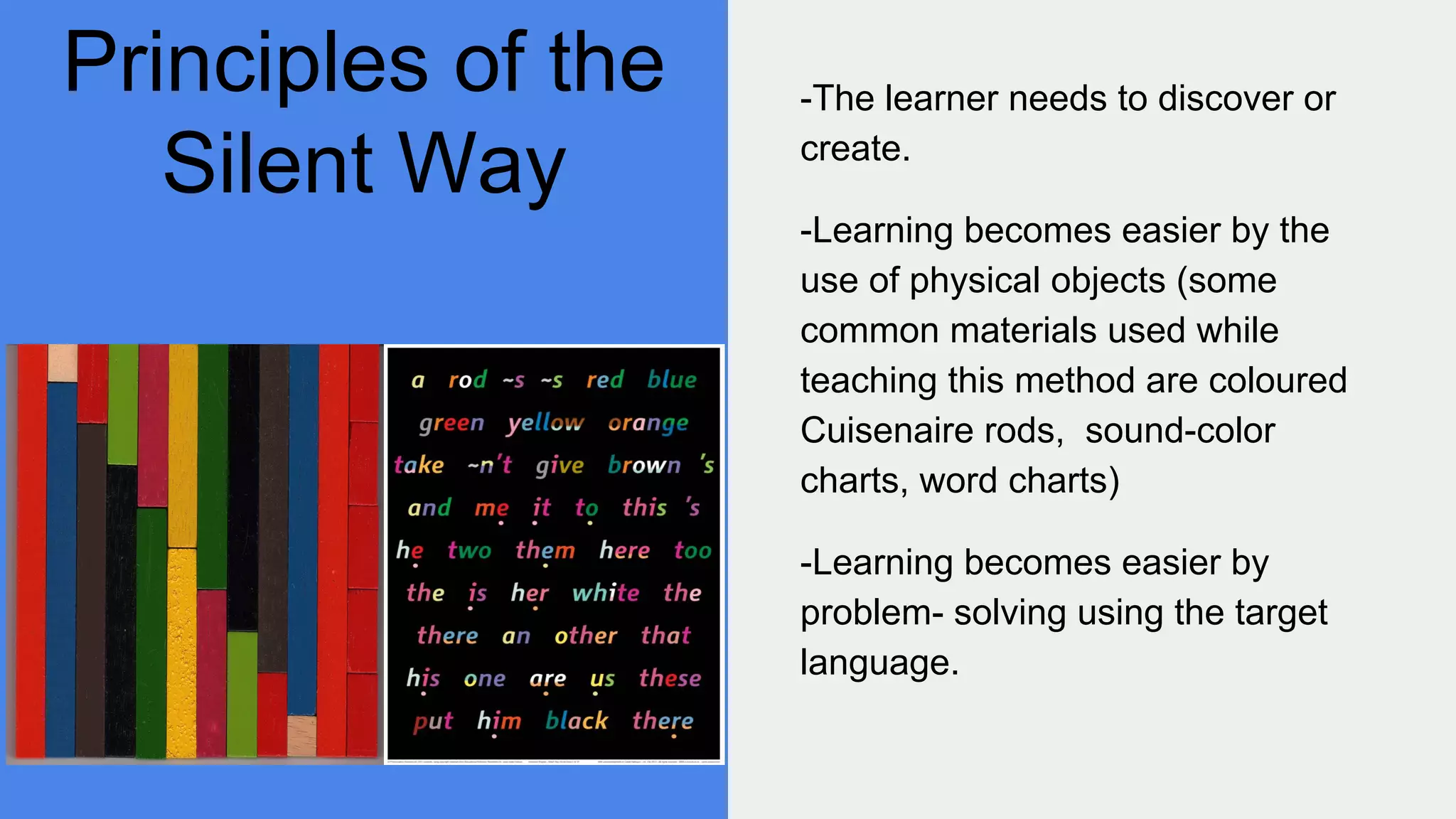
-Learning becomes easier by the
use of physical objects (some
common materials used while
teaching this method are coloured
Cuisenaire rods, sound-color
charts, word charts)
-Learning becomes easier by
problem- solving using the target
language.
Communicative
Language
Teaching
It is EFL and ESL teaching
approach that emphasizes
interaction as both the means and
the goal of study.
This approach appeared as the
language theories such as the
Audiolingual Method and Situational
Language teaching method were
questioned by important linguists
likeChomsky (1960s).
Principles of
CLT
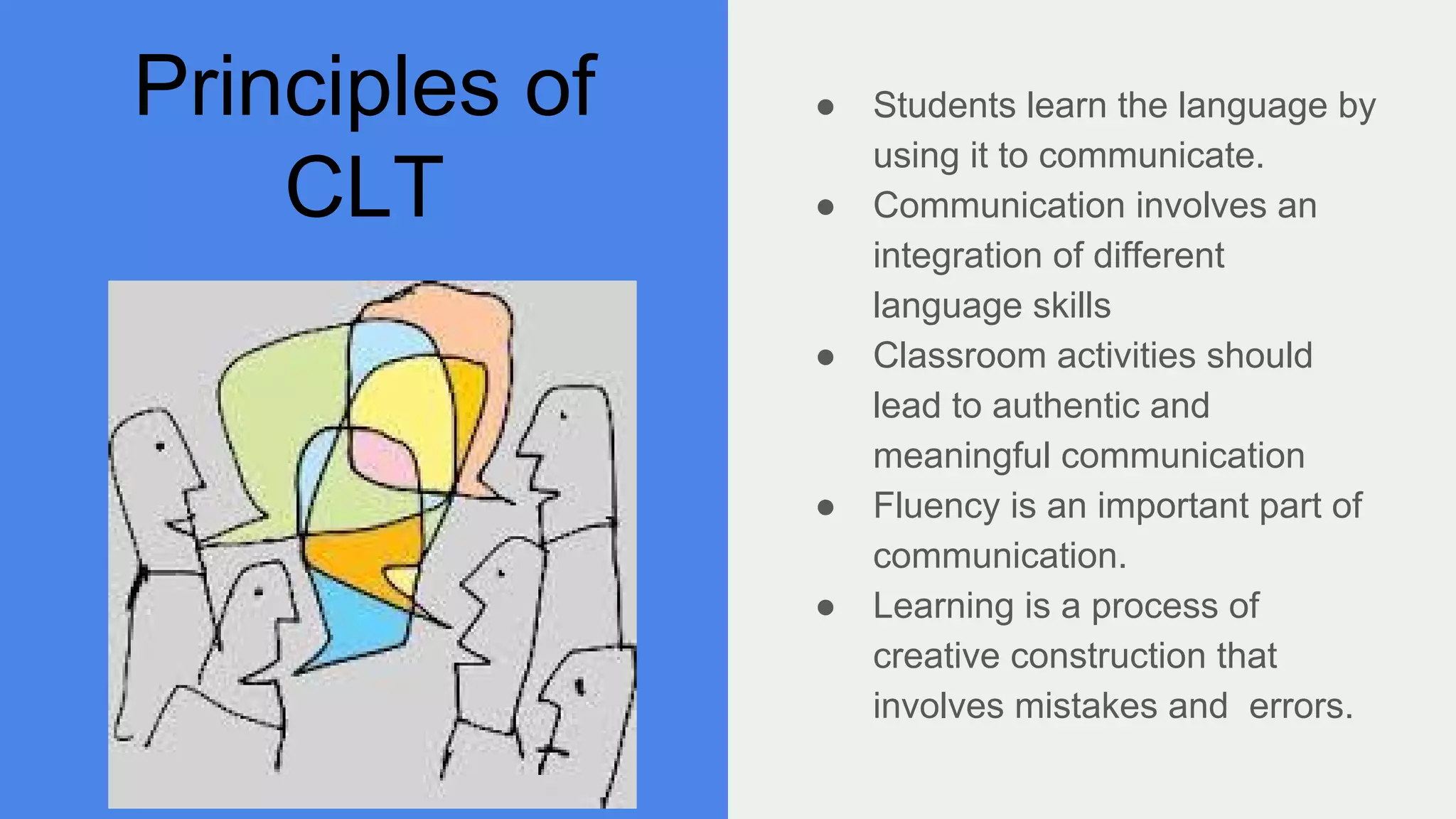
● Students learn the language by
using it to communicate.
● Communication involves an
integration of different
language skills
● Classroom activities should
lead to authentic and
meaningful communication
● Fluency is an important part of
communication.
● Learning is a process of
creative construction that
involves mistakes and errors.
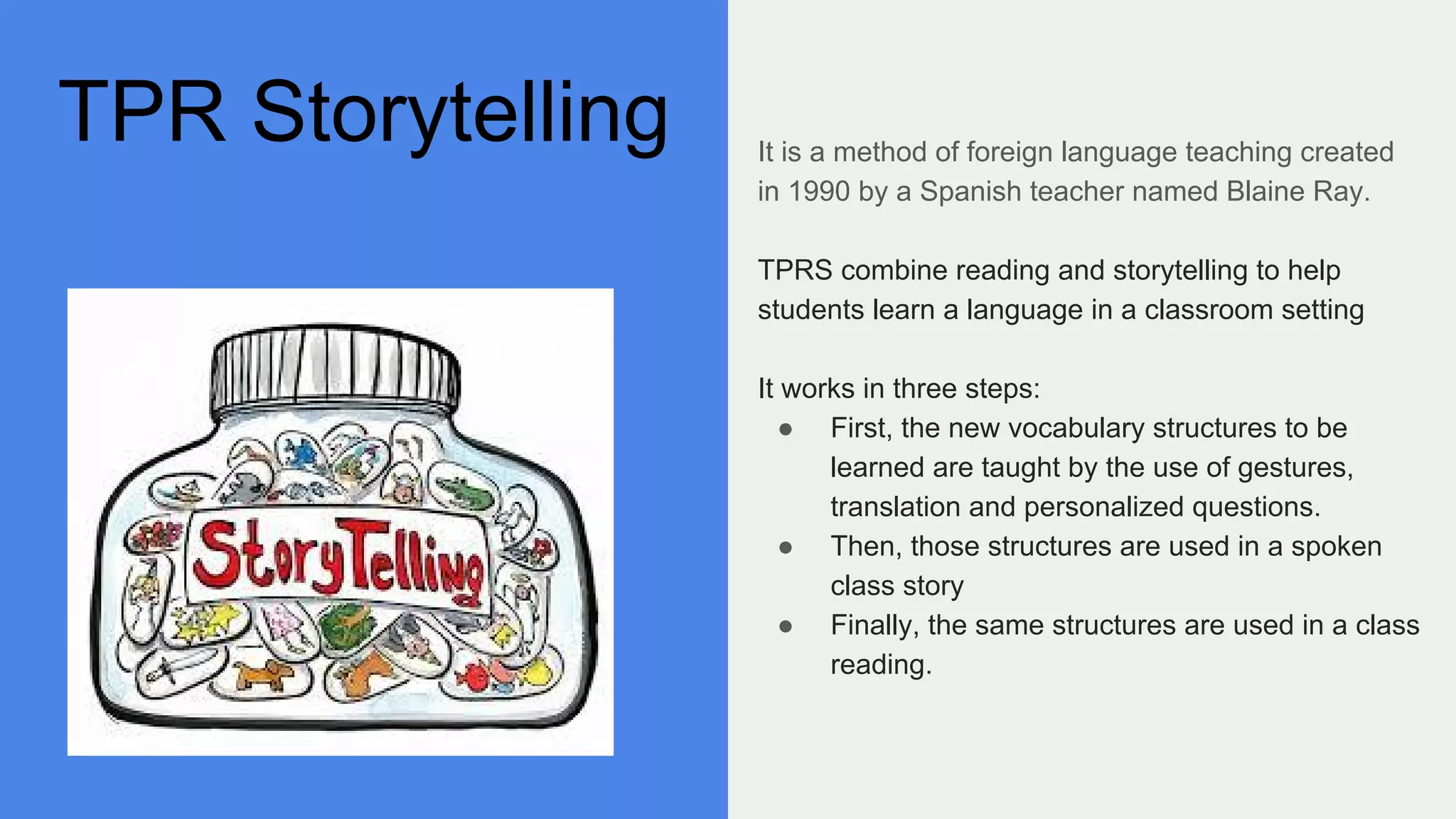
TPR Storytelling It is a method of foreign language teaching created
in 1990 by a Spanish teacher named Blaine Ray.
TPRS combine reading and storytelling to help
students learn a language in a classroom setting
It works in three steps:
● First, the new vocabulary structures to be
learned are taught by the use of gestures,
translation and personalized questions.
● Then, those structures are used in a spoken
class story
● Finally, the same structures are used in a class
reading.
BIBLIOGRAPHY
LARSEN-FREEMAN, Diane. "Techniques and Principles in language
Teaching". Oxford University Press 2008. 1st pub. 2000.
DÍAZ MAGGIOLI, Gabriel. “Self-access booklets for Student-Teachers
at CFE: Introduction to Didactics”. Published by National Administration
of Public Education. ANEP, Montevideo, Uruguay 2012.
PRATOR, C-CELCE-MURCIA, M. “An Outline of Language
Teaching Approaches”. In Teaching English as a Second or Foreign
Language, Published by Newbury House, New York, USA, 1979

History of language teaching methodology

  • 1.
    History of Language TeachingMethodology Fiorella Cetani, Lucía Pereyra, Sebastián Ruiz, Lorena Suárez 1º B I.P.A Introducción a la Didáctica Prof. Alicia Correa
  • 2.
    Many theories aboutthe learning and teaching of languages have been proposed. These theories, normally influenced by developments in the fields of linguistics and psychology, have inspired many approaches to the teaching of second and foreign languages. This presentation will try to explain in an easy and simple way most of these approaches.
  • 3.
  • 4.
    Typical Techniques associated with TheGrammar Translation Method ➢ Translation of a Literary Passage (Translating target language to native language) ➢ Reading Comprehension Questions (Finding information in a passage, making inferences and relating to personal experience) ➢ Antonyms/Synonyms (Finding antonyms and synonyms for words or sets of words). ➢ Cognates (Learning spelling/sound patterns that correspond between L1 and the target language) ➢ Deductive Application of Rule (Understanding grammar rules and their exceptions, then applying them to new examples) ➢ Fill-in-the-blanks (Filling in gaps in sentences with new words or items of a particular grammar type). ➢ Memorization (Memorizing vocabulary lists, grammatical rules and grammatical paradigms) ➢ Use Words in Sentences (Students create sentences to illustrate they know the meaning and use of new words) ➢ Composition (Students write about a topic using the target language)
  • 5.
    The Direct Method The DirectMethod aims at establishing the direct bond between thought and expressions and between experience and language. It is based on the assumption that the learner should experience the new language in the same way as he experienced his mother tongue. Pupils are taught new words by actually showing them the objects for which they stand or performing actions or by suitable illustration in context. This enables them to think in English and respond directly in English.
  • 6.
    "Teach the languagenot about the language” Principles and Procedures 1. Classroom instruction is conducted exclusively in the target language. 2. Only everyday vocabulary and sentences are taught. 3. Oral communication skills are built up in a carefully graded progression organized around question-and-answer exchanges between teachers and students in small, intensive classes. 4. Grammar is taught inductively. 5. New teaching points are introduced orally. 6. Concrete vocabulary is taught through demonstration, objects, and pic­tures; abstract vocabulary is taught by association of ideas. 7. Both speech and listening comprehension are taught. 8. Correct pronunciation and grammar are
  • 7.
    The Reading Method Used speciallyin scientific studies. Help teachers to perform their reading. In this method the capacity of reading , involving the knowledge of the country of the language spoken,are important components. The translation is a valid resource and the acquisition of vocabulary is better than grammar skills.
  • 8.
    The reading Method (Activities) Typesof teaching and learning activities: ● Skimming- reading short texts to extract the main ideas. ● Scanning: Reading texts very fast to find out the key words. ● Extensive reading: Usually to learn vocabulary. ● Intensive reading: i order to increase comprehension and retention. ● Reading aloud ● Shared reading ● Guided reading ● Learners and teachers roles
  • 9.
    The Audiolingual army method Basedon behaviourist theory. Student must learn a language without using their native language. Students learn in audio form. The vocabulary is taught in the context. The skills are taught in this order: listening, speaking, reading and writing. Practices such repetition ( repeating an utterance) , inflection (one word changing when it appears in another sentence), replacement (one word for another) and restatement (rephrasing the utterance)are the most common in this method.
  • 10.
    The Natural Approach It wasoriginally created in 1977 by Terrel, a Spanish teacher in California, AIM: To develop communicative skills and create situations in the classrooms that are motivating for the students. The teacher emphasizes comprehensible input and low anxiety situations. Lessons in the Natural Approach focus on understanding messages in the foreign language and place no importance on error correction, drilling on no conscious learning of grammar rules.
  • 11.
    Principles of the NaturalApproach ➢ Focus of instruction is on communication rather than its form. ➢ Speech production comes slowly and is never forced. ➢ Early speech goes through natural stages (yes on no responses, one- word answers, lists of words, short phrases, complete sentences). ➢ Teaching according to the Natural approach focuses on communicative abilities. ➢ One of its objectives is to help beginners become intermediate. ➢ Vocabulary is considered prior to syntactic structures. ➢ A lot of comprehensible input must be provided. ➢ Use of visual aids to help comprehension. ➢ Focus is on listening and reading. Speaking emerges later.
  • 12.
    Suggestopedia This teachingmethod was developed by the bulgarian psychotherapist Georgi Lozanov. Classroom atmosphere: Students must feel comfortable and confident. Teachers: Partner to the students, participating in the activities.
  • 13.
    Four phases ● Introduction:the teacher teaches material in a “playful manner” instead of analyzing lexis and grammar. ● Concert session: (active and passive). In the active session the teacher reads as selected music is played. The passive session is done more calmly. ● Elaboration: students sing classical songs and play games while the teacher acts more like a consultant. ● Production: the students spontaneously speak and interact in the target language without interruption or correction.
  • 14.
    Total Physical Response It wasoriginated by Dr. James J Asher, a professor at San Jose University It is a language teaching method built around the coordination of speech and action. It attempts to teach language through physical (motor activity)
  • 15.
    Principles of Total PhysicalResponse ● Understanding of the spoken language should develop before speaking the language. ● Understanding should evolve through the movement of the student´s body ● Students should not be forced to speak, they will produce sounds spontaneously.
  • 16.
    Advantages of TPR● Fun and easy: students enjoy the activities. ● Simple TPR activities do not require a great deal of preparation on the part of the teacher. ● TPR is inclusive and works well with misex ability levels. ● Actions help build connections in the brain. ● Works well for child and adult learners.
  • 17.
    The Silent Way Itis a teaching method created in 1963 by Caleb Gattegno. Bases on the idea that the teacher is silent most of the time, while students have to speak and figure out how to use the language by themselves.
  • 18.
    Principles of the SilentWay -The learner needs to discover or create. -Learning becomes easier by the use of physical objects (some common materials used while teaching this method are coloured Cuisenaire rods, sound-color charts, word charts) -Learning becomes easier by problem- solving using the target language.
  • 19.
    Communicative Language Teaching It is EFLand ESL teaching approach that emphasizes interaction as both the means and the goal of study. This approach appeared as the language theories such as the Audiolingual Method and Situational Language teaching method were questioned by important linguists likeChomsky (1960s).
  • 20.
    Principles of CLT ● Studentslearn the language by using it to communicate. ● Communication involves an integration of different language skills ● Classroom activities should lead to authentic and meaningful communication ● Fluency is an important part of communication. ● Learning is a process of creative construction that involves mistakes and errors.
  • 21.
    TPR Storytelling Itis a method of foreign language teaching created in 1990 by a Spanish teacher named Blaine Ray. TPRS combine reading and storytelling to help students learn a language in a classroom setting It works in three steps: ● First, the new vocabulary structures to be learned are taught by the use of gestures, translation and personalized questions. ● Then, those structures are used in a spoken class story ● Finally, the same structures are used in a class reading.
  • 22.
    BIBLIOGRAPHY LARSEN-FREEMAN, Diane. "Techniquesand Principles in language Teaching". Oxford University Press 2008. 1st pub. 2000. DÍAZ MAGGIOLI, Gabriel. “Self-access booklets for Student-Teachers at CFE: Introduction to Didactics”. Published by National Administration of Public Education. ANEP, Montevideo, Uruguay 2012. PRATOR, C-CELCE-MURCIA, M. “An Outline of Language Teaching Approaches”. In Teaching English as a Second or Foreign Language, Published by Newbury House, New York, USA, 1979