The Grammar-Translation
Method
Introduction
Iqbal hussain
Objectives of GTM
 To be able to read literature written in
the target language
 To be able to translate from one
language to another
 To develop reading and writing skill
Key Features of GTM
 Native language
 Vocabulary / grammatical rules
 Accuracy /translation
 Language skills
Advantages of GTM
 An effective way for application of
grammar and sentence structure
 Few demands on teachers
 Least stressful for students
Disadvantage of GTM
 Wrong idea of what language is
 Less learners’ motivation
 Create frustration for learners
Application: Typical Techniques
 (1) Translation of a Literary Passage
 (2) Reading Comprehension Questions
 (3) Antonyms/Synonyms
 (4) Cognates
 (5) Deductive Application of Rule
 (6) Fill-in-the-blanks
 (7) Memorization
 (8) Use Words in Sentences
 (9) Composition
Reading Method
outstanding following the
Committee of Twelve in 1900 in
the U.S.
The Purpose
For people who do not travel
abroad, reading is a useful skill to
learn a foreign language.
GTM & RM
˙Similarity
Little or no attention is given to
pronunciation.
˙Diversity
GTM read difficult texts begun early
GTM has Single Vocabulary lists
The Characteristic
( 1 ) Acquisition of vocabulary>
Grammatical skill
( 2 ) Control vocabulary difficulty
( 3 ) Reading Comprehension >
Pronunciation and Conversational
Skills
( 4 ) Translation reappear
Advantages with using RM
˙Good for people who do not travel
abroad
˙Teacher does not need to have good oral
skill
Disadvantages with using
RM
˙Narrow skill ability
˙Unbalanced learning
Typical Procedure in a RM
Course
( 1 ) Read a lot
( 2 ) Expand vocabulary fast
The Direct Method
Introduction
Rationale of DM
 First language learning process
(1) No grammar
(2) No mother tongue
(3) No translation
(4) Postponement of printed word
(5) Postponement of written word
Key Features of DM
 Target language
 Vocabulary / grammar
 Teaching point
 Language skills
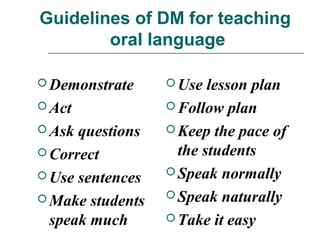
Guidelines of DM for teaching
oral language
 Demonstrate
 Act
 Ask questions
 Correct
 Use sentences
 Make students
speak much
 Use lesson plan
 Follow plan
 Keep the pace of
the students
 Speak normally
 Speak naturally
 Take it easy
Advantages of DM
 An effective way in creating
learners to be competent in using
the target communicatively.
Disadvantage of DM
 Difficult to implement in public
secondary school education
 Time-wasting
 Not all teachers were proficient
enough in the foreign language
Application: Typical Techniques
 (1) Reading Aloud
 (2) Question and Answer Exercise
 (3) Student Self-Correction
 (4) Conversation Practice
 (5) Fill-in-the-blank Exercise
 (6) Dictation
 (7) Paragraph Writing
The Audiolingual Method
˙Founded during World War II for
military purposes in USA
˙Popular in the 1960s but died out in
the 70s
The Purpose
Focus on students’ pronunciation,
and train their ability of listening by
dialogues and drills
Direct Method & ALM
˙Similarity
taught language directly without
using L1
˙Diversity
ALM drilled students without
teaching vocabulary
Structural Linguistics &
ALM
˙Mastering the building blocks
˙Learning the rules
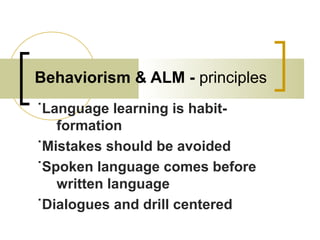
Behaviorism & ALM - principles
˙Language learning is habit-
formation
˙Mistakes should be avoided
˙Spoken language comes before
written language
˙Dialogues and drill centered
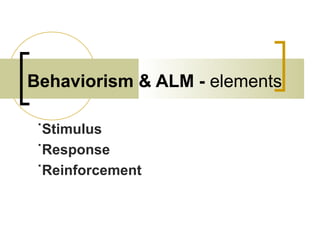
Behaviorism & ALM - elements
˙Stimulus
˙Response
˙Reinforcement
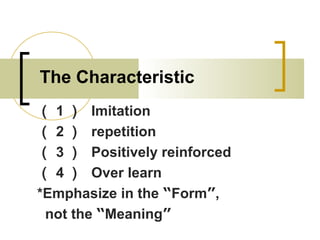
The Characteristic
( 1 ) Imitation
( 2 ) repetition
( 3 ) Positively reinforced
( 4 ) Over learn
*Emphasize in the “Form”,
not the “Meaning”
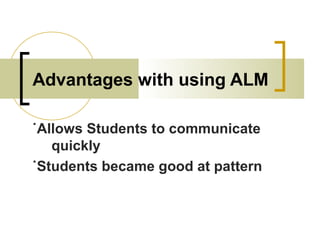
Advantages with using ALM
˙Allows Students to communicate
quickly
˙Students became good at pattern
Disadvantages with using
ALM
˙Turn Students into parrots
˙Boring and mindless
˙Reduce the motivation
Typical Procedure in an ALM
Course
( 1 ) hear a dialogue
( 2 ) repeat the dialogue
( 3 ) key words or structures
changed
( 4 ) practice substitutions in the
pattern drills
The Cognitive Approach
Introduction & Rationale
Key Features
 Instruction is often individualized
 Vocabulary / grammar
 Language skills
 Demands on teachers
Application: Cognitive approach
to grammar teaching
 Grammar teaching should be planned
and systematic
 Necessary grammar instruction
 Extensive exposure to instructed
grammar points
 Production activities
 Group work and task performance
 Postlesson activities
Total Physical Response/TPR
(James Asher , 1966)
founded by James Asher, a
professor of psychology at San
José State University, California,
USA
The Purpose
To have basic oral expression
ability through using imperative
sentences.
The Characteristic
( 1 ) retention
( 2 ) Direct commands
( 3 ) No stress
( 4 ) Listen first
*Emphasize in the “Meaning”,
not the “Form”
Advantages with using TPR
˙Fun.
˙Memorable.
˙Good for kinesthetic learners.
˙No matter the class size.
>>>
Advantages with using TPR
˙Work well with mixed-ability
classes.
˙No requirement for many
preparation or materials.
˙Effective with young learners.
˙Involves both left and right-brained
learning
Disadvantages with using
TPR
˙Students feel shy
˙Less useful for upper levels
˙overuse TPR
Typical Procedure in a TPR
Course
( 1 ) input
( 2 ) comprehension
( 3 ) express
Oral-Situational Approach
Developed in Britain and popular
between the 1930s and 1960s
Main difference between DM
and OSA
Oral-Situational Approach has a
systematic planed vocabulary
and grammar rules, DM hasn’t.
Main difference between
ALM &OSA
Oral-Situational Approach doesn’t
mention about reinforcement,
ALM does.
Purpose
Teaching a practical skill of L2
through copy the way children
acquire L1
Characteristic
˙Start from spoken language
˙Avoid errors
˙Teacher-centered
˙Focus on Listening and speaking
˙Chosen the vocabulary
˙The first method uses structural
syllabus
Advantages with using OSA
•˙Bring the reality situation in the
classroom
•˙Scheduled progress
Disadvantages with using
OSA
˙Turn students into parrots
˙Boring and mindless
˙Reduce the motivation
Typical Procedure
˙Teacher gave a topic
˙Demonstrate with teaching aids
˙Key word changed
Suggestopedia
The name is from the words
suggestion and pedagogy.
Developed in the 1970s by the
Bulgarian psychologist Georgi
Lozanov
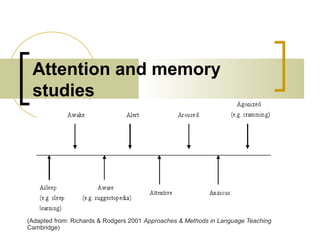
Attention and memory
studies
(Adapted from: Richards & Rodgers 2001 Approaches & Methods in Language Teaching
Cambridge)
Purpose
Desuggest the psychological
barriers to learn vocabulary and
conversation
Characteristic
˙Present text with music
˙Practiced breathing
˙Comfortable
˙Choose target language name
˙Colorful posters on the wall
˙Liberate instead of teach
Elements to Suggestopedia
˙Authority
˙Infantilization
˙Double-planedness
˙Intonation, Rhythm and concert
pseudo-passiveness
Advantages with using
Suggestopedia
˙Increase oral proficiency
˙Lower classroom anxiety
Disadvantages with using
Suggestopedia
˙Unavailable of music and
comfortable chair
˙No advanced comprehension
technique
Typical Procedure
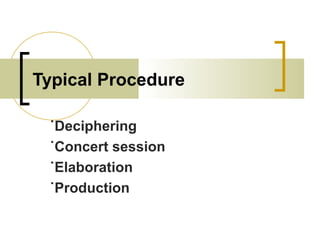
˙Deciphering
˙Concert session
˙Elaboration
˙Production
Community Language
Learning
Developed by Charles Curran and
his associates in 1970s
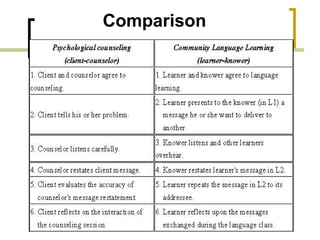
Comparison
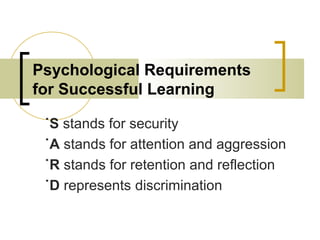
Psychological Requirements
for Successful Learning
˙S stands for security
˙A stands for attention and aggression
˙R stands for retention and reflection
˙D represents discrimination
Purpose
The teacher can successfully
transfer his or her knowledge and
proficiency in the L2 to the
students; Specific purposes are
not mentioned.
Characteristic
˙Client-Counselor and Learner-
Knower relationships
˙Humanistic Techniques
˙Code Alternation
Advantages with using CLL
˙Remove the feeling of distance
and insecure
˙Counselor allows the learner to
decide the topic
Disadvantages with using
CLL
˙Teacher may become too
indirective
˙Confidence based on an inductive
strategy for learning
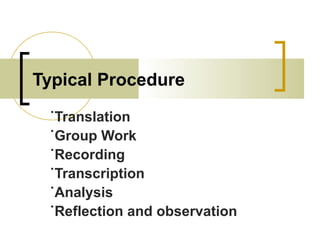
Typical Procedure
˙Translation
˙Group Work
˙Recording
˙Transcription
˙Analysis
˙Reflection and observation
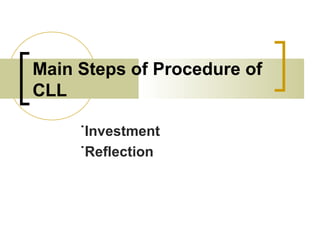
Main Steps of Procedure of
CLL
˙Investment
˙Reflection
The Comprehension-based
Approach
(Natural Approach)
Introduction
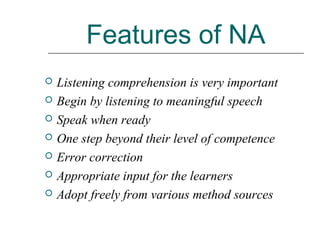
Features of NA
 Listening comprehension is very important
 Begin by listening to meaningful speech
 Speak when ready
 One step beyond their level of competence
 Error correction
 Appropriate input for the learners
 Adopt freely from various method sources
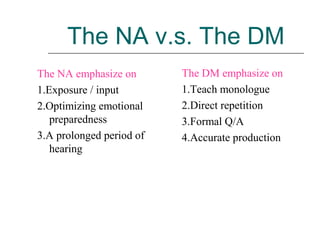
The NA v.s. The DM
The NA emphasize on
1.Exposure / input
2.Optimizing emotional
preparedness
3.A prolonged period of
hearing
The DM emphasize on
1.Teach monologue
2.Direct repetition
3.Formal Q/A
4.Accurate production
Objectives of NA
 To be able to function adequately in
the target situation.
 To be able to convey their requests
and idea
Teacher and Student Roles
Teacher Roles
 The primary source
 Create a classroom atmosphere
 Choose a rich mix of classroom activities
Student Roles
Participator ; responder
The Communicative
Approach
Introduction
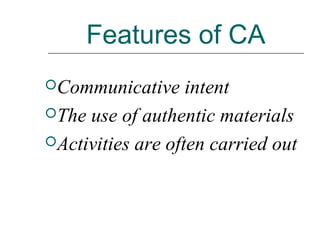
Features of CA
Communicative intent
The use of authentic materials
Activities are often carried out
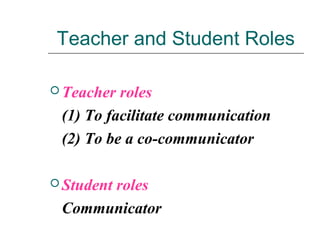
Teacher and Student Roles
 Teacher roles
(1) To facilitate communication
(2) To be a co-communicator
 Student roles
Communicator
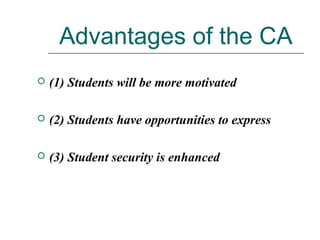
Advantages of the CA
 (1) Students will be more motivated
 (2) Students have opportunities to express
 (3) Student security is enhanced
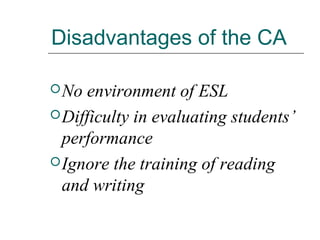
Disadvantages of the CA
No environment of ESL
Difficulty in evaluating students’
performance
Ignore the training of reading
and writing
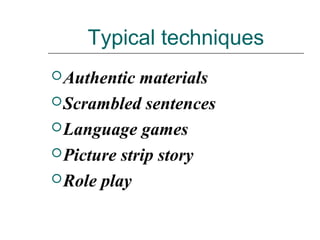
Typical techniques
Authentic materials
Scrambled sentences
Language games
Picture strip story
Role play
Task-Based Approach
Introduction
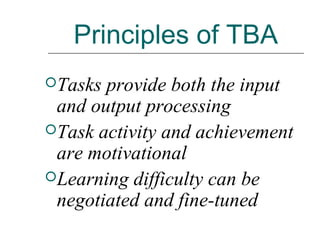
Principles of TBA
Tasks provide both the input
and output processing
Task activity and achievement
are motivational
Learning difficulty can be
negotiated and fine-tuned
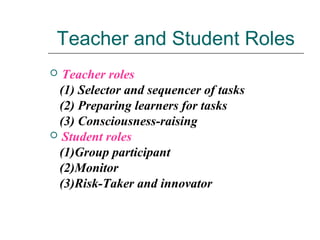
Teacher and Student Roles
 Teacher roles
(1) Selector and sequencer of tasks
(2) Preparing learners for tasks
(3) Consciousness-raising
 Student roles
(1)Group participant
(2)Monitor
(3)Risk-Taker and innovator
Advantages of TBA
 (1) Students are free of language control
 (2) Students have more varied exposure to
language
 (3) Enjoyable and motivating
Disadvantages of TBA
 focus on meaning could come at
the expense of focus on form
Typical techniques
Lesson plans should be designed
to cover 3 stages in the TBA
(1)Pre-task stage
(2)During-task stage
(3)Post-task stage

Teaching approaches