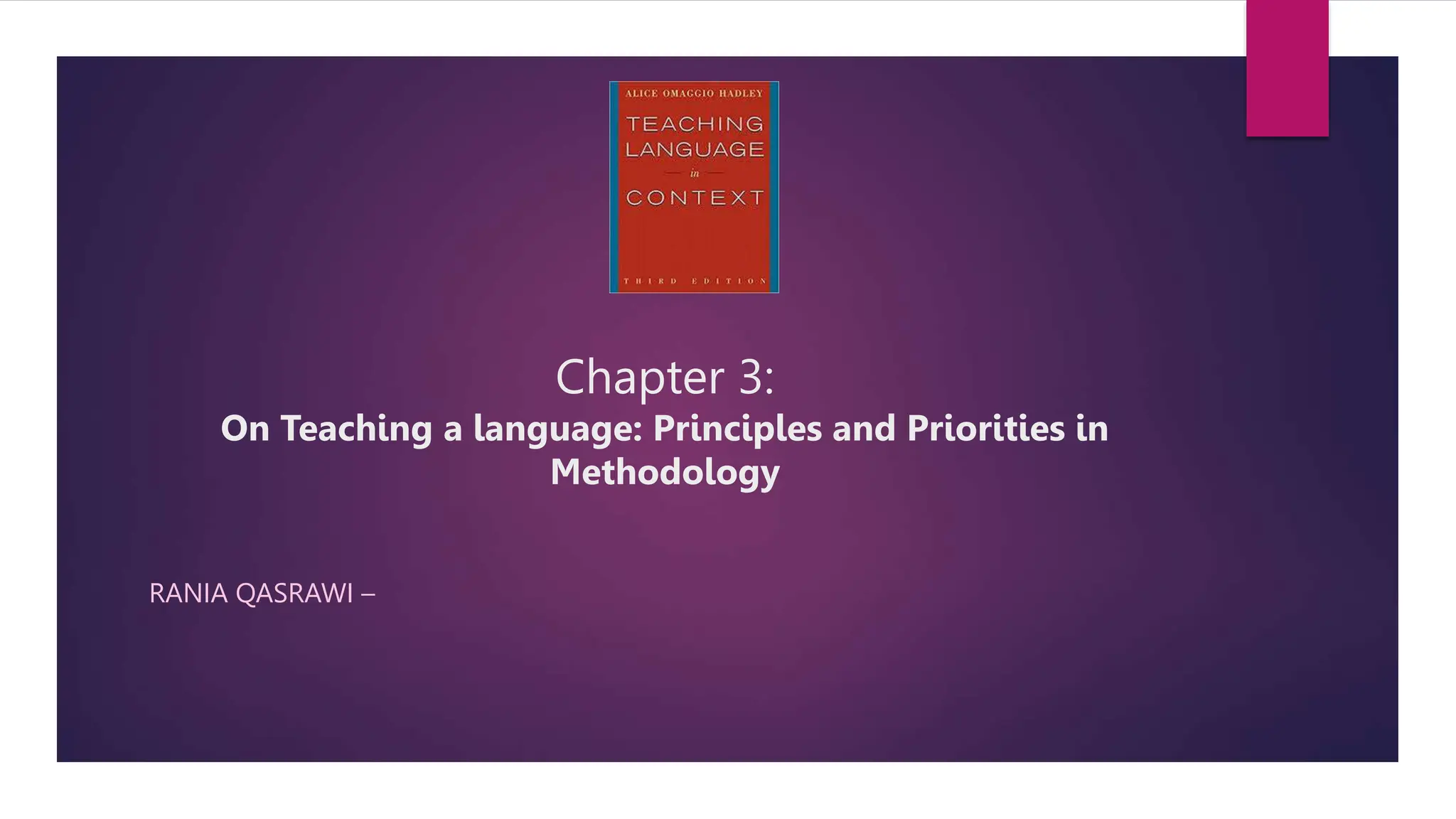
Chapter 3:
On Teaching a language: Principles and Priorities in
Methodology
RANIA QASRAWI –
Outline
 1. Three Traditional Methods
 A. Grammar Translation Method
 D. The Direct Method
 C. Audiolingual methodology (1940s-1950s). ( Aural-Oral)
 2 Two Mentalist Perspectives
 A . The Cognitive Anti- Method
 B. The cognitive- code Method
 3. A Functional Approach: Communicative Language Teaching ( CLT) by Richards and Rodgers ( 1986)
 4. Modern Adaptation of the Direct Method
 A. Total Physical Response ( TPR) ( Asher,1974)
 B. The Natural Approach ( Terrell,1982)
 5. Humanistic Approaches to Language Learning
 A. Community Language Learning (CLL)
 B. The Silent Way: Learning through Self- reliance ( Gattegno,1972)
 C. Suggestopedia: Tapping Subconscious Resources (Lazonov,1978)
Ice- breaker
 Why do we need to study teaching langauge approaches?
 Why do we need theories of teaching?
Each method will be discussed from 4
main parts:
 1. The theoretical and/ or the philosophical premise upon which the
methods are based.
 2. A list of methods’ major characteristics
 3. A preliminary/ introductory assessment of the proficiency orientation.
 4. Possible drawbacks ( shortcomings)
What are the aspects of language
proficiency?
 Accuracy and Fluency
 Communication/ Communicative situation
 Grammar rules
 Cultural aspects / sociolinguistic aspects
 Language skills
 Cognitive and mental engagement.
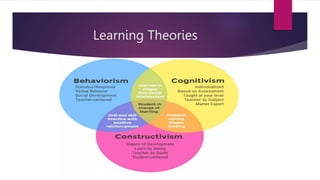
Learning Theories
Three Traditional Methods
 A. Grammar Translation Method
 B. The Direct Method
 C. Audiolingual methodology (1940s-1950s). ( Aural-Oral)
A. Grammar Translation Method
 This method was primarily being applied to teach Latin and Greek.
 It was applied to the teaching of modern languages in the late 19h and 20th century
 Major characteristics:
 Students first learn the rules of grammar and a bilingual list of vocabulary.
 Grammar is introduced deductively.
 When the rules are explained, the translation exercise follows.
 Learning is achieved when learners could translate the passages well.
 The native and the target language were constantly compared.
 Few opportunities for listening and speaking.
A. Grammar Translation Method
 Drawbacks:
 No oral proficiency is addressed.
 No communication
 No personalization
 No interaction or communicative atmosphere.
 No cultural aspects/ awareness.
 Accuracy is a priority.
 Informative- corrective feedback is needed.
B. The Direct Method
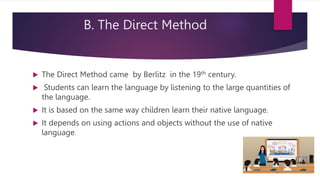
 The Direct Method came by Berlitz in the 19th century.
 Students can learn the language by listening to the large quantities of
the language.
 It is based on the same way children learn their native language.
 It depends on using actions and objects without the use of native
language.
B. The Direct Method
 Major Characteristics
 Language learning starts with the here-and-now utilizing classroom objects
and simple actions.
 L1 is prohibited / avoid translation/ no dictionaries
 It involves using pictures and mimicry.
 At the beginning, it takes question-answer exchanges.
 Correct pronunciation is important/ without immediate feedback.
 Grammar rules are not explicitly taught.
 Responding to teacher’s questions.
 The affective needs of the learners are addressed.
B. The Direct Method
 Drawback
 Inaccurate fluency
 Unstructured situation for novice.
 Lack of grammar explanation.
Audiolingual Methodology
(1940s-1950s). ( Aural-Oral)
 This method was rooted to two schools: Psychological (
behaviorism ) and linguistics ( Structural).
 The combination of structural linguistics and behaviorist psychology
resulted in a new theory of language learning.
Audiolingual methodology (1940s-1950s). (
Aural-Oral)
 Major characteristics:
 The audio-lingual method was considered a “ scientific “
approach of language teaching.
 Lado (1964) proposed the empirical laws of this methodology (
p. 110):
Audiolingual methodology (1940s-1950s).
( Aural-Oral)
 “ when Two experiences have occurred together, the return of one will recall the
other”
 “ The more a response practiced, the better it is learned and the longer it will be
remembered”
 The law of assimilation that learning is a habit formation,
 The law of intensity.
 The law of the effects ( reinforcement ).
Audiolingual methodology (1940s-1950s).
( Aural-Oral)
 Five basic Characteristics for Audio- lingual Method:
 The goal of this method is to develop with students the same types of ability with
native speakers. ( native-like )

 The native language should be banned from classrooms.
 Students learn through( S-R) techniques, no time for thinking, practicing without
knowing how the language is put together.
 Patterns DRILLS are without explanation ( no grammar or very brief).
 The natural sequence followed in the learning native language should be
maintained.
Audiolingual methodology (1940s-1950s).
( Aural-Oral)
 Rivers (1981) clarifies these characteristics as:
 Language is speech, not writing.
 A language is a set of habits.
 Teach the language not about the language ( no explanation)
 A Language is what native speakers say, not what someone thinks .
 Languages are different ( they reject the notion of the Universal
Grammar).
Audiolingual methodology (1940s-1950s).
( Aural-Oral)
 Proficiency Orientation
 ALM does not encourage the creation in dealing with
language( mental engagement).
 ALM exposes students to the use of the colloquial,
sociolinguistic appropriate language.
 ALM is Oral that improves the pronunciation and the
accuracy.
Audiolingual methodology (1940s-1950s). (
Aural-Oral)
 Potential Drawbacks
 ALM did not achieve the target goals.
 ALM did not address the diversity among learners ( only by
ears auditory, rather than visulal..etc).
 By 1970s, many language practitioners started looking for
alternatives for ALM.
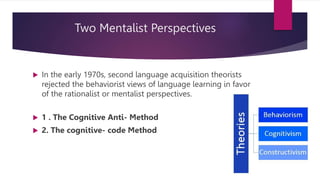
Two Mentalist Perspectives
 In the early 1970s, second language acquisition theorists
rejected the behaviorist views of language learning in favor
of the rationalist or mentalist perspectives.
 1 . The Cognitive Anti- Method
 2. The cognitive- code Method
1 . The Cognitive Anti- Method
 Major characteristics: ( p: 114)
 It is controlled by the learners not the teachers.
 Learners have innate abilities.
 No need to pay attention to the form ( no grammar).
 errors should be tolerated.
 L1 interference will disappear with more exposure to the target language.
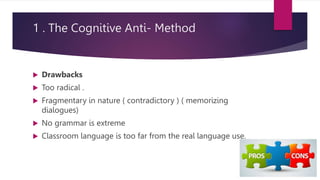
1 . The Cognitive Anti- Method
 Drawbacks
 Too radical .
 Fragmentary in nature ( contradictory ) ( memorizing
dialogues)
 No grammar is extreme
 Classroom language is too far from the real language use.
2. The Cognitive- Code Method
 Major characteristics (p:115)
 The main assumption is that the meaningful learning is essential to language acquisition, and that
the conscious knowledge of grammar is important.
 - The goal to develop the abilities of learners as native speakers; there is a need that students attain
some control over the rules, then they will generate their own language.
 - In teaching, instructors move from the known to the unknown, competence then performance.
 Teachers and text books should introduce students to situations that promote creative use of the
language.
 Grammar should be taught in a cognitive classroom.
 Learning should be meaningful matching students’ differences and styles.
2. The Cognitive-Code Method
 Proficiency Orientation
 This depends on how this approach is interpreted in the (textbooks, and by the
teachers ).
 The focus is on the meaning,
 Communication,
 Integrated Cultural material,
 Contextualization,
 and on the form (accuracy).
A Functional Approach:
Communicative Language Teaching ( CLT)
by Richards and Rodgers ( 1986).
 This approach emphasizes the notional functional concepts
and the communicative competence.
Communicative Language Teaching ( CLT)
by Richards and Rodgers ( 1986).
 Major characteristics (p: 116)
 Meaning is important in CLT, and contextualization is a basic principle.
 Students should be encouraged to communicate with the language.
 Students’ interest in the material should be determined be the content, the function and the
meaning.
 Minor use of the native language is acceptable.
 Activities and strategies for learning should vary to meet learners’ needs and preferences.
 The main concern is poured on fluency.
Communicative Language Teaching ( CLT)
by Richards and Rodgers ( 1986).
 Some theoretical premise:
 The communicative principle
 The task principles
 The meaningfulness principle.
 Sample classrooms Activities (p:117-118)
4. Modern Adaptation of the Direct Method
 A. Total Physical Response ( TPR) ( Asher,1974)
 B. The Natural Approach ( Terrell,1982)
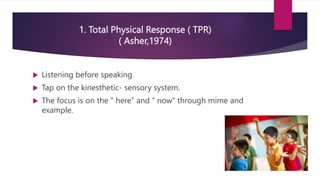
1. Total Physical Response ( TPR)
( Asher,1974)
 Listening before speaking
 Tap on the kinesthetic- sensory system.
 The focus is on the “ here” and “ now” through mime and
example.
. Total Physical Response ( TPR) (
Asher,1974)
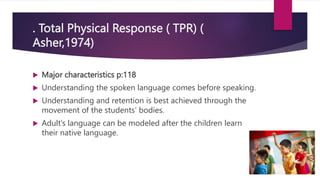
 Major characteristics p:118
 Understanding the spoken language comes before speaking.
 Understanding and retention is best achieved through the
movement of the students’ bodies.
 Adult’s language can be modeled after the children learn
their native language.
. Total Physical Response ( TPR)
( Asher,1974)
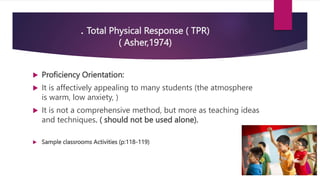
 Proficiency Orientation:
 It is affectively appealing to many students (the atmosphere
is warm, low anxiety, )
 It is not a comprehensive method, but more as teaching ideas
and techniques. ( should not be used alone).
 Sample classrooms Activities (p:118-119)
2. The Natural Approach ( Terrell,1982)
 It is based Krashen’s theory of L2 acquisition.
 Major characteristics: p: 120
 Distribution of learning and acquisition activities.
 Error correction is not necessary.( affective factors)
 Responses in both L1 and l2
The Natural Approach (Terrell,1982)
 Terrell ( 1977) suggested 4 main principles to guide language teaching :
 Beginning language instruction should be focusing on the attainment of
the communicative competence.
 Teaching should address improving students’ developing grammar, not
one rule at a time.
 Teachers should afford the opportunity to acquire the language not just
learning it.
 Affective factors are more important than cognitive factors.
The Natural Approach ( Terrell,1982)
 Drawbacks
 The lack of the corrective feedback in classroom instruction.
 The lack of the form- focused instruction.
Humanistic Approaches to Language Learning
 Since 1970s, different approaches suggested that the affective development
of the individuals is the first concern
 A. Community Language Learning (CLL),
 B. The Silent Way: Learning through Self- reliance ( Gattegno,1972),
 C. Suggestopedia: Tapping Subconscious Resources ( Lazonov, 1978).
Community Language Learning (CLL)
 It is based on techniques borrowed from psychological counseling.
 The individual needs need to be understood and fulfilled.
 Major characteristics
 The teachers’ role is passive
 Teachers provide the language when necessary .
 Class needs to be 6-12 learners seated in a circle.
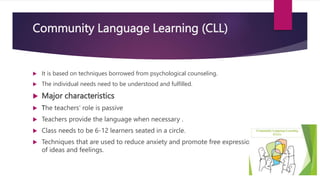
 Techniques that are used to reduce anxiety and promote free expression
of ideas and feelings.
Community Language Learning (CLL)
 There are 5 stages can be followed ( p: 124)
 Drawbacks:
 Although this approach involves contextualized and
personalized learning, creativity, and accuracy, the content or
the context is questioned; the content id determined by the
participants, which means it may be unnecessary in the target
language.
 Some students may be uncomfortable with the lack of
structure or sequence of the introduction.
The Silent Way: Learning through Self-
reliance ( Gattegno,1972)
 It assumes that the mind is an active agent capable of constructing
its own criteria for learning.
 The three key words of the philosophy behind this approach are:
independence, autonomy, responsibility.
 Learners must work with their own inner resources, to absorb the
language from the environment.
 Learners are responsible for what they learn.
The Silent Way: Learning through Self-
reliance ( Gattegno,1972)
 Major characteristics
 Teaching should be subordinated to learning.
 Learning is not primarily imitation or drills.
 In learning, the mind can revise and correct.
 Teachers should stop interfere the activities.
The Silent Way: Learning through Self-
reliance ( Gattegno,1972)
 Drawbacks
 One of the drawbacks is that the learners do not work with
authentic culturally based materials, or being exposed native
speakers’ speech.
Suggestopedia:
Tapping Subconscious Resources (Lazonov,1978)
 Relaxation techniques and concentration will help learners tap their
subconscious resources and learn more vocabulary and structures.
 The atmosphere with soft light, music, cheerful room’s decoration and
techniques used by teachers.
 This approach addresses the two hemispheres of brain: the left and the
right.
 Anxiety is a hindrance that severely limits learning potential .
 Major characteristics
 (p: 127)
 Drawbacks :
 Although,
 The language is presented in context,
 The accuracy is addressed,
 The cultural aspects are presented,
 and the Affective factors are considered.
 The First drawback is that the dialogue- based approach may pedagogically prepared.
 - the use of authentic material may be limited.
 - it does not fit the traditional classrooms.
Suggestopedia:
Tapping Subconscious Resources (Lazonov,1978)
Conclusion
 Today… many teachers are adopting eclectic approach to language
learning teaching, believing that the search for one “ true” way can
be frustrating, as learning is a complex process with learners and
individuals with their different personalities, styles and preferences.
 Eclecticism
Thank you

presentation1approachesch-200309053259.pptx

  • 1.
    Chapter 3: On Teachinga language: Principles and Priorities in Methodology RANIA QASRAWI –
  • 2.
    Outline  1. ThreeTraditional Methods  A. Grammar Translation Method  D. The Direct Method  C. Audiolingual methodology (1940s-1950s). ( Aural-Oral)  2 Two Mentalist Perspectives  A . The Cognitive Anti- Method  B. The cognitive- code Method  3. A Functional Approach: Communicative Language Teaching ( CLT) by Richards and Rodgers ( 1986)  4. Modern Adaptation of the Direct Method  A. Total Physical Response ( TPR) ( Asher,1974)  B. The Natural Approach ( Terrell,1982)  5. Humanistic Approaches to Language Learning  A. Community Language Learning (CLL)  B. The Silent Way: Learning through Self- reliance ( Gattegno,1972)  C. Suggestopedia: Tapping Subconscious Resources (Lazonov,1978)
  • 3.
    Ice- breaker  Whydo we need to study teaching langauge approaches?  Why do we need theories of teaching?
  • 4.
    Each method willbe discussed from 4 main parts:  1. The theoretical and/ or the philosophical premise upon which the methods are based.  2. A list of methods’ major characteristics  3. A preliminary/ introductory assessment of the proficiency orientation.  4. Possible drawbacks ( shortcomings)
  • 5.
    What are theaspects of language proficiency?  Accuracy and Fluency  Communication/ Communicative situation  Grammar rules  Cultural aspects / sociolinguistic aspects  Language skills  Cognitive and mental engagement.
  • 6.
  • 7.
    Three Traditional Methods A. Grammar Translation Method  B. The Direct Method  C. Audiolingual methodology (1940s-1950s). ( Aural-Oral)
  • 8.
    A. Grammar TranslationMethod  This method was primarily being applied to teach Latin and Greek.  It was applied to the teaching of modern languages in the late 19h and 20th century  Major characteristics:  Students first learn the rules of grammar and a bilingual list of vocabulary.  Grammar is introduced deductively.  When the rules are explained, the translation exercise follows.  Learning is achieved when learners could translate the passages well.  The native and the target language were constantly compared.  Few opportunities for listening and speaking.
  • 9.
    A. Grammar TranslationMethod  Drawbacks:  No oral proficiency is addressed.  No communication  No personalization  No interaction or communicative atmosphere.  No cultural aspects/ awareness.  Accuracy is a priority.  Informative- corrective feedback is needed.
  • 10.
    B. The DirectMethod  The Direct Method came by Berlitz in the 19th century.  Students can learn the language by listening to the large quantities of the language.  It is based on the same way children learn their native language.  It depends on using actions and objects without the use of native language.
  • 11.
    B. The DirectMethod  Major Characteristics  Language learning starts with the here-and-now utilizing classroom objects and simple actions.  L1 is prohibited / avoid translation/ no dictionaries  It involves using pictures and mimicry.  At the beginning, it takes question-answer exchanges.  Correct pronunciation is important/ without immediate feedback.  Grammar rules are not explicitly taught.  Responding to teacher’s questions.  The affective needs of the learners are addressed.
  • 12.
    B. The DirectMethod  Drawback  Inaccurate fluency  Unstructured situation for novice.  Lack of grammar explanation.
  • 13.
    Audiolingual Methodology (1940s-1950s). (Aural-Oral)  This method was rooted to two schools: Psychological ( behaviorism ) and linguistics ( Structural).  The combination of structural linguistics and behaviorist psychology resulted in a new theory of language learning.
  • 14.
    Audiolingual methodology (1940s-1950s).( Aural-Oral)  Major characteristics:  The audio-lingual method was considered a “ scientific “ approach of language teaching.  Lado (1964) proposed the empirical laws of this methodology ( p. 110):
  • 15.
    Audiolingual methodology (1940s-1950s). (Aural-Oral)  “ when Two experiences have occurred together, the return of one will recall the other”  “ The more a response practiced, the better it is learned and the longer it will be remembered”  The law of assimilation that learning is a habit formation,  The law of intensity.  The law of the effects ( reinforcement ).
  • 16.
    Audiolingual methodology (1940s-1950s). (Aural-Oral)  Five basic Characteristics for Audio- lingual Method:  The goal of this method is to develop with students the same types of ability with native speakers. ( native-like )  The native language should be banned from classrooms.  Students learn through( S-R) techniques, no time for thinking, practicing without knowing how the language is put together.  Patterns DRILLS are without explanation ( no grammar or very brief).  The natural sequence followed in the learning native language should be maintained.
  • 17.
    Audiolingual methodology (1940s-1950s). (Aural-Oral)  Rivers (1981) clarifies these characteristics as:  Language is speech, not writing.  A language is a set of habits.  Teach the language not about the language ( no explanation)  A Language is what native speakers say, not what someone thinks .  Languages are different ( they reject the notion of the Universal Grammar).
  • 18.
    Audiolingual methodology (1940s-1950s). (Aural-Oral)  Proficiency Orientation  ALM does not encourage the creation in dealing with language( mental engagement).  ALM exposes students to the use of the colloquial, sociolinguistic appropriate language.  ALM is Oral that improves the pronunciation and the accuracy.
  • 19.
    Audiolingual methodology (1940s-1950s).( Aural-Oral)  Potential Drawbacks  ALM did not achieve the target goals.  ALM did not address the diversity among learners ( only by ears auditory, rather than visulal..etc).  By 1970s, many language practitioners started looking for alternatives for ALM.
  • 20.
    Two Mentalist Perspectives In the early 1970s, second language acquisition theorists rejected the behaviorist views of language learning in favor of the rationalist or mentalist perspectives.  1 . The Cognitive Anti- Method  2. The cognitive- code Method
  • 21.
    1 . TheCognitive Anti- Method  Major characteristics: ( p: 114)  It is controlled by the learners not the teachers.  Learners have innate abilities.  No need to pay attention to the form ( no grammar).  errors should be tolerated.  L1 interference will disappear with more exposure to the target language.
  • 22.
    1 . TheCognitive Anti- Method  Drawbacks  Too radical .  Fragmentary in nature ( contradictory ) ( memorizing dialogues)  No grammar is extreme  Classroom language is too far from the real language use.
  • 23.
    2. The Cognitive-Code Method  Major characteristics (p:115)  The main assumption is that the meaningful learning is essential to language acquisition, and that the conscious knowledge of grammar is important.  - The goal to develop the abilities of learners as native speakers; there is a need that students attain some control over the rules, then they will generate their own language.  - In teaching, instructors move from the known to the unknown, competence then performance.  Teachers and text books should introduce students to situations that promote creative use of the language.  Grammar should be taught in a cognitive classroom.  Learning should be meaningful matching students’ differences and styles.
  • 24.
    2. The Cognitive-CodeMethod  Proficiency Orientation  This depends on how this approach is interpreted in the (textbooks, and by the teachers ).  The focus is on the meaning,  Communication,  Integrated Cultural material,  Contextualization,  and on the form (accuracy).
  • 25.
    A Functional Approach: CommunicativeLanguage Teaching ( CLT) by Richards and Rodgers ( 1986).  This approach emphasizes the notional functional concepts and the communicative competence.
  • 26.
    Communicative Language Teaching( CLT) by Richards and Rodgers ( 1986).  Major characteristics (p: 116)  Meaning is important in CLT, and contextualization is a basic principle.  Students should be encouraged to communicate with the language.  Students’ interest in the material should be determined be the content, the function and the meaning.  Minor use of the native language is acceptable.  Activities and strategies for learning should vary to meet learners’ needs and preferences.  The main concern is poured on fluency.
  • 27.
    Communicative Language Teaching( CLT) by Richards and Rodgers ( 1986).  Some theoretical premise:  The communicative principle  The task principles  The meaningfulness principle.  Sample classrooms Activities (p:117-118)
  • 28.
    4. Modern Adaptationof the Direct Method  A. Total Physical Response ( TPR) ( Asher,1974)  B. The Natural Approach ( Terrell,1982)
  • 29.
    1. Total PhysicalResponse ( TPR) ( Asher,1974)  Listening before speaking  Tap on the kinesthetic- sensory system.  The focus is on the “ here” and “ now” through mime and example.
  • 30.
    . Total PhysicalResponse ( TPR) ( Asher,1974)  Major characteristics p:118  Understanding the spoken language comes before speaking.  Understanding and retention is best achieved through the movement of the students’ bodies.  Adult’s language can be modeled after the children learn their native language.
  • 31.
    . Total PhysicalResponse ( TPR) ( Asher,1974)  Proficiency Orientation:  It is affectively appealing to many students (the atmosphere is warm, low anxiety, )  It is not a comprehensive method, but more as teaching ideas and techniques. ( should not be used alone).  Sample classrooms Activities (p:118-119)
  • 32.
    2. The NaturalApproach ( Terrell,1982)  It is based Krashen’s theory of L2 acquisition.  Major characteristics: p: 120  Distribution of learning and acquisition activities.  Error correction is not necessary.( affective factors)  Responses in both L1 and l2
  • 33.
    The Natural Approach(Terrell,1982)  Terrell ( 1977) suggested 4 main principles to guide language teaching :  Beginning language instruction should be focusing on the attainment of the communicative competence.  Teaching should address improving students’ developing grammar, not one rule at a time.  Teachers should afford the opportunity to acquire the language not just learning it.  Affective factors are more important than cognitive factors.
  • 34.
    The Natural Approach( Terrell,1982)  Drawbacks  The lack of the corrective feedback in classroom instruction.  The lack of the form- focused instruction.
  • 35.
    Humanistic Approaches toLanguage Learning  Since 1970s, different approaches suggested that the affective development of the individuals is the first concern  A. Community Language Learning (CLL),  B. The Silent Way: Learning through Self- reliance ( Gattegno,1972),  C. Suggestopedia: Tapping Subconscious Resources ( Lazonov, 1978).
  • 36.
    Community Language Learning(CLL)  It is based on techniques borrowed from psychological counseling.  The individual needs need to be understood and fulfilled.  Major characteristics  The teachers’ role is passive  Teachers provide the language when necessary .  Class needs to be 6-12 learners seated in a circle.  Techniques that are used to reduce anxiety and promote free expression of ideas and feelings.
  • 37.
    Community Language Learning(CLL)  There are 5 stages can be followed ( p: 124)  Drawbacks:  Although this approach involves contextualized and personalized learning, creativity, and accuracy, the content or the context is questioned; the content id determined by the participants, which means it may be unnecessary in the target language.  Some students may be uncomfortable with the lack of structure or sequence of the introduction.
  • 38.
    The Silent Way:Learning through Self- reliance ( Gattegno,1972)  It assumes that the mind is an active agent capable of constructing its own criteria for learning.  The three key words of the philosophy behind this approach are: independence, autonomy, responsibility.  Learners must work with their own inner resources, to absorb the language from the environment.  Learners are responsible for what they learn.
  • 39.
    The Silent Way:Learning through Self- reliance ( Gattegno,1972)  Major characteristics  Teaching should be subordinated to learning.  Learning is not primarily imitation or drills.  In learning, the mind can revise and correct.  Teachers should stop interfere the activities.
  • 40.
    The Silent Way:Learning through Self- reliance ( Gattegno,1972)  Drawbacks  One of the drawbacks is that the learners do not work with authentic culturally based materials, or being exposed native speakers’ speech.
  • 41.
    Suggestopedia: Tapping Subconscious Resources(Lazonov,1978)  Relaxation techniques and concentration will help learners tap their subconscious resources and learn more vocabulary and structures.  The atmosphere with soft light, music, cheerful room’s decoration and techniques used by teachers.  This approach addresses the two hemispheres of brain: the left and the right.  Anxiety is a hindrance that severely limits learning potential .
  • 42.
     Major characteristics (p: 127)  Drawbacks :  Although,  The language is presented in context,  The accuracy is addressed,  The cultural aspects are presented,  and the Affective factors are considered.  The First drawback is that the dialogue- based approach may pedagogically prepared.  - the use of authentic material may be limited.  - it does not fit the traditional classrooms. Suggestopedia: Tapping Subconscious Resources (Lazonov,1978)
  • 43.
    Conclusion  Today… manyteachers are adopting eclectic approach to language learning teaching, believing that the search for one “ true” way can be frustrating, as learning is a complex process with learners and individuals with their different personalities, styles and preferences.  Eclecticism
  • 44.