Methods & Approaches
Juan Cuevas
UNIVERSIDAD UBO
March 2020
Adapted from: Harmer, Jeremy (2015). The Practice of English Language Teaching, Pearson
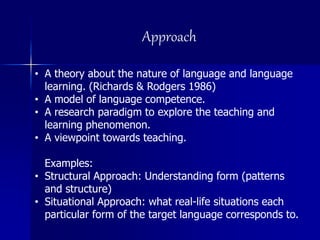
Approach
• A theory about the nature of language and language
learning. (Richards & Rodgers 1986)
• A model of language competence.
• A research paradigm to explore the teaching and
learning phenomenon.
• A viewpoint towards teaching.
Examples:
• Structural Approach: Understanding form (patterns
and structure)
• Situational Approach: what real-life situations each
particular form of the target language corresponds to.
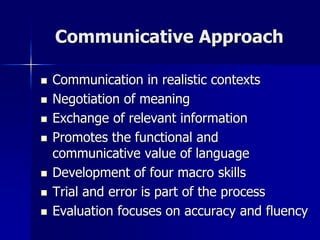
Communicative Approach
 Communication in realistic contexts
 Negotiation of meaning
 Exchange of relevant information
 Promotes the functional and
communicative value of language
 Development of four macro skills
 Trial and error is part of the process
 Evaluation focuses on accuracy and fluency
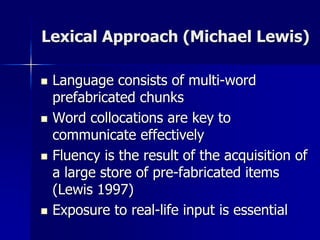
Lexical Approach (Michael Lewis)
 Language consists of multi-word
prefabricated chunks
 Word collocations are key to
communicate effectively
 Fluency is the result of the acquisition of
a large store of pre-fabricated items
(Lewis 1997)
 Exposure to real-life input is essential
Method
• The practical execution of a particular approach, with
corresponding procedures and techniques as
standardization. (Harmer, 2001)
• A list of procedures of precisely how to do something.
• A syllabus
• An inventory of things a learner should master.
Examples:
• Grammar Translation Method
• Audiolingualism
• Direct Method
• PPP (Presentation, Practice & Production)
• Silent way
• Suggestopedia
• TPR (Total Physical Response)
• CLL (Comunity Language
Learning)
• CLT (Communicative
Language Teaching)
• TBL (Task-based Learning)
• PBL (Project-based Learning )
Grammar Translation Method
 Use of mother tongue to explain
 Presentation of rules out of context
 Translation exercises
 Grammar worksheets
 Emphasis on reading and writing
 Lost of drilling
 Lists of isolated words
Audiolingualism
 A behaviorist model
 An oral-based approach
 Practice of patterns by drilling
 Use of simple dialogs
 Use of mimicry and memorization
 Use of sentence repetition
 Little or no grammar analysis
 Grammar is taught inductively
Direct Method (Charles Berlitz)
 Similar to learning mother tongue
 Emphasis on speaking aspects
 No use of translation
 Little grammar analysis or explanation
 Use of target language to condcut the
class
 Inductive approach to grammar
 Vocabulary in context
PPP
 Language is contextualized
 Teacher models patterns in context
 Students practice individually or in pairs
 Students reproduce models given by
teacher
 Students create their sentences and
personalize after the practice stage
Silent Way (Caleb Cattegno)
 Teacher should be as silent as possible
 Learners discover or create new
language
 Emphasis on problem-solving using
the language
Suggestopedia (Georgi Lozanov)
 The place and atmosphere of the classroom is
essential
 Students must be confortable, confident and relaxed
 Students are assigned different roles or imaginary
names
 Empahasis on lowering the affective filter
 Each lesson has 3 main parts: 1. Relaxation activity.
2. Students listen to teacher reading dialog while
music plays in the background. 3. Teacher reads
again using normal speed and intonation, eliciting
from students.
TPR (James Asher)
 Learning is linked to physical activity
 Students respond to commands
 Emphasizes stress-free learning
 A stimulus-response view
 Students listen, watch and imitate
 Promotes learning by doing
(Kinesthetic activities)
CLL
 Students sit in a circle
 Students decide what they speak about
 The “knower” (teacher) provides and
corrects target language
 The teacher is a facilitator
 Students pair up only if the feel confident
CLT
 Emphasis on communication through
interaction in the target language
 Authentic meaningful communication is the
goal
 The learning experience is personalized
 It involves the integration of four skills
 Learning implies a process of creative
construction
 Making mistakes is part of the process
TBL
 Emphasizes the use of authentic language
 Students do meaningful tasks using the
target language
 Assessment is based on task outcome
 The teacher supports the students and
invents tasks
 It includes a pre-task, a doing the task, and
a post-task phase
PBL
 Promotes a student-centered pedagogy
 Students explore real-world challenges and
problems
 Students work for an extended period of
time to investigate and respond to a
complex question
 Encourages active learning and inquiry-
based learning
Each method answers questions like…
• How should the language be presented?
• How should the language be sequenced?
• How much focus should be placed on the
various language skills?
• What specific language activities should be
appropriate to accomplish the class
objectives?
Procedure
• An ordered sequence of techniques.
• A sequence which can be described in
terms such as first you do this, then
you do that.
Technique
• A specific application of a single activity. (Harmer,
2001)
• A task or a classroom activity.
• The personal creative art or style of a teacher when
delivering knowledge.
Examples:
• Brainstorming
• Concept mapping
• Role-playing
• Story telling
• Slip writing
• Dilemmas
• Dialog creation
• Debates
• Clozed texts
• Reading activities
• Writing activities
• Games
• Problem solving
• Projects
• Presentations
• Singing
• Dictation
• (Chain) Drilling
• Interviews
• Silent viewing
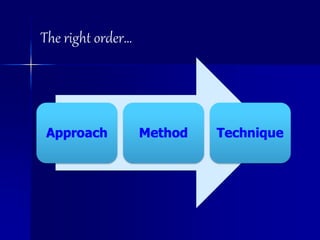
The right order…

Methods & approaches ubo

  • 1.
    Methods & Approaches JuanCuevas UNIVERSIDAD UBO March 2020 Adapted from: Harmer, Jeremy (2015). The Practice of English Language Teaching, Pearson
  • 2.
    Approach • A theoryabout the nature of language and language learning. (Richards & Rodgers 1986) • A model of language competence. • A research paradigm to explore the teaching and learning phenomenon. • A viewpoint towards teaching. Examples: • Structural Approach: Understanding form (patterns and structure) • Situational Approach: what real-life situations each particular form of the target language corresponds to.
  • 3.
    Communicative Approach  Communicationin realistic contexts  Negotiation of meaning  Exchange of relevant information  Promotes the functional and communicative value of language  Development of four macro skills  Trial and error is part of the process  Evaluation focuses on accuracy and fluency
  • 4.
    Lexical Approach (MichaelLewis)  Language consists of multi-word prefabricated chunks  Word collocations are key to communicate effectively  Fluency is the result of the acquisition of a large store of pre-fabricated items (Lewis 1997)  Exposure to real-life input is essential
  • 5.
    Method • The practicalexecution of a particular approach, with corresponding procedures and techniques as standardization. (Harmer, 2001) • A list of procedures of precisely how to do something. • A syllabus • An inventory of things a learner should master. Examples: • Grammar Translation Method • Audiolingualism • Direct Method • PPP (Presentation, Practice & Production) • Silent way • Suggestopedia • TPR (Total Physical Response) • CLL (Comunity Language Learning) • CLT (Communicative Language Teaching) • TBL (Task-based Learning) • PBL (Project-based Learning )
  • 6.
    Grammar Translation Method Use of mother tongue to explain  Presentation of rules out of context  Translation exercises  Grammar worksheets  Emphasis on reading and writing  Lost of drilling  Lists of isolated words
  • 7.
    Audiolingualism  A behavioristmodel  An oral-based approach  Practice of patterns by drilling  Use of simple dialogs  Use of mimicry and memorization  Use of sentence repetition  Little or no grammar analysis  Grammar is taught inductively
  • 8.
    Direct Method (CharlesBerlitz)  Similar to learning mother tongue  Emphasis on speaking aspects  No use of translation  Little grammar analysis or explanation  Use of target language to condcut the class  Inductive approach to grammar  Vocabulary in context
  • 9.
    PPP  Language iscontextualized  Teacher models patterns in context  Students practice individually or in pairs  Students reproduce models given by teacher  Students create their sentences and personalize after the practice stage
  • 10.
    Silent Way (CalebCattegno)  Teacher should be as silent as possible  Learners discover or create new language  Emphasis on problem-solving using the language
  • 11.
    Suggestopedia (Georgi Lozanov) The place and atmosphere of the classroom is essential  Students must be confortable, confident and relaxed  Students are assigned different roles or imaginary names  Empahasis on lowering the affective filter  Each lesson has 3 main parts: 1. Relaxation activity. 2. Students listen to teacher reading dialog while music plays in the background. 3. Teacher reads again using normal speed and intonation, eliciting from students.
  • 12.
    TPR (James Asher) Learning is linked to physical activity  Students respond to commands  Emphasizes stress-free learning  A stimulus-response view  Students listen, watch and imitate  Promotes learning by doing (Kinesthetic activities)
  • 13.
    CLL  Students sitin a circle  Students decide what they speak about  The “knower” (teacher) provides and corrects target language  The teacher is a facilitator  Students pair up only if the feel confident
  • 14.
    CLT  Emphasis oncommunication through interaction in the target language  Authentic meaningful communication is the goal  The learning experience is personalized  It involves the integration of four skills  Learning implies a process of creative construction  Making mistakes is part of the process
  • 15.
    TBL  Emphasizes theuse of authentic language  Students do meaningful tasks using the target language  Assessment is based on task outcome  The teacher supports the students and invents tasks  It includes a pre-task, a doing the task, and a post-task phase
  • 16.
    PBL  Promotes astudent-centered pedagogy  Students explore real-world challenges and problems  Students work for an extended period of time to investigate and respond to a complex question  Encourages active learning and inquiry- based learning
  • 17.
    Each method answersquestions like… • How should the language be presented? • How should the language be sequenced? • How much focus should be placed on the various language skills? • What specific language activities should be appropriate to accomplish the class objectives?
  • 18.
    Procedure • An orderedsequence of techniques. • A sequence which can be described in terms such as first you do this, then you do that.
  • 19.
    Technique • A specificapplication of a single activity. (Harmer, 2001) • A task or a classroom activity. • The personal creative art or style of a teacher when delivering knowledge. Examples: • Brainstorming • Concept mapping • Role-playing • Story telling • Slip writing • Dilemmas • Dialog creation • Debates • Clozed texts • Reading activities • Writing activities • Games • Problem solving • Projects • Presentations • Singing • Dictation • (Chain) Drilling • Interviews • Silent viewing
  • 20.

Editor's Notes

  • #20 Brainstorming: Money Concept Mapping: Living in a big city (Popplet) Roleplaying: Story telling: Given verbs, students create a story Slip Writing: 2 things you like & 2 things you dislike Dilemma: Someone drowning Reading: Madlibs Games: Coffeepot Problem solving: