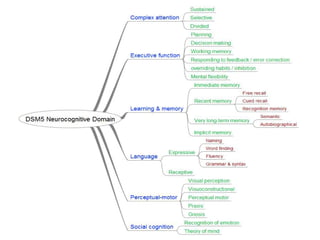
Dr Zahiruddin Othman
Department of Psychiatry
School of Medical Sciences
Universiti Sains Malaysia
Introduction - definitions
• EXECUTIVE PROCESSES
– Processes that modulate (control) the operation of other
processes and that are responsible for the coordination of
mental activity so that a particular goal is achieved
– Meta-process
• FRONTAL EXECUTIVE HYPOTHESIS
– Every executive process is primarily mediated by the PFC
(prefrontal cortex)
• FRONTAL LOBE SYNDROMES
– Syndrome resulting from frontal lobe damage and
subsequent impairment of executive functions
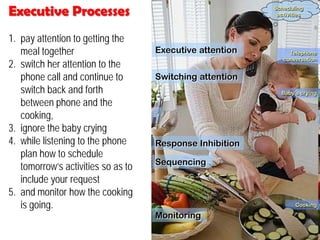
Executive Processes
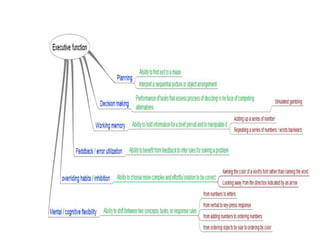
1. pay attention to getting the
meal together
2. switch her attention to the
phone call and continue to
switch back and forth
between phone and the
cooking,
3. ignore the baby crying
4. while listening to the phone
plan how to schedule
tomorrow’s activities so as to
include your request
5. and monitor how the cooking
is going.
Executive attention
Switching attention
Response Inhibition
Sequencing
Monitoring
Baby’s crying
Cooking
Telephone
conversation
Scheduling
activities
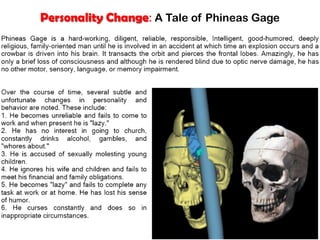
Personality Change: A Tale of Phineas Gage
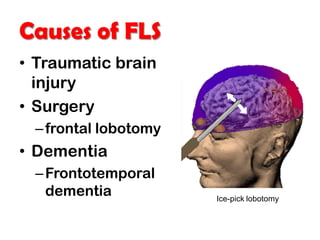
Causes of FLS
• Traumatic brain
injury
• Surgery
–frontal lobotomy
• Dementia
–Frontotemporal
dementia Ice-pick lobotomy
Frontal Lobe Syndromes
or Dysexecutive syndromes
• Difficulties initiating behavior
• Perseveration (the inability to stop a
behavioral pattern once started)
• Exaggerated imitative and utilization
behavior
• Difficulties in planning and problem solving
• May be incapable of creative thinking
• Difficulties with holding complex structures
in mind
Frontal Lobe Syndromes
Orbitofrontal Lobe Syndrome
[disinhibited]
Frontal Convexity Syndrome
[apathetic]
 Impulsive behavior
(pseudopsychopathic)
 Inappropriate jocular
affect, euphoria
 Emotional lability
 Poor judgment and
insight
 Distractibility
 Apathy
(pseudodepressive)
 Indifference
 Psychomotor retardation
 Motor perseveration and
impersistence
 Stimulus-bound behavior
 Motor programming
deficits
 Poor word list generation
Social Cognition [comportment]
"Comportment" is a term that refers to social
behavior, insight, and "appropriateness" in
different social contexts. Normal comportment
involves having insight and the ability to
recognize what behavior is appropriate in a
particular social situation and to adapt one's
behavior to the situation.
For example, while it may be perfectly natural
and acceptable to take one's shoes and socks
off at home, it is probably not the thing to do
while in a restaurant.
Behavior in Dementia
Behavior is often disorganized,
inappropriate, distractible, and
restless. There are a few sign
of initiative. Changes in
personality may manifest as an
antisocial behavior, which
sometimes include sexual
disinhibition or shoplifting.
Behavior in Dementia
Goldstein (1975) describes the ways in
which behavior can be affected by
cognitive defects. Typically there is
reduction of interests [shrinkage of milieu]
and, rigid and stereotyped routines
[organic orderliness] and, when the person
is taxed beyond restricted abilities, a
sudden explosion of anger or other
emotion [catastrophic reaction]
Oxford textbook of psychiatry, second edition, page 351
Frontotemporal Dementia
FTD is associated with Kluver-Bucy syndrome [KBS]. The most common
symptoms of KBS in FTD is hyperorality manifested as bingeing, altered food
preferences especially for sweets, food fads, weight gain or increased smoking
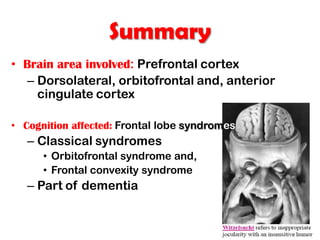
Summary
• Brain area involved: Prefrontal cortex
– Dorsolateral, orbitofrontal and, anterior
cingulate cortex
• Cognition affected: Frontal lobe syndromes
– Classical syndromes
• Orbitofrontal syndrome and,
• Frontal convexity syndrome
– Part of dementia
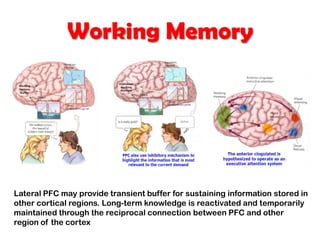
Working Memory
Lateral PFC may provide transient buffer for sustaining information stored in
other cortical regions. Long-term knowledge is reactivated and temporarily
maintained through the reciprocal connection between PFC and other
region of the cortex
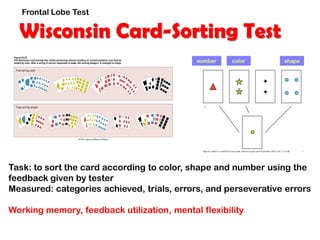
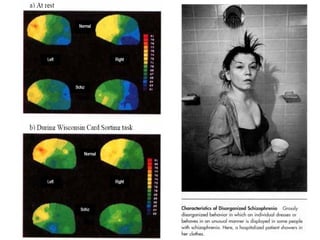
Wisconsin Card-Sorting Test
Task: to sort the card according to color, shape and number using the
feedback given by tester
Measured: categories achieved, trials, errors, and perseverative errors
Working memory, feedback utilization, mental flexibility
number color shape
Frontal Lobe Test
Motor Cortex
Superior
Temporal Cortex
Occipital Cortex
Overriding Habits
STROOP TEST
State the color as fast as you can
color
GREEN
word
RED
RED
GREEN
Conflict
Monitor
[cingulate]
Attention
Controller
[DLPFC]
INPUT RESPONSE
DLPFC=dorsolateral prefrontal cortex
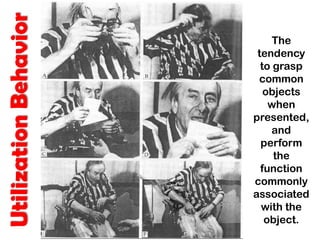
UtilizationBehavior
The
tendency
to grasp
common
objects
when
presented,
and
perform
the
function
commonly
associated
with the
object.
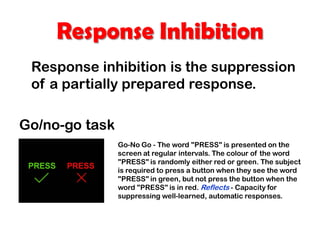
Response Inhibition
Response inhibition is the suppression
of a partially prepared response.
Go/no-go task
Go-No Go - The word "PRESS" is presented on the
screen at regular intervals. The colour of the word
"PRESS" is randomly either red or green. The subject
is required to press a button when they see the word
"PRESS" in green, but not press the button when the
word "PRESS" is in red. Reflects - Capacity for
suppressing well-learned, automatic responses.
PRESSPRESSPRESSPRESSPRESSPRESS
PRESS
PRESS
Go trials, when no inhibition is required
Dorsolateral prefrontal [DLPFC] cortex is activated
No-go trials, when response inhibition is required
DLPFC + Orbitofrontal cortex is activated
1) orbitofrontal cortex
2) lateral prefrontal cortex
3) ventromedial cortex
4) limbic system
Response Inhibition
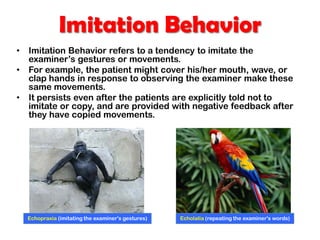
Imitation Behavior
• Imitation Behavior refers to a tendency to imitate the
examiner’s gestures or movements.
• For example, the patient might cover his/her mouth, wave, or
clap hands in response to observing the examiner make these
same movements.
• It persists even after the patients are explicitly told not to
imitate or copy, and are provided with negative feedback after
they have copied movements.
Echopraxia (imitating the examiner's gestures) Echolalia (repeating the examiner's words)
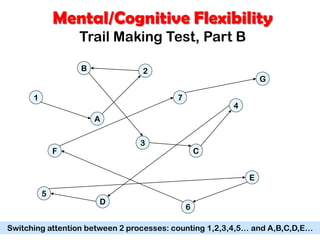
Mental/Cognitive Flexibility
Trail Making Test, Part B
1
2
3
4
5
6
7
A
B
C
D
E
F
G
Switching attention between 2 processes: counting 1,2,3,4,5… and A,B,C,D,E…
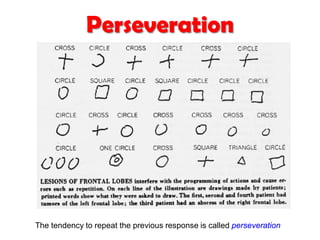
The tendency to repeat the previous response is called perseveration
Perseveration
Tower of Hanoi
Frontal Lobe Test
Task: Move all 3 disc to peg 3
Rule: 1) move one disc at a time
2) larger disc cannot be placed on smaller one
3) subjects must solve problem “in their head”
Executive processes involved
1. [selective attention] executive attention
2. [mental flexibility] switching attention
3. Updating working memory
4. Setting a goal and analysis of sub-goals
5. Sequencing of steps
Frontal-lobe patients, particularly patients with damage to the DLPFC,
perform poorly on the Tower of Hanoi problem (Shallice, 1982)
Mix all ingredients except the
oil for about 2 min or until smooth
Have all the
ingredients
Make three long, thick dough strips and then make them
like a doughnut shape and connect the 2 sides really well
Put the oil in a medium sized pan
on the stove set on med or med high
Keep in for approximately
7 minutes or until gold
Let cool and enjoy!
Sequence operations or events to accomplish a goal
When warm gently
Place in one doughnut
Sequencing [Planing]
How To Make A Doughnut
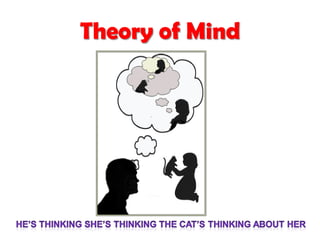
Theory of Mind
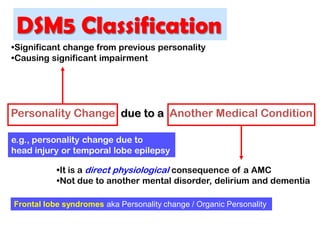
Personality Change due to a Another Medical Condition
•Significant change from previous personality
•Causing significant impairment
•It is a direct physiological consequence of a AMC
•Not due to another mental disorder, delirium and dementia
e.g., personality change due to
head injury or temporal lobe epilepsy
Frontal lobe syndromes aka Personality change / Organic Personality
DSM5 Classification
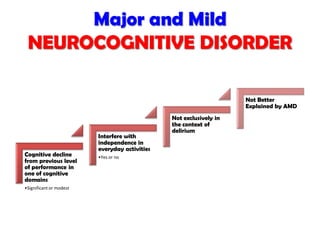
Major and Mild
NEUROCOGNITIVE DISORDER
Cognitive decline
from previous level
of performance in
one of cognitive
domains
•Significant or modest
Interfere with
independence in
everyday activities
•Yes or no
Not exclusively in
the context of
delirium
Not Better
Explained by AMD
thank you
for your attention

Frontal Lobe Syndromes [2014]

  • 1.
    Dr Zahiruddin Othman Departmentof Psychiatry School of Medical Sciences Universiti Sains Malaysia
  • 2.
    Introduction - definitions •EXECUTIVE PROCESSES – Processes that modulate (control) the operation of other processes and that are responsible for the coordination of mental activity so that a particular goal is achieved – Meta-process • FRONTAL EXECUTIVE HYPOTHESIS – Every executive process is primarily mediated by the PFC (prefrontal cortex) • FRONTAL LOBE SYNDROMES – Syndrome resulting from frontal lobe damage and subsequent impairment of executive functions
  • 3.
    Executive Processes 1. payattention to getting the meal together 2. switch her attention to the phone call and continue to switch back and forth between phone and the cooking, 3. ignore the baby crying 4. while listening to the phone plan how to schedule tomorrow’s activities so as to include your request 5. and monitor how the cooking is going. Executive attention Switching attention Response Inhibition Sequencing Monitoring Baby’s crying Cooking Telephone conversation Scheduling activities
  • 4.
    Personality Change: ATale of Phineas Gage
  • 5.
    Causes of FLS •Traumatic brain injury • Surgery –frontal lobotomy • Dementia –Frontotemporal dementia Ice-pick lobotomy
  • 6.
    Frontal Lobe Syndromes orDysexecutive syndromes • Difficulties initiating behavior • Perseveration (the inability to stop a behavioral pattern once started) • Exaggerated imitative and utilization behavior • Difficulties in planning and problem solving • May be incapable of creative thinking • Difficulties with holding complex structures in mind
  • 7.
    Frontal Lobe Syndromes OrbitofrontalLobe Syndrome [disinhibited] Frontal Convexity Syndrome [apathetic]  Impulsive behavior (pseudopsychopathic)  Inappropriate jocular affect, euphoria  Emotional lability  Poor judgment and insight  Distractibility  Apathy (pseudodepressive)  Indifference  Psychomotor retardation  Motor perseveration and impersistence  Stimulus-bound behavior  Motor programming deficits  Poor word list generation
  • 8.
    Social Cognition [comportment] "Comportment"is a term that refers to social behavior, insight, and "appropriateness" in different social contexts. Normal comportment involves having insight and the ability to recognize what behavior is appropriate in a particular social situation and to adapt one's behavior to the situation. For example, while it may be perfectly natural and acceptable to take one's shoes and socks off at home, it is probably not the thing to do while in a restaurant.
  • 9.
    Behavior in Dementia Behavioris often disorganized, inappropriate, distractible, and restless. There are a few sign of initiative. Changes in personality may manifest as an antisocial behavior, which sometimes include sexual disinhibition or shoplifting.
  • 10.
    Behavior in Dementia Goldstein(1975) describes the ways in which behavior can be affected by cognitive defects. Typically there is reduction of interests [shrinkage of milieu] and, rigid and stereotyped routines [organic orderliness] and, when the person is taxed beyond restricted abilities, a sudden explosion of anger or other emotion [catastrophic reaction] Oxford textbook of psychiatry, second edition, page 351
  • 11.
    Frontotemporal Dementia FTD isassociated with Kluver-Bucy syndrome [KBS]. The most common symptoms of KBS in FTD is hyperorality manifested as bingeing, altered food preferences especially for sweets, food fads, weight gain or increased smoking
  • 12.
    Summary • Brain areainvolved: Prefrontal cortex – Dorsolateral, orbitofrontal and, anterior cingulate cortex • Cognition affected: Frontal lobe syndromes – Classical syndromes • Orbitofrontal syndrome and, • Frontal convexity syndrome – Part of dementia
  • 15.
    Working Memory Lateral PFCmay provide transient buffer for sustaining information stored in other cortical regions. Long-term knowledge is reactivated and temporarily maintained through the reciprocal connection between PFC and other region of the cortex
  • 16.
    Wisconsin Card-Sorting Test Task:to sort the card according to color, shape and number using the feedback given by tester Measured: categories achieved, trials, errors, and perseverative errors Working memory, feedback utilization, mental flexibility number color shape Frontal Lobe Test
  • 17.
    Motor Cortex Superior Temporal Cortex OccipitalCortex Overriding Habits STROOP TEST State the color as fast as you can color GREEN word RED RED GREEN Conflict Monitor [cingulate] Attention Controller [DLPFC] INPUT RESPONSE DLPFC=dorsolateral prefrontal cortex
  • 18.
  • 19.
    Response Inhibition Response inhibitionis the suppression of a partially prepared response. Go/no-go task Go-No Go - The word "PRESS" is presented on the screen at regular intervals. The colour of the word "PRESS" is randomly either red or green. The subject is required to press a button when they see the word "PRESS" in green, but not press the button when the word "PRESS" is in red. Reflects - Capacity for suppressing well-learned, automatic responses. PRESSPRESSPRESSPRESSPRESSPRESS
  • 20.
    PRESS PRESS Go trials, whenno inhibition is required Dorsolateral prefrontal [DLPFC] cortex is activated No-go trials, when response inhibition is required DLPFC + Orbitofrontal cortex is activated 1) orbitofrontal cortex 2) lateral prefrontal cortex 3) ventromedial cortex 4) limbic system Response Inhibition
  • 21.
    Imitation Behavior • ImitationBehavior refers to a tendency to imitate the examiner’s gestures or movements. • For example, the patient might cover his/her mouth, wave, or clap hands in response to observing the examiner make these same movements. • It persists even after the patients are explicitly told not to imitate or copy, and are provided with negative feedback after they have copied movements. Echopraxia (imitating the examiner's gestures) Echolalia (repeating the examiner's words)
  • 22.
    Mental/Cognitive Flexibility Trail MakingTest, Part B 1 2 3 4 5 6 7 A B C D E F G Switching attention between 2 processes: counting 1,2,3,4,5… and A,B,C,D,E…
  • 23.
    The tendency torepeat the previous response is called perseveration Perseveration
  • 24.
    Tower of Hanoi FrontalLobe Test Task: Move all 3 disc to peg 3 Rule: 1) move one disc at a time 2) larger disc cannot be placed on smaller one 3) subjects must solve problem “in their head” Executive processes involved 1. [selective attention] executive attention 2. [mental flexibility] switching attention 3. Updating working memory 4. Setting a goal and analysis of sub-goals 5. Sequencing of steps Frontal-lobe patients, particularly patients with damage to the DLPFC, perform poorly on the Tower of Hanoi problem (Shallice, 1982)
  • 25.
    Mix all ingredientsexcept the oil for about 2 min or until smooth Have all the ingredients Make three long, thick dough strips and then make them like a doughnut shape and connect the 2 sides really well Put the oil in a medium sized pan on the stove set on med or med high Keep in for approximately 7 minutes or until gold Let cool and enjoy! Sequence operations or events to accomplish a goal When warm gently Place in one doughnut Sequencing [Planing] How To Make A Doughnut
  • 27.
  • 28.
    Personality Change dueto a Another Medical Condition •Significant change from previous personality •Causing significant impairment •It is a direct physiological consequence of a AMC •Not due to another mental disorder, delirium and dementia e.g., personality change due to head injury or temporal lobe epilepsy Frontal lobe syndromes aka Personality change / Organic Personality DSM5 Classification
  • 29.
    Major and Mild NEUROCOGNITIVEDISORDER Cognitive decline from previous level of performance in one of cognitive domains •Significant or modest Interfere with independence in everyday activities •Yes or no Not exclusively in the context of delirium Not Better Explained by AMD
  • 30.