INTRODUCTION TO
MECHANISM DESIGN
Summary of Jackson (2014)
Yosuke YASUDA | Osaka University
1
“MECHANISM THEORY”
BY MATTHEW O. JACKSON
All the contents are based on this article.
A well-known survey on Mechanism Design.
The author, MJ, is a top researcher in the field.
The paper is available from the link below (for free):
http://papers.ssrn.com/sol3/Papers.cfm?abstract_id=2542983
2
TABLE OF CONTENTS
1. Introduction
2. A General Mechanism Design Setting
3. Dominant Strategy Mechanism Design
4. Bayesian Mechanism Design
5. Implementation
3
1. INTRODUCTION
The theory of mechanism design takes a systematic
look at the design of institutions and how these affect
the outcomes of interactions.
The main focus of mechanism design is on on the
design of institutions that satisfy certain objectives,
assuming that the individuals interacting through the
institution will act strategically and may hold private
information that is relevant to the decision at hand.
4
Another question is whether there exists such a
mechanism so that the buyer and seller voluntarily
participate in the mechanism.
In a mechanism each individual has a message (or
strategy) space and decisions result as a function of
the messages chosen.
5
A theme that comes out of the literature is that it is
often impossible to find mechanisms compatible with
individual incentives that simultaneously result in
efficient decisions (maximizing total welfare), the
voluntary participation of the individuals, and
balanced transfers (taxes and subsidies that always
net out across individuals).
Nevertheless, there are some important settings
where incentives and efficiency are compatible and in
other settings a “second-best” analysis is still
possible.
6
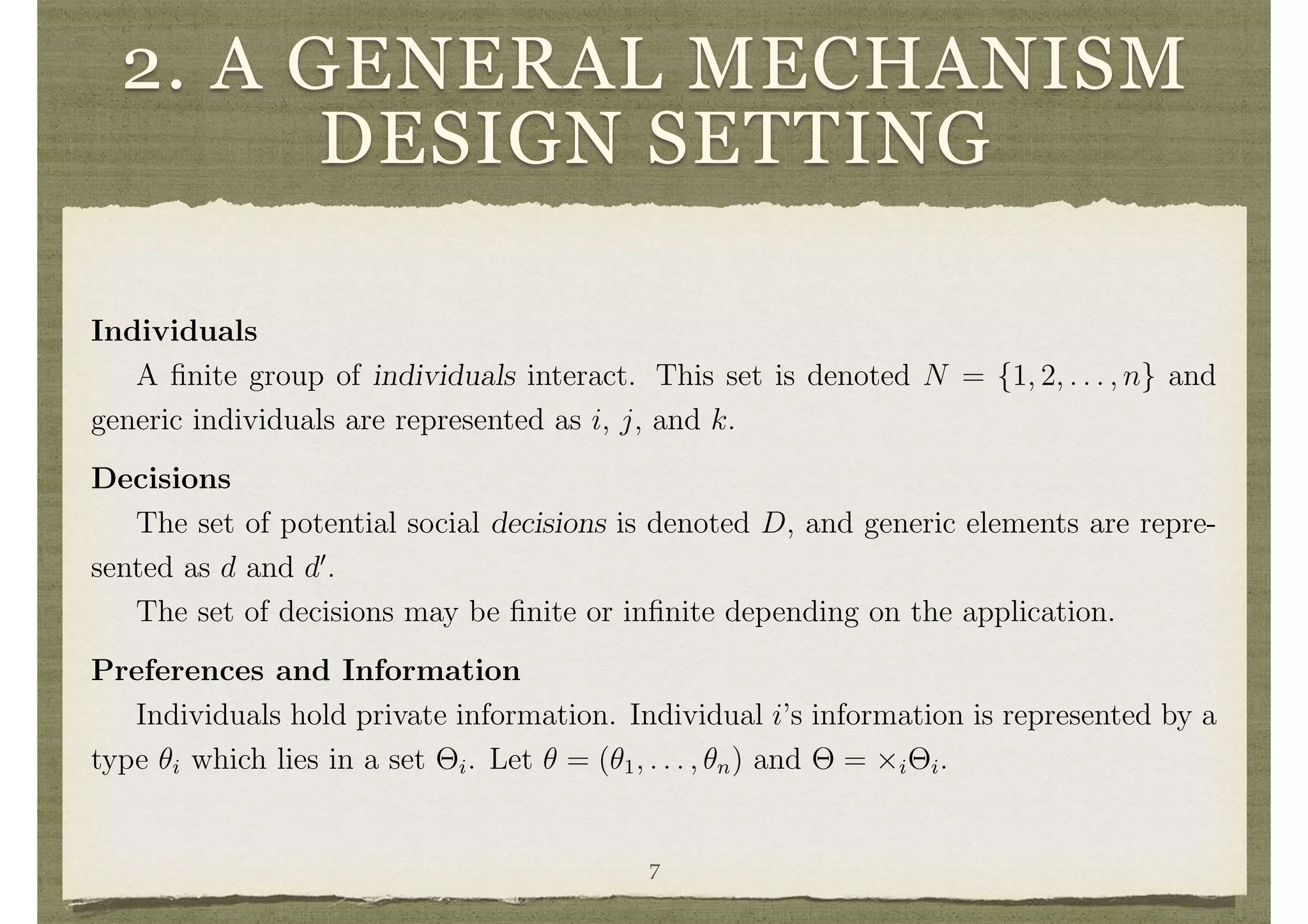
2. A GENERAL MECHANISM
DESIGN SETTING
compatible and in other settings a “second-best” analysis is still possible. This is
described in detail in what follows in the context of di↵erent incentive compatibility
requirements, public and private goods settings, small and large societies, and forms
of private information held by individuals.
2 A General Mechanism Design Setting
Individuals
A finite group of individuals interact. This set is denoted N = {1, 2, . . . , n} and
generic individuals are represented as i, j, and k.
Decisions
The set of potential social decisions is denoted D, and generic elements are repre-
sented as d and d0
.
The set of decisions may be finite or infinite depending on the application.
Preferences and Information
Individuals hold private information. Individual i’s information is represented by a
type ✓i which lies in a set ⇥i. Let ✓ = (✓1, . . . , ✓n) and ⇥ = ⇥i⇥i.
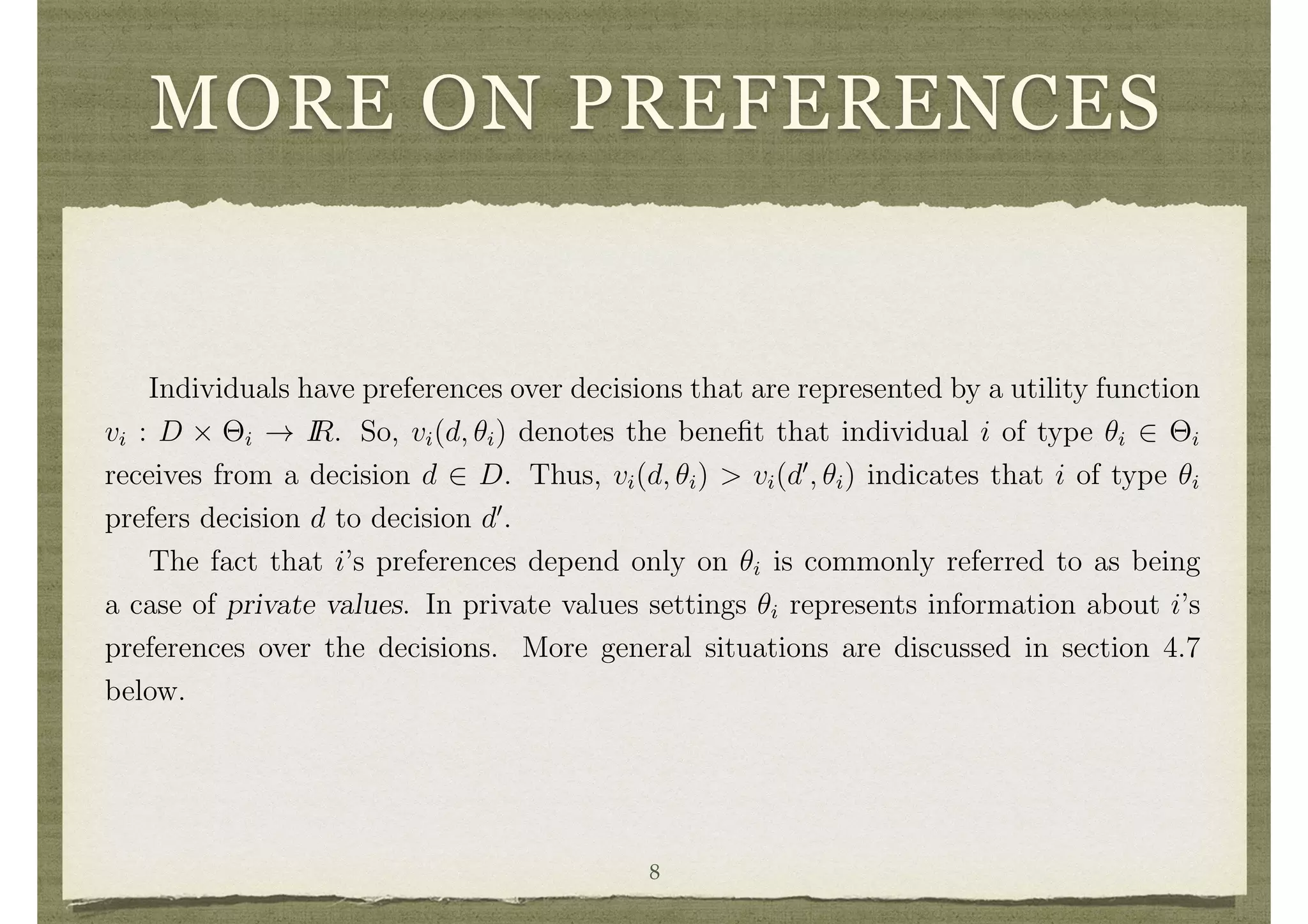
Individuals have preferences over decisions that are represented by a utility function
vi : D ⇥ ⇥i ! IR. So, vi(d, ✓i) denotes the benefit that individual i of type ✓i 2 ⇥i
receives from a decision d 2 D. Thus, vi(d, ✓i) > vi(d0
, ✓i) indicates that i of type ✓i
7
MORE ON PREFERENCES
generic individuals are represented as i, j, and k.
Decisions
The set of potential social decisions is denoted D, and generic elements are repre-
sented as d and d0
.
The set of decisions may be finite or infinite depending on the application.
Preferences and Information
Individuals hold private information. Individual i’s information is represented by a
type ✓i which lies in a set ⇥i. Let ✓ = (✓1, . . . , ✓n) and ⇥ = ⇥i⇥i.
Individuals have preferences over decisions that are represented by a utility function
vi : D ⇥ ⇥i ! IR. So, vi(d, ✓i) denotes the benefit that individual i of type ✓i 2 ⇥i
receives from a decision d 2 D. Thus, vi(d, ✓i) > vi(d0
, ✓i) indicates that i of type ✓i
prefers decision d to decision d0
.
The fact that i’s preferences depend only on ✓i is commonly referred to as being
a case of private values. In private values settings ✓i represents information about i’s
preferences over the decisions. More general situations are discussed in section 4.7
below.
Example 1 A Public Project.
A society is deciding on whether or not to build a public project at a cost c. For
example the project might be a public swimming pool, a public library, a park, a8
EX.1) A PUBLIC PROJECT
prefers decision d to decision d0
.
The fact that i’s preferences depend only on ✓i is commonly referred to as being
a case of private values. In private values settings ✓i represents information about i’s
preferences over the decisions. More general situations are discussed in section 4.7
below.
Example 1 A Public Project.
A society is deciding on whether or not to build a public project at a cost c. For
example the project might be a public swimming pool, a public library, a park, a
defense system, or any of many public goods. The cost of the public project is to be
equally divided equally. Here D = {0, 1} with 0 representing not building the project
and 1 representing building the project.
5
Individual i’s value from use of the public project is represented by ✓i. In this case,
i’s net benefit is 0 from not having a project built and ✓i
c
n
from having a project
built. The utility function of i can then be represented as
vi(d, ✓i) = d✓i d
c
n
.
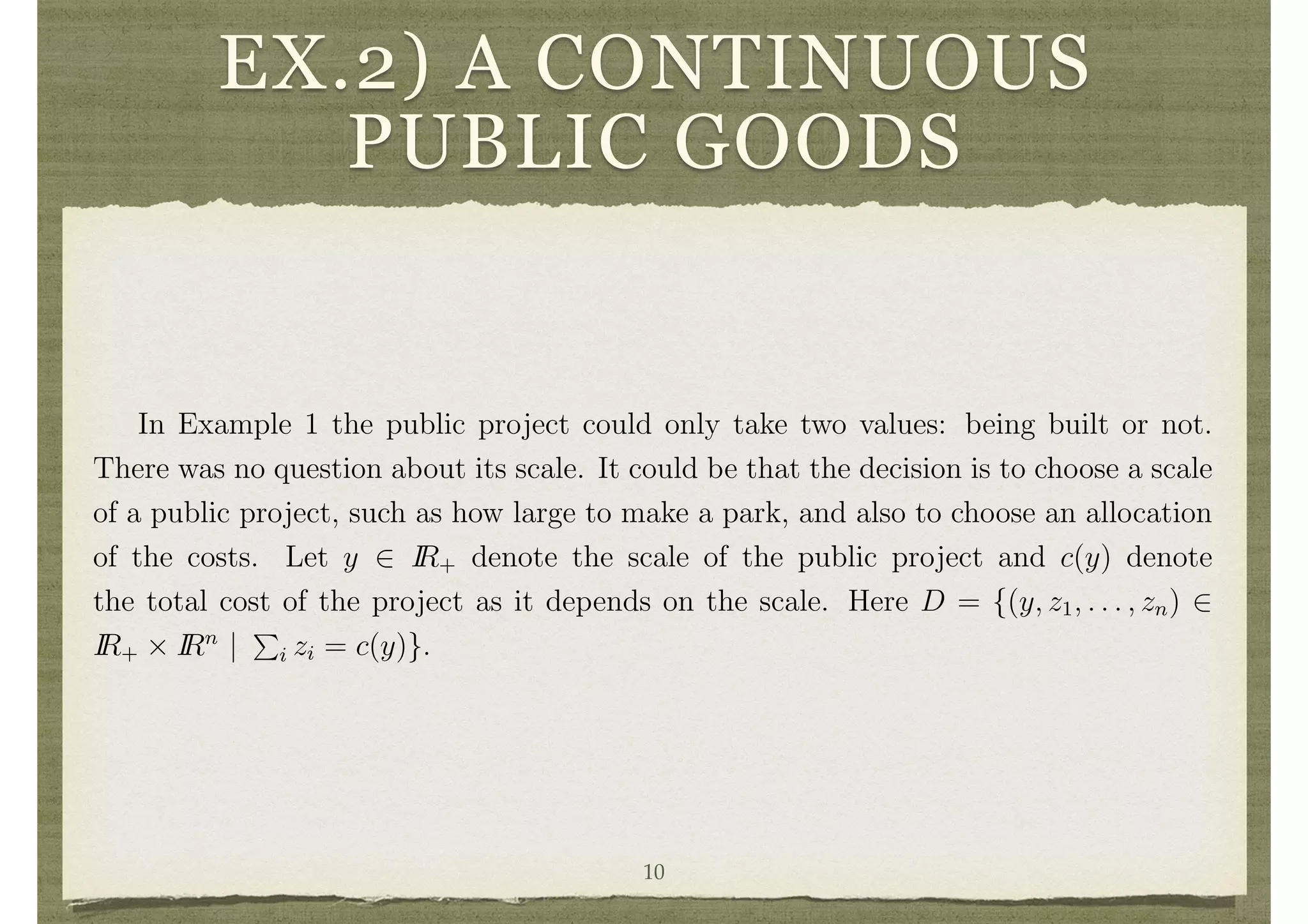
Example 2 A Continuous Public Good Setting.
In Example 1 the public project could only take two values: being built or not.
There was no question about its scale. It could be that the decision is to choose a scale
9
EX.2) A CONTINUOUS
PUBLIC GOODSIndividual i’s value from use of the public project is represented by ✓i. In this case,
i’s net benefit is 0 from not having a project built and ✓i
c
n
from having a project
built. The utility function of i can then be represented as
vi(d, ✓i) = d✓i d
c
n
.
Example 2 A Continuous Public Good Setting.
In Example 1 the public project could only take two values: being built or not.
There was no question about its scale. It could be that the decision is to choose a scale
of a public project, such as how large to make a park, and also to choose an allocation
of the costs. Let y 2 IR+ denote the scale of the public project and c(y) denote
the total cost of the project as it depends on the scale. Here D = {(y, z1, . . . , zn) 2
IR+ ⇥ IRn
|
P
i zi = c(y)}.
Example 3 Allocating a Private Good.
An indivisible good is to be allocated to one member of society. For instance, the
rights to an exclusive license are to be allocated or an enterprise is to be privatized.
Here, D = {d 2 {0, 1}n
:
P
i di = 1}, where di = 1 denotes that individual i gets the
object. If individual i is allocated the object, then i will benefit by an amount ✓ , so
10
EX.3) A PRIVATE GOOD
Example 2 A Continuous Public Good Setting.
In Example 1 the public project could only take two values: being built or not.
There was no question about its scale. It could be that the decision is to choose a scale
of a public project, such as how large to make a park, and also to choose an allocation
of the costs. Let y 2 IR+ denote the scale of the public project and c(y) denote
the total cost of the project as it depends on the scale. Here D = {(y, z1, . . . , zn) 2
IR+ ⇥ IRn
|
P
i zi = c(y)}.
Example 3 Allocating a Private Good.
An indivisible good is to be allocated to one member of society. For instance, the
rights to an exclusive license are to be allocated or an enterprise is to be privatized.
Here, D = {d 2 {0, 1}n
:
P
i di = 1}, where di = 1 denotes that individual i gets the
object. If individual i is allocated the object, then i will benefit by an amount ✓i, so
vi(d, ✓i) = di✓i.
Clearly, there are many other examples that can be accommodated in the mecha-
nism design analysis as the formulation of the space D has no restrictions.
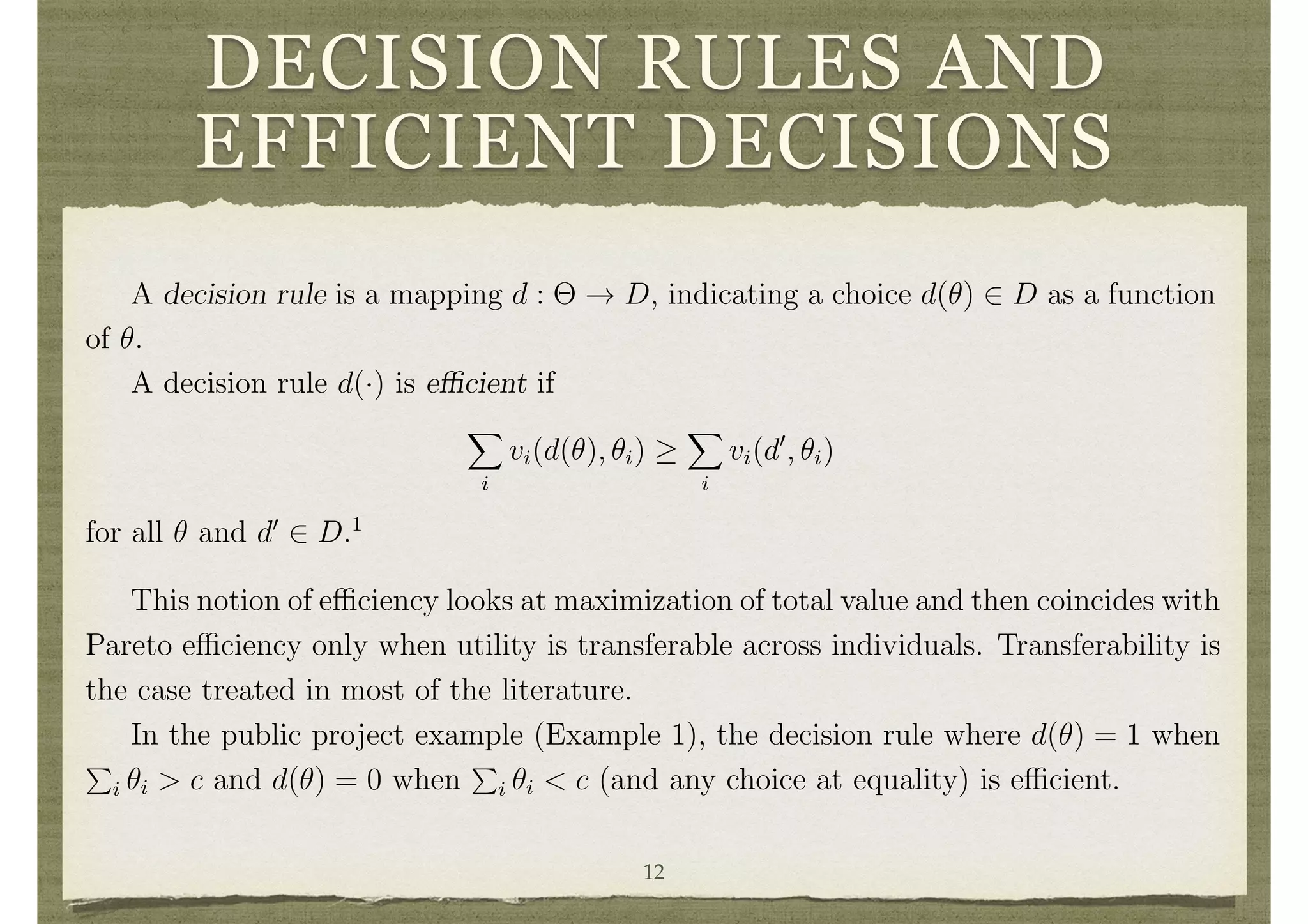
Decision Rules and E cient Decisions
It is clear from the above examples that the decision a society would like to make
will depend on the ✓i’s. For instance, a public project should only be built if the total11
DECISION RULES AND
EFFICIENT DECISIONS
Clearly, there are many other examples that can be accommodated in the mecha-
nism design analysis as the formulation of the space D has no restrictions.
Decision Rules and E cient Decisions
It is clear from the above examples that the decision a society would like to make
will depend on the ✓i’s. For instance, a public project should only be built if the total
value it generates exceeds its cost.
A decision rule is a mapping d : ⇥ ! D, indicating a choice d(✓) 2 D as a function
of ✓.
A decision rule d(·) is e cient if
X
i
vi(d(✓), ✓i)
X
i
vi(d0
, ✓i)
for all ✓ and d0
2 D.1
1
This notion of e ciency takes an ex-post perspective. That is, it looks at comparisons given that
that ✓i’s are already realized, and so may ignore improvements that are obtainable due to risk sharing
in applications where the d’s may involve some randomization.
6
This notion of e ciency looks at maximization of total value and then coincides with
Pareto e ciency only when utility is transferable across individuals. Transferability is
the case treated in most of the literature.
In the public project example (Example 1), the decision rule where d(✓) = 1 when
P
i ✓i > c and d(✓) = 0 when
P
i ✓i < c (and any choice at equality) is e cient.
Transfer Functions
In order to provide the incentives necessary to make e cient choices, it may be12
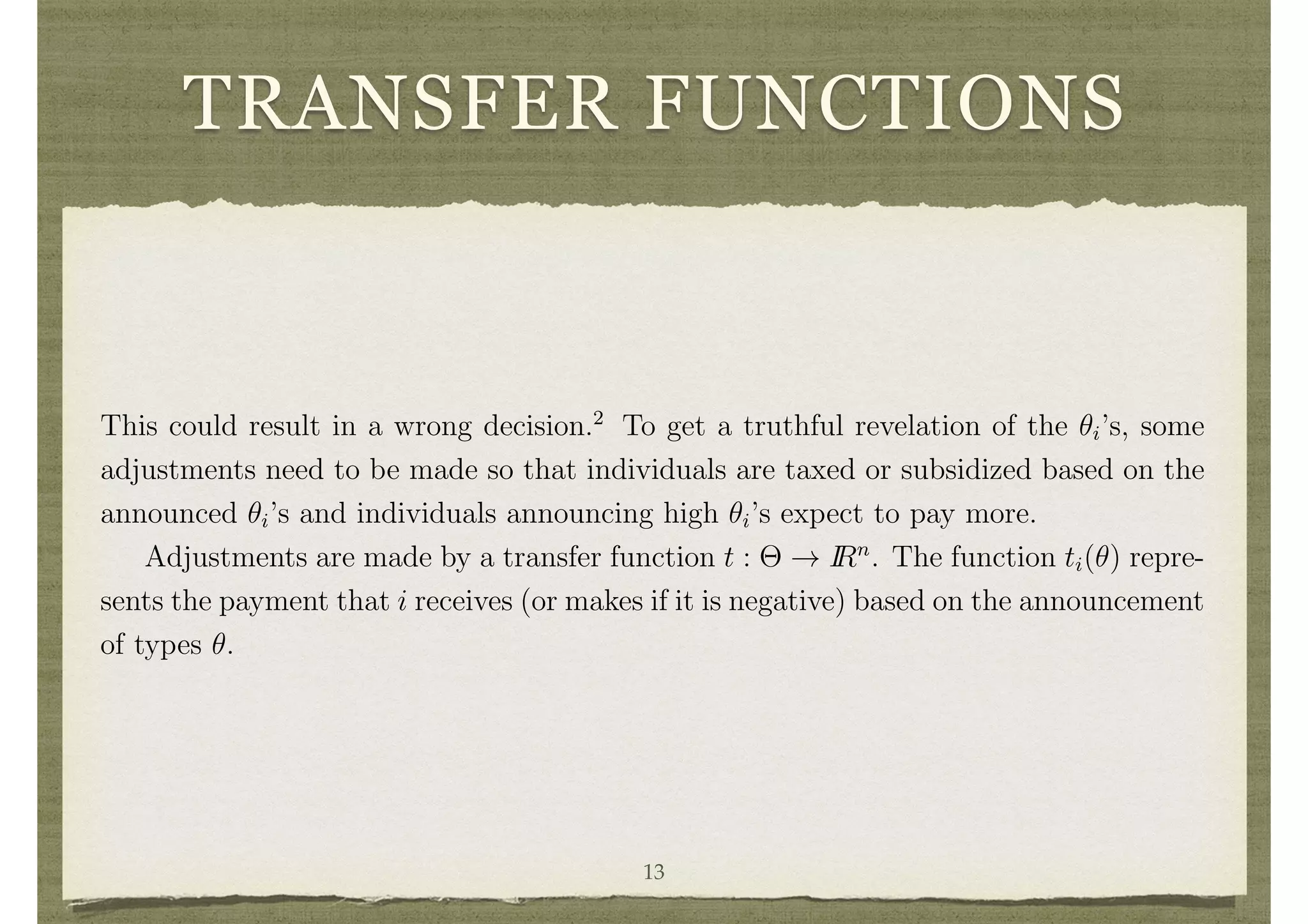
TRANSFER FUNCTIONS
necessary to tax or subsidize various individuals. To see the role of such transfers,
consider the example of the public project above. Any individual i for whom ✓i < c
n
would rather not see the project built and any individual for whom ✓i > c
n
would
rather not see the project built. Imagine that the government simply decides to poll
individuals to ask for their ✓i’s and then build the project if the sum of the announced
✓i’s is greater than c. This would result in an e cient decision if the ✓i’s were announced
truthfully. However, individuals with ✓i < c
n
have an incentive to underreport their
values and say they see no value in a project, and individuals for whom ✓i > c
n
have
an incentive to overreport and say that they have a very high value from the project.
This could result in a wrong decision.2
To get a truthful revelation of the ✓i’s, some
adjustments need to be made so that individuals are taxed or subsidized based on the
announced ✓i’s and individuals announcing high ✓i’s expect to pay more.
Adjustments are made by a transfer function t : ⇥ ! IRn
. The function ti(✓) repre-
sents the payment that i receives (or makes if it is negative) based on the announcement
of types ✓.
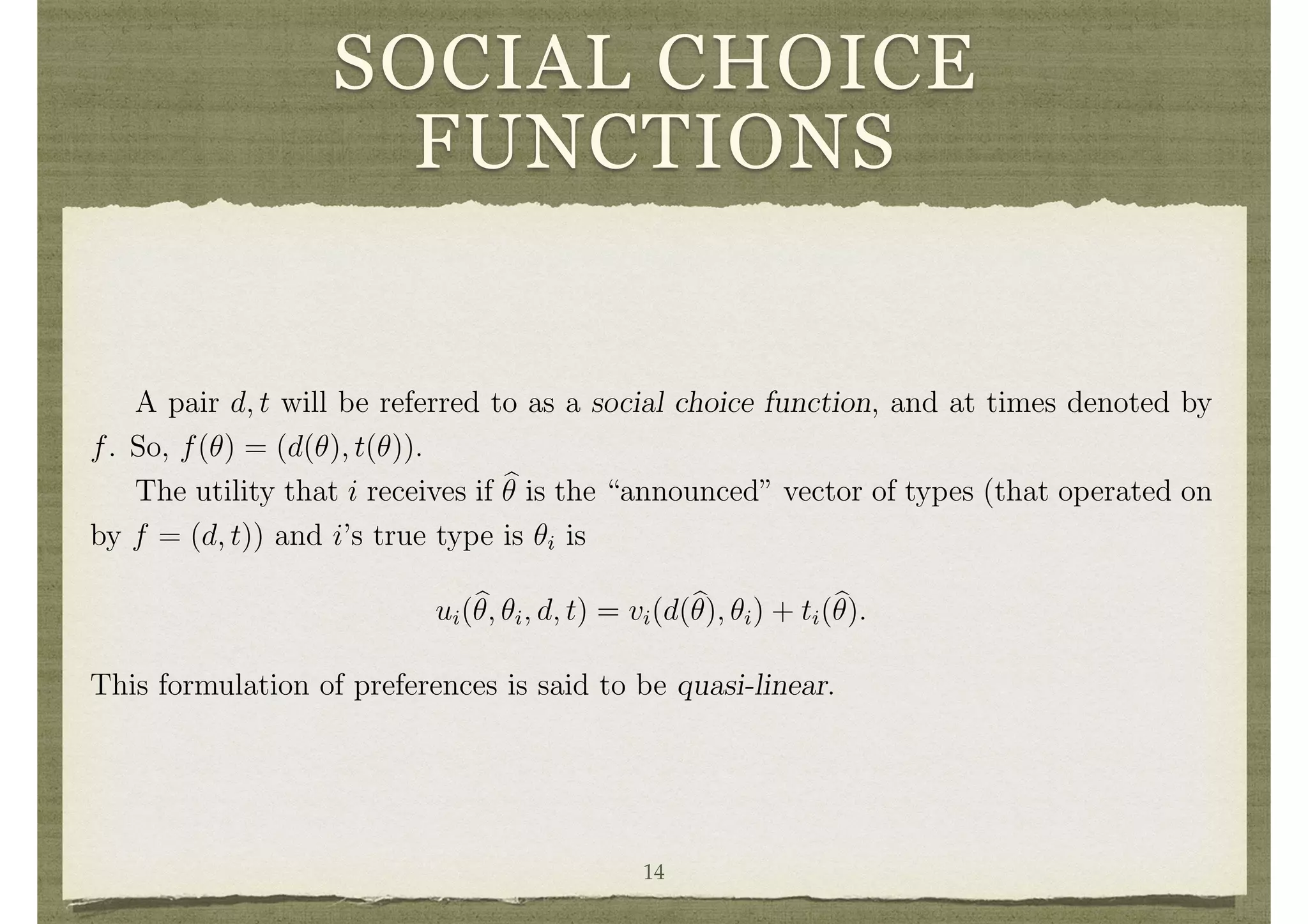
Social Choice Functions
A pair d, t will be referred to as a social choice function, and at times denoted by
f. So, f(✓) = (d(✓), t(✓)).
The utility that i receives if b✓ is the “announced” vector of types (that operated on
by f = (d, t)) and i’s true type is ✓i is 13
SOCIAL CHOICE
FUNCTIONS
i n
an incentive to overreport and say that they have a very high value from the project.
This could result in a wrong decision.2
To get a truthful revelation of the ✓i’s, some
adjustments need to be made so that individuals are taxed or subsidized based on the
announced ✓i’s and individuals announcing high ✓i’s expect to pay more.
Adjustments are made by a transfer function t : ⇥ ! IRn
. The function ti(✓) repre-
sents the payment that i receives (or makes if it is negative) based on the announcement
of types ✓.
Social Choice Functions
A pair d, t will be referred to as a social choice function, and at times denoted by
f. So, f(✓) = (d(✓), t(✓)).
The utility that i receives if b✓ is the “announced” vector of types (that operated on
by f = (d, t)) and i’s true type is ✓i is
ui(b✓, ✓i, d, t) = vi(d(b✓), ✓i) + ti(b✓).
This formulation of preferences is said to be quasi-linear.
Feasibility and Balance
2
Similarly, if the decision is simply made by a majority vote of the population, the number who
vote yes will simply be the number for whom ✓i > c
n . This can easily result in not building the project
when it is socially e cient, or building it when it is not socially e cient.14
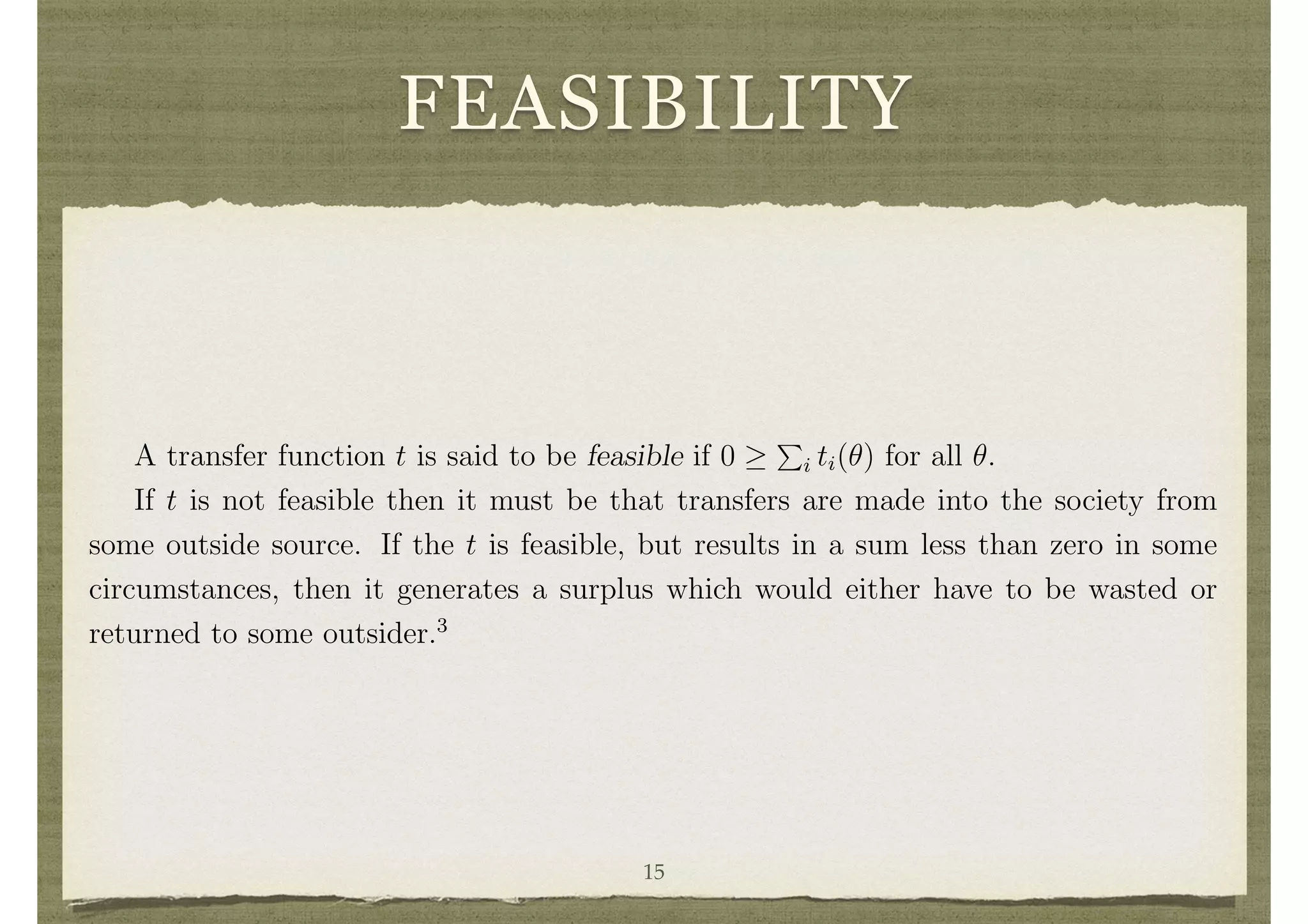
FEASIBILITY
A transfer function t is said to be feasible if 0
P
i ti(✓) for all ✓.
If t is not feasible then it must be that transfers are made into the society from
some outside source. If the t is feasible, but results in a sum less than zero in some
circumstances, then it generates a surplus which would either have to be wasted or
returned to some outsider.3
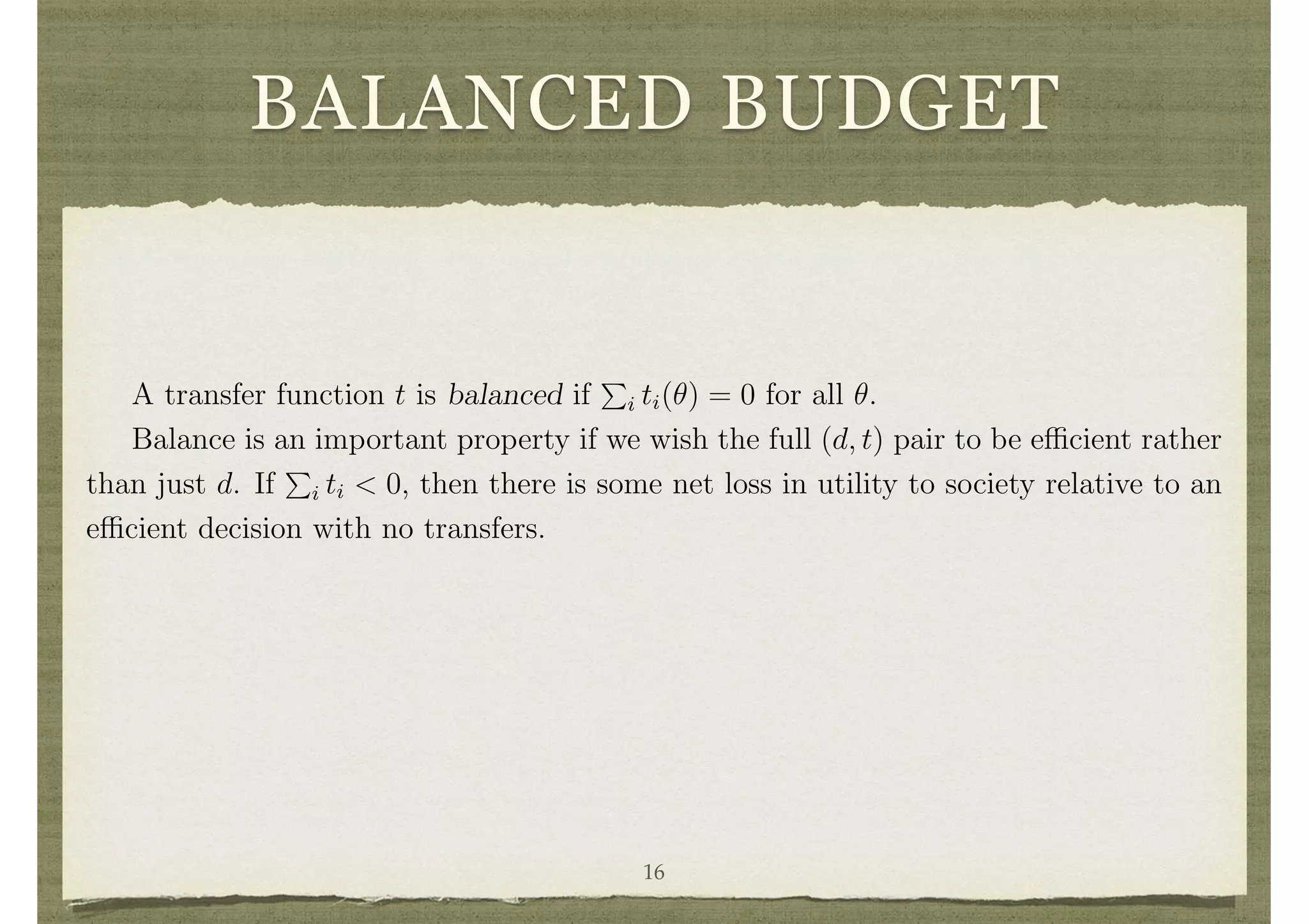
A transfer function t is balanced if
P
i ti(✓) = 0 for all ✓.
Balance is an important property if we wish the full (d, t) pair to be e cient rather
than just d. If
P
i ti < 0, then there is some net loss in utility to society relative to an
e cient decision with no transfers.
Mechanisms 15
BALANCED BUDGET
A transfer function t is said to be feasible if 0
P
i ti(✓) for all ✓.
If t is not feasible then it must be that transfers are made into the society from
some outside source. If the t is feasible, but results in a sum less than zero in some
circumstances, then it generates a surplus which would either have to be wasted or
returned to some outsider.3
A transfer function t is balanced if
P
i ti(✓) = 0 for all ✓.
Balance is an important property if we wish the full (d, t) pair to be e cient rather
than just d. If
P
i ti < 0, then there is some net loss in utility to society relative to an
e cient decision with no transfers.
Mechanisms
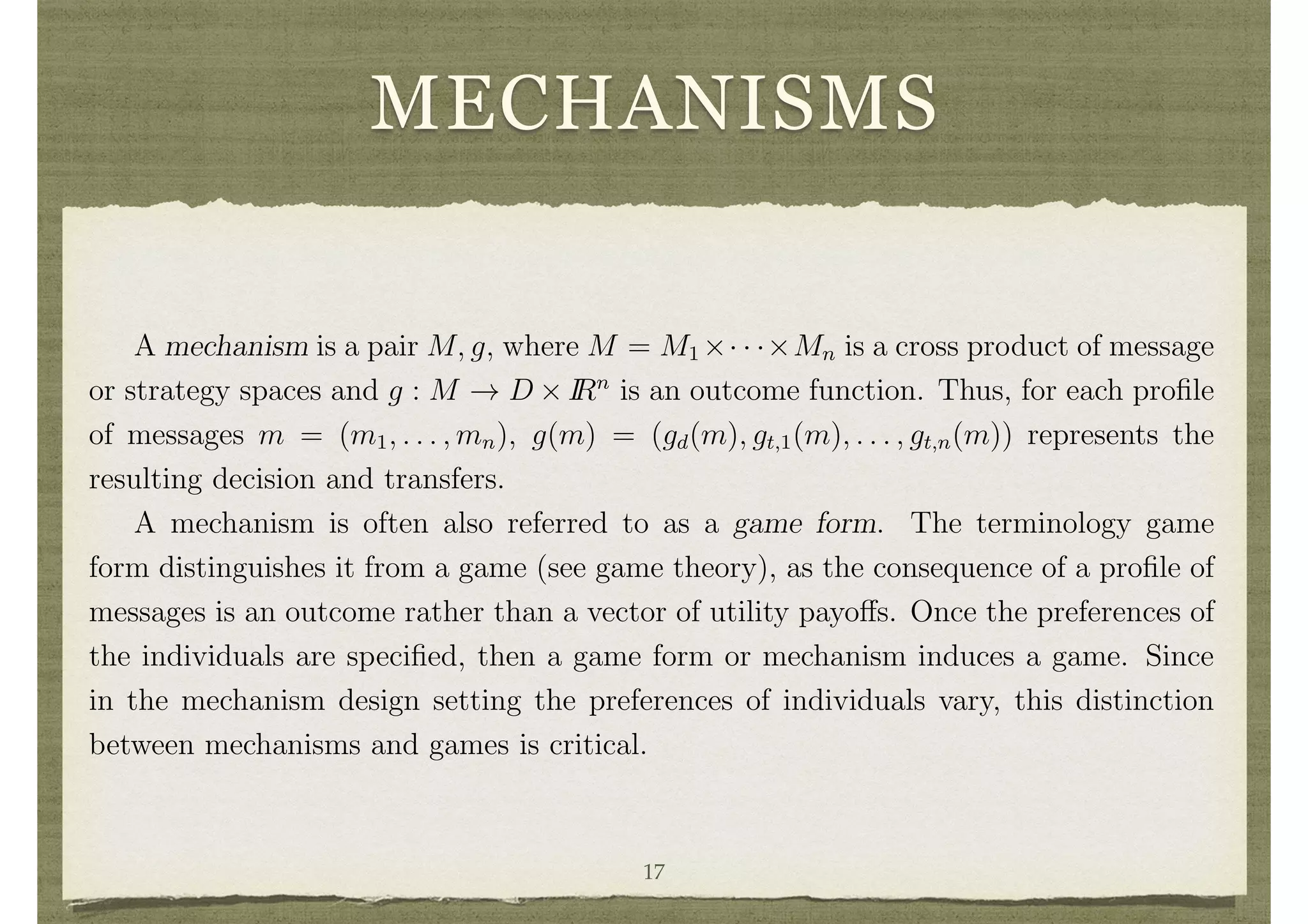
A mechanism is a pair M, g, where M = M1 ⇥· · ·⇥Mn is a cross product of message
or strategy spaces and g : M ! D ⇥ IRn
is an outcome function. Thus, for each profile
of messages m = (m1, . . . , mn), g(m) = (gd(m), gt,1(m), . . . , gt,n(m)) represents the
resulting decision and transfers.
A mechanism is often also referred to as a game form. The terminology game
form distinguishes it from a game (see game theory), as the consequence of a profile of
messages is an outcome rather than a vector of utility payo↵s. Once the preferences of
16
MECHANISMS
circumstances, then it generates a surplus which would either have to be wasted or
returned to some outsider.3
A transfer function t is balanced if
P
i ti(✓) = 0 for all ✓.
Balance is an important property if we wish the full (d, t) pair to be e cient rather
than just d. If
P
i ti < 0, then there is some net loss in utility to society relative to an
e cient decision with no transfers.
Mechanisms
A mechanism is a pair M, g, where M = M1 ⇥· · ·⇥Mn is a cross product of message
or strategy spaces and g : M ! D ⇥ IRn
is an outcome function. Thus, for each profile
of messages m = (m1, . . . , mn), g(m) = (gd(m), gt,1(m), . . . , gt,n(m)) represents the
resulting decision and transfers.
A mechanism is often also referred to as a game form. The terminology game
form distinguishes it from a game (see game theory), as the consequence of a profile of
messages is an outcome rather than a vector of utility payo↵s. Once the preferences of
the individuals are specified, then a game form or mechanism induces a game. Since
in the mechanism design setting the preferences of individuals vary, this distinction
between mechanisms and games is critical.
3 Dominant Strategy Mechanism Design17
3. DOMINANT STRATEGY
MECHANISM DESIGN
The mechanism design problem is to design a
mechanism so that when individuals interact through
the mechanism, they have incentives to choose
messages as a function of their private information
that leads to socially desired outcomes.
In order to make predictions of how individuals will
choose messages as a function of their private
information, game theoretic reasoning is used
18
IMPLEMENTATION IN
DOMINANT STRATEGIES
3.1 Dominant Strategies
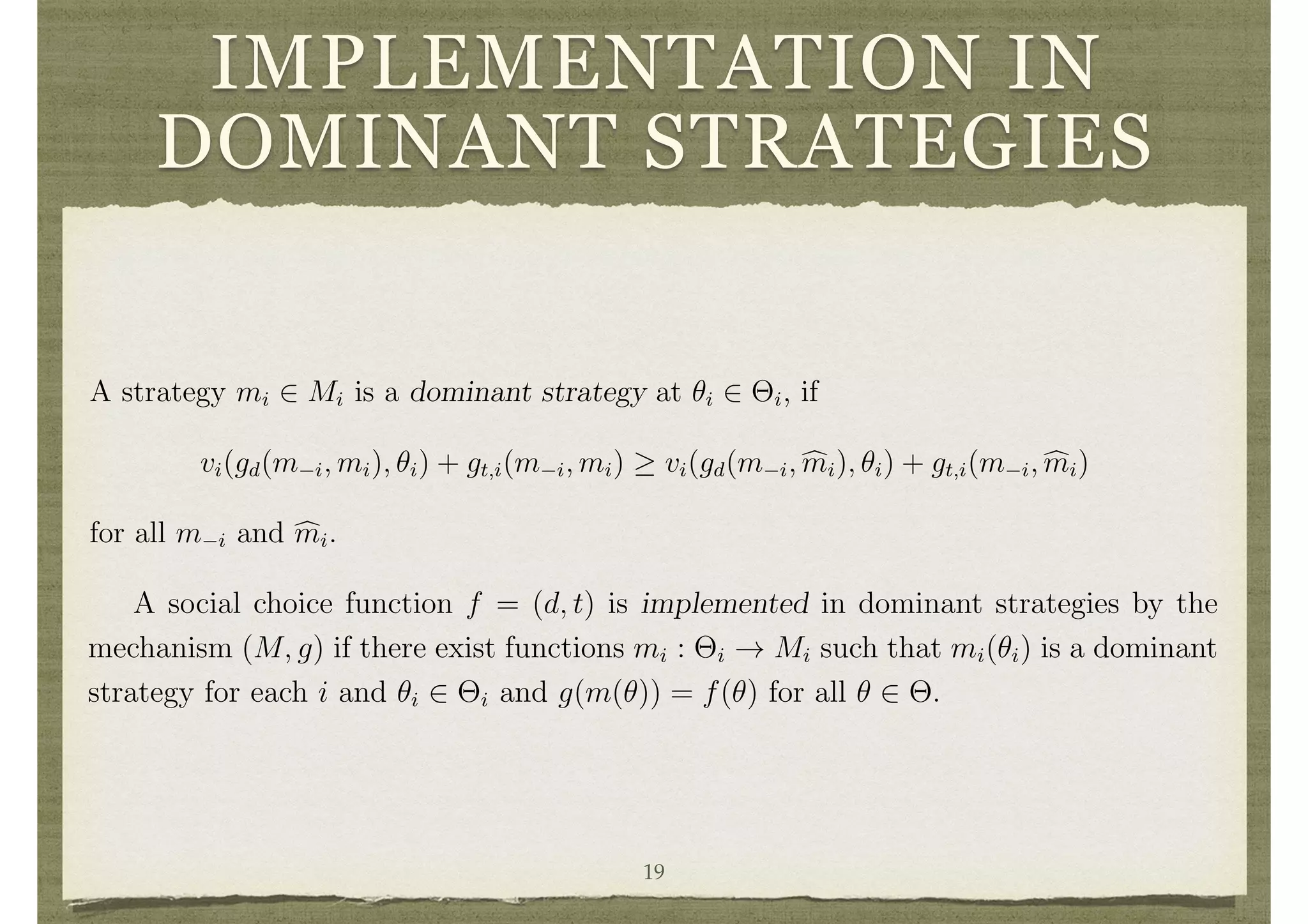
A strategy mi 2 Mi is a dominant strategy at ✓i 2 ⇥i, if
vi(gd(m i, mi), ✓i) + gt,i(m i, mi) vi(gd(m i, cmi), ✓i) + gt,i(m i, cmi)
for all m i and cmi.
A dominant strategy has the strong property that it is optimal for a player no matter
what the other players do. When dominant strategies exist, they provide compelling
predictions for strategies that players should employ. However, the strong properties
required of dominant strategies limits the set of situations where they exist.
A social choice function f = (d, t) is implemented in dominant strategies by the
mechanism (M, g) if there exist functions mi : ⇥i ! Mi such that mi(✓i) is a dominant
strategy for each i and ✓i 2 ⇥i and g(m(✓)) = f(✓) for all ✓ 2 ⇥.
3.1 Dominant Strategies
A strategy mi 2 Mi is a dominant strategy at ✓i 2 ⇥i, if
vi(gd(m i, mi), ✓i) + gt,i(m i, mi) vi(gd(m i, cmi), ✓i) + gt,i(m i, cmi)
for all m i and cmi.
A dominant strategy has the strong property that it is optimal for a player no matter
what the other players do. When dominant strategies exist, they provide compelling
predictions for strategies that players should employ. However, the strong properties
required of dominant strategies limits the set of situations where they exist.
A social choice function f = (d, t) is implemented in dominant strategies by the
mechanism (M, g) if there exist functions mi : ⇥i ! Mi such that mi(✓i) is a dominant
strategy for each i and ✓i 2 ⇥i and g(m(✓)) = f(✓) for all ✓ 2 ⇥.
3.2 Direct Mechanisms and the Revelation Principle
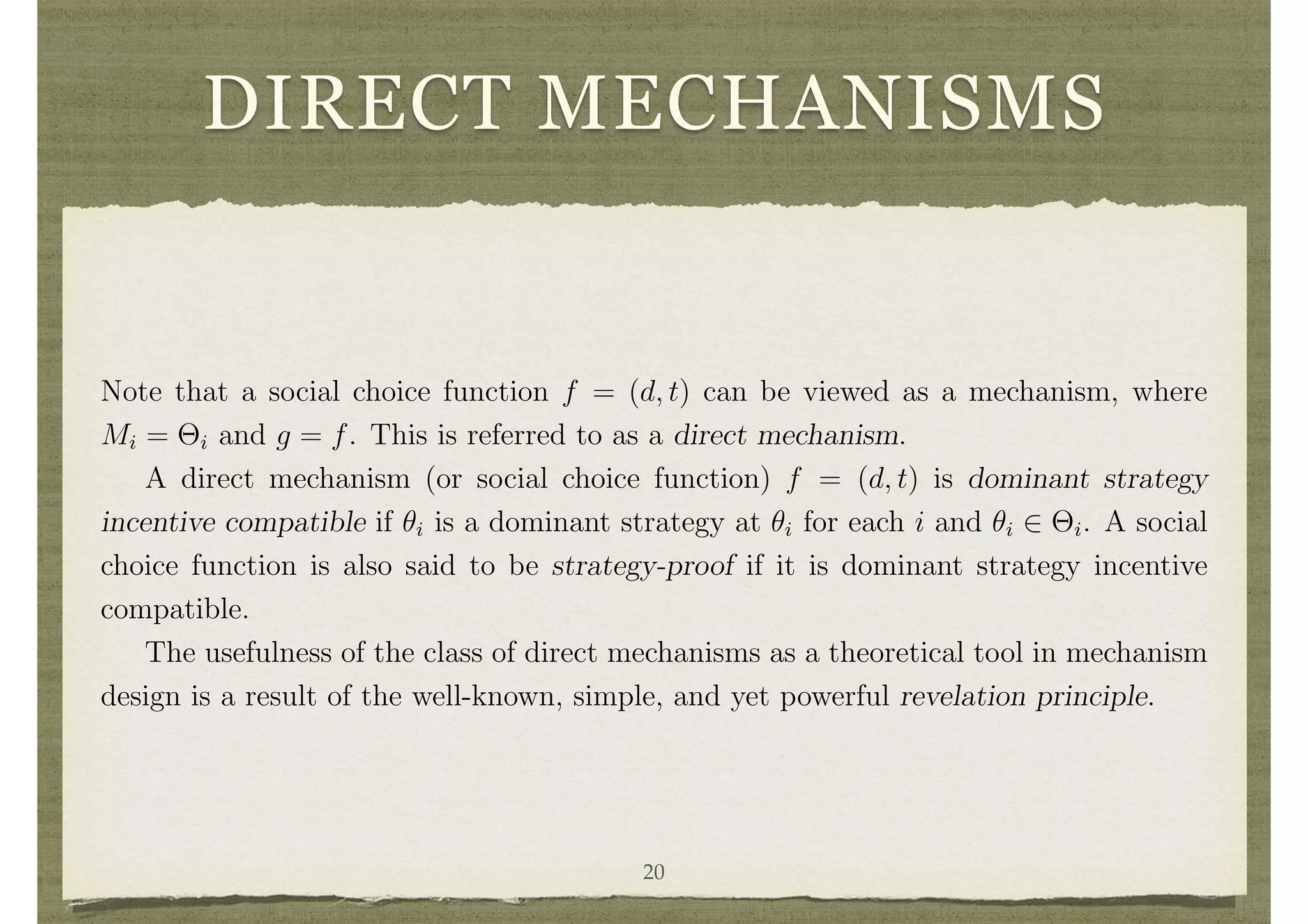
Note that a social choice function f = (d, t) can be viewed as a mechanism, where
Mi = ⇥i and g = f. This is referred to as a direct mechanism.
19
DIRECT MECHANISMS
what the other players do. When dominant strategies exist, they provide compelling
predictions for strategies that players should employ. However, the strong properties
required of dominant strategies limits the set of situations where they exist.
A social choice function f = (d, t) is implemented in dominant strategies by the
mechanism (M, g) if there exist functions mi : ⇥i ! Mi such that mi(✓i) is a dominant
strategy for each i and ✓i 2 ⇥i and g(m(✓)) = f(✓) for all ✓ 2 ⇥.
3.2 Direct Mechanisms and the Revelation Principle
Note that a social choice function f = (d, t) can be viewed as a mechanism, where
Mi = ⇥i and g = f. This is referred to as a direct mechanism.
A direct mechanism (or social choice function) f = (d, t) is dominant strategy
incentive compatible if ✓i is a dominant strategy at ✓i for each i and ✓i 2 ⇥i. A social
choice function is also said to be strategy-proof if it is dominant strategy incentive
compatible.
The usefulness of the class of direct mechanisms as a theoretical tool in mechanism
design is a result of the well-known, simple, and yet powerful revelation principle.
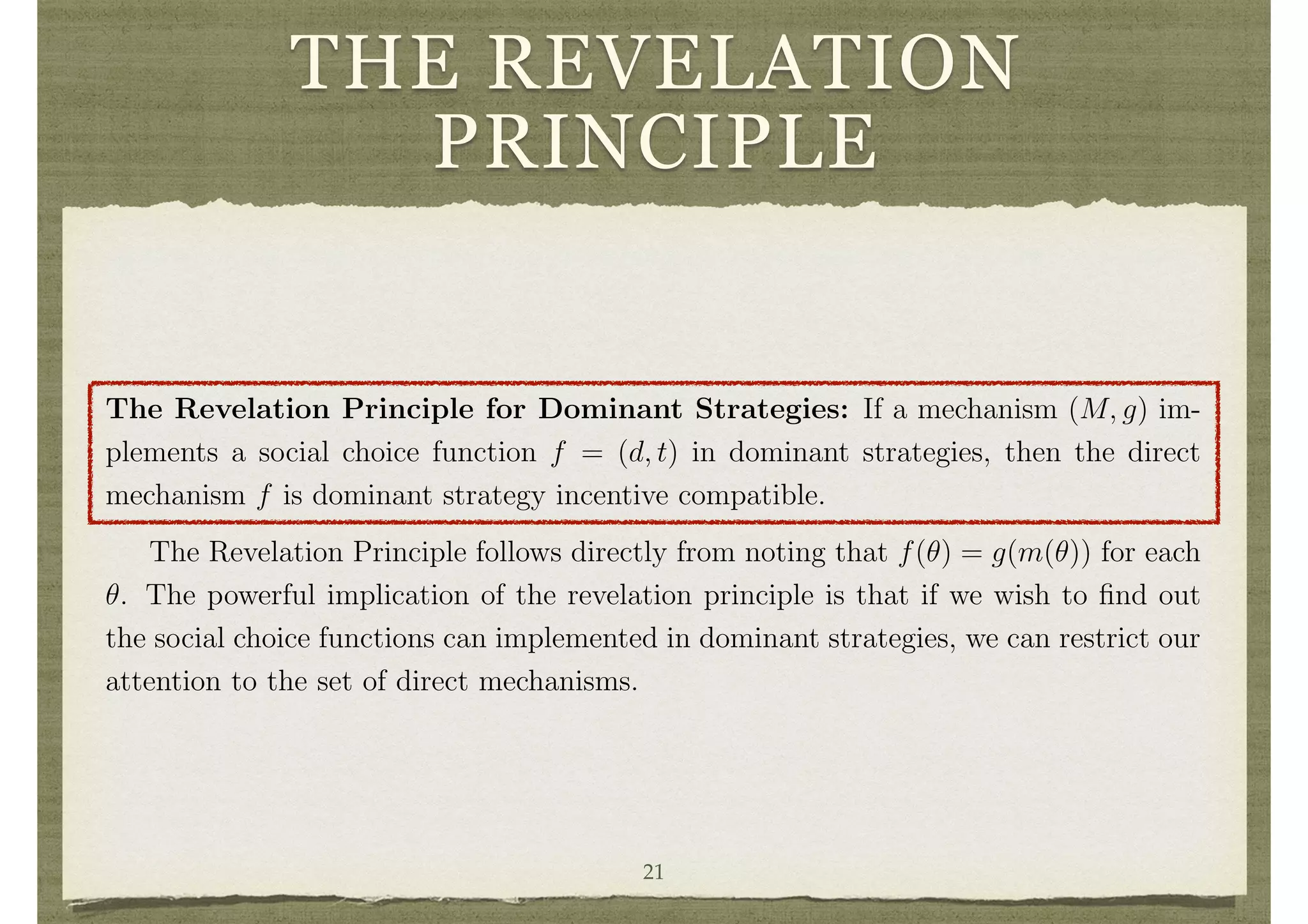
The Revelation Principle for Dominant Strategies: If a mechanism (M, g) im-
plements a social choice function f = (d, t) in dominant strategies, then the direct
mechanism f is dominant strategy incentive compatible.
The Revelation Principle follows directly from noting that f(✓) = g(m(✓)) for each
20
THE REVELATION
PRINCIPLE
Note that a social choice function f = (d, t) can be viewed as a mechanism, where
Mi = ⇥i and g = f. This is referred to as a direct mechanism.
A direct mechanism (or social choice function) f = (d, t) is dominant strategy
incentive compatible if ✓i is a dominant strategy at ✓i for each i and ✓i 2 ⇥i. A social
choice function is also said to be strategy-proof if it is dominant strategy incentive
compatible.
The usefulness of the class of direct mechanisms as a theoretical tool in mechanism
design is a result of the well-known, simple, and yet powerful revelation principle.
The Revelation Principle for Dominant Strategies: If a mechanism (M, g) im-
plements a social choice function f = (d, t) in dominant strategies, then the direct
mechanism f is dominant strategy incentive compatible.
The Revelation Principle follows directly from noting that f(✓) = g(m(✓)) for each
✓. The powerful implication of the revelation principle is that if we wish to find out
the social choice functions can implemented in dominant strategies, we can restrict our
attention to the set of direct mechanisms.
3.3 The Gibbard-Satterthwaite Theorem
Given that the specification of the space of decisions D can be quite general, it can keep
track of all the aspects of a decision that are salient to a society. Thus, the transfer21
THE GIBBARD-
SATTERTHWAITE THEOREMfunctions t are an extra that may be needed to provide correct incentives, but might
best be avoided if possible. So, we start by exploring the set of decisions that can be
implemented in dominant strategies without having to resort to transfers (beyond any
that society already wished to specify inside the decisions), or in other words with t
set to 0.
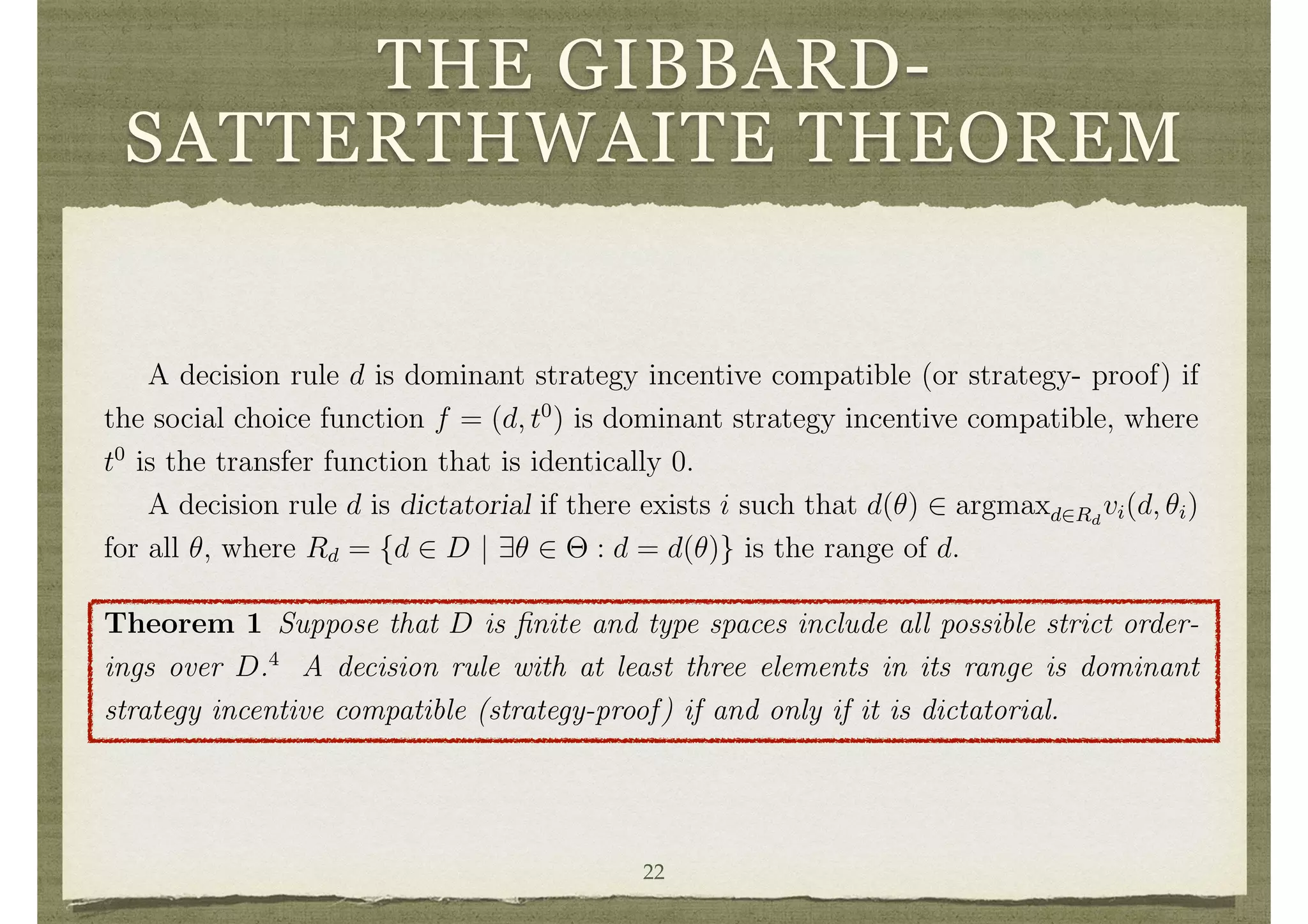
A decision rule d is dominant strategy incentive compatible (or strategy- proof) if
the social choice function f = (d, t0
) is dominant strategy incentive compatible, where
t0
is the transfer function that is identically 0.
A decision rule d is dictatorial if there exists i such that d(✓) 2 argmaxd2Rd
vi(d, ✓i)
for all ✓, where Rd = {d 2 D | 9✓ 2 ⇥ : d = d(✓)} is the range of d.
Theorem 1 Suppose that D is finite and type spaces include all possible strict order-
ings over D.4
A decision rule with at least three elements in its range is dominant
strategy incentive compatible (strategy-proof) if and only if it is dictatorial.
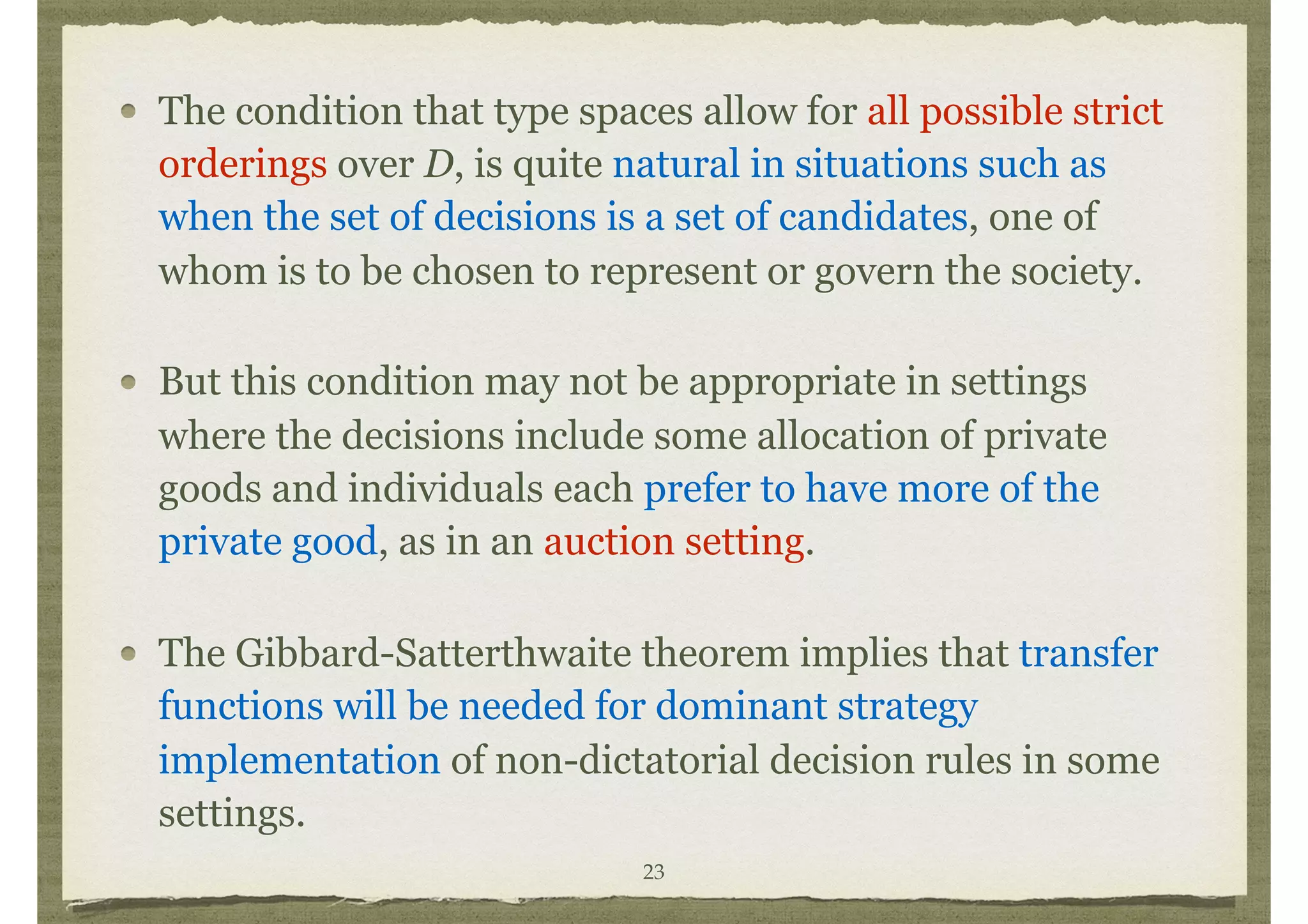
The condition that type spaces allow for all possible strict orderings over D, is quite
natural in situations such as when the set of decisions is a set of candidates, one of
whom is to be chosen to represent or govern the society. But this condition may not22
The condition that type spaces allow for all possible strict
orderings over D, is quite natural in situations such as
when the set of decisions is a set of candidates, one of
whom is to be chosen to represent or govern the society.
But this condition may not be appropriate in settings
where the decisions include some allocation of private
goods and individuals each prefer to have more of the
private good, as in an auction setting.
The Gibbard-Satterthwaite theorem implies that transfer
functions will be needed for dominant strategy
implementation of non-dictatorial decision rules in some
settings.
23
SINGLE-PEAKED
PREFERENCES
environments. It implies that transfer functions will be needed for dominant strategy
implementation of non-dictatorial decision rules in some settings. Before discussing the
role of transfer functions, let us point out some prominent settings where the preferences
do not satisfy the richness of types assumption of the Gibbard-Satterthwaite theorem
and there exist non-dictatorial strategy-proof social choice functions that do not rely
on transfer functions.
3.4 Single-Peaked Preferences and Other Restricted Domains
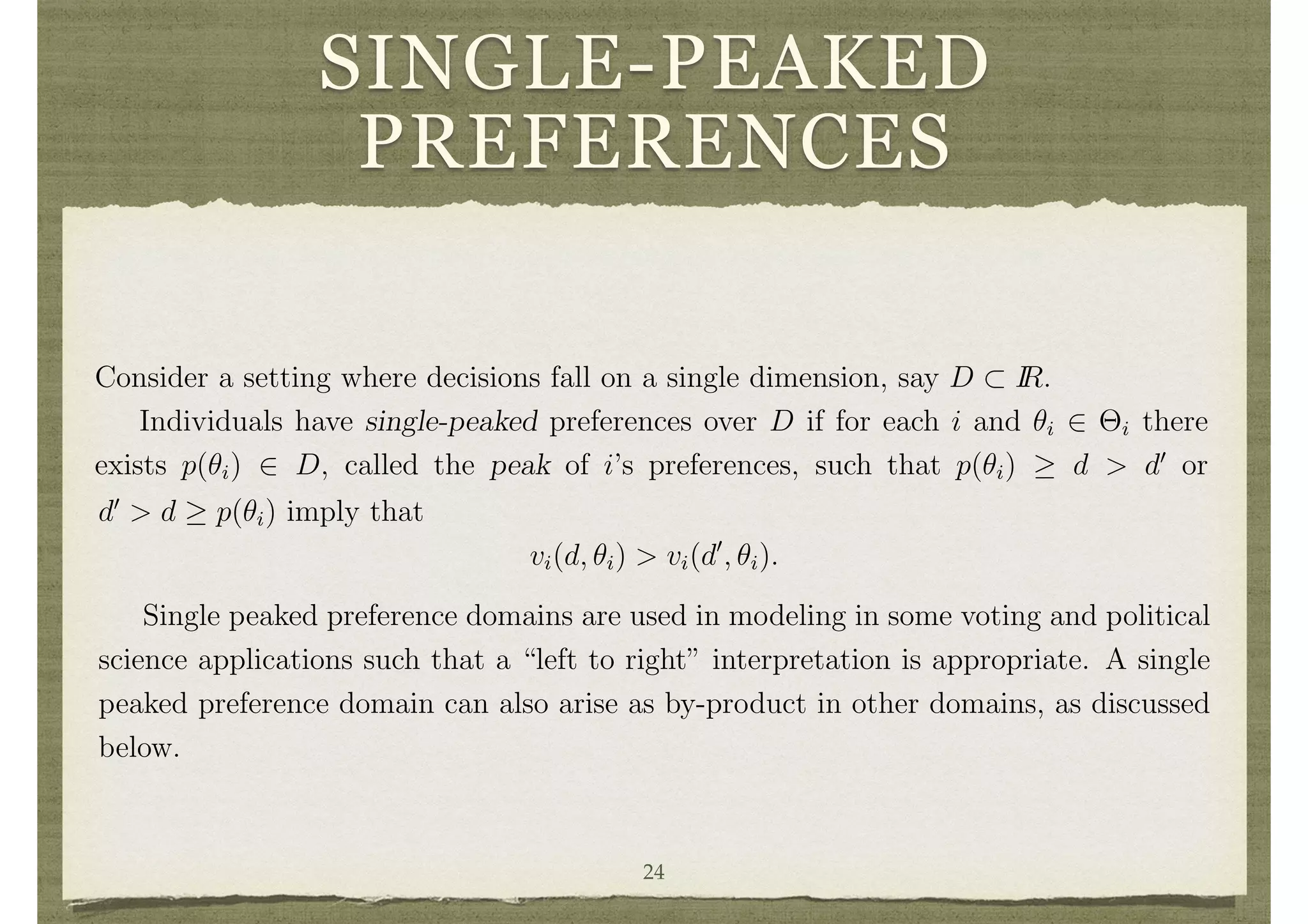
Consider a setting where decisions fall on a single dimension, say D ⇢ IR.
Individuals have single-peaked preferences over D if for each i and ✓i 2 ⇥i there
exists p(✓i) 2 D, called the peak of i’s preferences, such that p(✓i) d > d0
or
4
For any ordering h : D ! {1, . . . , #D} (where h is onto) of elements of D and i 2 N there exists
a type ✓i 2 ⇥i such that vi(d, ✓i) < vi(d0
, ✓i) when h(d) < h(d0
).
10
d0
> d p(✓i) imply that
vi(d, ✓i) > vi(d0
, ✓i).
Single peaked preference domains are used in modeling in some voting and political
science applications such that a “left to right” interpretation is appropriate. A single
peaked preference domain can also arise as by-product in other domains, as discussed
below.
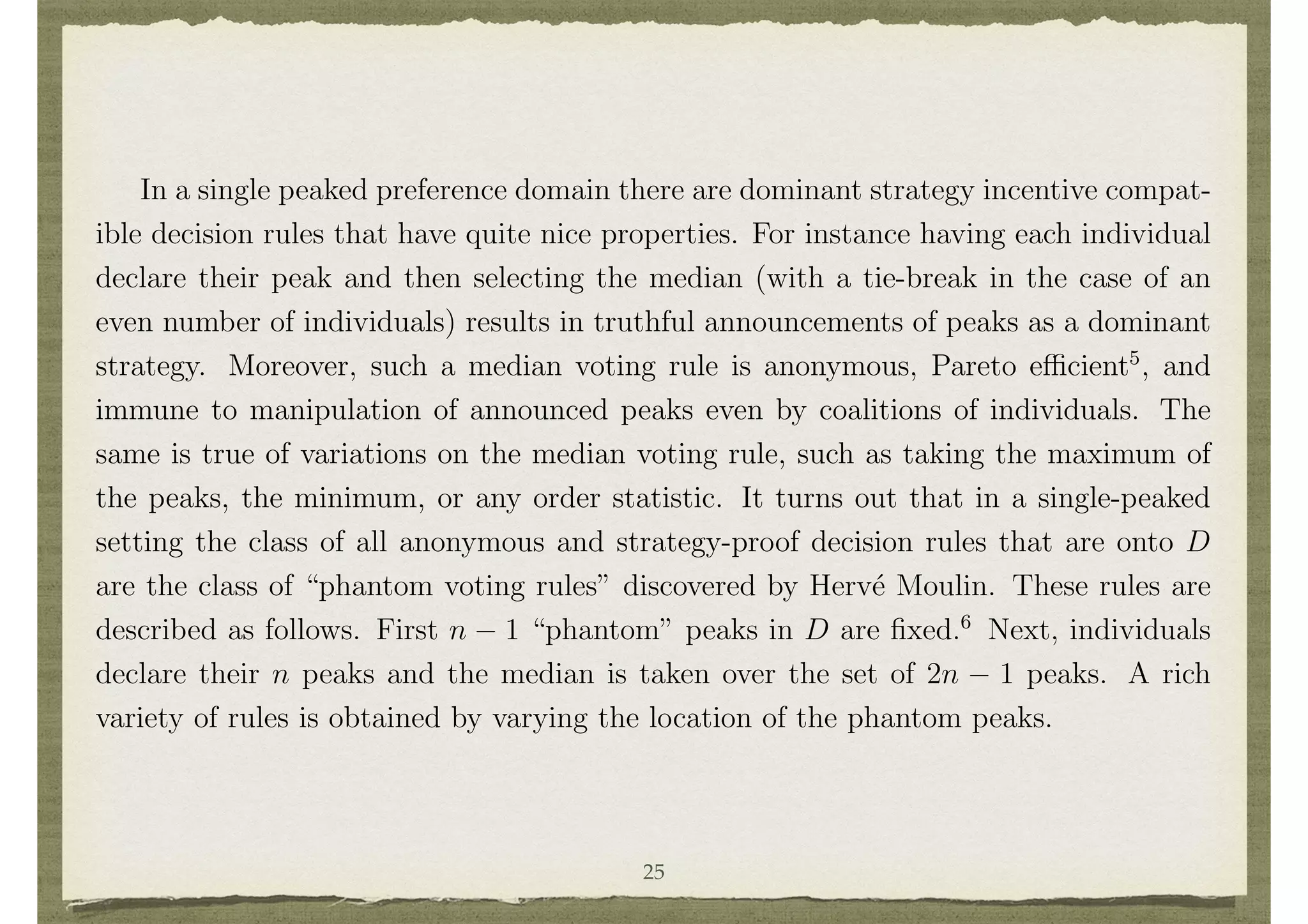
In a single peaked preference domain there are dominant strategy incentive compat-
ible decision rules that have quite nice properties. For instance having each individual
declare their peak and then selecting the median (with a tie-break in the case of an24
Single peaked preference domains are used in modeling in some voting and political
science applications such that a “left to right” interpretation is appropriate. A single
peaked preference domain can also arise as by-product in other domains, as discussed
below.
In a single peaked preference domain there are dominant strategy incentive compat-
ible decision rules that have quite nice properties. For instance having each individual
declare their peak and then selecting the median (with a tie-break in the case of an
even number of individuals) results in truthful announcements of peaks as a dominant
strategy. Moreover, such a median voting rule is anonymous, Pareto e cient5
, and
immune to manipulation of announced peaks even by coalitions of individuals. The
same is true of variations on the median voting rule, such as taking the maximum of
the peaks, the minimum, or any order statistic. It turns out that in a single-peaked
setting the class of all anonymous and strategy-proof decision rules that are onto D
are the class of “phantom voting rules” discovered by Herv´e Moulin. These rules are
described as follows. First n 1 “phantom” peaks in D are fixed.6
Next, individuals
declare their n peaks and the median is taken over the set of 2n 1 peaks. A rich
variety of rules is obtained by varying the location of the phantom peaks.
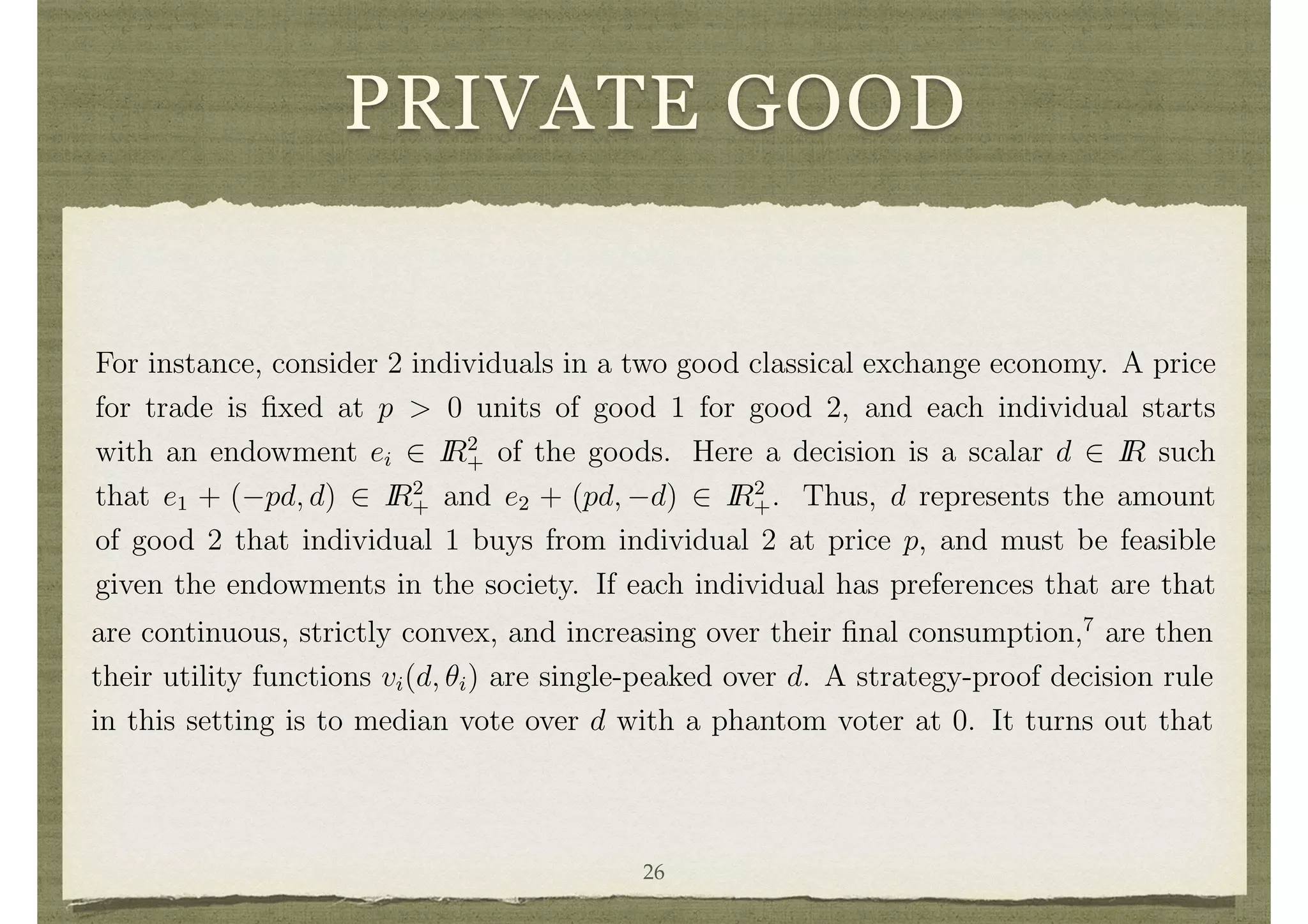
Although single-peaked preference domains are described above in the context of
a left to right political choice, such settings can arise even in private good settings.
For instance, consider 2 individuals in a two good classical exchange economy. A price
for trade is fixed at p > 0 units of good 1 for good 2, and each individual starts
25
PRIVATE GOOD
the peaks, the minimum, or any order statistic. It turns out that in a single-peaked
setting the class of all anonymous and strategy-proof decision rules that are onto D
are the class of “phantom voting rules” discovered by Herv´e Moulin. These rules are
described as follows. First n 1 “phantom” peaks in D are fixed.6
Next, individuals
declare their n peaks and the median is taken over the set of 2n 1 peaks. A rich
variety of rules is obtained by varying the location of the phantom peaks.
Although single-peaked preference domains are described above in the context of
a left to right political choice, such settings can arise even in private good settings.
For instance, consider 2 individuals in a two good classical exchange economy. A price
for trade is fixed at p > 0 units of good 1 for good 2, and each individual starts
with an endowment ei 2 IR2
+ of the goods. Here a decision is a scalar d 2 IR such
that e1 + ( pd, d) 2 IR2
+ and e2 + (pd, d) 2 IR2
+. Thus, d represents the amount
of good 2 that individual 1 buys from individual 2 at price p, and must be feasible
given the endowments in the society. If each individual has preferences that are that
5
It results in a decision such that there is no other decision that is improving for all individuals.
Pareto e ciency is a weaker condition than the e ciency defined previously. Median voting will
not generally result in a decision that maximizes the sum of utilities. If one wants to implement
e cient decisions in this stronger sense, then transfers are needed even in the context of single-peaked
preference domains.
6
If D is not compact, then add points 1 and 1 as possible points for the phantoms. Then, for
example, to get the minimum peak rule, set the phantoms at the lowest point and then the median
of the phantom peaks and the n peaks of the individuals will always be the lowest peak announced
are continuous, strictly convex, and increasing over their final consumption,7
are then
their utility functions vi(d, ✓i) are single-peaked over d. A strategy-proof decision rule
in this setting is to median vote over d with a phantom voter at 0. It turns out that
the class of all strategy-proof decision rules in exchange economies (with any number
of agents and goods) satisfying an anonymity, individual rationality, and additional
technical condition, are of a similar form, as shown by Salvador Barbera and Matthew
Jackson. In particular, goods must be traded in fixed proportions, where individuals
26
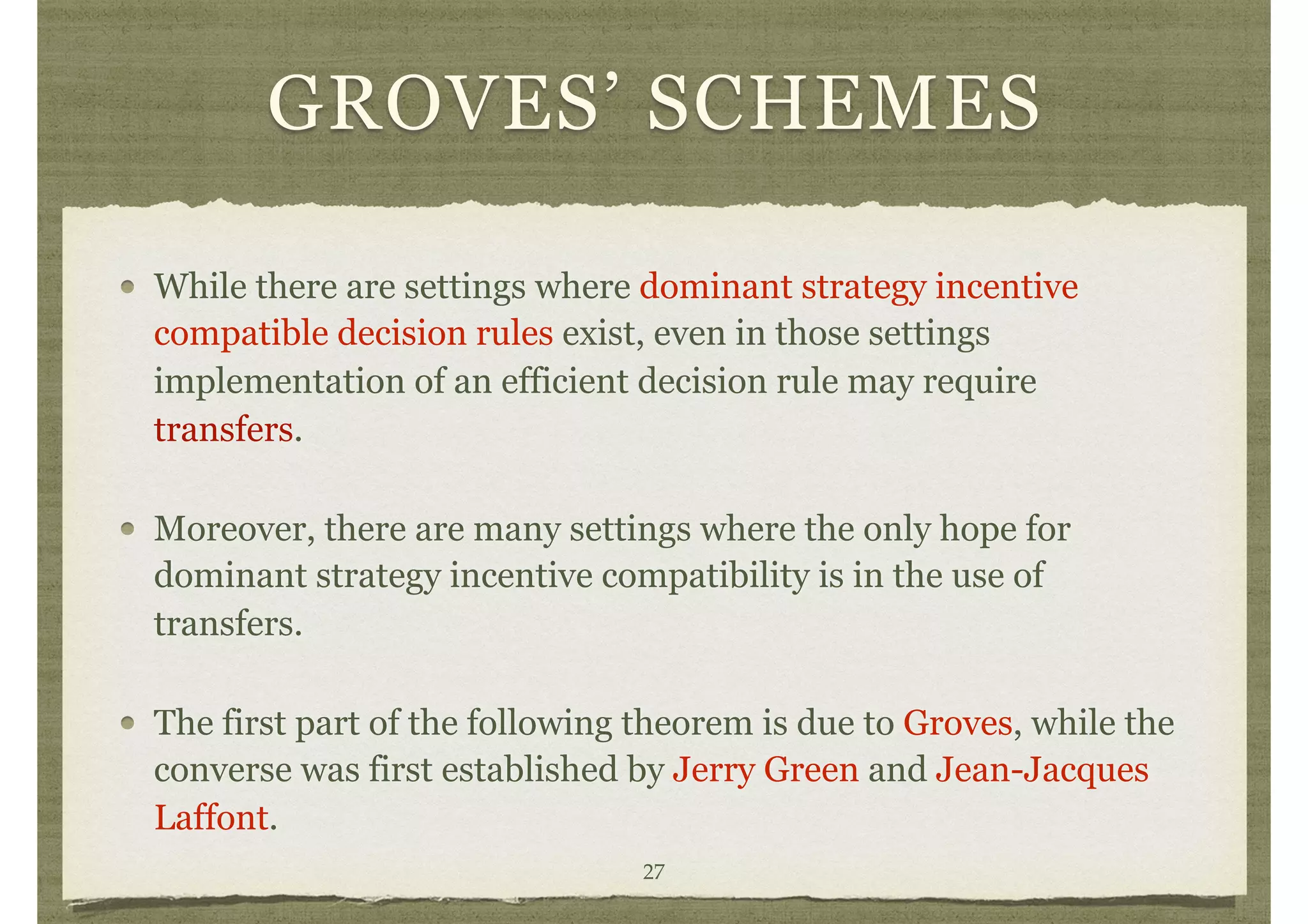
GROVES’ SCHEMES
While there are settings where dominant strategy incentive
compatible decision rules exist, even in those settings
implementation of an efficient decision rule may require
transfers.
Moreover, there are many settings where the only hope for
dominant strategy incentive compatibility is in the use of
transfers.
The first part of the following theorem is due to Groves, while the
converse was first established by Jerry Green and Jean-Jacques
Laffont.
27
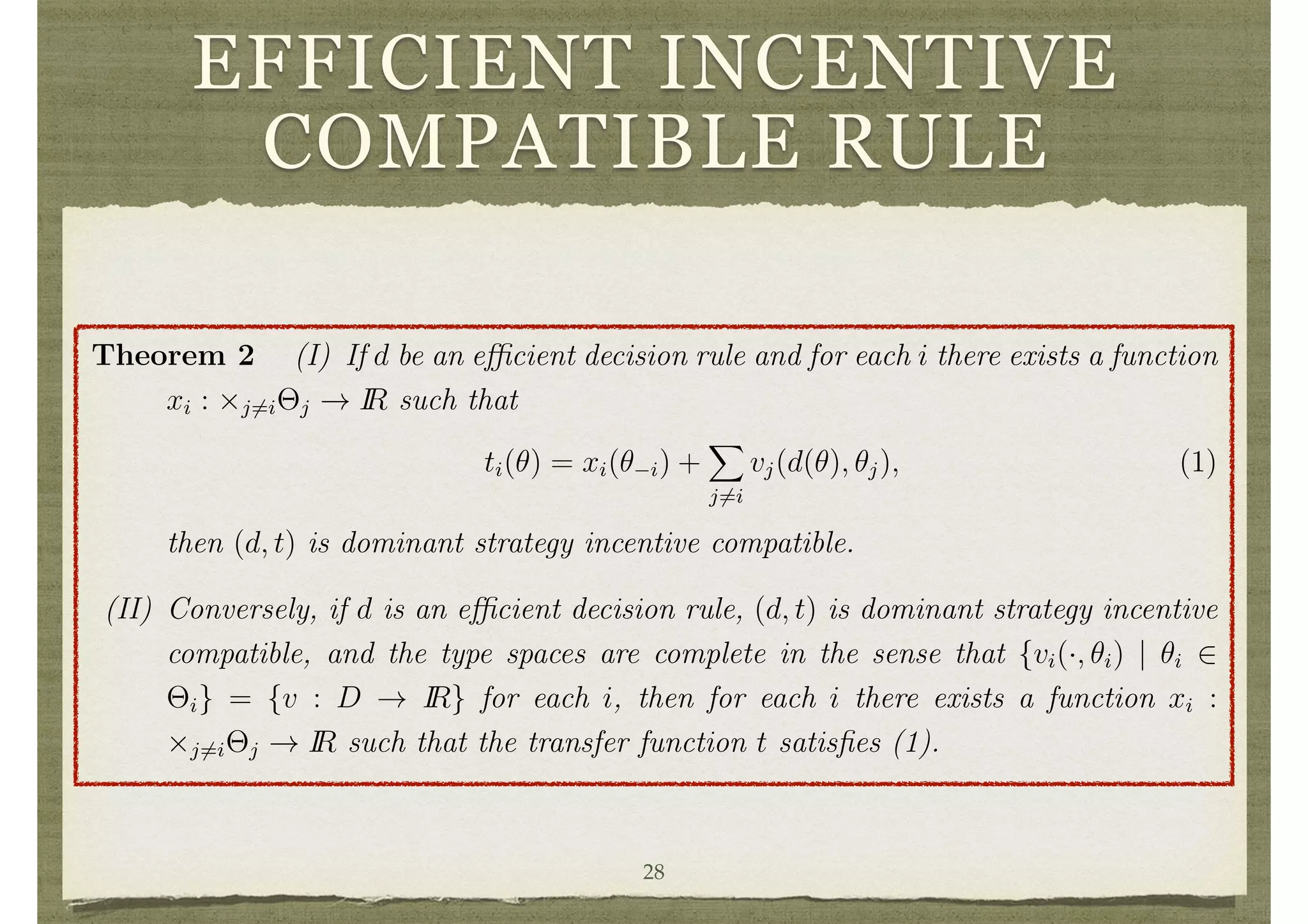
EFFICIENT INCENTIVE
COMPATIBLE RULE
to another approach below). It starts with some e cient decision rule d and then asks
what form of transfers are necessary so that d, t is dominant strategy incentive com-
patible. The resulting social choice functions are referred to as Groves’ schemes after
Theodore Groves, who first pointed out this full class of dominant strategy incentive
compatible social choice functions with e cient decisions. The first part of the follow-
ing theorem is due to Groves, while the converse was first established by Jerry Green
and Jean-Jacques La↵ont.
Theorem 2 (I) If d be an e cient decision rule and for each i there exists a function
xi : ⇥j6=i⇥j ! IR such that
ti(✓) = xi(✓ i) +
X
j6=i
vj(d(✓), ✓j), (1)
then (d, t) is dominant strategy incentive compatible.
(II) Conversely, if d is an e cient decision rule, (d, t) is dominant strategy incentive
compatible, and the type spaces are complete in the sense that {vi(·, ✓i) | ✓i 2
⇥i} = {v : D ! IR} for each i, then for each i there exists a function xi :
⇥j6=i⇥j ! IR such that the transfer function t satisfies (1).
7
Preferences are continuous if upper and lower contour sets are closed, strictly convex if upper
contour sets are convex, and increasing if c c0
and c 6= c0
(where c 2 IR2
+ is the vector of goods
consumed by i) implies that c is preferred to c0
. 28
EX.4) LACK OF BALANCE
3.7 The Tension between Balance and Incentive Compatibil-
ity
Requiring e ciency of the decision is only part of the e ciency that society should
desire. If the transfer functions are not balanced, then there is waste and it can
be considerable. To see this problem, let us reexamine the public project example
(Example 1) in a simple case.
Example 4 Lack of Balance in a Public Goods Setting
Consider a situation where there are two individuals (n = 2) and ⇥1 = ⇥2 = IR -
so individuals’ might have any value for the public project. By Theorem 2 there exist
x1 and x2 so that (1) is satisfied. Let the cost of the project be c = 3/2.
Let us investigate the requirements imposed by feasibility of the transfers. Applying
feasibility when ✓1 = ✓2 = 1 implies that 0 t1(1, 1)+t2(1, 1), Noting that d(1, 1) = 1,
equation (1) implies that
1
2
x1(1) + x2(1).
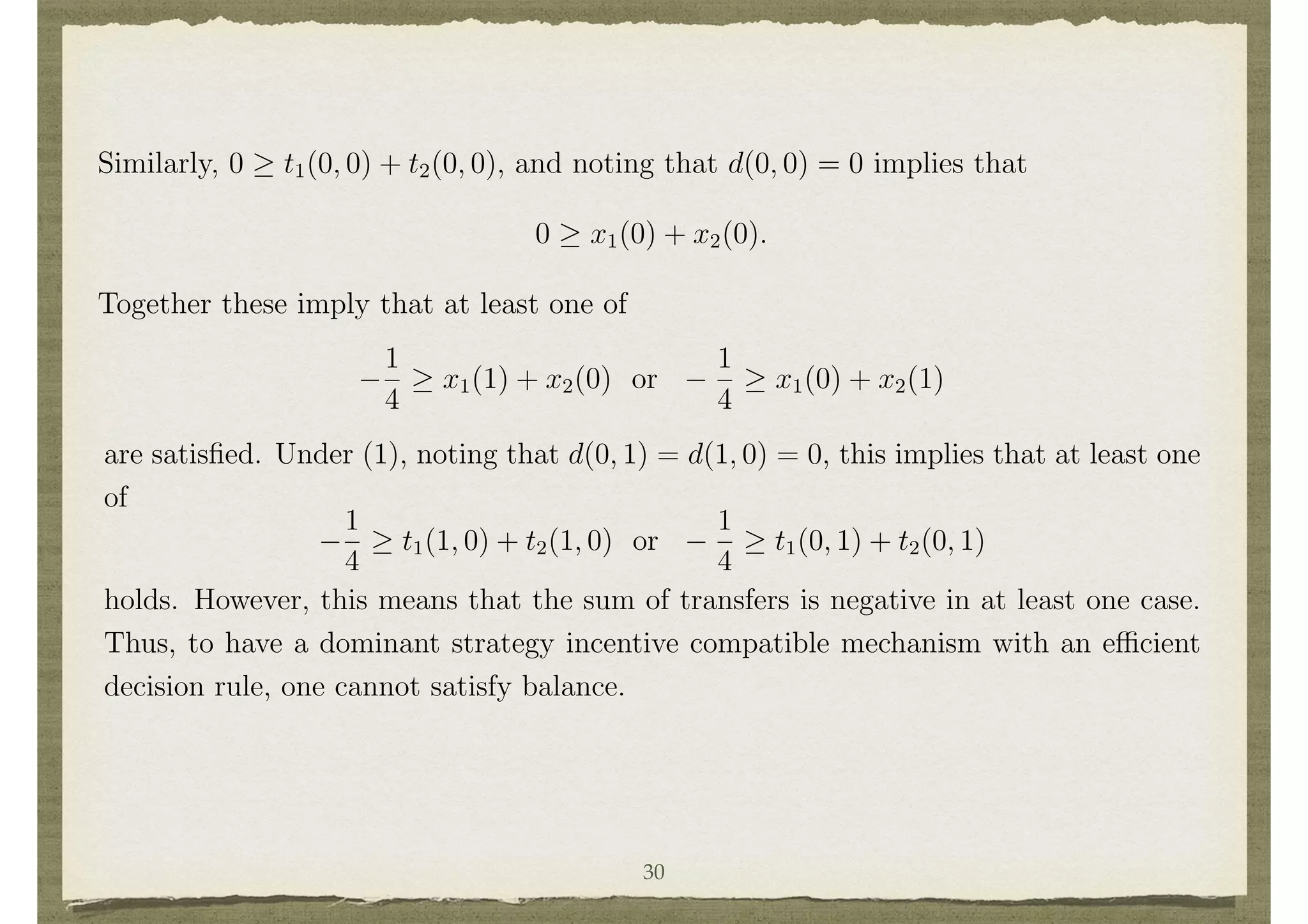
Similarly, 0 t1(0, 0) + t2(0, 0), and noting that d(0, 0) = 0 implies that
0 x1(0) + x2(0).
Together these imply that at least one of 29
feasibility when ✓1 = ✓2 = 1 implies that 0 t1(1, 1)+t2(1, 1), Noting that d(1, 1) = 1,
equation (1) implies that
1
2
x1(1) + x2(1).
Similarly, 0 t1(0, 0) + t2(0, 0), and noting that d(0, 0) = 0 implies that
0 x1(0) + x2(0).
Together these imply that at least one of
1
4
x1(1) + x2(0) or
1
4
x1(0) + x2(1)
8
This also corresponds to the ascending oral or English auction, which is one of the most common
auction forms used. It is a dominant strategy to remain in the bidding until the bid hits one’s
valuations and then to drop out. The highest valuation individual will get the object at the second
highest bidder’s valuation.
15
are satisfied. Under (1), noting that d(0, 1) = d(1, 0) = 0, this implies that at least one
of
1
4
t1(1, 0) + t2(1, 0) or
1
4
t1(0, 1) + t2(0, 1)
holds. However, this means that the sum of transfers is negative in at least one case.
Thus, to have a dominant strategy incentive compatible mechanism with an e cient
decision rule, one cannot satisfy balance.
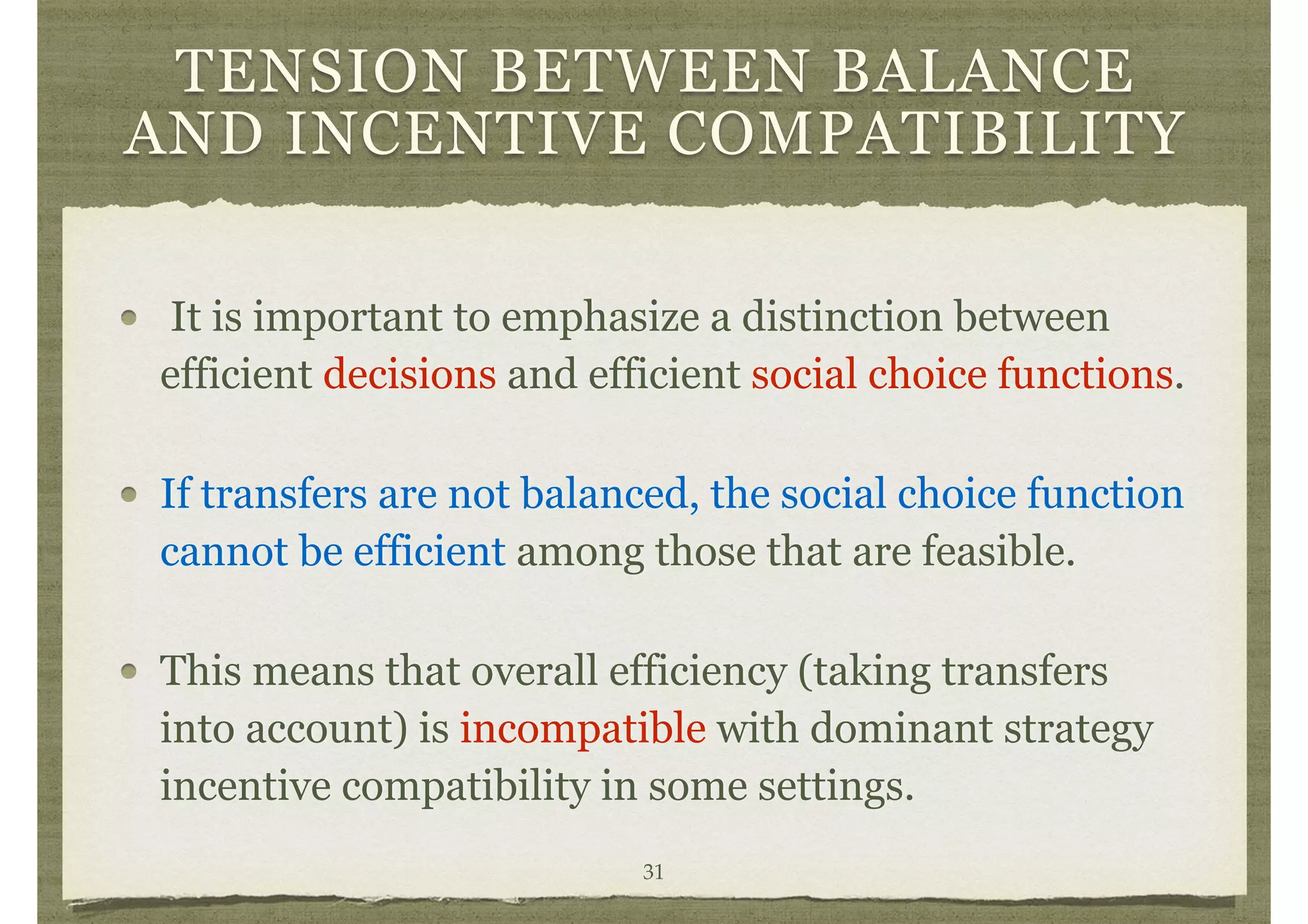
At this point it is important to emphasize a distinction between e cient decisions
and e cient social choice functions. If transfers are not balanced, then the social
choice function cannot be e cient among those that are feasible. This means that
overall e ciency (taking transfers into account) is incompatible with dominant strategy
incentive compatibility in some settings.
30
TENSION BETWEEN BALANCE
AND INCENTIVE COMPATIBILITY
It is important to emphasize a distinction between
efficient decisions and efficient social choice functions.
If transfers are not balanced, the social choice function
cannot be efficient among those that are feasible.
This means that overall efficiency (taking transfers
into account) is incompatible with dominant strategy
incentive compatibility in some settings.
31
INDIVIDUAL IRRATIONALITY
IN GROVES’ SCHEMES
if individual 1 were not present. The result will be feasible and any surplus generated
can be given to individual 1. The overall mechanism will be balanced, but the decision
will not be e cient. However, the per-capita loss in terms of e ciency will be at most
maxd,d0,✓1 [v1(d, ✓1) v1(d0
, ✓1)]/n. If utility is bounded, this tends to 0 as n becomes
large. While this obtains approximate e ciency, it still retains some di culties in
terms of individual rationality. This is discussed next.
3.9 Lack of Individual Rationality in Groves’ Schemes
In addition to the balance problems that are present with trying to achieve an e cient
decision with a dominant strategy mechanism, there are related problems. One is the
violation of what is commonly referred to as an individual rationality or voluntary
participation condition.9
That requires that vi(d(✓), ✓i) + ti(✓) 0 for each i and ✓,
assuming a proper normalization of utility. As we argued above in the example above,
at least one of 1
4
t1(0, 1)+t2(0, 1) or 1
4
t1(1, 0)+t2(1, 0) holds. Since no project
is built in these cases, this implies that some individual ends up with a negative total
utility. That individual would have been better o↵ by not participating and obtaining
a 0 utility.
3.10 Ine cient Decisions
Groves’ schemes impose e cient decision making and then set potentially unbalanced
32
INEFFICIENT DECISIONS
3.10 Ine cient Decisions
Groves’ schemes impose e cient decision making and then set potentially unbalanced
transfers to induce incentive compatibility. An alternative approach is to impose bal-
ance and then set decision making to induce incentive compatibility. This approach
was taken by Herv´e Moulin and strengthened by Shigehiro Serizawa in the context of
a public good decision. It results in a completely di↵erent set of social choice functions
from the Groves’ schemes, which is outlined here in a special case.
Let D = [0, 1]⇥IRn
+ where d = (y, z1, . . . , zn) is such that
P
i zi = cy, where c > 0 is
a cost per unit of production of y. The interpretation is that y is the level of public good
chosen and z1 to zn are the allocations of cost of producing y paid by the individuals.
9
Another problem is that Groves’ schemes can be open to coalitional manipulations even though
they are dominant strategy incentive compatible. For example in a pivotal mechanism individuals
may be taxed even when the project is not built. They can eliminate those taxes by jointly changing
their announcements.
17
The class of admissible preferences di↵ers from the quasi-linear case focused on above.
An individual’s preferences are represented by a utility function over (d, t, ✓i) that takes
the form wi(y, ti zi, ✓i) where wi is continuous, strictly quasi-concave, and monotonic
in its first two arguments, and all such functions are admitted as ✓i varies across ⇥i.
In the situation where no transfers are made and costs are split equally, the resulting
wi(y, cy/n, ✓i) is single-peaked over y, with a peak denoted byi(✓i).
Theorem 3 In the above described public good setting, a social choice function (d, t)
is balanced, anonymous,10
has a full range of public good levels, and dominant strategy
incentive compatible if and only if it is of the form ti(✓) = 0 for all i and d(✓) =
(y(✓), cy(✓)/n, . . . , cy(✓)/n), where there exists (p1, . . . , pn 1) 2 [0, 1]n 1
33
in its first two arguments, and all such functions are admitted as ✓i varies across ⇥i.
In the situation where no transfers are made and costs are split equally, the resulting
wi(y, cy/n, ✓i) is single-peaked over y, with a peak denoted byi(✓i).
Theorem 3 In the above described public good setting, a social choice function (d, t)
is balanced, anonymous,10
has a full range of public good levels, and dominant strategy
incentive compatible if and only if it is of the form ti(✓) = 0 for all i and d(✓) =
(y(✓), cy(✓)/n, . . . , cy(✓)/n), where there exists (p1, . . . , pn 1) 2 [0, 1]n 1
y(✓) = median [p1, . . . , pn 1, by1(✓1), . . . , byn(✓n)] .
If in addition individual rationality is required, then the mechanism must be a minimum
demand mechanism( y(✓) = mini byi(✓i)).
The intuition Theorem 3 relates back to the discussion of single-peaked preferences.
The anonymity and balance conditions, together with incentive compatibility, restrict
the ti’s to be 0 and the zi’s to be an even split of the cost. Given this, the preferences of
individuals over choices y are then single-peaked. Then the phantom voting methods
described in section 3.4 govern how the choice. The expression for y(✓) fits the phantom
voting methods, where p1, . . . , pn 1 are the phantoms.
The answer to the question of which approach - that of fixing decisions to be e cient
and solving for transfers, or that of fixing transfers to be balanced and solving for
decisions - results in “better” mechanisms is ambiguous.11
There are preference profiles
34
BAYESIAN MECHANISM
DESIGN
announcements of the others. Some of the limitations of the schemes outlined above
are due to this strong requirement. Weaker forms of incentive compatibility may often
be appropriate
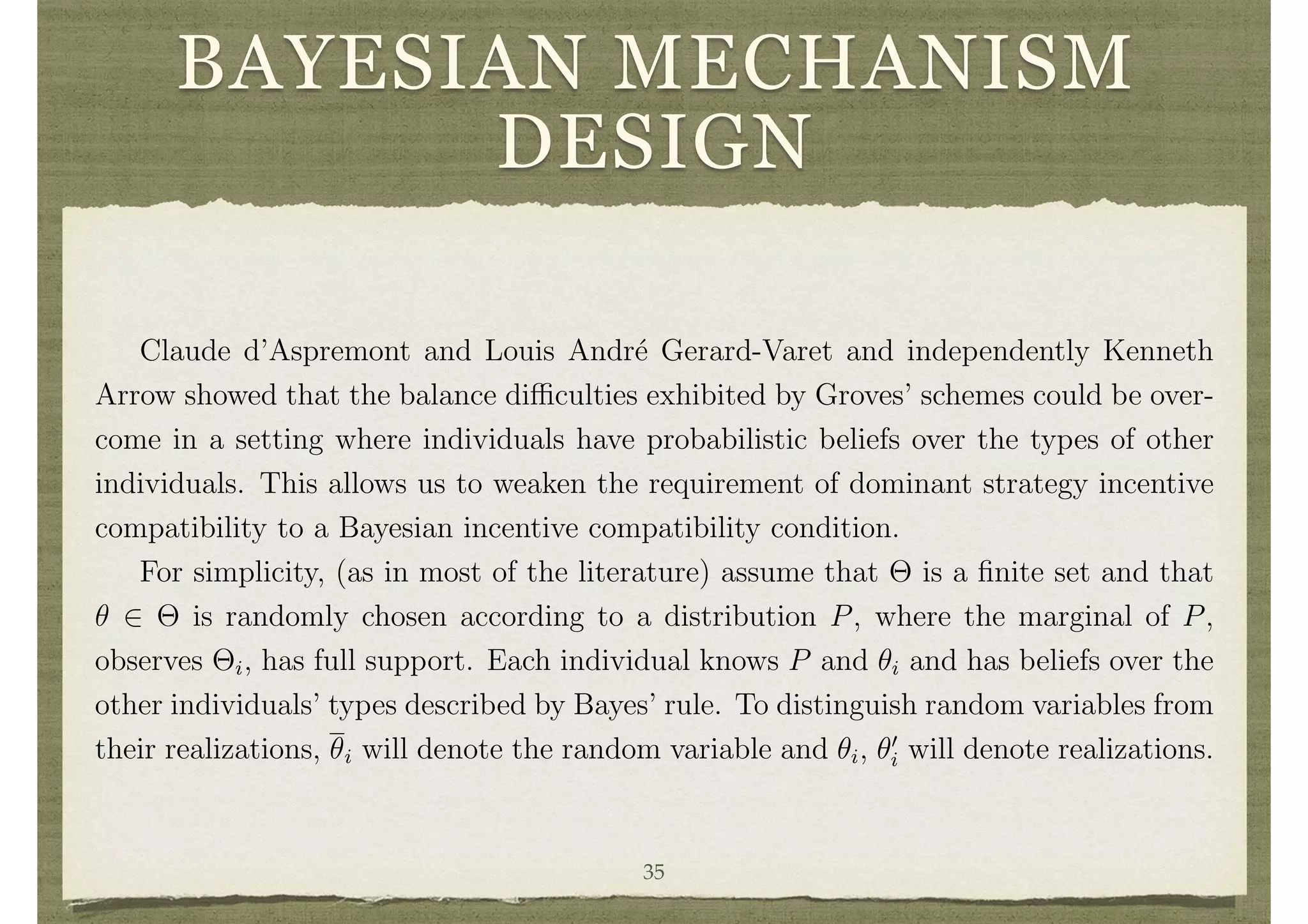
Claude d’Aspremont and Louis Andr´e Gerard-Varet and independently Kenneth
Arrow showed that the balance di culties exhibited by Groves’ schemes could be over-
come in a setting where individuals have probabilistic beliefs over the types of other
individuals. This allows us to weaken the requirement of dominant strategy incentive
compatibility to a Bayesian incentive compatibility condition.
For simplicity, (as in most of the literature) assume that ⇥ is a finite set and that
✓ 2 ⇥ is randomly chosen according to a distribution P, where the marginal of P,
observes ⇥i, has full support. Each individual knows P and ✓i and has beliefs over the
other individuals’ types described by Bayes’ rule. To distinguish random variables from
their realizations, ✓i will denote the random variable and ✓i, ✓0
i will denote realizations.
4.1 A Bayesian Revelation Principle
Following John Harsanyi, we define Bayesian equilibrium for a mechanism (M, g). A
35
BAYESIAN INCENTIVE
COMPATIBILITY
observes ⇥i, has full support. Each individual knows P and ✓i and has beliefs over the
other individuals’ types described by Bayes’ rule. To distinguish random variables from
their realizations, ✓i will denote the random variable and ✓i, ✓0
i will denote realizations.
4.1 A Bayesian Revelation Principle
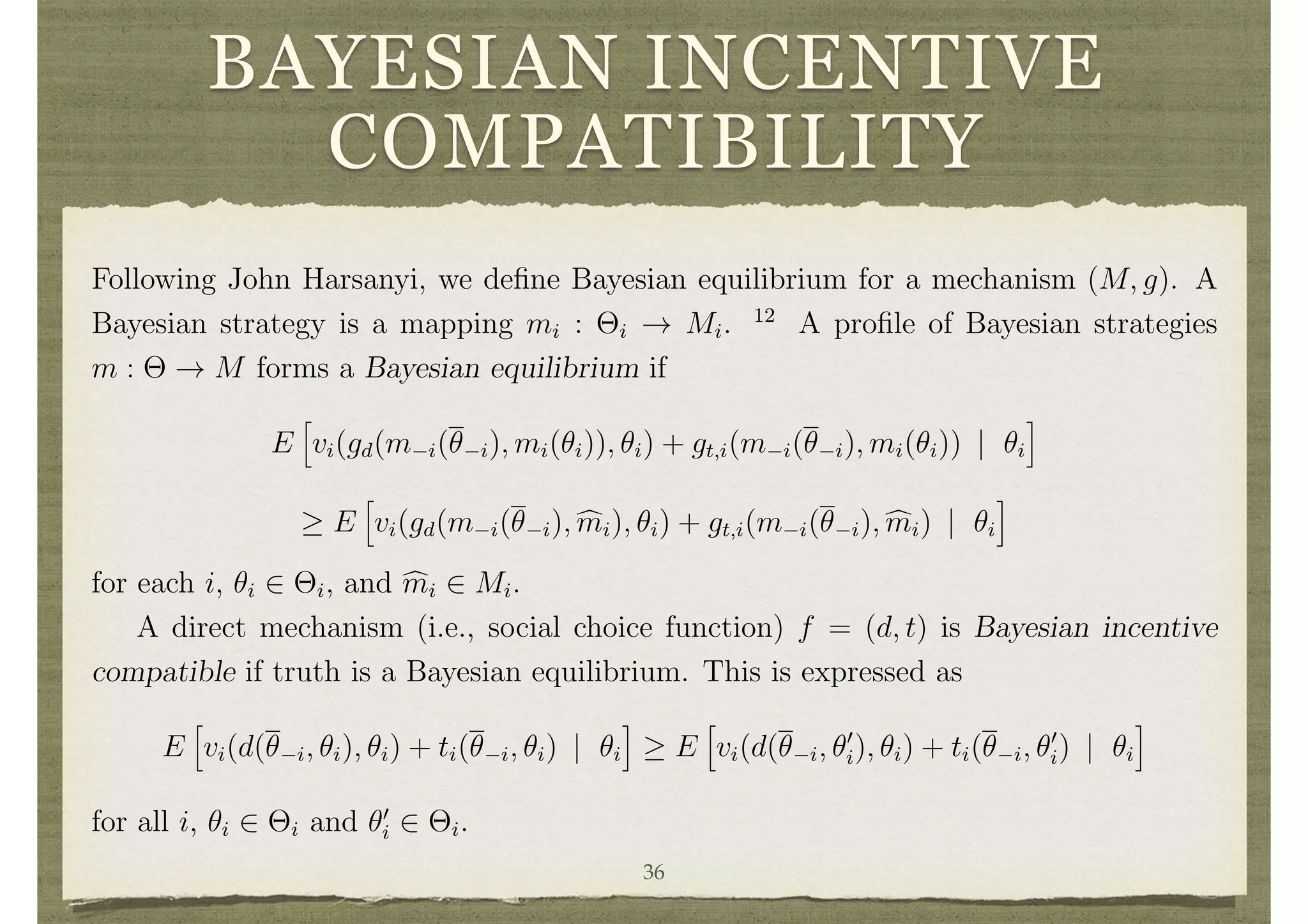
Following John Harsanyi, we define Bayesian equilibrium for a mechanism (M, g). A
Bayesian strategy is a mapping mi : ⇥i ! Mi. 12
A profile of Bayesian strategies
m : ⇥ ! M forms a Bayesian equilibrium if
E
h
vi(gd(m i(✓ i), mi(✓i)), ✓i) + gt,i(m i(✓ i), mi(✓i)) | ✓i
i
E
h
vi(gd(m i(✓ i), cmi), ✓i) + gt,i(m i(✓ i), cmi) | ✓i
i
for each i, ✓i 2 ⇥i, and cmi 2 Mi.
A direct mechanism (i.e., social choice function) f = (d, t) is Bayesian incentive
compatible if truth is a Bayesian equilibrium. This is expressed as
E
h
vi(d(✓ i, ✓i), ✓i) + ti(✓ i, ✓i) | ✓i
i
E
h
vi(d(✓ i, ✓0
i), ✓i) + ti(✓ i, ✓0
i) | ✓i
i
for all i, ✓i 2 ⇥i and ✓0
i 2 ⇥i.
A mechanism (M, g) realizes a social choice function f in Bayesian equilibrium if
there exists a Bayesian equilibrium m(·) of (M, g) such that g(m(✓)) = f(✓) for all ✓
36
A BAYESIAN REVELATION
PRINCIPLE
i d i i i i i t,i i i i i i
E
h
vi(gd(m i(✓ i), cmi), ✓i) + gt,i(m i(✓ i), cmi) | ✓i
i
for each i, ✓i 2 ⇥i, and cmi 2 Mi.
A direct mechanism (i.e., social choice function) f = (d, t) is Bayesian incentive
compatible if truth is a Bayesian equilibrium. This is expressed as
E
h
vi(d(✓ i, ✓i), ✓i) + ti(✓ i, ✓i) | ✓i
i
E
h
vi(d(✓ i, ✓0
i), ✓i) + ti(✓ i, ✓0
i) | ✓i
i
for all i, ✓i 2 ⇥i and ✓0
i 2 ⇥i.
A mechanism (M, g) realizes a social choice function f in Bayesian equilibrium if
there exists a Bayesian equilibrium m(·) of (M, g) such that g(m(✓)) = f(✓) for all ✓
(that occur with positive probability).
12
Only pure strategies are treated here. To consider mixed strategies (see game theory), given the
finite type spaces, simply map ⇥i into distributions over Mi.
19
The Revelation Principle for Bayesian Equilibrium: If a mechanism (M, g)
realizes a social choice function f = (d, t) in Bayesian equilibrium, then the direct
mechanism f is Bayesian incentive compatible.
Again, the proof is straightforward, and the usefulness of the Bayesian version of
the revelation principle parallels that of dominant strategies.
4.2 A Balanced Mechanism with Independent Types
37
INDEPENDENT TYPES
4.2 A Balanced Mechanism with Independent Types
To get a feeling for the implications of the weakening of dominant strategy incentive
compatibility to that of Bayesian incentive compatibility, let us examine the case of
independent types. The mechanisms of d’Aspremont and Gerard-Varet, and of Arrow,
can then be expressed as follows.
Theorem 4 If types are independent (✓ i and ✓i are independent for each i), d is
e cient, and
ti(✓) = E
2
4
X
j6=i
vj(d(✓), ✓j) | ✓i
3
5
1
n 1
X
k6=i
E
2
4
X
j6=k
vj(d(✓), ✓j) | ✓k
3
5 ,
then (d, t) is Bayesian incentive compatible and t is balanced.
Theorem 4 has a converse just as Theorem 2 did. Here it is that if (d, t) is Bayesian
incentive compatible, d is e cient, and t is balanced, then t is of the form above plus
a function xi(✓) such that
P
i xi(✓) = 0 and E[xi(✓) | ✓i] does not depend on ✓i.13
Proof of Theorem 4: The balance of t follows directly from its definition. Let us
verify that (d, t) is Bayesian incentive compatible.
E
h
vi(d(✓ i, ✓0
i), ✓i) + ti(✓ i, ✓0
i) | ✓i
i 38
a function xi(✓) such that
P
i xi(✓) = 0 and E[xi(✓) | ✓i] does not depend on ✓i.13
Proof of Theorem 4: The balance of t follows directly from its definition. Let us
verify that (d, t) is Bayesian incentive compatible.
E
h
vi(d(✓ i, ✓0
i), ✓i) + ti(✓ i, ✓0
i) | ✓i
i
= E
h
vi(d(✓ i, ✓0
i), ✓i) | ✓i
i
+ E
2
4
X
j6=i
vj(d(✓), ✓j) | ✓0
i
3
5
1
n 1
X
k6=i
E
2
4E
2
4
X
j6=k
vj(d(✓), ✓j) | ✓k
3
5 | ✓i
3
5 .
13
Note that it is possible for E[xi(✓) | ✓i] not to depend on ✓i and yet xi(✓) to depend on ✓. For
instance, suppose that each ⇥k = { 1, 1} and that xi(✓) = ⇥k✓k.
20
Under independence, this expression becomes
= E
2
4vi(d(✓ i, ✓0
i), ✓i) +
X
j6=i
vj(d(✓ i, ✓0
i), ✓j) | ✓i
3
5
1
n 1
X
k6=i
E
2
4
X
j6=k
vj(d(✓), ✓j)
3
5 .
The second expression is independent of the announced ✓0
i, and so maximizing
E
h
vi(d(✓ i, ✓0
i), ✓i) + ti(✓ i, ✓0
i) | ✓i
i
with respect to ✓0
i boils down to maximizing:
E
2
4vi(d(✓ i, ✓0
i), ✓i) +
X
j6=i
vj(d(✓ i, ✓0
i), ✓j) | ✓i
3
5 .
Since d is e cient, this expression is maximized when ✓0
i = ✓i.
Note that truth remains a best response even after ✓ i is known to i. Thus, the
39
DEPENDENT TYPES
The independence condition in Theorem 4 is important in
providing the simple structure of the transfer functions, and
is critical to the proof.
Without independence, it is still possible to find an efficient,
balanced, Bayesian incentive compatible mechanisms in
“most” settings.
Since d is e cient, this expression is maximized when ✓0
i = ✓i.
Note that truth remains a best response even after ✓ i is known to i. Thus, the
incentive compatibility is robust to any leakage or sharing of information among the
individuals. Nevertheless, the design of the Bayesian mechanisms outlined in Theo-
rem 4 still requires knowledge of E[· | ✓i]’s, and so such mechanisms are sensitive to
particular ways on the distribution of uncertainty in the society.
4.3 Dependent Types
The independence condition in Theorem 4 is important in providing the simple struc-
ture of the transfer functions, and is critical to the proof. Without independence, it is
still possible to find e cient, balanced, Bayesian incentive compatible mechanisms in
“most” settings. The extent of “most” has been made precise by d’Aspremont, Cr´emer,
and Gerard-Varet by showing that “most” means except those where the distribution
of types is degenerate in that the matrix of conditional probabilities does not have full
rank, which leads to the following theorem.
Theorem 5 Fix the finite type space ⇥ and the decisions D. If n 3, then the set of
probability distributions P for which there exists a Bayesian incentive compatible social
choice function that has an e cient decision rule and balanced transfers, is an open
and dense subset of the set of all probability distributions on ⇥.14
To get a feeling for how correlation can be used in structuring transfers, see Example
40
INDIVIDUAL RATIONALITY
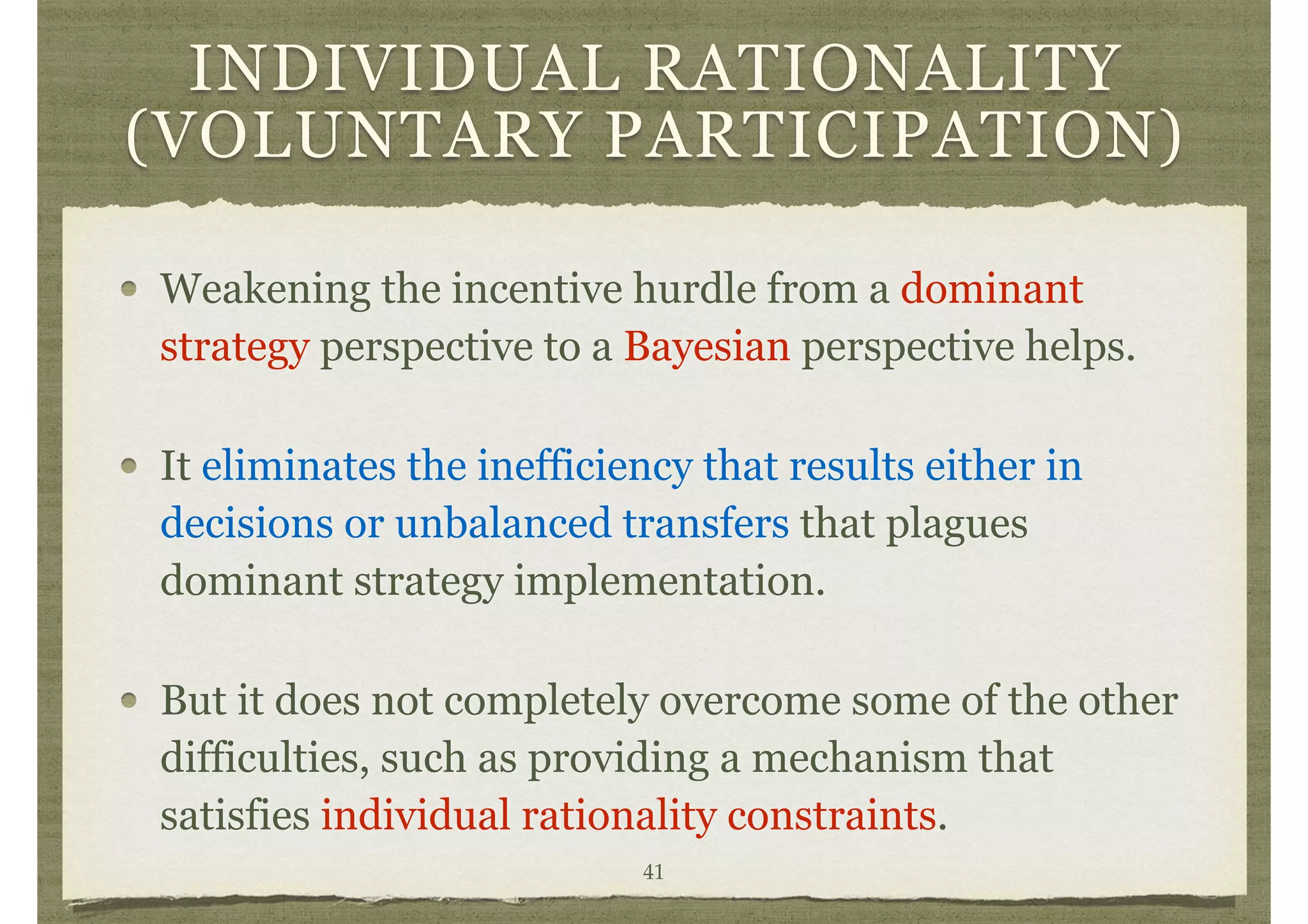
(VOLUNTARY PARTICIPATION)
Weakening the incentive hurdle from a dominant
strategy perspective to a Bayesian perspective helps.
It eliminates the inefficiency that results either in
decisions or unbalanced transfers that plagues
dominant strategy implementation.
But it does not completely overcome some of the other
difficulties, such as providing a mechanism that
satisfies individual rationality constraints.
41
EX-POST IR
perspective helps. It eliminates the ine ciency that results either in decisions or un-
balanced transfers that plagues dominant strategy implementation. But it does not
completely overcome some of the other di culties that are present, such as providing
a mechanism that satisfies individual rationality constraints. Let us examine this issue
in some detail.
There are various time perspectives that one can take on individual rationality,
which correspond to di↵erent timings at which individuals become bound to a mechanism.15
First let us normalize the utility functions vi so that 0 represents the value that
individual i would get from not participating in the mechanism for any ✓i.
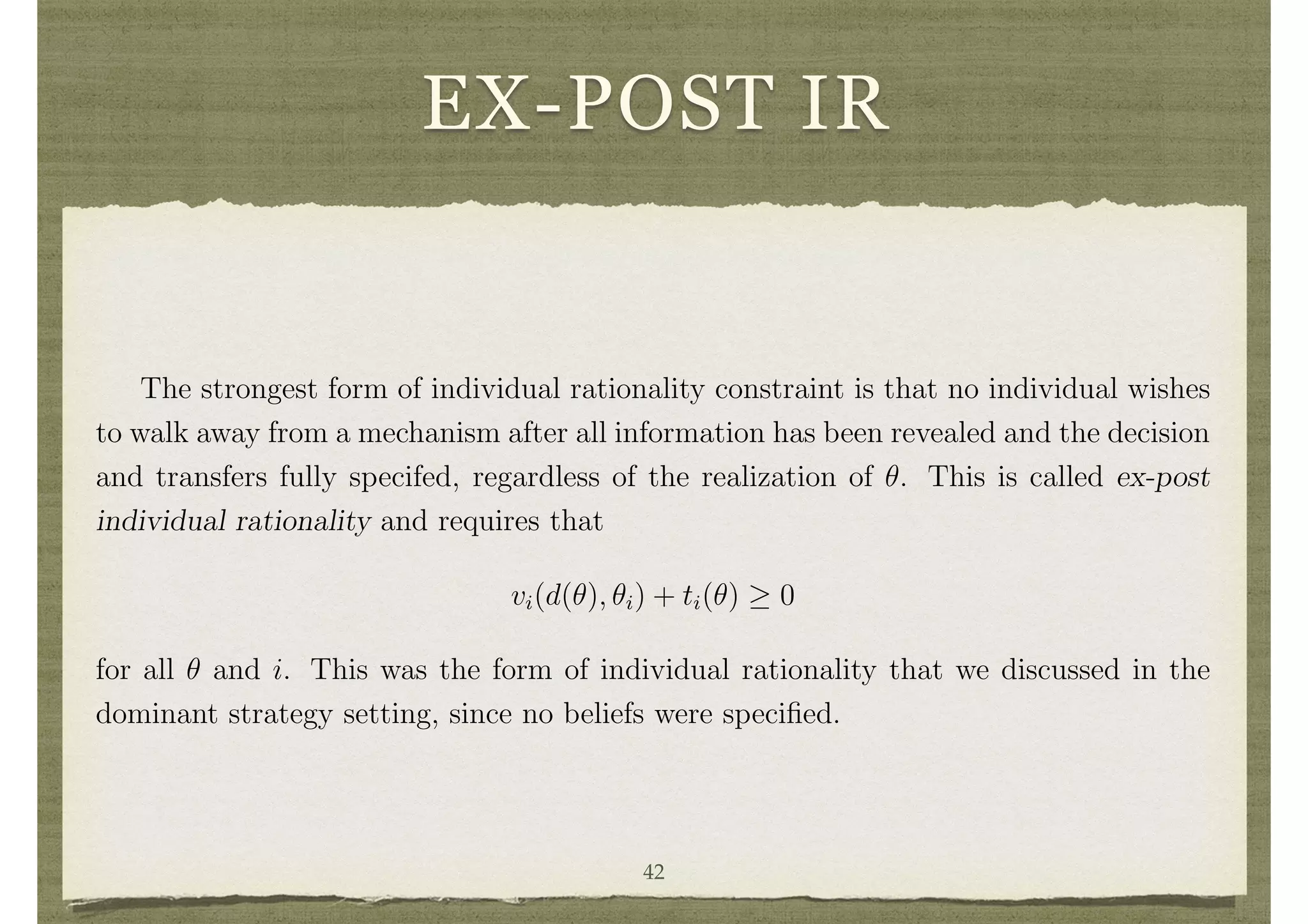
The strongest form of individual rationality constraint is that no individual wishes
to walk away from a mechanism after all information has been revealed and the decision
and transfers fully specifed, regardless of the realization of ✓. This is called ex-post
individual rationality and requires that
vi(d(✓), ✓i) + ti(✓) 0
for all ✓ and i. This was the form of individual rationality that we discussed in the
dominant strategy setting, since no beliefs were specified.
A weaker form of individual rationality is that no individual wishes to walk away
from the mechanism at a point where they know their own type ✓i, but only have
expectations over the other individuals’ types and the resulting decision and transfers.
This is called interim individual rationality and requires that
42
INTERIM IR
individual i would get from not participating in the mechanism for any ✓i.
The strongest form of individual rationality constraint is that no individual wishes
to walk away from a mechanism after all information has been revealed and the decision
and transfers fully specifed, regardless of the realization of ✓. This is called ex-post
individual rationality and requires that
vi(d(✓), ✓i) + ti(✓) 0
for all ✓ and i. This was the form of individual rationality that we discussed in the
dominant strategy setting, since no beliefs were specified.
A weaker form of individual rationality is that no individual wishes to walk away
from the mechanism at a point where they know their own type ✓i, but only have
expectations over the other individuals’ types and the resulting decision and transfers.
This is called interim individual rationality and requires that
E
h
vi(d(✓), ✓i) + ti(✓) | ✓i
i
0
for all i and ✓i 2 ⇥i.
15
The time perspective can give rise to di↵erent versions of e ciency as well. However, in terms
of maximizing
P
i vi the time perspective is irrelevant as maximizing E[
P
i vi(d(✓), ✓i)] is equivalent
to maximizing
P
i vi(d(✓), ✓i) at each ✓ (given the finite type space). If one instead considers Pareto
e ciency, then the ex-ante, interim, and ex-post perspectives are no longer equivalent.
43
EX-ANTE IR
The weakest form of individual rationality is that no individual wishes to walk away
from the mechanism before they know their own type ✓i, and only have expectations
over all the realizations of types and the resulting decision and transfers. This is called
ex-ante individual rationality and requires that
E
h
vi(d(✓), ✓i) + ti(✓)
i
0
for all i.
Consider any social choice function (d, t) such that
P
i E[vi(d(✓), ✓i) + ti(✓)] 0.
This will generally be satisfied, as otherwise it would be better not to run the mecha-
nism at all. Then if (d, t) does not satisfy ex-ante individual rationality, it is easy to
alter transfers (simply adding or subtracting a constant to each individual’s transfer44
LACK OF INTERIM IR IN
PUBLIC GOODS
alter transfers (simply adding or subtracting a constant to each individual’s transfer
function) to reallocate utility so that each individual’s expected value from participat-
ing in the mechanism is nonnegative. Thus, ex-ante individual rationality is generally
vacuously satisfied.
Interim individual rationality is more di cult to satisfy. Let us examine the problem
in the context of simple public goods and private goods examples.
Example 5 Lack of Interim Individual Rationality in a Public Goods Setting
Let us consider the public project setting described in Example 1 when n = 2,
⇥i = {0, 1}, and c = 3/4. Types are equally likely and independent across individuals.
In this case, the e cient decision is to build the project when either ✓i = 1. Split costs
among the i’s who announce ✓i = 1.16
So the rule d(·) takes on four values: not build;
build and i = 1 pays 3/4; build and i = 2 pays 3/4; and build and both pay 3/8.
Interim individual rationality implies that
1
2
(t1(0, 1) + t1(0, 0)) 0 and
1
2
(t2(1, 0) + t2(0, 0)) 0 (2)
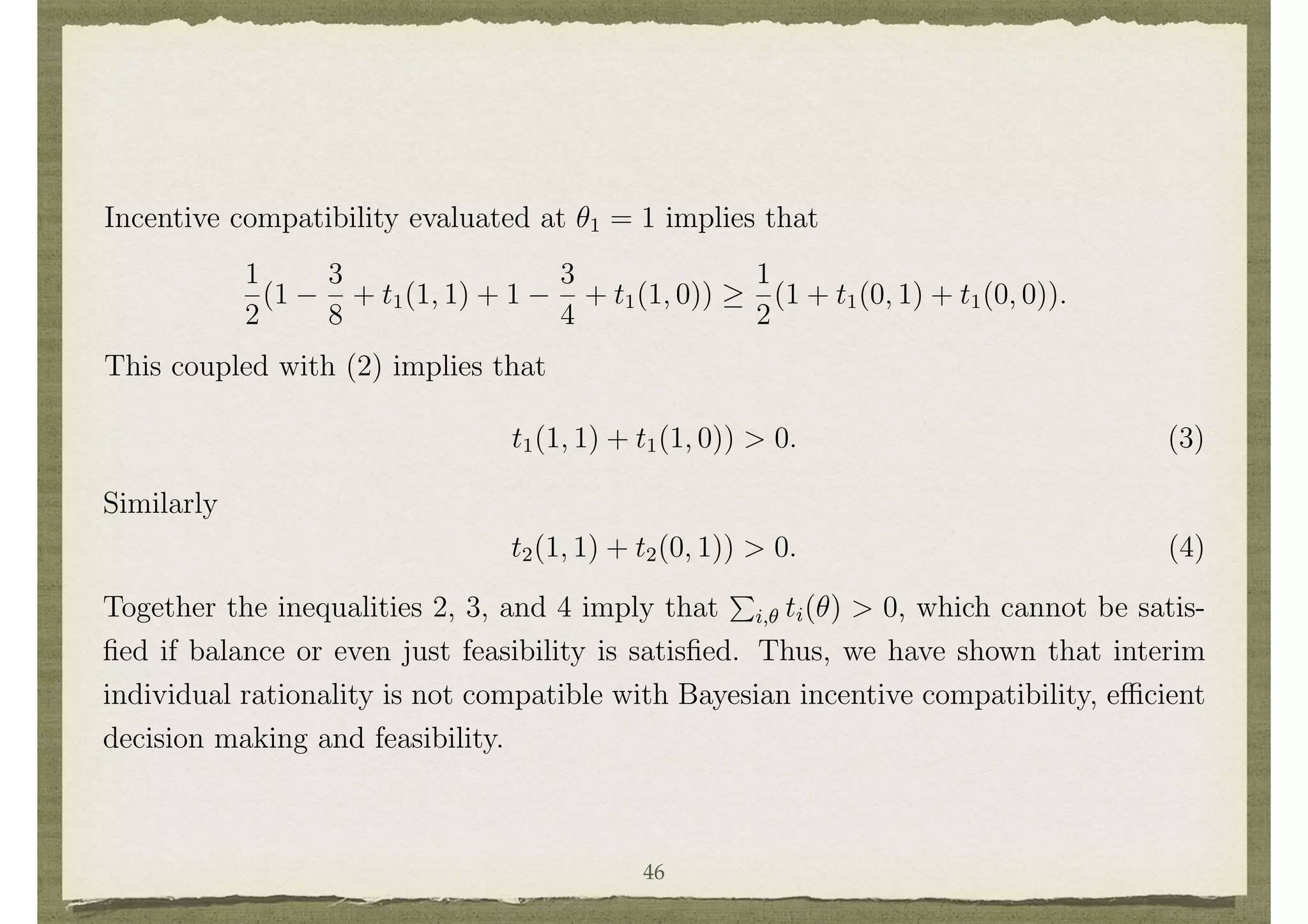
Incentive compatibility evaluated at ✓1 = 1 implies that
1
2
(1
3
8
+ t1(1, 1) + 1
3
4
+ t1(1, 0))
1
2
(1 + t1(0, 1) + t1(0, 0)).
This coupled with (2) implies that
45
build and i = 1 pays 3/4; build and i = 2 pays 3/4; and build and both pay 3/8.
Interim individual rationality implies that
1
2
(t1(0, 1) + t1(0, 0)) 0 and
1
2
(t2(1, 0) + t2(0, 0)) 0 (2)
Incentive compatibility evaluated at ✓1 = 1 implies that
1
2
(1
3
8
+ t1(1, 1) + 1
3
4
+ t1(1, 0))
1
2
(1 + t1(0, 1) + t1(0, 0)).
This coupled with (2) implies that
t1(1, 1) + t1(1, 0)) > 0. (3)
16
The specification of who pays the cost is actually irrelevant to this example as it comes out in an
adjustment of the transfers.
23
Similarly
t2(1, 1) + t2(0, 1)) > 0. (4)
Together the inequalities 2, 3, and 4 imply that
P
i,✓ ti(✓) > 0, which cannot be satis-
fied if balance or even just feasibility is satisfied. Thus, we have shown that interim
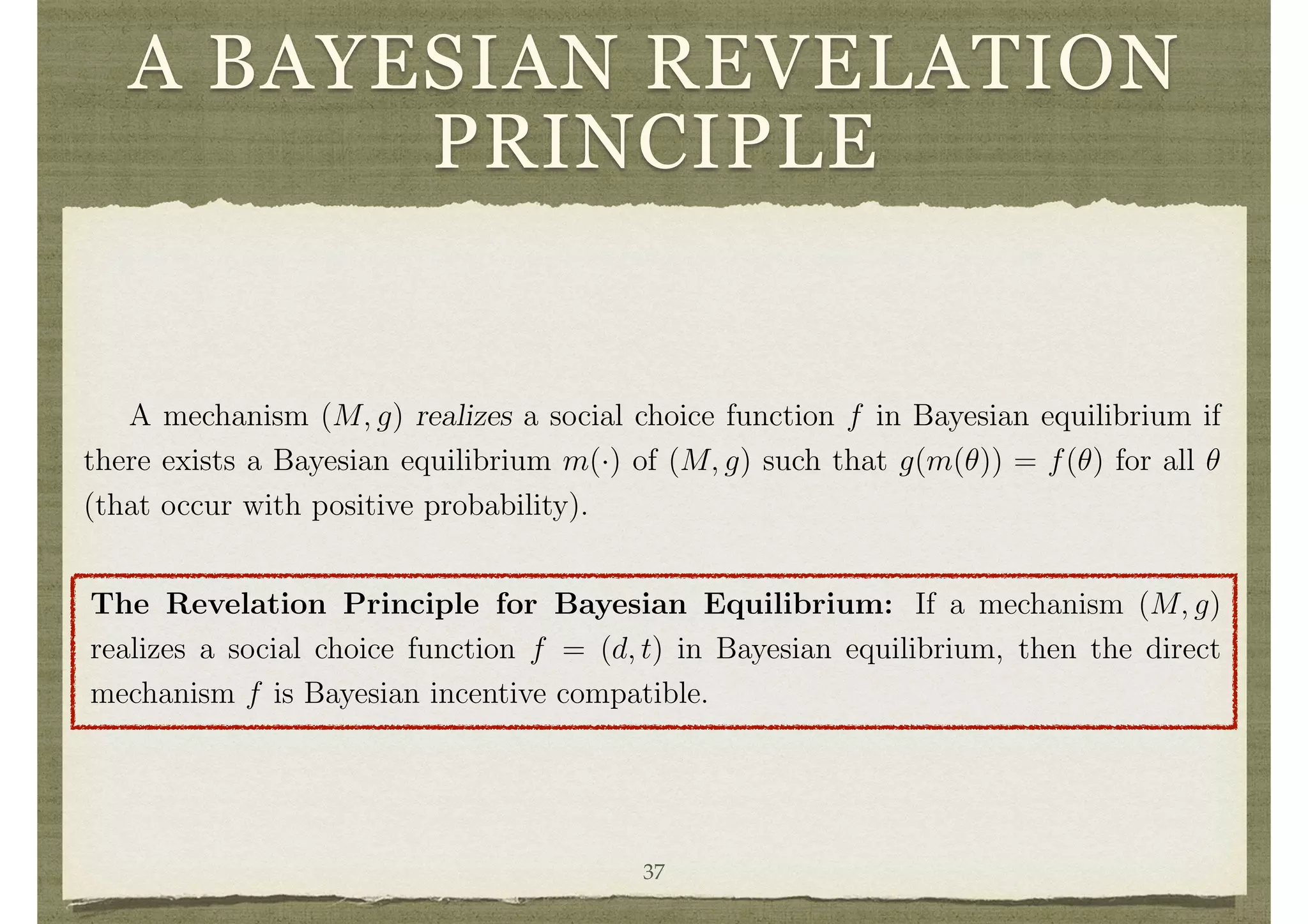
individual rationality is not compatible with Bayesian incentive compatibility, e cient
decision making and feasibility.
Finding mechanisms that take e cient decisions, are incentive compatible, balanced
and interim individually rational, is not simply a problem in public goods settings, but
is also a problem in private goods settings as was pointed out by Roger Myerson and
Mark Satterthwaite. That point is illustrated here in the context of a simple example.
46
LACK OF IR IN
BARGAINING
decision making and feasibility.
Finding mechanisms that take e cient decisions, are incentive compatible, balanced
and interim individually rational, is not simply a problem in public goods settings, but
is also a problem in private goods settings as was pointed out by Roger Myerson and
Mark Satterthwaite. That point is illustrated here in the context of a simple example.
Example 6 Lack of Interim Individual Rationality in a Bargaining Setting
A seller (i = 1) has an indivisible object worth ✓1 which takes on values in ⇥1 =
{0, 3/4} with equal probability. A buyer has a value for the object of of ✓2 that takes on
values in ⇥2 = [0, 1] according to a uniform distribution. A decision is a specification
in D = {0, 1} where 0 indicates that the object stays in the seller’s hands, while 1
indicates that the object is traded to the buyer.
An e cient decision is d(✓) = 1 if ✓2 > ✓1, and d(✓) = 0 if ✓2 < ✓1. Interim
individual rationality requires that if ✓2 < 3/4 (noting that these types only trade 1/2
of the time), then 1
2
✓2 + E[t2(✓1, ✓2)] 0, or
E[t2(✓1, ✓2)]
1
2
✓2. (5)
Since an e cient decision is the same for any 0 < ✓2 < 3/4 and 0 < ✓0
2 < 3/4, Bayesian
incentive compatibility implies that t2(✓1, ✓2) is constant across 0 < ✓2 < 3/4. Then
(5) implies that for any 0 < ✓2 < 3/4
47
E[t2(✓1, ✓2)]
1
2
✓2. (5)
Since an e cient decision is the same for any 0 < ✓2 < 3/4 and 0 < ✓0
2 < 3/4, Bayesian
incentive compatibility implies that t2(✓1, ✓2) is constant across 0 < ✓2 < 3/4. Then
(5) implies that for any 0 < ✓2 < 3/4
E[t2(✓1, ✓2)] 0. (6)
Interim individual rationality for sellers of type ✓1 = 3/4 (who expect to trade 1/4 of
the time) implies that (3
4
)2
+E[t1(3/4, ✓2)] 3
4
or E[t1(3/4, ✓2)] 3/16. Then incentive
compatibility for type ✓1 = 0 implies that E[t1(0, ✓2)] 3/16. Thus, E[t1(✓)] 3/16.
Feasibility then implies that 3/16 E[t2(✓)]. Then by (6) it follows that
3
4
E[t2(✓1, ✓2)]
24
for some ✓2 3/4. However, this, 1 ✓2 > 3/4, and (6) then imply that
✓2
2
+ E[t2(✓1, 0)] ✓2 + E[t2(✓1, ✓2)],
which violates incentive compatibility.
Thus, there does not exist a mechanism that satisfies interim individual rationality,
feasibility, e ciency, and Bayesian incentive compatibility in this setting.
48
NOT INTERIM BUT EX-
ANTE IR MECHANISM
The Myerson-Satterthwaite theorem shows that there does not exist a mechanism
that satisfies interim individual rationality, balance, e ciency, and Bayesian incentive
compatibility for a general set of distributions. That theorem extracts the full implica-
tions of the incentive compatibility constraints and develops expressions for the interim
expected utility of the buyer and seller in a similar setting as this example while al-
lowing for general forms of uncertainty (with independent types). Those expressions
show the impossibility of satisfying interim individual rationality, balance, e ciency
and Bayesian incentive compatibility for a wide range of distributions over types.
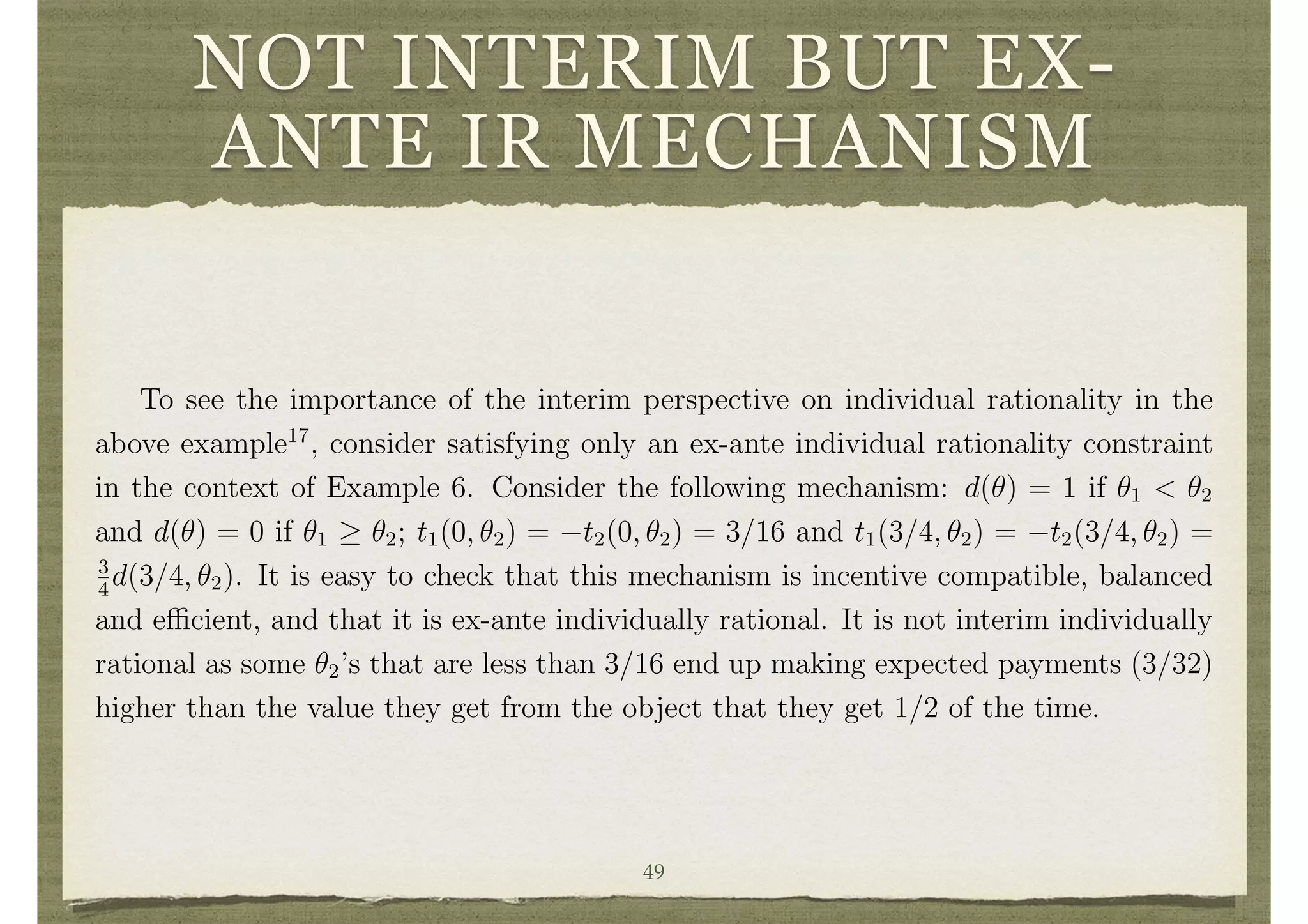
To see the importance of the interim perspective on individual rationality in the
above example17
, consider satisfying only an ex-ante individual rationality constraint
in the context of Example 6. Consider the following mechanism: d(✓) = 1 if ✓1 < ✓2
and d(✓) = 0 if ✓1 ✓2; t1(0, ✓2) = t2(0, ✓2) = 3/16 and t1(3/4, ✓2) = t2(3/4, ✓2) =
3
4
d(3/4, ✓2). It is easy to check that this mechanism is incentive compatible, balanced
and e cient, and that it is ex-ante individually rational. It is not interim individually
rational as some ✓2’s that are less than 3/16 end up making expected payments (3/32)
higher than the value they get from the object that they get 1/2 of the time.
Which time perspective is appropriate depends on the application and in particular
on the time at which a mechanisms prescriptions become binding. If contracting occurs
at an ex-ante time (as in many long term contracts and forward contracts), then the
ex-ante perspective would be appropriate and there will not be problems in finding a49
REMARKS ON THE
REVELATION PRINCIPLE
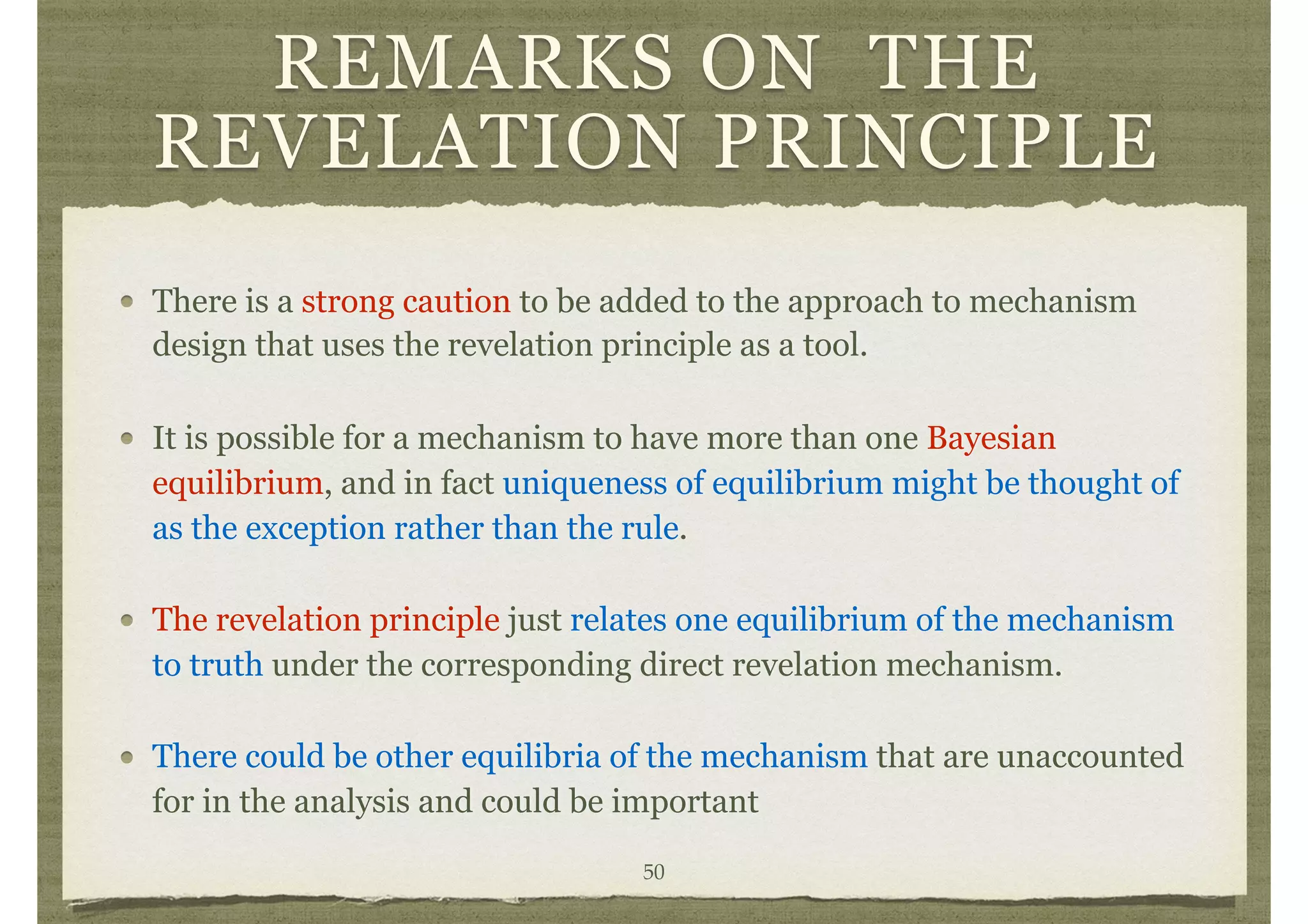
There is a strong caution to be added to the approach to mechanism
design that uses the revelation principle as a tool.
It is possible for a mechanism to have more than one Bayesian
equilibrium, and in fact uniqueness of equilibrium might be thought of
as the exception rather than the rule.
The revelation principle just relates one equilibrium of the mechanism
to truth under the corresponding direct revelation mechanism.
There could be other equilibria of the mechanism that are unaccounted
for in the analysis and could be important
50
IMPLEMENTATION
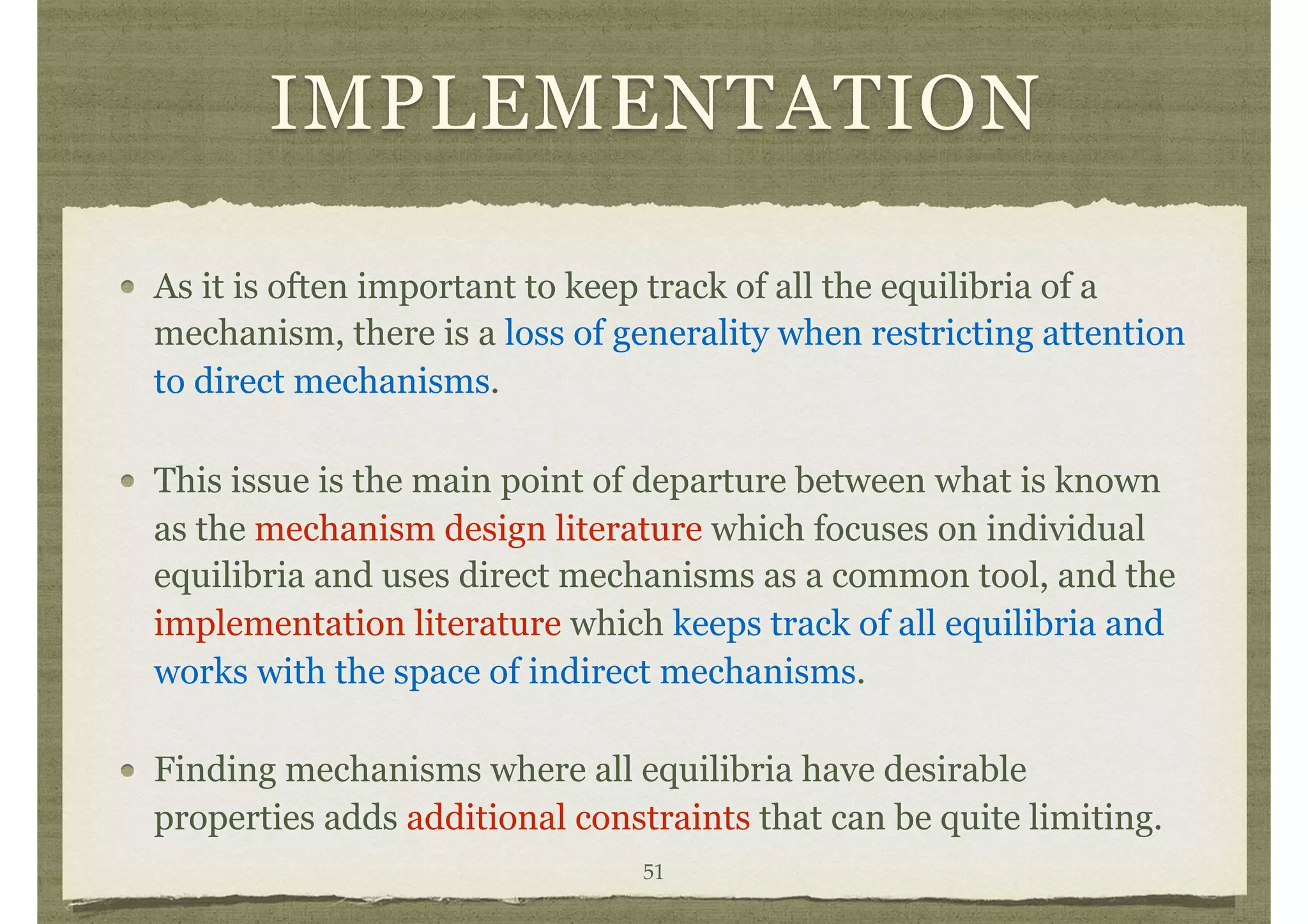
As it is often important to keep track of all the equilibria of a
mechanism, there is a loss of generality when restricting attention
to direct mechanisms.
This issue is the main point of departure between what is known
as the mechanism design literature which focuses on individual
equilibria and uses direct mechanisms as a common tool, and the
implementation literature which keeps track of all equilibria and
works with the space of indirect mechanisms.
Finding mechanisms where all equilibria have desirable
properties adds additional constraints that can be quite limiting.
51

Introduction to Mechanism Design

  • 1.
    INTRODUCTION TO MECHANISM DESIGN Summaryof Jackson (2014) Yosuke YASUDA | Osaka University 1
  • 2.
    “MECHANISM THEORY” BY MATTHEWO. JACKSON All the contents are based on this article. A well-known survey on Mechanism Design. The author, MJ, is a top researcher in the field. The paper is available from the link below (for free): http://papers.ssrn.com/sol3/Papers.cfm?abstract_id=2542983 2
  • 3.
    TABLE OF CONTENTS 1.Introduction 2. A General Mechanism Design Setting 3. Dominant Strategy Mechanism Design 4. Bayesian Mechanism Design 5. Implementation 3
  • 4.
    1. INTRODUCTION The theoryof mechanism design takes a systematic look at the design of institutions and how these affect the outcomes of interactions. The main focus of mechanism design is on on the design of institutions that satisfy certain objectives, assuming that the individuals interacting through the institution will act strategically and may hold private information that is relevant to the decision at hand. 4
  • 5.
    Another question iswhether there exists such a mechanism so that the buyer and seller voluntarily participate in the mechanism. In a mechanism each individual has a message (or strategy) space and decisions result as a function of the messages chosen. 5
  • 6.
    A theme thatcomes out of the literature is that it is often impossible to find mechanisms compatible with individual incentives that simultaneously result in efficient decisions (maximizing total welfare), the voluntary participation of the individuals, and balanced transfers (taxes and subsidies that always net out across individuals). Nevertheless, there are some important settings where incentives and efficiency are compatible and in other settings a “second-best” analysis is still possible. 6
  • 7.
    2. A GENERALMECHANISM DESIGN SETTING compatible and in other settings a “second-best” analysis is still possible. This is described in detail in what follows in the context of di↵erent incentive compatibility requirements, public and private goods settings, small and large societies, and forms of private information held by individuals. 2 A General Mechanism Design Setting Individuals A finite group of individuals interact. This set is denoted N = {1, 2, . . . , n} and generic individuals are represented as i, j, and k. Decisions The set of potential social decisions is denoted D, and generic elements are repre- sented as d and d0 . The set of decisions may be finite or infinite depending on the application. Preferences and Information Individuals hold private information. Individual i’s information is represented by a type ✓i which lies in a set ⇥i. Let ✓ = (✓1, . . . , ✓n) and ⇥ = ⇥i⇥i. Individuals have preferences over decisions that are represented by a utility function vi : D ⇥ ⇥i ! IR. So, vi(d, ✓i) denotes the benefit that individual i of type ✓i 2 ⇥i receives from a decision d 2 D. Thus, vi(d, ✓i) > vi(d0 , ✓i) indicates that i of type ✓i 7
  • 8.
    MORE ON PREFERENCES genericindividuals are represented as i, j, and k. Decisions The set of potential social decisions is denoted D, and generic elements are repre- sented as d and d0 . The set of decisions may be finite or infinite depending on the application. Preferences and Information Individuals hold private information. Individual i’s information is represented by a type ✓i which lies in a set ⇥i. Let ✓ = (✓1, . . . , ✓n) and ⇥ = ⇥i⇥i. Individuals have preferences over decisions that are represented by a utility function vi : D ⇥ ⇥i ! IR. So, vi(d, ✓i) denotes the benefit that individual i of type ✓i 2 ⇥i receives from a decision d 2 D. Thus, vi(d, ✓i) > vi(d0 , ✓i) indicates that i of type ✓i prefers decision d to decision d0 . The fact that i’s preferences depend only on ✓i is commonly referred to as being a case of private values. In private values settings ✓i represents information about i’s preferences over the decisions. More general situations are discussed in section 4.7 below. Example 1 A Public Project. A society is deciding on whether or not to build a public project at a cost c. For example the project might be a public swimming pool, a public library, a park, a8
  • 9.
    EX.1) A PUBLICPROJECT prefers decision d to decision d0 . The fact that i’s preferences depend only on ✓i is commonly referred to as being a case of private values. In private values settings ✓i represents information about i’s preferences over the decisions. More general situations are discussed in section 4.7 below. Example 1 A Public Project. A society is deciding on whether or not to build a public project at a cost c. For example the project might be a public swimming pool, a public library, a park, a defense system, or any of many public goods. The cost of the public project is to be equally divided equally. Here D = {0, 1} with 0 representing not building the project and 1 representing building the project. 5 Individual i’s value from use of the public project is represented by ✓i. In this case, i’s net benefit is 0 from not having a project built and ✓i c n from having a project built. The utility function of i can then be represented as vi(d, ✓i) = d✓i d c n . Example 2 A Continuous Public Good Setting. In Example 1 the public project could only take two values: being built or not. There was no question about its scale. It could be that the decision is to choose a scale 9
  • 10.
    EX.2) A CONTINUOUS PUBLICGOODSIndividual i’s value from use of the public project is represented by ✓i. In this case, i’s net benefit is 0 from not having a project built and ✓i c n from having a project built. The utility function of i can then be represented as vi(d, ✓i) = d✓i d c n . Example 2 A Continuous Public Good Setting. In Example 1 the public project could only take two values: being built or not. There was no question about its scale. It could be that the decision is to choose a scale of a public project, such as how large to make a park, and also to choose an allocation of the costs. Let y 2 IR+ denote the scale of the public project and c(y) denote the total cost of the project as it depends on the scale. Here D = {(y, z1, . . . , zn) 2 IR+ ⇥ IRn | P i zi = c(y)}. Example 3 Allocating a Private Good. An indivisible good is to be allocated to one member of society. For instance, the rights to an exclusive license are to be allocated or an enterprise is to be privatized. Here, D = {d 2 {0, 1}n : P i di = 1}, where di = 1 denotes that individual i gets the object. If individual i is allocated the object, then i will benefit by an amount ✓ , so 10
  • 11.
    EX.3) A PRIVATEGOOD Example 2 A Continuous Public Good Setting. In Example 1 the public project could only take two values: being built or not. There was no question about its scale. It could be that the decision is to choose a scale of a public project, such as how large to make a park, and also to choose an allocation of the costs. Let y 2 IR+ denote the scale of the public project and c(y) denote the total cost of the project as it depends on the scale. Here D = {(y, z1, . . . , zn) 2 IR+ ⇥ IRn | P i zi = c(y)}. Example 3 Allocating a Private Good. An indivisible good is to be allocated to one member of society. For instance, the rights to an exclusive license are to be allocated or an enterprise is to be privatized. Here, D = {d 2 {0, 1}n : P i di = 1}, where di = 1 denotes that individual i gets the object. If individual i is allocated the object, then i will benefit by an amount ✓i, so vi(d, ✓i) = di✓i. Clearly, there are many other examples that can be accommodated in the mecha- nism design analysis as the formulation of the space D has no restrictions. Decision Rules and E cient Decisions It is clear from the above examples that the decision a society would like to make will depend on the ✓i’s. For instance, a public project should only be built if the total11
  • 12.
    DECISION RULES AND EFFICIENTDECISIONS Clearly, there are many other examples that can be accommodated in the mecha- nism design analysis as the formulation of the space D has no restrictions. Decision Rules and E cient Decisions It is clear from the above examples that the decision a society would like to make will depend on the ✓i’s. For instance, a public project should only be built if the total value it generates exceeds its cost. A decision rule is a mapping d : ⇥ ! D, indicating a choice d(✓) 2 D as a function of ✓. A decision rule d(·) is e cient if X i vi(d(✓), ✓i) X i vi(d0 , ✓i) for all ✓ and d0 2 D.1 1 This notion of e ciency takes an ex-post perspective. That is, it looks at comparisons given that that ✓i’s are already realized, and so may ignore improvements that are obtainable due to risk sharing in applications where the d’s may involve some randomization. 6 This notion of e ciency looks at maximization of total value and then coincides with Pareto e ciency only when utility is transferable across individuals. Transferability is the case treated in most of the literature. In the public project example (Example 1), the decision rule where d(✓) = 1 when P i ✓i > c and d(✓) = 0 when P i ✓i < c (and any choice at equality) is e cient. Transfer Functions In order to provide the incentives necessary to make e cient choices, it may be12
  • 13.
    TRANSFER FUNCTIONS necessary totax or subsidize various individuals. To see the role of such transfers, consider the example of the public project above. Any individual i for whom ✓i < c n would rather not see the project built and any individual for whom ✓i > c n would rather not see the project built. Imagine that the government simply decides to poll individuals to ask for their ✓i’s and then build the project if the sum of the announced ✓i’s is greater than c. This would result in an e cient decision if the ✓i’s were announced truthfully. However, individuals with ✓i < c n have an incentive to underreport their values and say they see no value in a project, and individuals for whom ✓i > c n have an incentive to overreport and say that they have a very high value from the project. This could result in a wrong decision.2 To get a truthful revelation of the ✓i’s, some adjustments need to be made so that individuals are taxed or subsidized based on the announced ✓i’s and individuals announcing high ✓i’s expect to pay more. Adjustments are made by a transfer function t : ⇥ ! IRn . The function ti(✓) repre- sents the payment that i receives (or makes if it is negative) based on the announcement of types ✓. Social Choice Functions A pair d, t will be referred to as a social choice function, and at times denoted by f. So, f(✓) = (d(✓), t(✓)). The utility that i receives if b✓ is the “announced” vector of types (that operated on by f = (d, t)) and i’s true type is ✓i is 13
  • 14.
    SOCIAL CHOICE FUNCTIONS i n anincentive to overreport and say that they have a very high value from the project. This could result in a wrong decision.2 To get a truthful revelation of the ✓i’s, some adjustments need to be made so that individuals are taxed or subsidized based on the announced ✓i’s and individuals announcing high ✓i’s expect to pay more. Adjustments are made by a transfer function t : ⇥ ! IRn . The function ti(✓) repre- sents the payment that i receives (or makes if it is negative) based on the announcement of types ✓. Social Choice Functions A pair d, t will be referred to as a social choice function, and at times denoted by f. So, f(✓) = (d(✓), t(✓)). The utility that i receives if b✓ is the “announced” vector of types (that operated on by f = (d, t)) and i’s true type is ✓i is ui(b✓, ✓i, d, t) = vi(d(b✓), ✓i) + ti(b✓). This formulation of preferences is said to be quasi-linear. Feasibility and Balance 2 Similarly, if the decision is simply made by a majority vote of the population, the number who vote yes will simply be the number for whom ✓i > c n . This can easily result in not building the project when it is socially e cient, or building it when it is not socially e cient.14
  • 15.
    FEASIBILITY A transfer functiont is said to be feasible if 0 P i ti(✓) for all ✓. If t is not feasible then it must be that transfers are made into the society from some outside source. If the t is feasible, but results in a sum less than zero in some circumstances, then it generates a surplus which would either have to be wasted or returned to some outsider.3 A transfer function t is balanced if P i ti(✓) = 0 for all ✓. Balance is an important property if we wish the full (d, t) pair to be e cient rather than just d. If P i ti < 0, then there is some net loss in utility to society relative to an e cient decision with no transfers. Mechanisms 15
  • 16.
    BALANCED BUDGET A transferfunction t is said to be feasible if 0 P i ti(✓) for all ✓. If t is not feasible then it must be that transfers are made into the society from some outside source. If the t is feasible, but results in a sum less than zero in some circumstances, then it generates a surplus which would either have to be wasted or returned to some outsider.3 A transfer function t is balanced if P i ti(✓) = 0 for all ✓. Balance is an important property if we wish the full (d, t) pair to be e cient rather than just d. If P i ti < 0, then there is some net loss in utility to society relative to an e cient decision with no transfers. Mechanisms A mechanism is a pair M, g, where M = M1 ⇥· · ·⇥Mn is a cross product of message or strategy spaces and g : M ! D ⇥ IRn is an outcome function. Thus, for each profile of messages m = (m1, . . . , mn), g(m) = (gd(m), gt,1(m), . . . , gt,n(m)) represents the resulting decision and transfers. A mechanism is often also referred to as a game form. The terminology game form distinguishes it from a game (see game theory), as the consequence of a profile of messages is an outcome rather than a vector of utility payo↵s. Once the preferences of 16
  • 17.
    MECHANISMS circumstances, then itgenerates a surplus which would either have to be wasted or returned to some outsider.3 A transfer function t is balanced if P i ti(✓) = 0 for all ✓. Balance is an important property if we wish the full (d, t) pair to be e cient rather than just d. If P i ti < 0, then there is some net loss in utility to society relative to an e cient decision with no transfers. Mechanisms A mechanism is a pair M, g, where M = M1 ⇥· · ·⇥Mn is a cross product of message or strategy spaces and g : M ! D ⇥ IRn is an outcome function. Thus, for each profile of messages m = (m1, . . . , mn), g(m) = (gd(m), gt,1(m), . . . , gt,n(m)) represents the resulting decision and transfers. A mechanism is often also referred to as a game form. The terminology game form distinguishes it from a game (see game theory), as the consequence of a profile of messages is an outcome rather than a vector of utility payo↵s. Once the preferences of the individuals are specified, then a game form or mechanism induces a game. Since in the mechanism design setting the preferences of individuals vary, this distinction between mechanisms and games is critical. 3 Dominant Strategy Mechanism Design17
  • 18.
    3. DOMINANT STRATEGY MECHANISMDESIGN The mechanism design problem is to design a mechanism so that when individuals interact through the mechanism, they have incentives to choose messages as a function of their private information that leads to socially desired outcomes. In order to make predictions of how individuals will choose messages as a function of their private information, game theoretic reasoning is used 18
  • 19.
    IMPLEMENTATION IN DOMINANT STRATEGIES 3.1Dominant Strategies A strategy mi 2 Mi is a dominant strategy at ✓i 2 ⇥i, if vi(gd(m i, mi), ✓i) + gt,i(m i, mi) vi(gd(m i, cmi), ✓i) + gt,i(m i, cmi) for all m i and cmi. A dominant strategy has the strong property that it is optimal for a player no matter what the other players do. When dominant strategies exist, they provide compelling predictions for strategies that players should employ. However, the strong properties required of dominant strategies limits the set of situations where they exist. A social choice function f = (d, t) is implemented in dominant strategies by the mechanism (M, g) if there exist functions mi : ⇥i ! Mi such that mi(✓i) is a dominant strategy for each i and ✓i 2 ⇥i and g(m(✓)) = f(✓) for all ✓ 2 ⇥. 3.1 Dominant Strategies A strategy mi 2 Mi is a dominant strategy at ✓i 2 ⇥i, if vi(gd(m i, mi), ✓i) + gt,i(m i, mi) vi(gd(m i, cmi), ✓i) + gt,i(m i, cmi) for all m i and cmi. A dominant strategy has the strong property that it is optimal for a player no matter what the other players do. When dominant strategies exist, they provide compelling predictions for strategies that players should employ. However, the strong properties required of dominant strategies limits the set of situations where they exist. A social choice function f = (d, t) is implemented in dominant strategies by the mechanism (M, g) if there exist functions mi : ⇥i ! Mi such that mi(✓i) is a dominant strategy for each i and ✓i 2 ⇥i and g(m(✓)) = f(✓) for all ✓ 2 ⇥. 3.2 Direct Mechanisms and the Revelation Principle Note that a social choice function f = (d, t) can be viewed as a mechanism, where Mi = ⇥i and g = f. This is referred to as a direct mechanism. 19
  • 20.
    DIRECT MECHANISMS what theother players do. When dominant strategies exist, they provide compelling predictions for strategies that players should employ. However, the strong properties required of dominant strategies limits the set of situations where they exist. A social choice function f = (d, t) is implemented in dominant strategies by the mechanism (M, g) if there exist functions mi : ⇥i ! Mi such that mi(✓i) is a dominant strategy for each i and ✓i 2 ⇥i and g(m(✓)) = f(✓) for all ✓ 2 ⇥. 3.2 Direct Mechanisms and the Revelation Principle Note that a social choice function f = (d, t) can be viewed as a mechanism, where Mi = ⇥i and g = f. This is referred to as a direct mechanism. A direct mechanism (or social choice function) f = (d, t) is dominant strategy incentive compatible if ✓i is a dominant strategy at ✓i for each i and ✓i 2 ⇥i. A social choice function is also said to be strategy-proof if it is dominant strategy incentive compatible. The usefulness of the class of direct mechanisms as a theoretical tool in mechanism design is a result of the well-known, simple, and yet powerful revelation principle. The Revelation Principle for Dominant Strategies: If a mechanism (M, g) im- plements a social choice function f = (d, t) in dominant strategies, then the direct mechanism f is dominant strategy incentive compatible. The Revelation Principle follows directly from noting that f(✓) = g(m(✓)) for each 20
  • 21.
    THE REVELATION PRINCIPLE Note thata social choice function f = (d, t) can be viewed as a mechanism, where Mi = ⇥i and g = f. This is referred to as a direct mechanism. A direct mechanism (or social choice function) f = (d, t) is dominant strategy incentive compatible if ✓i is a dominant strategy at ✓i for each i and ✓i 2 ⇥i. A social choice function is also said to be strategy-proof if it is dominant strategy incentive compatible. The usefulness of the class of direct mechanisms as a theoretical tool in mechanism design is a result of the well-known, simple, and yet powerful revelation principle. The Revelation Principle for Dominant Strategies: If a mechanism (M, g) im- plements a social choice function f = (d, t) in dominant strategies, then the direct mechanism f is dominant strategy incentive compatible. The Revelation Principle follows directly from noting that f(✓) = g(m(✓)) for each ✓. The powerful implication of the revelation principle is that if we wish to find out the social choice functions can implemented in dominant strategies, we can restrict our attention to the set of direct mechanisms. 3.3 The Gibbard-Satterthwaite Theorem Given that the specification of the space of decisions D can be quite general, it can keep track of all the aspects of a decision that are salient to a society. Thus, the transfer21
  • 22.
    THE GIBBARD- SATTERTHWAITE THEOREMfunctionst are an extra that may be needed to provide correct incentives, but might best be avoided if possible. So, we start by exploring the set of decisions that can be implemented in dominant strategies without having to resort to transfers (beyond any that society already wished to specify inside the decisions), or in other words with t set to 0. A decision rule d is dominant strategy incentive compatible (or strategy- proof) if the social choice function f = (d, t0 ) is dominant strategy incentive compatible, where t0 is the transfer function that is identically 0. A decision rule d is dictatorial if there exists i such that d(✓) 2 argmaxd2Rd vi(d, ✓i) for all ✓, where Rd = {d 2 D | 9✓ 2 ⇥ : d = d(✓)} is the range of d. Theorem 1 Suppose that D is finite and type spaces include all possible strict order- ings over D.4 A decision rule with at least three elements in its range is dominant strategy incentive compatible (strategy-proof) if and only if it is dictatorial. The condition that type spaces allow for all possible strict orderings over D, is quite natural in situations such as when the set of decisions is a set of candidates, one of whom is to be chosen to represent or govern the society. But this condition may not22
  • 23.
    The condition thattype spaces allow for all possible strict orderings over D, is quite natural in situations such as when the set of decisions is a set of candidates, one of whom is to be chosen to represent or govern the society. But this condition may not be appropriate in settings where the decisions include some allocation of private goods and individuals each prefer to have more of the private good, as in an auction setting. The Gibbard-Satterthwaite theorem implies that transfer functions will be needed for dominant strategy implementation of non-dictatorial decision rules in some settings. 23
  • 24.
    SINGLE-PEAKED PREFERENCES environments. It impliesthat transfer functions will be needed for dominant strategy implementation of non-dictatorial decision rules in some settings. Before discussing the role of transfer functions, let us point out some prominent settings where the preferences do not satisfy the richness of types assumption of the Gibbard-Satterthwaite theorem and there exist non-dictatorial strategy-proof social choice functions that do not rely on transfer functions. 3.4 Single-Peaked Preferences and Other Restricted Domains Consider a setting where decisions fall on a single dimension, say D ⇢ IR. Individuals have single-peaked preferences over D if for each i and ✓i 2 ⇥i there exists p(✓i) 2 D, called the peak of i’s preferences, such that p(✓i) d > d0 or 4 For any ordering h : D ! {1, . . . , #D} (where h is onto) of elements of D and i 2 N there exists a type ✓i 2 ⇥i such that vi(d, ✓i) < vi(d0 , ✓i) when h(d) < h(d0 ). 10 d0 > d p(✓i) imply that vi(d, ✓i) > vi(d0 , ✓i). Single peaked preference domains are used in modeling in some voting and political science applications such that a “left to right” interpretation is appropriate. A single peaked preference domain can also arise as by-product in other domains, as discussed below. In a single peaked preference domain there are dominant strategy incentive compat- ible decision rules that have quite nice properties. For instance having each individual declare their peak and then selecting the median (with a tie-break in the case of an24
  • 25.
    Single peaked preferencedomains are used in modeling in some voting and political science applications such that a “left to right” interpretation is appropriate. A single peaked preference domain can also arise as by-product in other domains, as discussed below. In a single peaked preference domain there are dominant strategy incentive compat- ible decision rules that have quite nice properties. For instance having each individual declare their peak and then selecting the median (with a tie-break in the case of an even number of individuals) results in truthful announcements of peaks as a dominant strategy. Moreover, such a median voting rule is anonymous, Pareto e cient5 , and immune to manipulation of announced peaks even by coalitions of individuals. The same is true of variations on the median voting rule, such as taking the maximum of the peaks, the minimum, or any order statistic. It turns out that in a single-peaked setting the class of all anonymous and strategy-proof decision rules that are onto D are the class of “phantom voting rules” discovered by Herv´e Moulin. These rules are described as follows. First n 1 “phantom” peaks in D are fixed.6 Next, individuals declare their n peaks and the median is taken over the set of 2n 1 peaks. A rich variety of rules is obtained by varying the location of the phantom peaks. Although single-peaked preference domains are described above in the context of a left to right political choice, such settings can arise even in private good settings. For instance, consider 2 individuals in a two good classical exchange economy. A price for trade is fixed at p > 0 units of good 1 for good 2, and each individual starts 25
  • 26.
    PRIVATE GOOD the peaks,the minimum, or any order statistic. It turns out that in a single-peaked setting the class of all anonymous and strategy-proof decision rules that are onto D are the class of “phantom voting rules” discovered by Herv´e Moulin. These rules are described as follows. First n 1 “phantom” peaks in D are fixed.6 Next, individuals declare their n peaks and the median is taken over the set of 2n 1 peaks. A rich variety of rules is obtained by varying the location of the phantom peaks. Although single-peaked preference domains are described above in the context of a left to right political choice, such settings can arise even in private good settings. For instance, consider 2 individuals in a two good classical exchange economy. A price for trade is fixed at p > 0 units of good 1 for good 2, and each individual starts with an endowment ei 2 IR2 + of the goods. Here a decision is a scalar d 2 IR such that e1 + ( pd, d) 2 IR2 + and e2 + (pd, d) 2 IR2 +. Thus, d represents the amount of good 2 that individual 1 buys from individual 2 at price p, and must be feasible given the endowments in the society. If each individual has preferences that are that 5 It results in a decision such that there is no other decision that is improving for all individuals. Pareto e ciency is a weaker condition than the e ciency defined previously. Median voting will not generally result in a decision that maximizes the sum of utilities. If one wants to implement e cient decisions in this stronger sense, then transfers are needed even in the context of single-peaked preference domains. 6 If D is not compact, then add points 1 and 1 as possible points for the phantoms. Then, for example, to get the minimum peak rule, set the phantoms at the lowest point and then the median of the phantom peaks and the n peaks of the individuals will always be the lowest peak announced are continuous, strictly convex, and increasing over their final consumption,7 are then their utility functions vi(d, ✓i) are single-peaked over d. A strategy-proof decision rule in this setting is to median vote over d with a phantom voter at 0. It turns out that the class of all strategy-proof decision rules in exchange economies (with any number of agents and goods) satisfying an anonymity, individual rationality, and additional technical condition, are of a similar form, as shown by Salvador Barbera and Matthew Jackson. In particular, goods must be traded in fixed proportions, where individuals 26
  • 27.
    GROVES’ SCHEMES While thereare settings where dominant strategy incentive compatible decision rules exist, even in those settings implementation of an efficient decision rule may require transfers. Moreover, there are many settings where the only hope for dominant strategy incentive compatibility is in the use of transfers. The first part of the following theorem is due to Groves, while the converse was first established by Jerry Green and Jean-Jacques Laffont. 27
  • 28.
    EFFICIENT INCENTIVE COMPATIBLE RULE toanother approach below). It starts with some e cient decision rule d and then asks what form of transfers are necessary so that d, t is dominant strategy incentive com- patible. The resulting social choice functions are referred to as Groves’ schemes after Theodore Groves, who first pointed out this full class of dominant strategy incentive compatible social choice functions with e cient decisions. The first part of the follow- ing theorem is due to Groves, while the converse was first established by Jerry Green and Jean-Jacques La↵ont. Theorem 2 (I) If d be an e cient decision rule and for each i there exists a function xi : ⇥j6=i⇥j ! IR such that ti(✓) = xi(✓ i) + X j6=i vj(d(✓), ✓j), (1) then (d, t) is dominant strategy incentive compatible. (II) Conversely, if d is an e cient decision rule, (d, t) is dominant strategy incentive compatible, and the type spaces are complete in the sense that {vi(·, ✓i) | ✓i 2 ⇥i} = {v : D ! IR} for each i, then for each i there exists a function xi : ⇥j6=i⇥j ! IR such that the transfer function t satisfies (1). 7 Preferences are continuous if upper and lower contour sets are closed, strictly convex if upper contour sets are convex, and increasing if c c0 and c 6= c0 (where c 2 IR2 + is the vector of goods consumed by i) implies that c is preferred to c0 . 28
  • 29.
    EX.4) LACK OFBALANCE 3.7 The Tension between Balance and Incentive Compatibil- ity Requiring e ciency of the decision is only part of the e ciency that society should desire. If the transfer functions are not balanced, then there is waste and it can be considerable. To see this problem, let us reexamine the public project example (Example 1) in a simple case. Example 4 Lack of Balance in a Public Goods Setting Consider a situation where there are two individuals (n = 2) and ⇥1 = ⇥2 = IR - so individuals’ might have any value for the public project. By Theorem 2 there exist x1 and x2 so that (1) is satisfied. Let the cost of the project be c = 3/2. Let us investigate the requirements imposed by feasibility of the transfers. Applying feasibility when ✓1 = ✓2 = 1 implies that 0 t1(1, 1)+t2(1, 1), Noting that d(1, 1) = 1, equation (1) implies that 1 2 x1(1) + x2(1). Similarly, 0 t1(0, 0) + t2(0, 0), and noting that d(0, 0) = 0 implies that 0 x1(0) + x2(0). Together these imply that at least one of 29
  • 30.
    feasibility when ✓1= ✓2 = 1 implies that 0 t1(1, 1)+t2(1, 1), Noting that d(1, 1) = 1, equation (1) implies that 1 2 x1(1) + x2(1). Similarly, 0 t1(0, 0) + t2(0, 0), and noting that d(0, 0) = 0 implies that 0 x1(0) + x2(0). Together these imply that at least one of 1 4 x1(1) + x2(0) or 1 4 x1(0) + x2(1) 8 This also corresponds to the ascending oral or English auction, which is one of the most common auction forms used. It is a dominant strategy to remain in the bidding until the bid hits one’s valuations and then to drop out. The highest valuation individual will get the object at the second highest bidder’s valuation. 15 are satisfied. Under (1), noting that d(0, 1) = d(1, 0) = 0, this implies that at least one of 1 4 t1(1, 0) + t2(1, 0) or 1 4 t1(0, 1) + t2(0, 1) holds. However, this means that the sum of transfers is negative in at least one case. Thus, to have a dominant strategy incentive compatible mechanism with an e cient decision rule, one cannot satisfy balance. At this point it is important to emphasize a distinction between e cient decisions and e cient social choice functions. If transfers are not balanced, then the social choice function cannot be e cient among those that are feasible. This means that overall e ciency (taking transfers into account) is incompatible with dominant strategy incentive compatibility in some settings. 30
  • 31.
    TENSION BETWEEN BALANCE ANDINCENTIVE COMPATIBILITY It is important to emphasize a distinction between efficient decisions and efficient social choice functions. If transfers are not balanced, the social choice function cannot be efficient among those that are feasible. This means that overall efficiency (taking transfers into account) is incompatible with dominant strategy incentive compatibility in some settings. 31
  • 32.
    INDIVIDUAL IRRATIONALITY IN GROVES’SCHEMES if individual 1 were not present. The result will be feasible and any surplus generated can be given to individual 1. The overall mechanism will be balanced, but the decision will not be e cient. However, the per-capita loss in terms of e ciency will be at most maxd,d0,✓1 [v1(d, ✓1) v1(d0 , ✓1)]/n. If utility is bounded, this tends to 0 as n becomes large. While this obtains approximate e ciency, it still retains some di culties in terms of individual rationality. This is discussed next. 3.9 Lack of Individual Rationality in Groves’ Schemes In addition to the balance problems that are present with trying to achieve an e cient decision with a dominant strategy mechanism, there are related problems. One is the violation of what is commonly referred to as an individual rationality or voluntary participation condition.9 That requires that vi(d(✓), ✓i) + ti(✓) 0 for each i and ✓, assuming a proper normalization of utility. As we argued above in the example above, at least one of 1 4 t1(0, 1)+t2(0, 1) or 1 4 t1(1, 0)+t2(1, 0) holds. Since no project is built in these cases, this implies that some individual ends up with a negative total utility. That individual would have been better o↵ by not participating and obtaining a 0 utility. 3.10 Ine cient Decisions Groves’ schemes impose e cient decision making and then set potentially unbalanced 32
  • 33.
    INEFFICIENT DECISIONS 3.10 Inecient Decisions Groves’ schemes impose e cient decision making and then set potentially unbalanced transfers to induce incentive compatibility. An alternative approach is to impose bal- ance and then set decision making to induce incentive compatibility. This approach was taken by Herv´e Moulin and strengthened by Shigehiro Serizawa in the context of a public good decision. It results in a completely di↵erent set of social choice functions from the Groves’ schemes, which is outlined here in a special case. Let D = [0, 1]⇥IRn + where d = (y, z1, . . . , zn) is such that P i zi = cy, where c > 0 is a cost per unit of production of y. The interpretation is that y is the level of public good chosen and z1 to zn are the allocations of cost of producing y paid by the individuals. 9 Another problem is that Groves’ schemes can be open to coalitional manipulations even though they are dominant strategy incentive compatible. For example in a pivotal mechanism individuals may be taxed even when the project is not built. They can eliminate those taxes by jointly changing their announcements. 17 The class of admissible preferences di↵ers from the quasi-linear case focused on above. An individual’s preferences are represented by a utility function over (d, t, ✓i) that takes the form wi(y, ti zi, ✓i) where wi is continuous, strictly quasi-concave, and monotonic in its first two arguments, and all such functions are admitted as ✓i varies across ⇥i. In the situation where no transfers are made and costs are split equally, the resulting wi(y, cy/n, ✓i) is single-peaked over y, with a peak denoted byi(✓i). Theorem 3 In the above described public good setting, a social choice function (d, t) is balanced, anonymous,10 has a full range of public good levels, and dominant strategy incentive compatible if and only if it is of the form ti(✓) = 0 for all i and d(✓) = (y(✓), cy(✓)/n, . . . , cy(✓)/n), where there exists (p1, . . . , pn 1) 2 [0, 1]n 1 33
  • 34.
    in its firsttwo arguments, and all such functions are admitted as ✓i varies across ⇥i. In the situation where no transfers are made and costs are split equally, the resulting wi(y, cy/n, ✓i) is single-peaked over y, with a peak denoted byi(✓i). Theorem 3 In the above described public good setting, a social choice function (d, t) is balanced, anonymous,10 has a full range of public good levels, and dominant strategy incentive compatible if and only if it is of the form ti(✓) = 0 for all i and d(✓) = (y(✓), cy(✓)/n, . . . , cy(✓)/n), where there exists (p1, . . . , pn 1) 2 [0, 1]n 1 y(✓) = median [p1, . . . , pn 1, by1(✓1), . . . , byn(✓n)] . If in addition individual rationality is required, then the mechanism must be a minimum demand mechanism( y(✓) = mini byi(✓i)). The intuition Theorem 3 relates back to the discussion of single-peaked preferences. The anonymity and balance conditions, together with incentive compatibility, restrict the ti’s to be 0 and the zi’s to be an even split of the cost. Given this, the preferences of individuals over choices y are then single-peaked. Then the phantom voting methods described in section 3.4 govern how the choice. The expression for y(✓) fits the phantom voting methods, where p1, . . . , pn 1 are the phantoms. The answer to the question of which approach - that of fixing decisions to be e cient and solving for transfers, or that of fixing transfers to be balanced and solving for decisions - results in “better” mechanisms is ambiguous.11 There are preference profiles 34
  • 35.
    BAYESIAN MECHANISM DESIGN announcements ofthe others. Some of the limitations of the schemes outlined above are due to this strong requirement. Weaker forms of incentive compatibility may often be appropriate Claude d’Aspremont and Louis Andr´e Gerard-Varet and independently Kenneth Arrow showed that the balance di culties exhibited by Groves’ schemes could be over- come in a setting where individuals have probabilistic beliefs over the types of other individuals. This allows us to weaken the requirement of dominant strategy incentive compatibility to a Bayesian incentive compatibility condition. For simplicity, (as in most of the literature) assume that ⇥ is a finite set and that ✓ 2 ⇥ is randomly chosen according to a distribution P, where the marginal of P, observes ⇥i, has full support. Each individual knows P and ✓i and has beliefs over the other individuals’ types described by Bayes’ rule. To distinguish random variables from their realizations, ✓i will denote the random variable and ✓i, ✓0 i will denote realizations. 4.1 A Bayesian Revelation Principle Following John Harsanyi, we define Bayesian equilibrium for a mechanism (M, g). A 35
  • 36.
    BAYESIAN INCENTIVE COMPATIBILITY observes ⇥i,has full support. Each individual knows P and ✓i and has beliefs over the other individuals’ types described by Bayes’ rule. To distinguish random variables from their realizations, ✓i will denote the random variable and ✓i, ✓0 i will denote realizations. 4.1 A Bayesian Revelation Principle Following John Harsanyi, we define Bayesian equilibrium for a mechanism (M, g). A Bayesian strategy is a mapping mi : ⇥i ! Mi. 12 A profile of Bayesian strategies m : ⇥ ! M forms a Bayesian equilibrium if E h vi(gd(m i(✓ i), mi(✓i)), ✓i) + gt,i(m i(✓ i), mi(✓i)) | ✓i i E h vi(gd(m i(✓ i), cmi), ✓i) + gt,i(m i(✓ i), cmi) | ✓i i for each i, ✓i 2 ⇥i, and cmi 2 Mi. A direct mechanism (i.e., social choice function) f = (d, t) is Bayesian incentive compatible if truth is a Bayesian equilibrium. This is expressed as E h vi(d(✓ i, ✓i), ✓i) + ti(✓ i, ✓i) | ✓i i E h vi(d(✓ i, ✓0 i), ✓i) + ti(✓ i, ✓0 i) | ✓i i for all i, ✓i 2 ⇥i and ✓0 i 2 ⇥i. A mechanism (M, g) realizes a social choice function f in Bayesian equilibrium if there exists a Bayesian equilibrium m(·) of (M, g) such that g(m(✓)) = f(✓) for all ✓ 36
  • 37.
    A BAYESIAN REVELATION PRINCIPLE id i i i i i t,i i i i i i E h vi(gd(m i(✓ i), cmi), ✓i) + gt,i(m i(✓ i), cmi) | ✓i i for each i, ✓i 2 ⇥i, and cmi 2 Mi. A direct mechanism (i.e., social choice function) f = (d, t) is Bayesian incentive compatible if truth is a Bayesian equilibrium. This is expressed as E h vi(d(✓ i, ✓i), ✓i) + ti(✓ i, ✓i) | ✓i i E h vi(d(✓ i, ✓0 i), ✓i) + ti(✓ i, ✓0 i) | ✓i i for all i, ✓i 2 ⇥i and ✓0 i 2 ⇥i. A mechanism (M, g) realizes a social choice function f in Bayesian equilibrium if there exists a Bayesian equilibrium m(·) of (M, g) such that g(m(✓)) = f(✓) for all ✓ (that occur with positive probability). 12 Only pure strategies are treated here. To consider mixed strategies (see game theory), given the finite type spaces, simply map ⇥i into distributions over Mi. 19 The Revelation Principle for Bayesian Equilibrium: If a mechanism (M, g) realizes a social choice function f = (d, t) in Bayesian equilibrium, then the direct mechanism f is Bayesian incentive compatible. Again, the proof is straightforward, and the usefulness of the Bayesian version of the revelation principle parallels that of dominant strategies. 4.2 A Balanced Mechanism with Independent Types 37
  • 38.
    INDEPENDENT TYPES 4.2 ABalanced Mechanism with Independent Types To get a feeling for the implications of the weakening of dominant strategy incentive compatibility to that of Bayesian incentive compatibility, let us examine the case of independent types. The mechanisms of d’Aspremont and Gerard-Varet, and of Arrow, can then be expressed as follows. Theorem 4 If types are independent (✓ i and ✓i are independent for each i), d is e cient, and ti(✓) = E 2 4 X j6=i vj(d(✓), ✓j) | ✓i 3 5 1 n 1 X k6=i E 2 4 X j6=k vj(d(✓), ✓j) | ✓k 3 5 , then (d, t) is Bayesian incentive compatible and t is balanced. Theorem 4 has a converse just as Theorem 2 did. Here it is that if (d, t) is Bayesian incentive compatible, d is e cient, and t is balanced, then t is of the form above plus a function xi(✓) such that P i xi(✓) = 0 and E[xi(✓) | ✓i] does not depend on ✓i.13 Proof of Theorem 4: The balance of t follows directly from its definition. Let us verify that (d, t) is Bayesian incentive compatible. E h vi(d(✓ i, ✓0 i), ✓i) + ti(✓ i, ✓0 i) | ✓i i 38
  • 39.
    a function xi(✓)such that P i xi(✓) = 0 and E[xi(✓) | ✓i] does not depend on ✓i.13 Proof of Theorem 4: The balance of t follows directly from its definition. Let us verify that (d, t) is Bayesian incentive compatible. E h vi(d(✓ i, ✓0 i), ✓i) + ti(✓ i, ✓0 i) | ✓i i = E h vi(d(✓ i, ✓0 i), ✓i) | ✓i i + E 2 4 X j6=i vj(d(✓), ✓j) | ✓0 i 3 5 1 n 1 X k6=i E 2 4E 2 4 X j6=k vj(d(✓), ✓j) | ✓k 3 5 | ✓i 3 5 . 13 Note that it is possible for E[xi(✓) | ✓i] not to depend on ✓i and yet xi(✓) to depend on ✓. For instance, suppose that each ⇥k = { 1, 1} and that xi(✓) = ⇥k✓k. 20 Under independence, this expression becomes = E 2 4vi(d(✓ i, ✓0 i), ✓i) + X j6=i vj(d(✓ i, ✓0 i), ✓j) | ✓i 3 5 1 n 1 X k6=i E 2 4 X j6=k vj(d(✓), ✓j) 3 5 . The second expression is independent of the announced ✓0 i, and so maximizing E h vi(d(✓ i, ✓0 i), ✓i) + ti(✓ i, ✓0 i) | ✓i i with respect to ✓0 i boils down to maximizing: E 2 4vi(d(✓ i, ✓0 i), ✓i) + X j6=i vj(d(✓ i, ✓0 i), ✓j) | ✓i 3 5 . Since d is e cient, this expression is maximized when ✓0 i = ✓i. Note that truth remains a best response even after ✓ i is known to i. Thus, the 39
  • 40.
    DEPENDENT TYPES The independencecondition in Theorem 4 is important in providing the simple structure of the transfer functions, and is critical to the proof. Without independence, it is still possible to find an efficient, balanced, Bayesian incentive compatible mechanisms in “most” settings. Since d is e cient, this expression is maximized when ✓0 i = ✓i. Note that truth remains a best response even after ✓ i is known to i. Thus, the incentive compatibility is robust to any leakage or sharing of information among the individuals. Nevertheless, the design of the Bayesian mechanisms outlined in Theo- rem 4 still requires knowledge of E[· | ✓i]’s, and so such mechanisms are sensitive to particular ways on the distribution of uncertainty in the society. 4.3 Dependent Types The independence condition in Theorem 4 is important in providing the simple struc- ture of the transfer functions, and is critical to the proof. Without independence, it is still possible to find e cient, balanced, Bayesian incentive compatible mechanisms in “most” settings. The extent of “most” has been made precise by d’Aspremont, Cr´emer, and Gerard-Varet by showing that “most” means except those where the distribution of types is degenerate in that the matrix of conditional probabilities does not have full rank, which leads to the following theorem. Theorem 5 Fix the finite type space ⇥ and the decisions D. If n 3, then the set of probability distributions P for which there exists a Bayesian incentive compatible social choice function that has an e cient decision rule and balanced transfers, is an open and dense subset of the set of all probability distributions on ⇥.14 To get a feeling for how correlation can be used in structuring transfers, see Example 40
  • 41.
    INDIVIDUAL RATIONALITY (VOLUNTARY PARTICIPATION) Weakeningthe incentive hurdle from a dominant strategy perspective to a Bayesian perspective helps. It eliminates the inefficiency that results either in decisions or unbalanced transfers that plagues dominant strategy implementation. But it does not completely overcome some of the other difficulties, such as providing a mechanism that satisfies individual rationality constraints. 41
  • 42.
    EX-POST IR perspective helps.It eliminates the ine ciency that results either in decisions or un- balanced transfers that plagues dominant strategy implementation. But it does not completely overcome some of the other di culties that are present, such as providing a mechanism that satisfies individual rationality constraints. Let us examine this issue in some detail. There are various time perspectives that one can take on individual rationality, which correspond to di↵erent timings at which individuals become bound to a mechanism.15 First let us normalize the utility functions vi so that 0 represents the value that individual i would get from not participating in the mechanism for any ✓i. The strongest form of individual rationality constraint is that no individual wishes to walk away from a mechanism after all information has been revealed and the decision and transfers fully specifed, regardless of the realization of ✓. This is called ex-post individual rationality and requires that vi(d(✓), ✓i) + ti(✓) 0 for all ✓ and i. This was the form of individual rationality that we discussed in the dominant strategy setting, since no beliefs were specified. A weaker form of individual rationality is that no individual wishes to walk away from the mechanism at a point where they know their own type ✓i, but only have expectations over the other individuals’ types and the resulting decision and transfers. This is called interim individual rationality and requires that 42
  • 43.
    INTERIM IR individual iwould get from not participating in the mechanism for any ✓i. The strongest form of individual rationality constraint is that no individual wishes to walk away from a mechanism after all information has been revealed and the decision and transfers fully specifed, regardless of the realization of ✓. This is called ex-post individual rationality and requires that vi(d(✓), ✓i) + ti(✓) 0 for all ✓ and i. This was the form of individual rationality that we discussed in the dominant strategy setting, since no beliefs were specified. A weaker form of individual rationality is that no individual wishes to walk away from the mechanism at a point where they know their own type ✓i, but only have expectations over the other individuals’ types and the resulting decision and transfers. This is called interim individual rationality and requires that E h vi(d(✓), ✓i) + ti(✓) | ✓i i 0 for all i and ✓i 2 ⇥i. 15 The time perspective can give rise to di↵erent versions of e ciency as well. However, in terms of maximizing P i vi the time perspective is irrelevant as maximizing E[ P i vi(d(✓), ✓i)] is equivalent to maximizing P i vi(d(✓), ✓i) at each ✓ (given the finite type space). If one instead considers Pareto e ciency, then the ex-ante, interim, and ex-post perspectives are no longer equivalent. 43
  • 44.
    EX-ANTE IR The weakestform of individual rationality is that no individual wishes to walk away from the mechanism before they know their own type ✓i, and only have expectations over all the realizations of types and the resulting decision and transfers. This is called ex-ante individual rationality and requires that E h vi(d(✓), ✓i) + ti(✓) i 0 for all i. Consider any social choice function (d, t) such that P i E[vi(d(✓), ✓i) + ti(✓)] 0. This will generally be satisfied, as otherwise it would be better not to run the mecha- nism at all. Then if (d, t) does not satisfy ex-ante individual rationality, it is easy to alter transfers (simply adding or subtracting a constant to each individual’s transfer44
  • 45.
    LACK OF INTERIMIR IN PUBLIC GOODS alter transfers (simply adding or subtracting a constant to each individual’s transfer function) to reallocate utility so that each individual’s expected value from participat- ing in the mechanism is nonnegative. Thus, ex-ante individual rationality is generally vacuously satisfied. Interim individual rationality is more di cult to satisfy. Let us examine the problem in the context of simple public goods and private goods examples. Example 5 Lack of Interim Individual Rationality in a Public Goods Setting Let us consider the public project setting described in Example 1 when n = 2, ⇥i = {0, 1}, and c = 3/4. Types are equally likely and independent across individuals. In this case, the e cient decision is to build the project when either ✓i = 1. Split costs among the i’s who announce ✓i = 1.16 So the rule d(·) takes on four values: not build; build and i = 1 pays 3/4; build and i = 2 pays 3/4; and build and both pay 3/8. Interim individual rationality implies that 1 2 (t1(0, 1) + t1(0, 0)) 0 and 1 2 (t2(1, 0) + t2(0, 0)) 0 (2) Incentive compatibility evaluated at ✓1 = 1 implies that 1 2 (1 3 8 + t1(1, 1) + 1 3 4 + t1(1, 0)) 1 2 (1 + t1(0, 1) + t1(0, 0)). This coupled with (2) implies that 45
  • 46.
    build and i= 1 pays 3/4; build and i = 2 pays 3/4; and build and both pay 3/8. Interim individual rationality implies that 1 2 (t1(0, 1) + t1(0, 0)) 0 and 1 2 (t2(1, 0) + t2(0, 0)) 0 (2) Incentive compatibility evaluated at ✓1 = 1 implies that 1 2 (1 3 8 + t1(1, 1) + 1 3 4 + t1(1, 0)) 1 2 (1 + t1(0, 1) + t1(0, 0)). This coupled with (2) implies that t1(1, 1) + t1(1, 0)) > 0. (3) 16 The specification of who pays the cost is actually irrelevant to this example as it comes out in an adjustment of the transfers. 23 Similarly t2(1, 1) + t2(0, 1)) > 0. (4) Together the inequalities 2, 3, and 4 imply that P i,✓ ti(✓) > 0, which cannot be satis- fied if balance or even just feasibility is satisfied. Thus, we have shown that interim individual rationality is not compatible with Bayesian incentive compatibility, e cient decision making and feasibility. Finding mechanisms that take e cient decisions, are incentive compatible, balanced and interim individually rational, is not simply a problem in public goods settings, but is also a problem in private goods settings as was pointed out by Roger Myerson and Mark Satterthwaite. That point is illustrated here in the context of a simple example. 46
  • 47.
    LACK OF IRIN BARGAINING decision making and feasibility. Finding mechanisms that take e cient decisions, are incentive compatible, balanced and interim individually rational, is not simply a problem in public goods settings, but is also a problem in private goods settings as was pointed out by Roger Myerson and Mark Satterthwaite. That point is illustrated here in the context of a simple example. Example 6 Lack of Interim Individual Rationality in a Bargaining Setting A seller (i = 1) has an indivisible object worth ✓1 which takes on values in ⇥1 = {0, 3/4} with equal probability. A buyer has a value for the object of of ✓2 that takes on values in ⇥2 = [0, 1] according to a uniform distribution. A decision is a specification in D = {0, 1} where 0 indicates that the object stays in the seller’s hands, while 1 indicates that the object is traded to the buyer. An e cient decision is d(✓) = 1 if ✓2 > ✓1, and d(✓) = 0 if ✓2 < ✓1. Interim individual rationality requires that if ✓2 < 3/4 (noting that these types only trade 1/2 of the time), then 1 2 ✓2 + E[t2(✓1, ✓2)] 0, or E[t2(✓1, ✓2)] 1 2 ✓2. (5) Since an e cient decision is the same for any 0 < ✓2 < 3/4 and 0 < ✓0 2 < 3/4, Bayesian incentive compatibility implies that t2(✓1, ✓2) is constant across 0 < ✓2 < 3/4. Then (5) implies that for any 0 < ✓2 < 3/4 47
  • 48.
    E[t2(✓1, ✓2)] 1 2 ✓2. (5) Sincean e cient decision is the same for any 0 < ✓2 < 3/4 and 0 < ✓0 2 < 3/4, Bayesian incentive compatibility implies that t2(✓1, ✓2) is constant across 0 < ✓2 < 3/4. Then (5) implies that for any 0 < ✓2 < 3/4 E[t2(✓1, ✓2)] 0. (6) Interim individual rationality for sellers of type ✓1 = 3/4 (who expect to trade 1/4 of the time) implies that (3 4 )2 +E[t1(3/4, ✓2)] 3 4 or E[t1(3/4, ✓2)] 3/16. Then incentive compatibility for type ✓1 = 0 implies that E[t1(0, ✓2)] 3/16. Thus, E[t1(✓)] 3/16. Feasibility then implies that 3/16 E[t2(✓)]. Then by (6) it follows that 3 4 E[t2(✓1, ✓2)] 24 for some ✓2 3/4. However, this, 1 ✓2 > 3/4, and (6) then imply that ✓2 2 + E[t2(✓1, 0)] ✓2 + E[t2(✓1, ✓2)], which violates incentive compatibility. Thus, there does not exist a mechanism that satisfies interim individual rationality, feasibility, e ciency, and Bayesian incentive compatibility in this setting. 48
  • 49.
    NOT INTERIM BUTEX- ANTE IR MECHANISM The Myerson-Satterthwaite theorem shows that there does not exist a mechanism that satisfies interim individual rationality, balance, e ciency, and Bayesian incentive compatibility for a general set of distributions. That theorem extracts the full implica- tions of the incentive compatibility constraints and develops expressions for the interim expected utility of the buyer and seller in a similar setting as this example while al- lowing for general forms of uncertainty (with independent types). Those expressions show the impossibility of satisfying interim individual rationality, balance, e ciency and Bayesian incentive compatibility for a wide range of distributions over types. To see the importance of the interim perspective on individual rationality in the above example17 , consider satisfying only an ex-ante individual rationality constraint in the context of Example 6. Consider the following mechanism: d(✓) = 1 if ✓1 < ✓2 and d(✓) = 0 if ✓1 ✓2; t1(0, ✓2) = t2(0, ✓2) = 3/16 and t1(3/4, ✓2) = t2(3/4, ✓2) = 3 4 d(3/4, ✓2). It is easy to check that this mechanism is incentive compatible, balanced and e cient, and that it is ex-ante individually rational. It is not interim individually rational as some ✓2’s that are less than 3/16 end up making expected payments (3/32) higher than the value they get from the object that they get 1/2 of the time. Which time perspective is appropriate depends on the application and in particular on the time at which a mechanisms prescriptions become binding. If contracting occurs at an ex-ante time (as in many long term contracts and forward contracts), then the ex-ante perspective would be appropriate and there will not be problems in finding a49
  • 50.
    REMARKS ON THE REVELATIONPRINCIPLE There is a strong caution to be added to the approach to mechanism design that uses the revelation principle as a tool. It is possible for a mechanism to have more than one Bayesian equilibrium, and in fact uniqueness of equilibrium might be thought of as the exception rather than the rule. The revelation principle just relates one equilibrium of the mechanism to truth under the corresponding direct revelation mechanism. There could be other equilibria of the mechanism that are unaccounted for in the analysis and could be important 50
  • 51.
    IMPLEMENTATION As it isoften important to keep track of all the equilibria of a mechanism, there is a loss of generality when restricting attention to direct mechanisms. This issue is the main point of departure between what is known as the mechanism design literature which focuses on individual equilibria and uses direct mechanisms as a common tool, and the implementation literature which keeps track of all equilibria and works with the space of indirect mechanisms. Finding mechanisms where all equilibria have desirable properties adds additional constraints that can be quite limiting. 51