Presentation
On
Sub:
COST AND COST CONCEPT
EEM
3nd Sem Computer
(2016-17)
Prepared By:
Name: Shail M. Nakum
Enr. No: 150410107054
Class: S.Y.: Computer
Div.-I
COST
 Cost is the prize paid by the
user of the scare economic
resources to the supplier of
the resources.
 Cost concept is used for
analyzing the cost of a
project in short and long
run.
TYPES OF COST
 1) On the basis of service period :
 i) Short-run cost
 ii) Long-run cost
 2)On the basis of cost behaviour to
production volume:
 i) Fixed cost
 ii) Variable cost
 3) On the basis of changes in total costs in relation
to certain specified volume :
 I) Total cost
 ii) Average cost
 iii) Marginal cost
 4) Some other important classification of costs:
 I) Opportunity cost
 ii) Implicit cost
 Iii) Sunk cost
SHORT-RUN COST
 Short-run costs have a short-term service
period, usually upto one year.
 Costs incurred on materials, operating
expenses like cost of labour and utilities
like power, water they are known as short-
term cost.
LONG-RUN COST
 The long-run costs are those cost whose benefits period extend
fir several future years.
 Purchase of fixed assets like land, building, machines, furniture,
vehicles etc. Cost incurred on research and development and
training to employees are treated as long-term cost.
FIXED COST
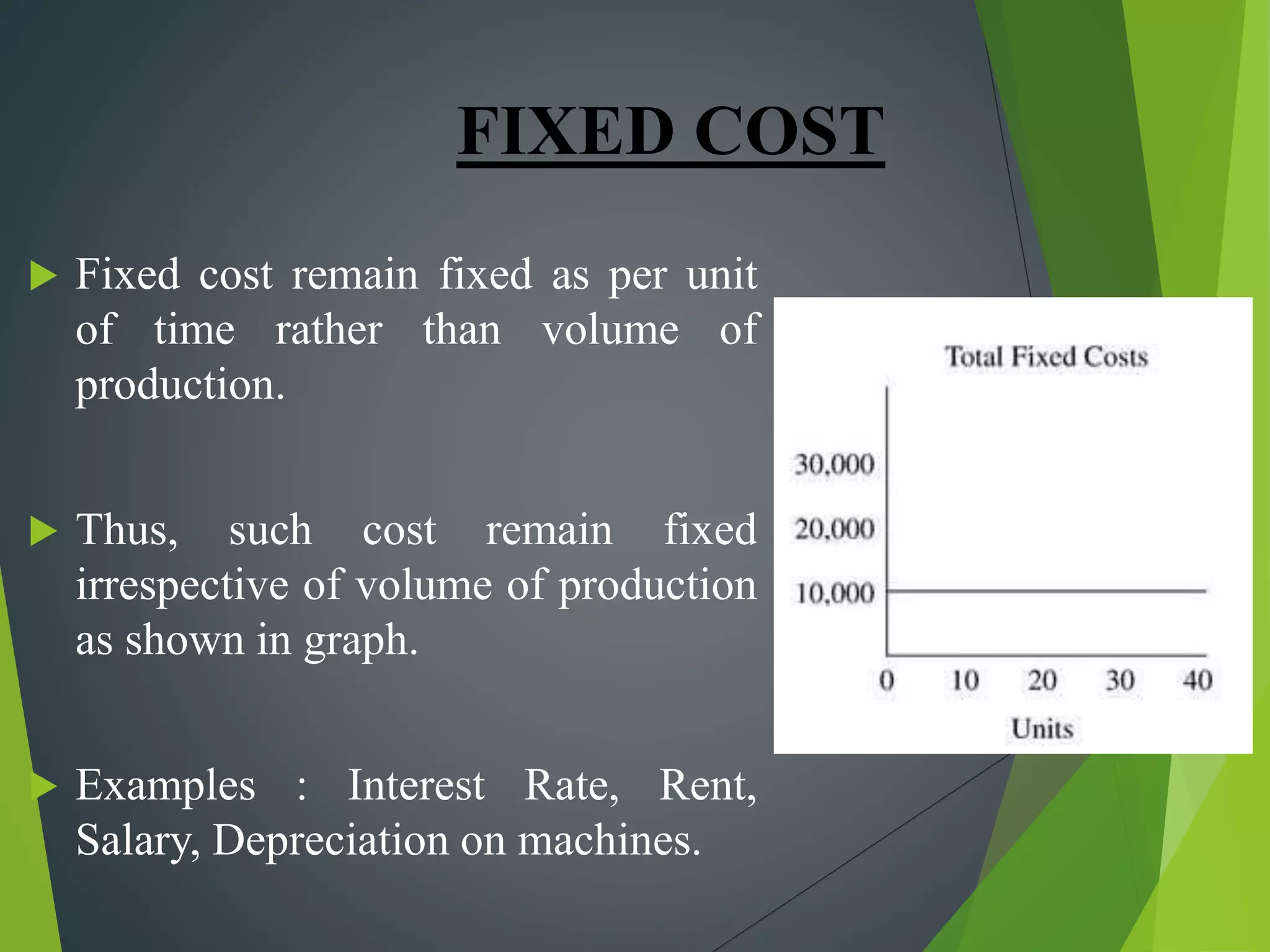
 Fixed cost remain fixed as per unit
of time rather than volume of
production.
 Thus, such cost remain fixed
irrespective of volume of production
as shown in graph.
 Examples : Interest Rate, Rent,
Salary, Depreciation on machines.
VARIABLE COST
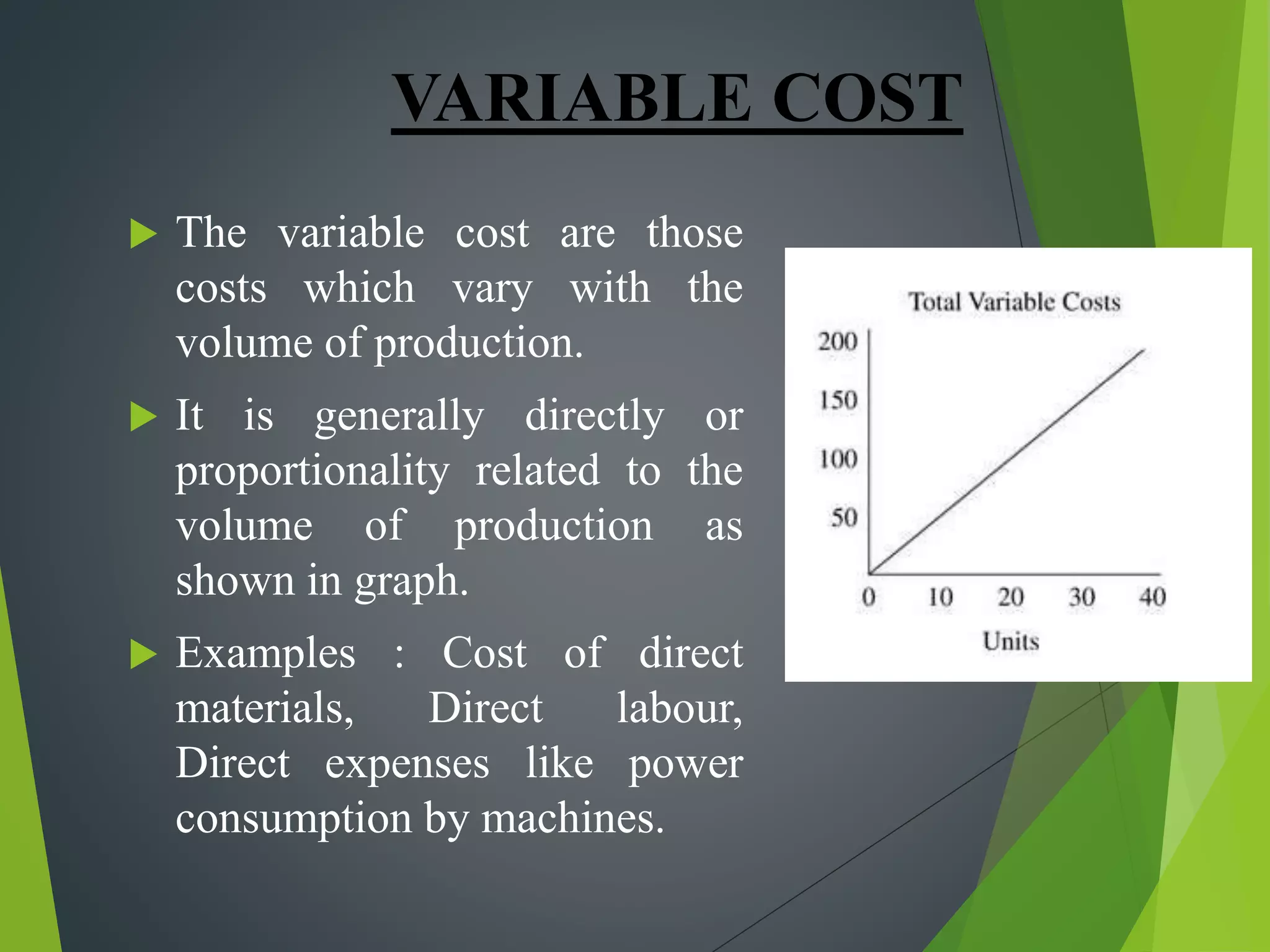
 The variable cost are those
costs which vary with the
volume of production.
 It is generally directly or
proportionality related to the
volume of production as
shown in graph.
 Examples : Cost of direct
materials, Direct labour,
Direct expenses like power
consumption by machines.
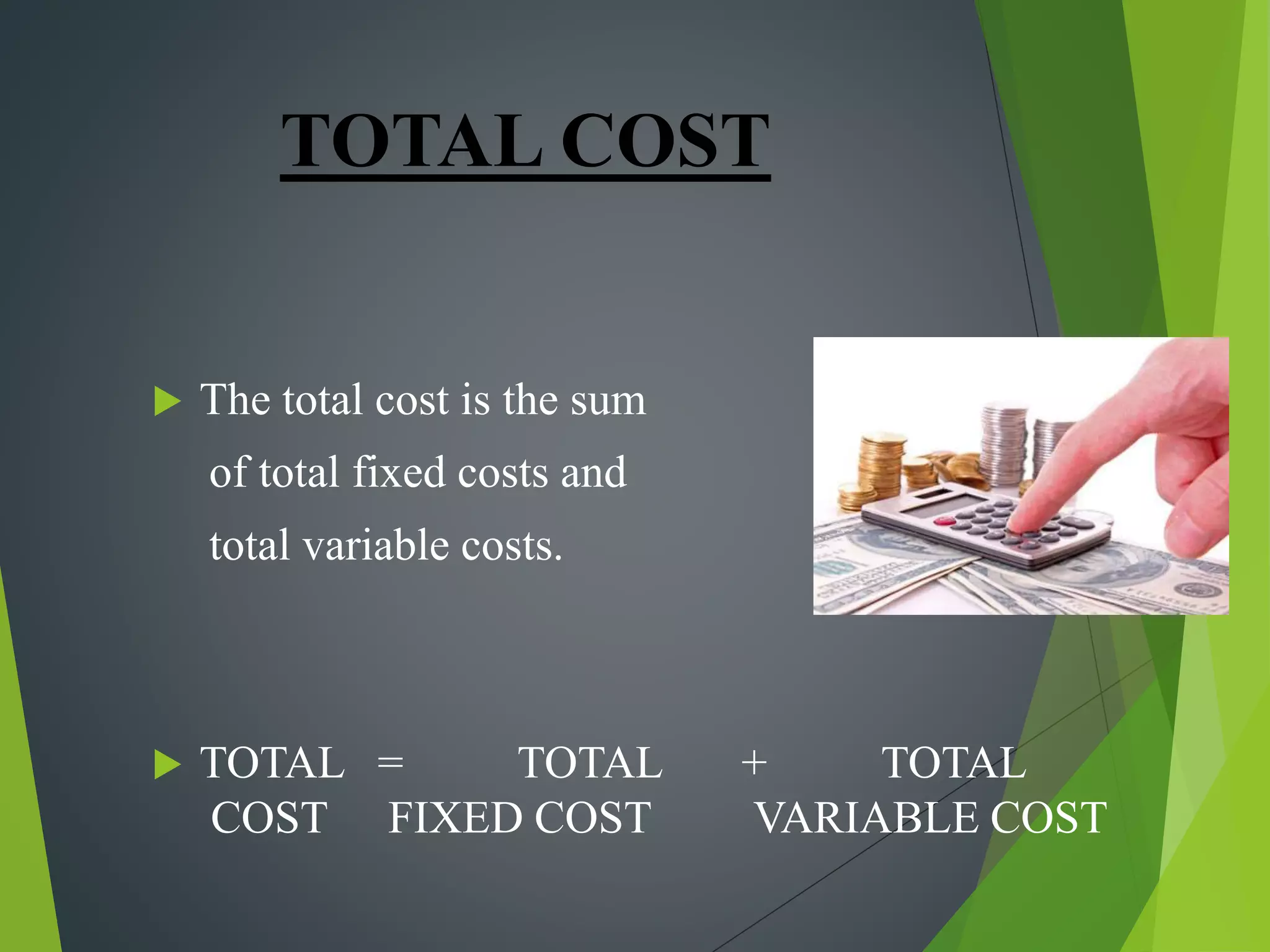
TOTAL COST
 The total cost is the sum
of total fixed costs and
total variable costs.
 TOTAL = TOTAL + TOTAL
COST FIXED COST VARIABLE COST
AVERAGE COST
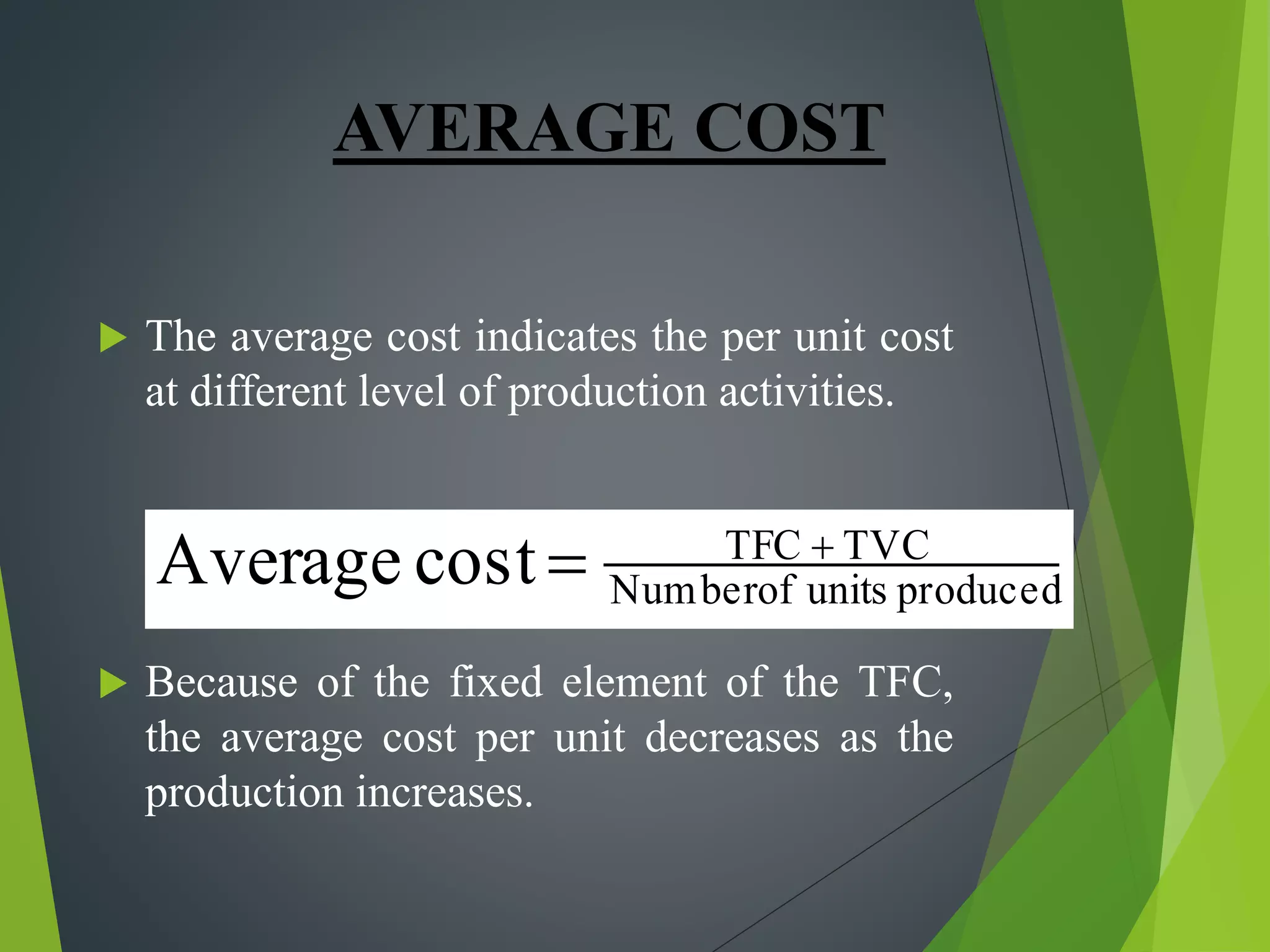
 The average cost indicates the per unit cost
at different level of production activities.
 Because of the fixed element of the TFC,
the average cost per unit decreases as the
production increases.
producedunitsofNumber
TVCTFC
costAverage 

MARGINAL COST
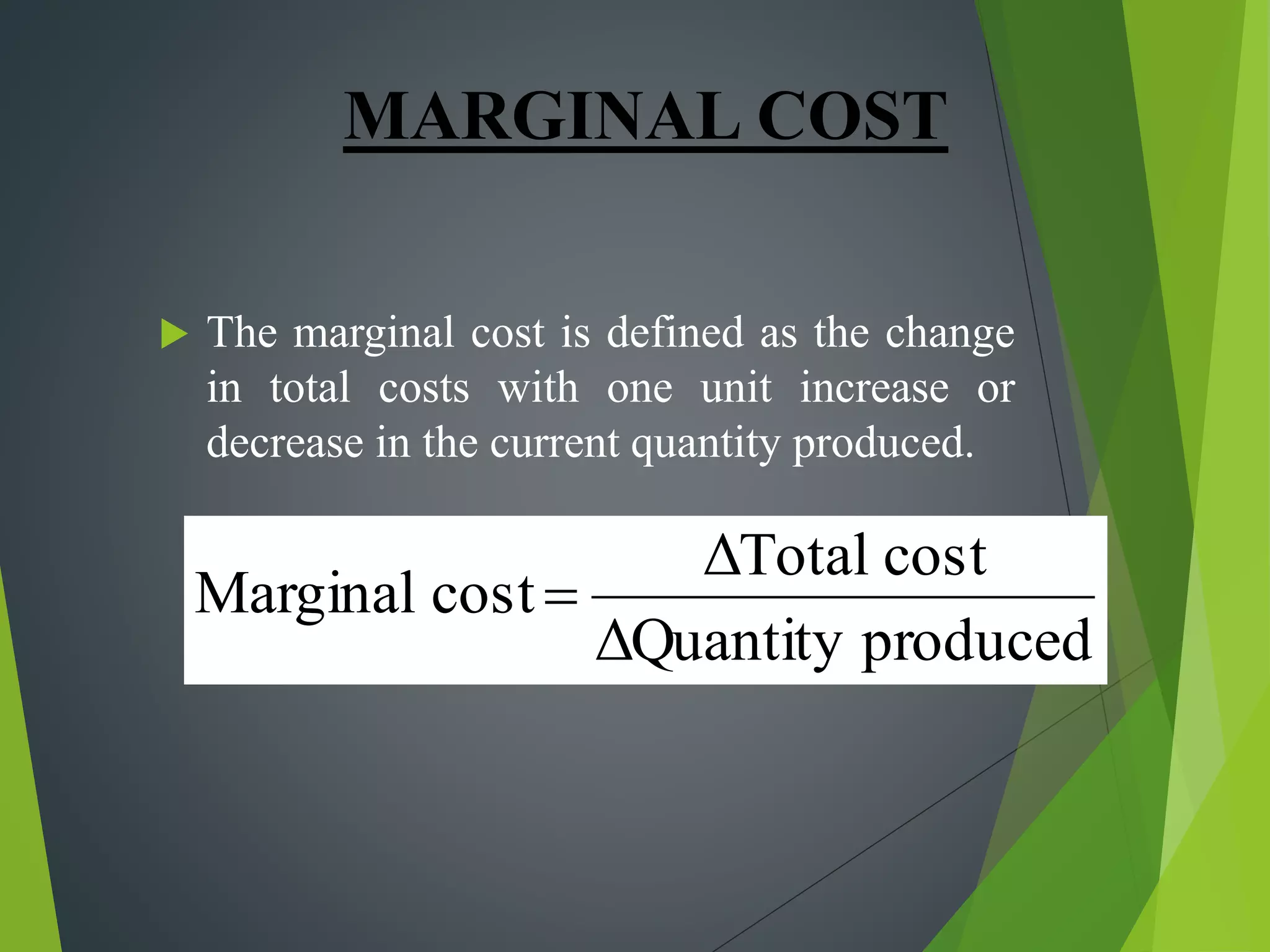
 The marginal cost is defined as the change
in total costs with one unit increase or
decrease in the current quantity produced.
producedΔQuantity
costΔTotal
costMarginal 
OPPORTUNITY AND SUNK
COST
 Opportunity cost is the cost of the next best
alternative sacrificed.
 The opportunity cost is also called
alternative cost.
 Sunk cost are such cash outflows incurred
currently which can not be reversed at later
stage.
IMPLICIT AND EXPLICIT
COST
 The explicit cost is certain and fixed
E.g.. 10% interest on bond.
 The implicit cost are also consider in terms
of incidental events or cost of
inconvenience.
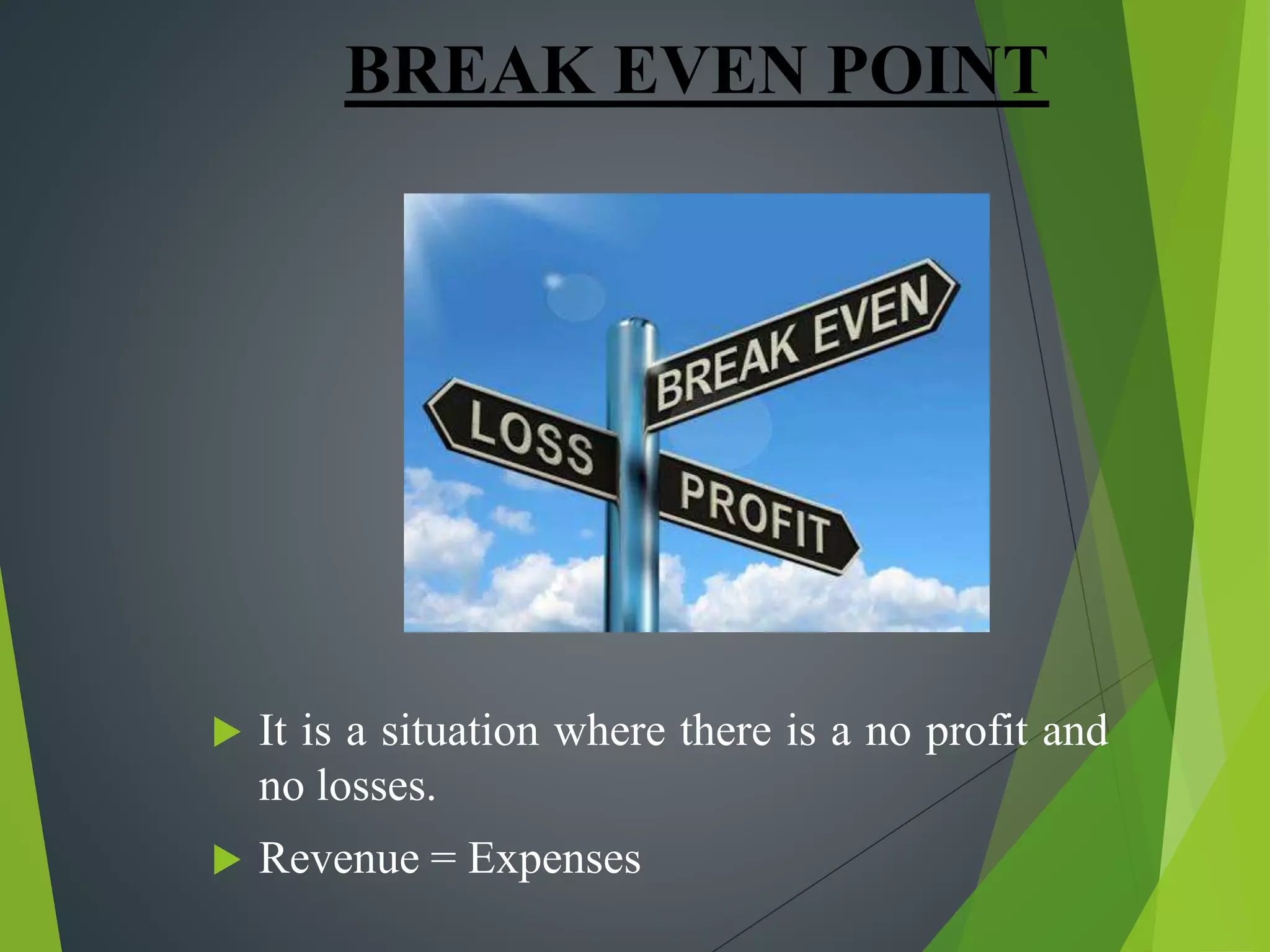
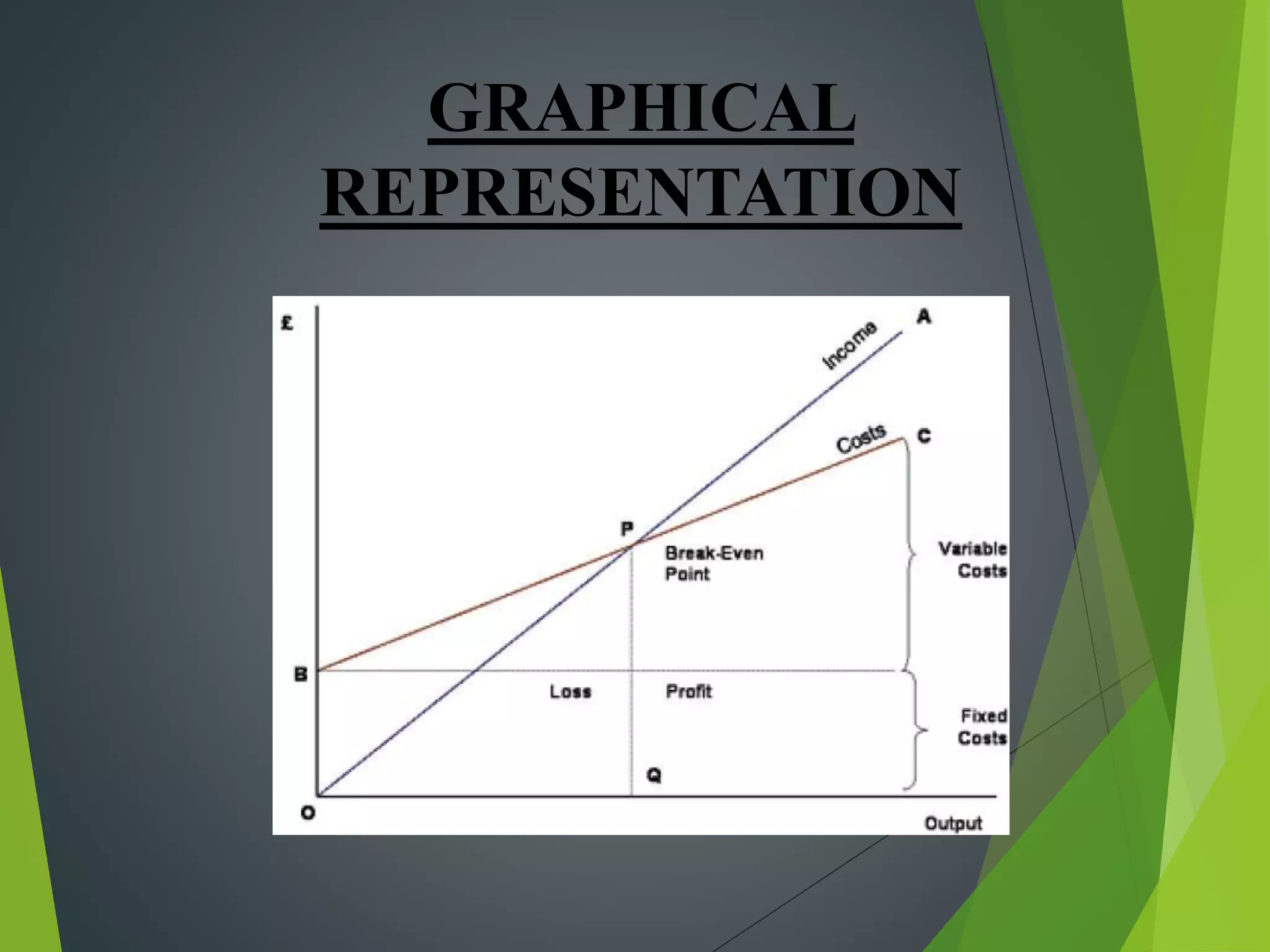
BREAK EVEN POINT
 It is a situation where there is a no profit and
no losses.
 Revenue = Expenses
BREAK EVEN ANALYSIS
 Break even analysis is based on the cost
behaviour pattern to the level of production.
 It is a key consideration in the pricing
decisions of any businesses.
USES OF B.E.A
1) To continue or To shut down the plan :
 Contribution positive  To continue
 Contribution negative  To be indifferent
 Contribution equal  To shut down
2) To make or buy a component :
 Outside price > Variable cost - To make
 Outside price = Variable cost - To be
indifferent
 Outside price < Variable cost - To buy
3) Price discrimination :
 To coat price for specific job.
 Break even analysis can be explained in two
forms.
 Algebraic
 Graphical
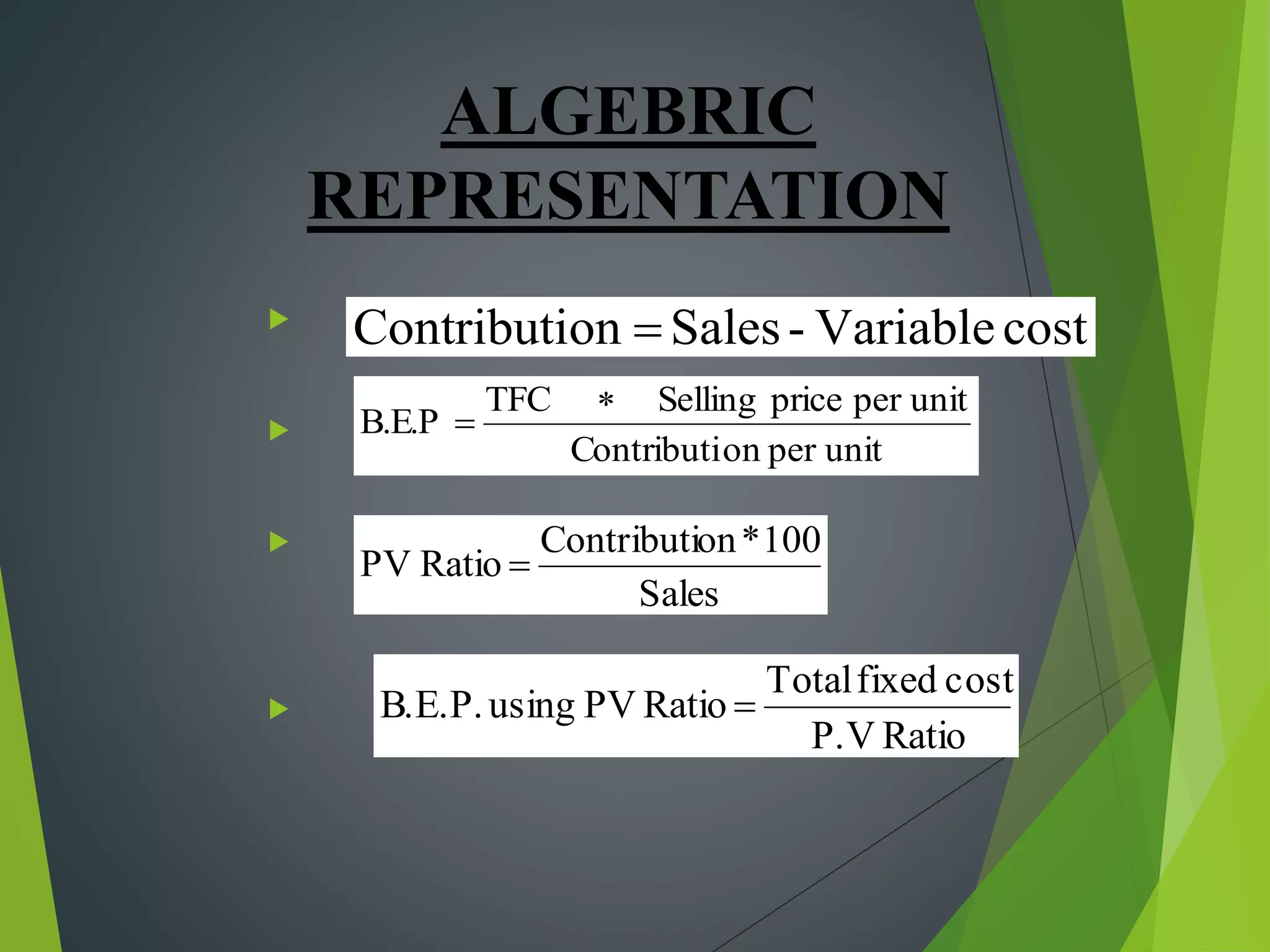
ALGEBRIC
REPRESENTATION




unitperonContributi
unitperpriceSellingTFC
B.E.P


costVariable-SalesonContributi 
Sales
100*onContributi
RatioPV 
RatioP.V
costfixedTotal
RatioPVusingB.E.P. 
GRAPHICAL
REPRESENTATION
ASSUMPTION AND
LIMITATION OF B.E.A
 All the cost are differentiable between fixed
cost and variable cost.
 The selling price per unit is independent of
volume of sales.
 Variable cost per unit is independent of
volume of production.
 Total fixed cost remain fixed with the
relevant range of capacity utilization.
GM MOTORS
A classic example of
break even success
and sustenance.
 Turnover of in its first full year of operation. (First
few years)
 The company has a turnover of $37,084 Mil sept 2016.
 Number of employees in year 2015 was 216,000 .
Information about GM
Motors
 They owned: Buick, GMC, Chevy, Pontiac, Saturn,
Cadillac, Opel, Hummer, Holden, Saab,
Vauxhall.
 they are
shareholders in: Daewoo, Suzuki, Isuzu
 They are in Joint
ventures with: Autovaz (lada), SAIC
 they are in Hybrid
partnerships with: Toyota, Daimler, Chrysler
 They Do engines
for: Fiat and Honda
 They do
manufacturing for: Renault
Early days :
 Founded September 16, 1908; 108 years ago (as General
Motors Corporation)August 11, 2009 (as General Motors
Company)
 Founder : William C. Durant,
Charles Stewart Mott
Frederic L. Smith
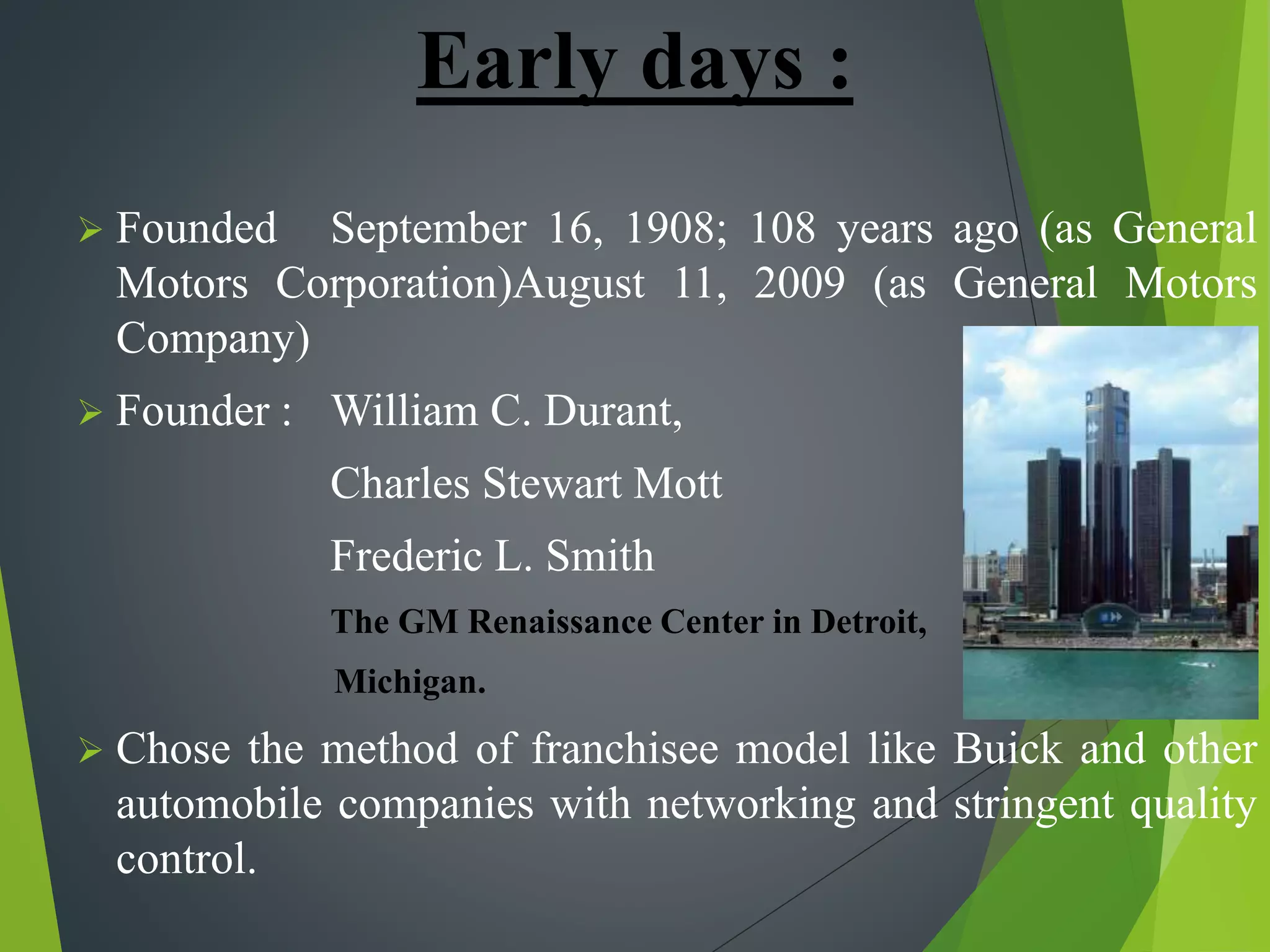
The GM Renaissance Center in Detroit,
Michigan.
 Chose the method of franchisee model like Buick and other
automobile companies with networking and stringent quality
control.
Cost incurred
Fixed cost
a) Electricity = 50,000 pm
b) Salaries = 30,000 pm ( cook and attendant )
c) Machinery = 4,00,000 ( one time cost )
 Variable cost
a) Production and raw materials = 5,00,000 pm
b) Other items = 10,000 pm ( assembly line maintenance cost
etc.)
 Selling price
Ranging from US$10,000 to US$100,000+
Current situation
Average demand
 General Motors (NYSE: GM) sold 208,290 vehicles in
October to individual or “retail” customers in the U.S.
Average revenue
 152.4 billion USD (2015)
Projected break even point
 10 million and 11 million annual units — a (huge) decline
of 8 million vehicles compared to the estimated 17.7 million
units forecast to be sold this year.
Number of employees in year 2015 was 216,000 .
Strategies applied
 Marketing Strategy plays one of the most important role to
achieve company goals and objectives.
 general Motor is one of the best automobile company in the
word. General Motors manufacturing the cars and trucks in the
international market.
 General Motors segmentation strategy is main aim to target the
different groups. In this GM think that the whole market is
single market
 General Motors design the car with the different range of cost
and it design it’s strategy according to the Income, Age,
Family, occupation.
Cost and cost concepts (Engineering Economics and Management)

Cost and cost concepts (Engineering Economics and Management)

  • 1.
    Presentation On Sub: COST AND COSTCONCEPT EEM 3nd Sem Computer (2016-17) Prepared By: Name: Shail M. Nakum Enr. No: 150410107054 Class: S.Y.: Computer Div.-I
  • 2.
    COST  Cost isthe prize paid by the user of the scare economic resources to the supplier of the resources.  Cost concept is used for analyzing the cost of a project in short and long run.
  • 3.
    TYPES OF COST 1) On the basis of service period :  i) Short-run cost  ii) Long-run cost  2)On the basis of cost behaviour to production volume:  i) Fixed cost  ii) Variable cost
  • 4.
     3) Onthe basis of changes in total costs in relation to certain specified volume :  I) Total cost  ii) Average cost  iii) Marginal cost  4) Some other important classification of costs:  I) Opportunity cost  ii) Implicit cost  Iii) Sunk cost
  • 5.
    SHORT-RUN COST  Short-runcosts have a short-term service period, usually upto one year.  Costs incurred on materials, operating expenses like cost of labour and utilities like power, water they are known as short- term cost.
  • 6.
    LONG-RUN COST  Thelong-run costs are those cost whose benefits period extend fir several future years.  Purchase of fixed assets like land, building, machines, furniture, vehicles etc. Cost incurred on research and development and training to employees are treated as long-term cost.
  • 7.
    FIXED COST  Fixedcost remain fixed as per unit of time rather than volume of production.  Thus, such cost remain fixed irrespective of volume of production as shown in graph.  Examples : Interest Rate, Rent, Salary, Depreciation on machines.
  • 8.
    VARIABLE COST  Thevariable cost are those costs which vary with the volume of production.  It is generally directly or proportionality related to the volume of production as shown in graph.  Examples : Cost of direct materials, Direct labour, Direct expenses like power consumption by machines.
  • 9.
    TOTAL COST  Thetotal cost is the sum of total fixed costs and total variable costs.  TOTAL = TOTAL + TOTAL COST FIXED COST VARIABLE COST
  • 10.
    AVERAGE COST  Theaverage cost indicates the per unit cost at different level of production activities.  Because of the fixed element of the TFC, the average cost per unit decreases as the production increases. producedunitsofNumber TVCTFC costAverage  
  • 11.
    MARGINAL COST  Themarginal cost is defined as the change in total costs with one unit increase or decrease in the current quantity produced. producedΔQuantity costΔTotal costMarginal 
  • 12.
    OPPORTUNITY AND SUNK COST Opportunity cost is the cost of the next best alternative sacrificed.  The opportunity cost is also called alternative cost.  Sunk cost are such cash outflows incurred currently which can not be reversed at later stage.
  • 13.
    IMPLICIT AND EXPLICIT COST The explicit cost is certain and fixed E.g.. 10% interest on bond.  The implicit cost are also consider in terms of incidental events or cost of inconvenience.
  • 14.
    BREAK EVEN POINT It is a situation where there is a no profit and no losses.  Revenue = Expenses
  • 15.
    BREAK EVEN ANALYSIS Break even analysis is based on the cost behaviour pattern to the level of production.  It is a key consideration in the pricing decisions of any businesses.
  • 16.
    USES OF B.E.A 1)To continue or To shut down the plan :  Contribution positive  To continue  Contribution negative  To be indifferent  Contribution equal  To shut down 2) To make or buy a component :  Outside price > Variable cost - To make  Outside price = Variable cost - To be indifferent  Outside price < Variable cost - To buy
  • 17.
    3) Price discrimination:  To coat price for specific job.  Break even analysis can be explained in two forms.  Algebraic  Graphical
  • 18.
  • 19.
  • 20.
    ASSUMPTION AND LIMITATION OFB.E.A  All the cost are differentiable between fixed cost and variable cost.  The selling price per unit is independent of volume of sales.  Variable cost per unit is independent of volume of production.  Total fixed cost remain fixed with the relevant range of capacity utilization.
  • 22.
    GM MOTORS A classicexample of break even success and sustenance.
  • 23.
     Turnover ofin its first full year of operation. (First few years)  The company has a turnover of $37,084 Mil sept 2016.  Number of employees in year 2015 was 216,000 . Information about GM Motors
  • 24.
     They owned:Buick, GMC, Chevy, Pontiac, Saturn, Cadillac, Opel, Hummer, Holden, Saab, Vauxhall.  they are shareholders in: Daewoo, Suzuki, Isuzu  They are in Joint ventures with: Autovaz (lada), SAIC  they are in Hybrid partnerships with: Toyota, Daimler, Chrysler  They Do engines for: Fiat and Honda  They do manufacturing for: Renault
  • 25.
    Early days : Founded September 16, 1908; 108 years ago (as General Motors Corporation)August 11, 2009 (as General Motors Company)  Founder : William C. Durant, Charles Stewart Mott Frederic L. Smith The GM Renaissance Center in Detroit, Michigan.  Chose the method of franchisee model like Buick and other automobile companies with networking and stringent quality control.
  • 26.
    Cost incurred Fixed cost a)Electricity = 50,000 pm b) Salaries = 30,000 pm ( cook and attendant ) c) Machinery = 4,00,000 ( one time cost )  Variable cost a) Production and raw materials = 5,00,000 pm b) Other items = 10,000 pm ( assembly line maintenance cost etc.)  Selling price Ranging from US$10,000 to US$100,000+
  • 27.
    Current situation Average demand General Motors (NYSE: GM) sold 208,290 vehicles in October to individual or “retail” customers in the U.S. Average revenue  152.4 billion USD (2015) Projected break even point  10 million and 11 million annual units — a (huge) decline of 8 million vehicles compared to the estimated 17.7 million units forecast to be sold this year. Number of employees in year 2015 was 216,000 .
  • 28.
    Strategies applied  MarketingStrategy plays one of the most important role to achieve company goals and objectives.  general Motor is one of the best automobile company in the word. General Motors manufacturing the cars and trucks in the international market.  General Motors segmentation strategy is main aim to target the different groups. In this GM think that the whole market is single market  General Motors design the car with the different range of cost and it design it’s strategy according to the Income, Age, Family, occupation.