Inequality-aware Market Design
Piotr Dworczak
based on joint work with
Mohammad Akbarpour and Scott Duke Kominers
August 1, 2022
GRAPE Seminar
Motivation
Market designers often respond to participants’ wealth inequalities in
markets they control:
Motivation
Market designers often respond to participants’ wealth inequalities in
markets they control:
▶ Housing market (rent control + public housing)
Motivation
Market designers often respond to participants’ wealth inequalities in
markets they control:
▶ Housing market (rent control + public housing)
▶ Health care
Motivation
Market designers often respond to participants’ wealth inequalities in
markets they control:
▶ Housing market (rent control + public housing)
▶ Health care
▶ Food
Motivation
Market designers often respond to participants’ wealth inequalities in
markets they control:
▶ Housing market (rent control + public housing)
▶ Health care
▶ Food
▶ Road access
Motivation
Market designers often respond to participants’ wealth inequalities in
markets they control:
▶ Housing market (rent control + public housing)
▶ Health care
▶ Food
▶ Road access
▶ (Iranian) kidney market
Motivation
Market designers often respond to participants’ wealth inequalities in
markets they control:
▶ Housing market (rent control + public housing)
▶ Health care
▶ Food
▶ Road access
▶ (Iranian) kidney market
▶ Covid-19 vaccines
Motivation
Market designers often respond to participants’ wealth inequalities in
markets they control:
▶ Housing market (rent control + public housing)
▶ Health care
▶ Food
▶ Road access
▶ (Iranian) kidney market
▶ Covid-19 vaccines
▶ ...
Motivation
Market designers often respond to participants’ wealth inequalities in
markets they control:
▶ Housing market (rent control + public housing)
▶ Health care
▶ Food
▶ Road access
▶ (Iranian) kidney market
▶ Covid-19 vaccines
▶ ...
At odds with classical intuitions (welfare theorems)?
Motivation
Market designers often respond to participants’ wealth inequalities in
markets they control:
▶ Housing market (rent control + public housing)
▶ Health care
▶ Food
▶ Road access
▶ (Iranian) kidney market
▶ Covid-19 vaccines
▶ ...
At odds with classical intuitions (welfare theorems)?
▶ Welfare theorems ignore private information...
Motivation
Market designers often respond to participants’ wealth inequalities in
markets they control:
▶ Housing market (rent control + public housing)
▶ Health care
▶ Food
▶ Road access
▶ (Iranian) kidney market
▶ Covid-19 vaccines
▶ ...
At odds with classical intuitions (welfare theorems)?
▶ Welfare theorems ignore private information...
Equity-efficiency trade-off in public finance...
Motivation
Market designers often respond to participants’ wealth inequalities in
markets they control:
▶ Housing market (rent control + public housing)
▶ Health care
▶ Food
▶ Road access
▶ (Iranian) kidney market
▶ Covid-19 vaccines
▶ ...
At odds with classical intuitions (welfare theorems)?
▶ Welfare theorems ignore private information...
Equity-efficiency trade-off in public finance...
▶ ... but doesn’t delve into the details of market design.
Motivation
Market designers often respond to participants’ wealth inequalities in
markets they control:
▶ Housing market (rent control + public housing)
▶ Health care
▶ Food
▶ Road access
▶ (Iranian) kidney market
▶ Covid-19 vaccines
▶ ...
At odds with classical intuitions (welfare theorems)?
▶ Welfare theorems ignore private information...
Equity-efficiency trade-off in public finance...
▶ ... but doesn’t delve into the details of market design.
Inequality-aware Market Design: How to design a market
“optimally” when there is inequality among participants?
Wealth vs Market Design
Key consequences of wealth effects for market design:
Wealth vs Market Design
Wealth may influence individuals’ preferences:
Wealth vs Market Design
Wealth may influence individuals’ preferences:
Wealth vs Market Design
Wealth may influence individuals’ preferences:
Wealth vs Market Design
Wealth inequality may influence social preferences:
Wealth vs Market Design
Wealth inequality may influence social preferences:
Wealth vs Market Design
Wealth inequality may influence social preferences:
Wealth vs Market Design
Maximizing welfare in the canonical quasi-linear framework in
mechanism design:
Wealth vs Market Design
Maximizing welfare in the canonical quasi-linear framework in
mechanism design:
Individuals have quasi-linear utilities
Wealth vs Market Design
Maximizing welfare in the canonical quasi-linear framework in
mechanism design:
Individuals have quasi-linear utilities
Everyone “values” money the same
Wealth vs Market Design
Our approach:
blank
Individuals have quasi-linear utilities
Agents differ in their marginal utility of money
Wealth vs Market Design
Our approach:
blank
Individuals have quasi-linear utilities
The designer attaches different Pareto weights to individuals
The Pareto frontier
The Pareto frontier
The Pareto frontier
The Pareto frontier
The Pareto frontier under IC and IR constraints
Related literature (incomplete)
Rationing vs. market mechanism: Weitzman (1977); Condorelli
(2013); Kang and Zheng (2021, 2022); Reuter and Groh (2021);
Kang (2022a, b)
Auctions with budget-constrained bidders: Che and Gale (1998),
Fernandez and Gali (1999); Che, Gale, and Kim (2012); Pai and
Vohra (2014); Kotowski (2017)
Optimal taxation: Diamond and Mirrlees (1971); Atkinson and
Stiglitz (1976); Piketty and Saez (2013); Scheuer (2014), Saez and
Stantcheva (2016, 2017); Scheuer and Werning (2017)
Minimum wage and labor taxation: Allen (1987), Guesnerie and
Roberts (1987), Boadway and Cuff (2001), Lee and Saez (2012),
Cahuc and Laroque (2014)
Market design for fairness: Hylland and Zeckhauser (1979);
Bogomolnaia and Moulin (2001); Budish (2011)
Framework
Framework
Framework
There are two goods: K and M.
Good K is indivisible and agents demand one unit, good M is
divisible and agents can hold any amount of it.
There is a unit mass of sellers (owners of good K), and a mass µ > 0
of buyers (non-owners of good K).
Each agent is characterized by (her ownership type and) a
two-dimensional type (vK, vM );
If (xK, xM ) denote the holdings of the two goods, then each agent’s
utility is given by
vK · xK + vM · xM .
(vK, vM ) ∼ Fj(vK, vM ) on side j of the market.
The designer maximizes expected total value with vK and vM
interpreted as social values.
Framework – some observations
Individual preferences depend only on the rate of substitution:
r =
vK
vM
.
Framework – some observations
Individual preferences depend only on the rate of substitution:
r =
vK
vM
.
It will turn out that this implies that it is wlog to consider mechanisms
whose outcomes only depend on r.
Framework – some observations
Individual preferences depend only on the rate of substitution:
r =
vK
vM
.
It will turn out that this implies that it is wlog to consider mechanisms
whose outcomes only depend on r. Let:
r ∼ Gj with positive density gj on [rj, r̄j].
Framework – some observations
Individual preferences depend only on the rate of substitution:
r =
vK
vM
.
It will turn out that this implies that it is wlog to consider mechanisms
whose outcomes only depend on r. Let:
r ∼ Gj with positive density gj on [rj, r̄j].
Social preferences can also be expressed as a function of r:
µEB
[xB
K · vK + xB
M · vM ] + ES
[xS
K · vK + xS
M · vM ].
Framework – some observations
Individual preferences depend only on the rate of substitution:
r =
vK
vM
.
It will turn out that this implies that it is wlog to consider mechanisms
whose outcomes only depend on r. Let:
r ∼ Gj with positive density gj on [rj, r̄j].
Social preferences can also be expressed as a function of r:
µEB

vM

xB
K ·
vK
vM
+ xB
M

+ ES

vM

xS
K ·
vK
vM
+ xS
M

.
Framework – some observations
Individual preferences depend only on the rate of substitution:
r =
vK
vM
.
It will turn out that this implies that it is wlog to consider mechanisms
whose outcomes only depend on r. Let:
r ∼ Gj with positive density gj on [rj, r̄j].
Social preferences can also be expressed as a function of r:
µEB

EB
[vM |r]

xB
K · r + xB
M

+ ES

ES
[vM |r]

xS
K · r + xS
M

.
Framework – some observations
Individual preferences depend only on the rate of substitution:
r =
vK
vM
.
It will turn out that this implies that it is wlog to consider mechanisms
whose outcomes only depend on r. Let:
r ∼ Gj with positive density gj on [rj, r̄j].
Social preferences can also be expressed as a function of r:
µEB


EB
[vM |r]
| {z }
λB(r)

xB
K · r + xB
M

| {z }
UB(r)


 + ES


ES
[vM |r]
| {z }
λS(r)

xS
K · r + xS
M

| {z }
US(r)


 .
Framework – some observations
Individual preferences depend only on the rate of substitution:
r =
vK
vM
.
It will turn out that this implies that it is wlog to consider mechanisms
whose outcomes only depend on r. Let:
r ≡ vK/vM ∼ Gj with positive density gj on [rj, r̄j].
Social preferences can also be expressed as a function of r:
TS(Λ) = µ
Z r̄B
rB
λB(r)UB(r)dGB(r) +
Z r̄S
rS
λS(r)US(r)dGS(r).
Framework
A key assumption:
λj(r) = E

vM |
vK
vM
= r

is non-increasing.
Framework
A key assumption:
λj(r) = E

vM |
vK
vM
= r

is non-increasing.
Example: What’s your willingness to pay for an Uber ride to the airport?
Agent 1: $100

= vK
vM

Agent 2: $10

= vK
vM
Framework
A key assumption:
λj(r) = E

vM |
vK
vM
= r

is non-increasing.
Example: What’s your willingness to pay for an Uber ride to the airport?
Agent 1: $100

= vK
vM

Agent 2: $10

= vK
vM

In our model, the designer attaches a higher weight to Agent 2.
Framework
A key assumption:
λj(r) = E

vM |
vK
vM
= r

is non-increasing.
Example: What’s your willingness to pay for an Uber ride to the airport?
Agent 1: $100

= vK
vM

Agent 2: $10

= vK
vM

In our model, the designer attaches a higher weight to Agent 2.
Idea: Willingness to pay can be used to make a statistical inference about
the marginal value for money; The designer attaches a higher Pareto
weight to agents with lower willingness to pay (that are “poor in
expectation”)
Framework
A key assumption:
λj(r) = E

vM |
vK
vM
= r

is non-increasing.
Example: What’s your WTP for a Tommy Emmanuel’s concert ticket?
Agent 1: $100

= vK
vM

Agent 2: $10

= vK
vM

In our model, the designer attaches a higher weight to Agent 2.
Idea: Willingness to pay can be used to make a statistical inference about
the marginal value for money; The designer attaches a higher Pareto
weight to agents with lower willingness to pay (that are “poor in
expectation”)
Framework
A key assumption:
λj(r) = E

vM |
vK
vM
= r

is non-increasing.
Example: What’s your willingness to pay for life-saving medicine?
Agent 1: $100

= vK
vM

Agent 2: $10

= vK
vM

In our model, the designer attaches a higher weight to Agent 2.
Idea: Willingness to pay can be used to make a statistical inference about
the marginal value for money; The designer attaches a higher Pareto
weight to agents with lower willingness to pay (that are “poor in
expectation”)
Framework – Mechanisms
The designer chooses a trading mechanism subject to 4 constraints:
Incentive Compatibility
Individual Rationality
Market Clearing
Budget Balance
Simple mechanisms
Simple mechanisms in a simplified setting
Simple mechanisms
Assumptions:
The rate of substitution r is uniformly distributed on both sides of
the market.
The designer uses a single-price or two-price mechanism.
Simple mechanisms
Assumptions:
The rate of substitution r is uniformly distributed on both sides of
the market.
The designer uses a single-price or two-price mechanism.
We will first solve one-sided problems (for a fixed volume of trade Q and
revenue/budget R), and then link the two sides.
Simple mechanisms
Single-price mechanisms
Seller-side optimality
Single-price mechanisms – seller side
Problem: Choose a price pS to maximize seller welfare while buying
quantity Q and not exceeding a budget of R (where R  QG−1
S (Q)).
Single-price mechanisms – seller side
Problem: Choose a price pS to maximize seller welfare while buying
quantity Q and not exceeding a budget of R (where R  QG−1
S (Q)).
max
pS≥G−1
S (Q)
(
Q
GS(pS)
Z pS
rS
λS(r)(pS − r)dGS(r) + ΛS(R − pSQ)
)
,
where ΛS = ES[vM ].
Single-price mechanisms – seller side
Problem: Choose a price pS to maximize seller welfare while buying
quantity Q and not exceeding a budget of R (where R  QG−1
S (Q)).
max
pS≥G−1
S (Q)
(
Q
GS(pS)
Z pS
rS
λS(r)(pS − r)dGS(r) + ΛS(R − pSQ)
)
,
where ΛS = ES[vM ].
We will refer to the price pC
S = G−1
S (Q) as the competitive price;
Any price pS  pC
S leads to rationing.
Single-price mechanisms – seller side
Low seller-side inequality ⇐⇒ λS(rS) ≤ 2ΛS.
Single-price mechanisms – seller side
Low seller-side inequality ⇐⇒ λS(rS) ≤ 2ΛS.
Single-price mechanisms – seller side
Low seller-side inequality ⇐⇒ λS(rS) ≤ 2ΛS.
Proposition
When seller-side inequality is low, it is optimal to choose pS = pC
S .
Single-price mechanisms – seller side
Low seller-side inequality ⇐⇒ λS(rS) ≤ 2ΛS.
Proposition
When seller-side inequality is low, it is optimal to choose pS = pC
S .
When seller-side inequality is high, there exists Q̄ ∈ [0, 1) such that
Rationing at a price pS  pC
S is optimal when Q  Q̄;
Setting pS = pC
S is optimal when Q ≥ Q̄.
Single-price mechanisms – seller side
Low seller-side inequality ⇐⇒ λS(rS) ≤ 2ΛS.
Proposition
When seller-side inequality is low, it is optimal to choose pS = pC
S .
When seller-side inequality is high, there exists Q̄ ∈ [0, 1) such that
Rationing at a price pS  pC
S is optimal when Q  Q̄;
Setting pS = pC
S is optimal when Q ≥ Q̄.
This is in fact the optimal mechanism overall!
Single-price mechanisms – seller side
Intuition: There are three effects associated with raising the price pS
above the competitive level pC
S :
1 Allocative efficiency is reduced ↓
Single-price mechanisms – seller side
Intuition: There are three effects associated with raising the price pS
above the competitive level pC
S :
1 Allocative efficiency is reduced ↓
2 The mechanism uses up more money leaving a smaller amount
R − pSQ to be redistributed as a lump-sum transfer to all sellers ↓
Single-price mechanisms – seller side
Intuition: There are three effects associated with raising the price pS
above the competitive level pC
S :
1 Allocative efficiency is reduced ↓
2 The mechanism uses up more money leaving a smaller amount
R − pSQ to be redistributed as a lump-sum transfer to all sellers ↓
3 Sellers that sell receive a higher price ↑
Single-price mechanisms – seller side
Intuition: There are three effects associated with raising the price pS
above the competitive level pC
S :
1 Allocative efficiency is reduced ↓
2 The mechanism uses up more money leaving a smaller amount
R − pSQ to be redistributed as a lump-sum transfer to all sellers ↓
3 Sellers that sell receive a higher price ↑
Single-price mechanisms – seller side
Intuition: There are three effects associated with raising the price pS
above the competitive level pC
S :
1 Allocative efficiency is reduced ↓
2 The mechanism uses up more money leaving a smaller amount
R − pSQ to be redistributed as a lump-sum transfer to all sellers ↓
3 Sellers that sell receive a higher price ↑
Consider the net redistribution effect 2+3:
−ΛS
Single-price mechanisms – seller side
Intuition: There are three effects associated with raising the price pS
above the competitive level pC
S :
1 Allocative efficiency is reduced ↓
2 The mechanism uses up more money leaving a smaller amount
R − pSQ to be redistributed as a lump-sum transfer to all sellers ↓
3 Sellers that sell receive a higher price ↑
Consider the net redistribution effect 2+3:
−ΛS + ES
[λS(r)|r ≤ pS]
Single-price mechanisms – seller side
Intuition: There are three effects associated with raising the price pS
above the competitive level pC
S :
1 Allocative efficiency is reduced ↓
2 The mechanism uses up more money leaving a smaller amount
R − pSQ to be redistributed as a lump-sum transfer to all sellers ↓
3 Sellers that sell receive a higher price ↑
Consider the net redistribution effect 2+3:
−ΛS + ES
[λS(r)|r ≤ pS] ≥ 0 ↑
Single-price mechanisms – seller side
Intuition: There are three effects associated with raising the price pS
above the competitive level pC
S :
1 Allocative efficiency is reduced ↓
2 The mechanism uses up more money leaving a smaller amount
R − pSQ to be redistributed as a lump-sum transfer to all sellers ↓
3 Sellers that sell receive a higher price ↑
Consider the net redistribution effect 2+3:
−ΛS + ES
[λS(r)|r ≤ pS] ≥ 0 ↑
This net effect must be stronger than the negative effect 1 to justify
rationing:
High seller-side inequality;
Low volume of trade: Q  Q̄.
Single-price mechanisms
Buyer-side optimality
Single-price mechanisms – buyer side
Problem: Choose a price pB to maximize buyer welfare while selling
quantity Q and raising a revenue of R (where R  QG−1
B (1 − Q)).
Single-price mechanisms – buyer side
Problem: Choose a price pB to maximize buyer welfare while selling
quantity Q and raising a revenue of R (where R  QG−1
B (1 − Q)).
max
pB≤G−1
B (1−Q)

Q
1 − GB(pB)
Z r̄B
pB
λB(r)(r − pB)dGB(r) + ΛB(pBQ − R)

.
where ΛB = EB[vM ].
Single-price mechanisms – buyer side
Problem: Choose a price pB to maximize buyer welfare while selling
quantity Q and raising a revenue of R (where R  QG−1
B (1 − Q)).
max
pB≤G−1
B (1−Q)

Q
1 − GB(pB)
Z r̄B
pB
λB(r)(r − pB)dGB(r) + ΛB(pBQ − R)

.
where ΛB = EB[vM ].
We will refer to the price pC
B = G−1
B (1 − Q) as the competitive price;
Any price pB  pC
B leads to rationing.
Single-price mechanisms – buyer side
Proposition
Regardless of buyer-side inequality, it is optimal to set pB = pC
B.
That is, the competitive mechanism is always optimal.
Single-price mechanisms – buyer side
Intuition: There are three effects associated with lowering the price pB
below the competitive level pC
B:
1 Allocative efficiency is reduced ↓
Single-price mechanisms – buyer side
Intuition: There are three effects associated with lowering the price pB
below the competitive level pC
B:
1 Allocative efficiency is reduced ↓
2 The mechanism generates less revenue pBQ − R that can be
redistributed as a lump-sum transfer to all buyers ↓
Single-price mechanisms – buyer side
Intuition: There are three effects associated with lowering the price pB
below the competitive level pC
B:
1 Allocative efficiency is reduced ↓
2 The mechanism generates less revenue pBQ − R that can be
redistributed as a lump-sum transfer to all buyers ↓
3 Buyers that buy pay a lower price ↑
Single-price mechanisms – buyer side
Intuition: There are three effects associated with lowering the price pB
below the competitive level pC
B:
1 Allocative efficiency is reduced ↓
2 The mechanism generates less revenue pBQ − R that can be
redistributed as a lump-sum transfer to all buyers ↓
3 Buyers that buy pay a lower price ↑
Single-price mechanisms – buyer side
Intuition: There are three effects associated with lowering the price pB
below the competitive level pC
B:
1 Allocative efficiency is reduced ↓
2 The mechanism generates less revenue pBQ − R that can be
redistributed as a lump-sum transfer to all buyers ↓
3 Buyers that buy pay a lower price ↑
Consider the net redistribution effect 2+3:
−ΛB
Single-price mechanisms – buyer side
Intuition: There are three effects associated with lowering the price pB
below the competitive level pC
B:
1 Allocative efficiency is reduced ↓
2 The mechanism generates less revenue pBQ − R that can be
redistributed as a lump-sum transfer to all buyers ↓
3 Buyers that buy pay a lower price ↑
Consider the net redistribution effect 2+3:
−ΛB + EB
[λB(r)|r ≥ pB]
Single-price mechanisms – buyer side
Intuition: There are three effects associated with lowering the price pB
below the competitive level pC
B:
1 Allocative efficiency is reduced ↓
2 The mechanism generates less revenue pBQ − R that can be
redistributed as a lump-sum transfer to all buyers ↓
3 Buyers that buy pay a lower price ↑
Consider the net redistribution effect 2+3:
−ΛB + EB
[λB(r)|r ≥ pB] ≤ 0 ↓
Single-price mechanisms – buyer side
Intuition: There are three effects associated with lowering the price pB
below the competitive level pC
B:
1 Allocative efficiency is reduced ↓
2 The mechanism generates less revenue pBQ − R that can be
redistributed as a lump-sum transfer to all buyers ↓
3 Buyers that buy pay a lower price ↑
Consider the net redistribution effect 2+3:
−ΛB + EB
[λB(r)|r ≥ pB] ≤ 0 ↓
The net redistribution effect is negative!
Two-price mechanisms
A designer can now post two prices, pH
j and pL
j , for each side j of the
market.
Two-price mechanisms
A designer can now post two prices, pH
j and pL
j , for each side j of the
market.
Traders trade with probability one at the less attractive price (higher
for buyers, lower for sellers), and trade with some interior probability
δ at the more attractive price.
Two-price mechanisms
Seller-side optimality
Two-price mechanisms – seller side
Nothing changes!
Two-price mechanisms
Buyer-side optimality
Two-price mechanisms – buyer side
max
pH
B ≥pL
B, δ





δ
Z rδ
pL
B
λB(r)(r − pL
B)dGB(r) +
Z r̄B
rδ
λB(r)(r − pH
B )dGB(r)
+ΛB pL
Bδ(GB(rδ) − GB(pL
B)) + pH
B (1 − GB(rδ)) − R






subject to the market-clearing and revenue-target constraints
1 − δGB(pL
B) − (1 − δ)GB(rδ) = Q,
pL
Bδ(GB(rδ) − GB(pL
B)) + pH
B (1 − GB(rδ)) ≥ R,
where rδ is the type indifferent between the high and the low price.
Two-price mechanisms – buyer side
max
pH
B ≥pL
B, δ





δ
Z rδ
pL
B
λB(r)(r − pL
B)dGB(r) +
Z r̄B
rδ
λB(r)(r − pH
B )dGB(r)
+ΛB pL
Bδ(GB(rδ) − GB(pL
B)) + pH
B (1 − GB(rδ)) − R






subject to the market-clearing and revenue-target constraints
1 − δGB(pL
B) − (1 − δ)GB(rδ) = Q,
pL
Bδ(GB(rδ) − GB(pL
B)) + pH
B (1 − GB(rδ)) ≥ R,
where rδ is the type indifferent between the high and the low price.
We say that there is rationing at the lower price pL
B if δ  1 and
GB(rδ)  GB(pL
B), i.e., if a non-zero measure of buyers choose the lottery.
Two-price mechanisms – buyer side
Low buyer-side inequality ⇐⇒ λB(rB) ≤ 2ΛB.
Two-price mechanisms – buyer side
Low buyer-side inequality ⇐⇒ λB(rB) ≤ 2ΛB.
Proposition
When buyer-side inequality is low, it is optimal not to offer the low price
pL
B and to choose pH
B = pC
B.
Two-price mechanisms – buyer side
Low buyer-side inequality ⇐⇒ λB(rB) ≤ 2ΛB.
Proposition
When buyer-side inequality is low, it is optimal not to offer the low price
pL
B and to choose pH
B = pC
B.
When buyer-side inequality is high, there exists Q ∈ (0, 1] such that
Rationing at the low price is optimal when Q  Q;
Setting pH
B = pC
B (and not offering the low price pL
B) is optimal for
Q ≤ Q.
Two-price mechanisms – buyer side
Low buyer-side inequality ⇐⇒ λB(rB) ≤ 2ΛB.
Proposition
When buyer-side inequality is low, it is optimal not to offer the low price
pL
B and to choose pH
B = pC
B.
When buyer-side inequality is high, there exists Q ∈ (0, 1] such that
Rationing at the low price is optimal when Q  Q;
Setting pH
B = pC
B (and not offering the low price pL
B) is optimal for
Q ≤ Q.
This is in fact the optimal mechanism overall!
Two-price mechanisms – buyer side
Intuition: This time rationing (a discounted price) is offered to buyers
with relatively low types r ∈ [pL
B, rδ], so that it is possible that the net
redistribution effect is positive:
−ΛB
Two-price mechanisms – buyer side
Intuition: This time rationing (a discounted price) is offered to buyers
with relatively low types r ∈ [pL
B, rδ], so that it is possible that the net
redistribution effect is positive:
−ΛB + EB
[λB(r)| r ∈ [pL
B, rδ]]
Two-price mechanisms – buyer side
Intuition: This time rationing (a discounted price) is offered to buyers
with relatively low types r ∈ [pL
B, rδ], so that it is possible that the net
redistribution effect is positive:
−ΛB + EB
[λB(r)| r ∈ [pL
B, rδ]] ≥ 0
Two-price mechanisms – buyer side
Intuition: This time rationing (a discounted price) is offered to buyers
with relatively low types r ∈ [pL
B, rδ], so that it is possible that the net
redistribution effect is positive:
−ΛB + EB
[λB(r)| r ∈ [pL
B, rδ]] ≥ 0 ↑
Two-price mechanisms – buyer side
Intuition: This time rationing (a discounted price) is offered to buyers
with relatively low types r ∈ [pL
B, rδ], so that it is possible that the net
redistribution effect is positive:
−ΛB + EB
[λB(r)| r ∈ [pL
B, rδ]] ≥ 0 ↑
This net effect must be stronger than the negative effect on allocative
efficiency to justify rationing:
High buyer-side inequality;
High volume of trade: Q  Q.
Cross-side optimality
Proposition
When same-side inequality is low on both sides of the market, it is optimal
to set pB ≥ pS such that the market clears, GS(pS) = µ(1 − GB(pB)),
and redistribute the resulting revenue as a lump-sum payment to the side
of the market j ∈ {B, S} with higher average value for money Λj.
Cross-side optimality
Proposition
When same-side inequality is low on both sides of the market, it is optimal
to set pB ≥ pS such that the market clears, GS(pS) = µ(1 − GB(pB)),
and redistribute the resulting revenue as a lump-sum payment to the side
of the market j ∈ {B, S} with higher average value for money Λj.
For example, when there is no same-side inequality:
pB − pS =

ΛS − ΛB
ΛS

1 − GB(pB)
gB(pB)
.
Cross-side optimality
Proposition
When same-side inequality is low on both sides of the market, it is optimal
to set pB ≥ pS such that the market clears, GS(pS) = µ(1 − GB(pB)),
and redistribute the resulting revenue as a lump-sum payment to the side
of the market j ∈ {B, S} with higher average value for money Λj.
For example, when there is no same-side inequality:
pB − pS =

ΛS − ΛB
ΛS

1 − GB(pB)
gB(pB)
.
We will refer to the situation ΛS ̸= ΛB as cross-side inequality.
Cross-side optimality
Proposition
When same-side inequality is low on both sides of the market, it is optimal
to set pB ≥ pS such that the market clears, GS(pS) = µ(1 − GB(pB)),
and redistribute the resulting revenue as a lump-sum payment to the side
of the market j ∈ {B, S} with higher average value for money Λj.
Competitive equilibrium, defined by pB = pS = pCE, where
GS(pCE
) = µ(1 − GB(pCE
)),
is optimal only when there is no cross-side inequality (ΛS = ΛB).
Cross-side optimality
Sellers:
Proposition
When seller-side inequality is high and ΛS ≥ ΛB, if µ is low enough, then
it is optimal to ration the sellers by setting a single price above the
competitive-equilibrium level.
Cross-side optimality
Sellers:
Proposition
When seller-side inequality is high and ΛS ≥ ΛB, if µ is low enough, then
it is optimal to ration the sellers by setting a single price above the
competitive-equilibrium level.
Intuition:
Low µ guarantees a low enough volume of trade;
Cross-side optimality
Sellers:
Proposition
When seller-side inequality is high and ΛS ≥ ΛB, if µ is low enough, then
it is optimal to ration the sellers by setting a single price above the
competitive-equilibrium level.
Intuition:
Low µ guarantees a low enough volume of trade;
ΛS ≥ ΛB guarantees that the budget constraint does not alter the optimal
mechanism for the seller side.
Cross-side optimality
Buyers:
Proposition
If seller-side inequality is low and rB = 0, then the optimal mechanism
does not ration the buyers (regardless of buyer-side inequality).
Cross-side optimality
Buyers:
Proposition
If seller-side inequality is low and rB = 0, then the optimal mechanism
does not ration the buyers (regardless of buyer-side inequality).
Rationing the buyers is suboptimal for any µ!
Cross-side optimality
Proposition
If seller-side inequality is low and rB = 0, then the optimal mechanism
does not ration the buyers (regardless of buyer-side inequality).
Intuition:
Under these conditions, it is never optimal to have a high volume of
trade in the mechanism;
Cross-side optimality
Proposition
If seller-side inequality is low and rB = 0, then the optimal mechanism
does not ration the buyers (regardless of buyer-side inequality).
Intuition:
Under these conditions, it is never optimal to have a high volume of
trade in the mechanism;
High volume of trade and rB = 0 imply that the revenue generated
by the mechanism is small;
Cross-side optimality
Proposition
If seller-side inequality is low and rB = 0, then the optimal mechanism
does not ration the buyers (regardless of buyer-side inequality).
Intuition:
Under these conditions, it is never optimal to have a high volume of
trade in the mechanism;
High volume of trade and rB = 0 imply that the revenue generated
by the mechanism is small;
Rationing = providing the good at a low price to “poor” agents, is
ineffective when rB = 0;
Cross-side optimality
Proposition
If seller-side inequality is low and rB = 0, then the optimal mechanism
does not ration the buyers (regardless of buyer-side inequality).
Intuition:
Under these conditions, it is never optimal to have a high volume of
trade in the mechanism;
High volume of trade and rB = 0 imply that the revenue generated
by the mechanism is small;
Rationing = providing the good at a low price to “poor” agents, is
ineffective when rB = 0;
A better idea: Limit volume, raise revenue, and help the “poor”
buyers by giving a lump-sum transfer.
Cross-side optimality
Proposition
If there is high buyer-side inequality, ΛB ≥ ΛS, and
rB − r̄S ≥
1
2
(r̄B − rS),
then there is some ϵ  0 such that it is optimal to ration the buyers for
any µ ∈ (1, 1 + ϵ).
Cross-side optimality
Proposition
If there is high buyer-side inequality, ΛB ≥ ΛS, and
rB − r̄S ≥
1
2
(r̄B − rS),
then there is some ϵ  0 such that it is optimal to ration the buyers for
any µ ∈ (1, 1 + ϵ).
Intuition:
Because there are large gains from trade, any optimal mechanism
must maximize volume of trade;
Cross-side optimality
Proposition
If there is high buyer-side inequality, ΛB ≥ ΛS, and
rB − r̄S ≥
1
2
(r̄B − rS),
then there is some ϵ  0 such that it is optimal to ration the buyers for
any µ ∈ (1, 1 + ϵ).
Intuition:
Because there are large gains from trade, any optimal mechanism
must maximize volume of trade;
Because there are slightly more buyers than sellers in the market,
almost all buyers buy;
Cross-side optimality
Proposition
If there is high buyer-side inequality, ΛB ≥ ΛS, and
rB − r̄S ≥
1
2
(r̄B − rS),
then there is some ϵ  0 such that it is optimal to ration the buyers for
any µ ∈ (1, 1 + ϵ).
Intuition:
Because there are large gains from trade, any optimal mechanism
must maximize volume of trade;
Because there are slightly more buyers than sellers in the market,
almost all buyers buy;
Thus, we have high volume + high buyer-side inequality =⇒ buyer
rationing.
General Framework
General Framework
General Framework
A designer chooses a mechanism to allocate a unit mass of objects to
a unit mass of agents.
Each object has quality q ∈ [0, 1], q is distributed acc. to cdf F.
Each agent is characterized by a type (i, r, λ), where:
i is an observable label, i ∈ I (finite);
r is an unobserved willingness to pay (for quality), r ∈ R+;
λ is an unobserved social welfare weight, λ ∈ R+;
The type distribution is known to the designer.
If (i, r, λ) gets a good with quality q and pays t, her utility is qr − t,
while her contribution to social welfare is λ(qr − t)
General Framework
The designer has access to arbitrary (direct) allocation mechanisms
(Γ, T) where Γ(q|i, r, λ) is the probability that (i, r, λ) gets a good with
quality q or less, and T(i, r, λ) is the associated payment, subject to:
Feasibility: E(i,r,λ) [Γ(q|i, r, λ)] ≥ F(q), ∀q ∈ [0, 1];
IC constraint: Each agent (i, r, λ) reports (r, λ) truthfully;
IR constraint: U(i, r, λ) ≡ r
R
qdΓ(q|i, r, λ) − T(i, r, λ) ≥ 0;
Non-negative transfers: T(i, r, λ) ≥ 0, ∀(i, r, λ).
The designer maximizes, for some constant α ≥ 0, a weighted sum of
revenue and agents’ utilities:
E(i,r,λ) [αT(i, r, λ) + λU(i, r, λ)] .
Framework
The role of revenue:
The weight α on revenue captures the value of a dollar in the
designer’s budget, spent on the most valuable “cause.”
Framework
The role of revenue:
The weight α on revenue captures the value of a dollar in the
designer’s budget, spent on the most valuable “cause.”
α = maxi λ̄i:
As if a lump-sum transfer to group i were allowed;
Framework
The role of revenue:
The weight α on revenue captures the value of a dollar in the
designer’s budget, spent on the most valuable “cause.”
α = maxi λ̄i:
As if a lump-sum transfer to group i were allowed;
α = averagei λ̄i:
As if lump-sum transfers to all agents were allowed.
Framework
The role of revenue:
The weight α on revenue captures the value of a dollar in the
designer’s budget, spent on the most valuable “cause.”
α = maxi λ̄i:
As if a lump-sum transfer to group i were allowed;
α = averagei λ̄i:
As if lump-sum transfers to all agents were allowed.
α  λ̄i for all i:
There is an “outside cause.”
Framework
The role of revenue:
The weight α on revenue captures the value of a dollar in the
designer’s budget, spent on the most valuable “cause.”
α = maxi λ̄i:
As if a lump-sum transfer to group i were allowed;
α = averagei λ̄i:
As if lump-sum transfers to all agents were allowed.
α  λ̄i for all i:
There is an “outside cause.”
α  λ̄i for some i:
Lump-sum payments to agents in group i are prohibited or costly.
Framework
Lemma
It is optimal for the designer to condition the allocation and transfers only
on agents’ labels i and WTP r.
Framework
Lemma
It is optimal for the designer to condition the allocation and transfers only
on agents’ labels i and WTP r.
Let Vi(r) be the expected per-unit-of-quality social benefit from allocating
a good to an agent with WTP r in group i in an IC mechanism.
Framework
Lemma
It is optimal for the designer to condition the allocation and transfers only
on agents’ labels i and WTP r.
Let Vi(r) be the expected per-unit-of-quality social benefit from allocating
a good to an agent with WTP r in group i in an IC mechanism.
Pareto optimality with perfectly transferable utility (first welfare theorem):
Vi(r) = r
text
Framework
Lemma
It is optimal for the designer to condition the allocation and transfers only
on agents’ labels i and WTP r.
Let Vi(r) be the expected per-unit-of-quality social benefit from allocating
a good to an agent with WTP r in group i in an IC mechanism.
Let Gi(r) be a continuous distribution of WTP conditional on label i.
Vi(r) = r
text
Framework
Lemma
It is optimal for the designer to condition the allocation and transfers only
on agents’ labels i and WTP r.
Let Vi(r) be the expected per-unit-of-quality social benefit from allocating
a good to an agent with WTP r in group i in an IC mechanism.
If the designer maximizes revenue a’la Myerson (1981):
Vi(r) = r −
1 − Gi(r)
gi(r)
text
Framework
Lemma
It is optimal for the designer to condition the allocation and transfers only
on agents’ labels i and WTP r.
Let Vi(r) be the expected per-unit-of-quality social benefit from allocating
a good to an agent with WTP r in group i in an IC mechanism.
Pareto optimality with perfectly transferable utility (first welfare theorem):
Vi(r) = r
text
Framework
Lemma
It is optimal for the designer to condition the allocation and transfers only
on agents’ labels i and WTP r.
Let Vi(r) be the expected per-unit-of-quality social benefit from allocating
a good to an agent with WTP r in group i in an IC mechanism.
A useful decomposition:
Vi(r) = Λi(r)·
1 − Gi(r)
gi(r)
+ α·

r −
1 − Gi(r)
gi(r)

text
Framework
Lemma
It is optimal for the designer to condition the allocation and transfers only
on agents’ labels i and WTP r.
Let Vi(r) be the expected per-unit-of-quality social benefit from allocating
a good to an agent with WTP r in group i in an IC mechanism.
A useful decomposition:
Vi(r) = Λi(r)·
1 − Gi(r)
gi(r)
| {z }
utility
+ α·

r −
1 − Gi(r)
gi(r)

| {z }
revenue
text
Framework
Lemma
It is optimal for the designer to condition the allocation and transfers only
on agents’ labels i and WTP r.
Let Vi(r) be the expected per-unit-of-quality social benefit from allocating
a good to an agent with WTP r in group i in an IC mechanism.
With redistributive preferences:
Vi(r) = Λi(r) ·
1 − Gi(r)
gi(r)
| {z }
utility
+ α ·

r −
1 − Gi(r)
gi(r)

| {z }
revenue
where Λi(r) = Er̃∼Gi [ λ | r̃ ≥ r, i].
Framework
Lemma
It is optimal for the designer to condition the allocation and transfers only
on agents’ labels i and WTP r.
Let Vi(r) be the expected per-unit-of-quality social benefit from allocating
a good to an agent with WTP r in group i in an IC mechanism.
With redistributive preferences:
Vi(r) = Λi(r) ·
1 − Gi(r)
gi(r)
| {z }
utility
+ α ·

r −
1 − Gi(r)
gi(r)

| {z }
revenue
where Λi(r) = Er̃∼Gi [ λ | r̃ ≥ r, i].
Framework
Economic idea:
The designer assesses the “need” of agents by estimating the unobserved
welfare weights based on the observable (label i) and elicitable (wtp r)
information:
Λi(r) = Er̃∼Gi [ λ | r̃ ≥ r, i].
Framework
Economic idea:
The designer assesses the “need” of agents by estimating the unobserved
welfare weights based on the observable (label i) and elicitable (wtp r)
information:
Λi(r) = Er̃∼Gi [ λ | r̃ ≥ r, i].
Consequence:
The optimal allocation depends on the statistical correlation of labels
and willingness to pay with the unobserved social welfare weights.
Framework
Economic idea:
The designer assesses the “need” of agents by estimating the unobserved
welfare weights based on the observable (label i) and elicitable (wtp r)
information:
Λi(r) = Er̃∼Gi [ λ | r̃ ≥ r, i].
Consequence:
The optimal allocation depends on the statistical correlation of labels
and willingness to pay with the unobserved social welfare weights.
Correlation is likely to be negative (however, the direction and strength
depend on the market context!)
Derivation of Optimal Mechanism
1 Objects are allocated “across” groups: F is split into I cdfs F⋆
i ;
Derivation of Optimal Mechanism
1 Objects are allocated “across” groups: F is split into I cdfs F⋆
i ;
2 Objects are allocated “within” groups: For each label i, the objects
F⋆
i are allocated optimally to agents in group i.
Derivation of Optimal Mechanism
1 Objects are allocated “across” groups: F is split into I cdfs F⋆
i ;
2 Objects are allocated “within” groups: For each label i, the objects
F⋆
i are allocated optimally to agents in group i.
Derivation of Optimal Mechanism
1 Objects are allocated “across” groups: F is split into I cdfs F⋆
i ;
2 Objects are allocated “within” groups: For each label i, the objects
F⋆
i are allocated optimally to agents in group i.
Brief recap of Myerson’s ironing:
Start with virtual surplus: V (r) = r − 1−G(r)
g(r) ;
Derivation of Optimal Mechanism
1 Objects are allocated “across” groups: F is split into I cdfs F⋆
i ;
2 Objects are allocated “within” groups: For each label i, the objects
F⋆
i are allocated optimally to agents in group i.
Brief recap of Myerson’s ironing:
Start with virtual surplus: V (r) = r − 1−G(r)
g(r) ;
Integrate (in the quantile space): Ψ(t) :=
R 1
t V (G−1(x))dx;
Derivation of Optimal Mechanism
1 Objects are allocated “across” groups: F is split into I cdfs F⋆
i ;
2 Objects are allocated “within” groups: For each label i, the objects
F⋆
i are allocated optimally to agents in group i.
Brief recap of Myerson’s ironing:
Start with virtual surplus: V (r) = r − 1−G(r)
g(r) ;
Integrate (in the quantile space): Ψ(t) :=
R 1
t V (G−1(x))dx;
Concavify the function Ψ;
Derivation of Optimal Mechanism
1 Objects are allocated “across” groups: F is split into I cdfs F⋆
i ;
2 Objects are allocated “within” groups: For each label i, the objects
F⋆
i are allocated optimally to agents in group i.
Brief recap of Myerson’s ironing:
Start with virtual surplus: V (r) = r − 1−G(r)
g(r) ;
Integrate (in the quantile space): Ψ(t) :=
R 1
t V (G−1(x))dx;
Concavify the function Ψ;
Differentiate Ψ to get the “ironed” virtual surplus V̄ (r);
Derivation of Optimal Mechanism
1 Objects are allocated “across” groups: F is split into I cdfs F⋆
i ;
2 Objects are allocated “within” groups: For each label i, the objects
F⋆
i are allocated optimally to agents in group i.
Brief recap of Myerson’s ironing:
Start with virtual surplus: V (r) = r − 1−G(r)
g(r) ;
Integrate (in the quantile space): Ψ(t) :=
R 1
t V (G−1(x))dx;
Concavify the function Ψ;
Differentiate Ψ to get the “ironed” virtual surplus V̄ (r);
▶ Ironed virtual surplus is negative =⇒ do not allocate;
Derivation of Optimal Mechanism
1 Objects are allocated “across” groups: F is split into I cdfs F⋆
i ;
2 Objects are allocated “within” groups: For each label i, the objects
F⋆
i are allocated optimally to agents in group i.
Brief recap of Myerson’s ironing:
Start with virtual surplus: V (r) = r − 1−G(r)
g(r) ;
Integrate (in the quantile space): Ψ(t) :=
R 1
t V (G−1(x))dx;
Concavify the function Ψ;
Differentiate Ψ to get the “ironed” virtual surplus V̄ (r);
▶ Ironed virtual surplus is negative =⇒ do not allocate;
▶ Ironed virtual surplus is constant =⇒ randomize (const. allocation);
Derivation of Optimal Mechanism
1 Objects are allocated “across” groups: F is split into I cdfs F⋆
i ;
2 Objects are allocated “within” groups: For each label i, the objects
F⋆
i are allocated optimally to agents in group i.
Brief recap of Myerson’s ironing:
Start with virtual surplus: V (r) = r − 1−G(r)
g(r) ;
Integrate (in the quantile space): Ψ(t) :=
R 1
t V (G−1(x))dx;
Concavify the function Ψ;
Differentiate Ψ to get the “ironed” virtual surplus V̄ (r);
▶ Ironed virtual surplus is negative =⇒ do not allocate;
▶ Ironed virtual surplus is constant =⇒ randomize (const. allocation);
▶ Ironed virtual surplus is increasing =⇒ auction (increasing allocation).
Derivation of Optimal Mechanism
1 Objects are allocated “across” groups: F is split into I cdfs F⋆
i ;
2 Objects are allocated “within” groups: For each label i, the objects
F⋆
i are allocated optimally to agents in group i.
Derivation of Optimal Mechanism
1 Objects are allocated “across” groups: F is split into I cdfs F⋆
i ;
2 Objects are allocated “within” groups: For each label i, the objects
F⋆
i are allocated optimally to agents in group i.
Observation: Only expected quality, Qi(r), matters for payoffs.
Derivation of Optimal Mechanism
1 Objects are allocated “across” groups: F is split into I cdfs F⋆
i ;
2 Objects are allocated “within” groups: For each label i, the objects
F⋆
i are allocated optimally to agents in group i.
Observation: Only expected quality, Qi(r), matters for payoffs.
Within a group, agents are partitioned into intervals according to WTP,
with either the “market” or “non-market” allocation in each interval:
Market allocation: assortative matching between WTP and quality
Qi(r) = (F⋆
i )−1
(Gi(r)), ∀r ∈ [a, b];
Derivation of Optimal Mechanism
1 Objects are allocated “across” groups: F is split into I cdfs F⋆
i ;
2 Objects are allocated “within” groups: For each label i, the objects
F⋆
i are allocated optimally to agents in group i.
Observation: Only expected quality, Qi(r), matters for payoffs.
Within a group, agents are partitioned into intervals according to WTP,
with either the “market” or “non-market” allocation in each interval:
Market allocation: assortative matching between WTP and quality
Qi(r) = (F⋆
i )−1
(Gi(r)), ∀r ∈ [a, b];
Non-market allocation: random matching between WTP and quality
Qi(r) = q̄, ∀r ∈ [a, b].
Details
Derivation of Optimal Mechanism: within-group allocation
Derivation of Optimal Mechanism: across-group allocation
Economic Implications
Assume first that the designer can give label-contingent lump-sum
transfers.
Economic Implications
Assume first that the designer can give label-contingent lump-sum
transfers.
Proposition (WTP-revealed inequality )
Suppose that α ≥ λ̄i. Then, it is optimal to provide a random allocation
to agents with willingness to pay in some (non-degenerate) interval if and
only if the function
Λi(r) ·
1 − Gi(r)
gi(r)
+ α ·

r −
1 − Gi(r)
gi(r)

is not increasing.
Economic Implications
Assuming differentiability, the condition for using a non-market mechanism
around type r in group i becomes
Λ′
i(r)
1 − Gi(r)
gi(r)
+ α + (Λi(r) − α)
d
dr

1 − Gi(r)
gi(r)

 0,
where recall that Λi(r) = Er̃∼Gi [ λ | r̃ ≥ r, i].
Economic Implications
Assuming differentiability, the condition for using a non-market mechanism
around type r in group i becomes
Λ′
i(r)
1 − Gi(r)
gi(r)
+ α + (Λi(r) − α)
d
dr

1 − Gi(r)
gi(r)

 0,
where recall that Λi(r) = Er̃∼Gi [ λ | r̃ ≥ r, i].
Thus, non-market allocation is optimal if willingness to pay is strongly
(negatively) correlated with the unobserved social welfare weights.
Economic Implications
Assuming differentiability, the condition for using a non-market mechanism
around type r in group i becomes
Λ′
i(r)
1 − Gi(r)
gi(r)
+ α + (Λi(r) − α)
d
dr

1 − Gi(r)
gi(r)

 0,
where recall that Λi(r) = Er̃∼Gi [ λ | r̃ ≥ r, i].
Thus, non-market allocation is optimal if willingness to pay is strongly
(negatively) correlated with the unobserved social welfare weights.
This is more likely to hold when:
The designer has strong redistributive preferences (dispersion in λ’s);
The good being allocated is relatively expensive and everyone needs it;
The label i is not very informative about λ.
Economic Implications
What if the designer cannot give a lump-sum transfer to group i?
Economic Implications
What if the designer cannot give a lump-sum transfer to group i?
We call the good universally desired (for group i) if ri  0.
Economic Implications
What if the designer cannot give a lump-sum transfer to group i?
We call the good universally desired (for group i) if ri  0.
Interpretation: A vast majority of agents have a willingness to pay that is
bounded away from zero.
Economic Implications
What if the designer cannot give a lump-sum transfer to group i?
We call the good universally desired (for group i) if ri  0.
Interpretation: A vast majority of agents have a willingness to pay that is
bounded away from zero.
Main example:
“Essential” goods: housing, food, basic health care;
Economic Implications
Proposition (Label-revealed inequality )
Suppose that
the average Pareto weight λ̄i for group i is strictly larger than the
weight on revenue α;
the good is universally desired (ri  0).
Then, there exists r⋆
i  ri such that the optimal allocation is random at a
price of 0 for all types r ≤ r⋆
i .
Economic Implications
Proposition (Label-revealed inequality )
Suppose that
the average Pareto weight λ̄i for group i is strictly larger than the
weight on revenue α;
the good is universally desired (ri  0).
Then, there exists r⋆
i  ri such that the optimal allocation is random at a
price of 0 for all types r ≤ r⋆
i .
Interpretation: If the designer would like to redistribute to group i but
cannot give agents in that group a direct cash transfer, then it is optimal
to provide the lowest qualities of universally desired goods for free.
Economic Implications
Proposition (Label-revealed inequality )
Suppose that
the average Pareto weight λ̄i for group i is strictly larger than the
weight on revenue α;
the good is universally desired (ri  0).
Then, there exists r⋆
i  ri such that the optimal allocation is random at a
price of 0 for all types r ≤ r⋆
i .
Interpretation: If the designer would like to redistribute to group i but
cannot give agents in that group a direct cash transfer, then it is optimal
to provide the lowest qualities of universally desired goods for free.
Note: There might still be a price gradient for higher qualities.
Economic Implications
Proposition (Label-revealed inequality )
Suppose that
the average Pareto weight λ̄i for group i is strictly larger than the
weight on revenue α;
the good is universally desired (ri  0).
Then, there exists r⋆
i  ri such that the optimal allocation is random at a
price of 0 for all types r ≤ r⋆
i .
“Wrong” intuition: A random allocation for free increases the welfare of
agents with lowest willingness to pay
Economic Implications
Proposition (Label-revealed inequality )
Suppose that
the average Pareto weight λ̄i for group i is strictly larger than the
weight on revenue α;
the good is universally desired (ri  0).
Then, there exists r⋆
i  ri such that the optimal allocation is random at a
price of 0 for all types r ≤ r⋆
i .
“Wrong” intuition: A random allocation for free increases the welfare of
agents with lowest willingness to pay
Correct Intuition: A random allocation for free enables the designer to
lower prices for all agents Picture
Conclusions
Conclusions
Conclusions
When to use in-kind redistribution? (random allocation of a range of
quality levels at a below-market price)
Conclusions
When to use in-kind redistribution? (random allocation of a range of
quality levels at a below-market price)
Roughly: When observable variables uncover inequality in the unobserved
welfare weights.
Conclusions
When to use in-kind redistribution? (random allocation of a range of
quality levels at a below-market price)
Roughly: When observable variables uncover inequality in the unobserved
welfare weights.
1 Label-revealed inequality:
Conclusions
When to use in-kind redistribution? (random allocation of a range of
quality levels at a below-market price)
Roughly: When observable variables uncover inequality in the unobserved
welfare weights.
1 Label-revealed inequality: When the average Pareto weight on
group i exceeds the weight on revenue, it is optimal to use at least
some in-kind redistribution for universally desired goods.
Conclusions
When to use in-kind redistribution? (random allocation of a range of
quality levels at a below-market price)
Roughly: When observable variables uncover inequality in the unobserved
welfare weights.
1 Label-revealed inequality: When the average Pareto weight on
group i exceeds the weight on revenue, it is optimal to use at least
some in-kind redistribution for universally desired goods.
▶ Qualified support for programs allocating essential goods to agents
satisfying verifiable eligibility criteria (if cash transfers are not feasible)
Conclusions
When to use in-kind redistribution? (random allocation of a range of
quality levels at a below-market price)
Roughly: When observable variables uncover inequality in the unobserved
welfare weights.
1 Label-revealed inequality: When the average Pareto weight on
group i exceeds the weight on revenue, it is optimal to use at least
some in-kind redistribution for universally desired goods.
▶ Qualified support for programs allocating essential goods to agents
satisfying verifiable eligibility criteria (if cash transfers are not feasible)
2 WTP-revealed inequality: When the welfare weights are strongly
and negatively correlated with willingness to pay.
Conclusions
When to use in-kind redistribution? (random allocation of a range of
quality levels at a below-market price)
Roughly: When observable variables uncover inequality in the unobserved
welfare weights.
1 Label-revealed inequality: When the average Pareto weight on
group i exceeds the weight on revenue, it is optimal to use at least
some in-kind redistribution for universally desired goods.
▶ Qualified support for programs allocating essential goods to agents
satisfying verifiable eligibility criteria (if cash transfers are not feasible)
2 WTP-revealed inequality: When the welfare weights are strongly
and negatively correlated with willingness to pay.
▶ Provision of a subsidized lower-quality option in addition to a
higher-quality option priced by the market (e.g., public health care)
Conclusions
When to use market mechanisms? (assortative matching of a range of
quality levels at market-clearing prices)
Conclusions
When to use market mechanisms? (assortative matching of a range of
quality levels at market-clearing prices)
Roughly: When the motives to maximize revenue and allocative efficiency
dominate the redistributive concerns.
Conclusions
When to use market mechanisms? (assortative matching of a range of
quality levels at market-clearing prices)
Roughly: When the motives to maximize revenue and allocative efficiency
dominate the redistributive concerns.
1 Revenue maximization:
Conclusions
When to use market mechanisms? (assortative matching of a range of
quality levels at market-clearing prices)
Roughly: When the motives to maximize revenue and allocative efficiency
dominate the redistributive concerns.
1 Revenue maximization: As long as the weight on revenue is above
the average Pareto weight, some assortative matching is optimal:
Conclusions
When to use market mechanisms? (assortative matching of a range of
quality levels at market-clearing prices)
Roughly: When the motives to maximize revenue and allocative efficiency
dominate the redistributive concerns.
1 Revenue maximization: As long as the weight on revenue is above
the average Pareto weight, some assortative matching is optimal:
▶ Allocation of goods to corporations (oil leases, spectrum licenses etc.)
Conclusions
When to use market mechanisms? (assortative matching of a range of
quality levels at market-clearing prices)
Roughly: When the motives to maximize revenue and allocative efficiency
dominate the redistributive concerns.
1 Revenue maximization: As long as the weight on revenue is above
the average Pareto weight, some assortative matching is optimal:
▶ Allocation of goods to corporations (oil leases, spectrum licenses etc.)
▶ Whenever lump-sum transfers to the target population are feasible
(e.g. tax credits for renters in the housing market).
Conclusions
When to use market mechanisms? (assortative matching of a range of
quality levels at market-clearing prices)
Roughly: When the motives to maximize revenue and allocative efficiency
dominate the redistributive concerns.
1 Revenue maximization: As long as the weight on revenue is above
the average Pareto weight, some assortative matching is optimal:
▶ Allocation of goods to corporations (oil leases, spectrum licenses etc.)
▶ Whenever lump-sum transfers to the target population are feasible
(e.g. tax credits for renters in the housing market).
2 Efficiency maximization: When the welfare weights are not strongly
correlated with willingness to pay:
Conclusions
When to use market mechanisms? (assortative matching of a range of
quality levels at market-clearing prices)
Roughly: When the motives to maximize revenue and allocative efficiency
dominate the redistributive concerns.
1 Revenue maximization: As long as the weight on revenue is above
the average Pareto weight, some assortative matching is optimal:
▶ Allocation of goods to corporations (oil leases, spectrum licenses etc.)
▶ Whenever lump-sum transfers to the target population are feasible
(e.g. tax credits for renters in the housing market).
2 Efficiency maximization: When the welfare weights are not strongly
correlated with willingness to pay:
▶ Small dispersion in welfare weights to begin with;
Conclusions
When to use market mechanisms? (assortative matching of a range of
quality levels at market-clearing prices)
Roughly: When the motives to maximize revenue and allocative efficiency
dominate the redistributive concerns.
1 Revenue maximization: As long as the weight on revenue is above
the average Pareto weight, some assortative matching is optimal:
▶ Allocation of goods to corporations (oil leases, spectrum licenses etc.)
▶ Whenever lump-sum transfers to the target population are feasible
(e.g. tax credits for renters in the housing market).
2 Efficiency maximization: When the welfare weights are not strongly
correlated with willingness to pay:
▶ Small dispersion in welfare weights to begin with;
▶ Large dispersion in welfare weights but little correlation with WTP
(affordable goods for which WTP depends heavily on taste).
Extensions and Future Work
Allocative externalities
Extensions and Future Work
Allocative externalities =⇒ vaccine allocation (ADK + Eric Budish)
Extensions and Future Work
Allocative externalities =⇒ vaccine allocation (ADK + Eric Budish)
Vi(r) = Λi(r) ·
1 − Gi(r)
gi(r)
| {z }
utility
+ α ·

r −
1 − Gi(r)
gi(r)

| {z }
revenue
+ E [Tex|i, r]
| {z }
externality
.
Extensions and Future Work
Allocative externalities =⇒ vaccine allocation (ADK + Eric Budish)
Vi(r) = Λi(r) ·
1 − Gi(r)
gi(r)
| {z }
utility
+ α ·

r −
1 − Gi(r)
gi(r)

| {z }
revenue
+ E [Tex|i, r]
| {z }
externality
.
Pricing versus Rationing
Extensions and Future Work
Allocative externalities =⇒ vaccine allocation (ADK + Eric Budish)
Vi(r) = Λi(r) ·
1 − Gi(r)
gi(r)
| {z }
utility
+ α ·

r −
1 − Gi(r)
gi(r)

| {z }
revenue
+ E [Tex|i, r]
| {z }
externality
.
Pricing versus Rationing versus Queuing (ADK + Shengwu Li)
Extensions and Future Work
Allocative externalities =⇒ vaccine allocation (ADK + Eric Budish)
Vi(r) = Λi(r) ·
1 − Gi(r)
gi(r)
| {z }
utility
+ α ·

r −
1 − Gi(r)
gi(r)

| {z }
revenue
+ E [Tex|i, r]
| {z }
externality
.
Pricing versus Rationing versus Queuing (ADK + Shengwu Li)
vK · xK + vM · xM − vQ · xQ
Extensions and Future Work
Allocative externalities =⇒ vaccine allocation (ADK + Eric Budish)
Vi(r) = Λi(r) ·
1 − Gi(r)
gi(r)
| {z }
utility
+ α ·

r −
1 − Gi(r)
gi(r)

| {z }
revenue
+ E [Tex|i, r]
| {z }
externality
.
Pricing versus Rationing versus Queuing (ADK + Shengwu Li)
vK · xK + vM · xM − vQ · xQ
Other on-going projects:
Extensions and Future Work
Allocative externalities =⇒ vaccine allocation (ADK + Eric Budish)
Vi(r) = Λi(r) ·
1 − Gi(r)
gi(r)
| {z }
utility
+ α ·

r −
1 − Gi(r)
gi(r)

| {z }
revenue
+ E [Tex|i, r]
| {z }
externality
.
Pricing versus Rationing versus Queuing (ADK + Shengwu Li)
vK · xK + vM · xM − vQ · xQ
Other on-going projects:
▶ Application to congestion pricing;
Extensions and Future Work
Allocative externalities =⇒ vaccine allocation (ADK + Eric Budish)
Vi(r) = Λi(r) ·
1 − Gi(r)
gi(r)
| {z }
utility
+ α ·

r −
1 − Gi(r)
gi(r)

| {z }
revenue
+ E [Tex|i, r]
| {z }
externality
.
Pricing versus Rationing versus Queuing (ADK + Shengwu Li)
vK · xK + vM · xM − vQ · xQ
Other on-going projects:
▶ Application to congestion pricing;
▶ Comparison of screening devices.
Extensions and Future Work
Interaction of IMD with conventional redistributive tools (income
taxation):
Extensions and Future Work
Interaction of IMD with conventional redistributive tools (income
taxation):
▶ Should redistribution through markets still be used? When?
Extensions and Future Work
Interaction of IMD with conventional redistributive tools (income
taxation):
▶ Should redistribution through markets still be used? When?
▶ Does IMD have a greater scope in developed or developing countries?
Extensions and Future Work
Interaction of IMD with conventional redistributive tools (income
taxation):
▶ Should redistribution through markets still be used? When?
▶ Does IMD have a greater scope in developed or developing countries?
The effects of concave utility functions:
Extensions and Future Work
Interaction of IMD with conventional redistributive tools (income
taxation):
▶ Should redistribution through markets still be used? When?
▶ Does IMD have a greater scope in developed or developing countries?
The effects of concave utility functions:
▶ Risk aversion (force against rationing)
Extensions and Future Work
Interaction of IMD with conventional redistributive tools (income
taxation):
▶ Should redistribution through markets still be used? When?
▶ Does IMD have a greater scope in developed or developing countries?
The effects of concave utility functions:
▶ Risk aversion (force against rationing)
▶ Income effects (force against using constant welfare weights)
Extensions and Future Work
Interaction of IMD with conventional redistributive tools (income
taxation):
▶ Should redistribution through markets still be used? When?
▶ Does IMD have a greater scope in developed or developing countries?
The effects of concave utility functions:
▶ Risk aversion (force against rationing)
▶ Income effects (force against using constant welfare weights)
The effects of aftermarkets:
Extensions and Future Work
Interaction of IMD with conventional redistributive tools (income
taxation):
▶ Should redistribution through markets still be used? When?
▶ Does IMD have a greater scope in developed or developing countries?
The effects of concave utility functions:
▶ Risk aversion (force against rationing)
▶ Income effects (force against using constant welfare weights)
The effects of aftermarkets:
▶ Is rationing even feasible?
Extensions and Future Work
Interaction of IMD with conventional redistributive tools (income
taxation):
▶ Should redistribution through markets still be used? When?
▶ Does IMD have a greater scope in developed or developing countries?
The effects of concave utility functions:
▶ Risk aversion (force against rationing)
▶ Income effects (force against using constant welfare weights)
The effects of aftermarkets:
▶ Is rationing even feasible?
▶ How do aftermarkets modify the optimal mechanism?
Extensions and Future Work
Interaction of IMD with conventional redistributive tools (income
taxation):
▶ Should redistribution through markets still be used? When?
▶ Does IMD have a greater scope in developed or developing countries?
The effects of concave utility functions:
▶ Risk aversion (force against rationing)
▶ Income effects (force against using constant welfare weights)
The effects of aftermarkets:
▶ Is rationing even feasible?
▶ How do aftermarkets modify the optimal mechanism?
... Much more work remains to be done:)
Appendix
Appendix
Intuition for factor 2
Why “2” in the definition of same-side inequality?
Intuition for factor 2
Why rationing becomes optimal when λj(rj)  2Λj?
Intuition for factor 2
Why rationing becomes optimal when λj(rj)  2Λj?
Consider the seller side and let rS = 0.
Intuition for factor 2
Why rationing becomes optimal when λj(rj)  2Λj?
Consider the seller side and let rS = 0.
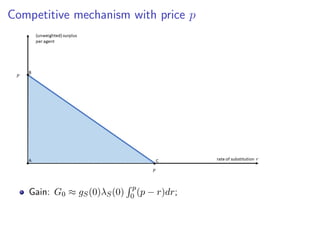
We will consider the welfare effects of raising the price from p to p + ϵ and
rationing, for some initial small price p ≈ 0.
Competitive mechanism with price p
Gain: G0 =
R p
0 λS(r)(p − r)dGS(r);
Competitive mechanism with price p
Gain: G0 ≈ gS(0)λS(0)
R p
0 (p − r)dr;
Competitive mechanism with price p
Gain: G0 ≈ gS(0)λS(0)
R p
0 (p − r)dr;
Competitive mechanism with price p
Gain: G0 ≈ gS(0)λS(0)
R p
0 (p − r)dr;
Cost: C0 = ΛS · pGS(p).
Competitive mechanism with price p + ϵ
Gain: G1 ≈ gS(0)λS(0)
R p+ϵ
0 (p + ϵ − r)dr;
Cost: C1 = ΛS · (p + ϵ)GS(p + ϵ).
Rationing at price p + ϵ
Gain: G1 ≈ gS(0)λS(0) p
p+ϵ
R p+ϵ
0 (p + ϵ − r)dr;
Cost: C1 = ΛS · (p + ϵ)GS(p).
Rationing at price p + ϵ
Gain: G1 ≈ gS(0)λS(0) p
p+ϵ
R p+ϵ
0 (p + ϵ − r)dr;
Cost: C1 = ΛS · (p + ϵ)GS(p).
Rationing at price p + ϵ
Gain: G1 ≈ gS(0)λS(0) p
p+ϵ
R p+ϵ
0 (p + ϵ − r)dr;
Cost: C1 = ΛS · (p + ϵ)GS(p).
Rationing at price p + ϵ
Gain: G1 ≈ gS(0)λS(0) p
p+ϵ
R p+ϵ
0 (p + ϵ − r)dr;
Cost: C1 = ΛS · (p + ϵ)GS(p).
Rationing at price p + ϵ
Change in gain: λS(0)
| {z }
value for money
GS(p)
| {z }
mass
1
2
ϵ
|{z}
per agent surplus
;
Change in cost: ΛS
|{z}
value for money
GS(p)
| {z }
mass
ϵ
|{z}
per agent cost
.
Back to slides
Back to slides
Back to slides
Back to slides
Back to slides
Derivation of the optimal “within-group” mechanism
The “within-group” problem:
Fixing a group of agents i, and a distribution of quality Fi available for
group i, what is the optimal way to allocate quality subject to IC and IR
constraints?
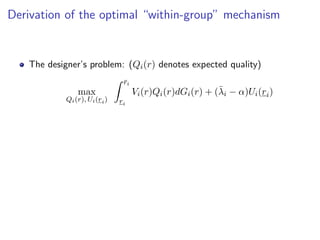
Derivation of the optimal “within-group” mechanism
The designer’s problem: (Qi(r) denotes expected quality)
max
Qi(r), Ui(ri)
Z r̄i
ri
Vi(r)Qi(r)dGi(r) + (λ̄i − α)Ui(ri)
Derivation of the optimal “within-group” mechanism
The designer’s problem: (Qi(r) denotes expected quality)
max
Qi(r)
Z r̄i
ri
Vi(r)Qi(r)dGi(r) + max{0, λ̄i − α}riQi(ri).
Derivation of the optimal “within-group” mechanism
The designer’s problem: (Qi(r) denotes expected quality)
max
Qi(r)
Z r̄i
ri
Vi(r)Qi(r)dGi(r) + max{0, λ̄i − α}riQi(ri).
In the above, Vi(r) = α(r − 1−Gi(r)
gi(r) ) + Λi(r)1−Gi(r)
gi(r) .
Derivation of the optimal “within-group” mechanism
The designer’s problem: (Qi(r) denotes expected quality)
max
Qi(r)
Z r̄i
ri
Vi(r)Qi(r)dGi(r) + max{0, λ̄i − α}riQi(ri).
In the above, Vi(r) = α(r − 1−Gi(r)
gi(r) ) + Λi(r)1−Gi(r)
gi(r) .
Feasible distribution of expected quality: CDF Φi such that
Fi ≻MPS Φi.
Derivation of the optimal “within-group” mechanism
The designer’s problem: (Qi(r) denotes expected quality)
max
Qi(r)
Z r̄i
ri
Vi(r)Qi(r)dGi(r) + max{0, λ̄i − α}riQi(ri).
In the above, Vi(r) = α(r − 1−Gi(r)
gi(r) ) + Λi(r)1−Gi(r)
gi(r) .
Feasible distribution of expected quality: CDF Φi such that
Fi ≻MPS Φi.
Incentive-compatibility =⇒ Gi(r) = Φi(q)
Derivation of the optimal “within-group” mechanism
The designer’s problem: (Qi(r) denotes expected quality)
max
Qi(r)
Z r̄i
ri
Vi(r)Qi(r)dGi(r) + max{0, λ̄i − α}riQi(ri).
In the above, Vi(r) = α(r − 1−Gi(r)
gi(r) ) + Λi(r)1−Gi(r)
gi(r) .
Feasible distribution of expected quality: CDF Φi such that
Fi ≻MPS Φi.
Incentive-compatibility =⇒ Qi(r) = Φ−1
i (Gi(r))
Derivation of the optimal “within-group” mechanism
The designer’s problem: (Qi(r) denotes expected quality)
max
Qi(r)
Z r̄i
ri
Vi(r)Qi(r)dGi(r) + max{0, λ̄i − α}riQi(ri).
In the above, Vi(r) = α(r − 1−Gi(r)
gi(r) ) + Λi(r)1−Gi(r)
gi(r) .
Feasible distribution of expected quality: CDF Φi such that
Φ−1
i ≻MPS F−1
i .
Incentive-compatibility =⇒ Qi(r) = Φ−1
i (Gi(r))
Derivation of the optimal “within-group” mechanism
The designer’s problem is
max
Ψi
Z r̄i
ri
Vi(r)Ψi(Gi(r))dGi(r) + max{0, λ̄i − α}riΨi(0)
s.t. Ψi ≻MPS
F−1
i
Back
Derivation of the optimal “within-group” mechanism
The designer’s problem is
max
Ψi
Z 1
0
Vi(t)
z }| {
Z 1
t
Vi(G−1
i (x))dx + max{0, λ̄i − α}ri1{t=0}

dΨi(t)
s.t. Ψi ≻MPS
F−1
i
Back
Derivation of the optimal “within-group” mechanism
The designer’s problem is
max
Ψi
Z 1
0
Vi(t)
z }| {
Z 1
t
Vi(G−1
i (x))dx + max{0, λ̄i − α}ri1{t=0}

dΨi(t)
s.t. Ψi ≻MPS
F−1
i
Agents are partitioned into intervals according to WTP:
Back
Derivation of the optimal “within-group” mechanism
The designer’s problem is
max
Ψi
Z 1
0
Vi(t)
z }| {
Z 1
t
Vi(G−1
i (x))dx + max{0, λ̄i − α}ri1{t=0}

dΨi(t)
s.t. Ψi ≻MPS
F−1
i
Agents are partitioned into intervals according to WTP:
▶ Market allocation: assortative matching between WTP and quality
Qi(r) = F−1
i (Gi(r)), ∀r ∈ [a, b];
Back
Derivation of the optimal “within-group” mechanism
The designer’s problem is
max
Ψi
Z 1
0
Vi(t)
z }| {
Z 1
t
Vi(G−1
i (x))dx + max{0, λ̄i − α}ri1{t=0}

dΨi(t)
s.t. Ψi ≻MPS
F−1
i
Agents are partitioned into intervals according to WTP:
▶ Market allocation: assortative matching between WTP and quality
Qi(r) = F−1
i (Gi(r)), ∀r ∈ [a, b];
▶ Non-market allocation: random matching between WTP and quality
Qi(r) = q̄, ∀r ∈ [a, b].
Back
Derivation of the optimal “within-group” mechanism
The designer’s problem is
max
Ψi, F̃i
Z 1
0
Vi(t)
z }| {
Z 1
t
Vi(G−1
i (x))dx + max{0, λ̄i − α}ri1{t=0}

dΨi(t)
s.t. Ψi ≻MPS
F̃−1
i ≻FOSD
F−1
i
Agents are partitioned into intervals according to WTP:
▶ Market allocation: assortative matching between WTP and quality
Qi(r) = F−1
i (Gi(r)), ∀r ∈ [a, b];
▶ Non-market allocation: random matching between WTP and quality
Qi(r) = q̄, ∀r ∈ [a, b].
Back

Redistribution through Markets

  • 1.
    Inequality-aware Market Design PiotrDworczak based on joint work with Mohammad Akbarpour and Scott Duke Kominers August 1, 2022 GRAPE Seminar
  • 2.
    Motivation Market designers oftenrespond to participants’ wealth inequalities in markets they control:
  • 3.
    Motivation Market designers oftenrespond to participants’ wealth inequalities in markets they control: ▶ Housing market (rent control + public housing)
  • 4.
    Motivation Market designers oftenrespond to participants’ wealth inequalities in markets they control: ▶ Housing market (rent control + public housing) ▶ Health care
  • 5.
    Motivation Market designers oftenrespond to participants’ wealth inequalities in markets they control: ▶ Housing market (rent control + public housing) ▶ Health care ▶ Food
  • 6.
    Motivation Market designers oftenrespond to participants’ wealth inequalities in markets they control: ▶ Housing market (rent control + public housing) ▶ Health care ▶ Food ▶ Road access
  • 7.
    Motivation Market designers oftenrespond to participants’ wealth inequalities in markets they control: ▶ Housing market (rent control + public housing) ▶ Health care ▶ Food ▶ Road access ▶ (Iranian) kidney market
  • 8.
    Motivation Market designers oftenrespond to participants’ wealth inequalities in markets they control: ▶ Housing market (rent control + public housing) ▶ Health care ▶ Food ▶ Road access ▶ (Iranian) kidney market ▶ Covid-19 vaccines
  • 9.
    Motivation Market designers oftenrespond to participants’ wealth inequalities in markets they control: ▶ Housing market (rent control + public housing) ▶ Health care ▶ Food ▶ Road access ▶ (Iranian) kidney market ▶ Covid-19 vaccines ▶ ...
  • 10.
    Motivation Market designers oftenrespond to participants’ wealth inequalities in markets they control: ▶ Housing market (rent control + public housing) ▶ Health care ▶ Food ▶ Road access ▶ (Iranian) kidney market ▶ Covid-19 vaccines ▶ ... At odds with classical intuitions (welfare theorems)?
  • 11.
    Motivation Market designers oftenrespond to participants’ wealth inequalities in markets they control: ▶ Housing market (rent control + public housing) ▶ Health care ▶ Food ▶ Road access ▶ (Iranian) kidney market ▶ Covid-19 vaccines ▶ ... At odds with classical intuitions (welfare theorems)? ▶ Welfare theorems ignore private information...
  • 12.
    Motivation Market designers oftenrespond to participants’ wealth inequalities in markets they control: ▶ Housing market (rent control + public housing) ▶ Health care ▶ Food ▶ Road access ▶ (Iranian) kidney market ▶ Covid-19 vaccines ▶ ... At odds with classical intuitions (welfare theorems)? ▶ Welfare theorems ignore private information... Equity-efficiency trade-off in public finance...
  • 13.
    Motivation Market designers oftenrespond to participants’ wealth inequalities in markets they control: ▶ Housing market (rent control + public housing) ▶ Health care ▶ Food ▶ Road access ▶ (Iranian) kidney market ▶ Covid-19 vaccines ▶ ... At odds with classical intuitions (welfare theorems)? ▶ Welfare theorems ignore private information... Equity-efficiency trade-off in public finance... ▶ ... but doesn’t delve into the details of market design.
  • 14.
    Motivation Market designers oftenrespond to participants’ wealth inequalities in markets they control: ▶ Housing market (rent control + public housing) ▶ Health care ▶ Food ▶ Road access ▶ (Iranian) kidney market ▶ Covid-19 vaccines ▶ ... At odds with classical intuitions (welfare theorems)? ▶ Welfare theorems ignore private information... Equity-efficiency trade-off in public finance... ▶ ... but doesn’t delve into the details of market design. Inequality-aware Market Design: How to design a market “optimally” when there is inequality among participants?
  • 15.
    Wealth vs MarketDesign Key consequences of wealth effects for market design:
  • 16.
    Wealth vs MarketDesign Wealth may influence individuals’ preferences:
  • 17.
    Wealth vs MarketDesign Wealth may influence individuals’ preferences:
  • 18.
    Wealth vs MarketDesign Wealth may influence individuals’ preferences:
  • 19.
    Wealth vs MarketDesign Wealth inequality may influence social preferences:
  • 20.
    Wealth vs MarketDesign Wealth inequality may influence social preferences:
  • 21.
    Wealth vs MarketDesign Wealth inequality may influence social preferences:
  • 22.
    Wealth vs MarketDesign Maximizing welfare in the canonical quasi-linear framework in mechanism design:
  • 23.
    Wealth vs MarketDesign Maximizing welfare in the canonical quasi-linear framework in mechanism design: Individuals have quasi-linear utilities
  • 24.
    Wealth vs MarketDesign Maximizing welfare in the canonical quasi-linear framework in mechanism design: Individuals have quasi-linear utilities Everyone “values” money the same
  • 25.
    Wealth vs MarketDesign Our approach: blank Individuals have quasi-linear utilities Agents differ in their marginal utility of money
  • 26.
    Wealth vs MarketDesign Our approach: blank Individuals have quasi-linear utilities The designer attaches different Pareto weights to individuals
  • 27.
  • 28.
  • 29.
  • 30.
  • 31.
    The Pareto frontierunder IC and IR constraints
  • 32.
    Related literature (incomplete) Rationingvs. market mechanism: Weitzman (1977); Condorelli (2013); Kang and Zheng (2021, 2022); Reuter and Groh (2021); Kang (2022a, b) Auctions with budget-constrained bidders: Che and Gale (1998), Fernandez and Gali (1999); Che, Gale, and Kim (2012); Pai and Vohra (2014); Kotowski (2017) Optimal taxation: Diamond and Mirrlees (1971); Atkinson and Stiglitz (1976); Piketty and Saez (2013); Scheuer (2014), Saez and Stantcheva (2016, 2017); Scheuer and Werning (2017) Minimum wage and labor taxation: Allen (1987), Guesnerie and Roberts (1987), Boadway and Cuff (2001), Lee and Saez (2012), Cahuc and Laroque (2014) Market design for fairness: Hylland and Zeckhauser (1979); Bogomolnaia and Moulin (2001); Budish (2011)
  • 33.
  • 34.
    Framework There are twogoods: K and M. Good K is indivisible and agents demand one unit, good M is divisible and agents can hold any amount of it. There is a unit mass of sellers (owners of good K), and a mass µ > 0 of buyers (non-owners of good K). Each agent is characterized by (her ownership type and) a two-dimensional type (vK, vM ); If (xK, xM ) denote the holdings of the two goods, then each agent’s utility is given by vK · xK + vM · xM . (vK, vM ) ∼ Fj(vK, vM ) on side j of the market. The designer maximizes expected total value with vK and vM interpreted as social values.
  • 35.
    Framework – someobservations Individual preferences depend only on the rate of substitution: r = vK vM .
  • 36.
    Framework – someobservations Individual preferences depend only on the rate of substitution: r = vK vM . It will turn out that this implies that it is wlog to consider mechanisms whose outcomes only depend on r.
  • 37.
    Framework – someobservations Individual preferences depend only on the rate of substitution: r = vK vM . It will turn out that this implies that it is wlog to consider mechanisms whose outcomes only depend on r. Let: r ∼ Gj with positive density gj on [rj, r̄j].
  • 38.
    Framework – someobservations Individual preferences depend only on the rate of substitution: r = vK vM . It will turn out that this implies that it is wlog to consider mechanisms whose outcomes only depend on r. Let: r ∼ Gj with positive density gj on [rj, r̄j]. Social preferences can also be expressed as a function of r: µEB [xB K · vK + xB M · vM ] + ES [xS K · vK + xS M · vM ].
  • 39.
    Framework – someobservations Individual preferences depend only on the rate of substitution: r = vK vM . It will turn out that this implies that it is wlog to consider mechanisms whose outcomes only depend on r. Let: r ∼ Gj with positive density gj on [rj, r̄j]. Social preferences can also be expressed as a function of r: µEB vM xB K · vK vM + xB M + ES vM xS K · vK vM + xS M .
  • 40.
    Framework – someobservations Individual preferences depend only on the rate of substitution: r = vK vM . It will turn out that this implies that it is wlog to consider mechanisms whose outcomes only depend on r. Let: r ∼ Gj with positive density gj on [rj, r̄j]. Social preferences can also be expressed as a function of r: µEB EB [vM |r] xB K · r + xB M + ES ES [vM |r] xS K · r + xS M .
  • 41.
    Framework – someobservations Individual preferences depend only on the rate of substitution: r = vK vM . It will turn out that this implies that it is wlog to consider mechanisms whose outcomes only depend on r. Let: r ∼ Gj with positive density gj on [rj, r̄j]. Social preferences can also be expressed as a function of r: µEB   EB [vM |r] | {z } λB(r) xB K · r + xB M | {z } UB(r)    + ES   ES [vM |r] | {z } λS(r) xS K · r + xS M | {z } US(r)    .
  • 42.
    Framework – someobservations Individual preferences depend only on the rate of substitution: r = vK vM . It will turn out that this implies that it is wlog to consider mechanisms whose outcomes only depend on r. Let: r ≡ vK/vM ∼ Gj with positive density gj on [rj, r̄j]. Social preferences can also be expressed as a function of r: TS(Λ) = µ Z r̄B rB λB(r)UB(r)dGB(r) + Z r̄S rS λS(r)US(r)dGS(r).
  • 43.
    Framework A key assumption: λj(r)= E vM | vK vM = r is non-increasing.
  • 44.
    Framework A key assumption: λj(r)= E vM | vK vM = r is non-increasing. Example: What’s your willingness to pay for an Uber ride to the airport? Agent 1: $100 = vK vM Agent 2: $10 = vK vM
  • 45.
    Framework A key assumption: λj(r)= E vM | vK vM = r is non-increasing. Example: What’s your willingness to pay for an Uber ride to the airport? Agent 1: $100 = vK vM Agent 2: $10 = vK vM In our model, the designer attaches a higher weight to Agent 2.
  • 46.
    Framework A key assumption: λj(r)= E vM | vK vM = r is non-increasing. Example: What’s your willingness to pay for an Uber ride to the airport? Agent 1: $100 = vK vM Agent 2: $10 = vK vM In our model, the designer attaches a higher weight to Agent 2. Idea: Willingness to pay can be used to make a statistical inference about the marginal value for money; The designer attaches a higher Pareto weight to agents with lower willingness to pay (that are “poor in expectation”)
  • 47.
    Framework A key assumption: λj(r)= E vM | vK vM = r is non-increasing. Example: What’s your WTP for a Tommy Emmanuel’s concert ticket? Agent 1: $100 = vK vM Agent 2: $10 = vK vM In our model, the designer attaches a higher weight to Agent 2. Idea: Willingness to pay can be used to make a statistical inference about the marginal value for money; The designer attaches a higher Pareto weight to agents with lower willingness to pay (that are “poor in expectation”)
  • 48.
    Framework A key assumption: λj(r)= E vM | vK vM = r is non-increasing. Example: What’s your willingness to pay for life-saving medicine? Agent 1: $100 = vK vM Agent 2: $10 = vK vM In our model, the designer attaches a higher weight to Agent 2. Idea: Willingness to pay can be used to make a statistical inference about the marginal value for money; The designer attaches a higher Pareto weight to agents with lower willingness to pay (that are “poor in expectation”)
  • 49.
    Framework – Mechanisms Thedesigner chooses a trading mechanism subject to 4 constraints: Incentive Compatibility Individual Rationality Market Clearing Budget Balance
  • 50.
    Simple mechanisms Simple mechanismsin a simplified setting
  • 51.
    Simple mechanisms Assumptions: The rateof substitution r is uniformly distributed on both sides of the market. The designer uses a single-price or two-price mechanism.
  • 52.
    Simple mechanisms Assumptions: The rateof substitution r is uniformly distributed on both sides of the market. The designer uses a single-price or two-price mechanism. We will first solve one-sided problems (for a fixed volume of trade Q and revenue/budget R), and then link the two sides.
  • 53.
  • 54.
  • 55.
    Single-price mechanisms –seller side Problem: Choose a price pS to maximize seller welfare while buying quantity Q and not exceeding a budget of R (where R QG−1 S (Q)).
  • 56.
    Single-price mechanisms –seller side Problem: Choose a price pS to maximize seller welfare while buying quantity Q and not exceeding a budget of R (where R QG−1 S (Q)). max pS≥G−1 S (Q) ( Q GS(pS) Z pS rS λS(r)(pS − r)dGS(r) + ΛS(R − pSQ) ) , where ΛS = ES[vM ].
  • 57.
    Single-price mechanisms –seller side Problem: Choose a price pS to maximize seller welfare while buying quantity Q and not exceeding a budget of R (where R QG−1 S (Q)). max pS≥G−1 S (Q) ( Q GS(pS) Z pS rS λS(r)(pS − r)dGS(r) + ΛS(R − pSQ) ) , where ΛS = ES[vM ]. We will refer to the price pC S = G−1 S (Q) as the competitive price; Any price pS pC S leads to rationing.
  • 58.
    Single-price mechanisms –seller side Low seller-side inequality ⇐⇒ λS(rS) ≤ 2ΛS.
  • 59.
    Single-price mechanisms –seller side Low seller-side inequality ⇐⇒ λS(rS) ≤ 2ΛS.
  • 60.
    Single-price mechanisms –seller side Low seller-side inequality ⇐⇒ λS(rS) ≤ 2ΛS. Proposition When seller-side inequality is low, it is optimal to choose pS = pC S .
  • 61.
    Single-price mechanisms –seller side Low seller-side inequality ⇐⇒ λS(rS) ≤ 2ΛS. Proposition When seller-side inequality is low, it is optimal to choose pS = pC S . When seller-side inequality is high, there exists Q̄ ∈ [0, 1) such that Rationing at a price pS pC S is optimal when Q Q̄; Setting pS = pC S is optimal when Q ≥ Q̄.
  • 62.
    Single-price mechanisms –seller side Low seller-side inequality ⇐⇒ λS(rS) ≤ 2ΛS. Proposition When seller-side inequality is low, it is optimal to choose pS = pC S . When seller-side inequality is high, there exists Q̄ ∈ [0, 1) such that Rationing at a price pS pC S is optimal when Q Q̄; Setting pS = pC S is optimal when Q ≥ Q̄. This is in fact the optimal mechanism overall!
  • 63.
    Single-price mechanisms –seller side Intuition: There are three effects associated with raising the price pS above the competitive level pC S : 1 Allocative efficiency is reduced ↓
  • 64.
    Single-price mechanisms –seller side Intuition: There are three effects associated with raising the price pS above the competitive level pC S : 1 Allocative efficiency is reduced ↓ 2 The mechanism uses up more money leaving a smaller amount R − pSQ to be redistributed as a lump-sum transfer to all sellers ↓
  • 65.
    Single-price mechanisms –seller side Intuition: There are three effects associated with raising the price pS above the competitive level pC S : 1 Allocative efficiency is reduced ↓ 2 The mechanism uses up more money leaving a smaller amount R − pSQ to be redistributed as a lump-sum transfer to all sellers ↓ 3 Sellers that sell receive a higher price ↑
  • 66.
    Single-price mechanisms –seller side Intuition: There are three effects associated with raising the price pS above the competitive level pC S : 1 Allocative efficiency is reduced ↓ 2 The mechanism uses up more money leaving a smaller amount R − pSQ to be redistributed as a lump-sum transfer to all sellers ↓ 3 Sellers that sell receive a higher price ↑
  • 67.
    Single-price mechanisms –seller side Intuition: There are three effects associated with raising the price pS above the competitive level pC S : 1 Allocative efficiency is reduced ↓ 2 The mechanism uses up more money leaving a smaller amount R − pSQ to be redistributed as a lump-sum transfer to all sellers ↓ 3 Sellers that sell receive a higher price ↑ Consider the net redistribution effect 2+3: −ΛS
  • 68.
    Single-price mechanisms –seller side Intuition: There are three effects associated with raising the price pS above the competitive level pC S : 1 Allocative efficiency is reduced ↓ 2 The mechanism uses up more money leaving a smaller amount R − pSQ to be redistributed as a lump-sum transfer to all sellers ↓ 3 Sellers that sell receive a higher price ↑ Consider the net redistribution effect 2+3: −ΛS + ES [λS(r)|r ≤ pS]
  • 69.
    Single-price mechanisms –seller side Intuition: There are three effects associated with raising the price pS above the competitive level pC S : 1 Allocative efficiency is reduced ↓ 2 The mechanism uses up more money leaving a smaller amount R − pSQ to be redistributed as a lump-sum transfer to all sellers ↓ 3 Sellers that sell receive a higher price ↑ Consider the net redistribution effect 2+3: −ΛS + ES [λS(r)|r ≤ pS] ≥ 0 ↑
  • 70.
    Single-price mechanisms –seller side Intuition: There are three effects associated with raising the price pS above the competitive level pC S : 1 Allocative efficiency is reduced ↓ 2 The mechanism uses up more money leaving a smaller amount R − pSQ to be redistributed as a lump-sum transfer to all sellers ↓ 3 Sellers that sell receive a higher price ↑ Consider the net redistribution effect 2+3: −ΛS + ES [λS(r)|r ≤ pS] ≥ 0 ↑ This net effect must be stronger than the negative effect 1 to justify rationing: High seller-side inequality; Low volume of trade: Q Q̄.
  • 71.
  • 72.
    Single-price mechanisms –buyer side Problem: Choose a price pB to maximize buyer welfare while selling quantity Q and raising a revenue of R (where R QG−1 B (1 − Q)).
  • 73.
    Single-price mechanisms –buyer side Problem: Choose a price pB to maximize buyer welfare while selling quantity Q and raising a revenue of R (where R QG−1 B (1 − Q)). max pB≤G−1 B (1−Q) Q 1 − GB(pB) Z r̄B pB λB(r)(r − pB)dGB(r) + ΛB(pBQ − R) . where ΛB = EB[vM ].
  • 74.
    Single-price mechanisms –buyer side Problem: Choose a price pB to maximize buyer welfare while selling quantity Q and raising a revenue of R (where R QG−1 B (1 − Q)). max pB≤G−1 B (1−Q) Q 1 − GB(pB) Z r̄B pB λB(r)(r − pB)dGB(r) + ΛB(pBQ − R) . where ΛB = EB[vM ]. We will refer to the price pC B = G−1 B (1 − Q) as the competitive price; Any price pB pC B leads to rationing.
  • 75.
    Single-price mechanisms –buyer side Proposition Regardless of buyer-side inequality, it is optimal to set pB = pC B. That is, the competitive mechanism is always optimal.
  • 76.
    Single-price mechanisms –buyer side Intuition: There are three effects associated with lowering the price pB below the competitive level pC B: 1 Allocative efficiency is reduced ↓
  • 77.
    Single-price mechanisms –buyer side Intuition: There are three effects associated with lowering the price pB below the competitive level pC B: 1 Allocative efficiency is reduced ↓ 2 The mechanism generates less revenue pBQ − R that can be redistributed as a lump-sum transfer to all buyers ↓
  • 78.
    Single-price mechanisms –buyer side Intuition: There are three effects associated with lowering the price pB below the competitive level pC B: 1 Allocative efficiency is reduced ↓ 2 The mechanism generates less revenue pBQ − R that can be redistributed as a lump-sum transfer to all buyers ↓ 3 Buyers that buy pay a lower price ↑
  • 79.
    Single-price mechanisms –buyer side Intuition: There are three effects associated with lowering the price pB below the competitive level pC B: 1 Allocative efficiency is reduced ↓ 2 The mechanism generates less revenue pBQ − R that can be redistributed as a lump-sum transfer to all buyers ↓ 3 Buyers that buy pay a lower price ↑
  • 80.
    Single-price mechanisms –buyer side Intuition: There are three effects associated with lowering the price pB below the competitive level pC B: 1 Allocative efficiency is reduced ↓ 2 The mechanism generates less revenue pBQ − R that can be redistributed as a lump-sum transfer to all buyers ↓ 3 Buyers that buy pay a lower price ↑ Consider the net redistribution effect 2+3: −ΛB
  • 81.
    Single-price mechanisms –buyer side Intuition: There are three effects associated with lowering the price pB below the competitive level pC B: 1 Allocative efficiency is reduced ↓ 2 The mechanism generates less revenue pBQ − R that can be redistributed as a lump-sum transfer to all buyers ↓ 3 Buyers that buy pay a lower price ↑ Consider the net redistribution effect 2+3: −ΛB + EB [λB(r)|r ≥ pB]
  • 82.
    Single-price mechanisms –buyer side Intuition: There are three effects associated with lowering the price pB below the competitive level pC B: 1 Allocative efficiency is reduced ↓ 2 The mechanism generates less revenue pBQ − R that can be redistributed as a lump-sum transfer to all buyers ↓ 3 Buyers that buy pay a lower price ↑ Consider the net redistribution effect 2+3: −ΛB + EB [λB(r)|r ≥ pB] ≤ 0 ↓
  • 83.
    Single-price mechanisms –buyer side Intuition: There are three effects associated with lowering the price pB below the competitive level pC B: 1 Allocative efficiency is reduced ↓ 2 The mechanism generates less revenue pBQ − R that can be redistributed as a lump-sum transfer to all buyers ↓ 3 Buyers that buy pay a lower price ↑ Consider the net redistribution effect 2+3: −ΛB + EB [λB(r)|r ≥ pB] ≤ 0 ↓ The net redistribution effect is negative!
  • 84.
  • 85.
    Two-price mechanisms A designercan now post two prices, pH j and pL j , for each side j of the market.
  • 86.
    Two-price mechanisms A designercan now post two prices, pH j and pL j , for each side j of the market. Traders trade with probability one at the less attractive price (higher for buyers, lower for sellers), and trade with some interior probability δ at the more attractive price.
  • 87.
  • 88.
    Two-price mechanisms –seller side Nothing changes!
  • 89.
  • 90.
    Two-price mechanisms –buyer side max pH B ≥pL B, δ      δ Z rδ pL B λB(r)(r − pL B)dGB(r) + Z r̄B rδ λB(r)(r − pH B )dGB(r) +ΛB pL Bδ(GB(rδ) − GB(pL B)) + pH B (1 − GB(rδ)) − R      subject to the market-clearing and revenue-target constraints 1 − δGB(pL B) − (1 − δ)GB(rδ) = Q, pL Bδ(GB(rδ) − GB(pL B)) + pH B (1 − GB(rδ)) ≥ R, where rδ is the type indifferent between the high and the low price.
  • 91.
    Two-price mechanisms –buyer side max pH B ≥pL B, δ      δ Z rδ pL B λB(r)(r − pL B)dGB(r) + Z r̄B rδ λB(r)(r − pH B )dGB(r) +ΛB pL Bδ(GB(rδ) − GB(pL B)) + pH B (1 − GB(rδ)) − R      subject to the market-clearing and revenue-target constraints 1 − δGB(pL B) − (1 − δ)GB(rδ) = Q, pL Bδ(GB(rδ) − GB(pL B)) + pH B (1 − GB(rδ)) ≥ R, where rδ is the type indifferent between the high and the low price. We say that there is rationing at the lower price pL B if δ 1 and GB(rδ) GB(pL B), i.e., if a non-zero measure of buyers choose the lottery.
  • 92.
    Two-price mechanisms –buyer side Low buyer-side inequality ⇐⇒ λB(rB) ≤ 2ΛB.
  • 93.
    Two-price mechanisms –buyer side Low buyer-side inequality ⇐⇒ λB(rB) ≤ 2ΛB. Proposition When buyer-side inequality is low, it is optimal not to offer the low price pL B and to choose pH B = pC B.
  • 94.
    Two-price mechanisms –buyer side Low buyer-side inequality ⇐⇒ λB(rB) ≤ 2ΛB. Proposition When buyer-side inequality is low, it is optimal not to offer the low price pL B and to choose pH B = pC B. When buyer-side inequality is high, there exists Q ∈ (0, 1] such that Rationing at the low price is optimal when Q Q; Setting pH B = pC B (and not offering the low price pL B) is optimal for Q ≤ Q.
  • 95.
    Two-price mechanisms –buyer side Low buyer-side inequality ⇐⇒ λB(rB) ≤ 2ΛB. Proposition When buyer-side inequality is low, it is optimal not to offer the low price pL B and to choose pH B = pC B. When buyer-side inequality is high, there exists Q ∈ (0, 1] such that Rationing at the low price is optimal when Q Q; Setting pH B = pC B (and not offering the low price pL B) is optimal for Q ≤ Q. This is in fact the optimal mechanism overall!
  • 96.
    Two-price mechanisms –buyer side Intuition: This time rationing (a discounted price) is offered to buyers with relatively low types r ∈ [pL B, rδ], so that it is possible that the net redistribution effect is positive: −ΛB
  • 97.
    Two-price mechanisms –buyer side Intuition: This time rationing (a discounted price) is offered to buyers with relatively low types r ∈ [pL B, rδ], so that it is possible that the net redistribution effect is positive: −ΛB + EB [λB(r)| r ∈ [pL B, rδ]]
  • 98.
    Two-price mechanisms –buyer side Intuition: This time rationing (a discounted price) is offered to buyers with relatively low types r ∈ [pL B, rδ], so that it is possible that the net redistribution effect is positive: −ΛB + EB [λB(r)| r ∈ [pL B, rδ]] ≥ 0
  • 99.
    Two-price mechanisms –buyer side Intuition: This time rationing (a discounted price) is offered to buyers with relatively low types r ∈ [pL B, rδ], so that it is possible that the net redistribution effect is positive: −ΛB + EB [λB(r)| r ∈ [pL B, rδ]] ≥ 0 ↑
  • 100.
    Two-price mechanisms –buyer side Intuition: This time rationing (a discounted price) is offered to buyers with relatively low types r ∈ [pL B, rδ], so that it is possible that the net redistribution effect is positive: −ΛB + EB [λB(r)| r ∈ [pL B, rδ]] ≥ 0 ↑ This net effect must be stronger than the negative effect on allocative efficiency to justify rationing: High buyer-side inequality; High volume of trade: Q Q.
  • 101.
  • 102.
    Cross-side optimality Proposition When same-sideinequality is low on both sides of the market, it is optimal to set pB ≥ pS such that the market clears, GS(pS) = µ(1 − GB(pB)), and redistribute the resulting revenue as a lump-sum payment to the side of the market j ∈ {B, S} with higher average value for money Λj.
  • 103.
    Cross-side optimality Proposition When same-sideinequality is low on both sides of the market, it is optimal to set pB ≥ pS such that the market clears, GS(pS) = µ(1 − GB(pB)), and redistribute the resulting revenue as a lump-sum payment to the side of the market j ∈ {B, S} with higher average value for money Λj. For example, when there is no same-side inequality: pB − pS = ΛS − ΛB ΛS 1 − GB(pB) gB(pB) .
  • 104.
    Cross-side optimality Proposition When same-sideinequality is low on both sides of the market, it is optimal to set pB ≥ pS such that the market clears, GS(pS) = µ(1 − GB(pB)), and redistribute the resulting revenue as a lump-sum payment to the side of the market j ∈ {B, S} with higher average value for money Λj. For example, when there is no same-side inequality: pB − pS = ΛS − ΛB ΛS 1 − GB(pB) gB(pB) . We will refer to the situation ΛS ̸= ΛB as cross-side inequality.
  • 105.
    Cross-side optimality Proposition When same-sideinequality is low on both sides of the market, it is optimal to set pB ≥ pS such that the market clears, GS(pS) = µ(1 − GB(pB)), and redistribute the resulting revenue as a lump-sum payment to the side of the market j ∈ {B, S} with higher average value for money Λj. Competitive equilibrium, defined by pB = pS = pCE, where GS(pCE ) = µ(1 − GB(pCE )), is optimal only when there is no cross-side inequality (ΛS = ΛB).
  • 106.
    Cross-side optimality Sellers: Proposition When seller-sideinequality is high and ΛS ≥ ΛB, if µ is low enough, then it is optimal to ration the sellers by setting a single price above the competitive-equilibrium level.
  • 107.
    Cross-side optimality Sellers: Proposition When seller-sideinequality is high and ΛS ≥ ΛB, if µ is low enough, then it is optimal to ration the sellers by setting a single price above the competitive-equilibrium level. Intuition: Low µ guarantees a low enough volume of trade;
  • 108.
    Cross-side optimality Sellers: Proposition When seller-sideinequality is high and ΛS ≥ ΛB, if µ is low enough, then it is optimal to ration the sellers by setting a single price above the competitive-equilibrium level. Intuition: Low µ guarantees a low enough volume of trade; ΛS ≥ ΛB guarantees that the budget constraint does not alter the optimal mechanism for the seller side.
  • 109.
    Cross-side optimality Buyers: Proposition If seller-sideinequality is low and rB = 0, then the optimal mechanism does not ration the buyers (regardless of buyer-side inequality).
  • 110.
    Cross-side optimality Buyers: Proposition If seller-sideinequality is low and rB = 0, then the optimal mechanism does not ration the buyers (regardless of buyer-side inequality). Rationing the buyers is suboptimal for any µ!
  • 111.
    Cross-side optimality Proposition If seller-sideinequality is low and rB = 0, then the optimal mechanism does not ration the buyers (regardless of buyer-side inequality). Intuition: Under these conditions, it is never optimal to have a high volume of trade in the mechanism;
  • 112.
    Cross-side optimality Proposition If seller-sideinequality is low and rB = 0, then the optimal mechanism does not ration the buyers (regardless of buyer-side inequality). Intuition: Under these conditions, it is never optimal to have a high volume of trade in the mechanism; High volume of trade and rB = 0 imply that the revenue generated by the mechanism is small;
  • 113.
    Cross-side optimality Proposition If seller-sideinequality is low and rB = 0, then the optimal mechanism does not ration the buyers (regardless of buyer-side inequality). Intuition: Under these conditions, it is never optimal to have a high volume of trade in the mechanism; High volume of trade and rB = 0 imply that the revenue generated by the mechanism is small; Rationing = providing the good at a low price to “poor” agents, is ineffective when rB = 0;
  • 114.
    Cross-side optimality Proposition If seller-sideinequality is low and rB = 0, then the optimal mechanism does not ration the buyers (regardless of buyer-side inequality). Intuition: Under these conditions, it is never optimal to have a high volume of trade in the mechanism; High volume of trade and rB = 0 imply that the revenue generated by the mechanism is small; Rationing = providing the good at a low price to “poor” agents, is ineffective when rB = 0; A better idea: Limit volume, raise revenue, and help the “poor” buyers by giving a lump-sum transfer.
  • 115.
    Cross-side optimality Proposition If thereis high buyer-side inequality, ΛB ≥ ΛS, and rB − r̄S ≥ 1 2 (r̄B − rS), then there is some ϵ 0 such that it is optimal to ration the buyers for any µ ∈ (1, 1 + ϵ).
  • 116.
    Cross-side optimality Proposition If thereis high buyer-side inequality, ΛB ≥ ΛS, and rB − r̄S ≥ 1 2 (r̄B − rS), then there is some ϵ 0 such that it is optimal to ration the buyers for any µ ∈ (1, 1 + ϵ). Intuition: Because there are large gains from trade, any optimal mechanism must maximize volume of trade;
  • 117.
    Cross-side optimality Proposition If thereis high buyer-side inequality, ΛB ≥ ΛS, and rB − r̄S ≥ 1 2 (r̄B − rS), then there is some ϵ 0 such that it is optimal to ration the buyers for any µ ∈ (1, 1 + ϵ). Intuition: Because there are large gains from trade, any optimal mechanism must maximize volume of trade; Because there are slightly more buyers than sellers in the market, almost all buyers buy;
  • 118.
    Cross-side optimality Proposition If thereis high buyer-side inequality, ΛB ≥ ΛS, and rB − r̄S ≥ 1 2 (r̄B − rS), then there is some ϵ 0 such that it is optimal to ration the buyers for any µ ∈ (1, 1 + ϵ). Intuition: Because there are large gains from trade, any optimal mechanism must maximize volume of trade; Because there are slightly more buyers than sellers in the market, almost all buyers buy; Thus, we have high volume + high buyer-side inequality =⇒ buyer rationing.
  • 119.
  • 120.
    General Framework A designerchooses a mechanism to allocate a unit mass of objects to a unit mass of agents. Each object has quality q ∈ [0, 1], q is distributed acc. to cdf F. Each agent is characterized by a type (i, r, λ), where: i is an observable label, i ∈ I (finite); r is an unobserved willingness to pay (for quality), r ∈ R+; λ is an unobserved social welfare weight, λ ∈ R+; The type distribution is known to the designer. If (i, r, λ) gets a good with quality q and pays t, her utility is qr − t, while her contribution to social welfare is λ(qr − t)
  • 121.
    General Framework The designerhas access to arbitrary (direct) allocation mechanisms (Γ, T) where Γ(q|i, r, λ) is the probability that (i, r, λ) gets a good with quality q or less, and T(i, r, λ) is the associated payment, subject to: Feasibility: E(i,r,λ) [Γ(q|i, r, λ)] ≥ F(q), ∀q ∈ [0, 1]; IC constraint: Each agent (i, r, λ) reports (r, λ) truthfully; IR constraint: U(i, r, λ) ≡ r R qdΓ(q|i, r, λ) − T(i, r, λ) ≥ 0; Non-negative transfers: T(i, r, λ) ≥ 0, ∀(i, r, λ). The designer maximizes, for some constant α ≥ 0, a weighted sum of revenue and agents’ utilities: E(i,r,λ) [αT(i, r, λ) + λU(i, r, λ)] .
  • 122.
    Framework The role ofrevenue: The weight α on revenue captures the value of a dollar in the designer’s budget, spent on the most valuable “cause.”
  • 123.
    Framework The role ofrevenue: The weight α on revenue captures the value of a dollar in the designer’s budget, spent on the most valuable “cause.” α = maxi λ̄i: As if a lump-sum transfer to group i were allowed;
  • 124.
    Framework The role ofrevenue: The weight α on revenue captures the value of a dollar in the designer’s budget, spent on the most valuable “cause.” α = maxi λ̄i: As if a lump-sum transfer to group i were allowed; α = averagei λ̄i: As if lump-sum transfers to all agents were allowed.
  • 125.
    Framework The role ofrevenue: The weight α on revenue captures the value of a dollar in the designer’s budget, spent on the most valuable “cause.” α = maxi λ̄i: As if a lump-sum transfer to group i were allowed; α = averagei λ̄i: As if lump-sum transfers to all agents were allowed. α λ̄i for all i: There is an “outside cause.”
  • 126.
    Framework The role ofrevenue: The weight α on revenue captures the value of a dollar in the designer’s budget, spent on the most valuable “cause.” α = maxi λ̄i: As if a lump-sum transfer to group i were allowed; α = averagei λ̄i: As if lump-sum transfers to all agents were allowed. α λ̄i for all i: There is an “outside cause.” α λ̄i for some i: Lump-sum payments to agents in group i are prohibited or costly.
  • 127.
    Framework Lemma It is optimalfor the designer to condition the allocation and transfers only on agents’ labels i and WTP r.
  • 128.
    Framework Lemma It is optimalfor the designer to condition the allocation and transfers only on agents’ labels i and WTP r. Let Vi(r) be the expected per-unit-of-quality social benefit from allocating a good to an agent with WTP r in group i in an IC mechanism.
  • 129.
    Framework Lemma It is optimalfor the designer to condition the allocation and transfers only on agents’ labels i and WTP r. Let Vi(r) be the expected per-unit-of-quality social benefit from allocating a good to an agent with WTP r in group i in an IC mechanism. Pareto optimality with perfectly transferable utility (first welfare theorem): Vi(r) = r text
  • 130.
    Framework Lemma It is optimalfor the designer to condition the allocation and transfers only on agents’ labels i and WTP r. Let Vi(r) be the expected per-unit-of-quality social benefit from allocating a good to an agent with WTP r in group i in an IC mechanism. Let Gi(r) be a continuous distribution of WTP conditional on label i. Vi(r) = r text
  • 131.
    Framework Lemma It is optimalfor the designer to condition the allocation and transfers only on agents’ labels i and WTP r. Let Vi(r) be the expected per-unit-of-quality social benefit from allocating a good to an agent with WTP r in group i in an IC mechanism. If the designer maximizes revenue a’la Myerson (1981): Vi(r) = r − 1 − Gi(r) gi(r) text
  • 132.
    Framework Lemma It is optimalfor the designer to condition the allocation and transfers only on agents’ labels i and WTP r. Let Vi(r) be the expected per-unit-of-quality social benefit from allocating a good to an agent with WTP r in group i in an IC mechanism. Pareto optimality with perfectly transferable utility (first welfare theorem): Vi(r) = r text
  • 133.
    Framework Lemma It is optimalfor the designer to condition the allocation and transfers only on agents’ labels i and WTP r. Let Vi(r) be the expected per-unit-of-quality social benefit from allocating a good to an agent with WTP r in group i in an IC mechanism. A useful decomposition: Vi(r) = Λi(r)· 1 − Gi(r) gi(r) + α· r − 1 − Gi(r) gi(r) text
  • 134.
    Framework Lemma It is optimalfor the designer to condition the allocation and transfers only on agents’ labels i and WTP r. Let Vi(r) be the expected per-unit-of-quality social benefit from allocating a good to an agent with WTP r in group i in an IC mechanism. A useful decomposition: Vi(r) = Λi(r)· 1 − Gi(r) gi(r) | {z } utility + α· r − 1 − Gi(r) gi(r) | {z } revenue text
  • 135.
    Framework Lemma It is optimalfor the designer to condition the allocation and transfers only on agents’ labels i and WTP r. Let Vi(r) be the expected per-unit-of-quality social benefit from allocating a good to an agent with WTP r in group i in an IC mechanism. With redistributive preferences: Vi(r) = Λi(r) · 1 − Gi(r) gi(r) | {z } utility + α · r − 1 − Gi(r) gi(r) | {z } revenue where Λi(r) = Er̃∼Gi [ λ | r̃ ≥ r, i].
  • 136.
    Framework Lemma It is optimalfor the designer to condition the allocation and transfers only on agents’ labels i and WTP r. Let Vi(r) be the expected per-unit-of-quality social benefit from allocating a good to an agent with WTP r in group i in an IC mechanism. With redistributive preferences: Vi(r) = Λi(r) · 1 − Gi(r) gi(r) | {z } utility + α · r − 1 − Gi(r) gi(r) | {z } revenue where Λi(r) = Er̃∼Gi [ λ | r̃ ≥ r, i].
  • 137.
    Framework Economic idea: The designerassesses the “need” of agents by estimating the unobserved welfare weights based on the observable (label i) and elicitable (wtp r) information: Λi(r) = Er̃∼Gi [ λ | r̃ ≥ r, i].
  • 138.
    Framework Economic idea: The designerassesses the “need” of agents by estimating the unobserved welfare weights based on the observable (label i) and elicitable (wtp r) information: Λi(r) = Er̃∼Gi [ λ | r̃ ≥ r, i]. Consequence: The optimal allocation depends on the statistical correlation of labels and willingness to pay with the unobserved social welfare weights.
  • 139.
    Framework Economic idea: The designerassesses the “need” of agents by estimating the unobserved welfare weights based on the observable (label i) and elicitable (wtp r) information: Λi(r) = Er̃∼Gi [ λ | r̃ ≥ r, i]. Consequence: The optimal allocation depends on the statistical correlation of labels and willingness to pay with the unobserved social welfare weights. Correlation is likely to be negative (however, the direction and strength depend on the market context!)
  • 140.
    Derivation of OptimalMechanism Derivation of Optimal Mechanism
  • 141.
    Derivation of OptimalMechanism 1 Objects are allocated “across” groups: F is split into I cdfs F⋆ i ;
  • 142.
    Derivation of OptimalMechanism 1 Objects are allocated “across” groups: F is split into I cdfs F⋆ i ; 2 Objects are allocated “within” groups: For each label i, the objects F⋆ i are allocated optimally to agents in group i.
  • 143.
    Derivation of OptimalMechanism 1 Objects are allocated “across” groups: F is split into I cdfs F⋆ i ; 2 Objects are allocated “within” groups: For each label i, the objects F⋆ i are allocated optimally to agents in group i.
  • 144.
    Derivation of OptimalMechanism 1 Objects are allocated “across” groups: F is split into I cdfs F⋆ i ; 2 Objects are allocated “within” groups: For each label i, the objects F⋆ i are allocated optimally to agents in group i. Brief recap of Myerson’s ironing: Start with virtual surplus: V (r) = r − 1−G(r) g(r) ;
  • 145.
    Derivation of OptimalMechanism 1 Objects are allocated “across” groups: F is split into I cdfs F⋆ i ; 2 Objects are allocated “within” groups: For each label i, the objects F⋆ i are allocated optimally to agents in group i. Brief recap of Myerson’s ironing: Start with virtual surplus: V (r) = r − 1−G(r) g(r) ; Integrate (in the quantile space): Ψ(t) := R 1 t V (G−1(x))dx;
  • 146.
    Derivation of OptimalMechanism 1 Objects are allocated “across” groups: F is split into I cdfs F⋆ i ; 2 Objects are allocated “within” groups: For each label i, the objects F⋆ i are allocated optimally to agents in group i. Brief recap of Myerson’s ironing: Start with virtual surplus: V (r) = r − 1−G(r) g(r) ; Integrate (in the quantile space): Ψ(t) := R 1 t V (G−1(x))dx; Concavify the function Ψ;
  • 147.
    Derivation of OptimalMechanism 1 Objects are allocated “across” groups: F is split into I cdfs F⋆ i ; 2 Objects are allocated “within” groups: For each label i, the objects F⋆ i are allocated optimally to agents in group i. Brief recap of Myerson’s ironing: Start with virtual surplus: V (r) = r − 1−G(r) g(r) ; Integrate (in the quantile space): Ψ(t) := R 1 t V (G−1(x))dx; Concavify the function Ψ; Differentiate Ψ to get the “ironed” virtual surplus V̄ (r);
  • 148.
    Derivation of OptimalMechanism 1 Objects are allocated “across” groups: F is split into I cdfs F⋆ i ; 2 Objects are allocated “within” groups: For each label i, the objects F⋆ i are allocated optimally to agents in group i. Brief recap of Myerson’s ironing: Start with virtual surplus: V (r) = r − 1−G(r) g(r) ; Integrate (in the quantile space): Ψ(t) := R 1 t V (G−1(x))dx; Concavify the function Ψ; Differentiate Ψ to get the “ironed” virtual surplus V̄ (r); ▶ Ironed virtual surplus is negative =⇒ do not allocate;
  • 149.
    Derivation of OptimalMechanism 1 Objects are allocated “across” groups: F is split into I cdfs F⋆ i ; 2 Objects are allocated “within” groups: For each label i, the objects F⋆ i are allocated optimally to agents in group i. Brief recap of Myerson’s ironing: Start with virtual surplus: V (r) = r − 1−G(r) g(r) ; Integrate (in the quantile space): Ψ(t) := R 1 t V (G−1(x))dx; Concavify the function Ψ; Differentiate Ψ to get the “ironed” virtual surplus V̄ (r); ▶ Ironed virtual surplus is negative =⇒ do not allocate; ▶ Ironed virtual surplus is constant =⇒ randomize (const. allocation);
  • 150.
    Derivation of OptimalMechanism 1 Objects are allocated “across” groups: F is split into I cdfs F⋆ i ; 2 Objects are allocated “within” groups: For each label i, the objects F⋆ i are allocated optimally to agents in group i. Brief recap of Myerson’s ironing: Start with virtual surplus: V (r) = r − 1−G(r) g(r) ; Integrate (in the quantile space): Ψ(t) := R 1 t V (G−1(x))dx; Concavify the function Ψ; Differentiate Ψ to get the “ironed” virtual surplus V̄ (r); ▶ Ironed virtual surplus is negative =⇒ do not allocate; ▶ Ironed virtual surplus is constant =⇒ randomize (const. allocation); ▶ Ironed virtual surplus is increasing =⇒ auction (increasing allocation).
  • 151.
    Derivation of OptimalMechanism 1 Objects are allocated “across” groups: F is split into I cdfs F⋆ i ; 2 Objects are allocated “within” groups: For each label i, the objects F⋆ i are allocated optimally to agents in group i.
  • 152.
    Derivation of OptimalMechanism 1 Objects are allocated “across” groups: F is split into I cdfs F⋆ i ; 2 Objects are allocated “within” groups: For each label i, the objects F⋆ i are allocated optimally to agents in group i. Observation: Only expected quality, Qi(r), matters for payoffs.
  • 153.
    Derivation of OptimalMechanism 1 Objects are allocated “across” groups: F is split into I cdfs F⋆ i ; 2 Objects are allocated “within” groups: For each label i, the objects F⋆ i are allocated optimally to agents in group i. Observation: Only expected quality, Qi(r), matters for payoffs. Within a group, agents are partitioned into intervals according to WTP, with either the “market” or “non-market” allocation in each interval: Market allocation: assortative matching between WTP and quality Qi(r) = (F⋆ i )−1 (Gi(r)), ∀r ∈ [a, b];
  • 154.
    Derivation of OptimalMechanism 1 Objects are allocated “across” groups: F is split into I cdfs F⋆ i ; 2 Objects are allocated “within” groups: For each label i, the objects F⋆ i are allocated optimally to agents in group i. Observation: Only expected quality, Qi(r), matters for payoffs. Within a group, agents are partitioned into intervals according to WTP, with either the “market” or “non-market” allocation in each interval: Market allocation: assortative matching between WTP and quality Qi(r) = (F⋆ i )−1 (Gi(r)), ∀r ∈ [a, b]; Non-market allocation: random matching between WTP and quality Qi(r) = q̄, ∀r ∈ [a, b]. Details
  • 155.
    Derivation of OptimalMechanism: within-group allocation
  • 156.
    Derivation of OptimalMechanism: within-group allocation
  • 157.
    Derivation of OptimalMechanism: within-group allocation
  • 158.
    Derivation of OptimalMechanism: within-group allocation
  • 159.
    Derivation of OptimalMechanism: within-group allocation
  • 160.
    Derivation of OptimalMechanism: within-group allocation
  • 161.
    Derivation of OptimalMechanism: within-group allocation
  • 162.
    Derivation of OptimalMechanism: across-group allocation
  • 163.
    Derivation of OptimalMechanism: across-group allocation
  • 164.
    Derivation of OptimalMechanism: across-group allocation
  • 165.
    Derivation of OptimalMechanism: across-group allocation
  • 166.
    Derivation of OptimalMechanism: across-group allocation
  • 167.
    Derivation of OptimalMechanism: across-group allocation
  • 168.
    Derivation of OptimalMechanism: across-group allocation
  • 169.
    Derivation of OptimalMechanism: across-group allocation
  • 170.
    Derivation of OptimalMechanism: across-group allocation
  • 171.
    Derivation of OptimalMechanism: across-group allocation
  • 172.
    Derivation of OptimalMechanism: across-group allocation
  • 173.
    Derivation of OptimalMechanism: across-group allocation
  • 174.
    Derivation of OptimalMechanism: across-group allocation
  • 175.
    Derivation of OptimalMechanism: across-group allocation
  • 176.
    Derivation of OptimalMechanism: across-group allocation
  • 177.
    Derivation of OptimalMechanism: across-group allocation
  • 178.
    Derivation of OptimalMechanism: across-group allocation
  • 179.
    Derivation of OptimalMechanism: across-group allocation
  • 180.
    Derivation of OptimalMechanism: across-group allocation
  • 181.
    Derivation of OptimalMechanism: across-group allocation
  • 182.
  • 183.
    Economic Implications Assume firstthat the designer can give label-contingent lump-sum transfers.
  • 184.
    Economic Implications Assume firstthat the designer can give label-contingent lump-sum transfers. Proposition (WTP-revealed inequality ) Suppose that α ≥ λ̄i. Then, it is optimal to provide a random allocation to agents with willingness to pay in some (non-degenerate) interval if and only if the function Λi(r) · 1 − Gi(r) gi(r) + α · r − 1 − Gi(r) gi(r) is not increasing.
  • 185.
    Economic Implications Assuming differentiability,the condition for using a non-market mechanism around type r in group i becomes Λ′ i(r) 1 − Gi(r) gi(r) + α + (Λi(r) − α) d dr 1 − Gi(r) gi(r) 0, where recall that Λi(r) = Er̃∼Gi [ λ | r̃ ≥ r, i].
  • 186.
    Economic Implications Assuming differentiability,the condition for using a non-market mechanism around type r in group i becomes Λ′ i(r) 1 − Gi(r) gi(r) + α + (Λi(r) − α) d dr 1 − Gi(r) gi(r) 0, where recall that Λi(r) = Er̃∼Gi [ λ | r̃ ≥ r, i]. Thus, non-market allocation is optimal if willingness to pay is strongly (negatively) correlated with the unobserved social welfare weights.
  • 187.
    Economic Implications Assuming differentiability,the condition for using a non-market mechanism around type r in group i becomes Λ′ i(r) 1 − Gi(r) gi(r) + α + (Λi(r) − α) d dr 1 − Gi(r) gi(r) 0, where recall that Λi(r) = Er̃∼Gi [ λ | r̃ ≥ r, i]. Thus, non-market allocation is optimal if willingness to pay is strongly (negatively) correlated with the unobserved social welfare weights. This is more likely to hold when: The designer has strong redistributive preferences (dispersion in λ’s); The good being allocated is relatively expensive and everyone needs it; The label i is not very informative about λ.
  • 188.
    Economic Implications What ifthe designer cannot give a lump-sum transfer to group i?
  • 189.
    Economic Implications What ifthe designer cannot give a lump-sum transfer to group i? We call the good universally desired (for group i) if ri 0.
  • 190.
    Economic Implications What ifthe designer cannot give a lump-sum transfer to group i? We call the good universally desired (for group i) if ri 0. Interpretation: A vast majority of agents have a willingness to pay that is bounded away from zero.
  • 191.
    Economic Implications What ifthe designer cannot give a lump-sum transfer to group i? We call the good universally desired (for group i) if ri 0. Interpretation: A vast majority of agents have a willingness to pay that is bounded away from zero. Main example: “Essential” goods: housing, food, basic health care;
  • 192.
    Economic Implications Proposition (Label-revealedinequality ) Suppose that the average Pareto weight λ̄i for group i is strictly larger than the weight on revenue α; the good is universally desired (ri 0). Then, there exists r⋆ i ri such that the optimal allocation is random at a price of 0 for all types r ≤ r⋆ i .
  • 193.
    Economic Implications Proposition (Label-revealedinequality ) Suppose that the average Pareto weight λ̄i for group i is strictly larger than the weight on revenue α; the good is universally desired (ri 0). Then, there exists r⋆ i ri such that the optimal allocation is random at a price of 0 for all types r ≤ r⋆ i . Interpretation: If the designer would like to redistribute to group i but cannot give agents in that group a direct cash transfer, then it is optimal to provide the lowest qualities of universally desired goods for free.
  • 194.
    Economic Implications Proposition (Label-revealedinequality ) Suppose that the average Pareto weight λ̄i for group i is strictly larger than the weight on revenue α; the good is universally desired (ri 0). Then, there exists r⋆ i ri such that the optimal allocation is random at a price of 0 for all types r ≤ r⋆ i . Interpretation: If the designer would like to redistribute to group i but cannot give agents in that group a direct cash transfer, then it is optimal to provide the lowest qualities of universally desired goods for free. Note: There might still be a price gradient for higher qualities.
  • 195.
    Economic Implications Proposition (Label-revealedinequality ) Suppose that the average Pareto weight λ̄i for group i is strictly larger than the weight on revenue α; the good is universally desired (ri 0). Then, there exists r⋆ i ri such that the optimal allocation is random at a price of 0 for all types r ≤ r⋆ i . “Wrong” intuition: A random allocation for free increases the welfare of agents with lowest willingness to pay
  • 196.
    Economic Implications Proposition (Label-revealedinequality ) Suppose that the average Pareto weight λ̄i for group i is strictly larger than the weight on revenue α; the good is universally desired (ri 0). Then, there exists r⋆ i ri such that the optimal allocation is random at a price of 0 for all types r ≤ r⋆ i . “Wrong” intuition: A random allocation for free increases the welfare of agents with lowest willingness to pay Correct Intuition: A random allocation for free enables the designer to lower prices for all agents Picture
  • 197.
  • 198.
    Conclusions When to usein-kind redistribution? (random allocation of a range of quality levels at a below-market price)
  • 199.
    Conclusions When to usein-kind redistribution? (random allocation of a range of quality levels at a below-market price) Roughly: When observable variables uncover inequality in the unobserved welfare weights.
  • 200.
    Conclusions When to usein-kind redistribution? (random allocation of a range of quality levels at a below-market price) Roughly: When observable variables uncover inequality in the unobserved welfare weights. 1 Label-revealed inequality:
  • 201.
    Conclusions When to usein-kind redistribution? (random allocation of a range of quality levels at a below-market price) Roughly: When observable variables uncover inequality in the unobserved welfare weights. 1 Label-revealed inequality: When the average Pareto weight on group i exceeds the weight on revenue, it is optimal to use at least some in-kind redistribution for universally desired goods.
  • 202.
    Conclusions When to usein-kind redistribution? (random allocation of a range of quality levels at a below-market price) Roughly: When observable variables uncover inequality in the unobserved welfare weights. 1 Label-revealed inequality: When the average Pareto weight on group i exceeds the weight on revenue, it is optimal to use at least some in-kind redistribution for universally desired goods. ▶ Qualified support for programs allocating essential goods to agents satisfying verifiable eligibility criteria (if cash transfers are not feasible)
  • 203.
    Conclusions When to usein-kind redistribution? (random allocation of a range of quality levels at a below-market price) Roughly: When observable variables uncover inequality in the unobserved welfare weights. 1 Label-revealed inequality: When the average Pareto weight on group i exceeds the weight on revenue, it is optimal to use at least some in-kind redistribution for universally desired goods. ▶ Qualified support for programs allocating essential goods to agents satisfying verifiable eligibility criteria (if cash transfers are not feasible) 2 WTP-revealed inequality: When the welfare weights are strongly and negatively correlated with willingness to pay.
  • 204.
    Conclusions When to usein-kind redistribution? (random allocation of a range of quality levels at a below-market price) Roughly: When observable variables uncover inequality in the unobserved welfare weights. 1 Label-revealed inequality: When the average Pareto weight on group i exceeds the weight on revenue, it is optimal to use at least some in-kind redistribution for universally desired goods. ▶ Qualified support for programs allocating essential goods to agents satisfying verifiable eligibility criteria (if cash transfers are not feasible) 2 WTP-revealed inequality: When the welfare weights are strongly and negatively correlated with willingness to pay. ▶ Provision of a subsidized lower-quality option in addition to a higher-quality option priced by the market (e.g., public health care)
  • 205.
    Conclusions When to usemarket mechanisms? (assortative matching of a range of quality levels at market-clearing prices)
  • 206.
    Conclusions When to usemarket mechanisms? (assortative matching of a range of quality levels at market-clearing prices) Roughly: When the motives to maximize revenue and allocative efficiency dominate the redistributive concerns.
  • 207.
    Conclusions When to usemarket mechanisms? (assortative matching of a range of quality levels at market-clearing prices) Roughly: When the motives to maximize revenue and allocative efficiency dominate the redistributive concerns. 1 Revenue maximization:
  • 208.
    Conclusions When to usemarket mechanisms? (assortative matching of a range of quality levels at market-clearing prices) Roughly: When the motives to maximize revenue and allocative efficiency dominate the redistributive concerns. 1 Revenue maximization: As long as the weight on revenue is above the average Pareto weight, some assortative matching is optimal:
  • 209.
    Conclusions When to usemarket mechanisms? (assortative matching of a range of quality levels at market-clearing prices) Roughly: When the motives to maximize revenue and allocative efficiency dominate the redistributive concerns. 1 Revenue maximization: As long as the weight on revenue is above the average Pareto weight, some assortative matching is optimal: ▶ Allocation of goods to corporations (oil leases, spectrum licenses etc.)
  • 210.
    Conclusions When to usemarket mechanisms? (assortative matching of a range of quality levels at market-clearing prices) Roughly: When the motives to maximize revenue and allocative efficiency dominate the redistributive concerns. 1 Revenue maximization: As long as the weight on revenue is above the average Pareto weight, some assortative matching is optimal: ▶ Allocation of goods to corporations (oil leases, spectrum licenses etc.) ▶ Whenever lump-sum transfers to the target population are feasible (e.g. tax credits for renters in the housing market).
  • 211.
    Conclusions When to usemarket mechanisms? (assortative matching of a range of quality levels at market-clearing prices) Roughly: When the motives to maximize revenue and allocative efficiency dominate the redistributive concerns. 1 Revenue maximization: As long as the weight on revenue is above the average Pareto weight, some assortative matching is optimal: ▶ Allocation of goods to corporations (oil leases, spectrum licenses etc.) ▶ Whenever lump-sum transfers to the target population are feasible (e.g. tax credits for renters in the housing market). 2 Efficiency maximization: When the welfare weights are not strongly correlated with willingness to pay:
  • 212.
    Conclusions When to usemarket mechanisms? (assortative matching of a range of quality levels at market-clearing prices) Roughly: When the motives to maximize revenue and allocative efficiency dominate the redistributive concerns. 1 Revenue maximization: As long as the weight on revenue is above the average Pareto weight, some assortative matching is optimal: ▶ Allocation of goods to corporations (oil leases, spectrum licenses etc.) ▶ Whenever lump-sum transfers to the target population are feasible (e.g. tax credits for renters in the housing market). 2 Efficiency maximization: When the welfare weights are not strongly correlated with willingness to pay: ▶ Small dispersion in welfare weights to begin with;
  • 213.
    Conclusions When to usemarket mechanisms? (assortative matching of a range of quality levels at market-clearing prices) Roughly: When the motives to maximize revenue and allocative efficiency dominate the redistributive concerns. 1 Revenue maximization: As long as the weight on revenue is above the average Pareto weight, some assortative matching is optimal: ▶ Allocation of goods to corporations (oil leases, spectrum licenses etc.) ▶ Whenever lump-sum transfers to the target population are feasible (e.g. tax credits for renters in the housing market). 2 Efficiency maximization: When the welfare weights are not strongly correlated with willingness to pay: ▶ Small dispersion in welfare weights to begin with; ▶ Large dispersion in welfare weights but little correlation with WTP (affordable goods for which WTP depends heavily on taste).
  • 214.
    Extensions and FutureWork Extensions and Future Work
  • 215.
    Extensions and FutureWork Allocative externalities
  • 216.
    Extensions and FutureWork Allocative externalities =⇒ vaccine allocation (ADK + Eric Budish)
  • 217.
    Extensions and FutureWork Allocative externalities =⇒ vaccine allocation (ADK + Eric Budish) Vi(r) = Λi(r) · 1 − Gi(r) gi(r) | {z } utility + α · r − 1 − Gi(r) gi(r) | {z } revenue + E [Tex|i, r] | {z } externality .
  • 218.
    Extensions and FutureWork Allocative externalities =⇒ vaccine allocation (ADK + Eric Budish) Vi(r) = Λi(r) · 1 − Gi(r) gi(r) | {z } utility + α · r − 1 − Gi(r) gi(r) | {z } revenue + E [Tex|i, r] | {z } externality . Pricing versus Rationing
  • 219.
    Extensions and FutureWork Allocative externalities =⇒ vaccine allocation (ADK + Eric Budish) Vi(r) = Λi(r) · 1 − Gi(r) gi(r) | {z } utility + α · r − 1 − Gi(r) gi(r) | {z } revenue + E [Tex|i, r] | {z } externality . Pricing versus Rationing versus Queuing (ADK + Shengwu Li)
  • 220.
    Extensions and FutureWork Allocative externalities =⇒ vaccine allocation (ADK + Eric Budish) Vi(r) = Λi(r) · 1 − Gi(r) gi(r) | {z } utility + α · r − 1 − Gi(r) gi(r) | {z } revenue + E [Tex|i, r] | {z } externality . Pricing versus Rationing versus Queuing (ADK + Shengwu Li) vK · xK + vM · xM − vQ · xQ
  • 221.
    Extensions and FutureWork Allocative externalities =⇒ vaccine allocation (ADK + Eric Budish) Vi(r) = Λi(r) · 1 − Gi(r) gi(r) | {z } utility + α · r − 1 − Gi(r) gi(r) | {z } revenue + E [Tex|i, r] | {z } externality . Pricing versus Rationing versus Queuing (ADK + Shengwu Li) vK · xK + vM · xM − vQ · xQ Other on-going projects:
  • 222.
    Extensions and FutureWork Allocative externalities =⇒ vaccine allocation (ADK + Eric Budish) Vi(r) = Λi(r) · 1 − Gi(r) gi(r) | {z } utility + α · r − 1 − Gi(r) gi(r) | {z } revenue + E [Tex|i, r] | {z } externality . Pricing versus Rationing versus Queuing (ADK + Shengwu Li) vK · xK + vM · xM − vQ · xQ Other on-going projects: ▶ Application to congestion pricing;
  • 223.
    Extensions and FutureWork Allocative externalities =⇒ vaccine allocation (ADK + Eric Budish) Vi(r) = Λi(r) · 1 − Gi(r) gi(r) | {z } utility + α · r − 1 − Gi(r) gi(r) | {z } revenue + E [Tex|i, r] | {z } externality . Pricing versus Rationing versus Queuing (ADK + Shengwu Li) vK · xK + vM · xM − vQ · xQ Other on-going projects: ▶ Application to congestion pricing; ▶ Comparison of screening devices.
  • 224.
    Extensions and FutureWork Interaction of IMD with conventional redistributive tools (income taxation):
  • 225.
    Extensions and FutureWork Interaction of IMD with conventional redistributive tools (income taxation): ▶ Should redistribution through markets still be used? When?
  • 226.
    Extensions and FutureWork Interaction of IMD with conventional redistributive tools (income taxation): ▶ Should redistribution through markets still be used? When? ▶ Does IMD have a greater scope in developed or developing countries?
  • 227.
    Extensions and FutureWork Interaction of IMD with conventional redistributive tools (income taxation): ▶ Should redistribution through markets still be used? When? ▶ Does IMD have a greater scope in developed or developing countries? The effects of concave utility functions:
  • 228.
    Extensions and FutureWork Interaction of IMD with conventional redistributive tools (income taxation): ▶ Should redistribution through markets still be used? When? ▶ Does IMD have a greater scope in developed or developing countries? The effects of concave utility functions: ▶ Risk aversion (force against rationing)
  • 229.
    Extensions and FutureWork Interaction of IMD with conventional redistributive tools (income taxation): ▶ Should redistribution through markets still be used? When? ▶ Does IMD have a greater scope in developed or developing countries? The effects of concave utility functions: ▶ Risk aversion (force against rationing) ▶ Income effects (force against using constant welfare weights)
  • 230.
    Extensions and FutureWork Interaction of IMD with conventional redistributive tools (income taxation): ▶ Should redistribution through markets still be used? When? ▶ Does IMD have a greater scope in developed or developing countries? The effects of concave utility functions: ▶ Risk aversion (force against rationing) ▶ Income effects (force against using constant welfare weights) The effects of aftermarkets:
  • 231.
    Extensions and FutureWork Interaction of IMD with conventional redistributive tools (income taxation): ▶ Should redistribution through markets still be used? When? ▶ Does IMD have a greater scope in developed or developing countries? The effects of concave utility functions: ▶ Risk aversion (force against rationing) ▶ Income effects (force against using constant welfare weights) The effects of aftermarkets: ▶ Is rationing even feasible?
  • 232.
    Extensions and FutureWork Interaction of IMD with conventional redistributive tools (income taxation): ▶ Should redistribution through markets still be used? When? ▶ Does IMD have a greater scope in developed or developing countries? The effects of concave utility functions: ▶ Risk aversion (force against rationing) ▶ Income effects (force against using constant welfare weights) The effects of aftermarkets: ▶ Is rationing even feasible? ▶ How do aftermarkets modify the optimal mechanism?
  • 233.
    Extensions and FutureWork Interaction of IMD with conventional redistributive tools (income taxation): ▶ Should redistribution through markets still be used? When? ▶ Does IMD have a greater scope in developed or developing countries? The effects of concave utility functions: ▶ Risk aversion (force against rationing) ▶ Income effects (force against using constant welfare weights) The effects of aftermarkets: ▶ Is rationing even feasible? ▶ How do aftermarkets modify the optimal mechanism? ... Much more work remains to be done:)
  • 234.
  • 235.
    Intuition for factor2 Why “2” in the definition of same-side inequality?
  • 236.
    Intuition for factor2 Why rationing becomes optimal when λj(rj) 2Λj?
  • 237.
    Intuition for factor2 Why rationing becomes optimal when λj(rj) 2Λj? Consider the seller side and let rS = 0.
  • 238.
    Intuition for factor2 Why rationing becomes optimal when λj(rj) 2Λj? Consider the seller side and let rS = 0. We will consider the welfare effects of raising the price from p to p + ϵ and rationing, for some initial small price p ≈ 0.
  • 239.
  • 240.
    Competitive mechanism withprice p Gain: G0 = R p 0 λS(r)(p − r)dGS(r);
  • 241.
    Competitive mechanism withprice p Gain: G0 ≈ gS(0)λS(0) R p 0 (p − r)dr;
  • 242.
    Competitive mechanism withprice p Gain: G0 ≈ gS(0)λS(0) R p 0 (p − r)dr;
  • 243.
    Competitive mechanism withprice p Gain: G0 ≈ gS(0)λS(0) R p 0 (p − r)dr; Cost: C0 = ΛS · pGS(p).
  • 244.
    Competitive mechanism withprice p + ϵ Gain: G1 ≈ gS(0)λS(0) R p+ϵ 0 (p + ϵ − r)dr; Cost: C1 = ΛS · (p + ϵ)GS(p + ϵ).
  • 245.
    Rationing at pricep + ϵ Gain: G1 ≈ gS(0)λS(0) p p+ϵ R p+ϵ 0 (p + ϵ − r)dr; Cost: C1 = ΛS · (p + ϵ)GS(p).
  • 246.
    Rationing at pricep + ϵ Gain: G1 ≈ gS(0)λS(0) p p+ϵ R p+ϵ 0 (p + ϵ − r)dr; Cost: C1 = ΛS · (p + ϵ)GS(p).
  • 247.
    Rationing at pricep + ϵ Gain: G1 ≈ gS(0)λS(0) p p+ϵ R p+ϵ 0 (p + ϵ − r)dr; Cost: C1 = ΛS · (p + ϵ)GS(p).
  • 248.
    Rationing at pricep + ϵ Gain: G1 ≈ gS(0)λS(0) p p+ϵ R p+ϵ 0 (p + ϵ − r)dr; Cost: C1 = ΛS · (p + ϵ)GS(p).
  • 249.
    Rationing at pricep + ϵ Change in gain: λS(0) | {z } value for money GS(p) | {z } mass 1 2 ϵ |{z} per agent surplus ; Change in cost: ΛS |{z} value for money GS(p) | {z } mass ϵ |{z} per agent cost .
  • 250.
  • 251.
  • 252.
  • 253.
  • 254.
  • 255.
    Derivation of theoptimal “within-group” mechanism The “within-group” problem: Fixing a group of agents i, and a distribution of quality Fi available for group i, what is the optimal way to allocate quality subject to IC and IR constraints?
  • 256.
    Derivation of theoptimal “within-group” mechanism The designer’s problem: (Qi(r) denotes expected quality) max Qi(r), Ui(ri) Z r̄i ri Vi(r)Qi(r)dGi(r) + (λ̄i − α)Ui(ri)
  • 257.
    Derivation of theoptimal “within-group” mechanism The designer’s problem: (Qi(r) denotes expected quality) max Qi(r) Z r̄i ri Vi(r)Qi(r)dGi(r) + max{0, λ̄i − α}riQi(ri).
  • 258.
    Derivation of theoptimal “within-group” mechanism The designer’s problem: (Qi(r) denotes expected quality) max Qi(r) Z r̄i ri Vi(r)Qi(r)dGi(r) + max{0, λ̄i − α}riQi(ri). In the above, Vi(r) = α(r − 1−Gi(r) gi(r) ) + Λi(r)1−Gi(r) gi(r) .
  • 259.
    Derivation of theoptimal “within-group” mechanism The designer’s problem: (Qi(r) denotes expected quality) max Qi(r) Z r̄i ri Vi(r)Qi(r)dGi(r) + max{0, λ̄i − α}riQi(ri). In the above, Vi(r) = α(r − 1−Gi(r) gi(r) ) + Λi(r)1−Gi(r) gi(r) . Feasible distribution of expected quality: CDF Φi such that Fi ≻MPS Φi.
  • 260.
    Derivation of theoptimal “within-group” mechanism The designer’s problem: (Qi(r) denotes expected quality) max Qi(r) Z r̄i ri Vi(r)Qi(r)dGi(r) + max{0, λ̄i − α}riQi(ri). In the above, Vi(r) = α(r − 1−Gi(r) gi(r) ) + Λi(r)1−Gi(r) gi(r) . Feasible distribution of expected quality: CDF Φi such that Fi ≻MPS Φi. Incentive-compatibility =⇒ Gi(r) = Φi(q)
  • 261.
    Derivation of theoptimal “within-group” mechanism The designer’s problem: (Qi(r) denotes expected quality) max Qi(r) Z r̄i ri Vi(r)Qi(r)dGi(r) + max{0, λ̄i − α}riQi(ri). In the above, Vi(r) = α(r − 1−Gi(r) gi(r) ) + Λi(r)1−Gi(r) gi(r) . Feasible distribution of expected quality: CDF Φi such that Fi ≻MPS Φi. Incentive-compatibility =⇒ Qi(r) = Φ−1 i (Gi(r))
  • 262.
    Derivation of theoptimal “within-group” mechanism The designer’s problem: (Qi(r) denotes expected quality) max Qi(r) Z r̄i ri Vi(r)Qi(r)dGi(r) + max{0, λ̄i − α}riQi(ri). In the above, Vi(r) = α(r − 1−Gi(r) gi(r) ) + Λi(r)1−Gi(r) gi(r) . Feasible distribution of expected quality: CDF Φi such that Φ−1 i ≻MPS F−1 i . Incentive-compatibility =⇒ Qi(r) = Φ−1 i (Gi(r))
  • 263.
    Derivation of theoptimal “within-group” mechanism The designer’s problem is max Ψi Z r̄i ri Vi(r)Ψi(Gi(r))dGi(r) + max{0, λ̄i − α}riΨi(0) s.t. Ψi ≻MPS F−1 i Back
  • 264.
    Derivation of theoptimal “within-group” mechanism The designer’s problem is max Ψi Z 1 0 Vi(t) z }| { Z 1 t Vi(G−1 i (x))dx + max{0, λ̄i − α}ri1{t=0} dΨi(t) s.t. Ψi ≻MPS F−1 i Back
  • 265.
    Derivation of theoptimal “within-group” mechanism The designer’s problem is max Ψi Z 1 0 Vi(t) z }| { Z 1 t Vi(G−1 i (x))dx + max{0, λ̄i − α}ri1{t=0} dΨi(t) s.t. Ψi ≻MPS F−1 i Agents are partitioned into intervals according to WTP: Back
  • 266.
    Derivation of theoptimal “within-group” mechanism The designer’s problem is max Ψi Z 1 0 Vi(t) z }| { Z 1 t Vi(G−1 i (x))dx + max{0, λ̄i − α}ri1{t=0} dΨi(t) s.t. Ψi ≻MPS F−1 i Agents are partitioned into intervals according to WTP: ▶ Market allocation: assortative matching between WTP and quality Qi(r) = F−1 i (Gi(r)), ∀r ∈ [a, b]; Back
  • 267.
    Derivation of theoptimal “within-group” mechanism The designer’s problem is max Ψi Z 1 0 Vi(t) z }| { Z 1 t Vi(G−1 i (x))dx + max{0, λ̄i − α}ri1{t=0} dΨi(t) s.t. Ψi ≻MPS F−1 i Agents are partitioned into intervals according to WTP: ▶ Market allocation: assortative matching between WTP and quality Qi(r) = F−1 i (Gi(r)), ∀r ∈ [a, b]; ▶ Non-market allocation: random matching between WTP and quality Qi(r) = q̄, ∀r ∈ [a, b]. Back
  • 268.
    Derivation of theoptimal “within-group” mechanism The designer’s problem is max Ψi, F̃i Z 1 0 Vi(t) z }| { Z 1 t Vi(G−1 i (x))dx + max{0, λ̄i − α}ri1{t=0} dΨi(t) s.t. Ψi ≻MPS F̃−1 i ≻FOSD F−1 i Agents are partitioned into intervals according to WTP: ▶ Market allocation: assortative matching between WTP and quality Qi(r) = F−1 i (Gi(r)), ∀r ∈ [a, b]; ▶ Non-market allocation: random matching between WTP and quality Qi(r) = q̄, ∀r ∈ [a, b]. Back