System Dynamics
                               MCT 3113

              Lecture #1: Introduction to System Dynamics
                                    Dr. Shahrul Naim Sidek


Department of Mechatronics Engineering
 International Islamic University Malaysia
What is system?
Definition of System
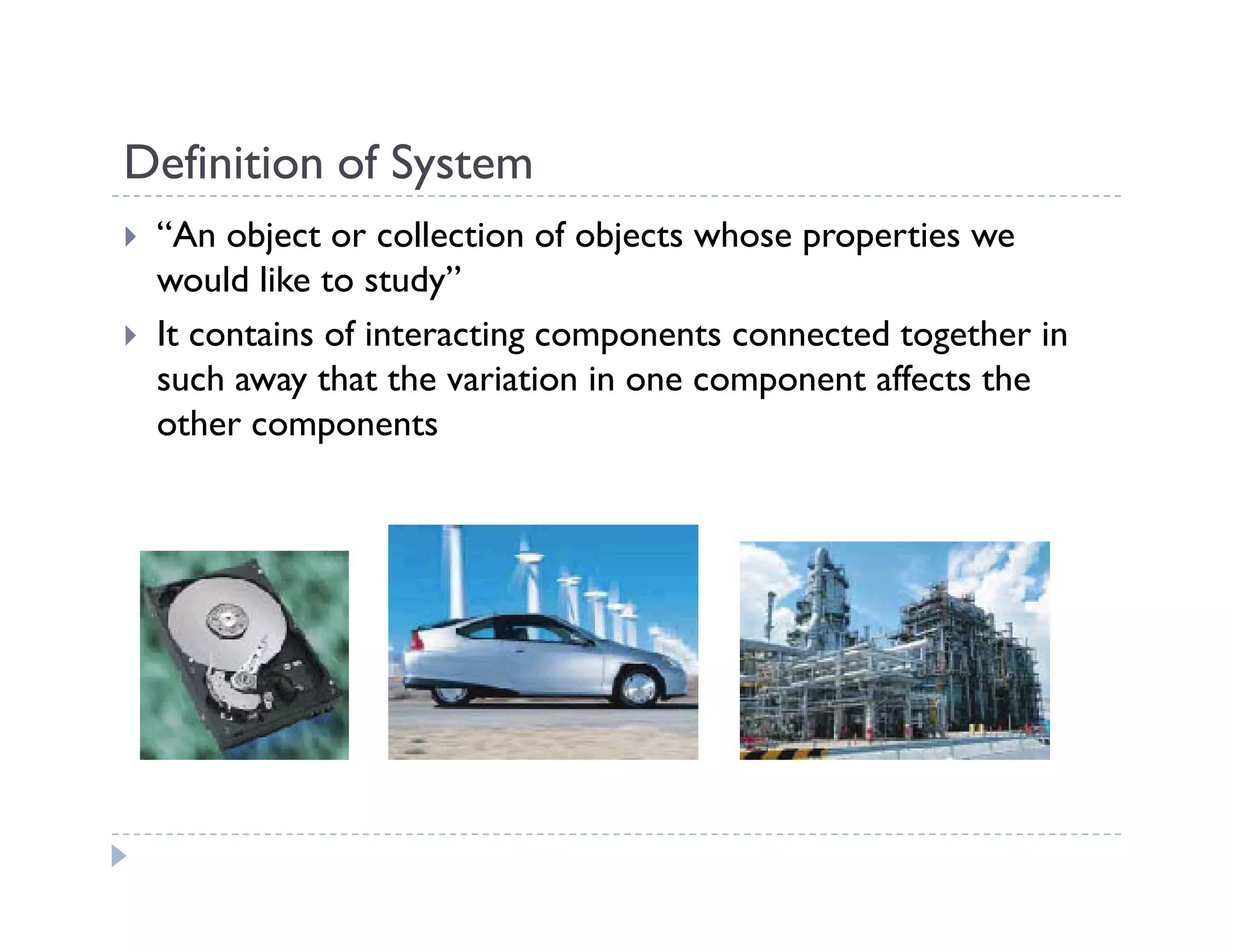
 “An object or collection of objects whose properties we
 would like to study”
 It contains of interacting components connected together in
 such away that the variation in one component affects the
 other components
Definition of System
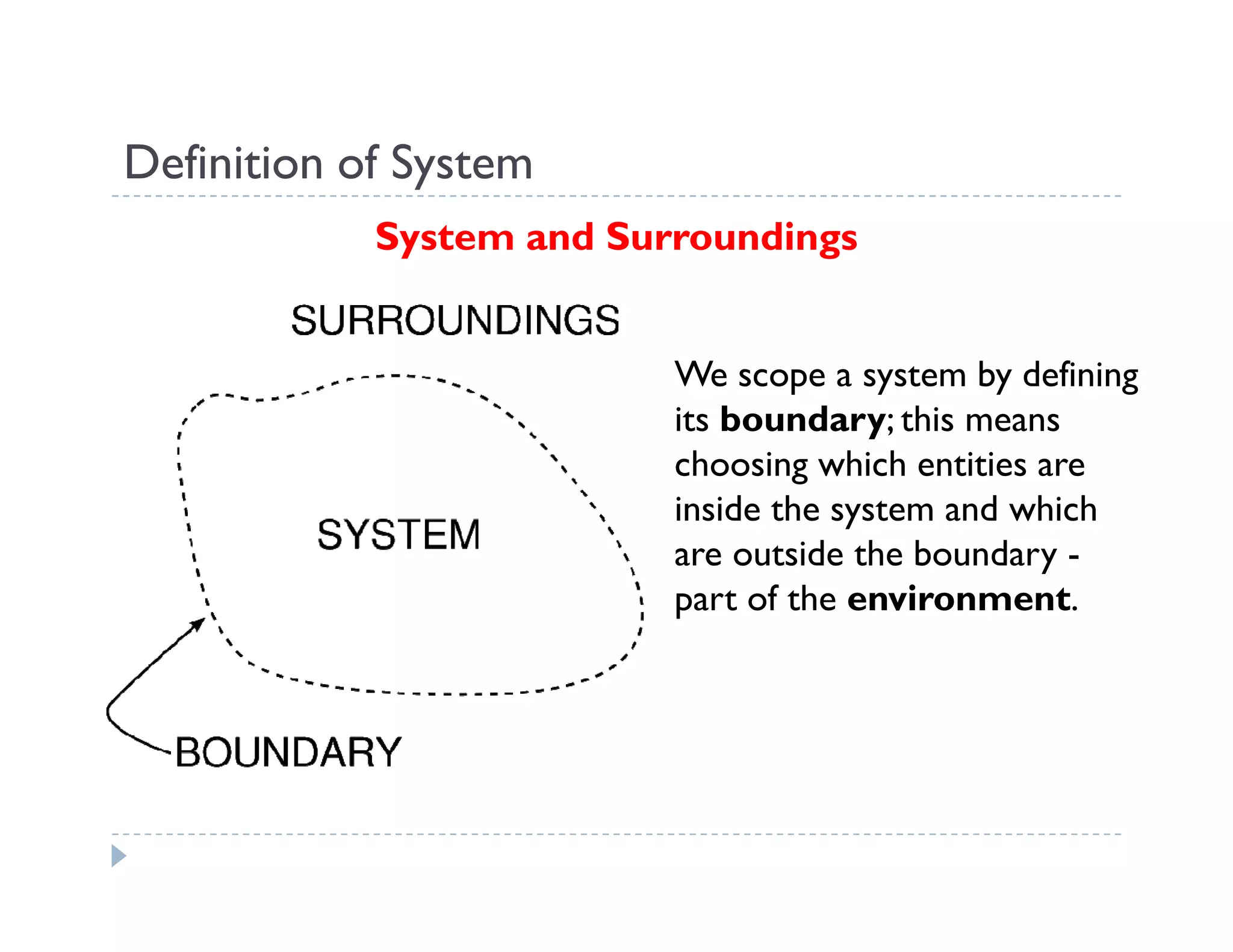
            System and Surroundings


                          We scope a system by defining
                          its boundary; this means
                          choosing which entities are
                          inside the system and which
                          are outside the boundary -
                          part of the environment.
Definition of System


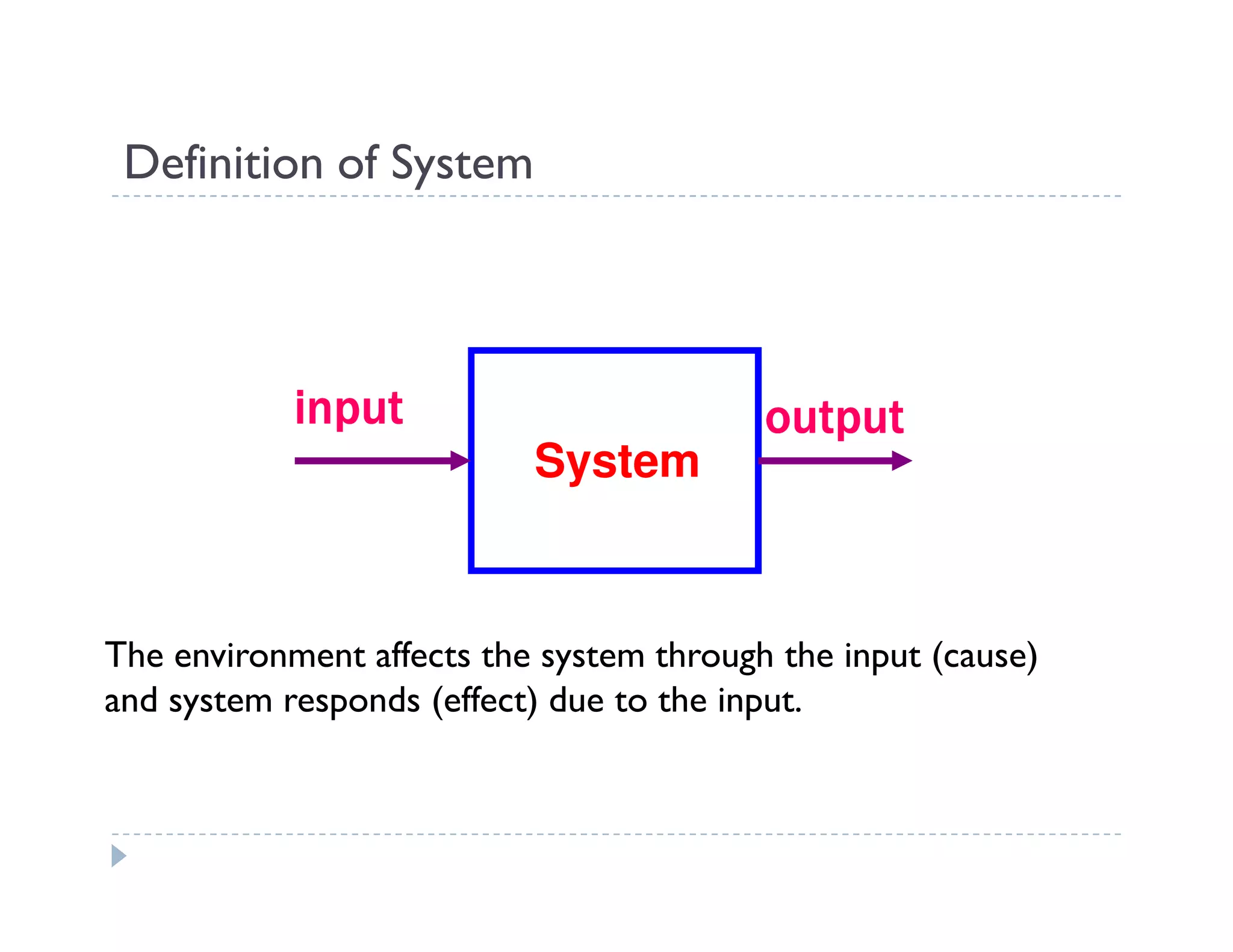
            input                         output
                           System


The environment affects the system through the input (cause)
and system responds (effect) due to the input.
Definition of System

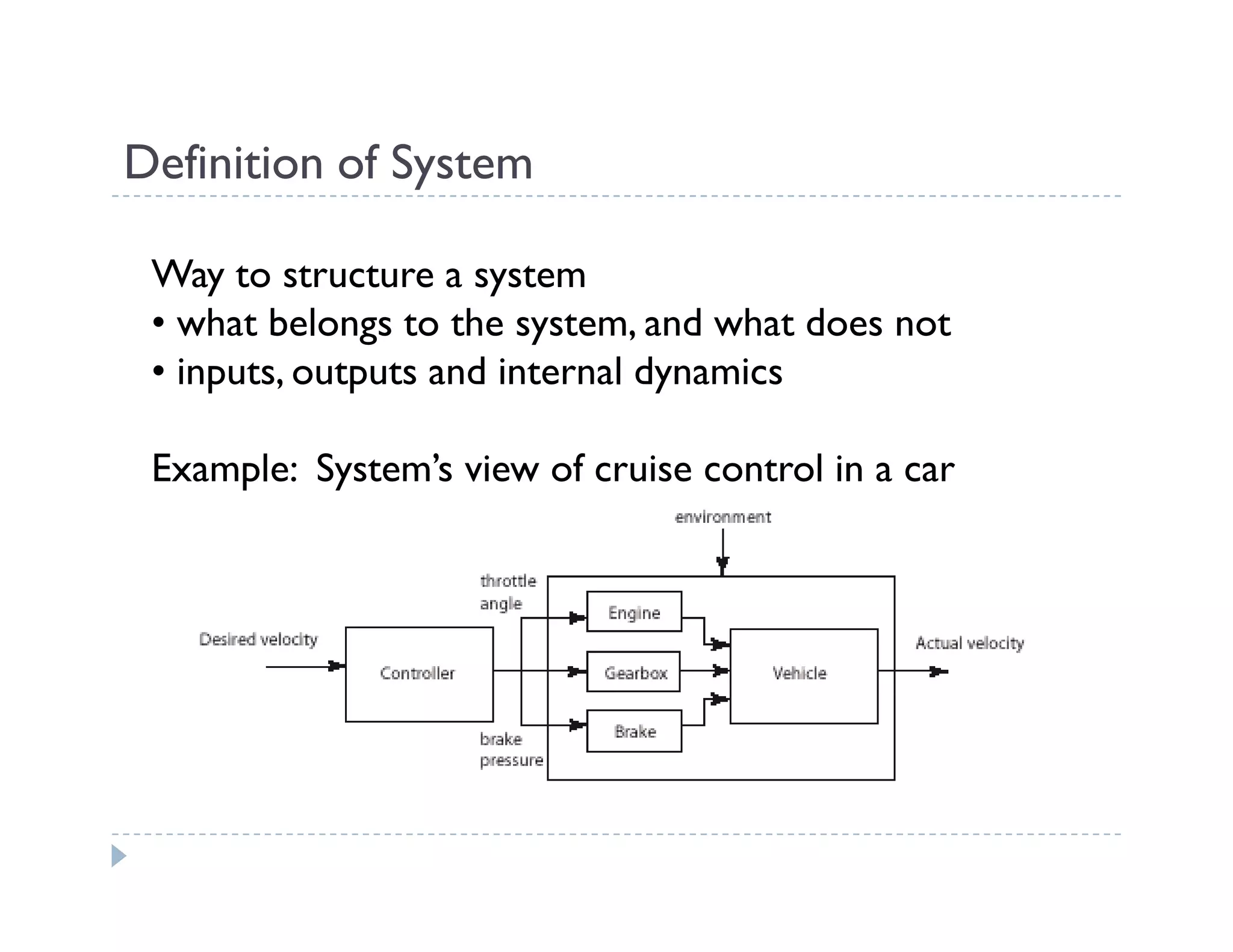
 Way to structure a system
 • what belongs to the system, and what does not
 • inputs, outputs and internal dynamics

 Example: System’s view of cruise control in a car
System Classifications
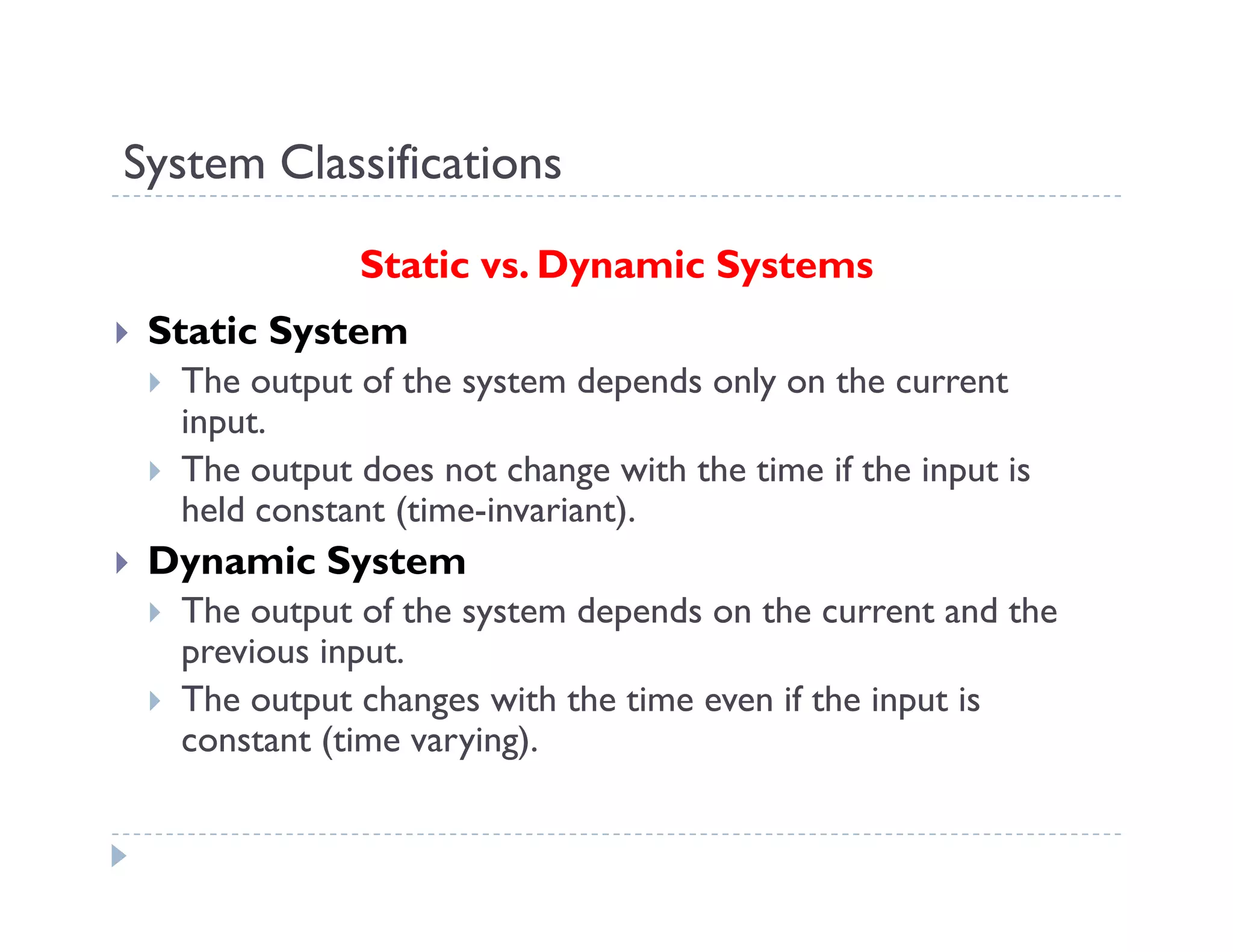
             Static vs. Dynamic Systems
 Static System
  The output of the system depends only on the current
  input.
  The output does not change with the time if the input is
  held constant (time-invariant).
 Dynamic System
  The output of the system depends on the current and the
  previous input.
  The output changes with the time even if the input is
  constant (time varying).
System Classifications

Dynamic systems are found in all major
engineering areas.

    Mechanical Systems
    Electrical Systems
    Thermal Systems
    Fluid Systems
    Mixed Systems
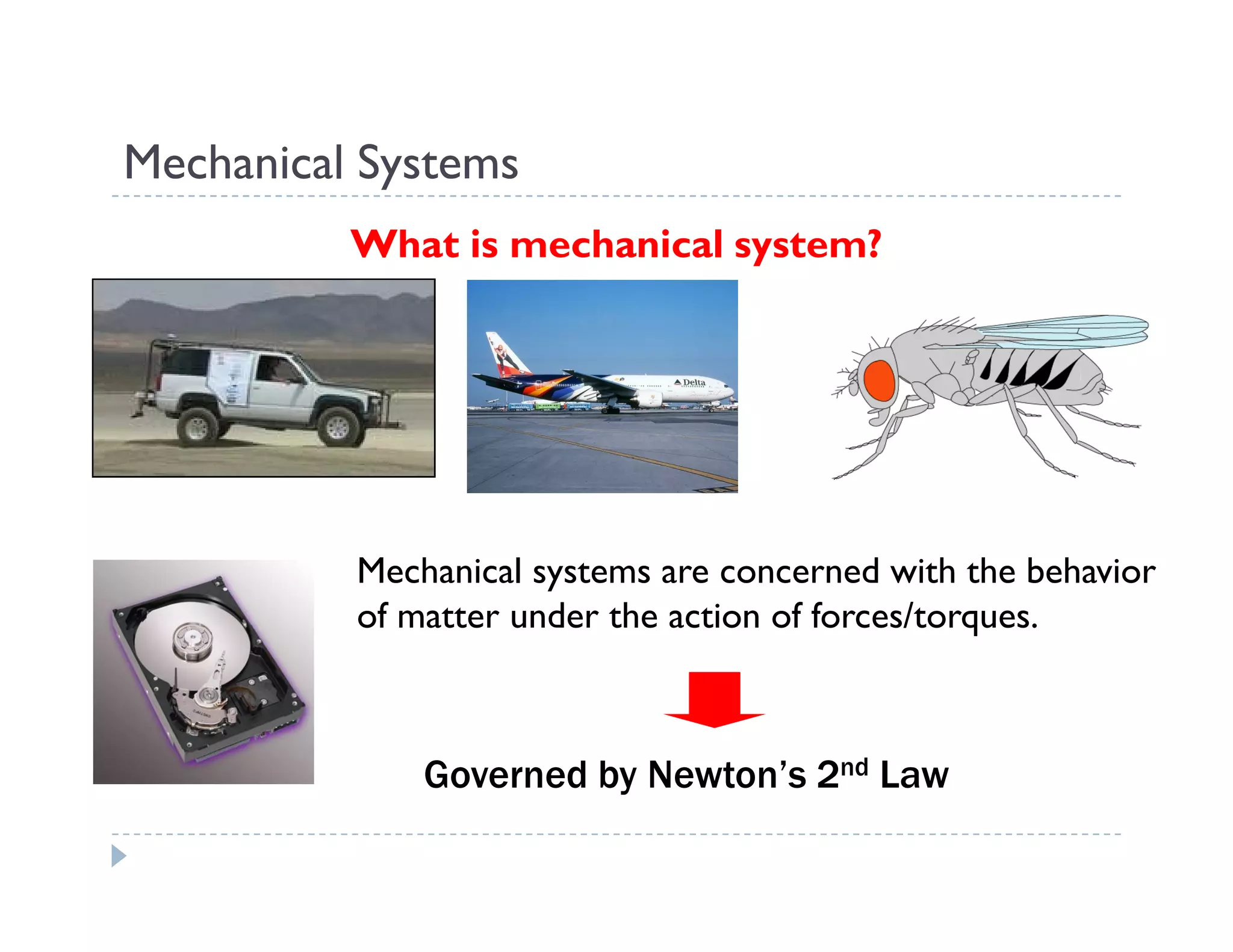
Mechanical Systems
          What is mechanical system?


          Mechanical systems are concerned with the behavior
          of matter under the action of forces/torques.


              Governed by Newton’s 2nd Law
Electrical Systems

              What is electrical system?

Electrical systems are concerned with the behavior of
three fundamental quantities: charge, current and voltage.


Two Kirchoff’s laws are used to model the electrical
system:
1. ?
2. ?
Thermal Systems

              What is thermal system?

Thermal systems involves heating of objects and
transports of thermal energy.


Example of thermal system ?
Fluid Systems

                 What is fluid system?

Fluid system involves connection of fluid flows in tube and
tank.


Example of fluid systems ?
Mixed Systems

                What is mixed system?

System which consists of two or more of previously
mentioned systems.


Electro-mechanical system
Fluid-mechanical system
Thermo-mechanical
Electro-thermal
Mechatronics system !
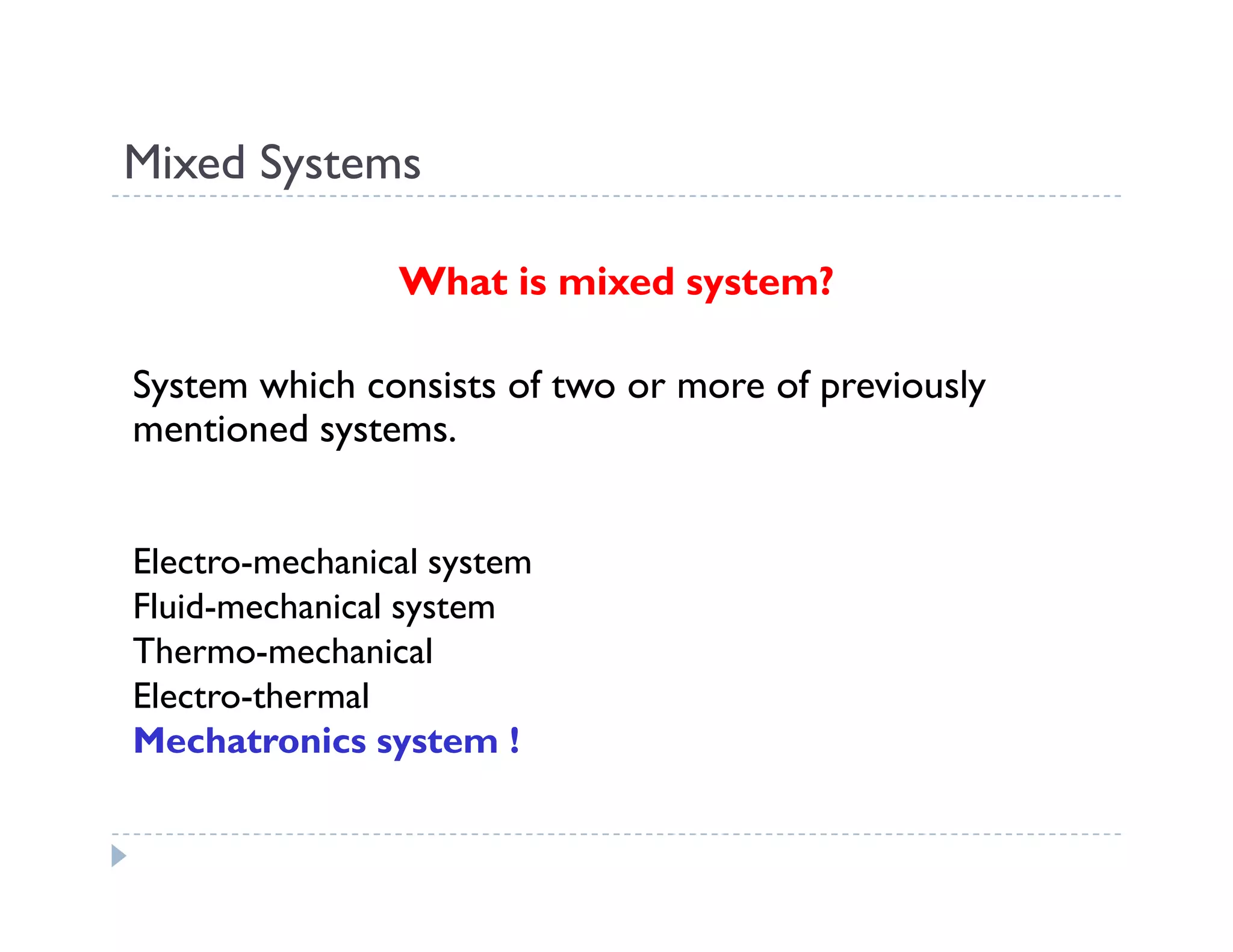
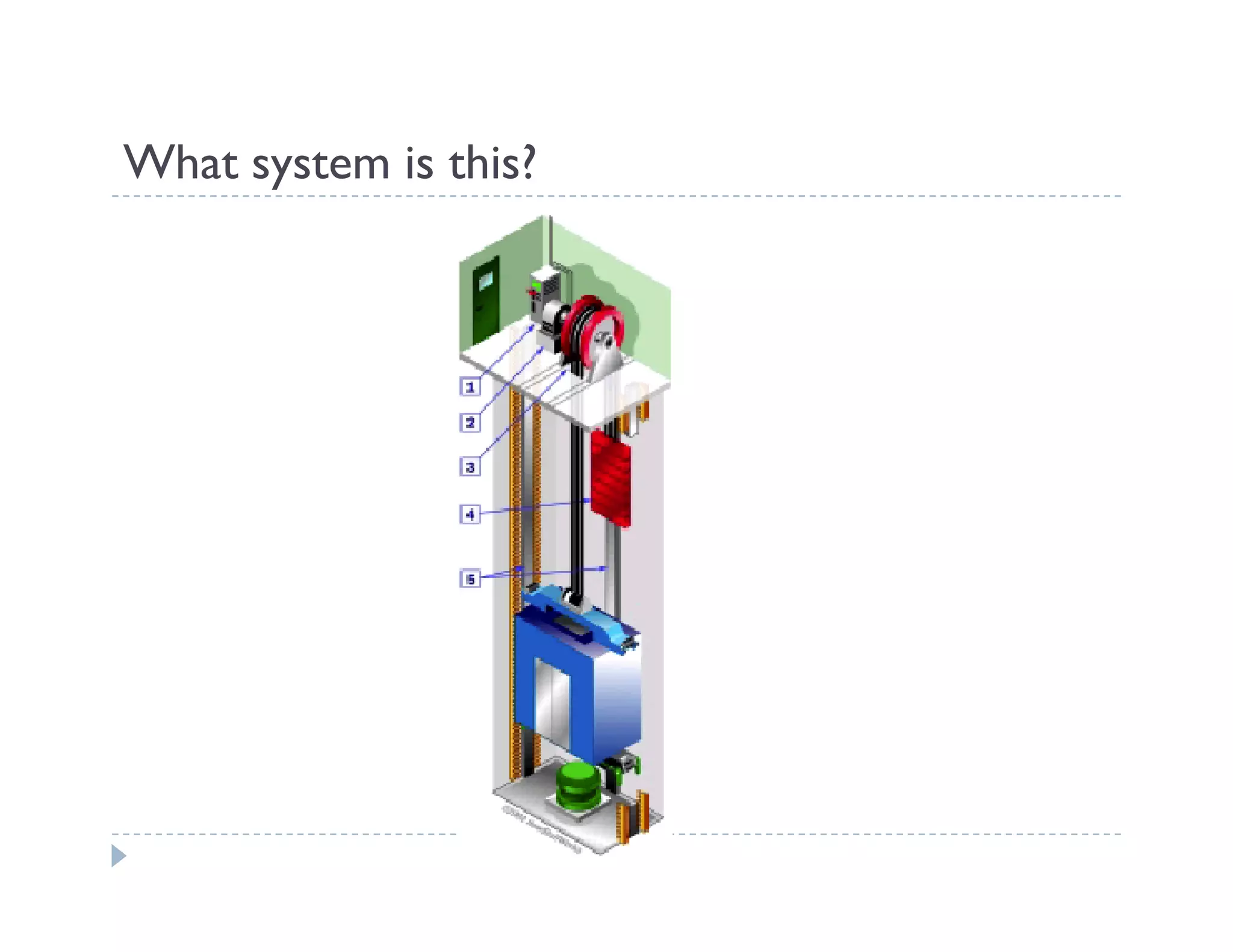
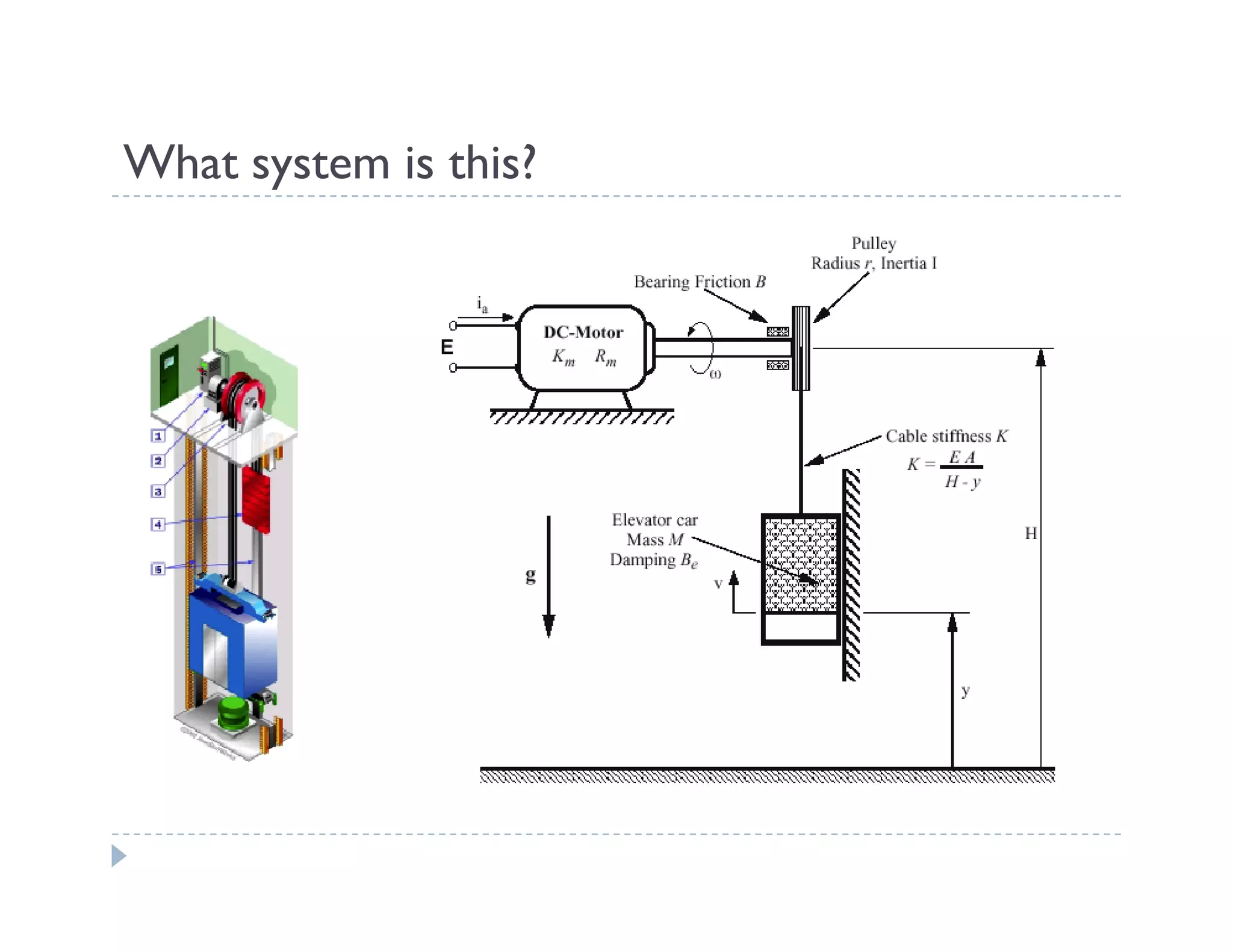
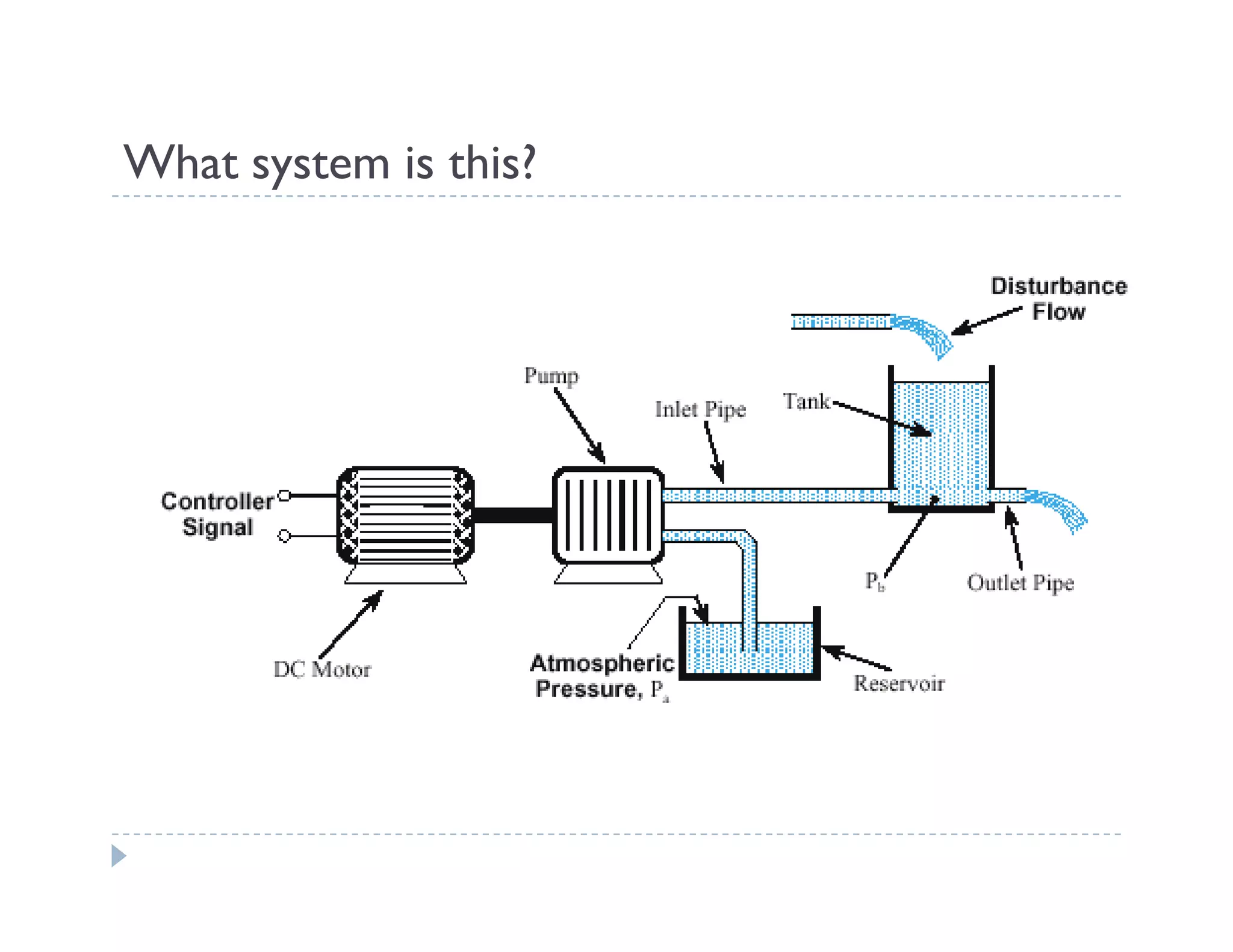
What system is this?
What is system dynamics?
Definition of System Dynamics
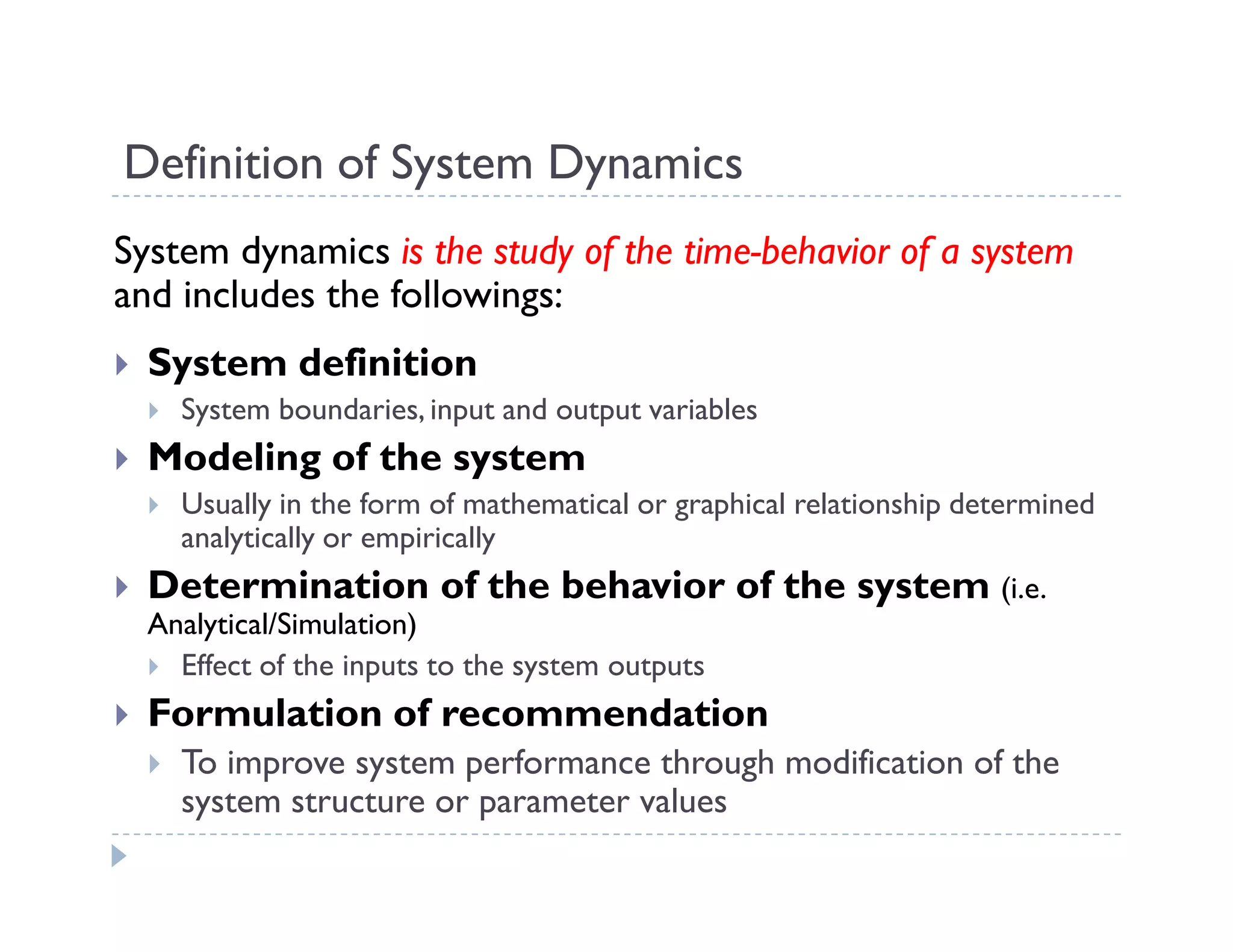
System dynamics is the study of the time-behavior of a system
and includes the followings:
  System definition
    System boundaries, input and output variables
  Modeling of the system
    Usually in the form of mathematical or graphical relationship determined
    analytically or empirically
  Determination of the behavior of the system (i.e.
  Analytical/Simulation)
    Effect of the inputs to the system outputs
  Formulation of recommendation
    To improve system performance through modification of the
    system structure or parameter values
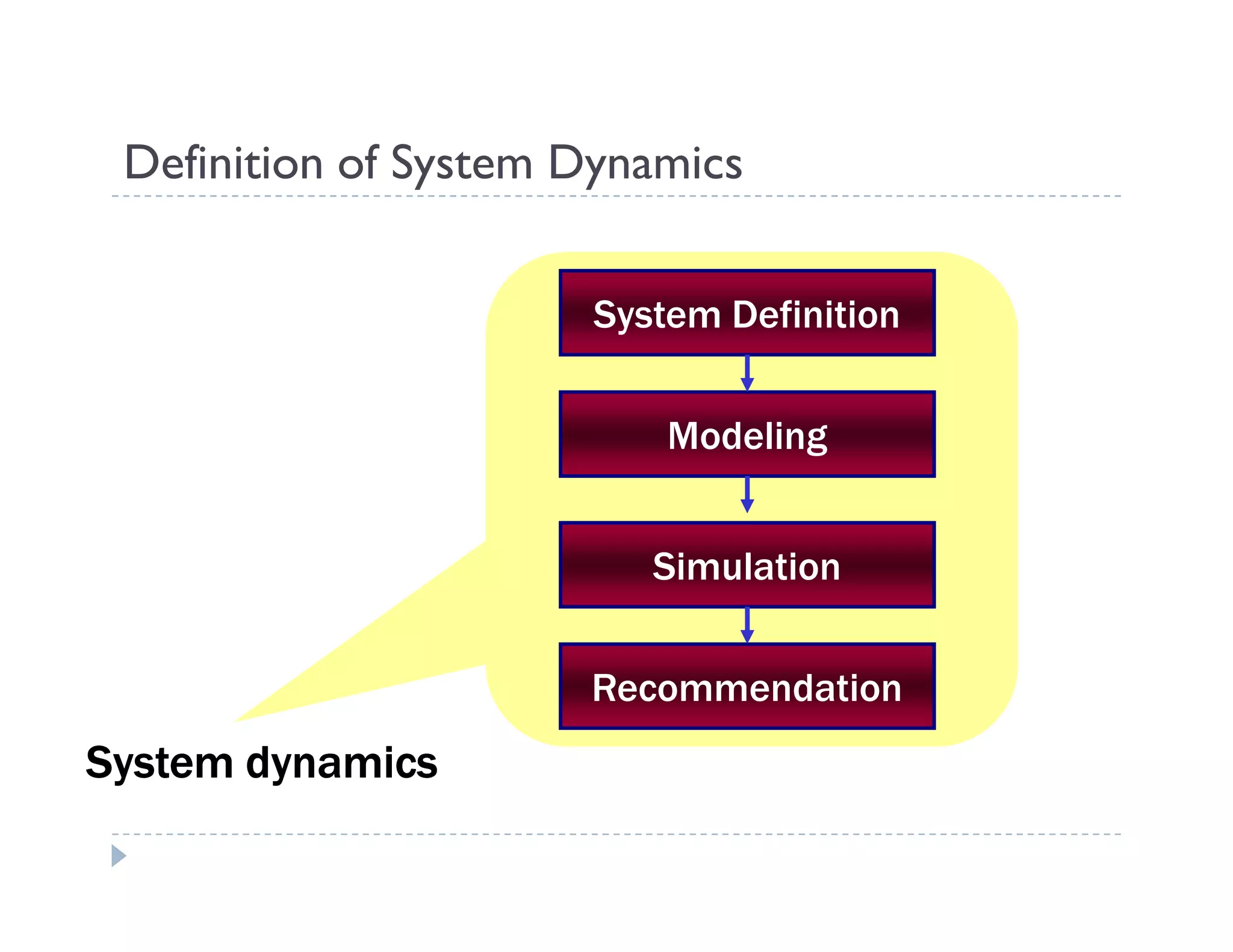
Definition of System Dynamics

                      System Definition

                          Modeling


                         Simulation

                      Recommendation
System dynamics
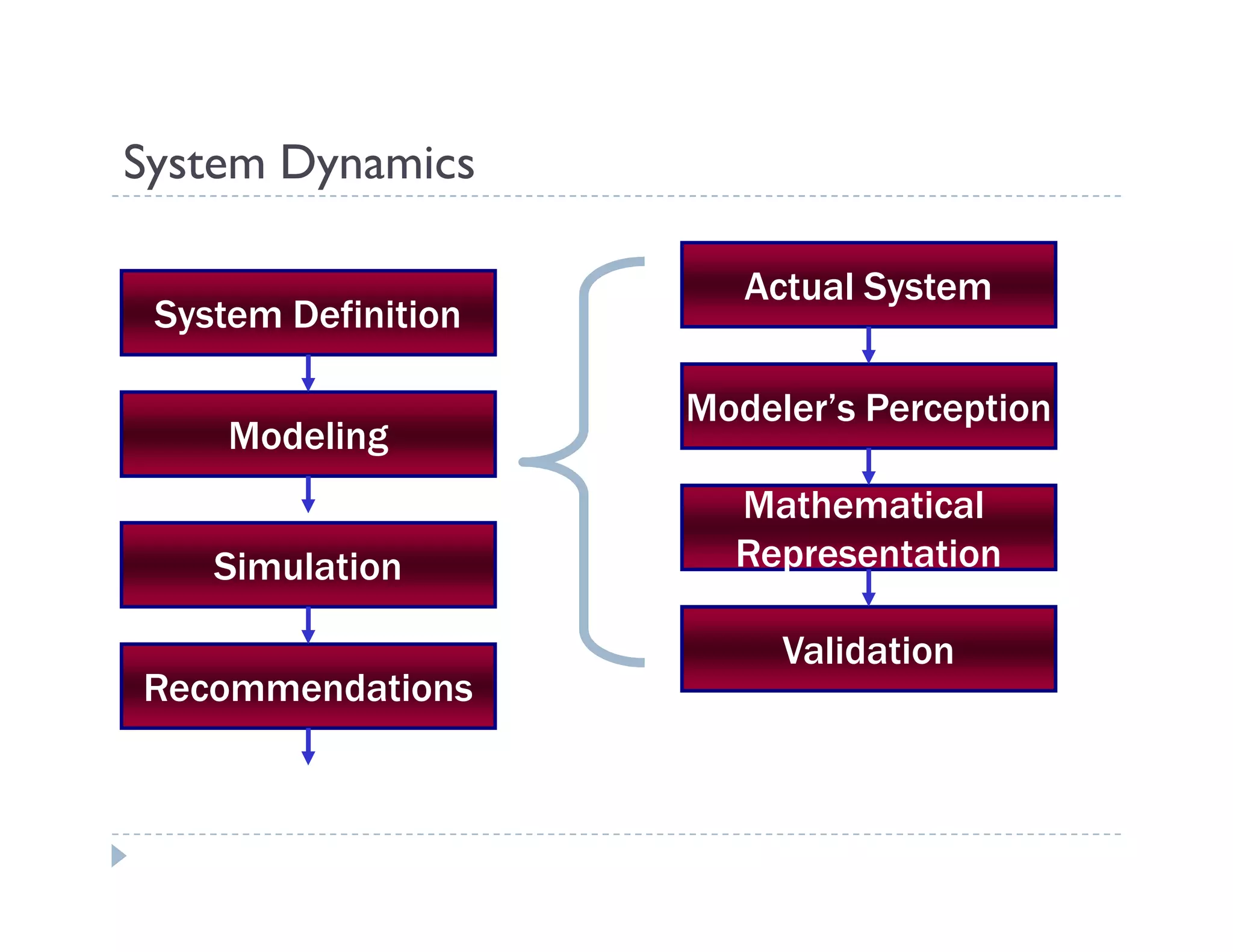
System Dynamics

                        Actual System
 System Definition

                     Modeler’s Perception
     Modeling
                       Mathematical
    Simulation         Representation

                          Validation
Recommendations
What is model?

 The word “model” is derived from a Latin word which
 originally means pattern or mold.
 Model of a system is basically a tool to study the behavior
 of a system without having experiment on the real
 system.
 Model can be: physical model, mental model, verbal model
 and also mathematical model.
 We concern ONLY mathematical model.
What is mathematical model?
Model is a collection of mathematical equations which
represent behavior/characteristic of real system

                     &
                  x, x
        f    m1
                                                        T = fr
                          (m1 + m2 )&& + m2l (θ& cosθ − θ& 2 sin θ + 2ml&θ& cosθ + m&&sin θ ) =
                                    x         &                                     l             f


              θ    l                 lθ& + 2l&θ + && cos θ + g sin θ = 0
                                      &        & x


                   m2
Why do we need mathematical model?
• To avoid physical system
  – Can treat new designs/technologies without physical
    prototype
  – Do not disturb operation of existing system

• Easier to work with than real world
  – Easy to check many approaches, parameter values,…
  – Flexible to time-scales
  – Can access immeasurable quantities

• Support safety
  – Experiments may be dangerous
  – Operators need to train for extreme situations

• Help to gain insight and understanding
Why do we need mathematical model?

The first step in understanding a
problem is to model its
behavior.
“If it works on paper, it will
work in real life”
          <Susan Koerner Wright>
                   mother to Wright ‘s brothers

Model can be simulated
Fast-time simulation save time.
Model Characteristics
A model captures only some aspects of a system
  Important to know which aspects are modeled and
  which are not.
  Make sure that model is valid for intended purpose

All-encompassing models often a bad           idea
   Large and complex – hard to gain insight
   Cumbersome and slow to manipulate

Good models are simple, yet capture the essentials!
Simulation

 Model can be used to compute how the system would
 react upon certain inputs.

 This can be done mathematically solve the equations that
 describe the system and study the answer.
                          OR
 With the power of computer we can perform a
 numerical computation to solve the equations.
Simulation

 Simulation is derived from Latin world simulare which
 means pretend.

 We may define simulation as a process of imitation the
 dynamic system using a computer in order to evaluate
 and/or improve the system performance.

01 Introduction to System Dynamics

  • 1.
    System Dynamics MCT 3113 Lecture #1: Introduction to System Dynamics Dr. Shahrul Naim Sidek Department of Mechatronics Engineering International Islamic University Malaysia
  • 2.
  • 3.
    Definition of System “An object or collection of objects whose properties we would like to study” It contains of interacting components connected together in such away that the variation in one component affects the other components
  • 4.
    Definition of System System and Surroundings We scope a system by defining its boundary; this means choosing which entities are inside the system and which are outside the boundary - part of the environment.
  • 5.
    Definition of System input output System The environment affects the system through the input (cause) and system responds (effect) due to the input.
  • 6.
    Definition of System Way to structure a system • what belongs to the system, and what does not • inputs, outputs and internal dynamics Example: System’s view of cruise control in a car
  • 7.
    System Classifications Static vs. Dynamic Systems Static System The output of the system depends only on the current input. The output does not change with the time if the input is held constant (time-invariant). Dynamic System The output of the system depends on the current and the previous input. The output changes with the time even if the input is constant (time varying).
  • 8.
    System Classifications Dynamic systemsare found in all major engineering areas. Mechanical Systems Electrical Systems Thermal Systems Fluid Systems Mixed Systems
  • 9.
    Mechanical Systems What is mechanical system? Mechanical systems are concerned with the behavior of matter under the action of forces/torques. Governed by Newton’s 2nd Law
  • 10.
    Electrical Systems What is electrical system? Electrical systems are concerned with the behavior of three fundamental quantities: charge, current and voltage. Two Kirchoff’s laws are used to model the electrical system: 1. ? 2. ?
  • 11.
    Thermal Systems What is thermal system? Thermal systems involves heating of objects and transports of thermal energy. Example of thermal system ?
  • 12.
    Fluid Systems What is fluid system? Fluid system involves connection of fluid flows in tube and tank. Example of fluid systems ?
  • 13.
    Mixed Systems What is mixed system? System which consists of two or more of previously mentioned systems. Electro-mechanical system Fluid-mechanical system Thermo-mechanical Electro-thermal Mechatronics system !
  • 14.
  • 15.
  • 16.
  • 17.
    What is systemdynamics?
  • 18.
    Definition of SystemDynamics System dynamics is the study of the time-behavior of a system and includes the followings: System definition System boundaries, input and output variables Modeling of the system Usually in the form of mathematical or graphical relationship determined analytically or empirically Determination of the behavior of the system (i.e. Analytical/Simulation) Effect of the inputs to the system outputs Formulation of recommendation To improve system performance through modification of the system structure or parameter values
  • 19.
    Definition of SystemDynamics System Definition Modeling Simulation Recommendation System dynamics
  • 20.
    System Dynamics Actual System System Definition Modeler’s Perception Modeling Mathematical Simulation Representation Validation Recommendations
  • 21.
    What is model? The word “model” is derived from a Latin word which originally means pattern or mold. Model of a system is basically a tool to study the behavior of a system without having experiment on the real system. Model can be: physical model, mental model, verbal model and also mathematical model. We concern ONLY mathematical model.
  • 22.
    What is mathematicalmodel? Model is a collection of mathematical equations which represent behavior/characteristic of real system & x, x f m1 T = fr (m1 + m2 )&& + m2l (θ& cosθ − θ& 2 sin θ + 2ml&θ& cosθ + m&&sin θ ) = x & l f θ l lθ& + 2l&θ + && cos θ + g sin θ = 0 & & x m2
  • 23.
    Why do weneed mathematical model? • To avoid physical system – Can treat new designs/technologies without physical prototype – Do not disturb operation of existing system • Easier to work with than real world – Easy to check many approaches, parameter values,… – Flexible to time-scales – Can access immeasurable quantities • Support safety – Experiments may be dangerous – Operators need to train for extreme situations • Help to gain insight and understanding
  • 24.
    Why do weneed mathematical model? The first step in understanding a problem is to model its behavior. “If it works on paper, it will work in real life” <Susan Koerner Wright> mother to Wright ‘s brothers Model can be simulated Fast-time simulation save time.
  • 25.
    Model Characteristics A modelcaptures only some aspects of a system Important to know which aspects are modeled and which are not. Make sure that model is valid for intended purpose All-encompassing models often a bad idea Large and complex – hard to gain insight Cumbersome and slow to manipulate Good models are simple, yet capture the essentials!
  • 26.
    Simulation Model canbe used to compute how the system would react upon certain inputs. This can be done mathematically solve the equations that describe the system and study the answer. OR With the power of computer we can perform a numerical computation to solve the equations.
  • 27.
    Simulation Simulation isderived from Latin world simulare which means pretend. We may define simulation as a process of imitation the dynamic system using a computer in order to evaluate and/or improve the system performance.