 You must have observed that in nature, many things
follow a certain pattern, such as the petals of sun
flower, the holes of a honeybee comb, the grains on a
maize cob, the spirals on a pineapple and on a pine
cone etc. We now look for some patterns which occur
in our daily life.
 For example: Mohit applied for a job and got selected.
He has been offered a job with a starting monthly
salary Rs 8000, with an annual increment of Rs 500 in
his salary. His salary for the 1st, 2nd,3rd,…years will be,
respectively 8000, 8500, 9000,…..
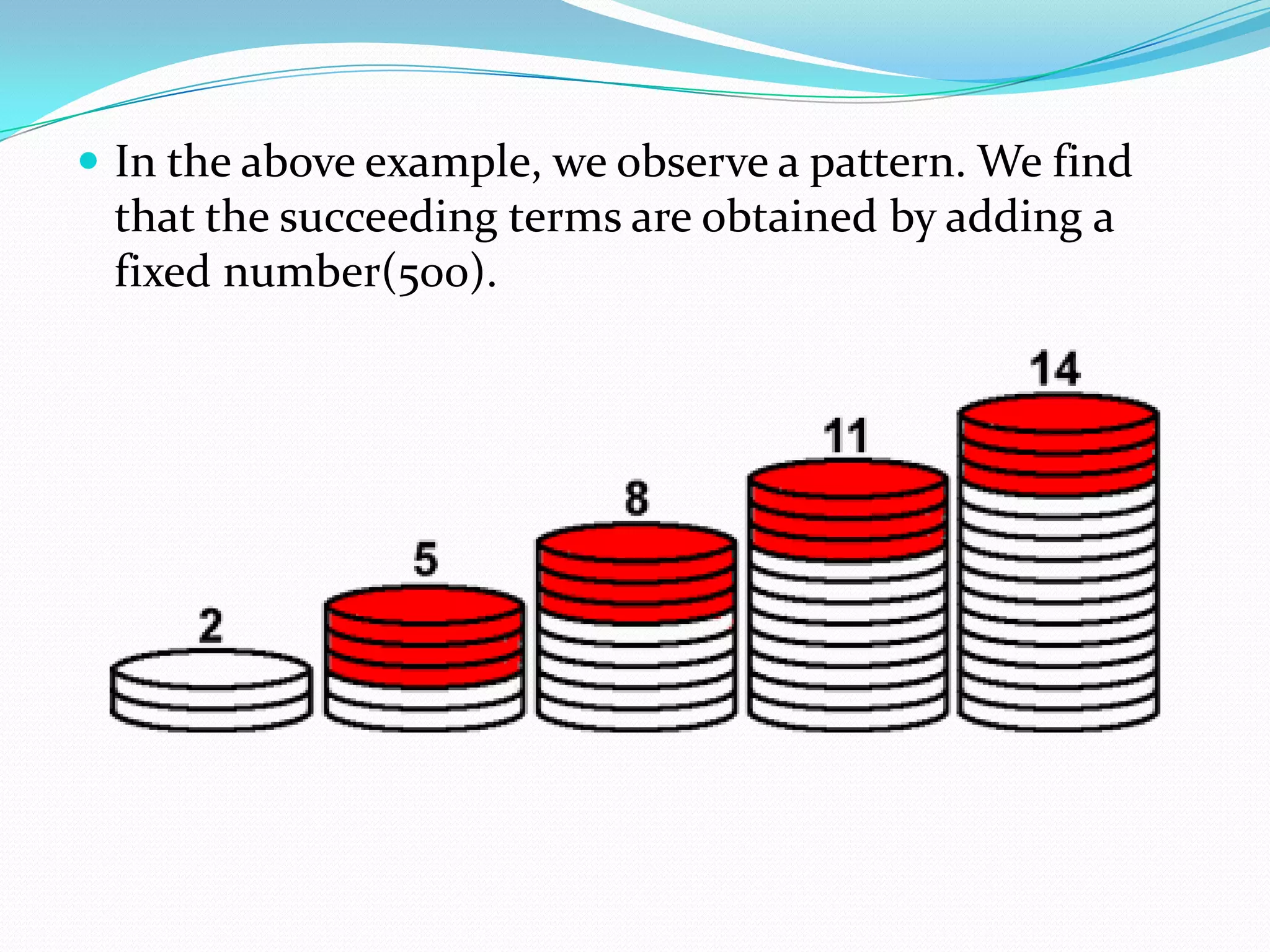
 In the above example, we observe a pattern. We find
that the succeeding terms are obtained by adding a
fixed number(500).
 Consider the following lists of numbers:
1) 1,2,3,4…..
2) 100,70,40,10…
3) -3,-2,-1, 0….
4) 3, 3, 3, 3…….
5) -1.0, -1.5, -2.0, -2.5,…….
Each of the numbers in the list is called a term.
 Given a term, can you write the next term in each of
the lists above? If so, how will you write it? Perhaps by
following a pattern or rule. Let us observe and write
the rule:
 In(1), each term is 1 more than the term preceding it.
In(2), each term is 30 less than the term preceding it.
In(3), each term is obtained by adding 1 to each term
preceding it. In(4), all the terms in the list are 3, ie,
each term is obtained by adding 0 to the term
preceding it. In(5), each term is obtained by adding -
0.5 to the term preceding it.
 In all the lists above, we see that the successive terms
are obtained by adding a fixed number to the
preceding terms. Such lists are called ARITHMETIC
PROGRESSIONS (or) AP.
 So, An Arithmetic Progression is a list of numbers in
which each term is obtained by adding a fixed number
preceding term except the first term.
 This fixed number is called the common difference of
the AP.
 Remember that it can be positive(+), negative(-) or
zero(0)
 Let us denote the first term of an Arithmetic
Progression by (a1)second term by (a2 ), nth term by
(ax ) and the common difference by d .
 The general form of an Arithmetic Progression is :
 a , a +d , a + 2d , a + 3d ………………, a + (n-1)d
 Now, let us consider the situation again in which
Mohit applied for a job and been selected. He has
been offered a starting monthly salary of Rs8000,
with an annual increment of Rs500. what would be
his salary for the fifth year?
 The nth term an of the Arithmetic Progression with first
term a and common difference d is given by an=a+(n-1) d.
 an is also called the general term of the AP.
 If there are m terms in the Arithmetic Progression , then am
represents the last term which is sometimes also denoted
by l.
 The sum of the first n terms of an Arithmetic Progression
is given by s=n/2[2a+(n-1) d].
 We can also write it as s=n/2[a +a+(n-1) d].
•The first term = a1 =a +0 d = a + (1-1)d
Let us consider an A.P. with first term ‘a’ and
common difference ‘d’ ,then
•The second term = a2 = a + d = a + (2-1)d
•The third term = a3 = a + 2d = a + (3-1)d
•The fourth term = a4 =a + 3d = a + (4-1)d
The nth term = an = a + (n-1)d
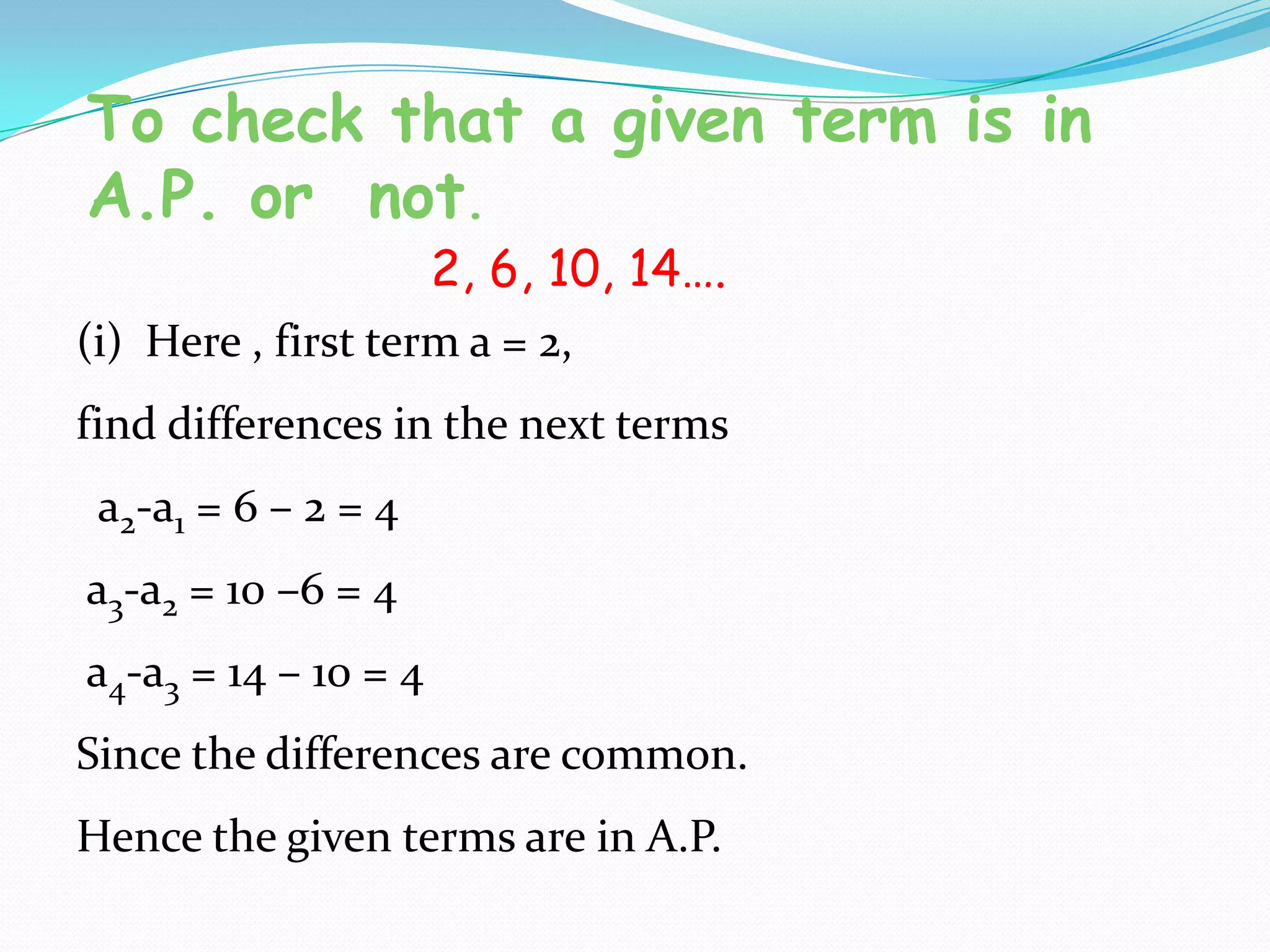
To check that a given term is in
A.P. or not.
2, 6, 10, 14….
(i) Here , first term a = 2,
find differences in the next terms
a2-a1 = 6 – 2 = 4
a3-a2 = 10 –6 = 4
a4-a3 = 14 – 10 = 4
Since the differences are common.
Hence the given terms are in A.P.
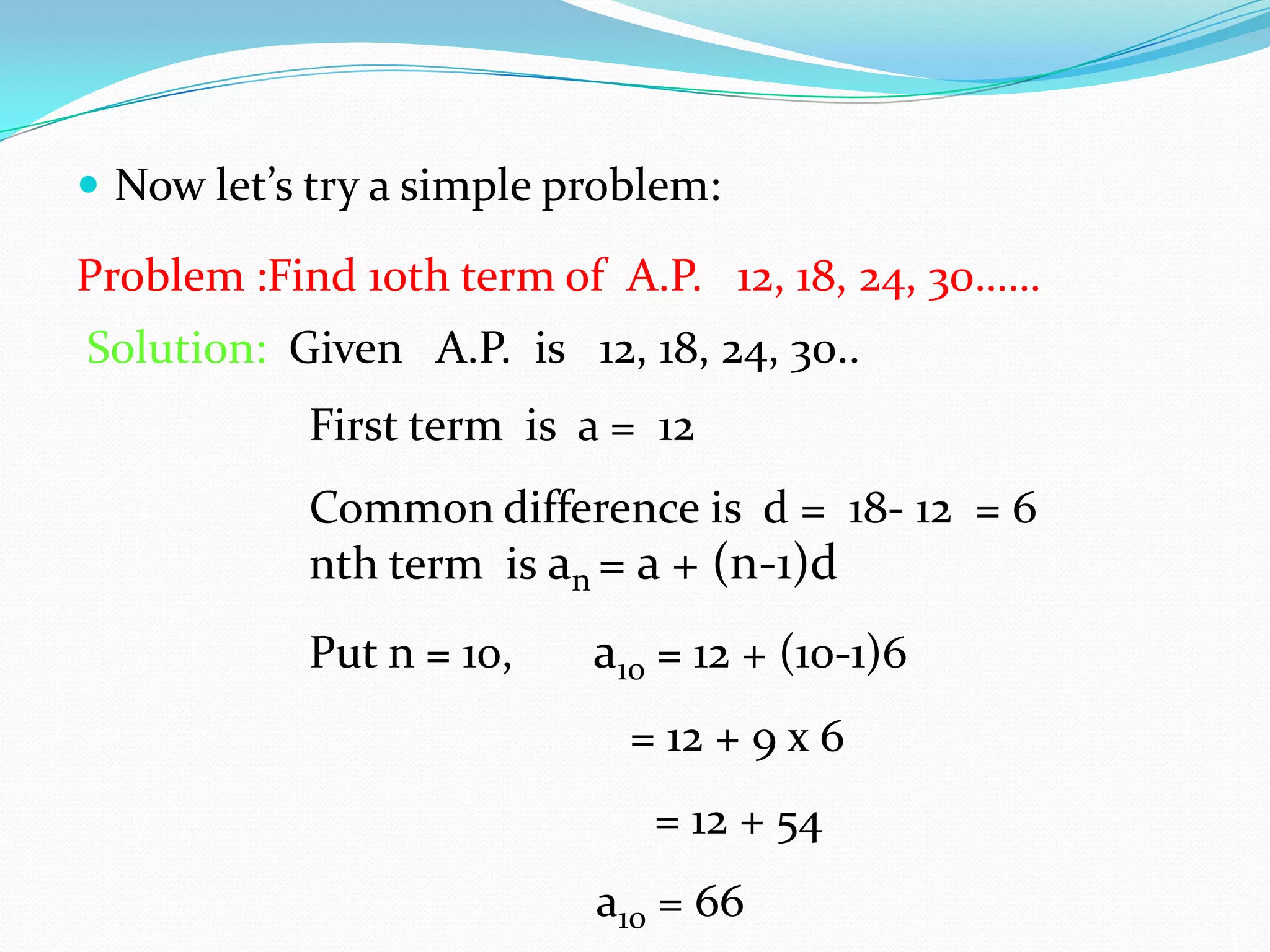
 Now let’s try a simple problem:
Problem :Find 10th term of A.P. 12, 18, 24, 30……
Solution: Given A.P. is 12, 18, 24, 30..
First term is a = 12
Common difference is d = 18- 12 = 6
nth term is an = a + (n-1)d
Put n = 10, a10 = 12 + (10-1)6
= 12 + 9 x 6
= 12 + 54
a10 = 66
Problem 2. Find the sum of 30 terms of given A.P.
12 + 20 + 28 + 36………
Solution : Given A.P. is 12 , 20, 28 , 36
Its first term is a = 12
Common difference is d = 20 – 12 = 8
The sum to n terms of an arithmetic progression
Sn = ½ n [ 2a + (n - 1)d ]
= ½ x 30 [ 2x 12 + (30-1)x 8]
= 15 [ 24 + 29 x8]
= 15[24 + 232]
= 15 x 246
= 3690
ARITHMETIC PROGRESSIONS

ARITHMETIC PROGRESSIONS

  • 2.
     You musthave observed that in nature, many things follow a certain pattern, such as the petals of sun flower, the holes of a honeybee comb, the grains on a maize cob, the spirals on a pineapple and on a pine cone etc. We now look for some patterns which occur in our daily life.  For example: Mohit applied for a job and got selected. He has been offered a job with a starting monthly salary Rs 8000, with an annual increment of Rs 500 in his salary. His salary for the 1st, 2nd,3rd,…years will be, respectively 8000, 8500, 9000,…..
  • 3.
     In theabove example, we observe a pattern. We find that the succeeding terms are obtained by adding a fixed number(500).
  • 4.
     Consider thefollowing lists of numbers: 1) 1,2,3,4….. 2) 100,70,40,10… 3) -3,-2,-1, 0…. 4) 3, 3, 3, 3……. 5) -1.0, -1.5, -2.0, -2.5,……. Each of the numbers in the list is called a term.
  • 5.
     Given aterm, can you write the next term in each of the lists above? If so, how will you write it? Perhaps by following a pattern or rule. Let us observe and write the rule:  In(1), each term is 1 more than the term preceding it. In(2), each term is 30 less than the term preceding it. In(3), each term is obtained by adding 1 to each term preceding it. In(4), all the terms in the list are 3, ie, each term is obtained by adding 0 to the term preceding it. In(5), each term is obtained by adding - 0.5 to the term preceding it.
  • 6.
     In allthe lists above, we see that the successive terms are obtained by adding a fixed number to the preceding terms. Such lists are called ARITHMETIC PROGRESSIONS (or) AP.  So, An Arithmetic Progression is a list of numbers in which each term is obtained by adding a fixed number preceding term except the first term.  This fixed number is called the common difference of the AP.  Remember that it can be positive(+), negative(-) or zero(0)
  • 7.
     Let usdenote the first term of an Arithmetic Progression by (a1)second term by (a2 ), nth term by (ax ) and the common difference by d .  The general form of an Arithmetic Progression is :  a , a +d , a + 2d , a + 3d ………………, a + (n-1)d  Now, let us consider the situation again in which Mohit applied for a job and been selected. He has been offered a starting monthly salary of Rs8000, with an annual increment of Rs500. what would be his salary for the fifth year?
  • 8.
     The nthterm an of the Arithmetic Progression with first term a and common difference d is given by an=a+(n-1) d.  an is also called the general term of the AP.  If there are m terms in the Arithmetic Progression , then am represents the last term which is sometimes also denoted by l.  The sum of the first n terms of an Arithmetic Progression is given by s=n/2[2a+(n-1) d].  We can also write it as s=n/2[a +a+(n-1) d].
  • 9.
    •The first term= a1 =a +0 d = a + (1-1)d Let us consider an A.P. with first term ‘a’ and common difference ‘d’ ,then •The second term = a2 = a + d = a + (2-1)d •The third term = a3 = a + 2d = a + (3-1)d •The fourth term = a4 =a + 3d = a + (4-1)d The nth term = an = a + (n-1)d
  • 10.
    To check thata given term is in A.P. or not. 2, 6, 10, 14…. (i) Here , first term a = 2, find differences in the next terms a2-a1 = 6 – 2 = 4 a3-a2 = 10 –6 = 4 a4-a3 = 14 – 10 = 4 Since the differences are common. Hence the given terms are in A.P.
  • 11.
     Now let’stry a simple problem: Problem :Find 10th term of A.P. 12, 18, 24, 30…… Solution: Given A.P. is 12, 18, 24, 30.. First term is a = 12 Common difference is d = 18- 12 = 6 nth term is an = a + (n-1)d Put n = 10, a10 = 12 + (10-1)6 = 12 + 9 x 6 = 12 + 54 a10 = 66
  • 12.
    Problem 2. Findthe sum of 30 terms of given A.P. 12 + 20 + 28 + 36……… Solution : Given A.P. is 12 , 20, 28 , 36 Its first term is a = 12 Common difference is d = 20 – 12 = 8 The sum to n terms of an arithmetic progression Sn = ½ n [ 2a + (n - 1)d ] = ½ x 30 [ 2x 12 + (30-1)x 8] = 15 [ 24 + 29 x8] = 15[24 + 232] = 15 x 246 = 3690