• Patterns in daily life…..
Rungs
50 cm
38 cm
41 cm
44 cm
47 cm
29 cm
32 cm
35 cm
-3
-3
-3
-3
-3
-3
-3
Megha apllied for a job and got selected. She has been offered
A job with starting salary Rs 10,000/- with an annual increment
Rs 1,000/-. What will be the salary given to her for first five years?
Ans:
10,000……….11,000……..12,000………13,000……..14,000……..
15,000……
• These patterns in mathematics called as Progressions…….
• We have many progressions in mathematics like Arithmetic
progression,…….. Geometric progression……etc.
Arithmetic Progression (AP)
To understand AP lets take following examples,
• 1,2,3,4,………
• 200,150,100,50,……..
• -8,-6,-4,-2,0,………
• 3,3,3,3,……
Each of the number in the list is
called a TERM.
1 + 1 = 2
3 + 1 = 4
2 + 1 = 3
4 + 1 = 5
5
200 - 50 = 150
150 – 50 = 100
100 – 50 = 50
50 – 50 = 0
0
2
3
In these examples we observe, the pattern is formed by adding or
subtracting a fixed number to the preceding term. Such list of numbers
is said to form an Arithmetic progression.
So, an AP is, “a list of numbers in which each term is obtained by
adding a fixed number to the preceding term except the first term.”
Arithmetic Progression
• 51,53,55,57,……..71
• 200,150,100,50,……..
• 3,3,3,3,3,……..
The fixed number is
called Common
difference.
why we call it as
common difference?
𝟓𝟑
−𝟓𝟏
𝟐
𝟓𝟓
−𝟓𝟑
𝟐
𝟓𝟕
−𝟓𝟓
𝟐
Difference is 2
Common is 2
Therefore it is called as Common difference
Common difference is denoted by
‘d’
d=2
d= -50
d= 0
Common difference can be
Positive
Negative
Zero
Arithmetic Progression
• 51,53,55,57,……71
• 200,150,100,50,……….
Lets denote the
first term of AP
by a1
Second term by
a2
and nth Term by
an
Therefore
d = a2 – a1 = a3 – a2 =…….. = an – a(n-1)
a1, a2, a3, a4,………., an
Finite AP
Infinite AP
What is the minimum information you required to create an AP?
a1 = 3….. Can you find AP?
d = 2……. Can you find AP?
No
No
If you have both a1 = 3 and d = 2….. Can you find AP? Yes
To create an AP we need both first term and common difference..
Arithmetic progression
The general form of AP can be written as,
a + (a+d) + (a+2d) + (a+3d) +………….. + (a+ (n-1)d)
1st + 2nd + 3rd + 4th +………… + nth
Arithmetic Progression
Exercise
1) For the AP :
3
2
,
1
2
, −
1
2
, −
3
2
, … … . Write the first term a and the common
difference d.
Ans: Here, a =
3
2
, and d =
1
2
−
3
2
= −1
2) Write the first four terms of AP.
i) a=10, d=10
Ans : a1 = a = 10
a2 = a+d = 10+10 = 20
a3 = (a+2d) = (10+ 2 x 10) = 30
a4 = (a+3d) = (10 + 3 x 10) = 40
Arithmetic progression
nth dterm
Megha apllied for a job and got selected. She has been offered
A job with starting salary Rs 10,000/- with an annual increment
Rs 1,000/-. What will be the salary given to her for first five years?
Ans:
10,000……….11,000……..12,000………13,000……..14,000……..
15,000……
If I ask what will be the salary after 23 years … what you do…
If you add 1000 for every year the salary she get after 23
years is 32000
We can find this in a simple way…
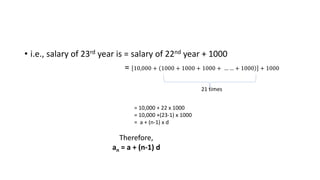
• i.e., salary of 23rd year is = salary of 22nd year + 1000
= 10,000 + 1000 + 1000 + 1000 + … … + 1000 + 1000
21 times
= 10,000 + 22 x 1000
= 10,000 +(23-1) x 1000
= a + (n-1) x d
Therefore,
an = a + (n-1) d
Arithmetic Progression
• Find the 10th term of the AP : 2,7,12,…..
Ans : here a = 2, d = 5 and n = 10
We have, an = a + (n-1) d
a10 = 2 + (10-1) 5
a10 = 2 + 9 x 5
a10 = 2 + 45
A10 = 47
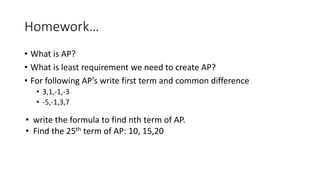
Homework…
• What is AP?
• What is least requirement we need to create AP?
• For following AP’s write first term and common difference
• 3,1,-1,-3
• -5,-1,3,7
• write the formula to find nth term of AP.
• Find the 25th term of AP: 10, 15,20

Arithmetic progression

  • 2.
    • Patterns indaily life….. Rungs 50 cm 38 cm 41 cm 44 cm 47 cm 29 cm 32 cm 35 cm -3 -3 -3 -3 -3 -3 -3 Megha apllied for a job and got selected. She has been offered A job with starting salary Rs 10,000/- with an annual increment Rs 1,000/-. What will be the salary given to her for first five years? Ans: 10,000……….11,000……..12,000………13,000……..14,000…….. 15,000……
  • 3.
    • These patternsin mathematics called as Progressions……. • We have many progressions in mathematics like Arithmetic progression,…….. Geometric progression……etc.
  • 4.
    Arithmetic Progression (AP) Tounderstand AP lets take following examples, • 1,2,3,4,……… • 200,150,100,50,…….. • -8,-6,-4,-2,0,……… • 3,3,3,3,…… Each of the number in the list is called a TERM. 1 + 1 = 2 3 + 1 = 4 2 + 1 = 3 4 + 1 = 5 5 200 - 50 = 150 150 – 50 = 100 100 – 50 = 50 50 – 50 = 0 0 2 3
  • 5.
    In these exampleswe observe, the pattern is formed by adding or subtracting a fixed number to the preceding term. Such list of numbers is said to form an Arithmetic progression. So, an AP is, “a list of numbers in which each term is obtained by adding a fixed number to the preceding term except the first term.”
  • 6.
    Arithmetic Progression • 51,53,55,57,……..71 •200,150,100,50,…….. • 3,3,3,3,3,…….. The fixed number is called Common difference. why we call it as common difference? 𝟓𝟑 −𝟓𝟏 𝟐 𝟓𝟓 −𝟓𝟑 𝟐 𝟓𝟕 −𝟓𝟓 𝟐 Difference is 2 Common is 2 Therefore it is called as Common difference Common difference is denoted by ‘d’ d=2 d= -50 d= 0 Common difference can be Positive Negative Zero
  • 7.
    Arithmetic Progression • 51,53,55,57,……71 •200,150,100,50,………. Lets denote the first term of AP by a1 Second term by a2 and nth Term by an Therefore d = a2 – a1 = a3 – a2 =…….. = an – a(n-1) a1, a2, a3, a4,………., an Finite AP Infinite AP What is the minimum information you required to create an AP? a1 = 3….. Can you find AP? d = 2……. Can you find AP? No No If you have both a1 = 3 and d = 2….. Can you find AP? Yes To create an AP we need both first term and common difference..
  • 8.
    Arithmetic progression The generalform of AP can be written as, a + (a+d) + (a+2d) + (a+3d) +………….. + (a+ (n-1)d) 1st + 2nd + 3rd + 4th +………… + nth
  • 9.
    Arithmetic Progression Exercise 1) Forthe AP : 3 2 , 1 2 , − 1 2 , − 3 2 , … … . Write the first term a and the common difference d. Ans: Here, a = 3 2 , and d = 1 2 − 3 2 = −1 2) Write the first four terms of AP. i) a=10, d=10 Ans : a1 = a = 10 a2 = a+d = 10+10 = 20 a3 = (a+2d) = (10+ 2 x 10) = 30 a4 = (a+3d) = (10 + 3 x 10) = 40
  • 10.
    Arithmetic progression nth dterm Meghaapllied for a job and got selected. She has been offered A job with starting salary Rs 10,000/- with an annual increment Rs 1,000/-. What will be the salary given to her for first five years? Ans: 10,000……….11,000……..12,000………13,000……..14,000…….. 15,000…… If I ask what will be the salary after 23 years … what you do… If you add 1000 for every year the salary she get after 23 years is 32000 We can find this in a simple way…
  • 11.
    • i.e., salaryof 23rd year is = salary of 22nd year + 1000 = 10,000 + 1000 + 1000 + 1000 + … … + 1000 + 1000 21 times = 10,000 + 22 x 1000 = 10,000 +(23-1) x 1000 = a + (n-1) x d Therefore, an = a + (n-1) d
  • 12.
    Arithmetic Progression • Findthe 10th term of the AP : 2,7,12,….. Ans : here a = 2, d = 5 and n = 10 We have, an = a + (n-1) d a10 = 2 + (10-1) 5 a10 = 2 + 9 x 5 a10 = 2 + 45 A10 = 47
  • 13.
    Homework… • What isAP? • What is least requirement we need to create AP? • For following AP’s write first term and common difference • 3,1,-1,-3 • -5,-1,3,7 • write the formula to find nth term of AP. • Find the 25th term of AP: 10, 15,20