ARITHMETIC PROGRESSIONS
GROUP 1
Members:- Akshita bansal, Sadhgi Mehta, Md. Hamiz, Payal
Aggarwal, Kainat Raza, Bhavya Mittal, Md. Zaid
What does the term Arithmetic
Progression mean?
 Arithmetic – Mathematical
Numbers
Progression – Moving from one
number to another
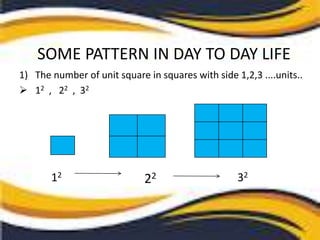
SOME PATTERN IN DAY TO DAY LIFE
1) The number of unit square in squares with side 1,2,3 ....units..
 12 , 22 , 32
12
22 32
SOME REAL LIFE EXAMPLES OF AP
What is a sequence?
A sequence is a set of numbers written in a
particular order.
Examples of sequence:-
 1 , 3 , 5 , 7 , 9....
 1 , 4 , 9 , 16 , 25....
What are Arithmetic Progressions?
An arithmetic Progressions is a sequence or list
of numbers in which each term is obtained by
adding a fixed number to the preceding term
except the first term.
For example:- 1) The heights of some students
of a school standing in a queue in a morning
assembly.
147, 148, 149,..., 157.
2) The minimum temperature recorded for a
week in January,
-3.1 , -3.0 , -2.9 , -2.8 , -2.7 ....
For example:-
1 , 2 , 3 , 4 , 5 , 6 ,.......10
So, each of the numbers in the list is called a term.
Here -1 is the fixed number which is the common difference
of the AP. This common number can either be positive,
negative or zero..
-1 -1
-1 -1 -1
For example:-
1 , 2 , 3 , 4 , 5 , 6 ,.......10
-1 -1
-1 -1 -1
The first term of the AP is denoted by a1 and then
second term as a2 and so on..The last term of AP is
denoted as an .
The common difference is denoted by d ..
General form of an AP
 The General form of an A.P is
a,a+d,a+2d,a+3d...
where ‘d’ is the common difference and ‘a’ is the first
term of AP.
Finite and Infinite AP
I. Finite Arithmetic Progressions :- A finite AP is
a sequence of numbers which has a last term.
Examples:-
1) 147,148,149,150,..........,157.
2) 950,900,850,800,.........,50.
3) 200,250,300,350,.........,750
And many more...
Finite and Infinite AP
II. Infinite Arithmetic Progressions :- A Infinite AP is
a sequence of numbers which do not have a last
term.
Examples:-
1) 1,2,3,4.....
2) 1,3,5,7....
3) 2,4,6,8......
And many more...
For example:-
6 , 9, 12 , 15...
For finding the common difference, we will subtract the
consecutive terms..
a1 = 6
a2 = 9
a3 = 12
a4 = 15
a2 - a1 = 9-6 = 3
a3 - a2 = 12-9 = 3
a4 - a3 = 15-12 = 3
Since, the common difference between the
consecutive terms is same..Hence, it is an
Arithmetic Progression (AP)...
ARITHMETIC PROGRESSIONS..GROUP 1..10E.pptx

ARITHMETIC PROGRESSIONS..GROUP 1..10E.pptx

  • 1.
    ARITHMETIC PROGRESSIONS GROUP 1 Members:-Akshita bansal, Sadhgi Mehta, Md. Hamiz, Payal Aggarwal, Kainat Raza, Bhavya Mittal, Md. Zaid
  • 2.
    What does theterm Arithmetic Progression mean?  Arithmetic – Mathematical Numbers Progression – Moving from one number to another
  • 3.
    SOME PATTERN INDAY TO DAY LIFE 1) The number of unit square in squares with side 1,2,3 ....units..  12 , 22 , 32 12 22 32
  • 4.
    SOME REAL LIFEEXAMPLES OF AP
  • 5.
    SOME REAL LIFEEXAMPLES OF AP
  • 6.
    What is asequence? A sequence is a set of numbers written in a particular order. Examples of sequence:-  1 , 3 , 5 , 7 , 9....  1 , 4 , 9 , 16 , 25....
  • 7.
    What are ArithmeticProgressions? An arithmetic Progressions is a sequence or list of numbers in which each term is obtained by adding a fixed number to the preceding term except the first term.
  • 8.
    For example:- 1)The heights of some students of a school standing in a queue in a morning assembly. 147, 148, 149,..., 157. 2) The minimum temperature recorded for a week in January, -3.1 , -3.0 , -2.9 , -2.8 , -2.7 ....
  • 9.
    For example:- 1 ,2 , 3 , 4 , 5 , 6 ,.......10 So, each of the numbers in the list is called a term. Here -1 is the fixed number which is the common difference of the AP. This common number can either be positive, negative or zero.. -1 -1 -1 -1 -1
  • 10.
    For example:- 1 ,2 , 3 , 4 , 5 , 6 ,.......10 -1 -1 -1 -1 -1 The first term of the AP is denoted by a1 and then second term as a2 and so on..The last term of AP is denoted as an . The common difference is denoted by d ..
  • 11.
    General form ofan AP  The General form of an A.P is a,a+d,a+2d,a+3d... where ‘d’ is the common difference and ‘a’ is the first term of AP.
  • 12.
    Finite and InfiniteAP I. Finite Arithmetic Progressions :- A finite AP is a sequence of numbers which has a last term. Examples:- 1) 147,148,149,150,..........,157. 2) 950,900,850,800,.........,50. 3) 200,250,300,350,.........,750 And many more...
  • 13.
    Finite and InfiniteAP II. Infinite Arithmetic Progressions :- A Infinite AP is a sequence of numbers which do not have a last term. Examples:- 1) 1,2,3,4..... 2) 1,3,5,7.... 3) 2,4,6,8...... And many more...
  • 14.
    For example:- 6 ,9, 12 , 15... For finding the common difference, we will subtract the consecutive terms.. a1 = 6 a2 = 9 a3 = 12 a4 = 15 a2 - a1 = 9-6 = 3 a3 - a2 = 12-9 = 3 a4 - a3 = 15-12 = 3 Since, the common difference between the consecutive terms is same..Hence, it is an Arithmetic Progression (AP)...