ASWATHI PV
Msc. Mathematics
Introduction
You must have observed that in nature many things
follow a certain pattern, such as the petals of sun
flower , the holes of a honeybee comb, the grains on
maize cob etc. We now look for some patterns which
occur in our daily life.
Example-1
Azad applied for a job and got selected. He has been
offered a job with a starting monthly salary 20,000
with an annual increment of Rs. 1000 in his salary. His
salary for the 1st , 2nd ,3rd… Years will be respectively
20000 , 21000, 22000 ….
Here we observe a pattern we find that the
succeeding terms are obtained by adding a fixed
number 1000.
Example -2
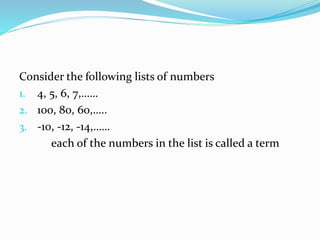
Consider the following lists of numbers
1. 4, 5, 6, 7,……
2. 100, 80, 60,…..
3. -10, -12, -14,……
each of the numbers in the list is called a term
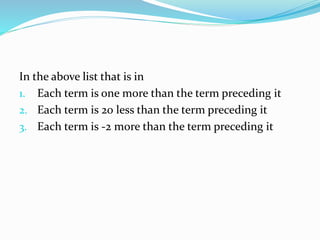
In the above list that is in
1. Each term is one more than the term preceding it
2. Each term is 20 less than the term preceding it
3. Each term is -2 more than the term preceding it
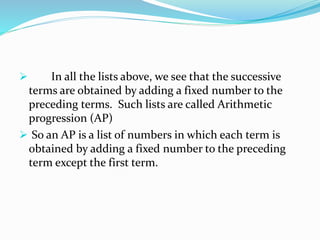
 In all the lists above, we see that the successive
terms are obtained by adding a fixed number to the
preceding terms. Such lists are called Arithmetic
progression (AP)
 So an AP is a list of numbers in which each term is
obtained by adding a fixed number to the preceding
term except the first term.
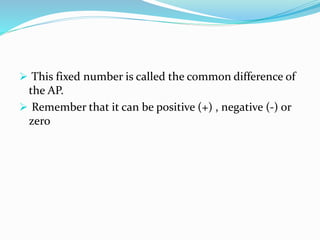
 This fixed number is called the common difference of
the AP.
 Remember that it can be positive (+) , negative (-) or
zero
?
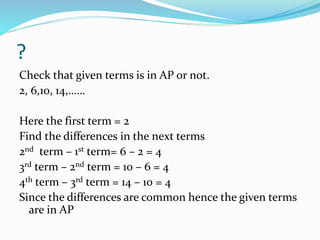
Check that given terms is in AP or not.
2, 6,10, 14,……
Here the first term = 2
Find the differences in the next terms
2nd term – 1st term= 6 – 2 = 4
3rd term – 2nd term = 10 – 6 = 4
4th term – 3rd term = 14 – 10 = 4
Since the differences are common hence the given terms
are in AP
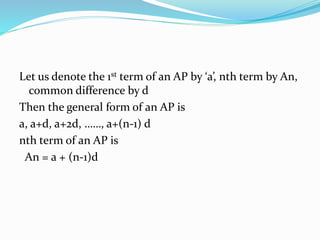
Let us denote the 1st term of an AP by ‘a’, nth term by An,
common difference by d
Then the general form of an AP is
a, a+d, a+2d, ……, a+(n-1) d
nth term of an AP is
An = a + (n-1)d
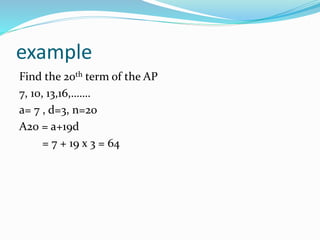
example
Find the 20th term of the AP
7, 10, 13,16,…….
a= 7 , d=3, n=20
A20 = a+19d
= 7 + 19 x 3 = 64
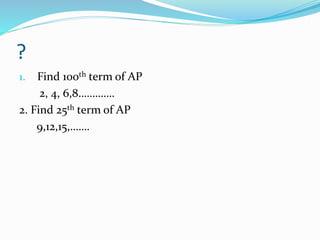
?
1. Find 100th term of AP
2, 4, 6,8………….
2. Find 25th term of AP
9,12,15,…….
arithmetic progression

arithmetic progression

  • 2.
  • 3.
    Introduction You must haveobserved that in nature many things follow a certain pattern, such as the petals of sun flower , the holes of a honeybee comb, the grains on maize cob etc. We now look for some patterns which occur in our daily life.
  • 4.
    Example-1 Azad applied fora job and got selected. He has been offered a job with a starting monthly salary 20,000 with an annual increment of Rs. 1000 in his salary. His salary for the 1st , 2nd ,3rd… Years will be respectively 20000 , 21000, 22000 …. Here we observe a pattern we find that the succeeding terms are obtained by adding a fixed number 1000.
  • 5.
  • 6.
    Consider the followinglists of numbers 1. 4, 5, 6, 7,…… 2. 100, 80, 60,….. 3. -10, -12, -14,…… each of the numbers in the list is called a term
  • 7.
    In the abovelist that is in 1. Each term is one more than the term preceding it 2. Each term is 20 less than the term preceding it 3. Each term is -2 more than the term preceding it
  • 8.
     In allthe lists above, we see that the successive terms are obtained by adding a fixed number to the preceding terms. Such lists are called Arithmetic progression (AP)  So an AP is a list of numbers in which each term is obtained by adding a fixed number to the preceding term except the first term.
  • 9.
     This fixednumber is called the common difference of the AP.  Remember that it can be positive (+) , negative (-) or zero
  • 10.
    ? Check that giventerms is in AP or not. 2, 6,10, 14,…… Here the first term = 2 Find the differences in the next terms 2nd term – 1st term= 6 – 2 = 4 3rd term – 2nd term = 10 – 6 = 4 4th term – 3rd term = 14 – 10 = 4 Since the differences are common hence the given terms are in AP
  • 11.
    Let us denotethe 1st term of an AP by ‘a’, nth term by An, common difference by d Then the general form of an AP is a, a+d, a+2d, ……, a+(n-1) d nth term of an AP is An = a + (n-1)d
  • 12.
    example Find the 20thterm of the AP 7, 10, 13,16,……. a= 7 , d=3, n=20 A20 = a+19d = 7 + 19 x 3 = 64
  • 13.
    ? 1. Find 100thterm of AP 2, 4, 6,8…………. 2. Find 25th term of AP 9,12,15,…….