“Nothing on earth is more international 
than disease” 
Paul Russel
GGlloobbaall BBuurrddeenn ooff DDiisseeaassee 
Sujata Mohapatra,Msc(N)
BBrriieeff IInnttrroodduuccttiioonn 
World 
Outreach
HHeeaalltthh 
“A state of complete 
physical, mental, and 
social well-being and 
not merely the 
absence of disease or 
infirmity.” 
WHO definition of health
GGlloobbaall HHeeaalltthh 
Refers to health problems that transcend national borders. 
• Problems such as infectious and insect-borne diseases that can 
spread from one country to another. It also includes health 
problems that are of such magnitude that they have a global 
political and economic impact. 
Refers to health problems that are best addressed by 
cooperative actions and solutions. 
• global health problems can move across national borders,. 
Cooperation across countries is essential to addressing those 
health problems that transcend borders. This includes helping 
other countries address their particular health care crises.
GGlloobbaall BBuurrddeenn ooff 
DDiisseeaassee 
 The global burden of disease (GBD) is a comprehensive regional and 
global assessment of mortality and disability. 
 Developed in 1990 by the WHO. 
 Provides information and projections about disease burden on a global 
scale. The GBD has three specific aims: 
• To systematically incorporate information on non-fatal outcomes into 
the assessment of health status. 
• To ensure that all estimates and projections were derived on the basis 
of objective epidemiological and demographic methods, which were not 
influenced by advocates. 
• To measure the burden of disease using a metric that could also be 
used to assess the cost-effectiveness of interventions. The metric 
chosen was the DALY.
WWhhyy sshhoouulldd wwee ccaarree?? 
• Medical missionaries have 
been on the forefront of 
health in developing nations 
for 100’s of years. 
• We can enable others to live 
more productive and 
fulfilling lives.
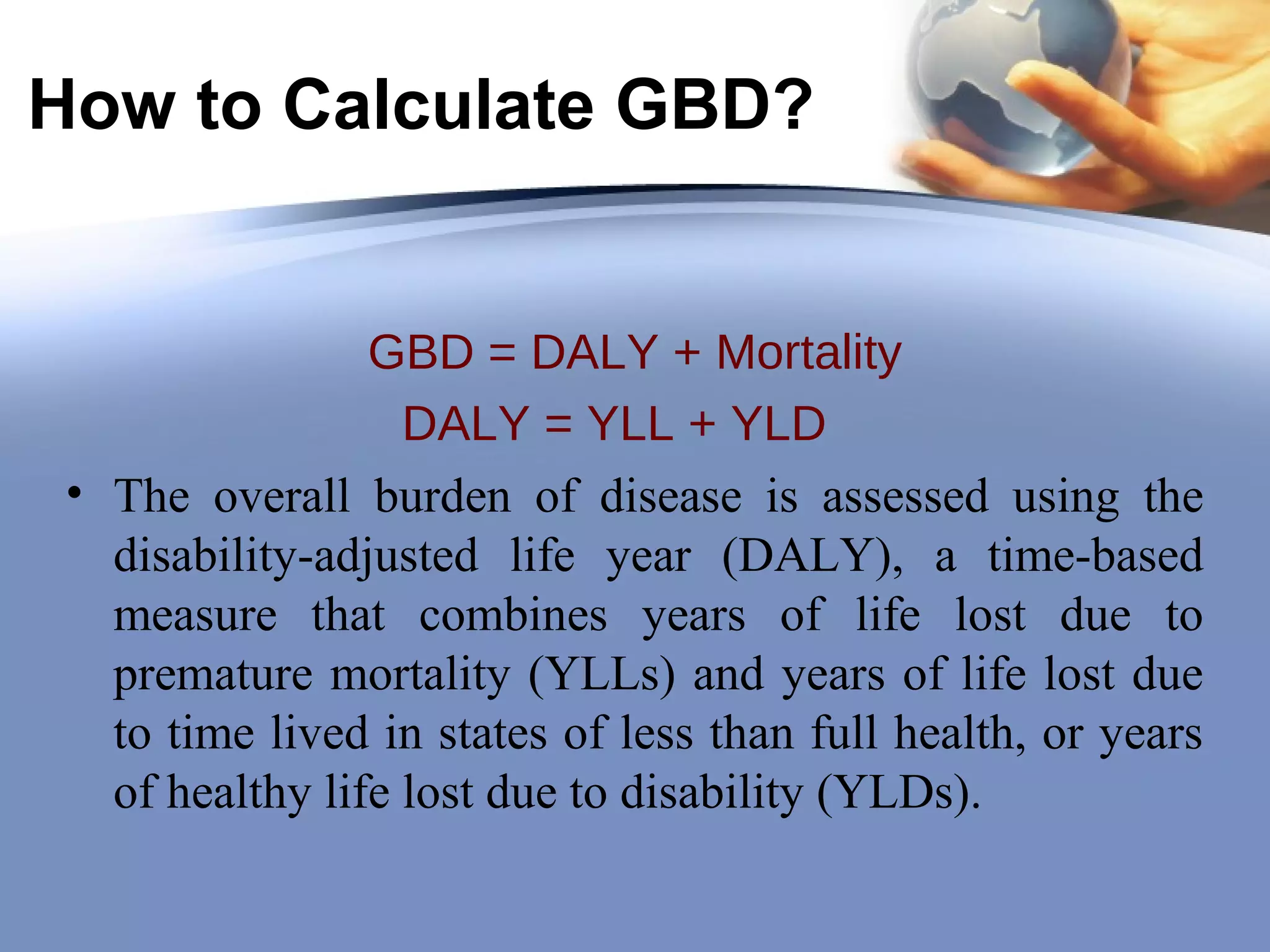
How to Calculate GBD? 
GBD = DALY + Mortality 
DALY = YLL + YLD 
• The overall burden of disease is assessed using the 
disability-adjusted life year (DALY), a time-based 
measure that combines years of life lost due to 
premature mortality (YLLs) and years of life lost due 
to time lived in states of less than full health, or years 
of healthy life lost due to disability (YLDs).
Comparison of the proportional 
distribution of deaths and YLL by 
region, 2004
Burden of disease by broad 
cause group and region, 2004
WWhhaatt’’ss tthhee wwoorrlldd ddyyiinngg ooff tthheessee ddaayyss?? 
TTHHEE LLEEAADDIINNGG CCAAUUSSEESS OOFF 
MMOORRTTAALLIITTYY
CChhrroonniicc DDiisseeaassee 
• CDs responsible for 60% of all deaths in 2005. 
• >80% of deaths occurred in low to middle income 
countries (LMIC). 
• NCDs are killing more people in their prime adult 
years. 
• Surprising fact: 
– TB, HIV, and malaria only account for 10% of the global 
deaths.
Leading Causes of Mortality and Burden of 
Disease in world, 2004 
MORTALITY DALY 
% 
1. Ischaemic heart disease 12.2 
2. Cerebrovascular disease 9.7 
3. Lower respiratory infections 7.1 
4. COPD 5.1 
5. Diarrhoeal diseases 3.7 
6. HIV/AIDS 3.5 
7. Tuberculosis 2.5 
8. Trachea, bronchus, lung cancers 2.3 
9. Road traffic accidents 2.2 
10. Prematurity, low birth weight 2.0 
% 
1. Lower respiratory infections 6.2 
2. Diarrhoeal diseases 4.8 
3. Depression 4.3 
4. Ischaemic heart disease 4.1 
5. HIV/AIDS 3.8 
6. Cerebrovascular disease 3.1 
7. Prematurity, low birth weight 2.9 
8. Birth asphyxia, birth trauma 2.7 
9. Road traffic accidents 2.7 
10. Neonatal infections and other 2.7
Major Causes of Death, World, 2004 
Source: The Global Burden of Disease: 2004 update, WHO 
Disease or Injury 
Deaths/ 
million 
% of total 
deaths 
1 Ischemic heart disease 7.2 12.2 
2 Cerebrovascular disease 5.7 9.7 
3 Lower respiratory infections 4.2 7.1 
4 COPD 3 5.1 
5 Diarrheal diseases 2.2 3.7 
6 HIV/AIDS 2 3.5 
7 Tuberculosis 2.5 1.5 
8 Trachea, bronchus, lung cancers 1.3 2.3 
9 Road traffic accidents 1.3 2.2 
10 Prematurity and low birth weight 1.2 2
NNuummbbeerr 11 KKiilllleerr 
• Cardiovascular diseases 
kill more people each 
year than any other. 
• In 2004 
– CHD killed 7.2 million 
people 
– Another 5.7 million died 
of stroke or another form 
of CVD
Comparison of Global Mortality, 2004 
Source: WHO Fact Sheet, Top 10 Causes of Death
Adult mortality rates by major cause 
Cardiovascular diseases 
Cancers 
Other noncommunicable diseases 
Injuries 
HIVAIDS 
Other infectious and parasitic diseases 
Maternal and nutritional conditions 
Cardiovascular diseases 
Cancers 
Other noncommunicable diseases 
Injuries 
HIVAIDS 
Other infectious and parasitic diseases 
Maternal and nutritional conditions 
group and region, 2004 
0 2 4 6 8 10 12 
0 2 4 6 8 10 12 
High income 
High income 
Western Pacific 
Western Pacific 
Americas 
Americas 
Eastern Mediterranean 
South East Asia 
South East Asia 
Europe 
Europe 
Africa 
Death rate per 1000 adults aged 15–59 years 
Africa 
Death rate per 1000 adults aged 15–59 years
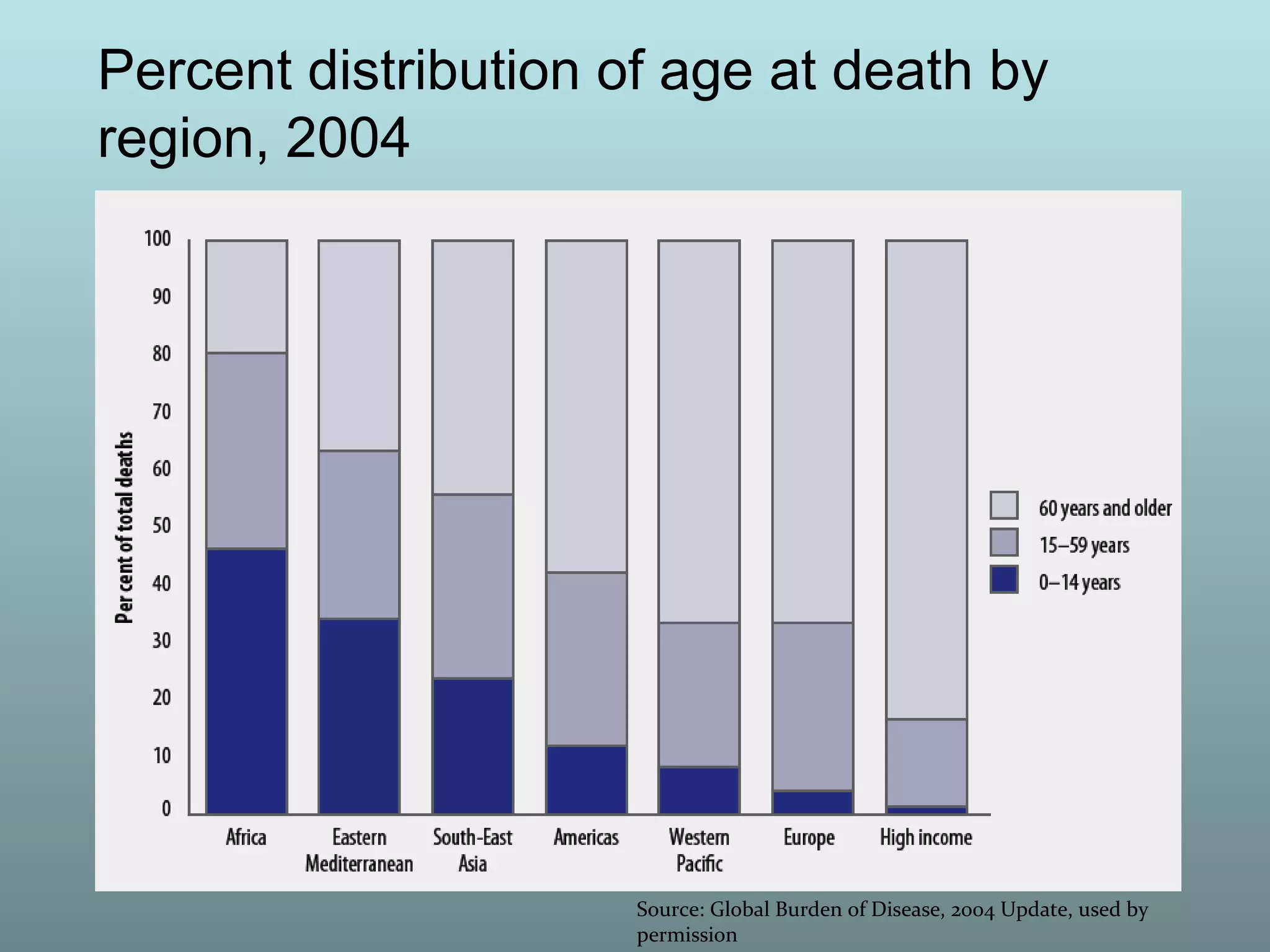
Percent distribution of age at death by 
region, 2004 
Source: Global Burden of Disease, 2004 Update, used by 
permission
Distribution of deaths in the world by 
sex, 2004
Distribution of age at death and numbers of deaths, 
world, 2004
MMoosstt ccoommmmoonn NNCCDDss 
RRIISSKK FFAACCTTOORRSS
GGlloobbaalliizzaattiioonn 
• “The increasing interconnectedness of countries and 
the openness of borders to ideas, people, commerce, 
and financial capital. “ (Lancet, 2003) 
• Refers to every aspect of life: cultural, social, 
psychological, and political. 
• Creates both negative and positive impacts on society 
and its health.
From the US to …
DDeevveellooppiinngg NNaattiioonnss 
PPoooorr nnuuttrriittiioonn nnooww aaffffeeccttss aallll ppaarrttss ooff tthhee wwoorrlldd 
China Tanzania
BBaadd HHaabbiittss sspprreeaaddiinngg
MMaajjoorr rriisskk ffaaccttoorrss 
• Tobacco use 
• High blood pressure 
• Alcohol 
• Overweight and obesity, physical inactivity 
• Cholesterol
Source: WHO Report on Global Tobacco Epidemic, 2008, used by 
permission 
TToobbaaccccoo uussee
Liang Liang smoking since 
age 1-1/2 
Warning! Warning!
AAllccoohhooll UUssee 
• About 2 billion people consume alcohol. 
• Developing countries increasing intake. 
• Highest burden in Latin America and Caribbean 
(9.7%). 
• Lowest in Middle Eastern Crescent (0.4%) and India 
(1.7%).
WWoorrllddwwiiddee AAllccoohhooll 
CCoonnssuummppttiioonn,, 22000088
OOvveerrwweeiigghhtt && OObbeessiittyy 
The World Health Organization predicts there will be 2.3 billion overweight 
adults in the world by 2015 and more than 700 million of them will be obese.
PPhhyyssiiccaall IInnaaccttiivviittyy 
• Physical inactivity is estimated to cause 2 million 
deaths worldwide annually. 
• Globally a causal factor in: 
– ~ 10-16% of cases each of breast cancer, colon cancers, and 
diabetes 
– 22% of ischemic heart disease.
CChhoolleesstteerrooll 
• Suboptimal levels 
contribute to ~ 2/3 of the 
global CVD risk. 
• 4.4 million deaths in 
world related to 
hyperlipidemia. 
• Responsible for 32% of 
ischemic stroke and 56% 
of IHD.
HHyyppeerrtteennssiioonn 
• Responsible for 13% of 
deaths world-wide. 
• Over 26% of adults in 
the world had 
hypertension in 2000— 
expected to jump to 30% 
by 2025. 
• 2/3 with HTN live in 
developing world.
AAddeeqquuaattee SSccrreeeenniinngg 
&& TTrreeaattmmeenntt 
• Still fairly unattained in much of the world. 
• Pakistan: >40% of docs prescribed sedatives for HTN! 
• Africa: control rates as low as 2%. 
• Saudi Arabia: >60% of physicians and nurses in large 
teaching hospital had poor knowledge of basic 
techniques of BP measurement.
TThhee mmaannyy ffaacceess ooff cchhrroonniicc 
ddiisseeaassee
IIllllnneessss 
Top 4 causes of illness worldwide include: 
1. Diarrheal disease 
2. Pneumonia and other lower respiratory tract infections 
 Except in Africa which has high levels of malaria 
1. Injuries 
2. Complications of pregnancy
DDiissaabbiilliittyy 
• More individuals have iron-deficiency anemia than 
any other health problem in the world. 
• Other very common conditions, with varying levels of 
severity, include: 
– asthma 
– arthritis 
– vision and hearing problems 
– migraine 
– major depressive episodes 
– intestinal worms.
10 facts on the state of global 
health, 2012 
• Life expectancy at birth increased globally by 6 years since 1990. 
• Around 6.6 million children under the age of 5 die each year. 
• Cardiovascular diseases are the leading causes of death in the world. 
• Preterm birth is the leading killer of newborn babies worldwide. 
• Most HIV/AIDS deaths occur in Africa. 
• Every day, about 800 women die due to complications of pregnancy 
and childbirth. 
• Mental health disorders such as depression are among the 20 leading 
causes of disability worldwide. 
• Tobacco kills nearly 6 million people each year. 
• Almost 1 in 10 adults has diabetes. 
• Nearly 3500 people die from road traffic crashes every day.
Global projections for selected 
causes,2004 to 2030 
12 
12 
10 
10 
8 
8 
6 
6 
4 
4 
2 
2 
0 
2000 2005 2010 2015 2020 2025 2030 
Deaths (millions) 
0 
2000 2005 2010 2015 2020 2025 2030 
Deaths (millions) 
Cancers 
Ischaemic HD 
Stroke 
Acute respiratory 
infections 
Road traffic 
accidents 
Perinatal 
HIV/AIDS 
TB 
Malaria
INTERNATIONAL HEALTH 
REGULATIONS (IHR) 
Since 15 June 2007, the world has been implementing 
the International Health Regulations (2005). 
Under the International Health Regulations 2005 (IHR 
2005), the World Health Organization is to establish case 
definitions for the following four critical diseases: 
• smallpox 
• poliomyelitis due to wild type poliovirus 
• human influenza caused by a new subtype, and 
• severe acute respiratory syndrome (SARS).
Purpose and scope of IHR 
(2005) 
The purpose and scope of these Regulations are to 
prevent, protect against, control, and provide a 
public health response to the international spread of 
disease in ways that are commensurate with and 
restricted to risks to public health, 
and 
which avoid unnecessary interference with 
international traffic and trade.
Ten things you need to do to 
implement the IHR 
1. Know the IHR; purpose, scope, principles and concepts 
2. Update national legislation 
3. Recognize shared realities and the need for collective 
defences 
4. Monitor and report on IHR implementation progress 
5. Notify, report, consult and inform WHO 
6. Understand WHO’s role in international event 
detection, joint assessment and response
Contd.. 
7. Participate in the PHEIC determination and 
WHO recommendations-making processes 
8. Strengthen national surveillance and 
response capacities 
9. Increase public health security at ports 
airports and ground crossings 
10. Use and disseminate IHR health documents 
at points of entry
IHR procedures and 
monitoring 
IHR (2005) include many rights and obligations for States Parties. 
These cover activities; 
Surveillance and response, 
Notification and verification to WHO of certain public health 
events and risks, 
Rules on application of health measures to international 
travellers, trade and transportation, 
Requirements for sanitary conditions and services at 
international ports, airports and ground crossings 
Development of minimum public health capacities for 
surveillance, assessment, response and reporting for a broad 
range of risks throughout the territories of all States Parties.
IHR Measures 
Notification 
Those diseases subject to international health regulation 
Diseases under surveillance by WHO 
Quarantine 
Absolute 
Modified 
Segregation
TThheessee ssmmiilliinngg 
ffaacceess mmaakkee aallll 
yyoouurr sswweeaatt aanndd 
tteeaarrss wwoorrtthh iitt!!
QQuueessttiioonnss??
Global burden of disease & International Health Regulation

Global burden of disease & International Health Regulation

  • 1.
    “Nothing on earthis more international than disease” Paul Russel
  • 2.
    GGlloobbaall BBuurrddeenn ooffDDiisseeaassee Sujata Mohapatra,Msc(N)
  • 3.
  • 4.
    HHeeaalltthh “A stateof complete physical, mental, and social well-being and not merely the absence of disease or infirmity.” WHO definition of health
  • 5.
    GGlloobbaall HHeeaalltthh Refersto health problems that transcend national borders. • Problems such as infectious and insect-borne diseases that can spread from one country to another. It also includes health problems that are of such magnitude that they have a global political and economic impact. Refers to health problems that are best addressed by cooperative actions and solutions. • global health problems can move across national borders,. Cooperation across countries is essential to addressing those health problems that transcend borders. This includes helping other countries address their particular health care crises.
  • 6.
    GGlloobbaall BBuurrddeenn ooff DDiisseeaassee  The global burden of disease (GBD) is a comprehensive regional and global assessment of mortality and disability.  Developed in 1990 by the WHO.  Provides information and projections about disease burden on a global scale. The GBD has three specific aims: • To systematically incorporate information on non-fatal outcomes into the assessment of health status. • To ensure that all estimates and projections were derived on the basis of objective epidemiological and demographic methods, which were not influenced by advocates. • To measure the burden of disease using a metric that could also be used to assess the cost-effectiveness of interventions. The metric chosen was the DALY.
  • 7.
    WWhhyy sshhoouulldd wweeccaarree?? • Medical missionaries have been on the forefront of health in developing nations for 100’s of years. • We can enable others to live more productive and fulfilling lives.
  • 8.
    How to CalculateGBD? GBD = DALY + Mortality DALY = YLL + YLD • The overall burden of disease is assessed using the disability-adjusted life year (DALY), a time-based measure that combines years of life lost due to premature mortality (YLLs) and years of life lost due to time lived in states of less than full health, or years of healthy life lost due to disability (YLDs).
  • 9.
    Comparison of theproportional distribution of deaths and YLL by region, 2004
  • 10.
    Burden of diseaseby broad cause group and region, 2004
  • 12.
    WWhhaatt’’ss tthhee wwoorrllddddyyiinngg ooff tthheessee ddaayyss?? TTHHEE LLEEAADDIINNGG CCAAUUSSEESS OOFF MMOORRTTAALLIITTYY
  • 13.
    CChhrroonniicc DDiisseeaassee •CDs responsible for 60% of all deaths in 2005. • >80% of deaths occurred in low to middle income countries (LMIC). • NCDs are killing more people in their prime adult years. • Surprising fact: – TB, HIV, and malaria only account for 10% of the global deaths.
  • 14.
    Leading Causes ofMortality and Burden of Disease in world, 2004 MORTALITY DALY % 1. Ischaemic heart disease 12.2 2. Cerebrovascular disease 9.7 3. Lower respiratory infections 7.1 4. COPD 5.1 5. Diarrhoeal diseases 3.7 6. HIV/AIDS 3.5 7. Tuberculosis 2.5 8. Trachea, bronchus, lung cancers 2.3 9. Road traffic accidents 2.2 10. Prematurity, low birth weight 2.0 % 1. Lower respiratory infections 6.2 2. Diarrhoeal diseases 4.8 3. Depression 4.3 4. Ischaemic heart disease 4.1 5. HIV/AIDS 3.8 6. Cerebrovascular disease 3.1 7. Prematurity, low birth weight 2.9 8. Birth asphyxia, birth trauma 2.7 9. Road traffic accidents 2.7 10. Neonatal infections and other 2.7
  • 15.
    Major Causes ofDeath, World, 2004 Source: The Global Burden of Disease: 2004 update, WHO Disease or Injury Deaths/ million % of total deaths 1 Ischemic heart disease 7.2 12.2 2 Cerebrovascular disease 5.7 9.7 3 Lower respiratory infections 4.2 7.1 4 COPD 3 5.1 5 Diarrheal diseases 2.2 3.7 6 HIV/AIDS 2 3.5 7 Tuberculosis 2.5 1.5 8 Trachea, bronchus, lung cancers 1.3 2.3 9 Road traffic accidents 1.3 2.2 10 Prematurity and low birth weight 1.2 2
  • 16.
    NNuummbbeerr 11 KKiilllleerr • Cardiovascular diseases kill more people each year than any other. • In 2004 – CHD killed 7.2 million people – Another 5.7 million died of stroke or another form of CVD
  • 17.
    Comparison of GlobalMortality, 2004 Source: WHO Fact Sheet, Top 10 Causes of Death
  • 18.
    Adult mortality ratesby major cause Cardiovascular diseases Cancers Other noncommunicable diseases Injuries HIVAIDS Other infectious and parasitic diseases Maternal and nutritional conditions Cardiovascular diseases Cancers Other noncommunicable diseases Injuries HIVAIDS Other infectious and parasitic diseases Maternal and nutritional conditions group and region, 2004 0 2 4 6 8 10 12 0 2 4 6 8 10 12 High income High income Western Pacific Western Pacific Americas Americas Eastern Mediterranean Eastern Mediterranean South East Asia South East Asia Europe Europe Africa Death rate per 1000 adults aged 15–59 years Africa Death rate per 1000 adults aged 15–59 years
  • 19.
    Percent distribution ofage at death by region, 2004 Source: Global Burden of Disease, 2004 Update, used by permission
  • 20.
    Distribution of deathsin the world by sex, 2004
  • 21.
    Distribution of ageat death and numbers of deaths, world, 2004
  • 22.
    MMoosstt ccoommmmoonn NNCCDDss RRIISSKK FFAACCTTOORRSS
  • 23.
    GGlloobbaalliizzaattiioonn • “Theincreasing interconnectedness of countries and the openness of borders to ideas, people, commerce, and financial capital. “ (Lancet, 2003) • Refers to every aspect of life: cultural, social, psychological, and political. • Creates both negative and positive impacts on society and its health.
  • 24.
  • 25.
    DDeevveellooppiinngg NNaattiioonnss PPoooorrnnuuttrriittiioonn nnooww aaffffeeccttss aallll ppaarrttss ooff tthhee wwoorrlldd China Tanzania
  • 26.
  • 27.
    MMaajjoorr rriisskk ffaaccttoorrss • Tobacco use • High blood pressure • Alcohol • Overweight and obesity, physical inactivity • Cholesterol
  • 28.
    Source: WHO Reporton Global Tobacco Epidemic, 2008, used by permission TToobbaaccccoo uussee
  • 29.
    Liang Liang smokingsince age 1-1/2 Warning! Warning!
  • 30.
    AAllccoohhooll UUssee •About 2 billion people consume alcohol. • Developing countries increasing intake. • Highest burden in Latin America and Caribbean (9.7%). • Lowest in Middle Eastern Crescent (0.4%) and India (1.7%).
  • 31.
  • 32.
    OOvveerrwweeiigghhtt && OObbeessiittyy The World Health Organization predicts there will be 2.3 billion overweight adults in the world by 2015 and more than 700 million of them will be obese.
  • 33.
    PPhhyyssiiccaall IInnaaccttiivviittyy •Physical inactivity is estimated to cause 2 million deaths worldwide annually. • Globally a causal factor in: – ~ 10-16% of cases each of breast cancer, colon cancers, and diabetes – 22% of ischemic heart disease.
  • 34.
    CChhoolleesstteerrooll • Suboptimallevels contribute to ~ 2/3 of the global CVD risk. • 4.4 million deaths in world related to hyperlipidemia. • Responsible for 32% of ischemic stroke and 56% of IHD.
  • 35.
    HHyyppeerrtteennssiioonn • Responsiblefor 13% of deaths world-wide. • Over 26% of adults in the world had hypertension in 2000— expected to jump to 30% by 2025. • 2/3 with HTN live in developing world.
  • 36.
    AAddeeqquuaattee SSccrreeeenniinngg &&TTrreeaattmmeenntt • Still fairly unattained in much of the world. • Pakistan: >40% of docs prescribed sedatives for HTN! • Africa: control rates as low as 2%. • Saudi Arabia: >60% of physicians and nurses in large teaching hospital had poor knowledge of basic techniques of BP measurement.
  • 37.
    TThhee mmaannyy ffaacceessooff cchhrroonniicc ddiisseeaassee
  • 38.
    IIllllnneessss Top 4causes of illness worldwide include: 1. Diarrheal disease 2. Pneumonia and other lower respiratory tract infections  Except in Africa which has high levels of malaria 1. Injuries 2. Complications of pregnancy
  • 39.
    DDiissaabbiilliittyy • Moreindividuals have iron-deficiency anemia than any other health problem in the world. • Other very common conditions, with varying levels of severity, include: – asthma – arthritis – vision and hearing problems – migraine – major depressive episodes – intestinal worms.
  • 40.
    10 facts onthe state of global health, 2012 • Life expectancy at birth increased globally by 6 years since 1990. • Around 6.6 million children under the age of 5 die each year. • Cardiovascular diseases are the leading causes of death in the world. • Preterm birth is the leading killer of newborn babies worldwide. • Most HIV/AIDS deaths occur in Africa. • Every day, about 800 women die due to complications of pregnancy and childbirth. • Mental health disorders such as depression are among the 20 leading causes of disability worldwide. • Tobacco kills nearly 6 million people each year. • Almost 1 in 10 adults has diabetes. • Nearly 3500 people die from road traffic crashes every day.
  • 41.
    Global projections forselected causes,2004 to 2030 12 12 10 10 8 8 6 6 4 4 2 2 0 2000 2005 2010 2015 2020 2025 2030 Deaths (millions) 0 2000 2005 2010 2015 2020 2025 2030 Deaths (millions) Cancers Ischaemic HD Stroke Acute respiratory infections Road traffic accidents Perinatal HIV/AIDS TB Malaria
  • 42.
    INTERNATIONAL HEALTH REGULATIONS(IHR) Since 15 June 2007, the world has been implementing the International Health Regulations (2005). Under the International Health Regulations 2005 (IHR 2005), the World Health Organization is to establish case definitions for the following four critical diseases: • smallpox • poliomyelitis due to wild type poliovirus • human influenza caused by a new subtype, and • severe acute respiratory syndrome (SARS).
  • 43.
    Purpose and scopeof IHR (2005) The purpose and scope of these Regulations are to prevent, protect against, control, and provide a public health response to the international spread of disease in ways that are commensurate with and restricted to risks to public health, and which avoid unnecessary interference with international traffic and trade.
  • 44.
    Ten things youneed to do to implement the IHR 1. Know the IHR; purpose, scope, principles and concepts 2. Update national legislation 3. Recognize shared realities and the need for collective defences 4. Monitor and report on IHR implementation progress 5. Notify, report, consult and inform WHO 6. Understand WHO’s role in international event detection, joint assessment and response
  • 45.
    Contd.. 7. Participatein the PHEIC determination and WHO recommendations-making processes 8. Strengthen national surveillance and response capacities 9. Increase public health security at ports airports and ground crossings 10. Use and disseminate IHR health documents at points of entry
  • 46.
    IHR procedures and monitoring IHR (2005) include many rights and obligations for States Parties. These cover activities; Surveillance and response, Notification and verification to WHO of certain public health events and risks, Rules on application of health measures to international travellers, trade and transportation, Requirements for sanitary conditions and services at international ports, airports and ground crossings Development of minimum public health capacities for surveillance, assessment, response and reporting for a broad range of risks throughout the territories of all States Parties.
  • 47.
    IHR Measures Notification Those diseases subject to international health regulation Diseases under surveillance by WHO Quarantine Absolute Modified Segregation
  • 49.
    TThheessee ssmmiilliinngg ffaacceessmmaakkee aallll yyoouurr sswweeaatt aanndd tteeaarrss wwoorrtthh iitt!!
  • 50.

Editor's Notes

  • #5 The WHO came up with this well-known definition of health over 30 years ago. It is still widely-quoted today.
  • #6 Health providers must understand health from a global perspective. Global health refers to health problems that transcend national borders—problems such as infectious and insect-borne diseases that can spread from one country to another. It also includes health problems that are of such magnitude that they have a global political and economic impact. Global health refers to health problems that are best addressed by cooperative actions and solutions—solutions that involve more than one country. Because global health problems can move across national borders, countries can learn from one another’s experiences, both in how diseases spread and in how they can be treated and controlled. Cooperation across countries is essential to addressing those health problems that transcend borders. This includes helping other countries address their particular health care crises.
  • #7 The GBD has three specific aims: To systematically incorporate information on non-fatal outcomes into the assessment of health status (using a time-based measure of healthy years of life lost due either to premature mortality or to years lived with a disability, weighted by the severity of that disability) To ensure that all estimates and projections were derived on the basis of objective epidemiological and demographic methods, which were not influenced by advocates. To measure the burden of disease using a metric that could also be used to assess the cost-effectiveness of interventions. The metric chosen was the DALY.
  • #13 With that backdrop, let’s now move onto the subject of leading causes of mortality among adults in the world.
  • #14 Chronic diseases now account for the leading cause of adult deaths globally. By 2020, the number of deaths caused by NCDs in developing countries will equal the deaths caused by communicable diseases. Unfortunately, chronic disease is a neglected global health issue. Much of the developed world has undergone efforts at addressing this issue; however, the developing world still focuses a lot of their attention on infectious diseases. However, even TB, HIV and malaria combined only account for 10% of the deaths in the world. Yet this statistic pales in comparison to chronic diseases which were estimated to cause more than 60% of all deaths in 2005. These deaths are not just concentrated in developed and affluent nations; more than 80% occurred in LMIC. And they are not just diseases of the elderly. One example of this is in Russia where poor diet and alcohol consumption have long blighted Russians' lives. The World Bank estimates that current life expectancy for women is 66 and 58 for men. Life expectancy in Russia is 12 years less than in the United States. The major gender difference suggests that behavioral factors are responsible, rather than factors related to the external environment or adequacy of health care, the World Bank experts said. If current ill health and disability continue, the life expectancy of Russian males will fall to 53 years. Russia is one of the few countries in the world where life expectancy is falling. This is driven largely by increasing mortality among those of working age and young adults—much of this due to CVD and injuries.
  • #16 According to the updated Global Burden of Disease Report released in 2008, cardiovascular diseases are the leading causes of death in the world. The most prevalent cardiovascular diseases are ischemic heart disease (IHD) and cerebrovascular disease. These 2 diseases combined were responsible for about 22% of all deaths in the world in 2004, and by 2030 they are estimated to account for 24% of global deaths. In the US, coronary heart disease is a leading cause of premature, permanent disability in the workforce and stroke accounts for more than a million disabled Americans. The WHO projects that within 10 years deaths from infectious diseases will decrease by 4%, while deaths from CD will increase by 20%! Conventional risk factors such as tobacco use, high blood pressure, high blood glucose, lipid abnormalities, obesity, and physical inactivity, account for the vast majority of cardiovascular disease. Following CVD, the next leading causes of death in the world are lower respiratory infections and COPD. These diseases are often a result of tobacco use and exposure to unvented coal-fired cooking stoves. The fifth leading cause of death—diarrheal disease, killed 2.2 million people in 2004 and was nearly 4% of all deaths. Sadly, this disease kills more children than adults. Of the 10.4 million children who die every year, 17% of these children die from pneumonia and another 17% die from diarrheal diseases. In contrast to adult disease, half of all the childhood deaths are caused by communicable diseases. Many of these child deaths share common risk factors and it is estimated that as much as 63% of these deaths could be averted by implementing several child survival interventions. The sixth and seventh leading causes of death in the world are HIV/AIDS and TB respectively [8]. Lung cancers are the 8th leading cause of death in the world. [6] Not surprising when we consider that more than 1 billion people in the world smoke [10]. Road traffic accidents are the 9th leading cause of death and prematurity and low birth weight is the 10th leading cause of death in the world [8].
  • #18 Deaths across the globe: an overview Imagine a diverse international group of 1000 individuals representative of the women, men and children from all over the globe who died in 2004. Of those 1000 people, 138 would have come from high-income countries, 415 from middle-income countries and 447 from low-income countries. What would be the top 10 causes of their deaths? In high-income countries more than two-thirds of all people live beyond the age of 70 and predominantly die of chronic diseases: cardiovascular disease, chronic obstructive lung disease, cancers, diabetes or dementia. Lung infection remains the only leading infectious cause of death. In middle-income countries, nearly half of all people live to the age of 70 and chronic diseases are the major killers, just as they are in high-income countries. Unlike in high-income countries, however, tuberculosis and road traffic accidents also are leading causes of death. In low-income countries less than a quarter of all people reach the age of 70, and over a third of all deaths are among children under 14. People predominantly die of infectious diseases: lung infections, diarrhoeal diseases, HIV/AIDS, tuberculosis, and malaria. Complications of pregnancy and childbirth together continue to be leading causes of death, claiming the lives of both infants and mothers.
  • #24 There are wide varieties of definitions regarding globalization, and quite a bit of debate regarding its timing. Some argue that it is a new phenomenon, while others maintain that it is a product of the modern-day world.
  • #25 Globalization is making moving across the globe at extraordinary speed. The habits and lifestyles of the “West” are now being imported and adopted by developing nations. New stats: 66 percent Americans Overweight, 30 percent Americans Obese
  • #26 Globally, there are more than 1 billion overweight adults, at least 300 million of them obese. Approximately 22 million children under five are estimated to be overweight worldwide.
  • #27 Wealth is also increasing in developing countries as a result of international trade. As people become wealthier, oftentimes unhealthy lifestyles result which raises the likelihood of diseases related to tobacco use, alcohol abuse, physical inactivity, and obesity.
  • #28 We are going to look at these one by one.
  • #29 Tobacco use is a risk factor for 6 of the 8 primary causes of death in the world. By 2020 tobacco is expected to kill more people than any single disease, even HIV/AIDS. The single largest cause of preventabledeath in the world today More than ¾ of CVD results from its use. Over 100 million people died from use in 20th century. May kill more than 1 billion in 21st century. Currently 70% of tobacco use is in LIC.
  • #30 I found this picture of a young child in an Asian country smoking. This is Liang Liang, an ordinary 2.5 years old child who lives in China. Liang Liang smokes in a pack of cigarettes daily. As it turned out, his parents gave him the first cigarette at age 1.5 to relieve pain. I took this other photograph in an airport duty free shop in Nairobi. Even with all the warning signs pasted all over the cartons of cigarettes, there were many buying tobacco products during their travels.
  • #31 Alcohol is estimated to cause 20 – 30% of esophageal cancer, liver disease, epilepsy, MVAs, and homicide and other intentional injuries.
  • #34 Appropriate regular physical activity is a major component in preventing the growing global burden of chronic disease. The risk of getting a cardiovascular disease increases by 1.5 times in people who do not follow minimum physical activity recommendations.
  • #35 However, the good news is that from 1966 – 2004, the percent of adults with serum cholesterol levels higher than 240 mg/dl were decreased by half. Much of this decrease can be attributed to the use of cholesterol lowering drugs [23]. The Third Report of the National Cholesterol Education Program (NCEP) Expert Panel on Detection, Evaluation, and Treatment of High Blood Cholesterol in Adults [49] continues to emphasize that lowering LDL levels is the primary target in patients with hyperlipidemia.
  • #36 Treating hypertension can result in a 40% decrease in risk of stroke and a 15% reduction in risk of MI.
  • #37 Saudi Arabia: >60% of physicians and nurses in large teaching hospital had poor knowledge of basic techniques of BP measurement.
  • #38 Chronic disease is seen across the globe. Poorer nations are being greatly taxed in caring for these diseases. There are not enough well trained health care workers and primary health care clinics in these LMIC have been traditionally focusing on acute and communicable diseases.
  • #39 According to a UNICEF survey, one in nine Afghan women die during or shortly after pregnancy in Afghanistan, one of the highest rates in the world.