KEYSTONEML
Evan R. Sparks, ShivaramVenkataraman
With:Tomer Kaftan, ZonghengYang, Mike Franklin, Ben Recht
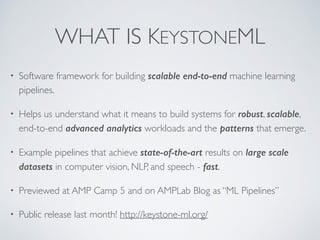
WHAT IS KEYSTONEML
• Software framework for building scalable end-to-end machine learning
pipelines.
• Helps us understand what it means to build systems for robust, scalable,
end-to-end advanced analytics workloads and the patterns that emerge.
• Example pipelines that achieve state-of-the-art results on large scale
datasets in computer vision, NLP, and speech - fast.
• Previewed at AMP Camp 5 and on AMPLab Blog as “ML Pipelines”
• Public release last month! http://keystone-ml.org/
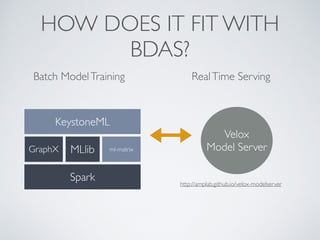
HOW DOES IT FIT WITH
BDAS?
Spark
MLlibGraphX ml-matrix
KeystoneML
Batch ModelTraining
Velox
Model Server
RealTime Serving
http://amplab.github.io/velox-modelserver
WHAT’S A MACHINE
LEARNING PIPELINE?
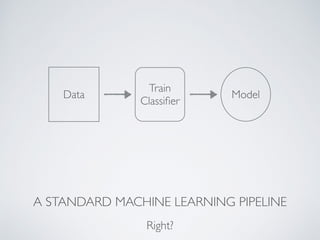
A STANDARD MACHINE LEARNING PIPELINE
Right?
Data
Train
Classifier
Model
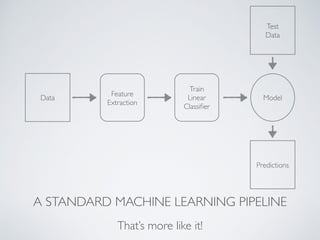
A STANDARD MACHINE LEARNING PIPELINE
That’s more like it!
Data
Train
Linear
Classifier
Model
Feature
Extraction
Test
Data
Predictions
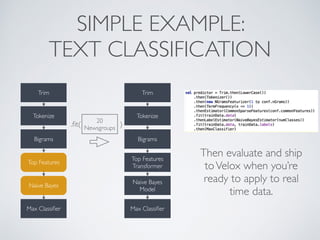
SIMPLE EXAMPLE:
TEXT CLASSIFICATION
20
Newsgroups
.fit( )
Trim
Tokenize
Bigrams
Top Features
Naive Bayes
Max Classifier
Trim
Tokenize
Bigrams
Max Classifier
Top Features
Transformer
Naive Bayes
Model
Then evaluate and ship
toVelox when you’re
ready to apply to real
time data.
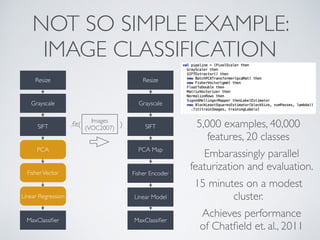
NOT SO SIMPLE EXAMPLE:
IMAGE CLASSIFICATION
Images
(VOC2007)
.fit( )
Resize
Grayscale
SIFT
PCA
FisherVector
MaxClassifier
Linear Regression
Resize
Grayscale
SIFT
MaxClassifier
PCA Map
Fisher Encoder
Linear Model
Achieves performance
of Chatfield et. al., 2011
Embarassingly parallel
featurization and evaluation.
15 minutes on a modest
cluster.
5,000 examples, 40,000
features, 20 classes
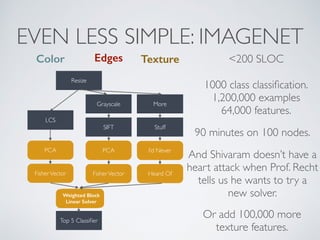
EVEN LESS SIMPLE: IMAGENET
Color Edges
Resize
Grayscale
SIFT
PCA
FisherVector
Top 5 Classifier
LCS
PCA
FisherVector
Block Linear
Solver
<200 SLOC
And Shivaram doesn’t have a
heart attack when Prof. Recht
tells us he wants to try a
new solver.Weighted Block
Linear Solver
Or add 100,000 more
texture features.
Texture
More
Stuff
I’d Never
Heard Of
1000 class classification.
1,200,000 examples
64,000 features.
90 minutes on 100 nodes.
SOFTWARE FEATURES
• Data Loaders
• CSV, CIFAR, ImageNet,VOC,TIMIT, 20 Newsgroups
• Transformers
• NLP -Tokenization, n-grams, term frequency, NER*,
parsing*
• Images - Convolution, Grayscaling, LCS, SIFT*,
FisherVector*, Pooling,Windowing, HOG, Daisy
• Speech - MFCCs*
• Stats - Random Features, Normalization, Scaling*,
Signed Hellinger Mapping, FFT
• Utility/misc - Caching,Top-K classifier, indicator label
mapping, sparse/dense encoding transformers.
• Estimators
• Learning - Block linear models, Linear Discriminant
Analysis, PCA, ZCA Whitening, Naive Bayes*, GMM*
• Example Pipelines
• NLP - 20 Newsgroups,Wikipedia
Language model
• Images - MNIST, CIFAR,VOC, ImageNet
• Speech -TIMIT
• Evaluation Metrics
• Binary Classification
• Multiclass Classification
• Multilabel Classification
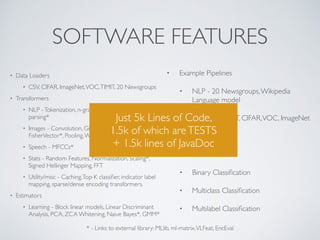
Just 5k Lines of Code,
1.5k of which areTESTS
+ 1.5k lines of JavaDoc
* - Links to external library: MLlib, ml-matrix,VLFeat, EncEval
KEY API CONCEPTS
TRANSFORMERS
TransformerInput Output
abstract classTransformer[In, Out] {
def apply(in: In): Out
def apply(in: RDD[In]): RDD[Out] = in.map(apply)
…
}
TYPE SAFETY HELPS ENSURE ROBUSTNESS
ESTIMATORS
EstimatorRDD[Input]
abstract class Estimator[In, Out] {
def fit(in: RDD[In]):Transformer[In,Out]
…
}
Transformer
.fit()
CHAINING
NGrams(2)String Vectorizer VectorBigrams
val featurizer:Transformer[String,Vector] = NGrams(2) thenVectorizer
featurizerString Vector
=
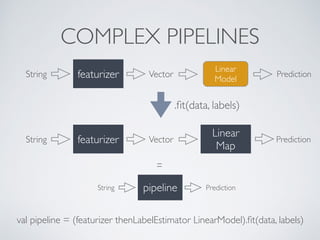
COMPLEX PIPELINES
.fit(data, labels)
pipelineString Prediction
=
val pipeline = (featurizer thenLabelEstimator LinearModel).fit(data, labels)
featurizerString Vector
Linear
Model
Prediction
featurizerString Vector
Linear
Map
Prediction
USINGTHE API
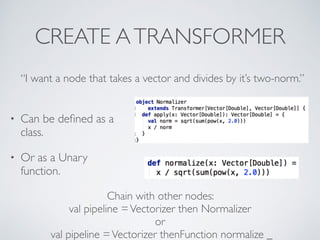
CREATE ATRANSFORMER
• Can be defined as a
class.
• Or as a Unary
function.
“I want a node that takes a vector and divides by it’s two-norm.”
Chain with other nodes:
val pipeline =Vectorizer then Normalizer
or
val pipeline =Vectorizer thenFunction normalize _
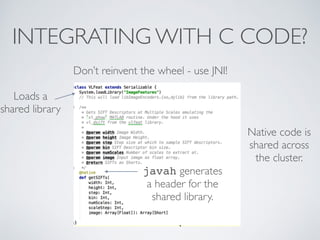
INTEGRATING WITH C CODE?
Don’t reinvent the wheel - use JNI!
Loads a
shared library
javah generates
a header for the
shared library.
Native code is
shared across
the cluster.
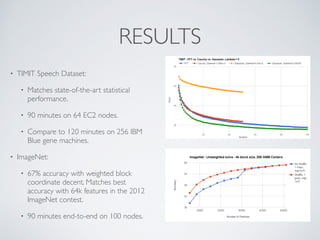
RESULTS
• TIMIT Speech Dataset:
• Matches state-of-the-art statistical
performance.
• 90 minutes on 64 EC2 nodes.
• Compare to 120 minutes on 256 IBM
Blue gene machines.
• ImageNet:
• 67% accuracy with weighted block
coordinate decent. Matches best
accuracy with 64k features in the 2012
ImageNet contest.
• 90 minutes end-to-end on 100 nodes.
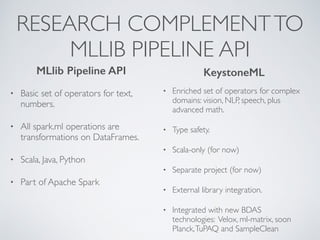
RESEARCH COMPLEMENTTO
MLLIB PIPELINE API
• Basic set of operators for text,
numbers.
• All spark.ml operations are
transformations on DataFrames.
• Scala, Java, Python
• Part of Apache Spark
MLlib Pipeline API
• Enriched set of operators for complex
domains: vision, NLP, speech, plus
advanced math.
• Type safety.
• Scala-only (for now)
• Separate project (for now)
• External library integration.
• Integrated with new BDAS
technologies: Velox, ml-matrix, soon
Planck,TuPAQ and SampleClean
KeystoneML
RESEARCH DIRECTIONS
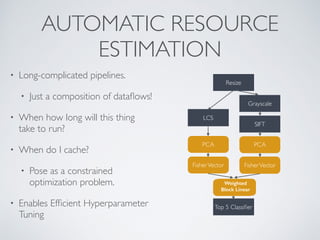
AUTOMATIC RESOURCE
ESTIMATION
• Long-complicated pipelines.
• Just a composition of dataflows!
• When how long will this thing
take to run?
• When do I cache?
• Pose as a constrained
optimization problem.
• Enables Efficient Hyperparameter
Tuning
Resize
Grayscale
SIFT
PCA
FisherVector
Top 5 Classifier
LCS
PCA
FisherVector
Block Linear
Solver
Weighted
Block Linear
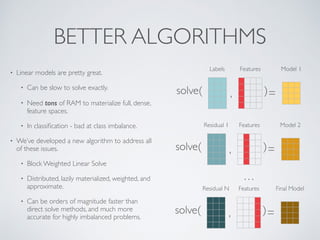
BETTER ALGORITHMS
• Linear models are pretty great.
• Can be slow to solve exactly.
• Need tons of RAM to materialize full, dense,
feature spaces.
• In classification - bad at class imbalance.
• We’ve developed a new algorithm to address all
of these issues.
• Block Weighted Linear Solve
• Distributed, lazily materialized, weighted, and
approximate.
• Can be orders of magnitude faster than
direct solve methods, and much more
accurate for highly imbalanced problems.
=
Labels Features Model 1
solve( , )
=
Residual 1 Features Model 2
solve( , )
=
Residual N Features Final Model
solve( , )
…
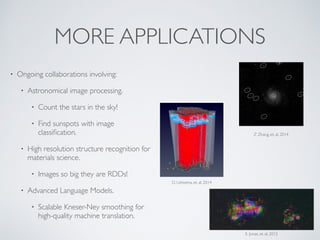
MORE APPLICATIONS
• Ongoing collaborations involving:
• Astronomical image processing.
• Count the stars in the sky!
• Find sunspots with image
classification.
• High resolution structure recognition for
materials science.
• Images so big they are RDDs!
• Advanced Language Models.
• Scalable Kneser-Ney smoothing for
high-quality machine translation.
D. Ushizima, et. al, 2014
Z Zhang, et. al, 2014
E. Jonas, et. al, 2015
QUESTIONS?
Contributors:
Daniel Bruckner, Mike Franklin, Glyfi Gudmundsson,Tomer Kaftan,
Daniel Langkilde, Henry Milner, Ben Recht,Vaishaal Shankar, Evan
Sparks, ShivaramVenkataraman, ZonghengYang
http://keystone-ml.org/
KeystoneML
Code
http://github.com/amplab/keystone

Building Large Scale Machine Learning Applications with Pipelines-(Evan Sparks and Shivaram Venkataraman, UC Berkeley AMPLAB)

  • 1.
    KEYSTONEML Evan R. Sparks,ShivaramVenkataraman With:Tomer Kaftan, ZonghengYang, Mike Franklin, Ben Recht
  • 2.
    WHAT IS KEYSTONEML •Software framework for building scalable end-to-end machine learning pipelines. • Helps us understand what it means to build systems for robust, scalable, end-to-end advanced analytics workloads and the patterns that emerge. • Example pipelines that achieve state-of-the-art results on large scale datasets in computer vision, NLP, and speech - fast. • Previewed at AMP Camp 5 and on AMPLab Blog as “ML Pipelines” • Public release last month! http://keystone-ml.org/
  • 3.
    HOW DOES ITFIT WITH BDAS? Spark MLlibGraphX ml-matrix KeystoneML Batch ModelTraining Velox Model Server RealTime Serving http://amplab.github.io/velox-modelserver
  • 4.
  • 5.
    A STANDARD MACHINELEARNING PIPELINE Right? Data Train Classifier Model
  • 6.
    A STANDARD MACHINELEARNING PIPELINE That’s more like it! Data Train Linear Classifier Model Feature Extraction Test Data Predictions
  • 7.
    SIMPLE EXAMPLE: TEXT CLASSIFICATION 20 Newsgroups .fit() Trim Tokenize Bigrams Top Features Naive Bayes Max Classifier Trim Tokenize Bigrams Max Classifier Top Features Transformer Naive Bayes Model Then evaluate and ship toVelox when you’re ready to apply to real time data.
  • 8.
    NOT SO SIMPLEEXAMPLE: IMAGE CLASSIFICATION Images (VOC2007) .fit( ) Resize Grayscale SIFT PCA FisherVector MaxClassifier Linear Regression Resize Grayscale SIFT MaxClassifier PCA Map Fisher Encoder Linear Model Achieves performance of Chatfield et. al., 2011 Embarassingly parallel featurization and evaluation. 15 minutes on a modest cluster. 5,000 examples, 40,000 features, 20 classes
  • 9.
    EVEN LESS SIMPLE:IMAGENET Color Edges Resize Grayscale SIFT PCA FisherVector Top 5 Classifier LCS PCA FisherVector Block Linear Solver <200 SLOC And Shivaram doesn’t have a heart attack when Prof. Recht tells us he wants to try a new solver.Weighted Block Linear Solver Or add 100,000 more texture features. Texture More Stuff I’d Never Heard Of 1000 class classification. 1,200,000 examples 64,000 features. 90 minutes on 100 nodes.
  • 10.
    SOFTWARE FEATURES • DataLoaders • CSV, CIFAR, ImageNet,VOC,TIMIT, 20 Newsgroups • Transformers • NLP -Tokenization, n-grams, term frequency, NER*, parsing* • Images - Convolution, Grayscaling, LCS, SIFT*, FisherVector*, Pooling,Windowing, HOG, Daisy • Speech - MFCCs* • Stats - Random Features, Normalization, Scaling*, Signed Hellinger Mapping, FFT • Utility/misc - Caching,Top-K classifier, indicator label mapping, sparse/dense encoding transformers. • Estimators • Learning - Block linear models, Linear Discriminant Analysis, PCA, ZCA Whitening, Naive Bayes*, GMM* • Example Pipelines • NLP - 20 Newsgroups,Wikipedia Language model • Images - MNIST, CIFAR,VOC, ImageNet • Speech -TIMIT • Evaluation Metrics • Binary Classification • Multiclass Classification • Multilabel Classification Just 5k Lines of Code, 1.5k of which areTESTS + 1.5k lines of JavaDoc * - Links to external library: MLlib, ml-matrix,VLFeat, EncEval
  • 11.
  • 12.
    TRANSFORMERS TransformerInput Output abstract classTransformer[In,Out] { def apply(in: In): Out def apply(in: RDD[In]): RDD[Out] = in.map(apply) … } TYPE SAFETY HELPS ENSURE ROBUSTNESS
  • 13.
    ESTIMATORS EstimatorRDD[Input] abstract class Estimator[In,Out] { def fit(in: RDD[In]):Transformer[In,Out] … } Transformer .fit()
  • 14.
    CHAINING NGrams(2)String Vectorizer VectorBigrams valfeaturizer:Transformer[String,Vector] = NGrams(2) thenVectorizer featurizerString Vector =
  • 15.
    COMPLEX PIPELINES .fit(data, labels) pipelineStringPrediction = val pipeline = (featurizer thenLabelEstimator LinearModel).fit(data, labels) featurizerString Vector Linear Model Prediction featurizerString Vector Linear Map Prediction
  • 16.
  • 17.
    CREATE ATRANSFORMER • Canbe defined as a class. • Or as a Unary function. “I want a node that takes a vector and divides by it’s two-norm.” Chain with other nodes: val pipeline =Vectorizer then Normalizer or val pipeline =Vectorizer thenFunction normalize _
  • 18.
    INTEGRATING WITH CCODE? Don’t reinvent the wheel - use JNI! Loads a shared library javah generates a header for the shared library. Native code is shared across the cluster.
  • 19.
    RESULTS • TIMIT SpeechDataset: • Matches state-of-the-art statistical performance. • 90 minutes on 64 EC2 nodes. • Compare to 120 minutes on 256 IBM Blue gene machines. • ImageNet: • 67% accuracy with weighted block coordinate decent. Matches best accuracy with 64k features in the 2012 ImageNet contest. • 90 minutes end-to-end on 100 nodes.
  • 20.
    RESEARCH COMPLEMENTTO MLLIB PIPELINEAPI • Basic set of operators for text, numbers. • All spark.ml operations are transformations on DataFrames. • Scala, Java, Python • Part of Apache Spark MLlib Pipeline API • Enriched set of operators for complex domains: vision, NLP, speech, plus advanced math. • Type safety. • Scala-only (for now) • Separate project (for now) • External library integration. • Integrated with new BDAS technologies: Velox, ml-matrix, soon Planck,TuPAQ and SampleClean KeystoneML
  • 21.
  • 22.
    AUTOMATIC RESOURCE ESTIMATION • Long-complicatedpipelines. • Just a composition of dataflows! • When how long will this thing take to run? • When do I cache? • Pose as a constrained optimization problem. • Enables Efficient Hyperparameter Tuning Resize Grayscale SIFT PCA FisherVector Top 5 Classifier LCS PCA FisherVector Block Linear Solver Weighted Block Linear
  • 23.
    BETTER ALGORITHMS • Linearmodels are pretty great. • Can be slow to solve exactly. • Need tons of RAM to materialize full, dense, feature spaces. • In classification - bad at class imbalance. • We’ve developed a new algorithm to address all of these issues. • Block Weighted Linear Solve • Distributed, lazily materialized, weighted, and approximate. • Can be orders of magnitude faster than direct solve methods, and much more accurate for highly imbalanced problems. = Labels Features Model 1 solve( , ) = Residual 1 Features Model 2 solve( , ) = Residual N Features Final Model solve( , ) …
  • 24.
    MORE APPLICATIONS • Ongoingcollaborations involving: • Astronomical image processing. • Count the stars in the sky! • Find sunspots with image classification. • High resolution structure recognition for materials science. • Images so big they are RDDs! • Advanced Language Models. • Scalable Kneser-Ney smoothing for high-quality machine translation. D. Ushizima, et. al, 2014 Z Zhang, et. al, 2014 E. Jonas, et. al, 2015
  • 25.
    QUESTIONS? Contributors: Daniel Bruckner, MikeFranklin, Glyfi Gudmundsson,Tomer Kaftan, Daniel Langkilde, Henry Milner, Ben Recht,Vaishaal Shankar, Evan Sparks, ShivaramVenkataraman, ZonghengYang http://keystone-ml.org/ KeystoneML Code http://github.com/amplab/keystone