Build, Scale, and Deploy
Deep Learning Pipelines
Using Apache Spark
Tim Hunter, Databricks
Spark Meetup London, March 2018
About Me
Tim Hunter
• Software engineer @ Databricks
• Ph.D. from UC Berkeley in Machine Learning
• Very early Spark user (Spark 0.0.2)
• Co-creator of GraphFrames, TensorFrames,
Joint work with
Sue Ann Hong
TEAM
About Databricks
Started Spark project (now Apache Spark) at UC Berkeley in 2009
PRODUCT
Unified Analytics Platform
MISSION
Making Big Data Simple
Try for free today.
databricks.com
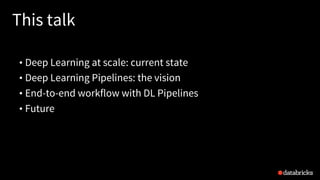
This talk
• Deep Learning at scale: current state
• Deep Learning Pipelines: the vision
• End-to-end workflow with DL Pipelines
• Future
Deep Learning at Scale
: current state
5put	your	#assignedhashtag	here	by	setting	the
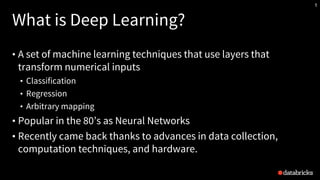
What is Deep Learning?
• A set of machine learning techniques that use layers that
transform numerical inputs
• Classification
• Regression
• Arbitrary mapping
• Popular in the 80’s as Neural Networks
• Recently came back thanks to advances in data collection,
computation techniques, and hardware.
t
Success of Deep Learning
Tremendous success for applications with complex data
• AlphaGo
• Image interpretation
• Automatic translation
• Speech recognition
But requires a lot of effort
• No exact science around deep learning
• Success requires many engineer-hours
• Low level APIs with steep learning curve
• Not well integrated with other enterprise tools
• Tedious to distribute computations
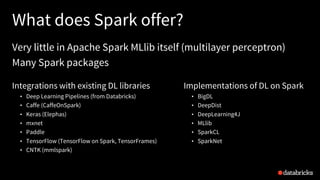
What does Spark offer?
Very little in Apache Spark MLlib itself (multilayer perceptron)
Many Spark packages
Integrations with existing DL libraries
• Deep Learning Pipelines (from Databricks)
• Caffe (CaffeOnSpark)
• Keras (Elephas)
• mxnet
• Paddle
• TensorFlow (TensorFlow on Spark, TensorFrames)
• CNTK (mmlspark)
Implementations of DL on Spark
• BigDL
• DeepDist
• DeepLearning4J
• MLlib
• SparkCL
• SparkNet
Deep Learning in industry
• Currently limited adoption
• Huge potential beyond the industrial giants
• How do we accelerate the road to massive availability?
Deep Learning Pipelines
11put	your	#assignedhashtag	here	by	setting	the
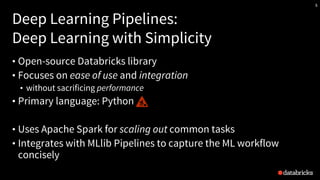
Deep Learning Pipelines:
Deep Learning with Simplicity
• Open-source Databricks library
• Focuses on ease of use and integration
• without sacrificing performance
• Primary language: Python
• Uses Apache Spark for scaling out common tasks
• Integrates with MLlib Pipelines to capture the ML workflow
concisely
s
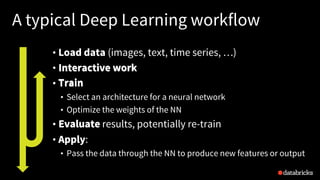
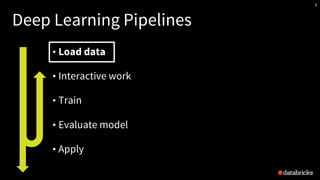
A typical Deep Learning workflow
• Load data (images, text, time series, …)
• Interactive work
• Train
• Select an architecture for a neural network
• Optimize the weights of the NN
• Evaluate results, potentially re-train
• Apply:
• Pass the data through the NN to produce new features or output
Load data
Interactive work
Train
Evaluate
Apply
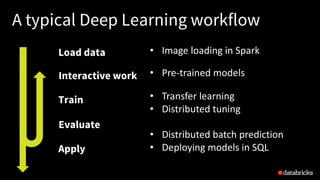
A typical Deep Learning workflow
Load data
Interactive work
Train
Evaluate
Apply
• Image	loading	in	Spark
• Distributed	batch	prediction
• Deploying	models	in	SQL
• Transfer	learning
• Distributed	tuning
• Pre-trained	models
End-to-End Workflow
with Deep Learning Pipelines
15put	your	#assignedhashtag	here	by	setting	the
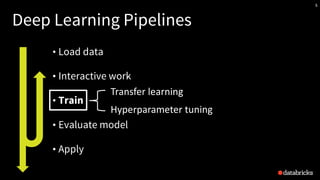
Deep Learning Pipelines
• Load data
• Interactive work
• Train
• Evaluate model
• Apply
t
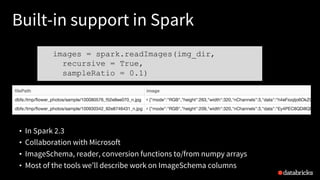
Built-in support in Spark
• In Spark 2.3
• Collaboration with Microsoft
• ImageSchema, reader, conversion functions to/from numpy arrays
• Most of the tools we’ll describe work on ImageSchema columns
images = spark.readImages(img_dir,
recursive = True,
sampleRatio = 0.1)
Deep Learning Pipelines
• Load data
• Interactive work
• Train
• Evaluate model
• Apply
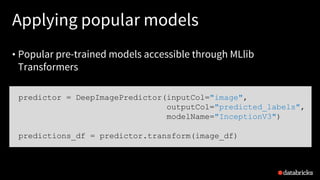
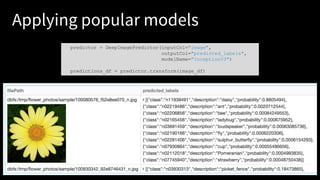
Applying popular models
• Popular pre-trained models accessible through MLlib
Transformers
predictor = DeepImagePredictor(inputCol="image",
outputCol="predicted_labels",
modelName="InceptionV3")
predictions_df = predictor.transform(image_df)
Applying popular models
predictor = DeepImagePredictor(inputCol="image",
outputCol="predicted_labels",
modelName="InceptionV3")
predictions_df = predictor.transform(image_df)
Deep Learning Pipelines
• Load data
• Interactive work
• Train
• Evaluate model
• Apply
Hyperparameter tuning
Transfer	learning
s
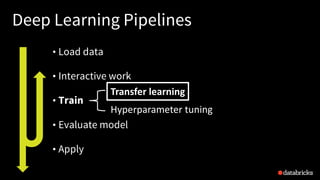
Deep Learning Pipelines
• Load data
• Interactive work
• Train
• Evaluate model
• Apply
Hyperparameter tuning
Transfer	learning
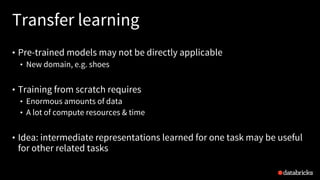
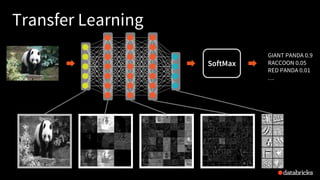
Transfer learning
• Pre-trained models may not be directly applicable
• New domain, e.g. shoes
• Training from scratch requires
• Enormous amounts of data
• A lot of compute resources & time
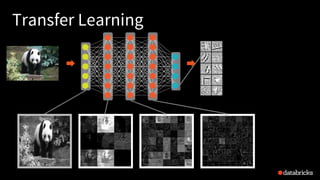
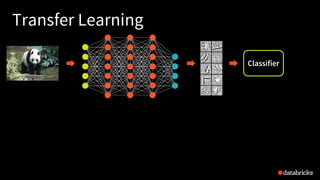
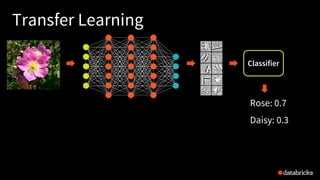
• Idea: intermediate representations learned for one task may be useful
for other related tasks
Transfer Learning
SoftMax
GIANT PANDA 0.9
RACCOON 0.05
RED PANDA 0.01
…
Transfer Learning
Transfer Learning
Classifier
Transfer Learning
Classifier
Rose: 0.7
Daisy: 0.3
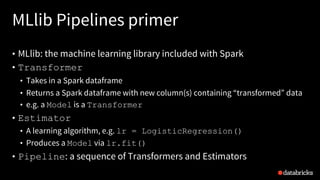
MLlib Pipelines primer
• MLlib: the machine learning library included with Spark
• Transformer
• Takes in a Spark dataframe
• Returns a Spark dataframe with new column(s) containing “transformed” data
• e.g. a Model is a Transformer
• Estimator
• A learning algorithm, e.g. lr = LogisticRegression()
• Produces a Model via lr.fit()
• Pipeline: a sequence of Transformers and Estimators
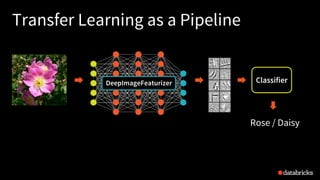
Transfer Learning as a Pipeline
ClassifierDeepImageFeaturizer
Rose / Daisy
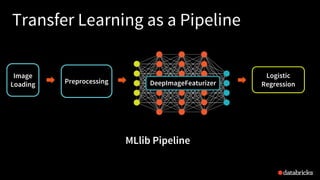
Transfer Learning as a Pipeline
DeepImageFeaturizer
Image
Loading Preprocessing
Logistic
Regression
MLlib Pipeline
Transfer Learning as a Pipeline
31put	your	#assignedhashtag	here	by	setting	the	
featurizer = DeepImageFeaturizer(inputCol="image",
outputCol="features",
modelName="InceptionV3")
lr = LogisticRegression(labelCol="label")
p = Pipeline(stages=[featurizer, lr])
p_model = p.fit(train_df)
Transfer Learning
• Usually for classification tasks
• Similar task, new domain
• But other forms of learning leveraging learned representations
can be loosely considered transfer learning
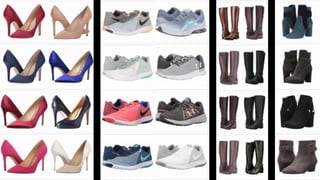
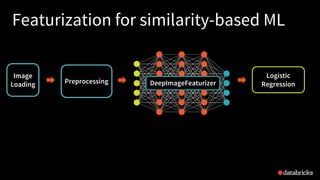
Featurization for similarity-based ML
DeepImageFeaturizer
Image
Loading Preprocessing
Logistic
Regression
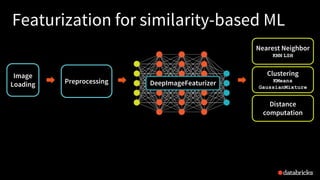
Featurization for similarity-based ML
DeepImageFeaturizer
Image
Loading Preprocessing
Clustering
KMeans
GaussianMixture
Nearest Neighbor
KNN LSH
Distance
computation
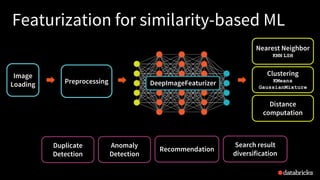
Featurization for similarity-based ML
DeepImageFeaturizer
Image
Loading Preprocessing
Clustering
KMeans
GaussianMixture
Nearest Neighbor
KNN LSH
Distance
computation
Duplicate
Detection
Recommendation
Anomaly
Detection
Search result
diversification
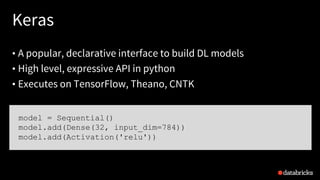
Keras
37
model = Sequential()
model.add(Dense(32, input_dim=784))
model.add(Activation('relu'))
• A popular, declarative interface to build DL models
• High level, expressive API in python
• Executes on TensorFlow, Theano, CNTK
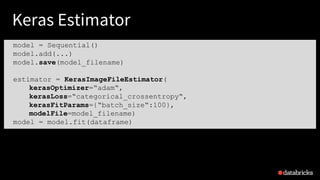
model = Sequential()
model.add(...)
model.save(model_filename)
estimator = KerasImageFileEstimator(
kerasOptimizer=“adam“,
kerasLoss=“categorical_crossentropy“,
kerasFitParams={“batch_size“:100},
modelFile=model_filename)
model = model.fit(dataframe)
38
Keras Estimator
39
Keras Estimator in Model Selection
estimator = KerasImageFileEstimator(
kerasOptimizer=“adam“,
kerasLoss=“categorical_crossentropy“)
paramGrid = ( ParamGridBuilder()
.addGrid(kerasFitParams=[{“batch_size“:100}, {“batch_size“:200}])
.addGrid(modelFile=[model1, model2]) )
cv = CrossValidator(estimator=estimator,
estimatorParamMaps=paramGrid,
evaluator=BinaryClassificationEvaluator(),
numFolds=3)
best_model = cv.fit(train_df)
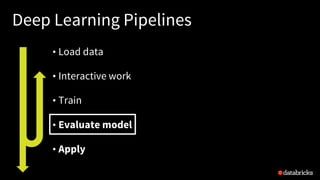
Deep Learning Pipelines
• Load data
• Interactive work
• Train
• Evaluate model
• Apply
Deep Learning Pipelines
• Load data
• Interactive work
• Train
• Evaluate model
• Apply
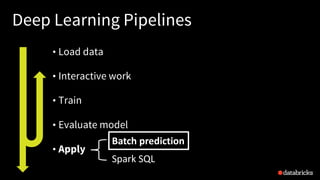
Spark	SQL
Batch	prediction
s
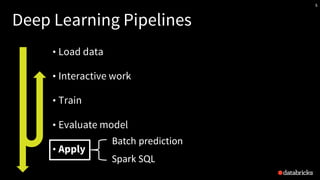
Deep Learning Pipelines
• Load data
• Interactive work
• Train
• Evaluate model
• Apply
Spark	SQL
Batch	prediction
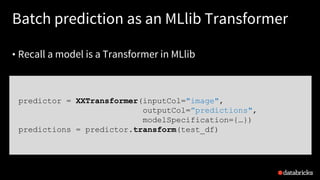
Batch prediction as an MLlib Transformer
• Recall a model is a Transformer in MLlib
predictor = XXTransformer(inputCol="image",
outputCol=”predictions",
modelSpecification={…})
predictions = predictor.transform(test_df)
Deep Learning Pipelines
• Load data
• Interactive work
• Train
• Evaluate model
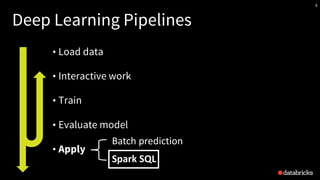
• Apply
Spark	SQL
Batch	prediction
s
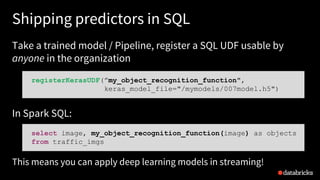
Shipping predictors in SQL
Take a trained model / Pipeline, register a SQL UDF usable by
anyone in the organization
In Spark SQL:
registerKerasUDF(”my_object_recognition_function",
keras_model_file="/mymodels/007model.h5")
select image, my_object_recognition_function(image) as objects
from traffic_imgs
This means you can apply deep learning models in streaming!
Deep Learning Pipelines : Future
In progress
• Scala API for DeepImageFeaturizer
• Text featurization (embeddings)
• TFTransformer for arbitrary vectors
Future
• Distributed training
• Support for more backends, e.g. MXNet, PyTorch, BigDL
Deep Learning without Deep Pockets
• Simple API for Deep Learning, integrated with MLlib
• Scales common tasks with transformers and estimators
• Embeds Deep Learning models in MLlib and SparkSQL
• Check out https://github.com/databricks/spark-deep-
learning !
Resources
Blog posts & webinars (http://databricks.com/blog)
• Deep Learning Pipelines
• GPU acceleration in Databricks
• BigDL on Databricks
• Deep Learning and Apache Spark
Docs for Deep Learning on Databricks (http://docs.databricks.com)
• Getting started
• Deep Learning Pipelines Example
• Spark integration
49
WWW.DATABRICKS.COM/SPARKAISUMMIT
DATE: June 4-6, 2018
LOCATION: San Francisco -
Moscone
TRACKS: Artificial
Intelligence, Spark Use
Cases, Enterprise,
Productionizing ML, Deep
Learning, Hardware in the
Cloud
ATTENDEES: 4000+ Data
Scientists, Data Engineers,
Analysts, & VP/CxOs
https://databricks.com/company/careers
GREAT
Thank You!
Questions?
Happy Sparking & Deep Learning!

Build, Scale, and Deploy Deep Learning Pipelines Using Apache Spark

  • 1.
    Build, Scale, andDeploy Deep Learning Pipelines Using Apache Spark Tim Hunter, Databricks Spark Meetup London, March 2018
  • 2.
    About Me Tim Hunter •Software engineer @ Databricks • Ph.D. from UC Berkeley in Machine Learning • Very early Spark user (Spark 0.0.2) • Co-creator of GraphFrames, TensorFrames, Joint work with Sue Ann Hong
  • 3.
    TEAM About Databricks Started Sparkproject (now Apache Spark) at UC Berkeley in 2009 PRODUCT Unified Analytics Platform MISSION Making Big Data Simple Try for free today. databricks.com
  • 4.
    This talk • DeepLearning at scale: current state • Deep Learning Pipelines: the vision • End-to-end workflow with DL Pipelines • Future
  • 5.
    Deep Learning atScale : current state 5put your #assignedhashtag here by setting the
  • 6.
    What is DeepLearning? • A set of machine learning techniques that use layers that transform numerical inputs • Classification • Regression • Arbitrary mapping • Popular in the 80’s as Neural Networks • Recently came back thanks to advances in data collection, computation techniques, and hardware. t
  • 7.
    Success of DeepLearning Tremendous success for applications with complex data • AlphaGo • Image interpretation • Automatic translation • Speech recognition
  • 8.
    But requires alot of effort • No exact science around deep learning • Success requires many engineer-hours • Low level APIs with steep learning curve • Not well integrated with other enterprise tools • Tedious to distribute computations
  • 9.
    What does Sparkoffer? Very little in Apache Spark MLlib itself (multilayer perceptron) Many Spark packages Integrations with existing DL libraries • Deep Learning Pipelines (from Databricks) • Caffe (CaffeOnSpark) • Keras (Elephas) • mxnet • Paddle • TensorFlow (TensorFlow on Spark, TensorFrames) • CNTK (mmlspark) Implementations of DL on Spark • BigDL • DeepDist • DeepLearning4J • MLlib • SparkCL • SparkNet
  • 10.
    Deep Learning inindustry • Currently limited adoption • Huge potential beyond the industrial giants • How do we accelerate the road to massive availability?
  • 11.
  • 12.
    Deep Learning Pipelines: DeepLearning with Simplicity • Open-source Databricks library • Focuses on ease of use and integration • without sacrificing performance • Primary language: Python • Uses Apache Spark for scaling out common tasks • Integrates with MLlib Pipelines to capture the ML workflow concisely s
  • 13.
    A typical DeepLearning workflow • Load data (images, text, time series, …) • Interactive work • Train • Select an architecture for a neural network • Optimize the weights of the NN • Evaluate results, potentially re-train • Apply: • Pass the data through the NN to produce new features or output Load data Interactive work Train Evaluate Apply
  • 14.
    A typical DeepLearning workflow Load data Interactive work Train Evaluate Apply • Image loading in Spark • Distributed batch prediction • Deploying models in SQL • Transfer learning • Distributed tuning • Pre-trained models
  • 15.
    End-to-End Workflow with DeepLearning Pipelines 15put your #assignedhashtag here by setting the
  • 16.
    Deep Learning Pipelines •Load data • Interactive work • Train • Evaluate model • Apply t
  • 17.
    Built-in support inSpark • In Spark 2.3 • Collaboration with Microsoft • ImageSchema, reader, conversion functions to/from numpy arrays • Most of the tools we’ll describe work on ImageSchema columns images = spark.readImages(img_dir, recursive = True, sampleRatio = 0.1)
  • 18.
    Deep Learning Pipelines •Load data • Interactive work • Train • Evaluate model • Apply
  • 19.
    Applying popular models •Popular pre-trained models accessible through MLlib Transformers predictor = DeepImagePredictor(inputCol="image", outputCol="predicted_labels", modelName="InceptionV3") predictions_df = predictor.transform(image_df)
  • 20.
    Applying popular models predictor= DeepImagePredictor(inputCol="image", outputCol="predicted_labels", modelName="InceptionV3") predictions_df = predictor.transform(image_df)
  • 21.
    Deep Learning Pipelines •Load data • Interactive work • Train • Evaluate model • Apply Hyperparameter tuning Transfer learning s
  • 22.
    Deep Learning Pipelines •Load data • Interactive work • Train • Evaluate model • Apply Hyperparameter tuning Transfer learning
  • 23.
    Transfer learning • Pre-trainedmodels may not be directly applicable • New domain, e.g. shoes • Training from scratch requires • Enormous amounts of data • A lot of compute resources & time • Idea: intermediate representations learned for one task may be useful for other related tasks
  • 24.
    Transfer Learning SoftMax GIANT PANDA0.9 RACCOON 0.05 RED PANDA 0.01 …
  • 25.
  • 26.
  • 27.
  • 28.
    MLlib Pipelines primer •MLlib: the machine learning library included with Spark • Transformer • Takes in a Spark dataframe • Returns a Spark dataframe with new column(s) containing “transformed” data • e.g. a Model is a Transformer • Estimator • A learning algorithm, e.g. lr = LogisticRegression() • Produces a Model via lr.fit() • Pipeline: a sequence of Transformers and Estimators
  • 29.
    Transfer Learning asa Pipeline ClassifierDeepImageFeaturizer Rose / Daisy
  • 30.
    Transfer Learning asa Pipeline DeepImageFeaturizer Image Loading Preprocessing Logistic Regression MLlib Pipeline
  • 31.
    Transfer Learning asa Pipeline 31put your #assignedhashtag here by setting the featurizer = DeepImageFeaturizer(inputCol="image", outputCol="features", modelName="InceptionV3") lr = LogisticRegression(labelCol="label") p = Pipeline(stages=[featurizer, lr]) p_model = p.fit(train_df)
  • 32.
    Transfer Learning • Usuallyfor classification tasks • Similar task, new domain • But other forms of learning leveraging learned representations can be loosely considered transfer learning
  • 34.
    Featurization for similarity-basedML DeepImageFeaturizer Image Loading Preprocessing Logistic Regression
  • 35.
    Featurization for similarity-basedML DeepImageFeaturizer Image Loading Preprocessing Clustering KMeans GaussianMixture Nearest Neighbor KNN LSH Distance computation
  • 36.
    Featurization for similarity-basedML DeepImageFeaturizer Image Loading Preprocessing Clustering KMeans GaussianMixture Nearest Neighbor KNN LSH Distance computation Duplicate Detection Recommendation Anomaly Detection Search result diversification
  • 37.
    Keras 37 model = Sequential() model.add(Dense(32,input_dim=784)) model.add(Activation('relu')) • A popular, declarative interface to build DL models • High level, expressive API in python • Executes on TensorFlow, Theano, CNTK
  • 38.
    model = Sequential() model.add(...) model.save(model_filename) estimator= KerasImageFileEstimator( kerasOptimizer=“adam“, kerasLoss=“categorical_crossentropy“, kerasFitParams={“batch_size“:100}, modelFile=model_filename) model = model.fit(dataframe) 38 Keras Estimator
  • 39.
    39 Keras Estimator inModel Selection estimator = KerasImageFileEstimator( kerasOptimizer=“adam“, kerasLoss=“categorical_crossentropy“) paramGrid = ( ParamGridBuilder() .addGrid(kerasFitParams=[{“batch_size“:100}, {“batch_size“:200}]) .addGrid(modelFile=[model1, model2]) ) cv = CrossValidator(estimator=estimator, estimatorParamMaps=paramGrid, evaluator=BinaryClassificationEvaluator(), numFolds=3) best_model = cv.fit(train_df)
  • 40.
    Deep Learning Pipelines •Load data • Interactive work • Train • Evaluate model • Apply
  • 41.
    Deep Learning Pipelines •Load data • Interactive work • Train • Evaluate model • Apply Spark SQL Batch prediction s
  • 42.
    Deep Learning Pipelines •Load data • Interactive work • Train • Evaluate model • Apply Spark SQL Batch prediction
  • 43.
    Batch prediction asan MLlib Transformer • Recall a model is a Transformer in MLlib predictor = XXTransformer(inputCol="image", outputCol=”predictions", modelSpecification={…}) predictions = predictor.transform(test_df)
  • 44.
    Deep Learning Pipelines •Load data • Interactive work • Train • Evaluate model • Apply Spark SQL Batch prediction s
  • 45.
    Shipping predictors inSQL Take a trained model / Pipeline, register a SQL UDF usable by anyone in the organization In Spark SQL: registerKerasUDF(”my_object_recognition_function", keras_model_file="/mymodels/007model.h5") select image, my_object_recognition_function(image) as objects from traffic_imgs This means you can apply deep learning models in streaming!
  • 46.
    Deep Learning Pipelines: Future In progress • Scala API for DeepImageFeaturizer • Text featurization (embeddings) • TFTransformer for arbitrary vectors Future • Distributed training • Support for more backends, e.g. MXNet, PyTorch, BigDL
  • 47.
    Deep Learning withoutDeep Pockets • Simple API for Deep Learning, integrated with MLlib • Scales common tasks with transformers and estimators • Embeds Deep Learning models in MLlib and SparkSQL • Check out https://github.com/databricks/spark-deep- learning !
  • 48.
    Resources Blog posts &webinars (http://databricks.com/blog) • Deep Learning Pipelines • GPU acceleration in Databricks • BigDL on Databricks • Deep Learning and Apache Spark Docs for Deep Learning on Databricks (http://docs.databricks.com) • Getting started • Deep Learning Pipelines Example • Spark integration
  • 49.
    49 WWW.DATABRICKS.COM/SPARKAISUMMIT DATE: June 4-6,2018 LOCATION: San Francisco - Moscone TRACKS: Artificial Intelligence, Spark Use Cases, Enterprise, Productionizing ML, Deep Learning, Hardware in the Cloud ATTENDEES: 4000+ Data Scientists, Data Engineers, Analysts, & VP/CxOs
  • 50.
  • 51.