SEPARATION TECHNIQUES
- INTRODUCTION
SIVASWAROOP YARASI
DEFINITION:
Separation techniques are those techniques that can be used to separate
two different states of matter such as liquids and solids.
Separation processes or a separation method or simply a separation is
methodology to attain any mass transfer phenomenon that convert a
mixture of substances into two or more distinct product mixtures.
Separation is an important asset to purify component of interest from a
mixtures.
NEED OF SEPARATION
TECHNIQUES:
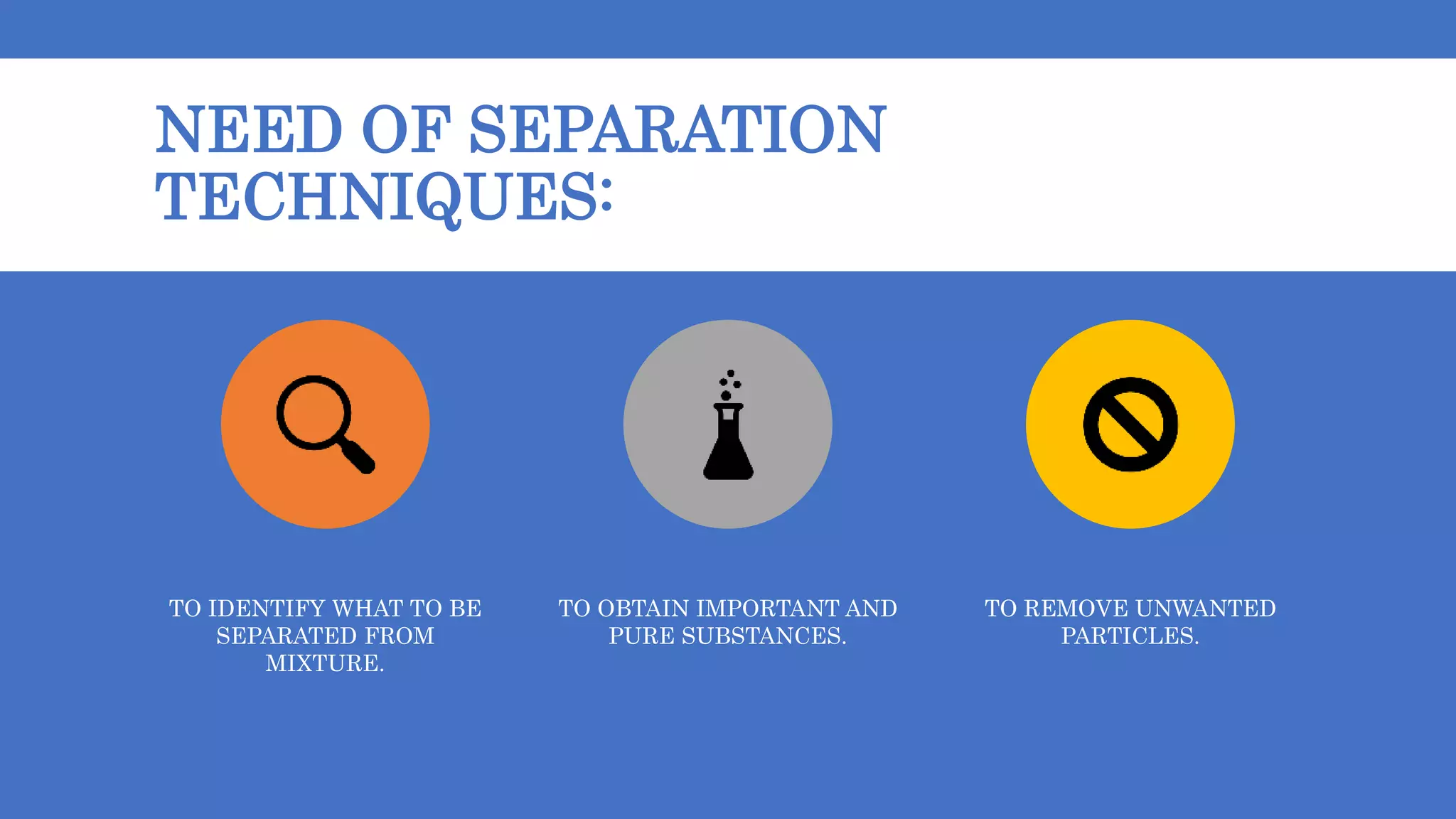
TO IDENTIFY WHAT TO BE
SEPARATED FROM
MIXTURE.
TO OBTAIN IMPORTANT AND
PURE SUBSTANCES.
TO REMOVE UNWANTED
PARTICLES.
TYPES OF SEPARATION TECHNIQUES:
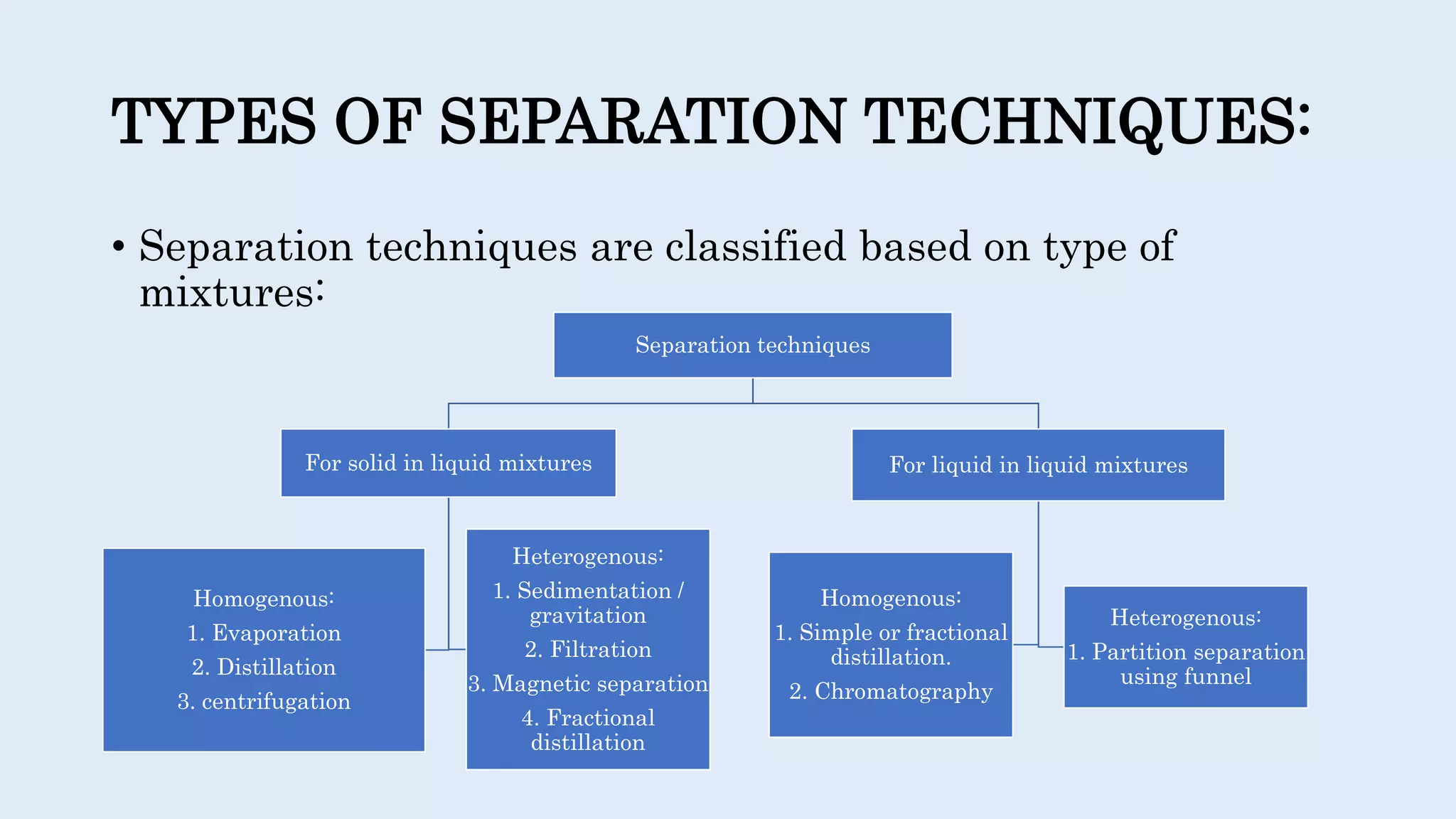
• Separation techniques are classified based on type of
mixtures:
Separation techniques
For solid in liquid mixtures
Homogenous:
1. Evaporation
2. Distillation
3. centrifugation
Heterogenous:
1. Sedimentation /
gravitation
2. Filtration
3. Magnetic separation
4. Fractional
distillation
For liquid in liquid mixtures
Homogenous:
1. Simple or fractional
distillation.
2. Chromatography
Heterogenous:
1. Partition separation
using funnel
MAGNETIC
SEPARATIO
N:
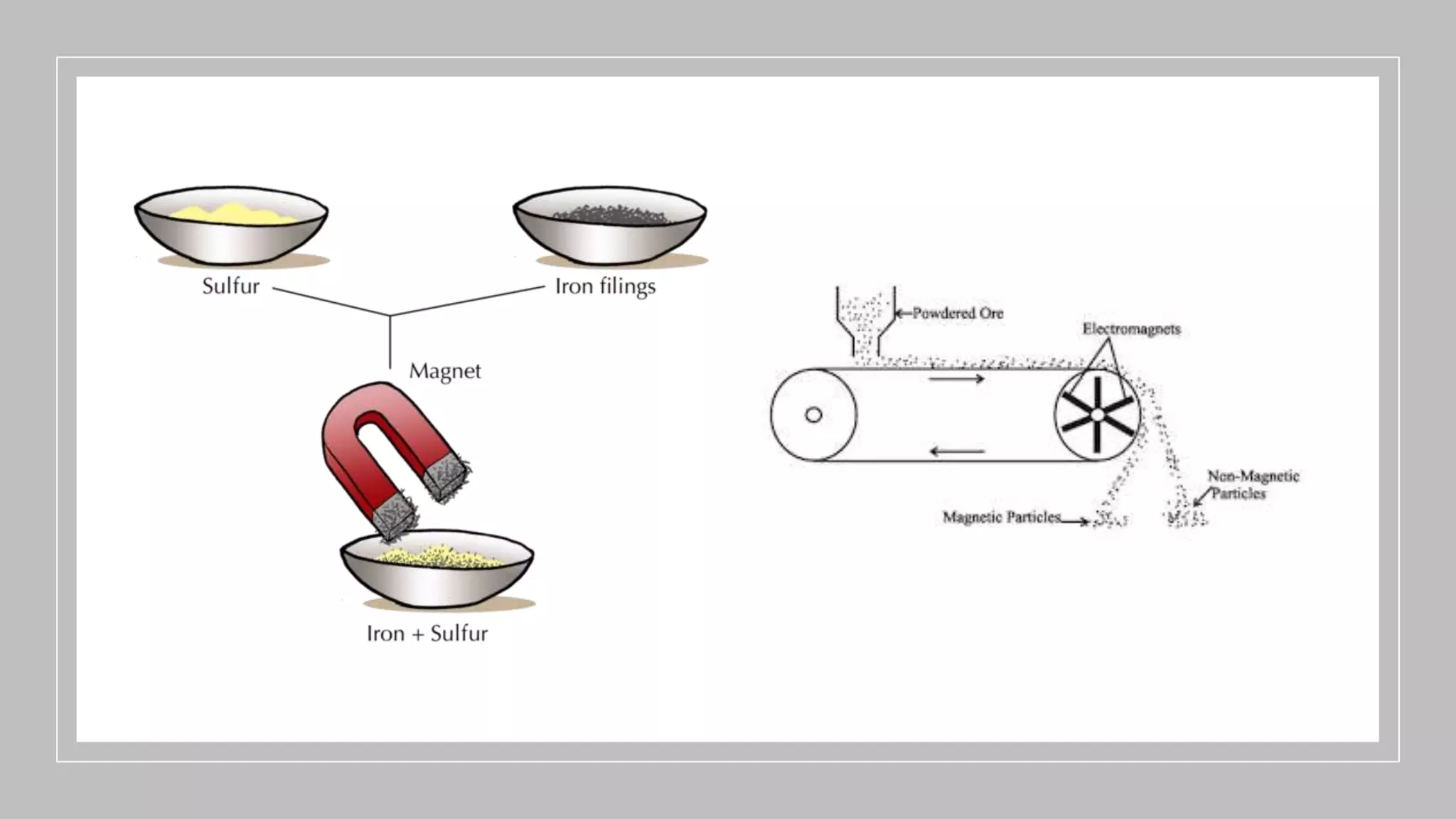
This method involves the separation of magnetic
substances from non-magnetic substances by means of
magnet.
Takes advantage of physical property of magnetism,
so it useful only for certain substances such
as ferromagnetic (materials strongly affected by
magnetic fields) and paramagnetic (materials that
are less affected, but the effect is still noticeable).
This method involves the separation of magnetic
substances from non-magnetic substances by means
of magnet.
• Applications:
• Waste management, low-magnetic field separation in water purification and
separation of complex mixtures.
• To remove metal contaminants from pharmaceutical product streams.
• Magnetic cell separation. It is currently being used in clinical therapies, more
specifically in cancer and hereditary diseases researches.
• These techniques are combined with PCR (polymerase chain reaction), to
increase sensitivity and specificity of results.
DECANTATION:
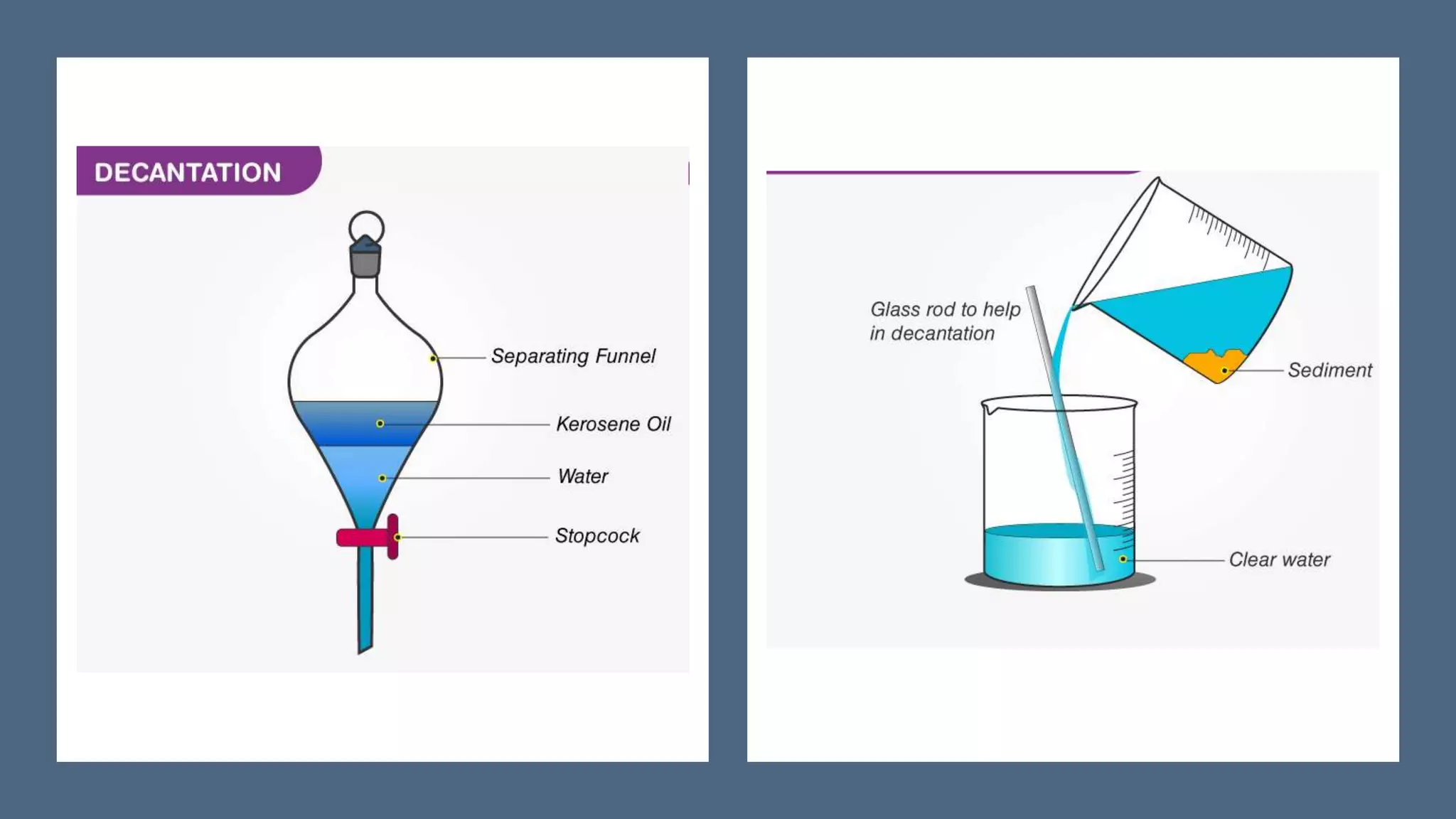
Decantation is a process for the separation of
mixtures of immiscible liquids or of a liquid and a solid
mixture such as a suspension.
Immiscible liquid separation:
• Takes advantage of differences in density of the liquids.
• A separatory funnel is an alternative apparatus for separating liquid
layers. It has a valve at the bottom to allow draining off the bottom layer.
It can give a better separation between the two liquids.
• Example: separation of mixture of oil and water.
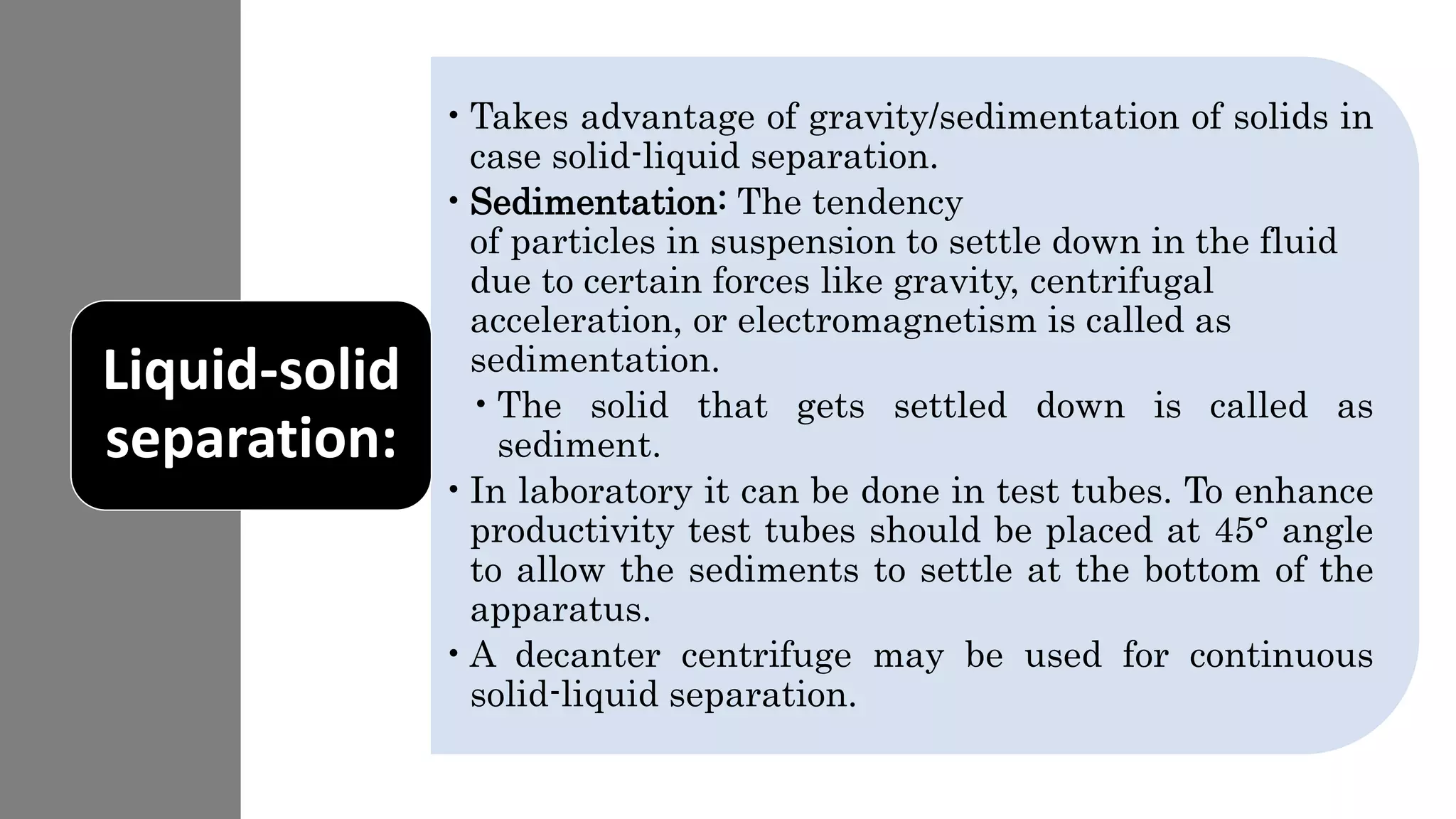
•Takes advantage of gravity/sedimentation of solids in
case solid-liquid separation.
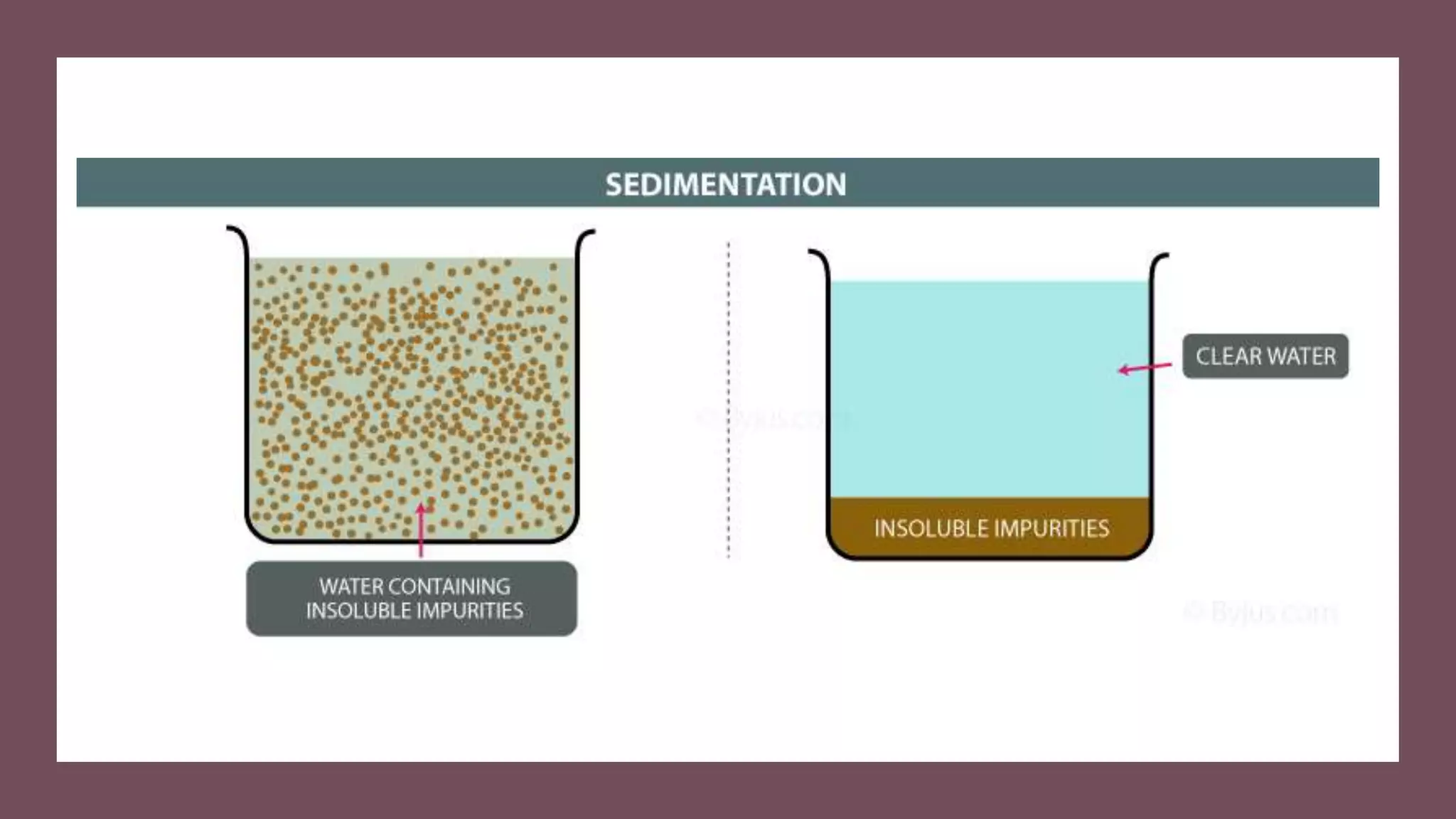
•Sedimentation: The tendency
of particles in suspension to settle down in the fluid
due to certain forces like gravity, centrifugal
acceleration, or electromagnetism is called as
sedimentation.
•The solid that gets settled down is called as
sediment.
•In laboratory it can be done in test tubes. To enhance
productivity test tubes should be placed at 45° angle
to allow the sediments to settle at the bottom of the
apparatus.
•A decanter centrifuge may be used for continuous
solid-liquid separation.
Liquid-solid
separation:
Examples/applications:
• Decantation is frequently used to purify a liquid by separating it
from a suspension of insoluble particles.
• Decantation is also present in nanotechnology. In the synthesis of
high-quality silver nanowire (AgNW) solutions and fabrication
process of high-performance electrodes, decantation is also being
applied which greatly simplifies the purification process.
• Fat is determined in butter by decantation.
• In sugar industry, processing of sugar beets into granular sugar
many liquid - solid separations are encountered.
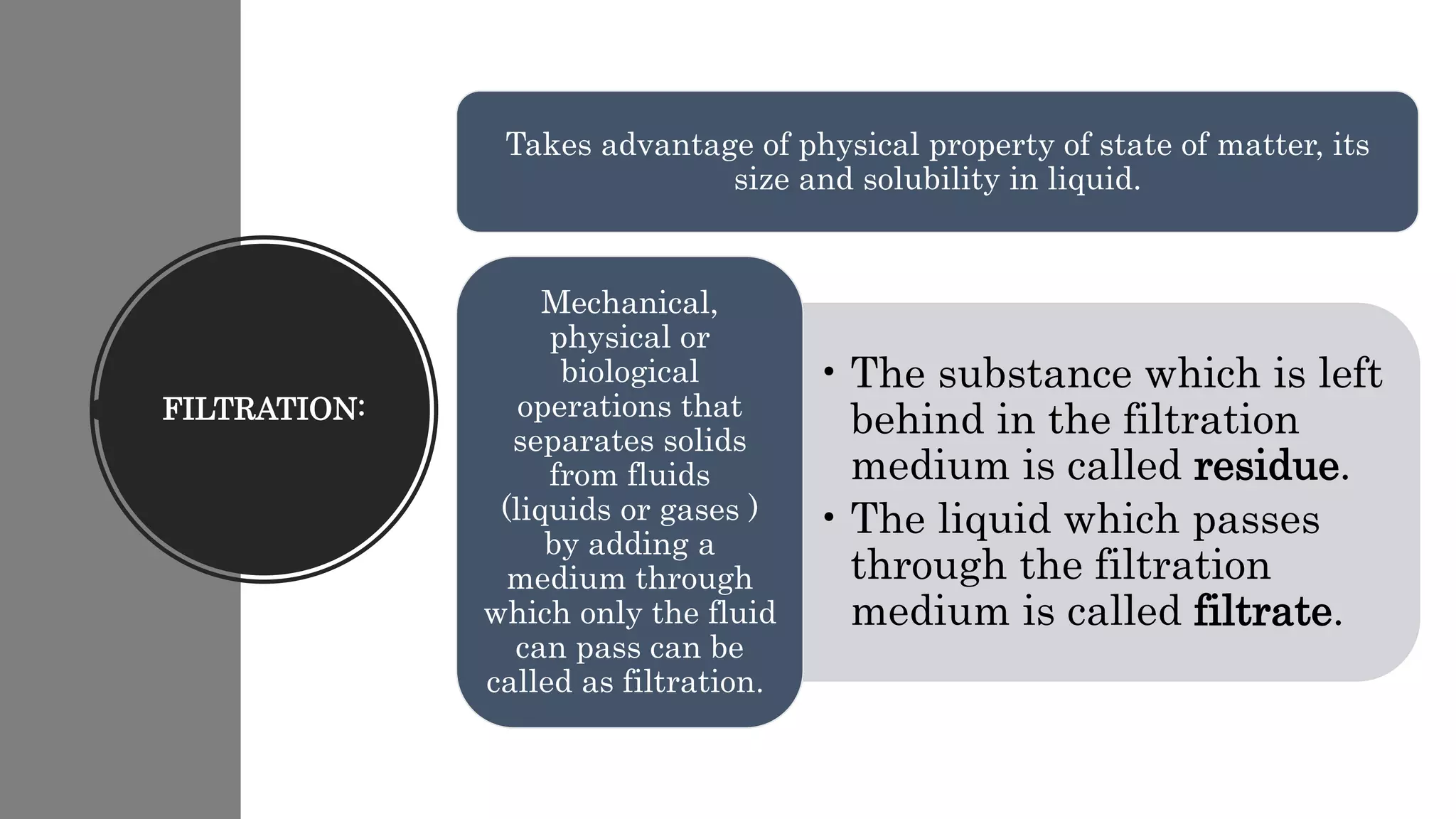
FILTRATION:
Takes advantage of physical property of state of matter, its
size and solubility in liquid.
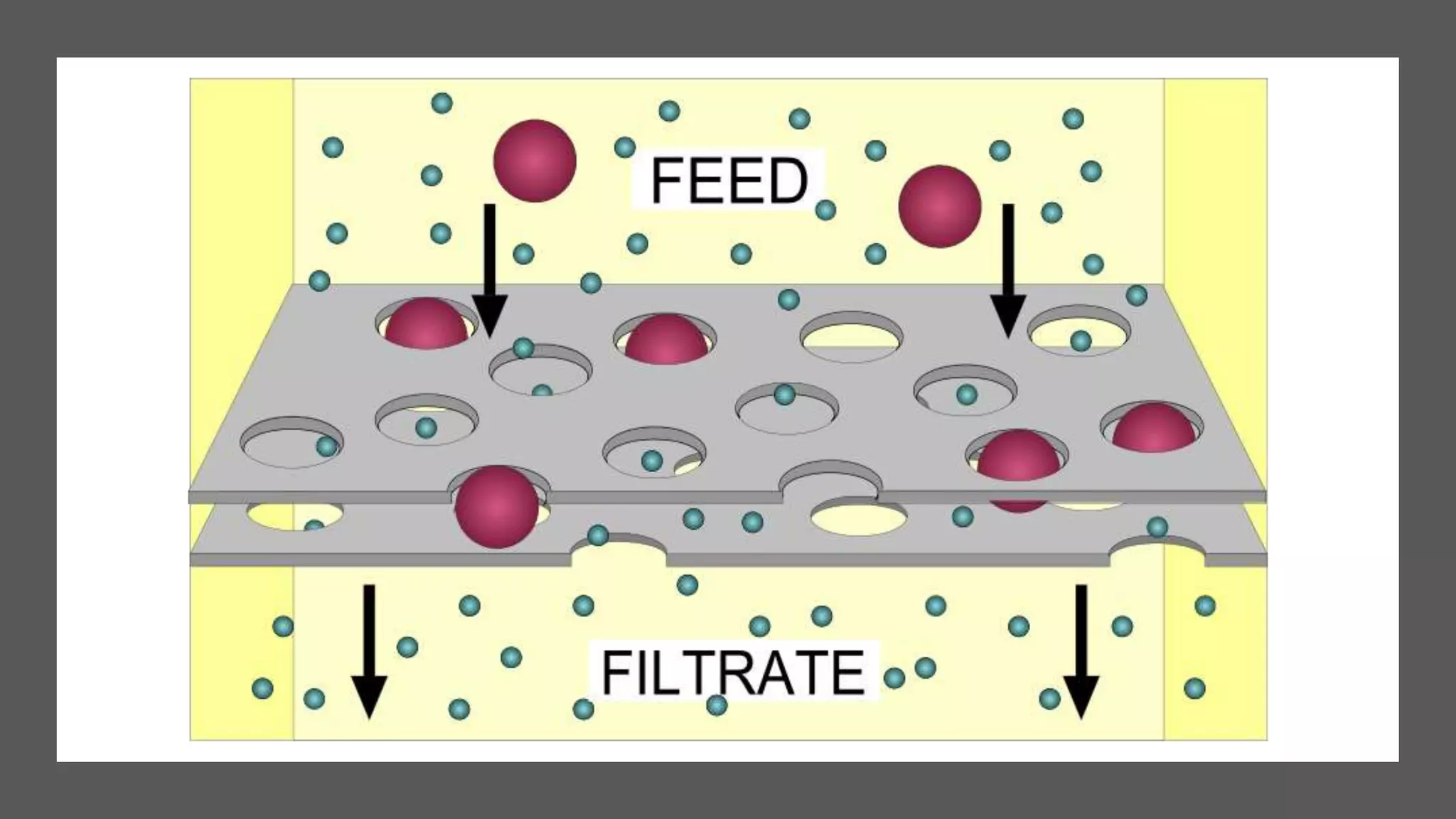
• The substance which is left
behind in the filtration
medium is called residue.
• The liquid which passes
through the filtration
medium is called filtrate.
Mechanical,
physical or
biological
operations that
separates solids
from fluids
(liquids or gases )
by adding a
medium through
which only the fluid
can pass can be
called as filtration.
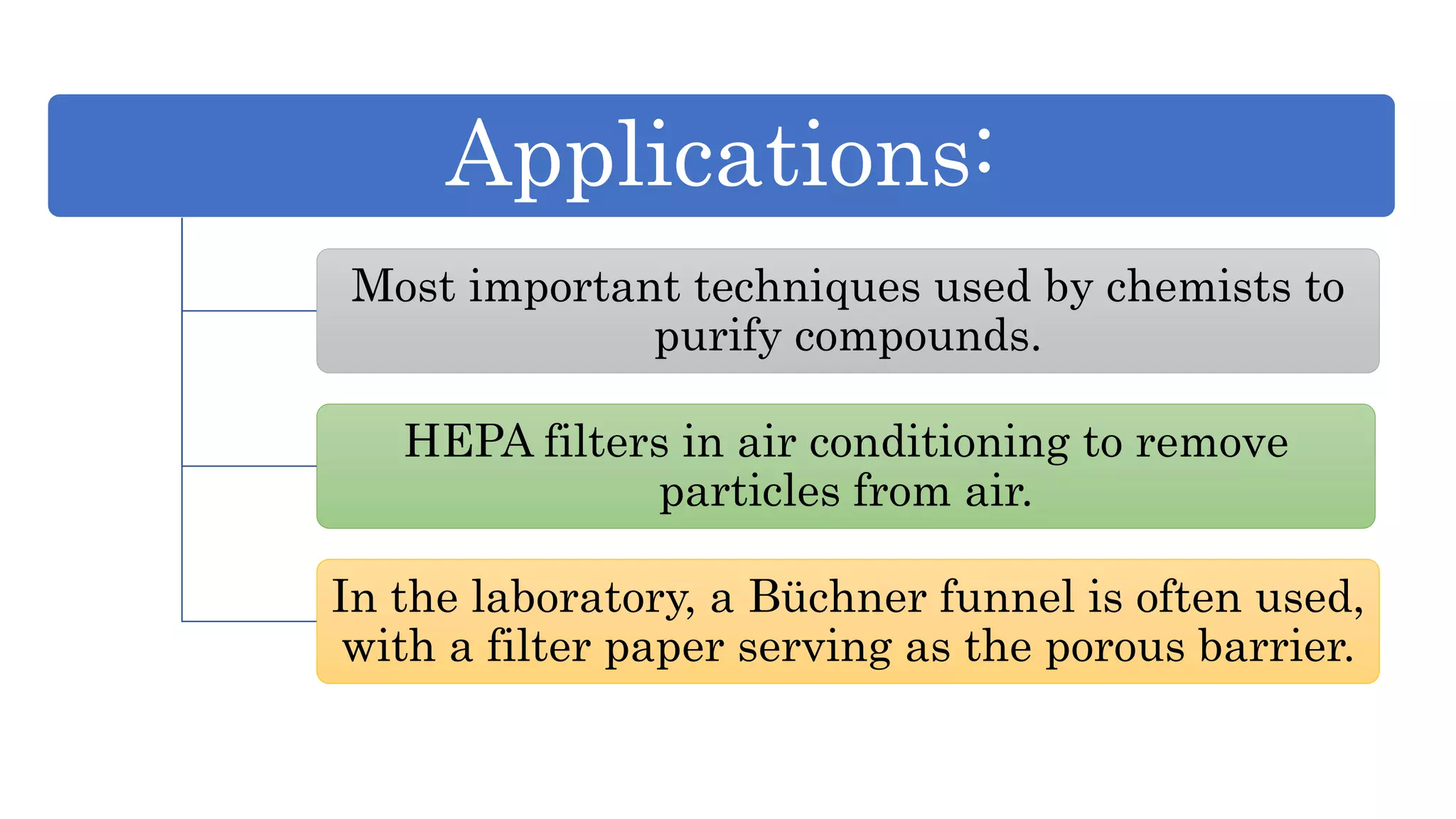
Applications:
Most important techniques used by chemists to
purify compounds.
HEPA filters in air conditioning to remove
particles from air.
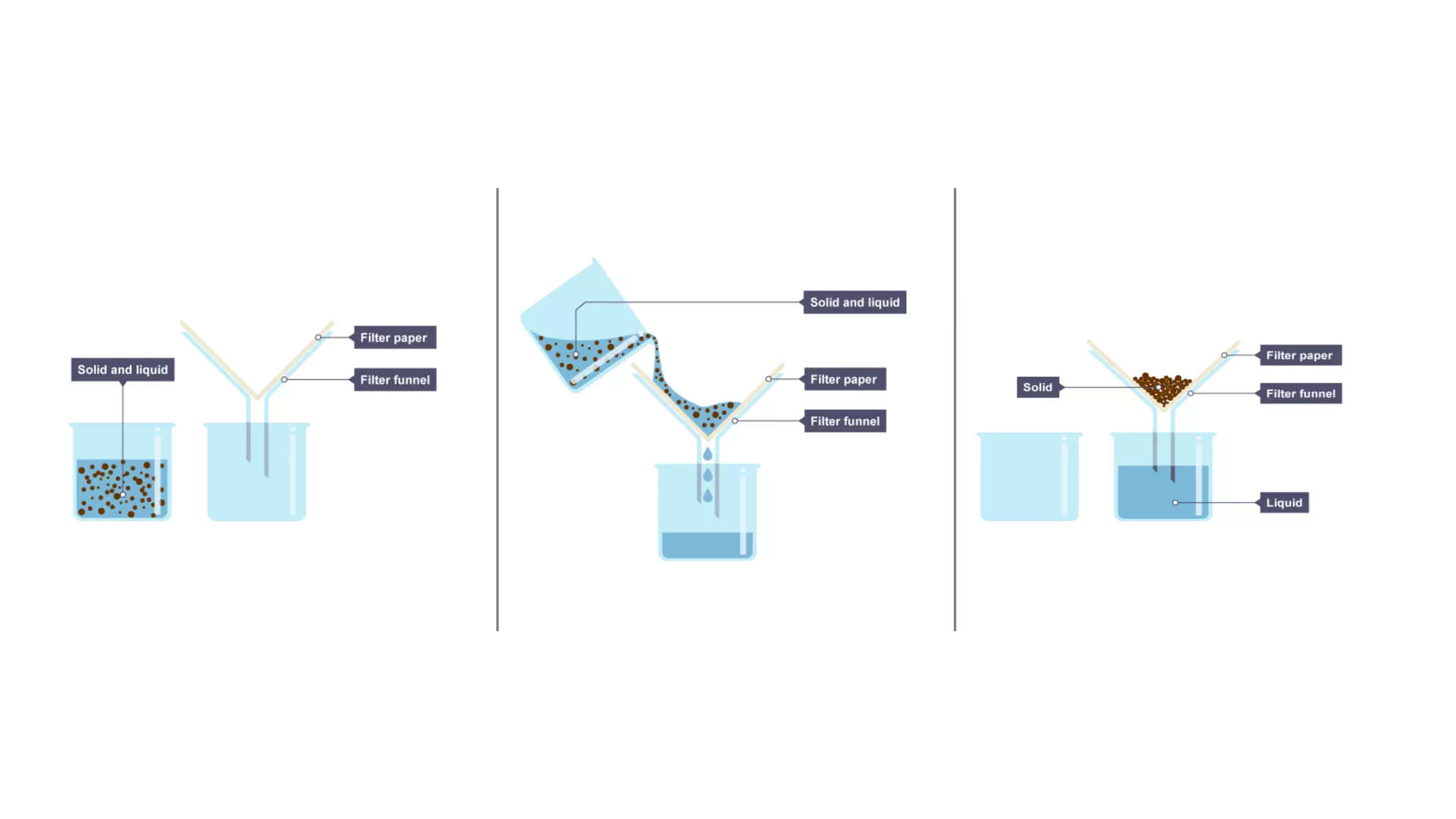
In the laboratory, a Büchner funnel is often used,
with a filter paper serving as the porous barrier.
CENTRIFUGATION:
It is used to separate
mixtures where the solid
particles don’t settle faster
and which are of very small
size and can't be separated
by filtration.
Centrifugation is a
technique which involves
the application
of centrifugal force to
separate particles from a
solution according to their
size, shape, density,
viscosity of the medium and
rotor speed.
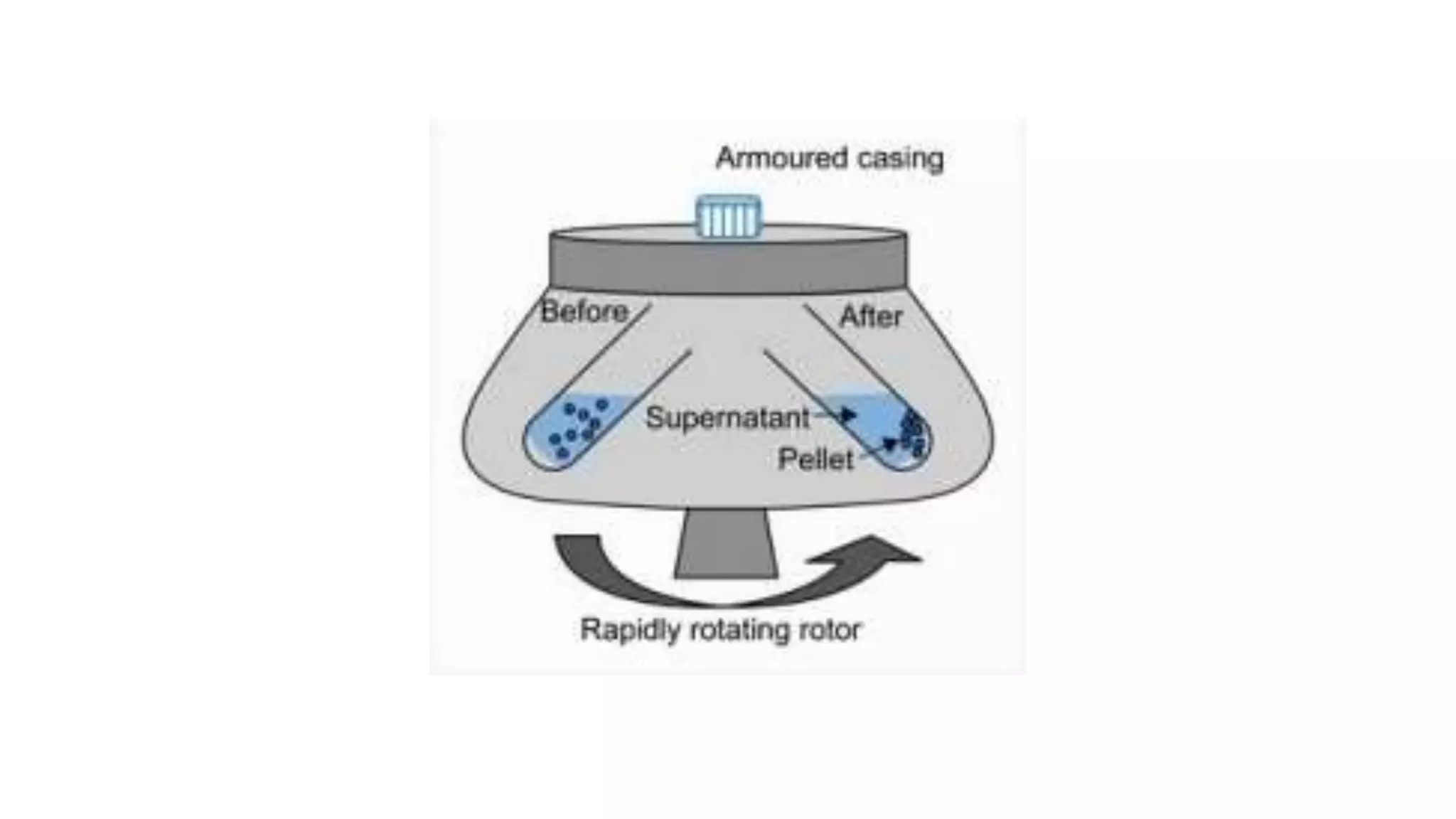
A centrifuge is a device that
separates particles from a
solution through use of a
rotor.
More-dense components of the
mixture migrate away from the
axis of the centrifuge (move to
the outside), while less-dense
components of the mixture
migrate towards the axis, i. e.,
move to the center.
The rate of centrifugation is
specified by the angular
velocity usually expressed
as revolutions per minute (RPM),
or acceleration expressed as g.
The conversion factor between
RPM and g depends on
the radius of the centrifuge rotor.
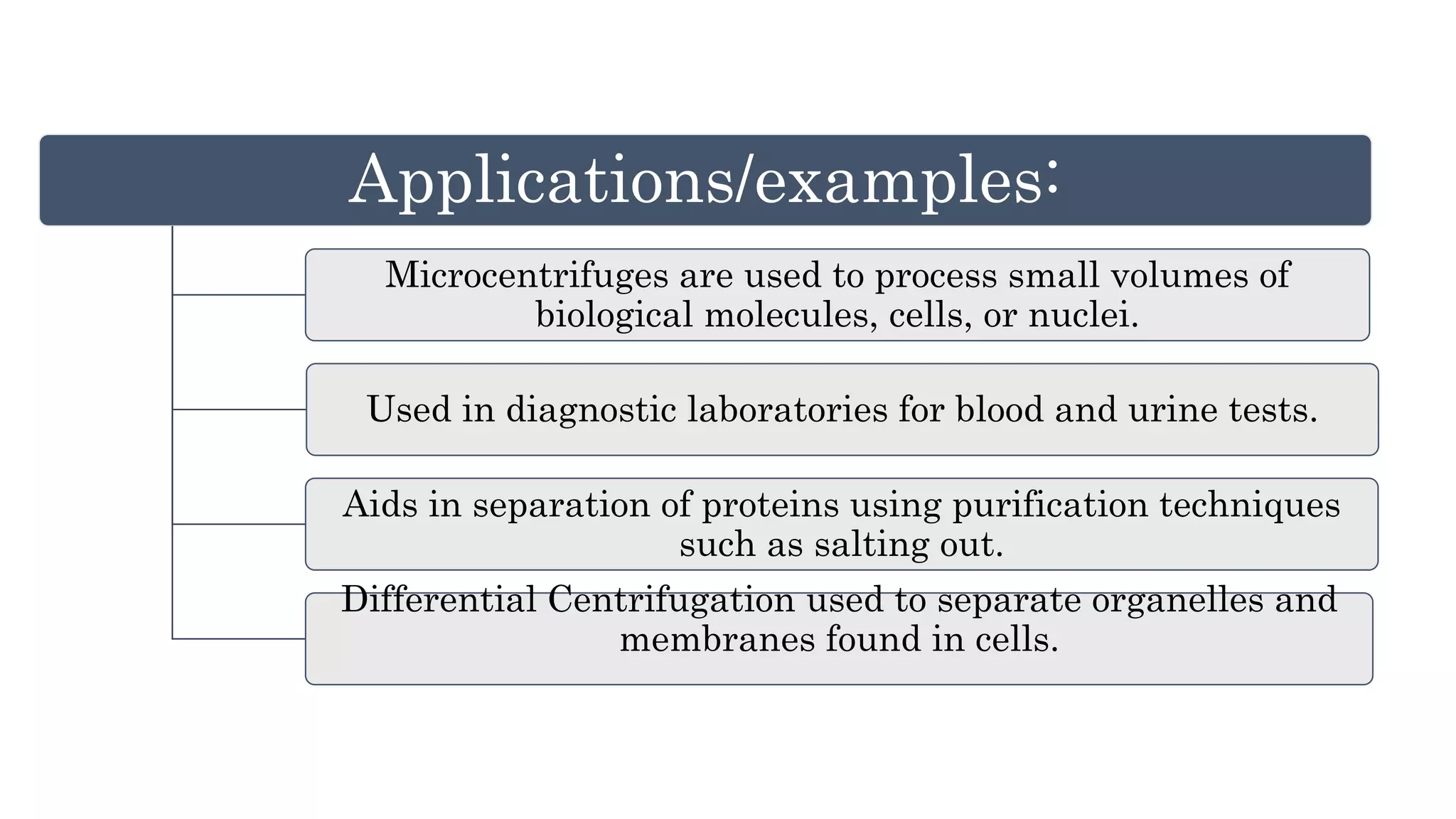
Applications/examples:
Microcentrifuges are used to process small volumes of
biological molecules, cells, or nuclei.
Used in diagnostic laboratories for blood and urine tests.
Aids in separation of proteins using purification techniques
such as salting out.
Differential Centrifugation used to separate organelles and
membranes found in cells.
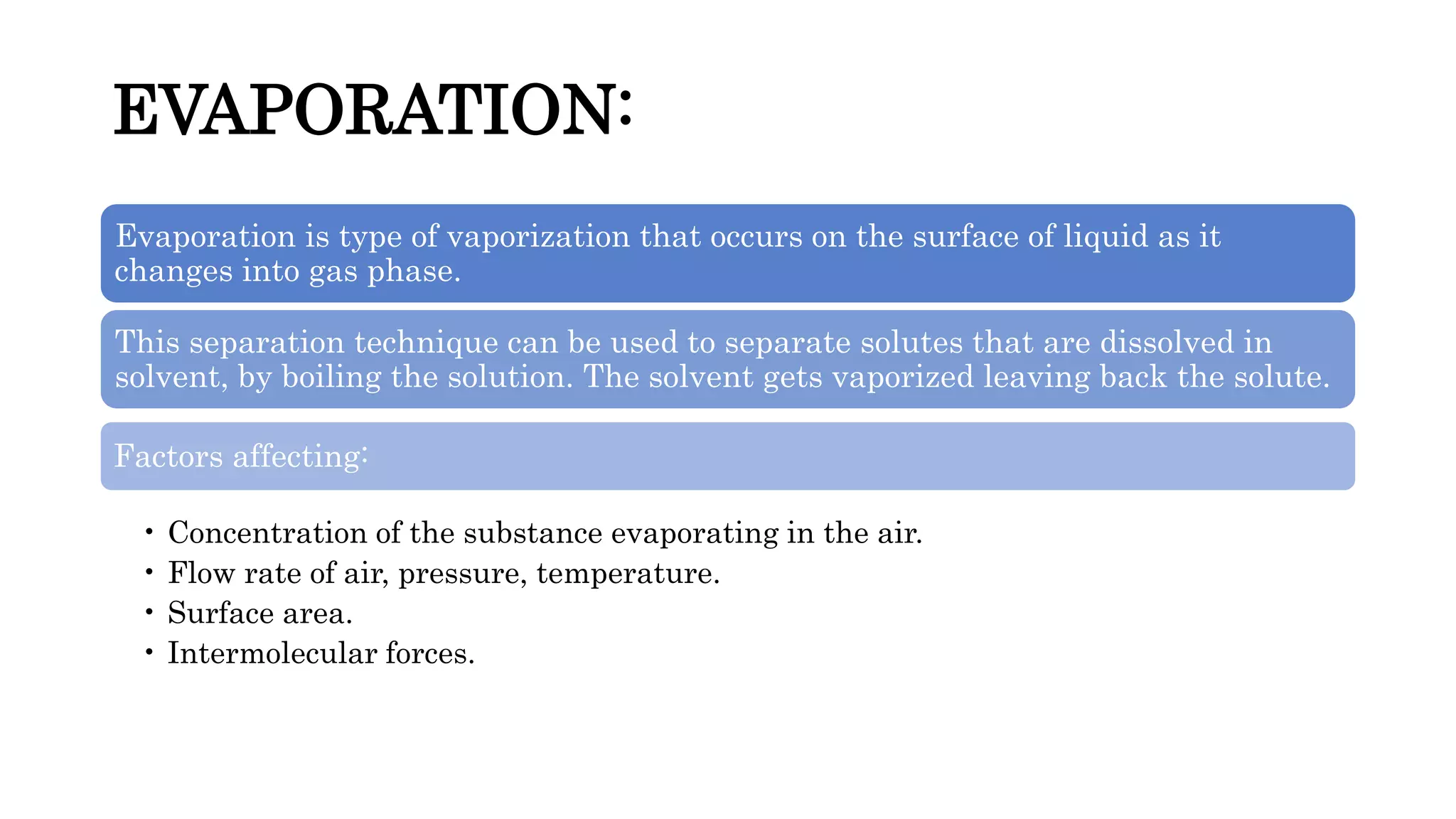
EVAPORATION:
Evaporation is type of vaporization that occurs on the surface of liquid as it
changes into gas phase.
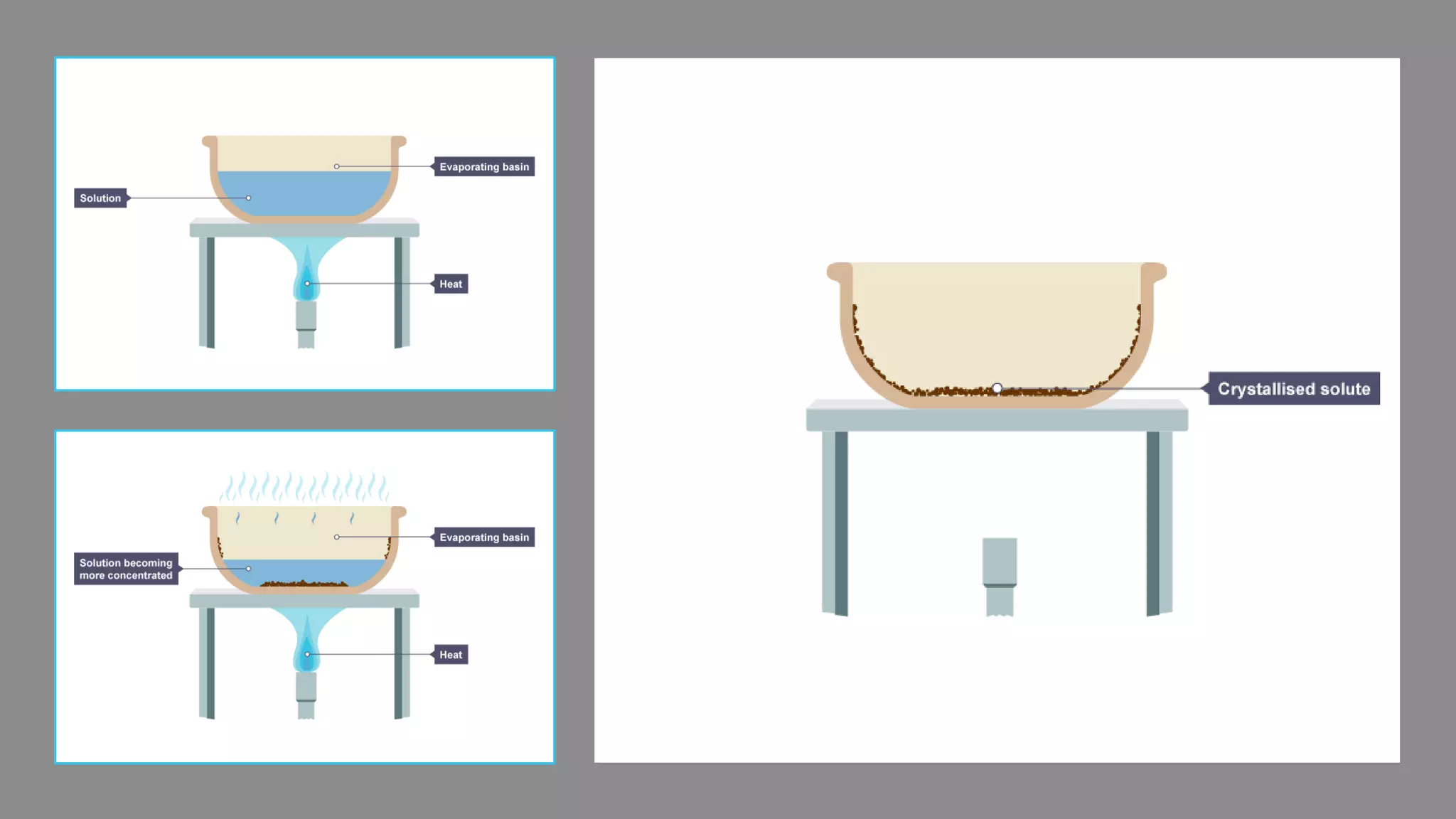
This separation technique can be used to separate solutes that are dissolved in
solvent, by boiling the solution. The solvent gets vaporized leaving back the solute.
Factors affecting:
• Concentration of the substance evaporating in the air.
• Flow rate of air, pressure, temperature.
• Surface area.
• Intermolecular forces.
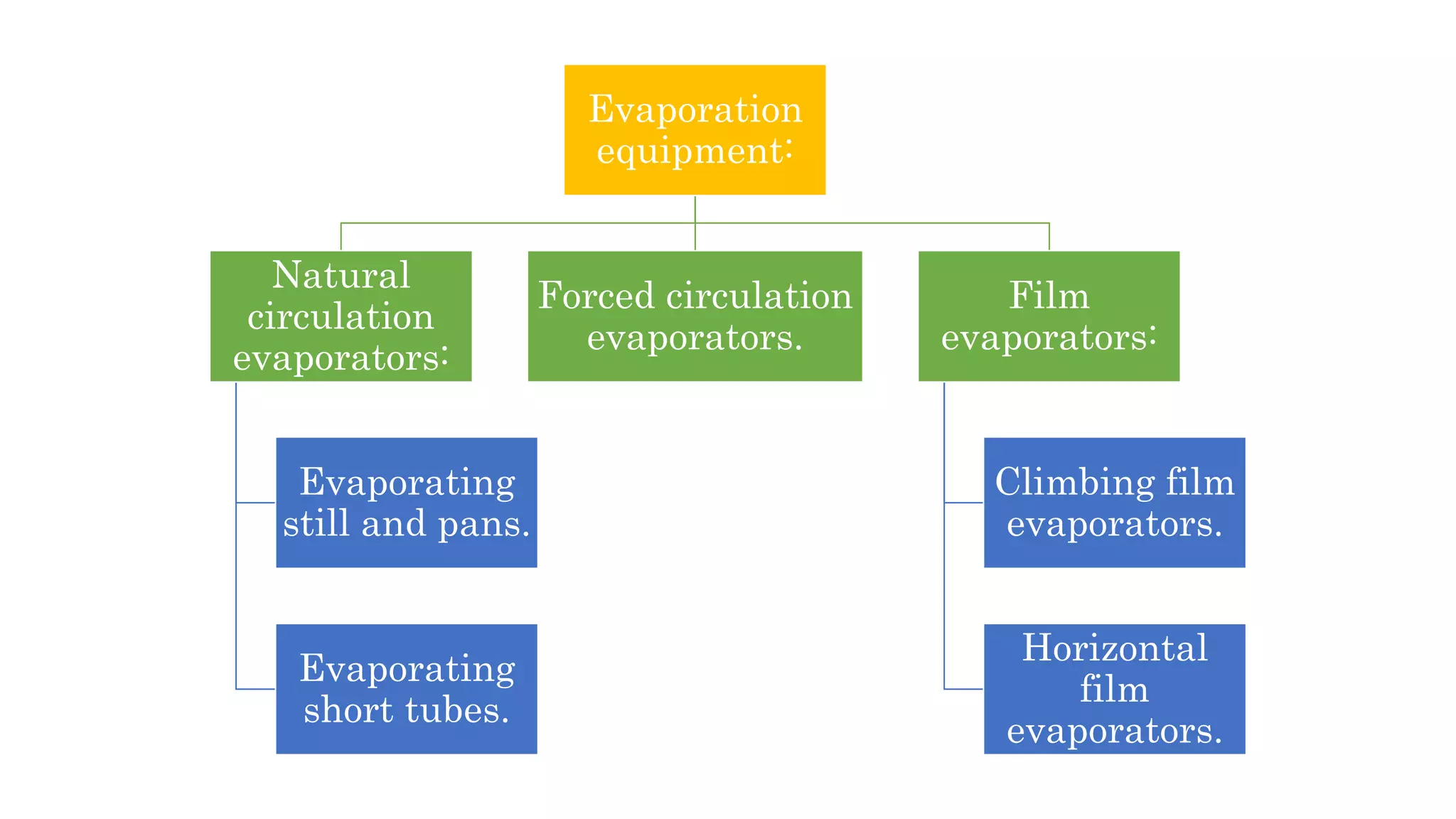
Evaporation
equipment:
Natural
circulation
evaporators:
Evaporating
still and pans.
Evaporating
short tubes.
Forced circulation
evaporators.
Film
evaporators:
Climbing film
evaporators.
Horizontal
film
evaporators.
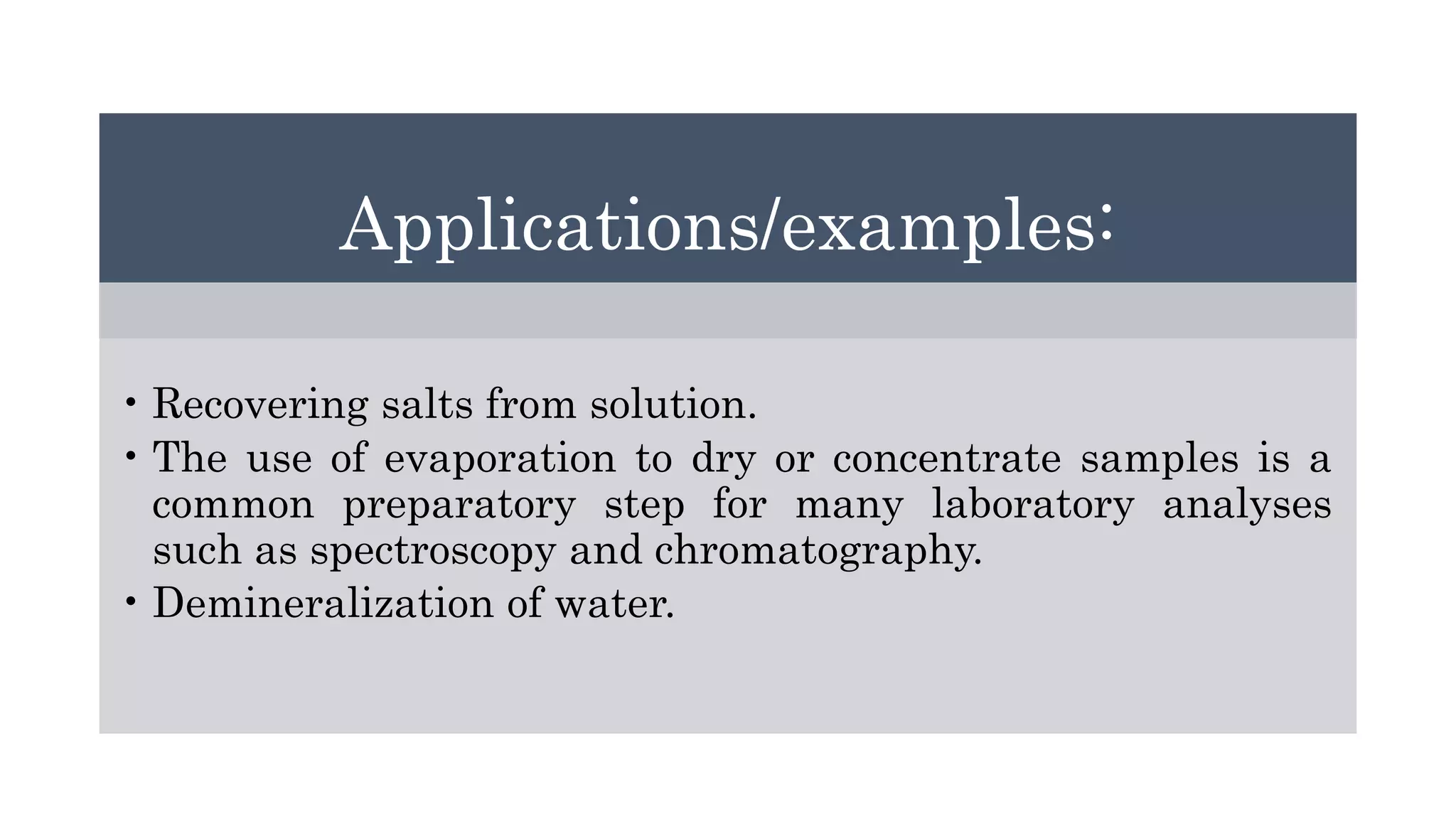
Applications/examples:
• Recovering salts from solution.
• The use of evaporation to dry or concentrate samples is a
common preparatory step for many laboratory analyses
such as spectroscopy and chromatography.
• Demineralization of water.
DISTILLATION:
Distillation is an
effective method to
separate mixtures
comprised of two or
more pure liquids
(called “components”).
The separation of a
mixture of liquids based
on the physical property
of boiling point.
Distillation is a
purification process
where the components
of a liquid mixture are
vaporized and then
condensed and isolated.
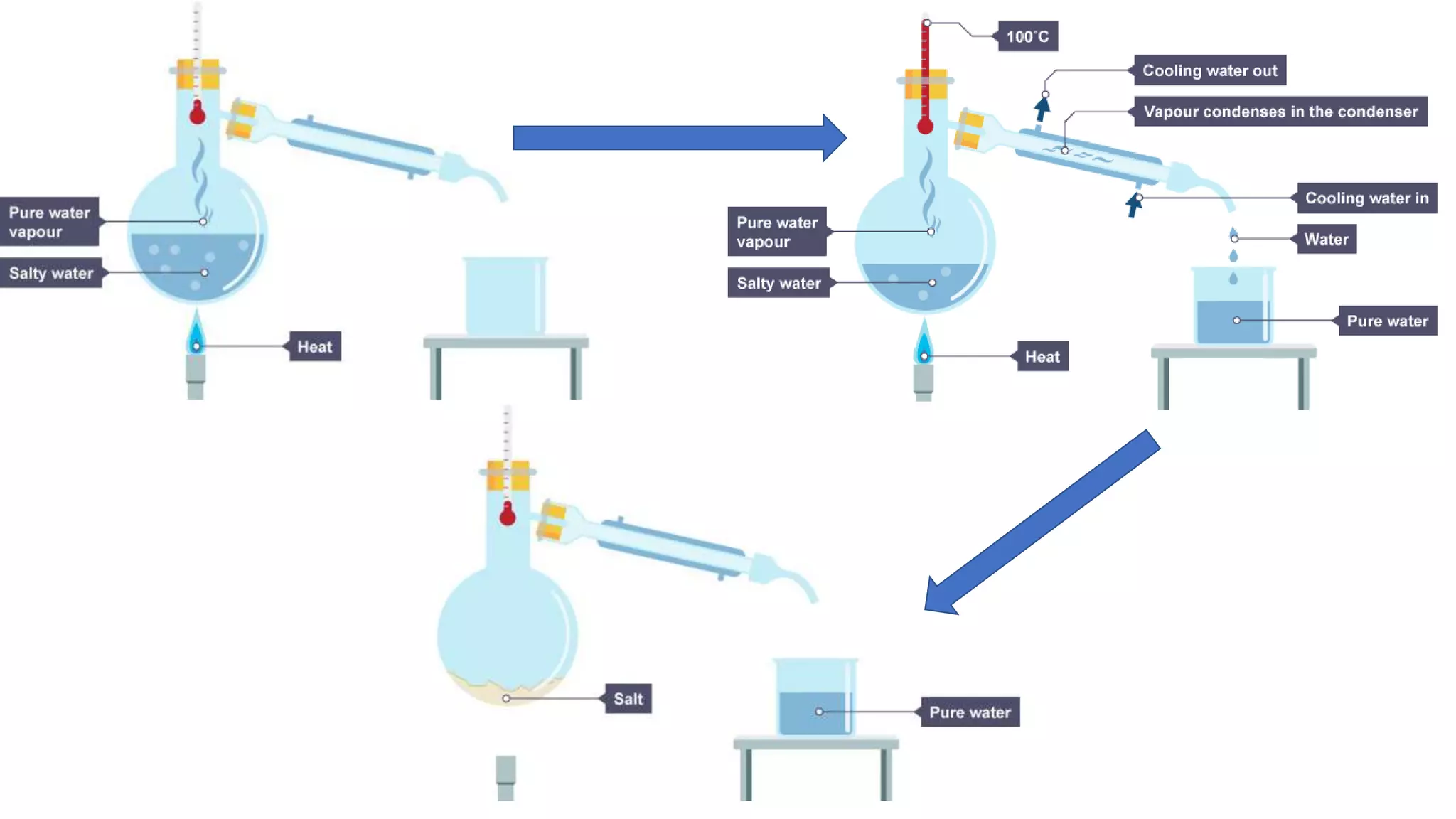
The mixture is heated until one of the
components boils (turns to a vapor). The vapor
is then fed into a condenser, which cools the
vapor and changes it back into a liquid that is
called distillate. What remains in the original
container is called the "residue".
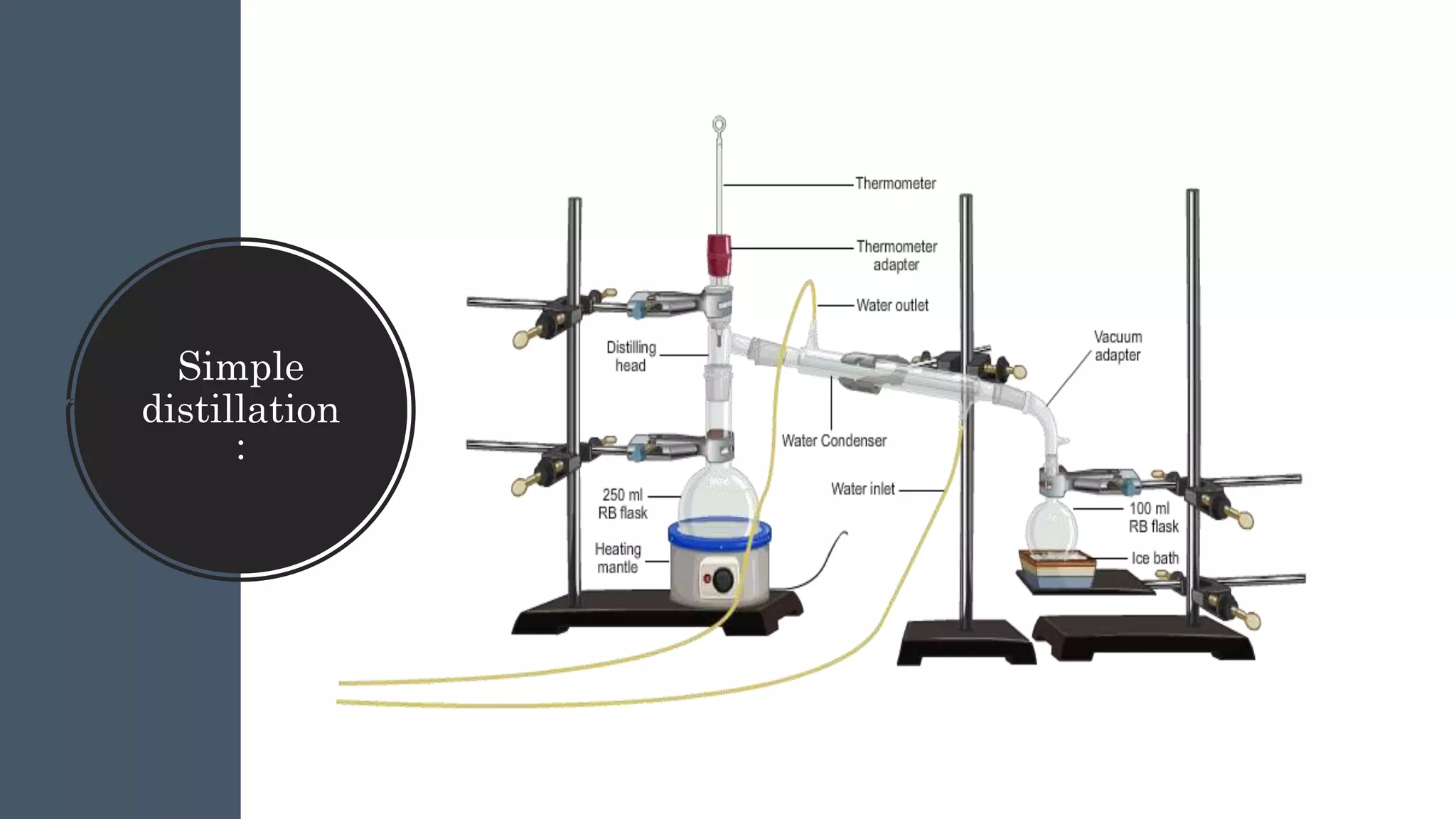
Simple
distillation
:
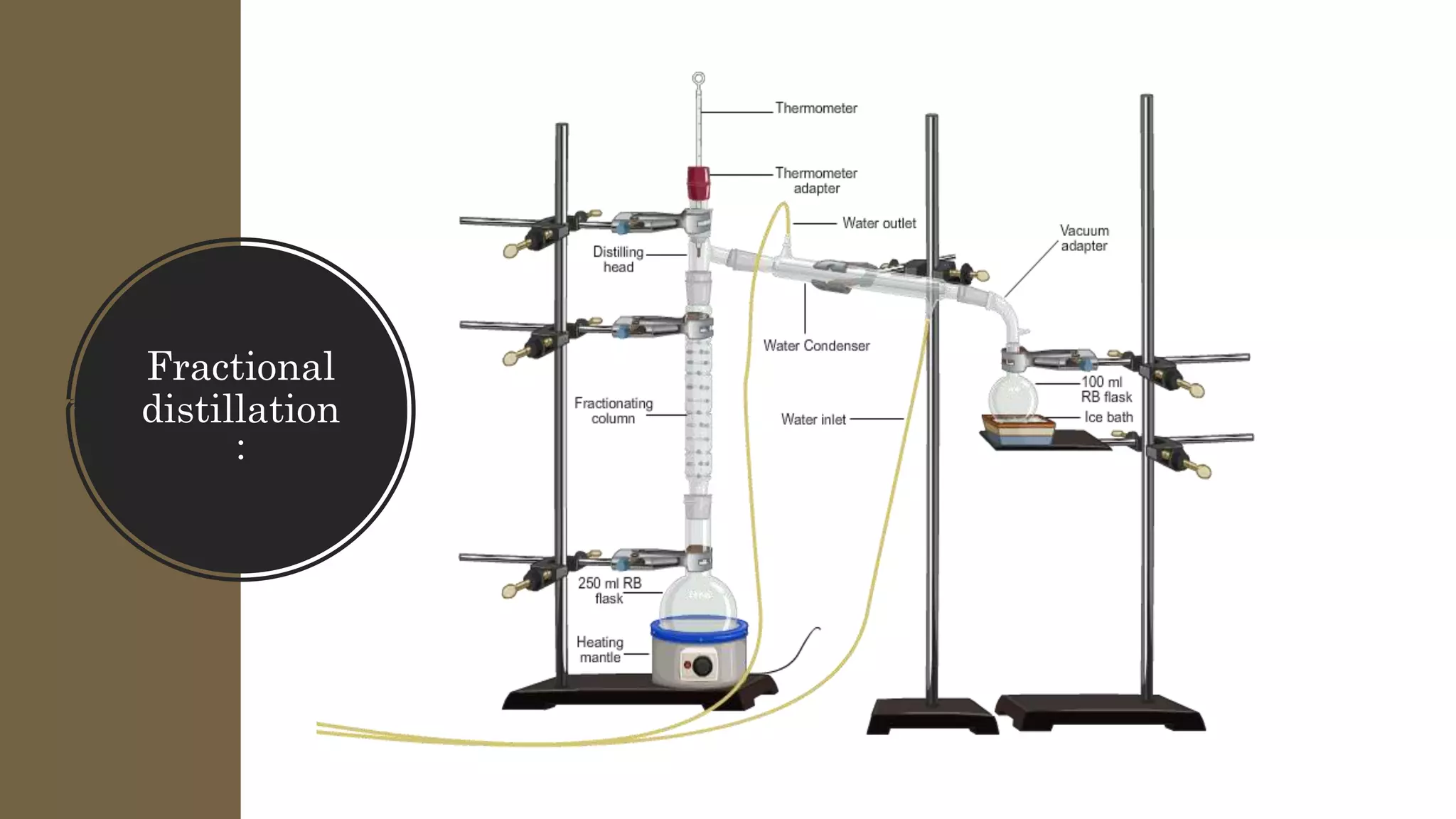
Fractional
distillation
:
Types:
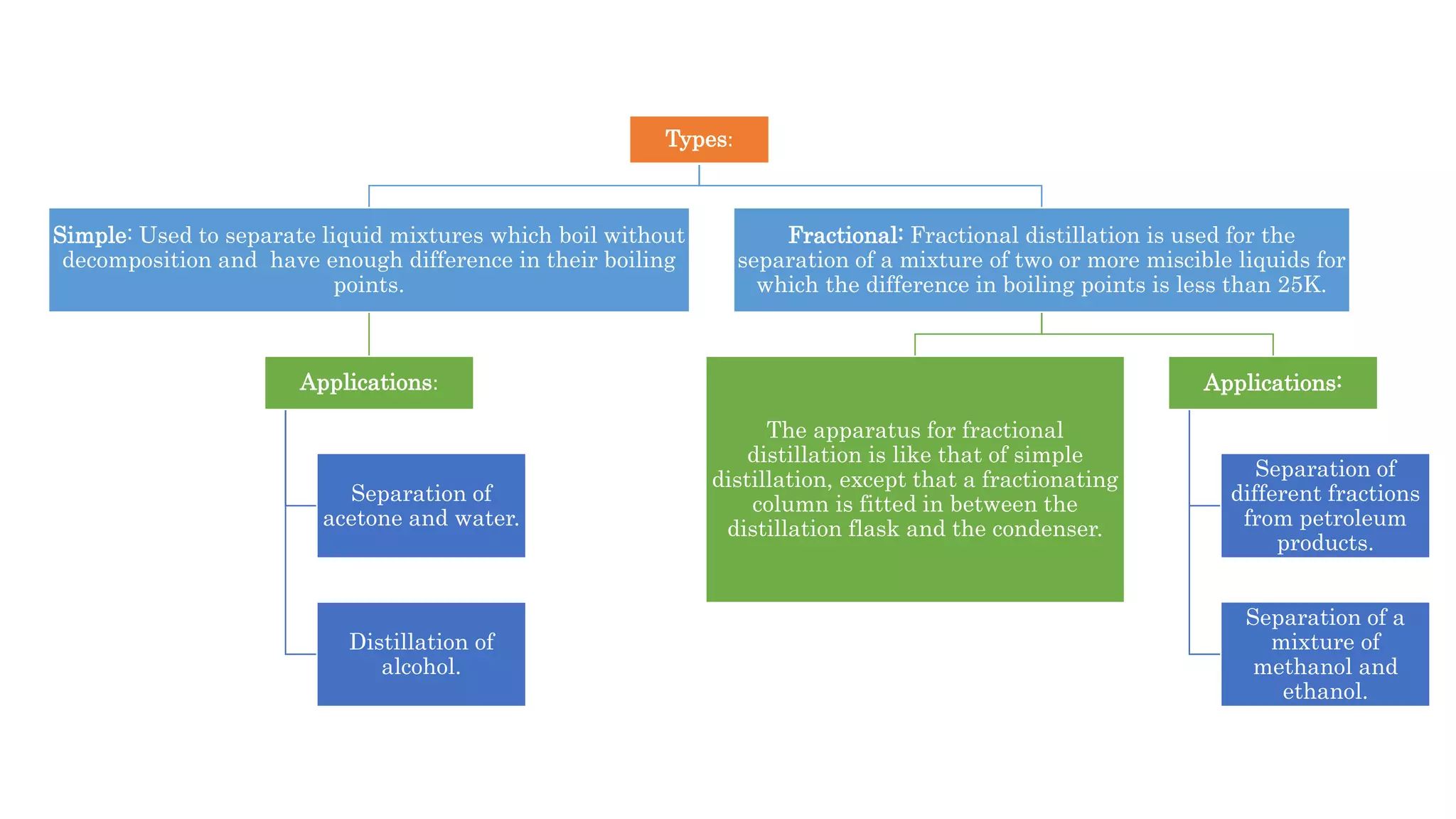
Simple: Used to separate liquid mixtures which boil without
decomposition and have enough difference in their boiling
points.
Applications:
Separation of
acetone and water.
Distillation of
alcohol.
Fractional: Fractional distillation is used for the
separation of a mixture of two or more miscible liquids for
which the difference in boiling points is less than 25K.
The apparatus for fractional
distillation is like that of simple
distillation, except that a fractionating
column is fitted in between the
distillation flask and the condenser.
Applications:
Separation of
different fractions
from petroleum
products.
Separation of a
mixture of
methanol and
ethanol.
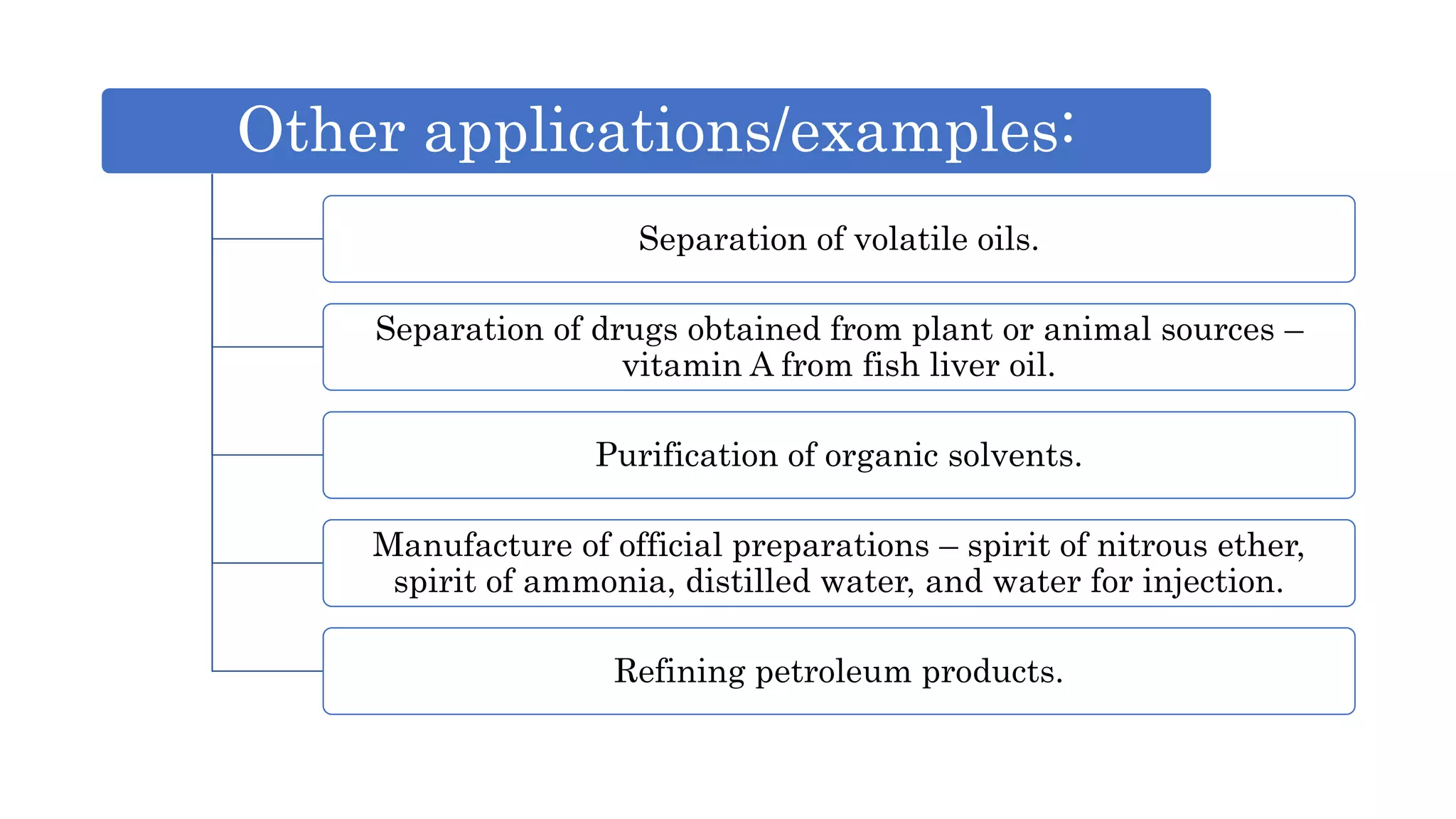
Other applications/examples:
Separation of volatile oils.
Separation of drugs obtained from plant or animal sources –
vitamin A from fish liver oil.
Purification of organic solvents.
Manufacture of official preparations – spirit of nitrous ether,
spirit of ammonia, distilled water, and water for injection.
Refining petroleum products.
CRYSTALLIZATION:
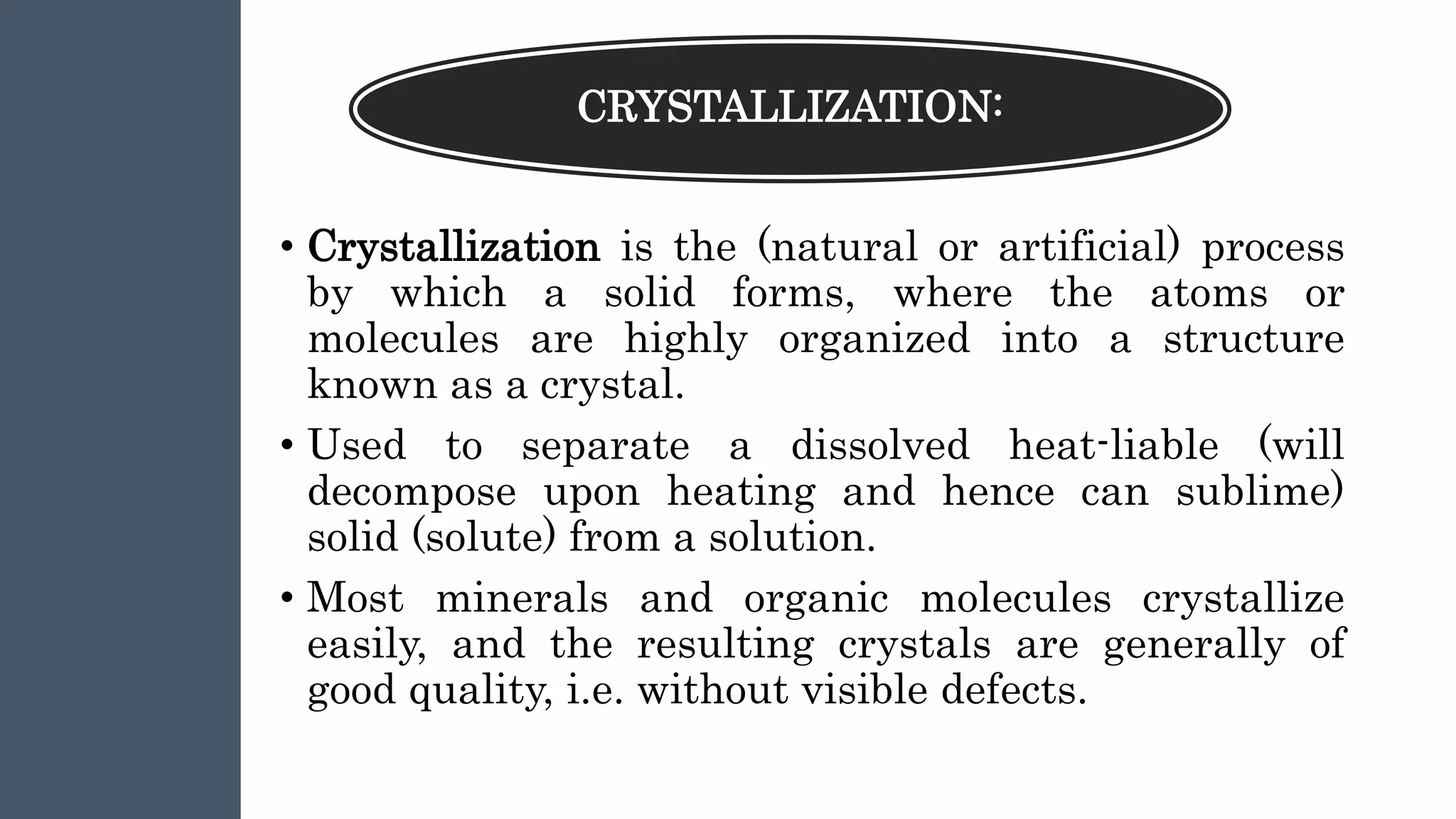
• Crystallization is the (natural or artificial) process
by which a solid forms, where the atoms or
molecules are highly organized into a structure
known as a crystal.
• Used to separate a dissolved heat-liable (will
decompose upon heating and hence can sublime)
solid (solute) from a solution.
• Most minerals and organic molecules crystallize
easily, and the resulting crystals are generally of
good quality, i.e. without visible defects.
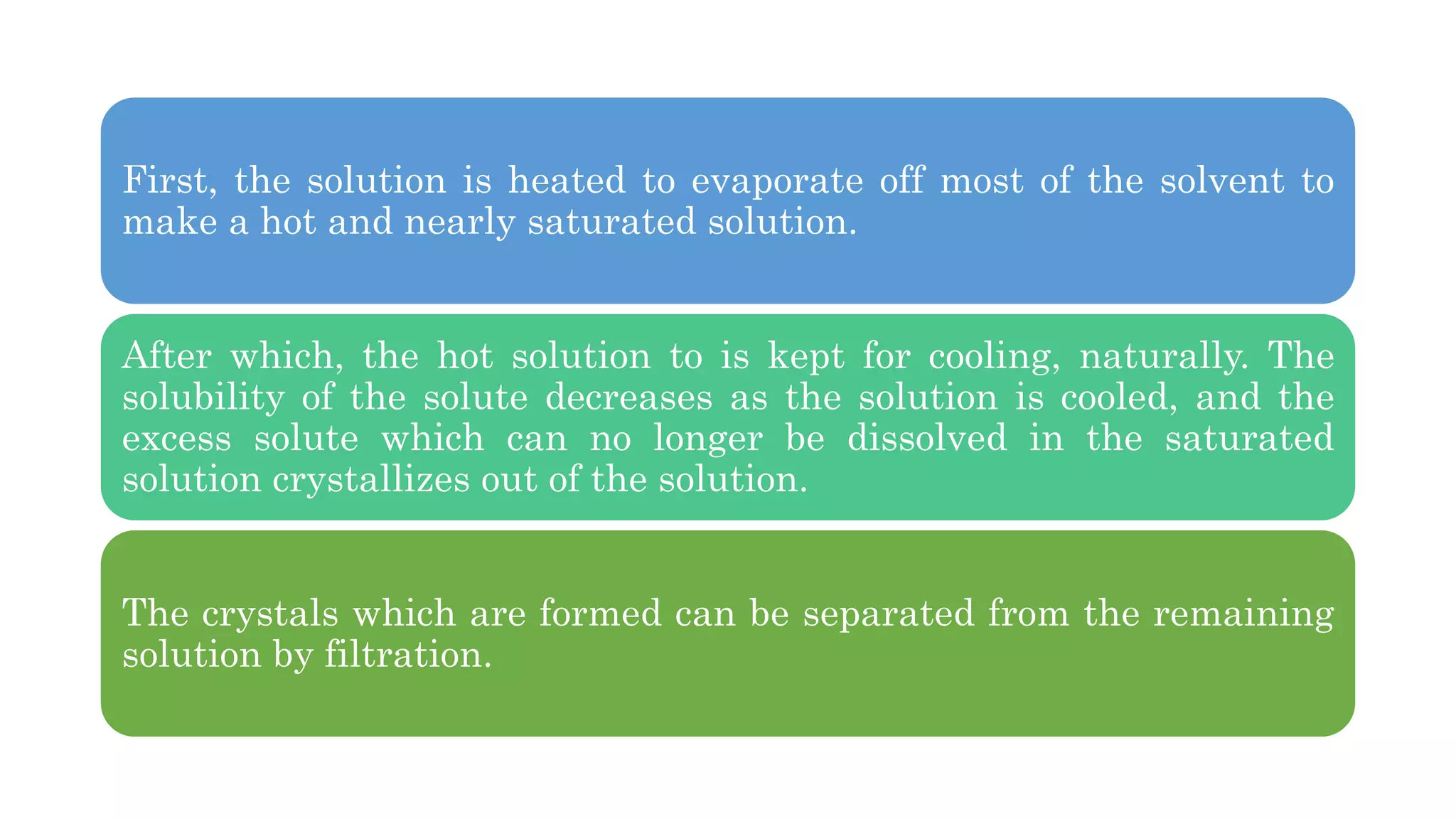
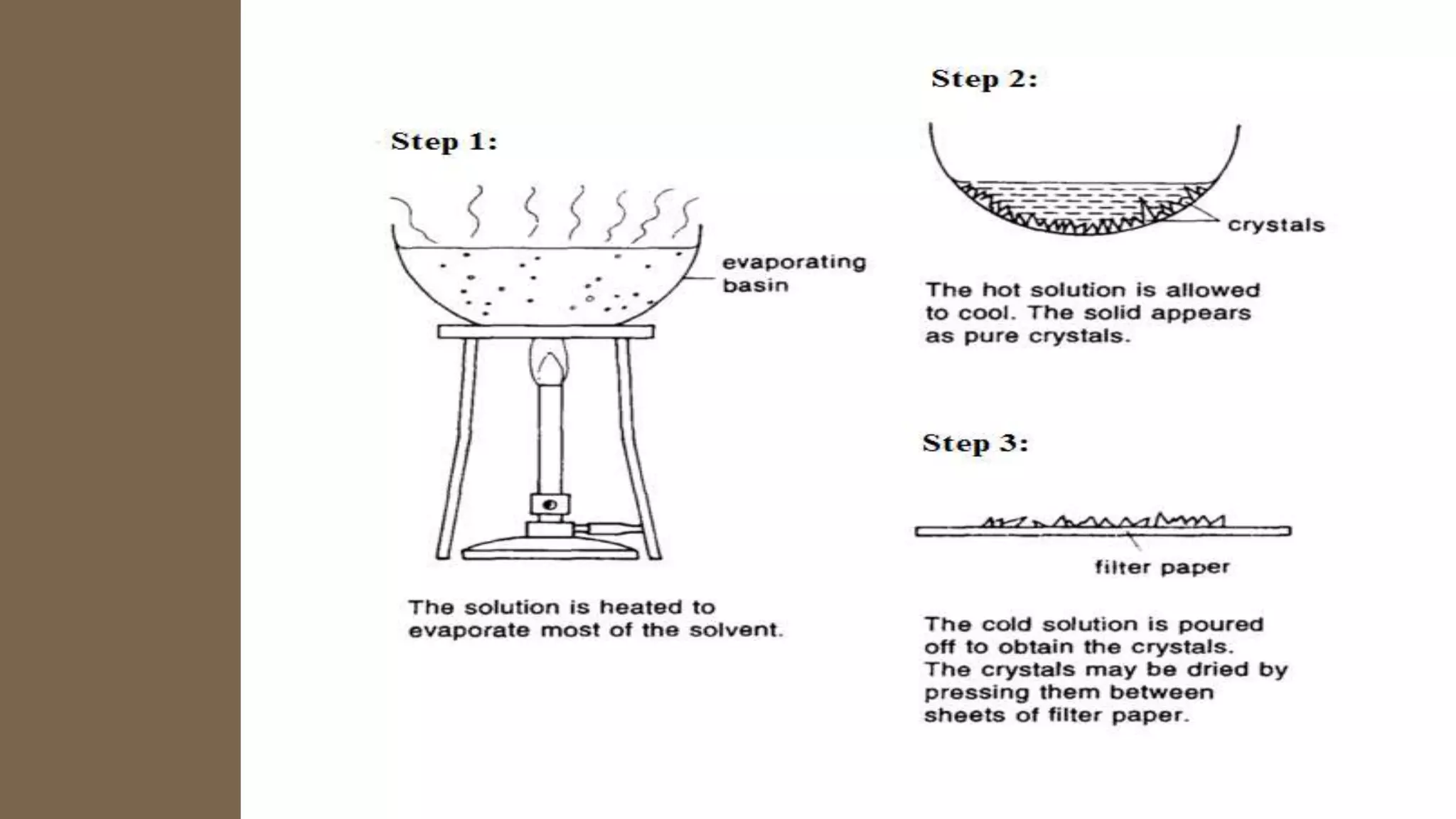
First, the solution is heated to evaporate off most of the solvent to
make a hot and nearly saturated solution.
After which, the hot solution to is kept for cooling, naturally. The
solubility of the solute decreases as the solution is cooled, and the
excess solute which can no longer be dissolved in the saturated
solution crystallizes out of the solution.
The crystals which are formed can be separated from the remaining
solution by filtration.
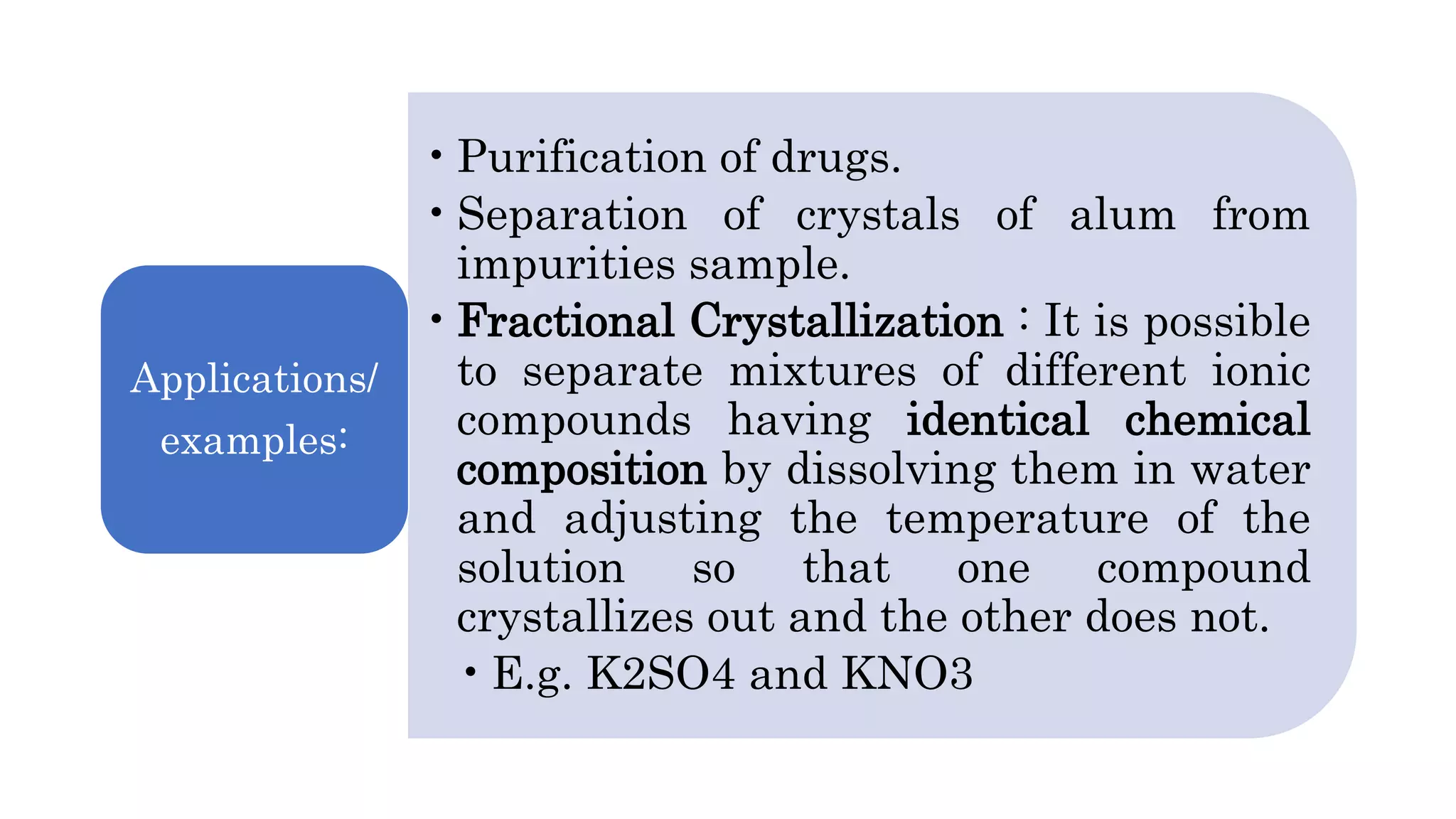
•Purification of drugs.
•Separation of crystals of alum from
impurities sample.
•Fractional Crystallization : It is possible
to separate mixtures of different ionic
compounds having identical chemical
composition by dissolving them in water
and adjusting the temperature of the
solution so that one compound
crystallizes out and the other does not.
•E.g. K2SO4 and KNO3
Applications/
examples:
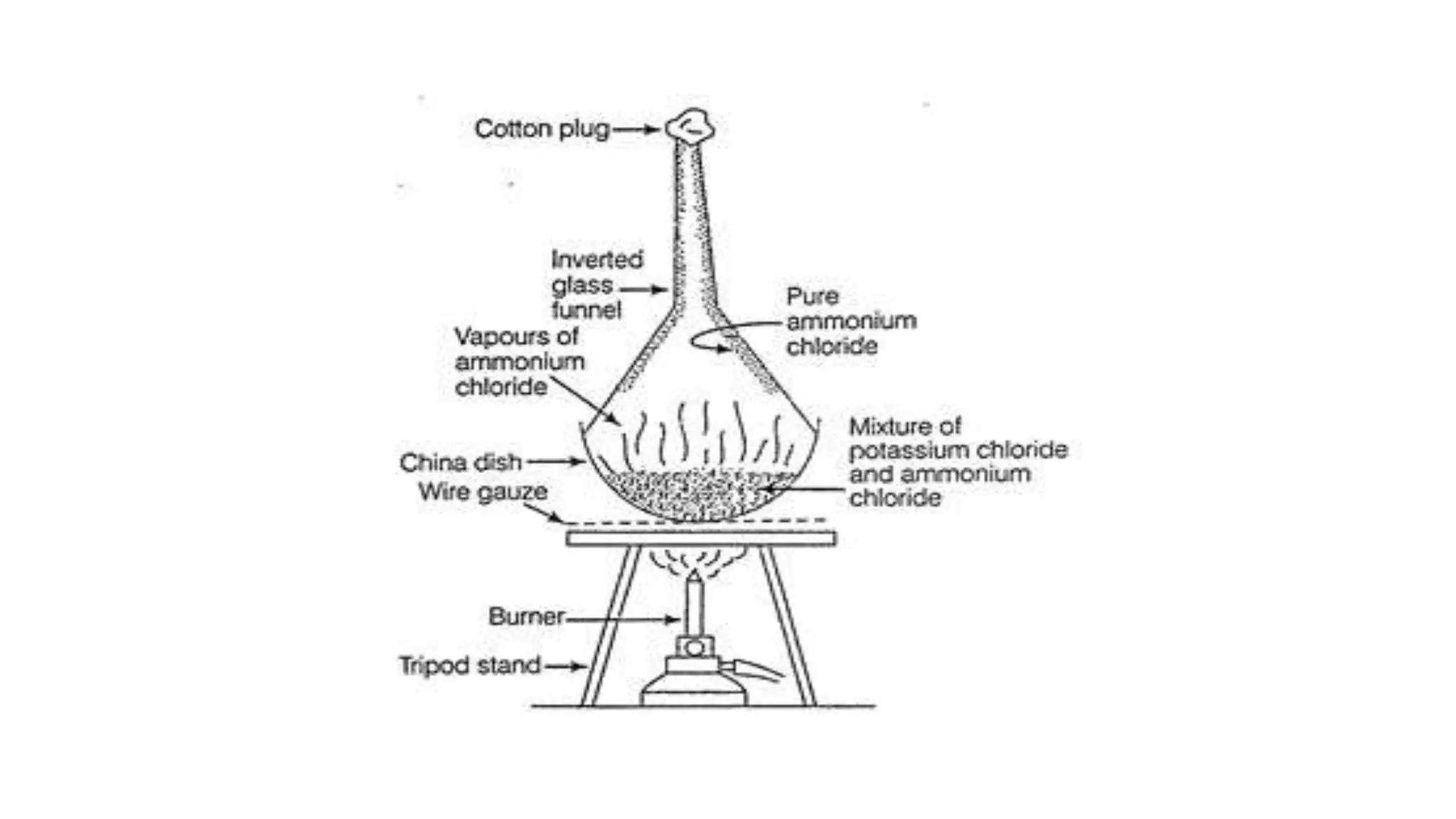
SUBLIMATION
SEPARATION:
• Sublimation is the transition of a
substance directly from the solid to
the gas phase, without passing
through the
intermediate liquid phase.
• This technique takes the advantage
of substance’s sublimable property.
• Separate a mixture of solids
containing one which sublimes and
one (or more than one) which does
not, by heating the mixture.
Applications/examples:
• Separate iodine from sand.
• Dye-sublimation printers help in rendering digital
pictures in a detailed and realistic fashion which helps
in the analysis of substances.
• Sublimation finds practical application in forensic
sciences.
• Chemists usually prefer sublimation as a purification
method to purify volatile compounds.
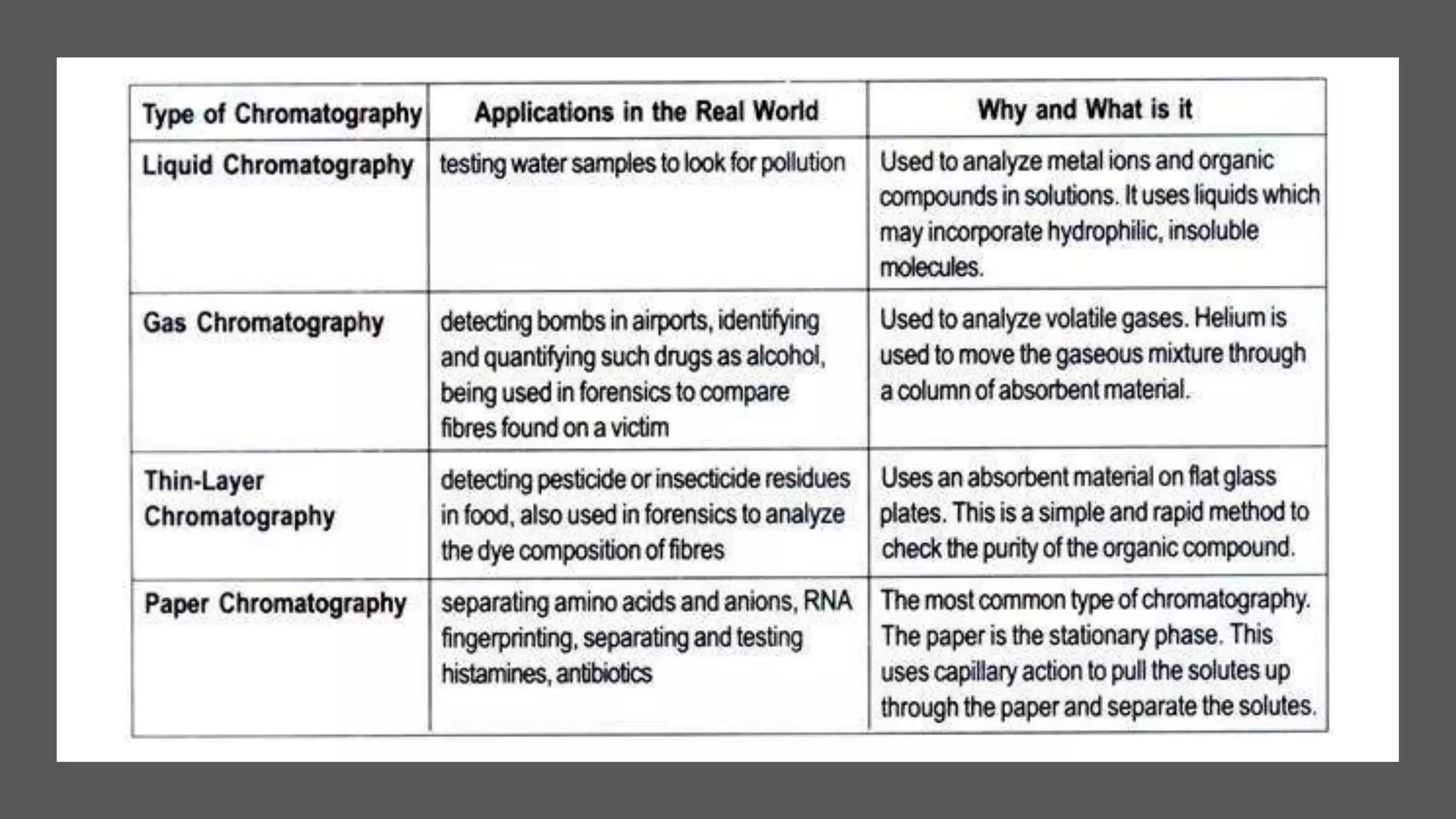
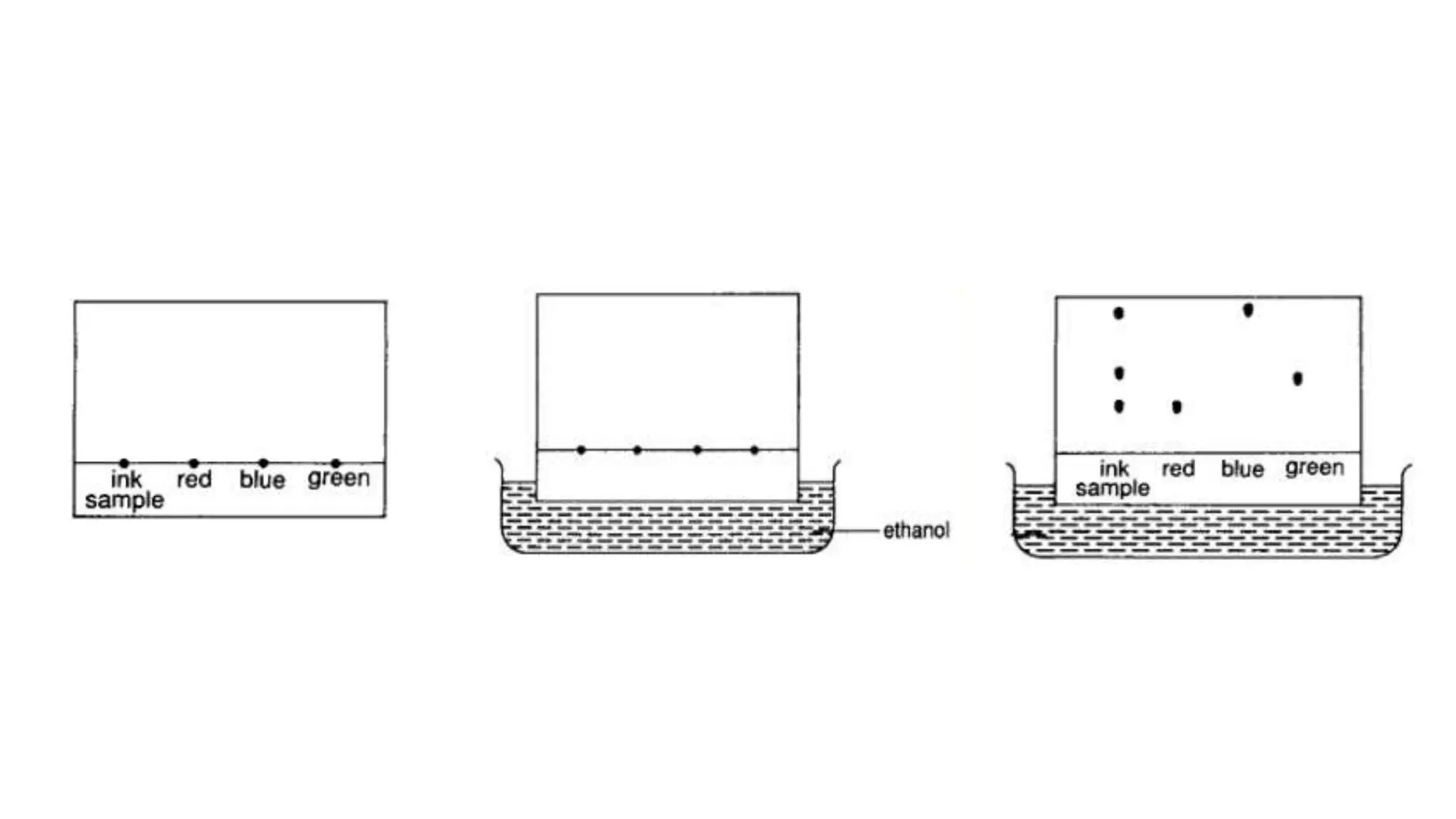
CHROMATOGRAPHY:
• Chromatography is a separation technique used to separate the
different components in a liquid mixture.
• The mixture is dissolved in a fluid called the mobile phase, which
carries it through a structure holding another material called
the stationary phase.
• Chromatography is vast separation technique which has many
methods or has different principles of separation involved.
EXTRACTION TECHNIQUES:
• Involves the separation of medicinally active
portions of plant or animal tissues from the
inactive or inert components by using selective
solvents in standard extraction procedures.
• Different methods of extraction are:
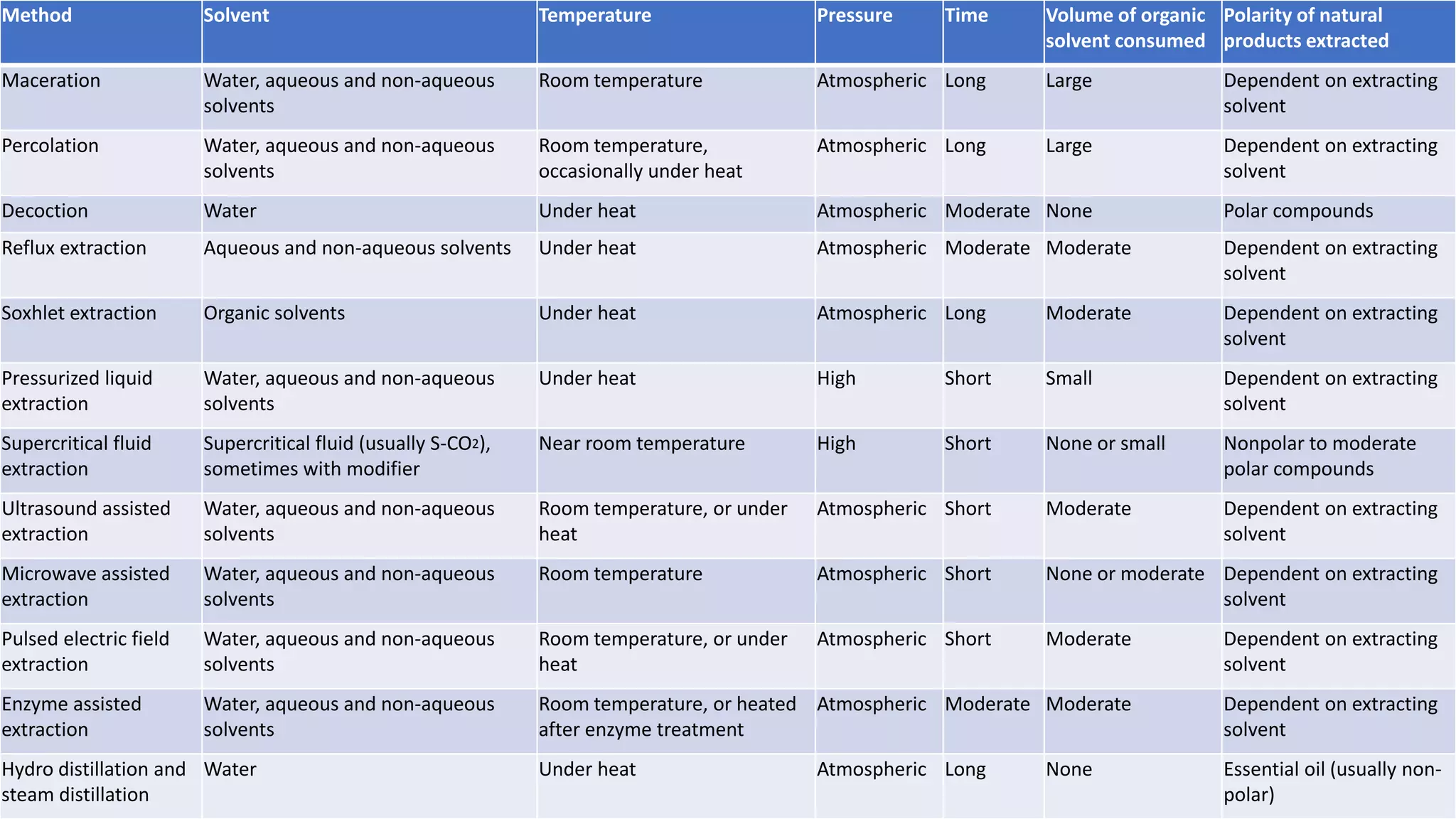
Method Solvent Temperature Pressure Time Volume of organic
solvent consumed
Polarity of natural
products extracted
Maceration Water, aqueous and non-aqueous
solvents
Room temperature Atmospheric Long Large Dependent on extracting
solvent
Percolation Water, aqueous and non-aqueous
solvents
Room temperature,
occasionally under heat
Atmospheric Long Large Dependent on extracting
solvent
Decoction Water Under heat Atmospheric Moderate None Polar compounds
Reflux extraction Aqueous and non-aqueous solvents Under heat Atmospheric Moderate Moderate Dependent on extracting
solvent
Soxhlet extraction Organic solvents Under heat Atmospheric Long Moderate Dependent on extracting
solvent
Pressurized liquid
extraction
Water, aqueous and non-aqueous
solvents
Under heat High Short Small Dependent on extracting
solvent
Supercritical fluid
extraction
Supercritical fluid (usually S-CO2),
sometimes with modifier
Near room temperature High Short None or small Nonpolar to moderate
polar compounds
Ultrasound assisted
extraction
Water, aqueous and non-aqueous
solvents
Room temperature, or under
heat
Atmospheric Short Moderate Dependent on extracting
solvent
Microwave assisted
extraction
Water, aqueous and non-aqueous
solvents
Room temperature Atmospheric Short None or moderate Dependent on extracting
solvent
Pulsed electric field
extraction
Water, aqueous and non-aqueous
solvents
Room temperature, or under
heat
Atmospheric Short Moderate Dependent on extracting
solvent
Enzyme assisted
extraction
Water, aqueous and non-aqueous
solvents
Room temperature, or heated
after enzyme treatment
Atmospheric Moderate Moderate Dependent on extracting
solvent
Hydro distillation and
steam distillation
Water Under heat Atmospheric Long None Essential oil (usually non-
polar)
THANK YOU

Separation techniques - introduction

  • 1.
  • 2.
    DEFINITION: Separation techniques arethose techniques that can be used to separate two different states of matter such as liquids and solids. Separation processes or a separation method or simply a separation is methodology to attain any mass transfer phenomenon that convert a mixture of substances into two or more distinct product mixtures. Separation is an important asset to purify component of interest from a mixtures.
  • 3.
    NEED OF SEPARATION TECHNIQUES: TOIDENTIFY WHAT TO BE SEPARATED FROM MIXTURE. TO OBTAIN IMPORTANT AND PURE SUBSTANCES. TO REMOVE UNWANTED PARTICLES.
  • 4.
    TYPES OF SEPARATIONTECHNIQUES: • Separation techniques are classified based on type of mixtures: Separation techniques For solid in liquid mixtures Homogenous: 1. Evaporation 2. Distillation 3. centrifugation Heterogenous: 1. Sedimentation / gravitation 2. Filtration 3. Magnetic separation 4. Fractional distillation For liquid in liquid mixtures Homogenous: 1. Simple or fractional distillation. 2. Chromatography Heterogenous: 1. Partition separation using funnel
  • 5.
    MAGNETIC SEPARATIO N: This method involvesthe separation of magnetic substances from non-magnetic substances by means of magnet. Takes advantage of physical property of magnetism, so it useful only for certain substances such as ferromagnetic (materials strongly affected by magnetic fields) and paramagnetic (materials that are less affected, but the effect is still noticeable). This method involves the separation of magnetic substances from non-magnetic substances by means of magnet.
  • 7.
    • Applications: • Wastemanagement, low-magnetic field separation in water purification and separation of complex mixtures. • To remove metal contaminants from pharmaceutical product streams. • Magnetic cell separation. It is currently being used in clinical therapies, more specifically in cancer and hereditary diseases researches. • These techniques are combined with PCR (polymerase chain reaction), to increase sensitivity and specificity of results.
  • 8.
    DECANTATION: Decantation is aprocess for the separation of mixtures of immiscible liquids or of a liquid and a solid mixture such as a suspension. Immiscible liquid separation: • Takes advantage of differences in density of the liquids. • A separatory funnel is an alternative apparatus for separating liquid layers. It has a valve at the bottom to allow draining off the bottom layer. It can give a better separation between the two liquids. • Example: separation of mixture of oil and water.
  • 9.
    •Takes advantage ofgravity/sedimentation of solids in case solid-liquid separation. •Sedimentation: The tendency of particles in suspension to settle down in the fluid due to certain forces like gravity, centrifugal acceleration, or electromagnetism is called as sedimentation. •The solid that gets settled down is called as sediment. •In laboratory it can be done in test tubes. To enhance productivity test tubes should be placed at 45° angle to allow the sediments to settle at the bottom of the apparatus. •A decanter centrifuge may be used for continuous solid-liquid separation. Liquid-solid separation:
  • 12.
    Examples/applications: • Decantation isfrequently used to purify a liquid by separating it from a suspension of insoluble particles. • Decantation is also present in nanotechnology. In the synthesis of high-quality silver nanowire (AgNW) solutions and fabrication process of high-performance electrodes, decantation is also being applied which greatly simplifies the purification process. • Fat is determined in butter by decantation. • In sugar industry, processing of sugar beets into granular sugar many liquid - solid separations are encountered.
  • 13.
    FILTRATION: Takes advantage ofphysical property of state of matter, its size and solubility in liquid. • The substance which is left behind in the filtration medium is called residue. • The liquid which passes through the filtration medium is called filtrate. Mechanical, physical or biological operations that separates solids from fluids (liquids or gases ) by adding a medium through which only the fluid can pass can be called as filtration.
  • 16.
    Applications: Most important techniquesused by chemists to purify compounds. HEPA filters in air conditioning to remove particles from air. In the laboratory, a Büchner funnel is often used, with a filter paper serving as the porous barrier.
  • 17.
    CENTRIFUGATION: It is usedto separate mixtures where the solid particles don’t settle faster and which are of very small size and can't be separated by filtration. Centrifugation is a technique which involves the application of centrifugal force to separate particles from a solution according to their size, shape, density, viscosity of the medium and rotor speed. A centrifuge is a device that separates particles from a solution through use of a rotor.
  • 18.
    More-dense components ofthe mixture migrate away from the axis of the centrifuge (move to the outside), while less-dense components of the mixture migrate towards the axis, i. e., move to the center. The rate of centrifugation is specified by the angular velocity usually expressed as revolutions per minute (RPM), or acceleration expressed as g. The conversion factor between RPM and g depends on the radius of the centrifuge rotor.
  • 20.
    Applications/examples: Microcentrifuges are usedto process small volumes of biological molecules, cells, or nuclei. Used in diagnostic laboratories for blood and urine tests. Aids in separation of proteins using purification techniques such as salting out. Differential Centrifugation used to separate organelles and membranes found in cells.
  • 21.
    EVAPORATION: Evaporation is typeof vaporization that occurs on the surface of liquid as it changes into gas phase. This separation technique can be used to separate solutes that are dissolved in solvent, by boiling the solution. The solvent gets vaporized leaving back the solute. Factors affecting: • Concentration of the substance evaporating in the air. • Flow rate of air, pressure, temperature. • Surface area. • Intermolecular forces.
  • 23.
    Evaporation equipment: Natural circulation evaporators: Evaporating still and pans. Evaporating shorttubes. Forced circulation evaporators. Film evaporators: Climbing film evaporators. Horizontal film evaporators.
  • 24.
    Applications/examples: • Recovering saltsfrom solution. • The use of evaporation to dry or concentrate samples is a common preparatory step for many laboratory analyses such as spectroscopy and chromatography. • Demineralization of water.
  • 25.
    DISTILLATION: Distillation is an effectivemethod to separate mixtures comprised of two or more pure liquids (called “components”). The separation of a mixture of liquids based on the physical property of boiling point. Distillation is a purification process where the components of a liquid mixture are vaporized and then condensed and isolated. The mixture is heated until one of the components boils (turns to a vapor). The vapor is then fed into a condenser, which cools the vapor and changes it back into a liquid that is called distillate. What remains in the original container is called the "residue".
  • 26.
  • 27.
  • 29.
    Types: Simple: Used toseparate liquid mixtures which boil without decomposition and have enough difference in their boiling points. Applications: Separation of acetone and water. Distillation of alcohol. Fractional: Fractional distillation is used for the separation of a mixture of two or more miscible liquids for which the difference in boiling points is less than 25K. The apparatus for fractional distillation is like that of simple distillation, except that a fractionating column is fitted in between the distillation flask and the condenser. Applications: Separation of different fractions from petroleum products. Separation of a mixture of methanol and ethanol.
  • 30.
    Other applications/examples: Separation ofvolatile oils. Separation of drugs obtained from plant or animal sources – vitamin A from fish liver oil. Purification of organic solvents. Manufacture of official preparations – spirit of nitrous ether, spirit of ammonia, distilled water, and water for injection. Refining petroleum products.
  • 31.
    CRYSTALLIZATION: • Crystallization isthe (natural or artificial) process by which a solid forms, where the atoms or molecules are highly organized into a structure known as a crystal. • Used to separate a dissolved heat-liable (will decompose upon heating and hence can sublime) solid (solute) from a solution. • Most minerals and organic molecules crystallize easily, and the resulting crystals are generally of good quality, i.e. without visible defects.
  • 32.
    First, the solutionis heated to evaporate off most of the solvent to make a hot and nearly saturated solution. After which, the hot solution to is kept for cooling, naturally. The solubility of the solute decreases as the solution is cooled, and the excess solute which can no longer be dissolved in the saturated solution crystallizes out of the solution. The crystals which are formed can be separated from the remaining solution by filtration.
  • 34.
    •Purification of drugs. •Separationof crystals of alum from impurities sample. •Fractional Crystallization : It is possible to separate mixtures of different ionic compounds having identical chemical composition by dissolving them in water and adjusting the temperature of the solution so that one compound crystallizes out and the other does not. •E.g. K2SO4 and KNO3 Applications/ examples:
  • 35.
    SUBLIMATION SEPARATION: • Sublimation isthe transition of a substance directly from the solid to the gas phase, without passing through the intermediate liquid phase. • This technique takes the advantage of substance’s sublimable property. • Separate a mixture of solids containing one which sublimes and one (or more than one) which does not, by heating the mixture.
  • 37.
    Applications/examples: • Separate iodinefrom sand. • Dye-sublimation printers help in rendering digital pictures in a detailed and realistic fashion which helps in the analysis of substances. • Sublimation finds practical application in forensic sciences. • Chemists usually prefer sublimation as a purification method to purify volatile compounds.
  • 38.
    CHROMATOGRAPHY: • Chromatography isa separation technique used to separate the different components in a liquid mixture. • The mixture is dissolved in a fluid called the mobile phase, which carries it through a structure holding another material called the stationary phase. • Chromatography is vast separation technique which has many methods or has different principles of separation involved.
  • 41.
    EXTRACTION TECHNIQUES: • Involvesthe separation of medicinally active portions of plant or animal tissues from the inactive or inert components by using selective solvents in standard extraction procedures. • Different methods of extraction are:
  • 42.
    Method Solvent TemperaturePressure Time Volume of organic solvent consumed Polarity of natural products extracted Maceration Water, aqueous and non-aqueous solvents Room temperature Atmospheric Long Large Dependent on extracting solvent Percolation Water, aqueous and non-aqueous solvents Room temperature, occasionally under heat Atmospheric Long Large Dependent on extracting solvent Decoction Water Under heat Atmospheric Moderate None Polar compounds Reflux extraction Aqueous and non-aqueous solvents Under heat Atmospheric Moderate Moderate Dependent on extracting solvent Soxhlet extraction Organic solvents Under heat Atmospheric Long Moderate Dependent on extracting solvent Pressurized liquid extraction Water, aqueous and non-aqueous solvents Under heat High Short Small Dependent on extracting solvent Supercritical fluid extraction Supercritical fluid (usually S-CO2), sometimes with modifier Near room temperature High Short None or small Nonpolar to moderate polar compounds Ultrasound assisted extraction Water, aqueous and non-aqueous solvents Room temperature, or under heat Atmospheric Short Moderate Dependent on extracting solvent Microwave assisted extraction Water, aqueous and non-aqueous solvents Room temperature Atmospheric Short None or moderate Dependent on extracting solvent Pulsed electric field extraction Water, aqueous and non-aqueous solvents Room temperature, or under heat Atmospheric Short Moderate Dependent on extracting solvent Enzyme assisted extraction Water, aqueous and non-aqueous solvents Room temperature, or heated after enzyme treatment Atmospheric Moderate Moderate Dependent on extracting solvent Hydro distillation and steam distillation Water Under heat Atmospheric Long None Essential oil (usually non- polar)
  • 43.