STANDARD SEPERATION
TECHNIQUES FOR MIXTURES
CHEMISTRY
W.A.L.T. – PART 1
• State the different standard methods of
separating mixtures and their individual
applications
• Manipulate different apparatus for separation
techniques
• Draw separation technique apparatus
• State the criteria for purity
• Distinguish between pure and impure
substances
• A mixture is a substance formed when
two or more constituents are physically
joined together
• Constituents of mixtures can be
elements, compounds or both
• A mixture does not have a fixed amount
of each element or compound in it
• The constituents maintain their
characteristic properties and can be
separated by physical means
MIXTURES
ELEMENTS, MIXTURES &
COMPOUNDS
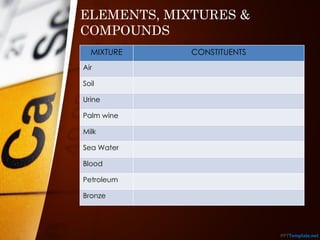
MIXTURE CONSTITUENTS
Air
Soil
Urine
Palm wine
Milk
Sea Water
Blood
Petroleum
Bronze
Attach Classwork
• State five differences between a
compound and a mixture
• State three differences between
homogeneous mixtures and
heterogeneous mixtures
• State three examples each of
the mixtures above
• Note: Use a tabular form to
present your work
ELEMENTS, MIXTURES &
COMPOUNDS
SEPARATION TECHNIQUES
• One feature of mixtures is that it is
possible to separate the
individual constituents by physical
means
• Each constituent of a mixture still
retains its individual properties
• There are many different physical
methods used to separate a
variety of mixtures
• Each method is dependent upon
the properties of the constituent
such as solubility, boiling point,
sublimation, rate of diffusion,
magnetic properties etc.
Types of Separating Techniques
include:
1. Sieving
2. Decantation
3. Filtration
4. Evaporation
5. Distillation
6. Fractional Distillation
7. Crystallization
8. Sublimation
9. Precipitation
10. Chromatography
11. Separating funnel method
12. Magnetic Separation
TERMS
• Solute
• Solvent
• Solution
Class work
• Describe the following terms
• Give two each examples
SIEVING
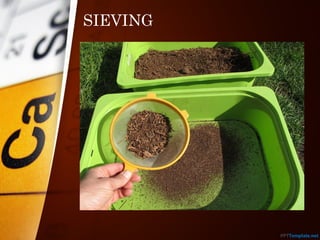
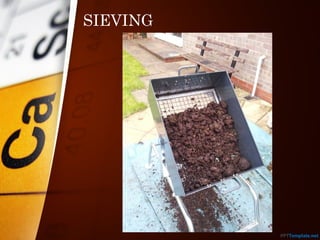
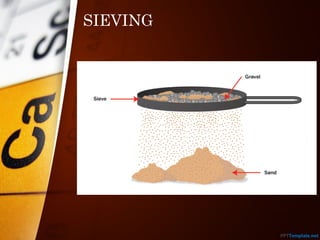
• This is used to separate solid
particles of different sizes
• The mixture is placed on a sieve
with a mesh of a particular size
• Particles smaller than the mesh
size of the sieve will pass through
the sieve while the bigger
particles will remain on the sieve
• This method is commonly used in
the mining and garri industries in
West Africa
SIEVING
SIEVING
SIEVING
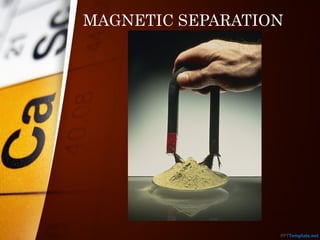
MAGNETIC SEPARATION
• This is used to separate magnetic
substances from non magnetic
particles
• It involves the use of a magnet
• A mixture of Iron and Sulphur can
be separated using this method.
The iron is magnetized and the
Sulphur is left behind.
• This method is commonly used in
the steel industry and to remove
magnetic impurities from tin ore.
MAGNETIC SEPARATION
DECANTATION
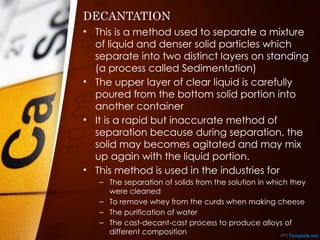
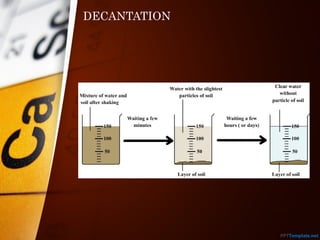
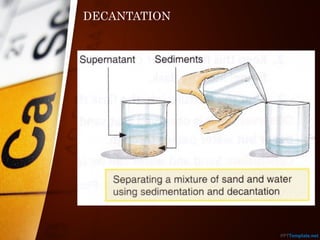
• This is a method used to separate a mixture
of liquid and denser solid particles which
separate into two distinct layers on standing
(a process called Sedimentation)
• The upper layer of clear liquid is carefully
poured from the bottom solid portion into
another container
• It is a rapid but inaccurate method of
separation because during separation, the
solid may becomes agitated and may mix
up again with the liquid portion.
• This method is used in the industries for
– The separation of solids from the solution in which they
were cleaned
– To remove whey from the curds when making cheese
– The purification of water
– The cast-decant-cast process to produce alloys of
different composition
DECANTATION
DECANTATION
FILTRATION
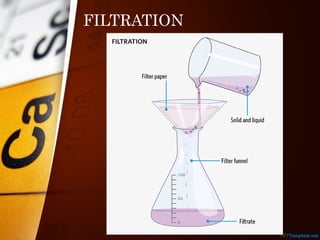
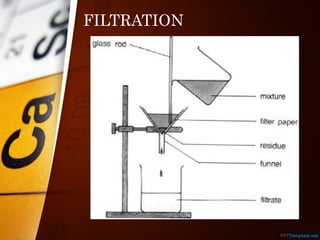
• This is a method used to separate insoluble
particles from liquids e.g. sand/dust in water
• It involves the use of a filter paper
• During the process of filtration, the liquid passes
through the filter paper while the solid material
remains on the filter paper
• The liquid which passes through is called the
Filtrate while the portion which remains on the
filter paper is called the Residue
• Filtration gives a better result than decantation
• Used in industries such as
– water purification plants and breweries to remove
impurities from liquids
– In the purification of air prior to liquefying air
– To remove particles from oil e.g. filter pumps in car
engines
FILTRATION
FILTRATION
EVAPORATION
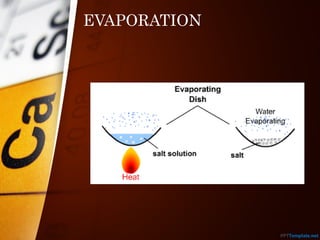
• A method used to separate a
dissolved solute from a solution by
heating the mixture to dryness
• This causes the liquid portion (usually
with a lower vapour pressure) to
evaporate leaving the solid portion
• It works on the principle of different
vapour pressures and the solvent is
sacrificed in the process
• Industrial applications include:
– In obtaining salt from the sea
– In the production of dry milk, starch and sugar
EVAPORATION
DISTILLATION
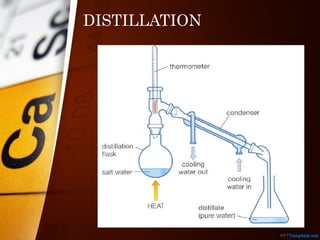
• This method is used to recover a solvent
from a solution
• It also a process of
evaporating/vapourising a liquid and
then condensing the vapour
• The vapour passes through a condenser
and is cooled back to a liquid. This
process is called Condensation
• This method can be used to separate
two liquids of different boiling points
e.g. a mixture of ethanol (78°C) and
water (100°C).
• Industrial application: This process is
used to purify liquids and in gin distilleries
DISTILLATION
FRACTIONAL DISTILLATION
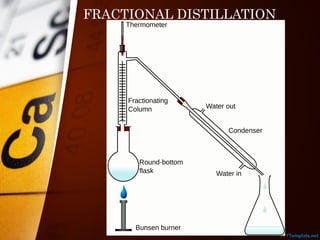
• This method is used to separate a mixture of two or
more liquids with close boiling points into their
component fractions
• This process is similar to distillation, however, a
fractionating column is introduced between the flask
and the condenser
• Separation occurs within the fractionating column as
it is filled with glass beads
• The upper part of the column is at a lower
temperature than the lower portion; therefore
vapours with high boiling points would be
condensed and return into the flask.
• The process is repeated until all components have
been distilled
• Industrial application: this process is used to separate
– a mixture of benzene methyl benzene and
liquefied air into pure nitrogen, oxygen and noble
gases.
– Petroleum into its fractions
FRACTIONAL DISTILLATION
Class work
• Liquified air is mainly a mixture of
nitrogen and oxygen which can be
separated into its components by
fractional distillation. Boiling points of
nitrogen and oxygen are -196°C and –
185°C.
• Name the fraction which distils over first
• Give reasons for your answer
• Give another industrial application of
fractional distillation as a separation
technique
CRYSTALLIZATION
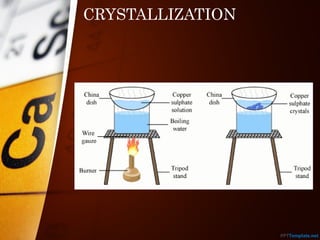
• This method is used to obtain a pure
solid sample from its solution (i.e. it can
be used to separate salts which
decompose easily on heating from
their solutions)
• Salts obtained from this process are
pure and contain water of
crystallization e.g.
– Copper(II) tetraoxosulphate (VI) pentahydrate –
CuSO4.5H2O
– Copper (II) trixonitrate (V) trihydrate –
Cu(NO3)2.3H2O
• Industrial application: it is used in the
manufacture of drugs and sugar
where purity of the product is essential
CRYSTALLIZATION
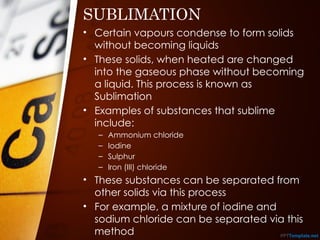
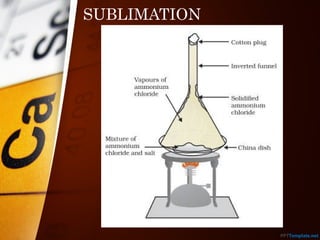
SUBLIMATION
• Certain vapours condense to form solids
without becoming liquids
• These solids, when heated are changed
into the gaseous phase without becoming
a liquid. This process is known as
Sublimation
• Examples of substances that sublime
include:
– Ammonium chloride
– Iodine
– Sulphur
– Iron (III) chloride
• These substances can be separated from
other solids via this process
• For example, a mixture of iodine and
sodium chloride can be separated via this
method
SUBLIMATION
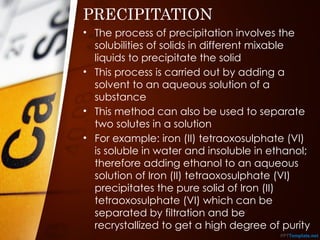
PRECIPITATION
• The process of precipitation involves the
solubilities of solids in different mixable
liquids to precipitate the solid
• This process is carried out by adding a
solvent to an aqueous solution of a
substance
• This method can also be used to separate
two solutes in a solution
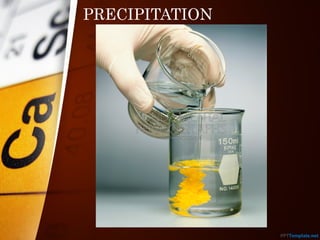
• For example: iron (II) tetraoxosulphate (VI)
is soluble in water and insoluble in ethanol;
therefore adding ethanol to an aqueous
solution of Iron (II) tetraoxosulphate (VI)
precipitates the pure solid of Iron (II)
tetraoxosulphate (VI) which can be
separated by filtration and be
recrystallized to get a high degree of purity
PRECIPITATION
CHROMATOGRAPHY
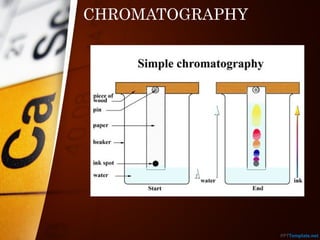
• This is a technique which can be used to:
– Separate the components in a sample and
thus identify the number of substances in such
sample
– Determine if a substance is pure
• This technique is based on the principle that if a
fluid containing a number of substances is
allowed to pass through an adsorbent medium,
the different substances in the fluid may travel at
different rates and can be separated
• The rate at which each constituent moves is
dependent on the affinity of each constituent for
the solvent and the absorbent medium (i.e.
solutes which are weakly adsorbed by the
adsorbent medium are easily re-dissolved by the
solvent and this travel up the adsorbent quickly).
Also, solutes which are soluble in the solvent travel
up at a faster rate than those which are less
soluble.
CHROMATOGRAPHY
CHROMATOGRAPHY
• In Paper Chromatography
– The adsorbent medium commonly
used is Filter paper
– Solvents used include ethanol,
methanol, chloroform, ethyl ethanoate
or aqueous phenol
Industrial Application
• Used in medicine to analyze blood or
urine
• Used in the identification of the
components of petroleum
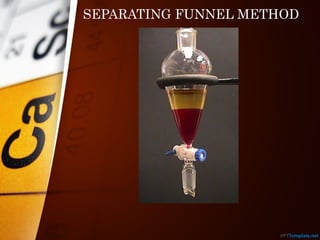
SEPARATING FUNNEL METHOD
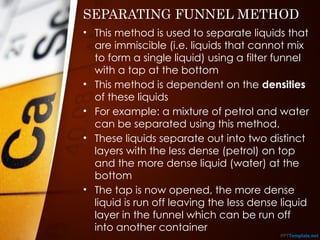
• This method is used to separate liquids that
are immiscible (i.e. liquids that cannot mix
to form a single liquid) using a filter funnel
with a tap at the bottom
• This method is dependent on the densities
of these liquids
• For example: a mixture of petrol and water
can be separated using this method.
• These liquids separate out into two distinct
layers with the less dense (petrol) on top
and the more dense liquid (water) at the
bottom
• The tap is now opened, the more dense
liquid is run off leaving the less dense liquid
layer in the funnel which can be run off
into another container
SEPARATING FUNNEL METHOD
FLOATATION
• This method is used to separate two
insoluble solids by mixing them with a
liquid such as water causing one to float
on the liquid and the other to sink
• A mixture of sawdust and sand can be
separated via this method
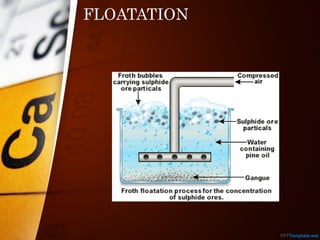
• Industrial application: it is used to
– Separate a mineral from waste
materials or from other minerals (froth
floatation)
FLOATATION
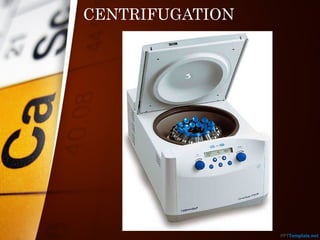
CENTRIFUGATION
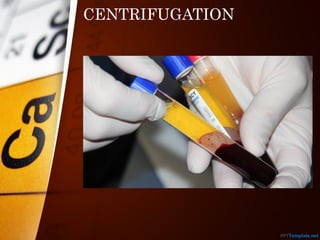
• Involves the use of a centrifuge. Used to
separate small amounts of a suspension
• Mixtures are placed in a centrifuge which
spins very quickly causing the solid to
move to the bottom
• Liquids can then be decanted from the
tube
• Industrial application: Used in:
– Dairies to separate milk from cream
when producing skimmed milk
– To separate blood cells and plasma
CENTRIFUGATION
CENTRIFUGATION
FROSTATION
• Used to obtain liquids and a concentrated
solute from a solution
• For example, sodium chloride solution is
allowed to cool to a very low temperature in a
freezer
• Pure water freezes out of the mixture in the
form of pure crystals leaving a concentrated
solution of sodium chloride
• This method is used for substances that
decompose when heated
• In industrial applications, it is referred to as
freeze concentration
• In industries:
– It is used to concentrate food products e.g.
juices with delicate flavours
– In waste water treatment to separate
clean water from waste materials
CRITERIA FOR PURITY
• Separation techniques are used for the
preparation of substances in a pure state.
• A pure substance is made up of only one
substance and is not mixed with any
other substance
• Impure substances are a mixture of a
pure substance and an impurity. The
presence of an impurity affects the
characteristics of the substances (i.e.
lowers the melting point and raises the
boiling point of a substance)
• Many substances in nature are impure
substances e.g. Air is a mixture of gases
PROPERTIES OF A PURE SUBSTANCE
Pure substances will possess the following:
• Sharp melting and boiling points at fixed
temperatures
• A definite density
• Will give one spot on a chromatogram
How can you show if a solid is pure?
• A pure solid will have a sharp and constant
melting point. (i.e. it will completely melt at
a definite or a very narrow range of
temperatures)
• The presence of an impurity in the solid will:
– Lower the melting point
– Cause the solid to melt over a wide
range of temperature
PROPERTIES OF A PURE SUBSTANCE
How can you show if a liquid is pure?
• A pure liquid will have a sharp and
constant boiling point. (i.e. it will
completely boil at a definite or a very
narrow range of temperatures)
• The presence of an impurity in the liquid
will:
– Increase the boiling point
– Cause the liquid to boil over a wide
range of temperature
DETERMINATION OF THE MELTING POINT OF A SOLID
or TEST FOR PURITY OF A SOLID
• Determination of melting point of a solid
(naphthalene)
– Put some naphthalene in a test tube and
warm the test tube in a bath over a flame. The
solid naphthalene melts and forms liquid
naphthalene
– Put a thermometer into the liquid
naphthalene, turn off the flame and read the
temperature at which the naphthalene
solidifies
– Warm the naphthalene again and read the
temperature at which it melts
– This temperature is the melting point
– Pure naphthalene melts at 80°C
– This process can be repeated after adding an
impurity
DETERMINATION OF THE BOILING POINT OF A LIQUID
or TEST FOR PURITY OF A LIQUID
• Determination of melting point of a liquid
(ethanol)
– Put a small quantity of ethanol in a test
tube and heat the test tube in a
beaker of water
– Put a thermometer into the ethanol
– Heat the beaker until the ethanol
begins to boil. As it boils, read the
constant temperature which is the
boiling point of ethanol
– Pure ethanol boils at 78°C

Year 10 - Standard Separation Techniques.pptx

  • 1.
  • 2.
    W.A.L.T. – PART1 • State the different standard methods of separating mixtures and their individual applications • Manipulate different apparatus for separation techniques • Draw separation technique apparatus • State the criteria for purity • Distinguish between pure and impure substances
  • 3.
    • A mixtureis a substance formed when two or more constituents are physically joined together • Constituents of mixtures can be elements, compounds or both • A mixture does not have a fixed amount of each element or compound in it • The constituents maintain their characteristic properties and can be separated by physical means MIXTURES
  • 4.
    ELEMENTS, MIXTURES & COMPOUNDS MIXTURECONSTITUENTS Air Soil Urine Palm wine Milk Sea Water Blood Petroleum Bronze
  • 5.
    Attach Classwork • Statefive differences between a compound and a mixture • State three differences between homogeneous mixtures and heterogeneous mixtures • State three examples each of the mixtures above • Note: Use a tabular form to present your work ELEMENTS, MIXTURES & COMPOUNDS
  • 6.
    SEPARATION TECHNIQUES • Onefeature of mixtures is that it is possible to separate the individual constituents by physical means • Each constituent of a mixture still retains its individual properties • There are many different physical methods used to separate a variety of mixtures • Each method is dependent upon the properties of the constituent such as solubility, boiling point, sublimation, rate of diffusion, magnetic properties etc. Types of Separating Techniques include: 1. Sieving 2. Decantation 3. Filtration 4. Evaporation 5. Distillation 6. Fractional Distillation 7. Crystallization 8. Sublimation 9. Precipitation 10. Chromatography 11. Separating funnel method 12. Magnetic Separation
  • 7.
    TERMS • Solute • Solvent •Solution Class work • Describe the following terms • Give two each examples
  • 8.
    SIEVING • This isused to separate solid particles of different sizes • The mixture is placed on a sieve with a mesh of a particular size • Particles smaller than the mesh size of the sieve will pass through the sieve while the bigger particles will remain on the sieve • This method is commonly used in the mining and garri industries in West Africa
  • 9.
  • 10.
  • 11.
  • 12.
    MAGNETIC SEPARATION • Thisis used to separate magnetic substances from non magnetic particles • It involves the use of a magnet • A mixture of Iron and Sulphur can be separated using this method. The iron is magnetized and the Sulphur is left behind. • This method is commonly used in the steel industry and to remove magnetic impurities from tin ore.
  • 13.
  • 14.
    DECANTATION • This isa method used to separate a mixture of liquid and denser solid particles which separate into two distinct layers on standing (a process called Sedimentation) • The upper layer of clear liquid is carefully poured from the bottom solid portion into another container • It is a rapid but inaccurate method of separation because during separation, the solid may becomes agitated and may mix up again with the liquid portion. • This method is used in the industries for – The separation of solids from the solution in which they were cleaned – To remove whey from the curds when making cheese – The purification of water – The cast-decant-cast process to produce alloys of different composition
  • 15.
  • 16.
  • 17.
    FILTRATION • This isa method used to separate insoluble particles from liquids e.g. sand/dust in water • It involves the use of a filter paper • During the process of filtration, the liquid passes through the filter paper while the solid material remains on the filter paper • The liquid which passes through is called the Filtrate while the portion which remains on the filter paper is called the Residue • Filtration gives a better result than decantation • Used in industries such as – water purification plants and breweries to remove impurities from liquids – In the purification of air prior to liquefying air – To remove particles from oil e.g. filter pumps in car engines
  • 18.
  • 19.
  • 20.
    EVAPORATION • A methodused to separate a dissolved solute from a solution by heating the mixture to dryness • This causes the liquid portion (usually with a lower vapour pressure) to evaporate leaving the solid portion • It works on the principle of different vapour pressures and the solvent is sacrificed in the process • Industrial applications include: – In obtaining salt from the sea – In the production of dry milk, starch and sugar
  • 21.
  • 22.
    DISTILLATION • This methodis used to recover a solvent from a solution • It also a process of evaporating/vapourising a liquid and then condensing the vapour • The vapour passes through a condenser and is cooled back to a liquid. This process is called Condensation • This method can be used to separate two liquids of different boiling points e.g. a mixture of ethanol (78°C) and water (100°C). • Industrial application: This process is used to purify liquids and in gin distilleries
  • 23.
  • 24.
    FRACTIONAL DISTILLATION • Thismethod is used to separate a mixture of two or more liquids with close boiling points into their component fractions • This process is similar to distillation, however, a fractionating column is introduced between the flask and the condenser • Separation occurs within the fractionating column as it is filled with glass beads • The upper part of the column is at a lower temperature than the lower portion; therefore vapours with high boiling points would be condensed and return into the flask. • The process is repeated until all components have been distilled • Industrial application: this process is used to separate – a mixture of benzene methyl benzene and liquefied air into pure nitrogen, oxygen and noble gases. – Petroleum into its fractions
  • 25.
  • 26.
    Class work • Liquifiedair is mainly a mixture of nitrogen and oxygen which can be separated into its components by fractional distillation. Boiling points of nitrogen and oxygen are -196°C and – 185°C. • Name the fraction which distils over first • Give reasons for your answer • Give another industrial application of fractional distillation as a separation technique
  • 27.
    CRYSTALLIZATION • This methodis used to obtain a pure solid sample from its solution (i.e. it can be used to separate salts which decompose easily on heating from their solutions) • Salts obtained from this process are pure and contain water of crystallization e.g. – Copper(II) tetraoxosulphate (VI) pentahydrate – CuSO4.5H2O – Copper (II) trixonitrate (V) trihydrate – Cu(NO3)2.3H2O • Industrial application: it is used in the manufacture of drugs and sugar where purity of the product is essential
  • 28.
  • 29.
    SUBLIMATION • Certain vapourscondense to form solids without becoming liquids • These solids, when heated are changed into the gaseous phase without becoming a liquid. This process is known as Sublimation • Examples of substances that sublime include: – Ammonium chloride – Iodine – Sulphur – Iron (III) chloride • These substances can be separated from other solids via this process • For example, a mixture of iodine and sodium chloride can be separated via this method
  • 30.
  • 31.
    PRECIPITATION • The processof precipitation involves the solubilities of solids in different mixable liquids to precipitate the solid • This process is carried out by adding a solvent to an aqueous solution of a substance • This method can also be used to separate two solutes in a solution • For example: iron (II) tetraoxosulphate (VI) is soluble in water and insoluble in ethanol; therefore adding ethanol to an aqueous solution of Iron (II) tetraoxosulphate (VI) precipitates the pure solid of Iron (II) tetraoxosulphate (VI) which can be separated by filtration and be recrystallized to get a high degree of purity
  • 32.
  • 33.
    CHROMATOGRAPHY • This isa technique which can be used to: – Separate the components in a sample and thus identify the number of substances in such sample – Determine if a substance is pure • This technique is based on the principle that if a fluid containing a number of substances is allowed to pass through an adsorbent medium, the different substances in the fluid may travel at different rates and can be separated • The rate at which each constituent moves is dependent on the affinity of each constituent for the solvent and the absorbent medium (i.e. solutes which are weakly adsorbed by the adsorbent medium are easily re-dissolved by the solvent and this travel up the adsorbent quickly). Also, solutes which are soluble in the solvent travel up at a faster rate than those which are less soluble.
  • 34.
  • 35.
    CHROMATOGRAPHY • In PaperChromatography – The adsorbent medium commonly used is Filter paper – Solvents used include ethanol, methanol, chloroform, ethyl ethanoate or aqueous phenol Industrial Application • Used in medicine to analyze blood or urine • Used in the identification of the components of petroleum
  • 36.
    SEPARATING FUNNEL METHOD •This method is used to separate liquids that are immiscible (i.e. liquids that cannot mix to form a single liquid) using a filter funnel with a tap at the bottom • This method is dependent on the densities of these liquids • For example: a mixture of petrol and water can be separated using this method. • These liquids separate out into two distinct layers with the less dense (petrol) on top and the more dense liquid (water) at the bottom • The tap is now opened, the more dense liquid is run off leaving the less dense liquid layer in the funnel which can be run off into another container
  • 37.
  • 38.
    FLOATATION • This methodis used to separate two insoluble solids by mixing them with a liquid such as water causing one to float on the liquid and the other to sink • A mixture of sawdust and sand can be separated via this method • Industrial application: it is used to – Separate a mineral from waste materials or from other minerals (froth floatation)
  • 39.
  • 40.
    CENTRIFUGATION • Involves theuse of a centrifuge. Used to separate small amounts of a suspension • Mixtures are placed in a centrifuge which spins very quickly causing the solid to move to the bottom • Liquids can then be decanted from the tube • Industrial application: Used in: – Dairies to separate milk from cream when producing skimmed milk – To separate blood cells and plasma
  • 41.
  • 42.
  • 43.
    FROSTATION • Used toobtain liquids and a concentrated solute from a solution • For example, sodium chloride solution is allowed to cool to a very low temperature in a freezer • Pure water freezes out of the mixture in the form of pure crystals leaving a concentrated solution of sodium chloride • This method is used for substances that decompose when heated • In industrial applications, it is referred to as freeze concentration • In industries: – It is used to concentrate food products e.g. juices with delicate flavours – In waste water treatment to separate clean water from waste materials
  • 44.
    CRITERIA FOR PURITY •Separation techniques are used for the preparation of substances in a pure state. • A pure substance is made up of only one substance and is not mixed with any other substance • Impure substances are a mixture of a pure substance and an impurity. The presence of an impurity affects the characteristics of the substances (i.e. lowers the melting point and raises the boiling point of a substance) • Many substances in nature are impure substances e.g. Air is a mixture of gases
  • 45.
    PROPERTIES OF APURE SUBSTANCE Pure substances will possess the following: • Sharp melting and boiling points at fixed temperatures • A definite density • Will give one spot on a chromatogram How can you show if a solid is pure? • A pure solid will have a sharp and constant melting point. (i.e. it will completely melt at a definite or a very narrow range of temperatures) • The presence of an impurity in the solid will: – Lower the melting point – Cause the solid to melt over a wide range of temperature
  • 46.
    PROPERTIES OF APURE SUBSTANCE How can you show if a liquid is pure? • A pure liquid will have a sharp and constant boiling point. (i.e. it will completely boil at a definite or a very narrow range of temperatures) • The presence of an impurity in the liquid will: – Increase the boiling point – Cause the liquid to boil over a wide range of temperature
  • 47.
    DETERMINATION OF THEMELTING POINT OF A SOLID or TEST FOR PURITY OF A SOLID • Determination of melting point of a solid (naphthalene) – Put some naphthalene in a test tube and warm the test tube in a bath over a flame. The solid naphthalene melts and forms liquid naphthalene – Put a thermometer into the liquid naphthalene, turn off the flame and read the temperature at which the naphthalene solidifies – Warm the naphthalene again and read the temperature at which it melts – This temperature is the melting point – Pure naphthalene melts at 80°C – This process can be repeated after adding an impurity
  • 48.
    DETERMINATION OF THEBOILING POINT OF A LIQUID or TEST FOR PURITY OF A LIQUID • Determination of melting point of a liquid (ethanol) – Put a small quantity of ethanol in a test tube and heat the test tube in a beaker of water – Put a thermometer into the ethanol – Heat the beaker until the ethanol begins to boil. As it boils, read the constant temperature which is the boiling point of ethanol – Pure ethanol boils at 78°C