MIXTURES
SEPARATING TECHNIQUES REVIEW
MRS. GRANT-GIBSON
CSEC SYLLABUS: SECTION A MIXTURES AND SEPARATIONS
SYLLABUS OBJECTIVE 2.5
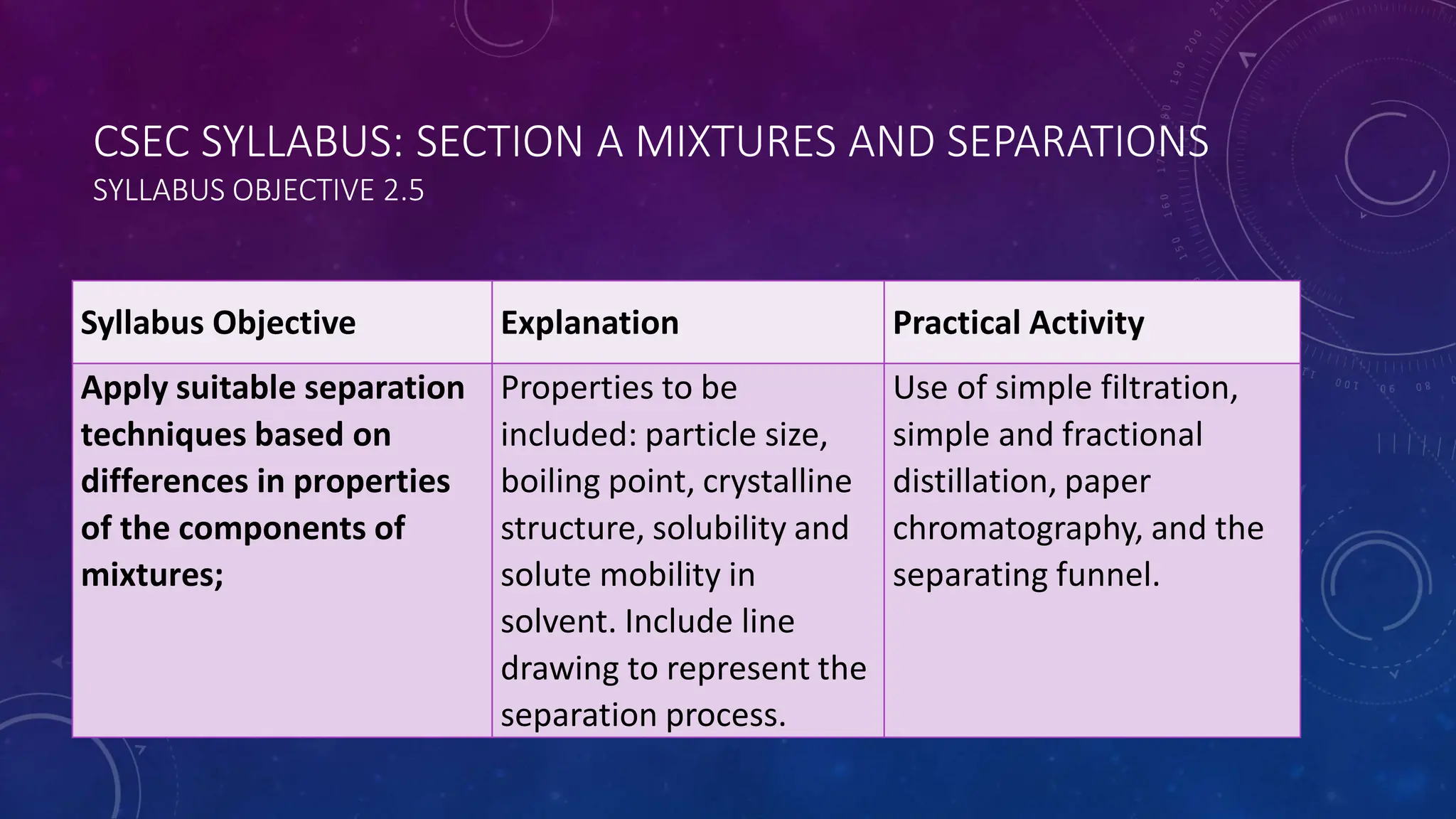
Syllabus Objective Explanation Practical Activity
Apply suitable separation
techniques based on
differences in properties
of the components of
mixtures;
Properties to be
included: particle size,
boiling point, crystalline
structure, solubility and
solute mobility in
solvent. Include line
drawing to represent the
separation process.
Use of simple filtration,
simple and fractional
distillation, paper
chromatography, and the
separating funnel.
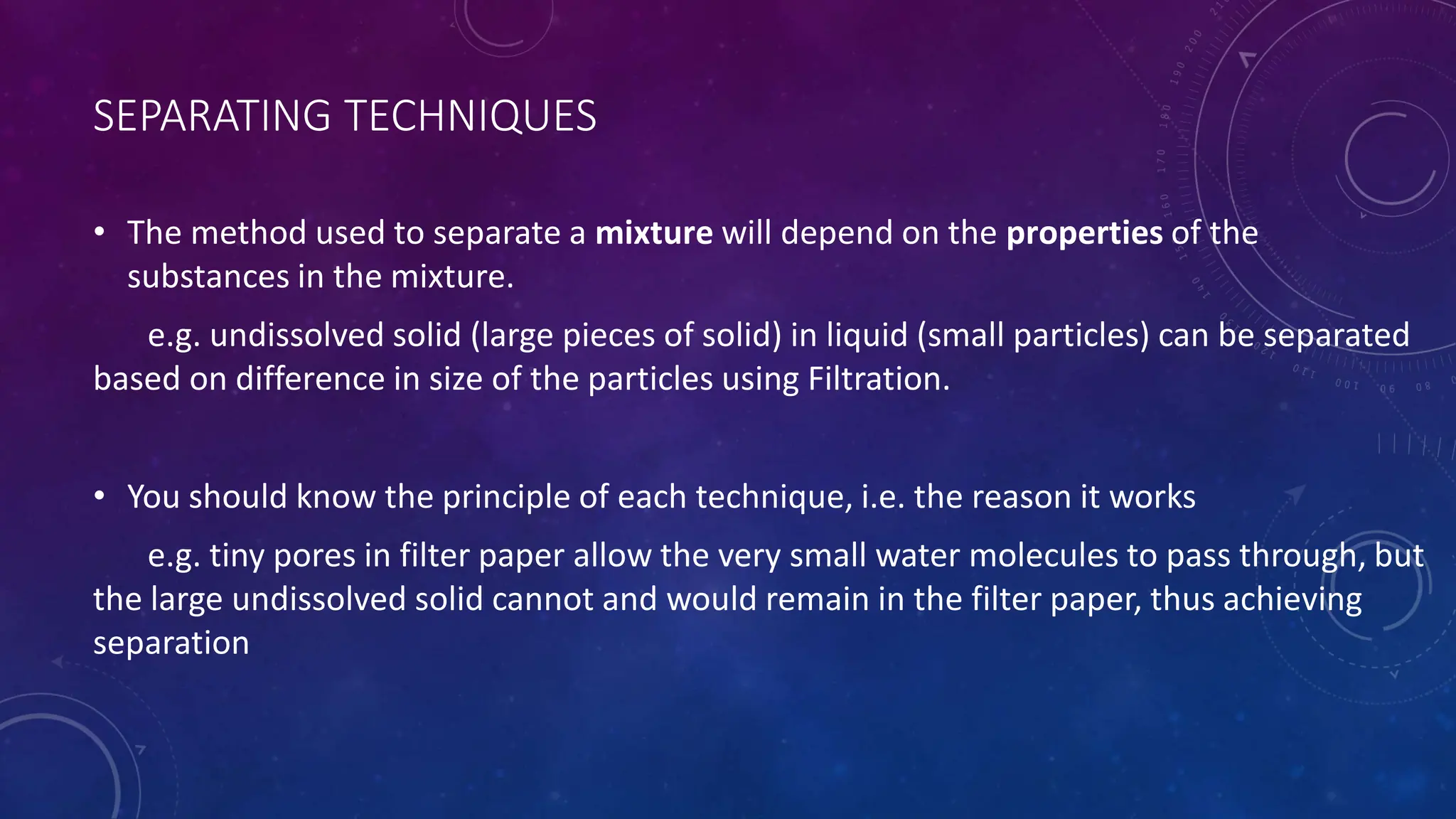
SEPARATING TECHNIQUES
• The method used to separate a mixture will depend on the properties of the
substances in the mixture.
e.g. undissolved solid (large pieces of solid) in liquid (small particles) can be separated
based on difference in size of the particles using Filtration.
• You should know the principle of each technique, i.e. the reason it works
e.g. tiny pores in filter paper allow the very small water molecules to pass through, but
the large undissolved solid cannot and would remain in the filter paper, thus achieving
separation
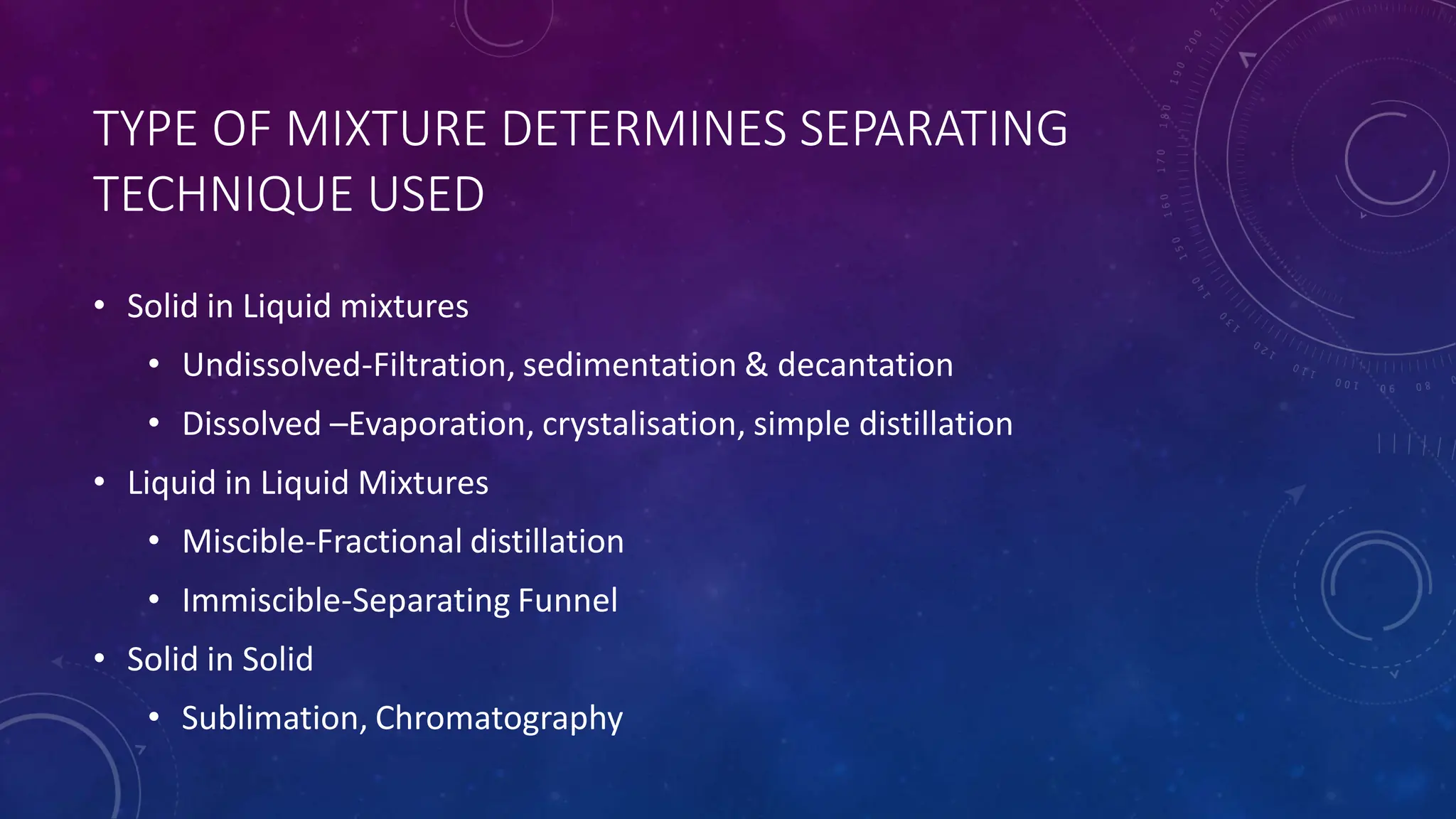
TYPE OF MIXTURE DETERMINES SEPARATING
TECHNIQUE USED
• Solid in Liquid mixtures
• Undissolved-Filtration, sedimentation & decantation
• Dissolved –Evaporation, crystalisation, simple distillation
• Liquid in Liquid Mixtures
• Miscible-Fractional distillation
• Immiscible-Separating Funnel
• Solid in Solid
• Sublimation, Chromatography
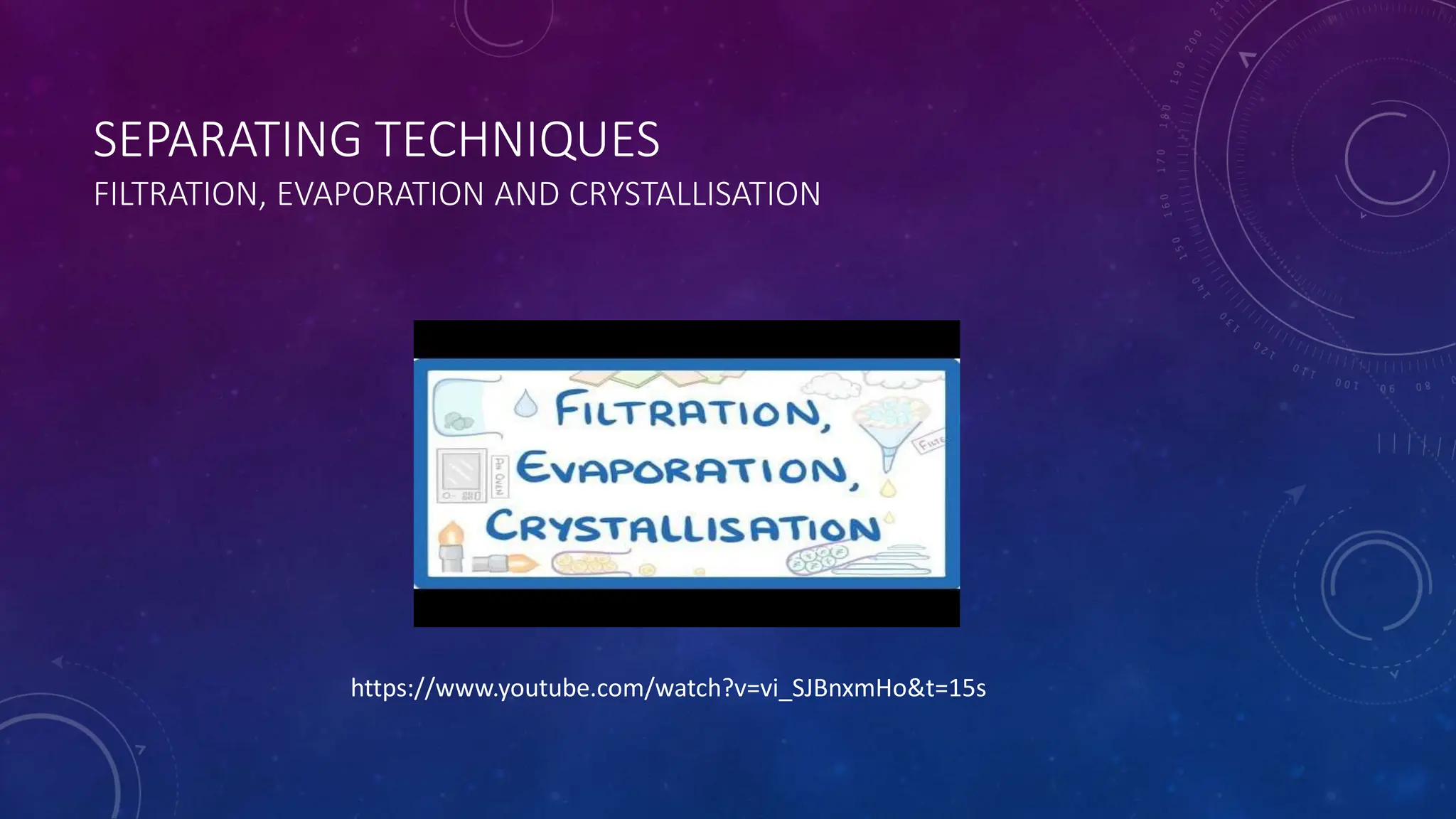
SEPARATING TECHNIQUES
FILTRATION, EVAPORATION AND CRYSTALLISATION
https://www.youtube.com/watch?v=vi_SJBnxmHo&t=15s
WATER OF CRYSTALLISATION
This is a fixed quantity of water molecules that forms part of the crystalline
structure of some ionic salts. It is loosely bound and can be easily removed by
heating.
Hydrated salts
Salts with water of crystallization e.g. CuSO4.5H2O, MgSO4.7H2O, FeCl3.6H2O
Anhydrous salt
Salts without water of crystallization e.g. CuSO4, MgSO4 FeCl3
WATER OF
CRYSTALLISATION
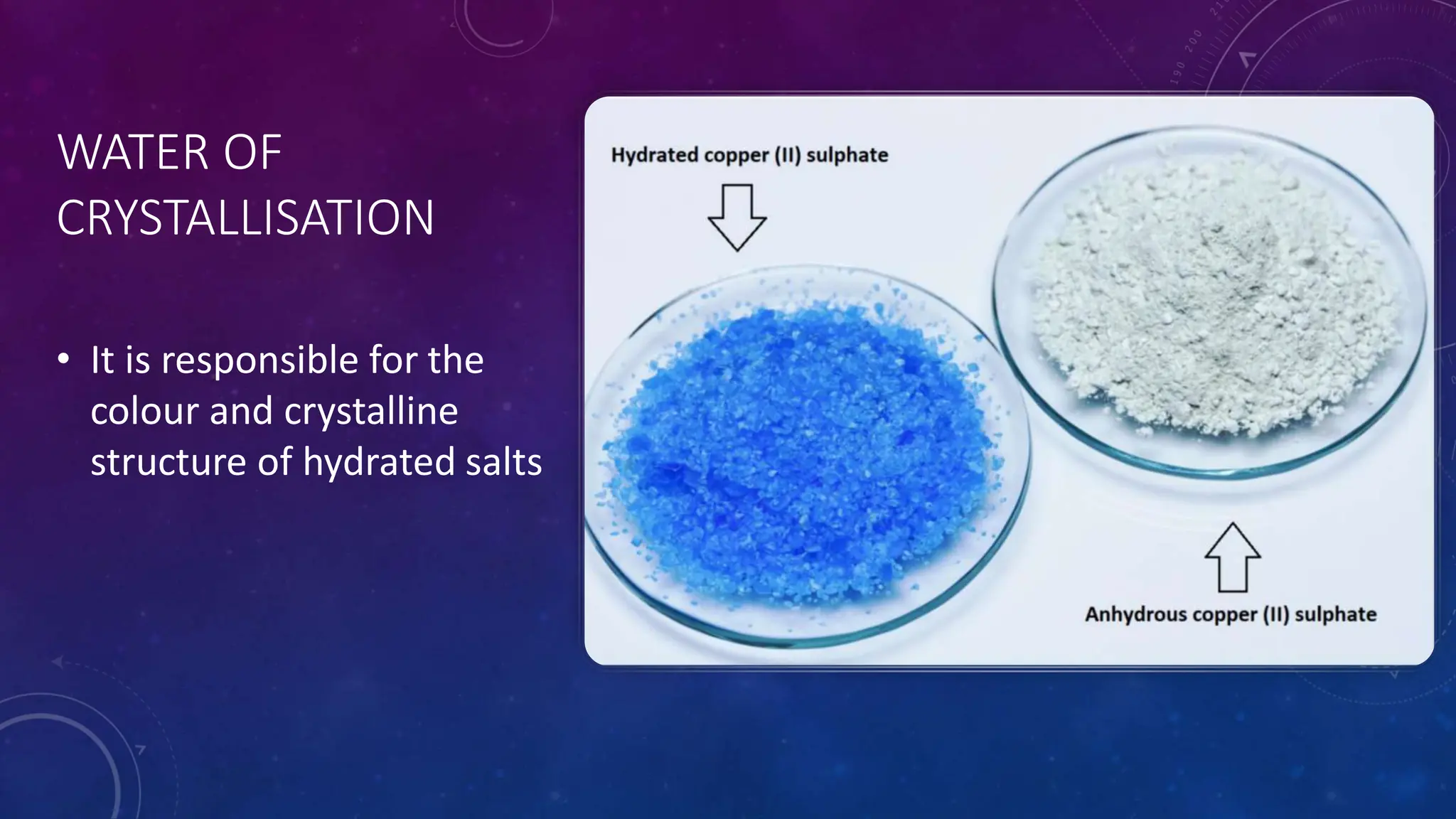
• It is responsible for the
colour and crystalline
structure of hydrated salts
WATER OF CRYSTALLISATION
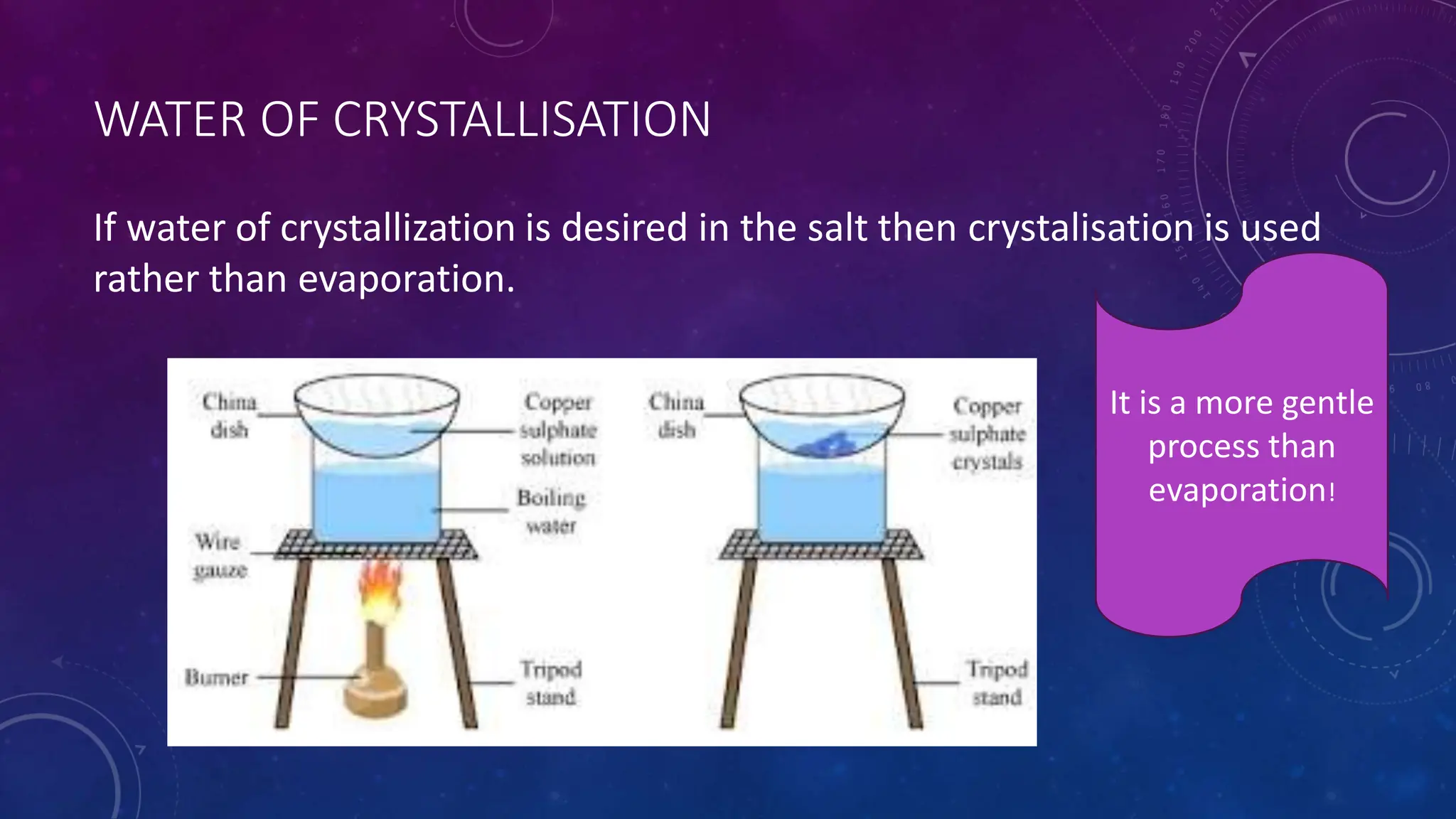
If water of crystallization is desired in the salt then crystalisation is used
rather than evaporation.
It is a more gentle
process than
evaporation!
WATER OF CRYSTALLISATION
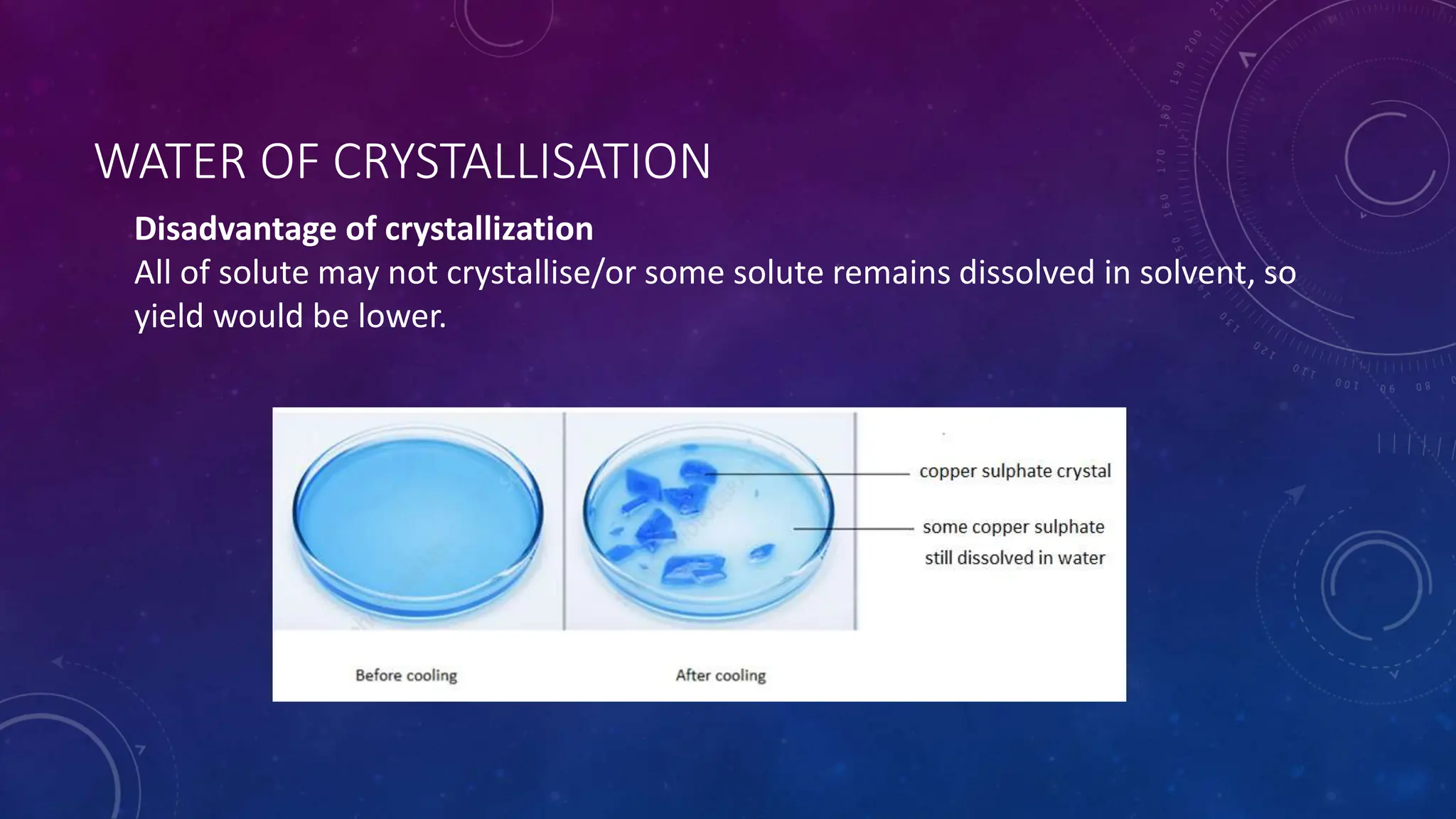
Disadvantage of crystallization
All of solute may not crystallise/or some solute remains dissolved in solvent, so
yield would be lower.
SEPARATING TECHNIQUES
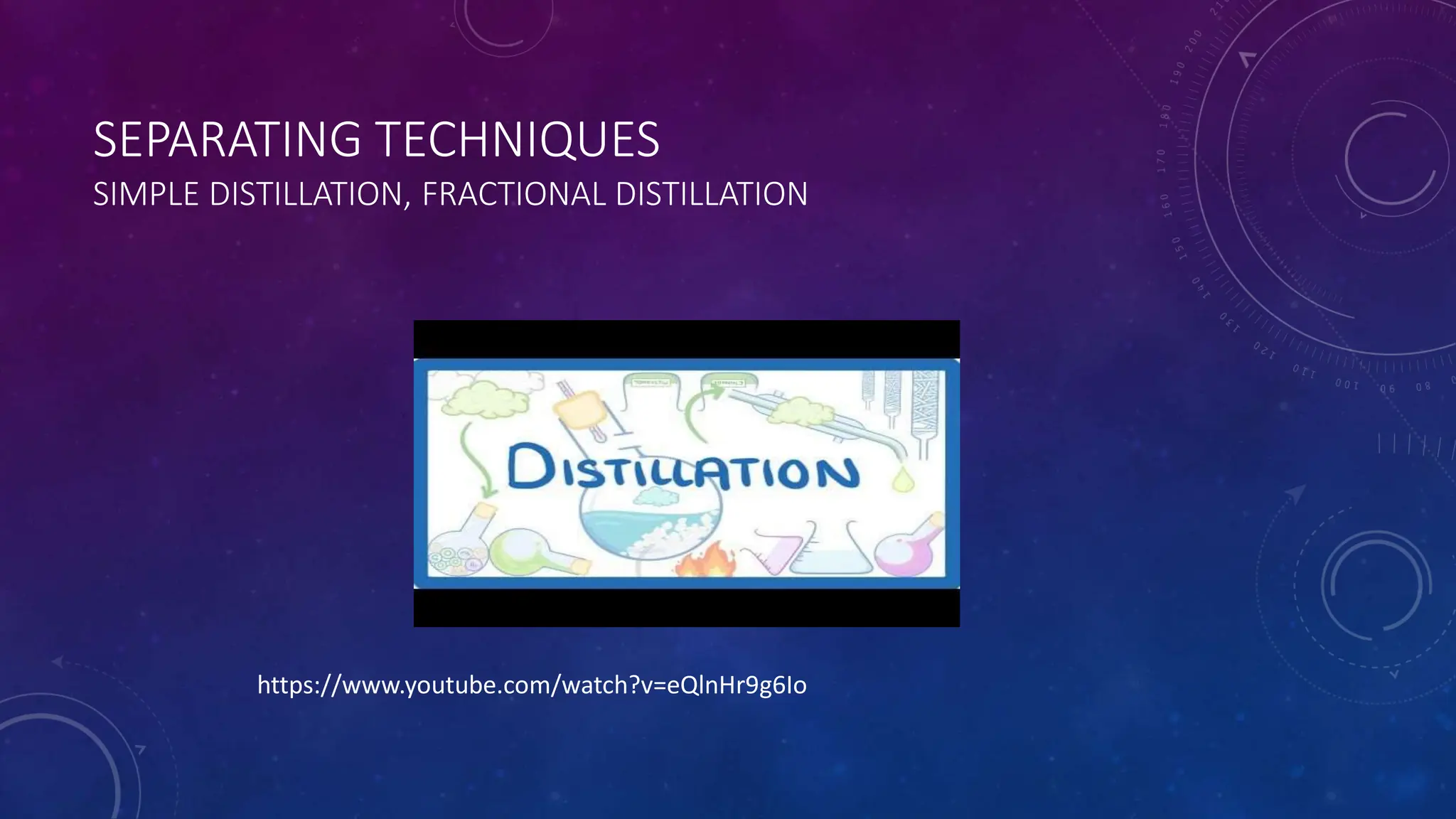
SIMPLE DISTILLATION, FRACTIONAL DISTILLATION
https://www.youtube.com/watch?v=eQlnHr9g6Io
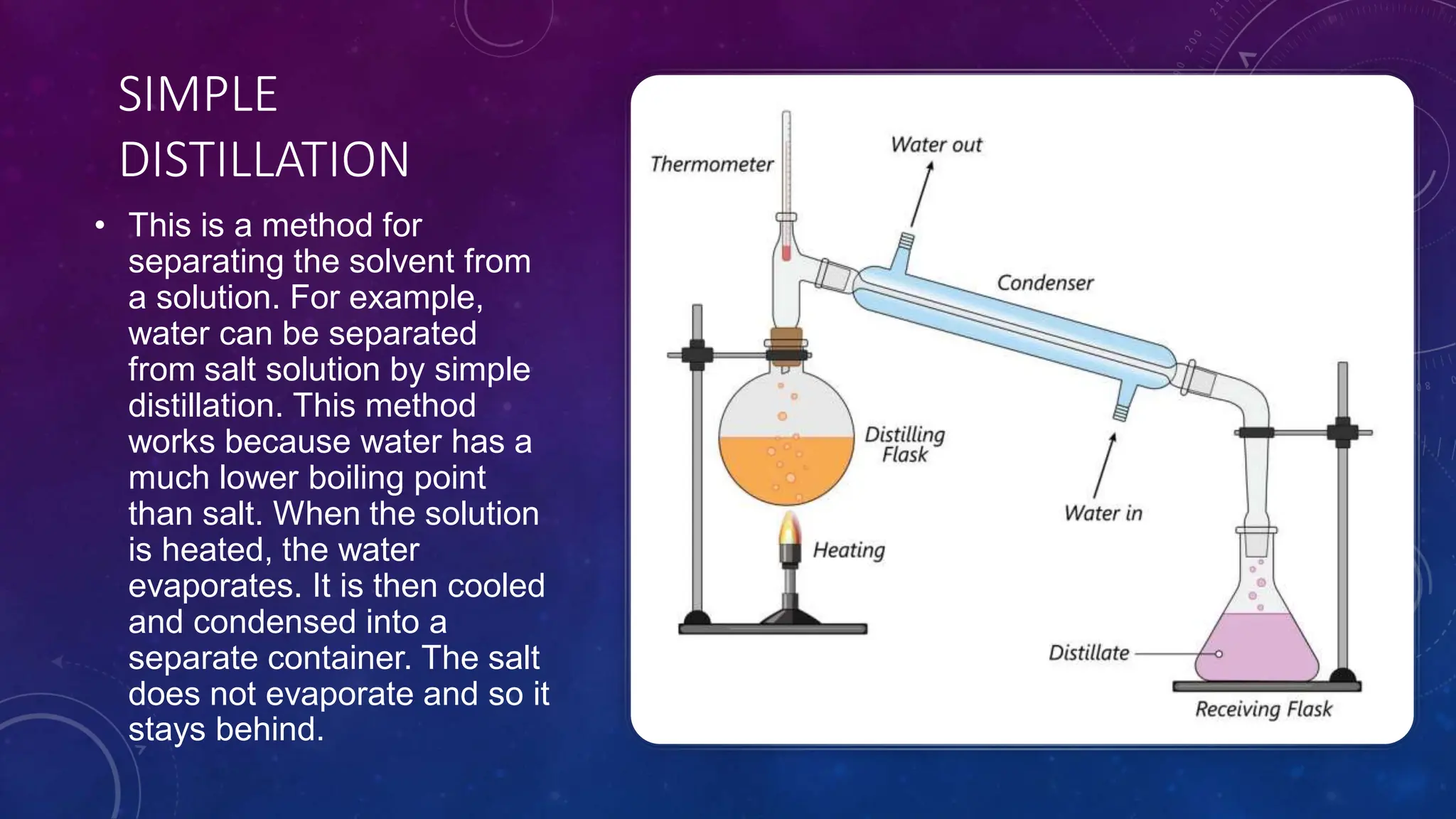
SIMPLE
DISTILLATION
• This is a method for
separating the solvent from
a solution. For example,
water can be separated
from salt solution by simple
distillation. This method
works because water has a
much lower boiling point
than salt. When the solution
is heated, the water
evaporates. It is then cooled
and condensed into a
separate container. The salt
does not evaporate and so it
stays behind.
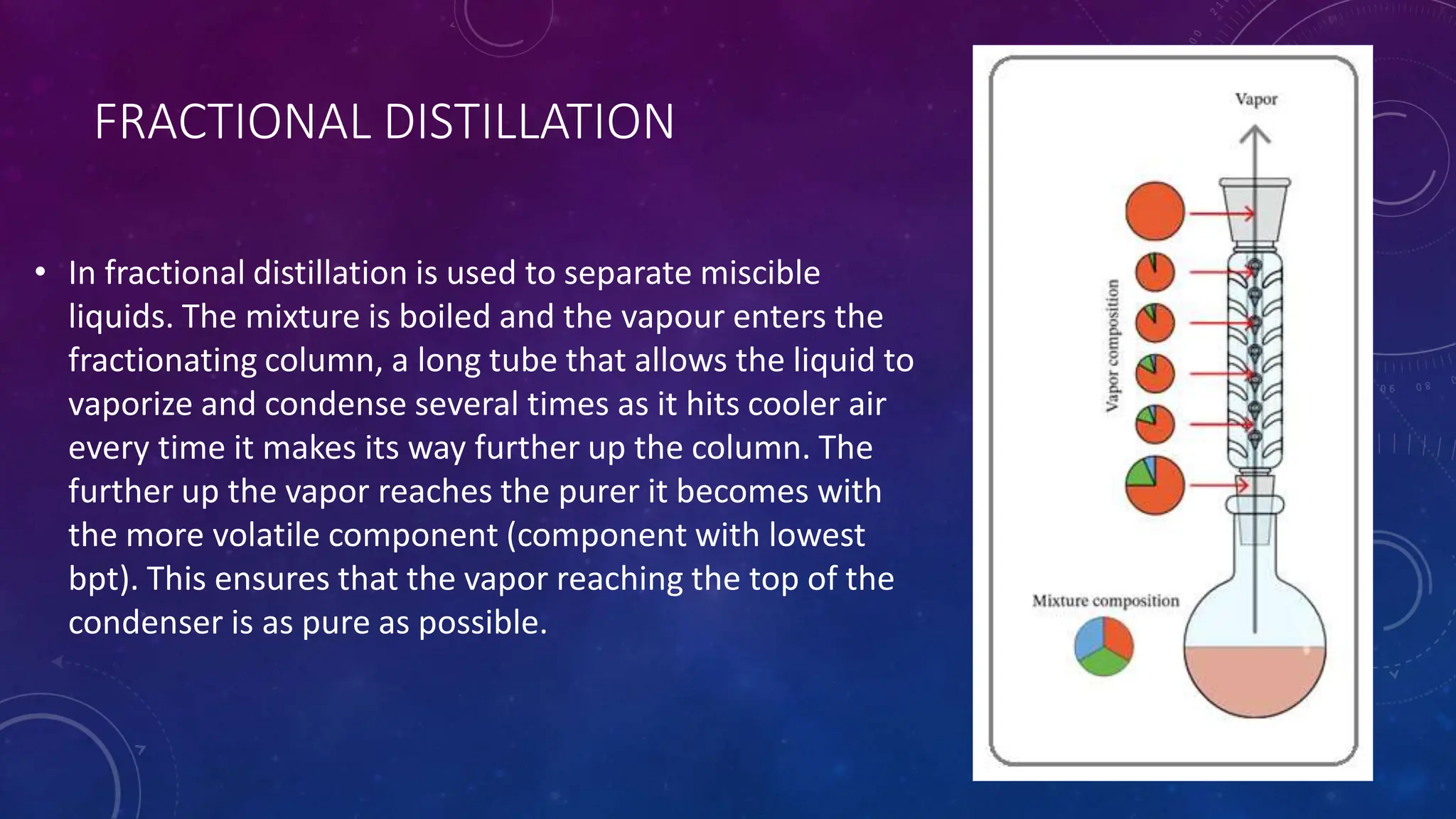
FRACTIONAL DISTILLATION
• In fractional distillation is used to separate miscible
liquids. The mixture is boiled and the vapour enters the
fractionating column, a long tube that allows the liquid to
vaporize and condense several times as it hits cooler air
every time it makes its way further up the column. The
further up the vapor reaches the purer it becomes with
the more volatile component (component with lowest
bpt). This ensures that the vapor reaching the top of the
condenser is as pure as possible.
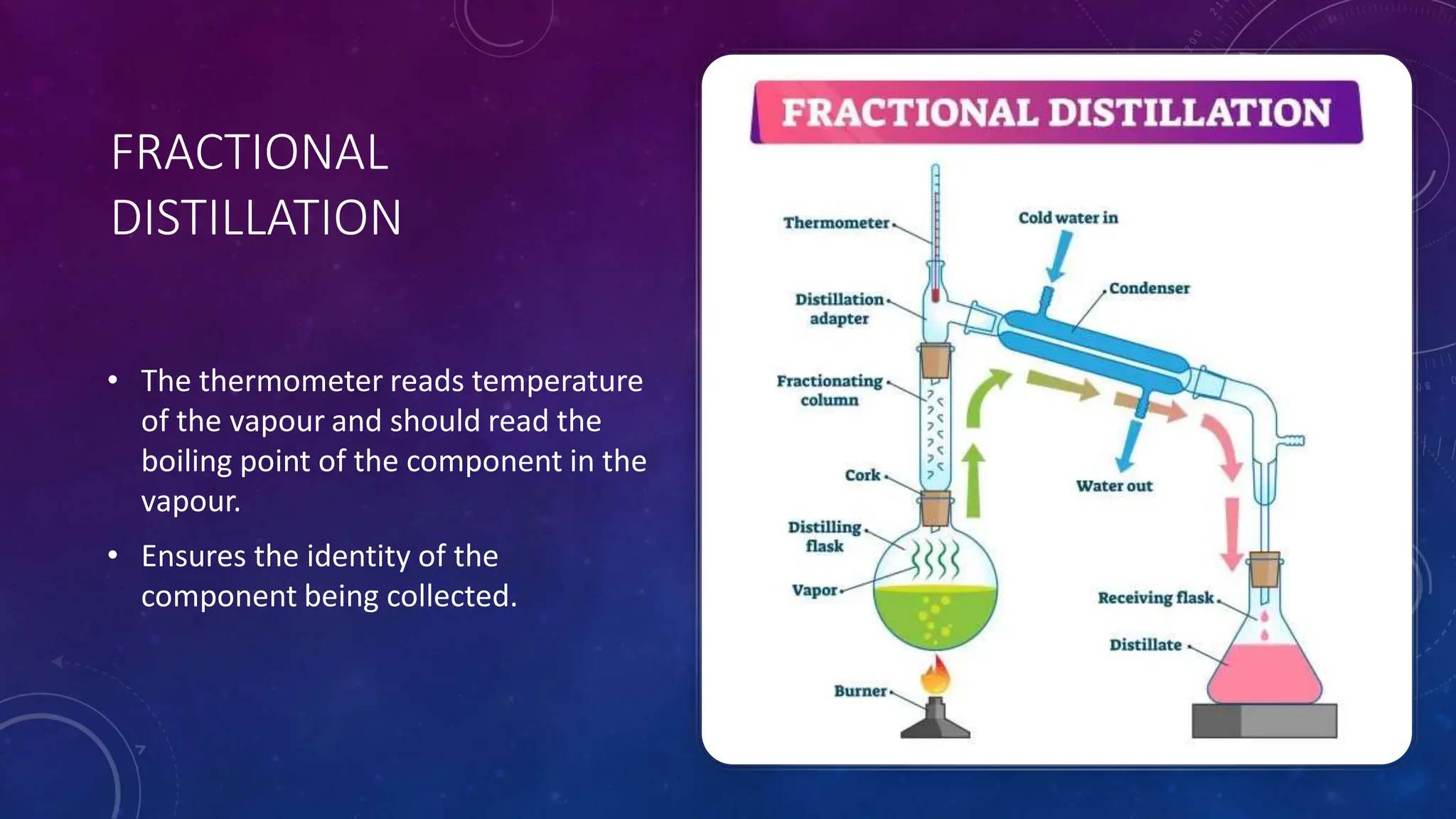
FRACTIONAL
DISTILLATION
• The thermometer reads temperature
of the vapour and should read the
boiling point of the component in the
vapour.
• Ensures the identity of the
component being collected.
FRACTIONAL DISTILLATION
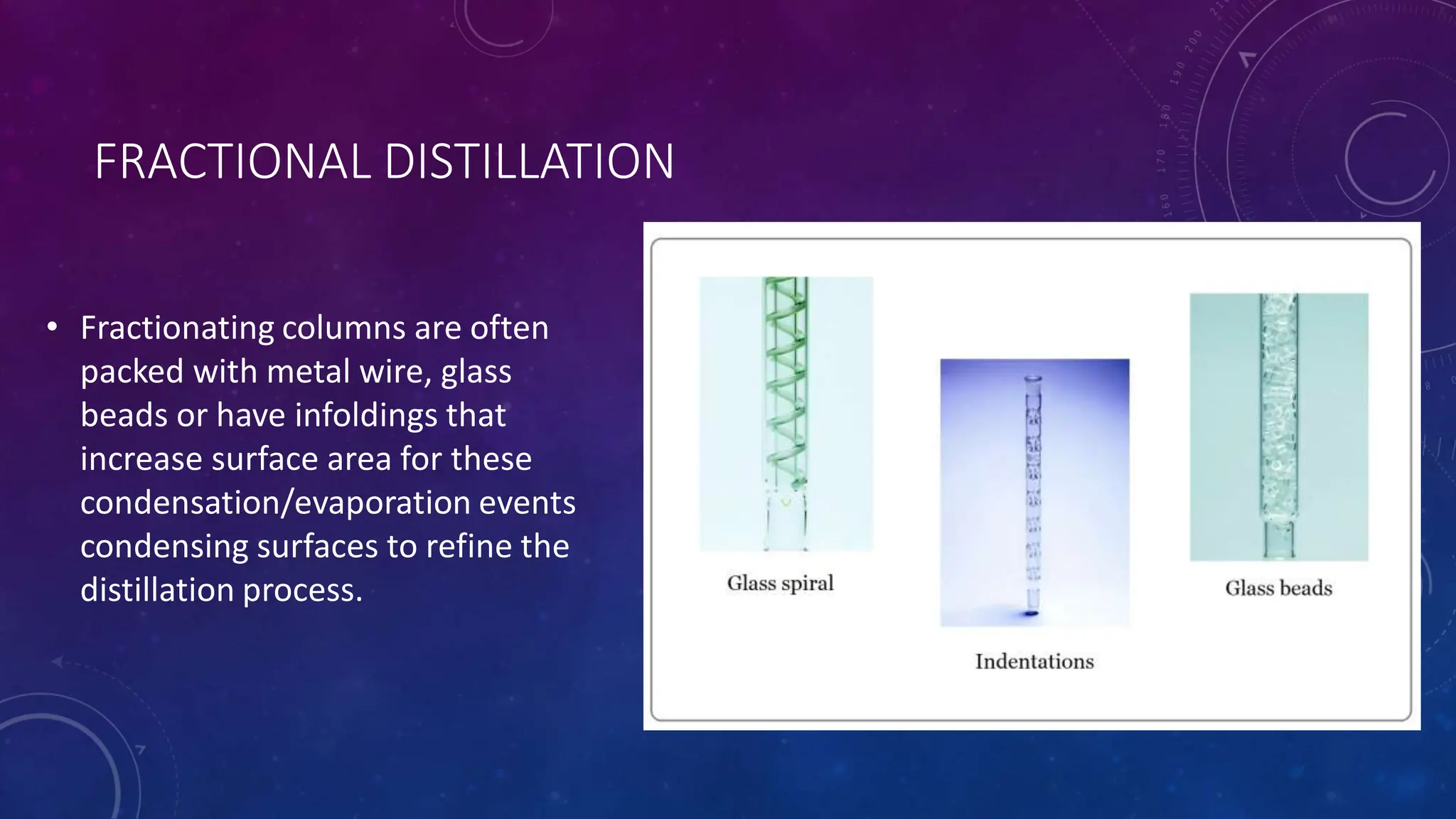
• Fractionating columns are often
packed with metal wire, glass
beads or have infoldings that
increase surface area for these
condensation/evaporation events
condensing surfaces to refine the
distillation process.
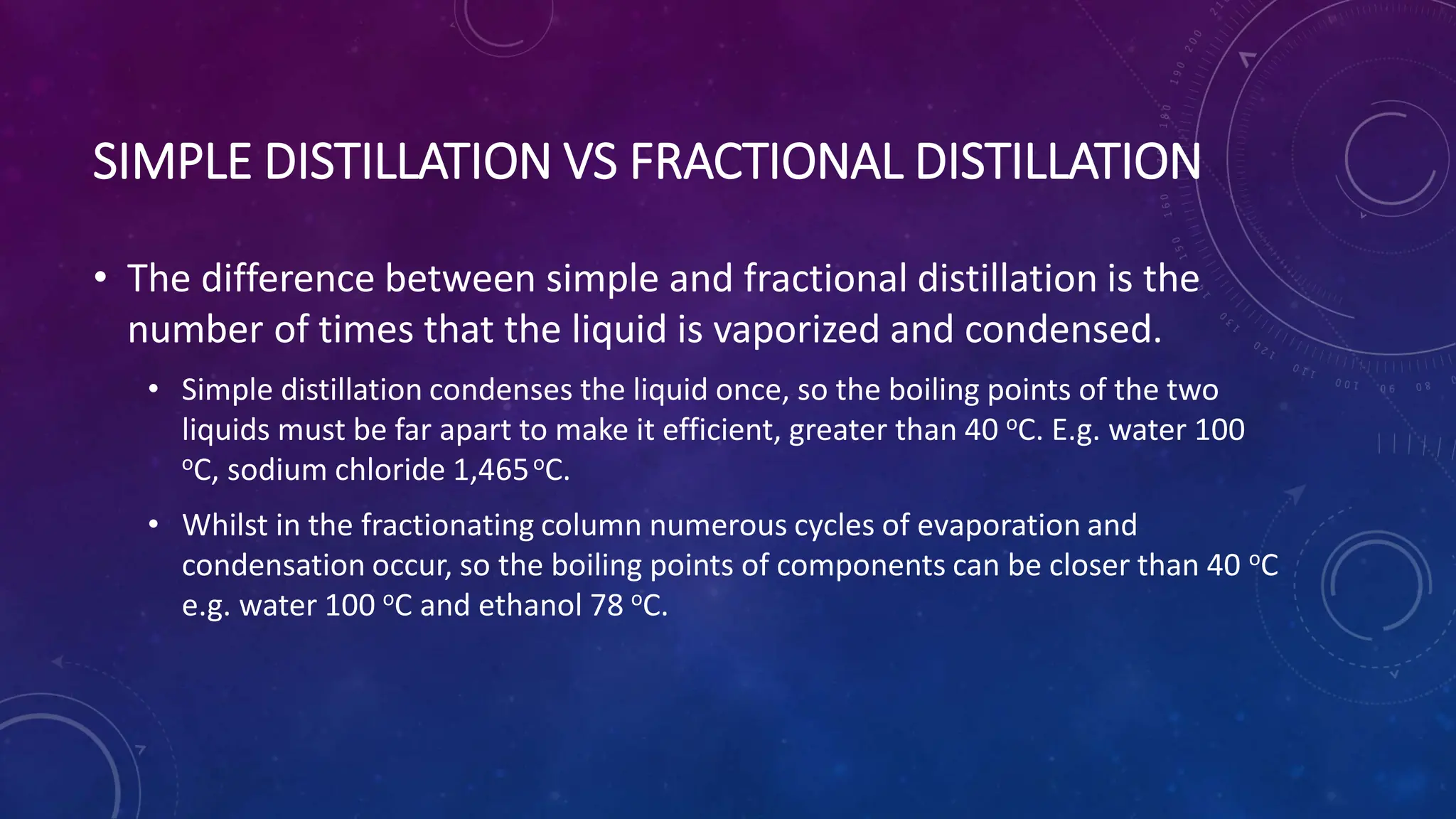
SIMPLE DISTILLATION VS FRACTIONAL DISTILLATION
• The difference between simple and fractional distillation is the
number of times that the liquid is vaporized and condensed.
• Simple distillation condenses the liquid once, so the boiling points of the two
liquids must be far apart to make it efficient, greater than 40 oC. E.g. water 100
oC, sodium chloride 1,465oC.
• Whilst in the fractionating column numerous cycles of evaporation and
condensation occur, so the boiling points of components can be closer than 40 oC
e.g. water 100 oC and ethanol 78 oC.
APPLICATIONS OF FRACTIONAL DISTILLATION
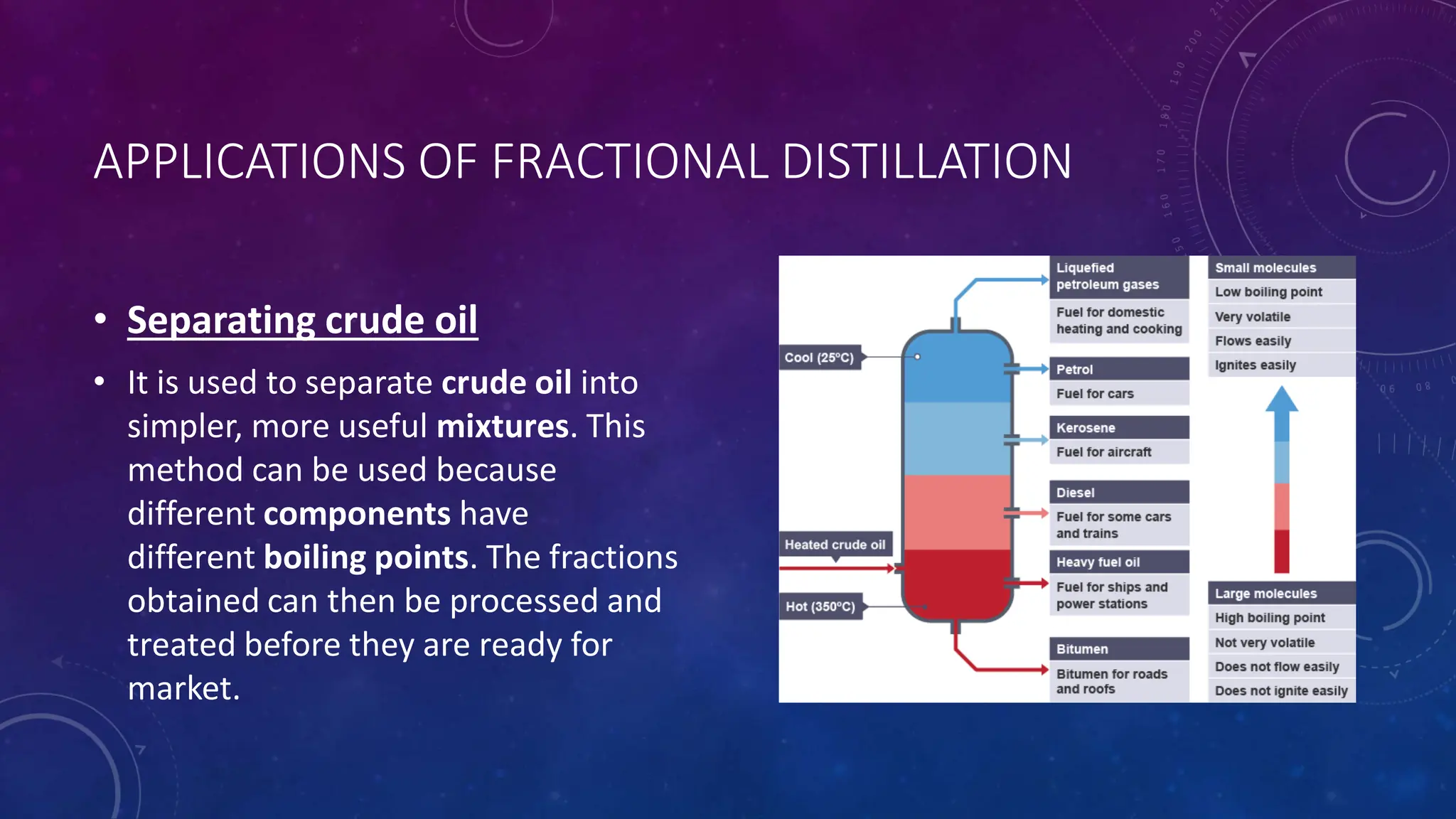
• Separating crude oil
• It is used to separate crude oil into
simpler, more useful mixtures. This
method can be used because
different components have
different boiling points. The fractions
obtained can then be processed and
treated before they are ready for
market.
APPLICATIONS OF FRACTIONAL DISTILLATION
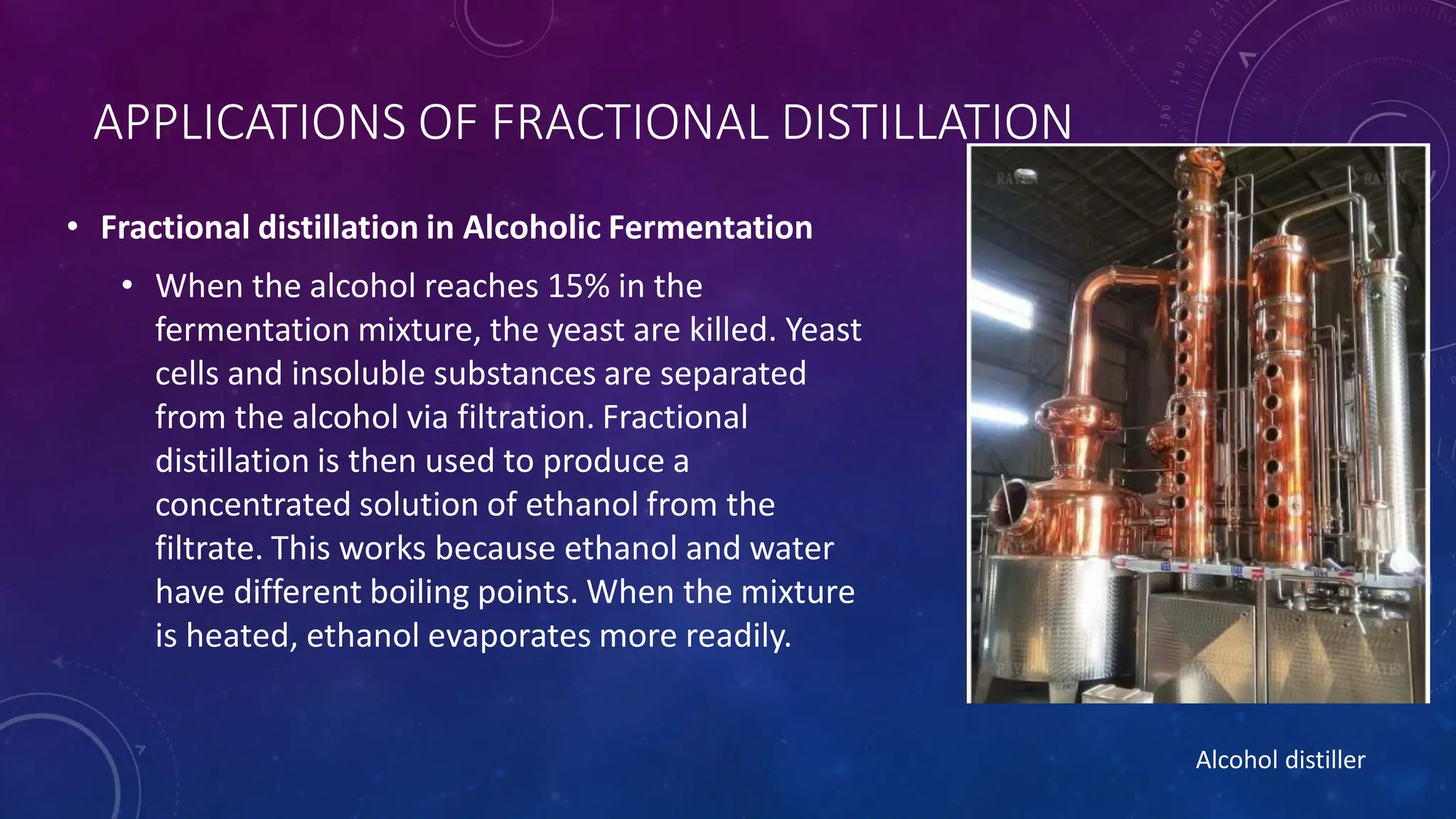
• Fractional distillation in Alcoholic Fermentation
• When the alcohol reaches 15% in the
fermentation mixture, the yeast are killed. Yeast
cells and insoluble substances are separated
from the alcohol via filtration. Fractional
distillation is then used to produce a
concentrated solution of ethanol from the
filtrate. This works because ethanol and water
have different boiling points. When the mixture
is heated, ethanol evaporates more readily.
Alcohol distiller
APPLICATIONS OF FRACTIONAL DISTILLATION
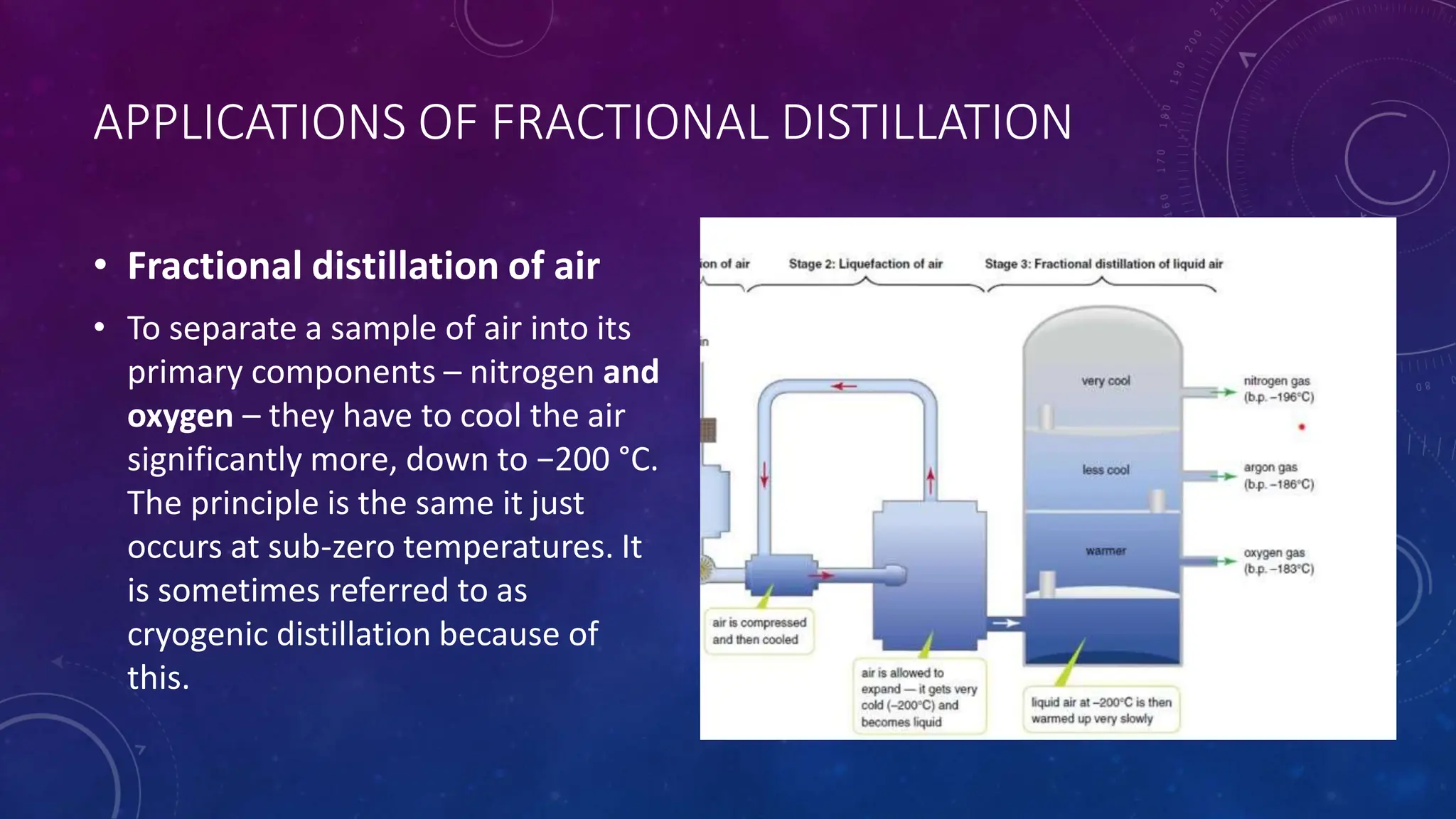
• Fractional distillation of air
• To separate a sample of air into its
primary components – nitrogen and
oxygen – they have to cool the air
significantly more, down to −200 °C.
The principle is the same it just
occurs at sub-zero temperatures. It
is sometimes referred to as
cryogenic distillation because of
this.
FRACTIONATING COLUMNS
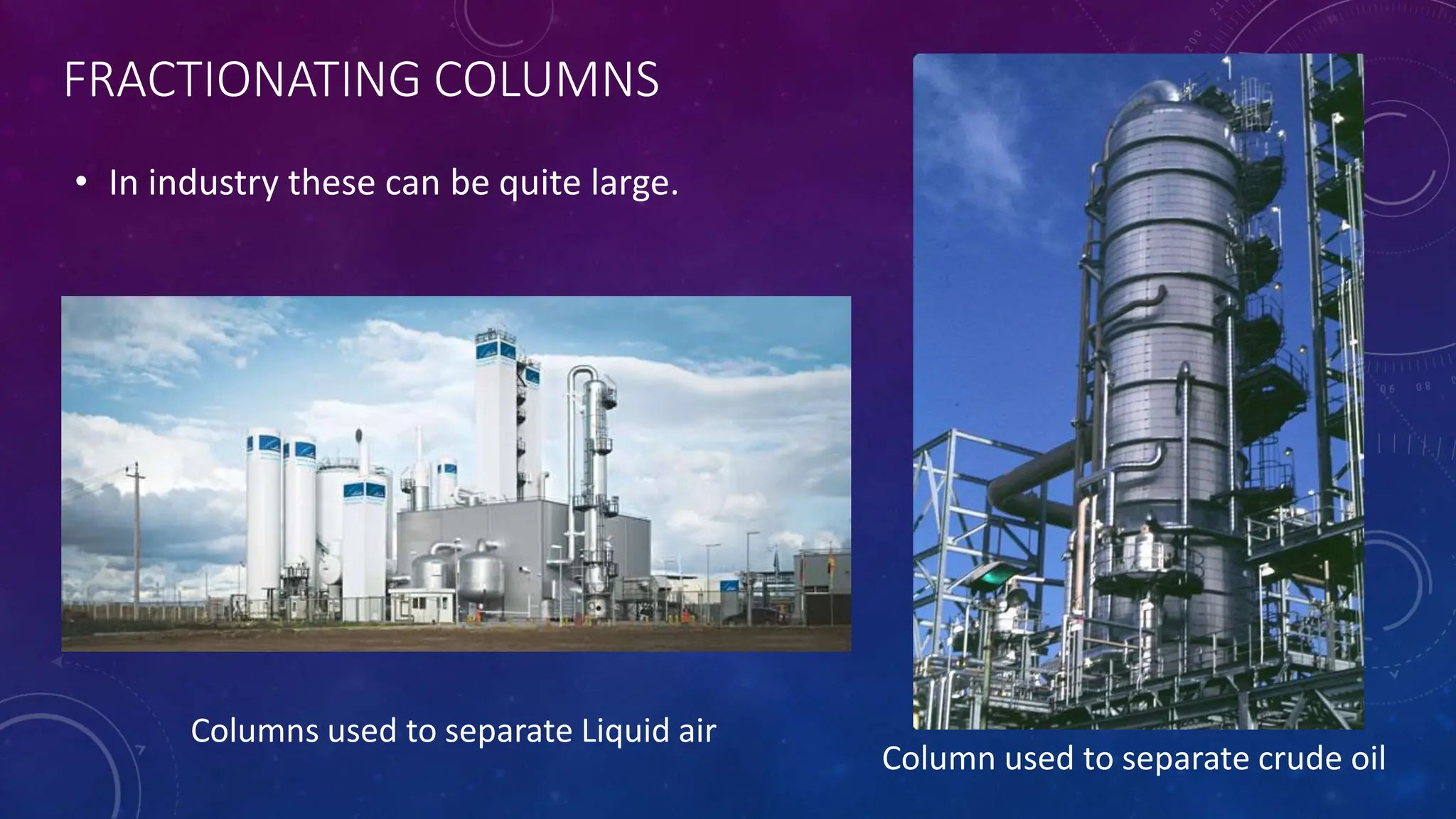
• In industry these can be quite large.
Column used to separate crude oil
Columns used to separate Liquid air
SEPARATING TECHNIQUES
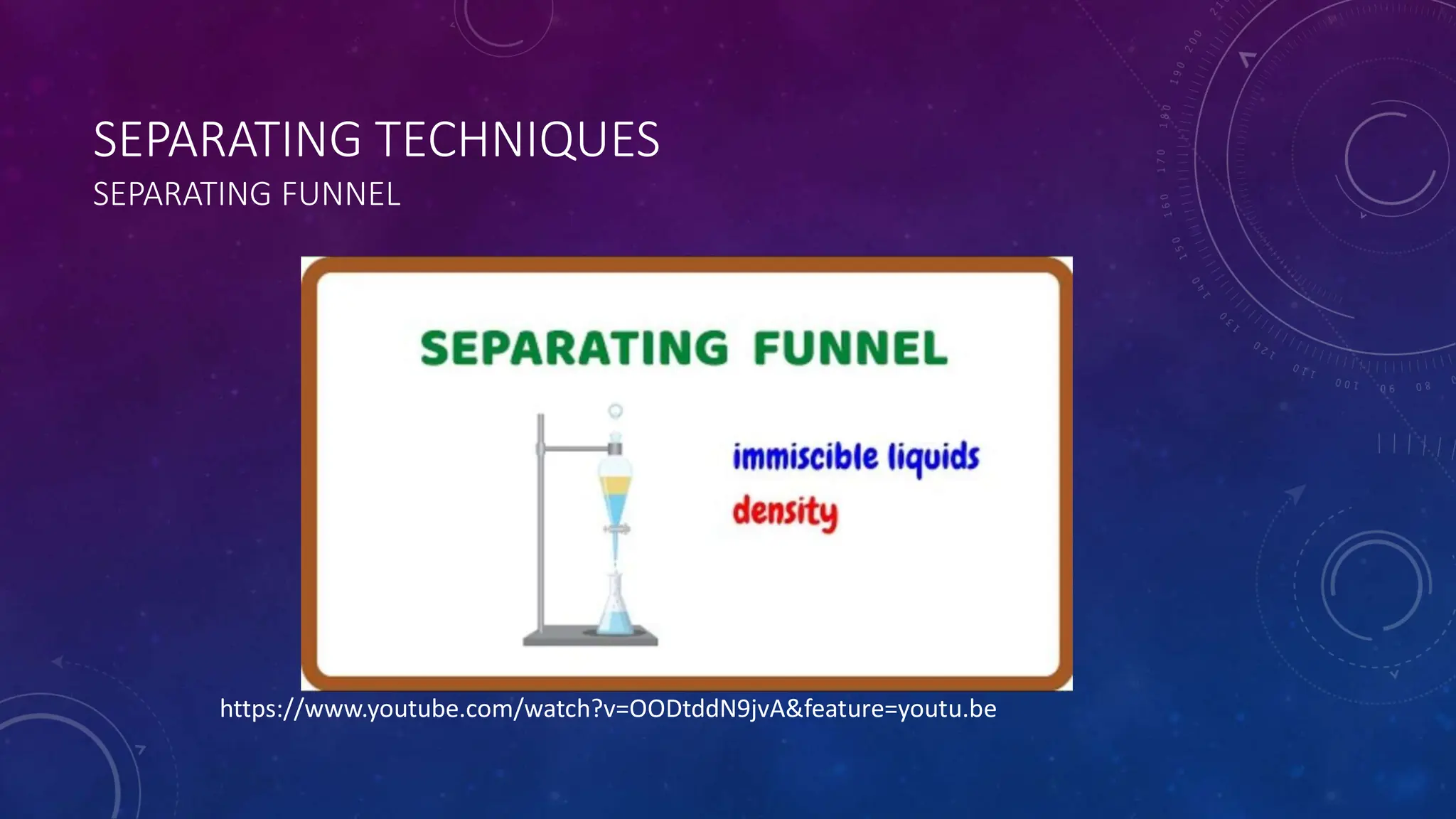
SEPARATING FUNNEL
https://www.youtube.com/watch?v=OODtddN9jvA&feature=youtu.be
SEPARATING TECHNIQUES
SUBLIMATION
https://www.youtube.com/watch?v=XRrGbNkYj6U
SEPARATING TECHNIQUES
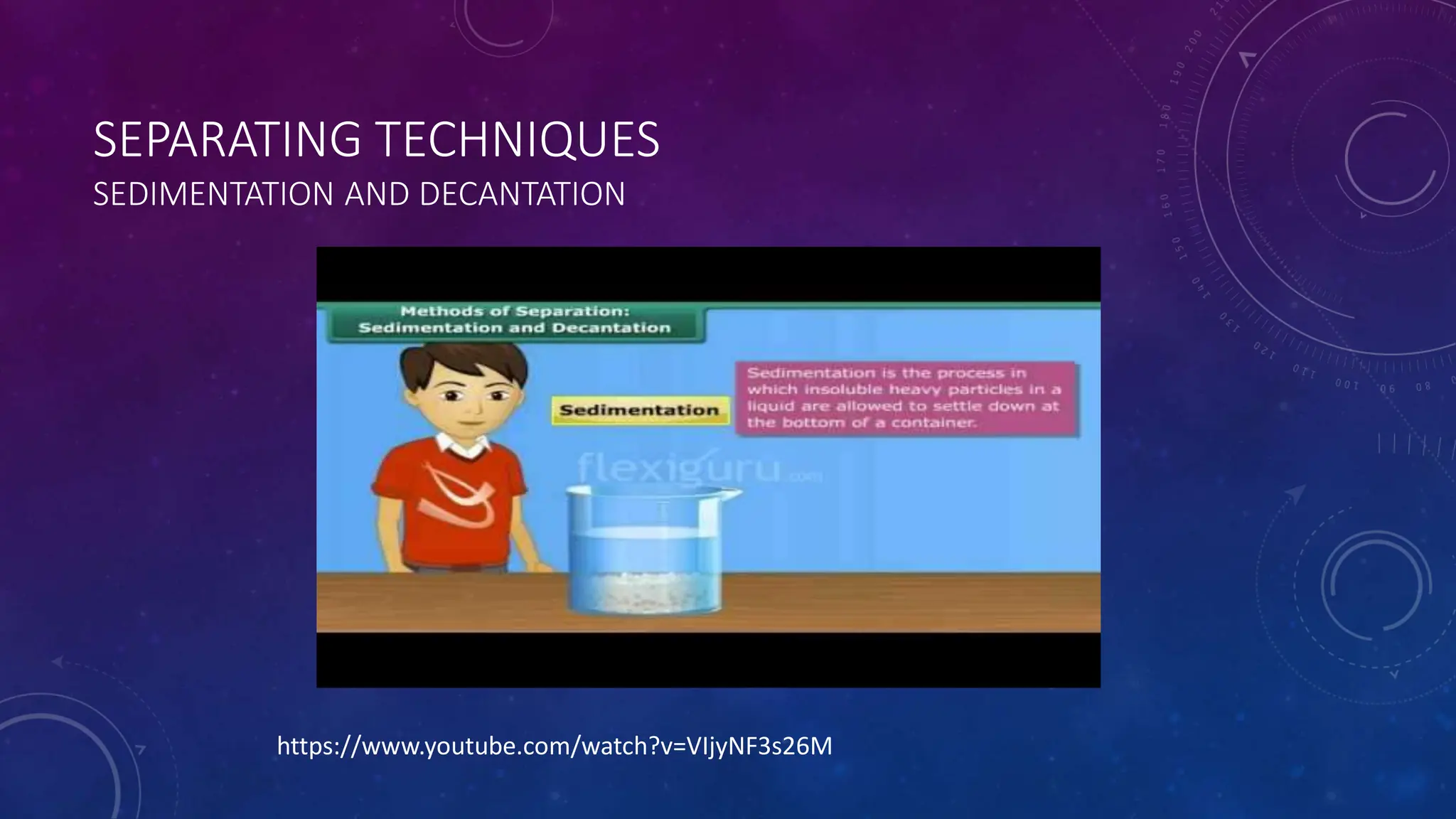
SEDIMENTATION AND DECANTATION
https://www.youtube.com/watch?v=VIjyNF3s26M
SEPARATING TECHNIQUES
CHROMATOGRAPHY
(WILL BE DONE IN GREATER DETAIL IN ANOTHER PRESENTATION)
https://www.youtube.com/watch?v=TdJ57SQ6GAQ
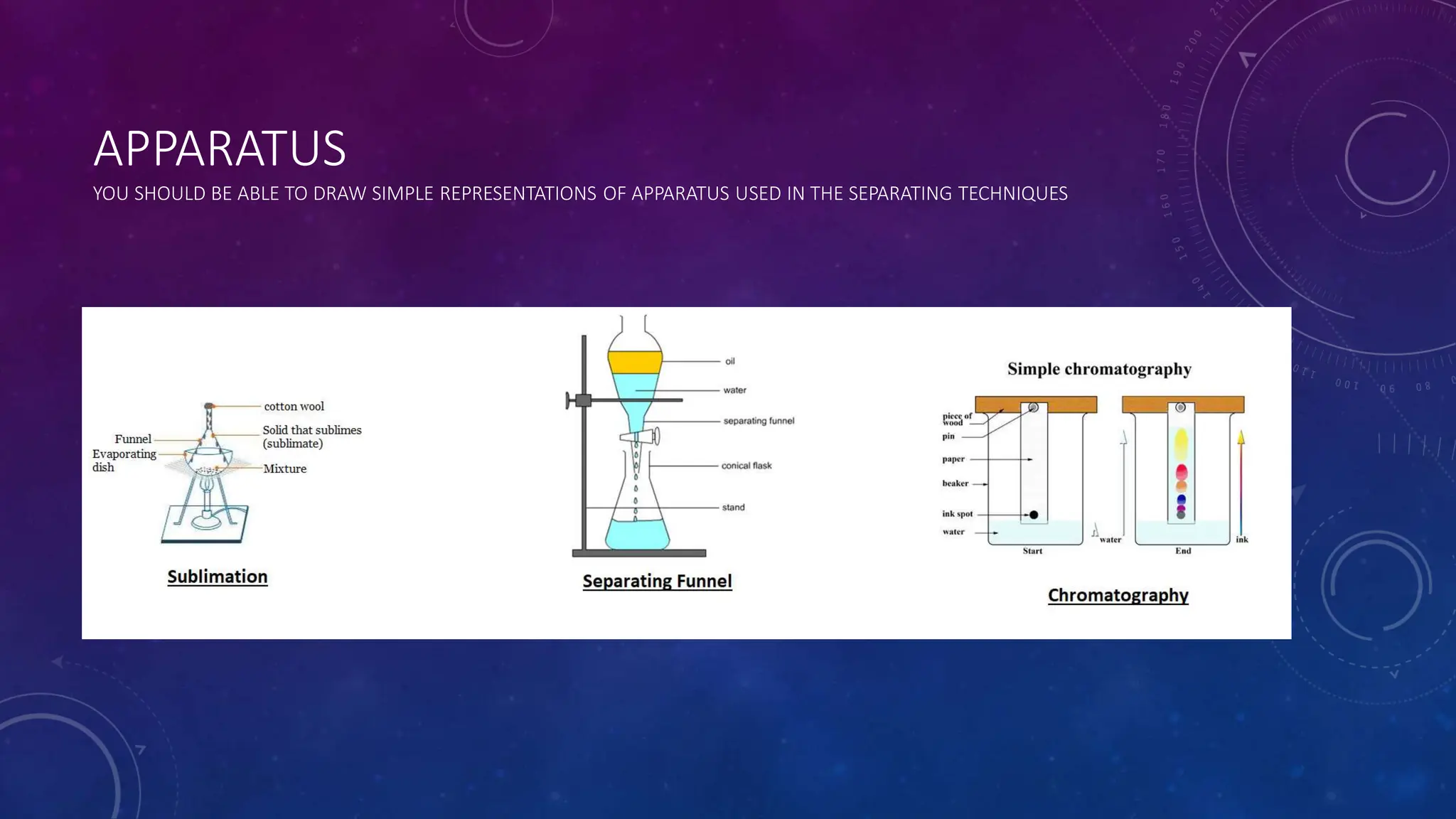
APPARATUS
YOU SHOULD BE ABLE TO DRAW SIMPLE REPRESENTATIONS OF APPARATUS USED IN THE SEPARATING TECHNIQUES
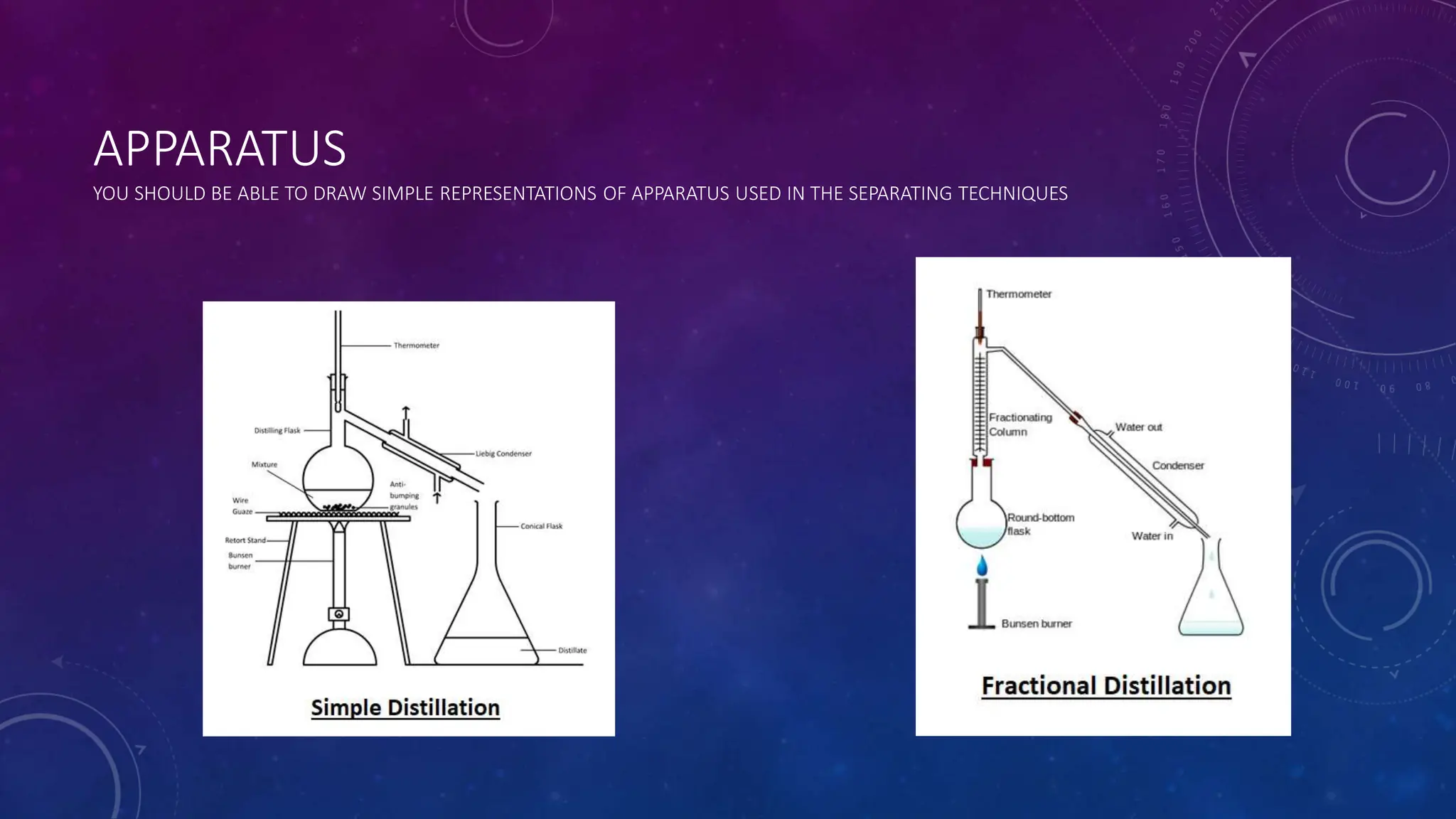
APPARATUS
YOU SHOULD BE ABLE TO DRAW SIMPLE REPRESENTATIONS OF APPARATUS USED IN THE SEPARATING TECHNIQUES
APPARATUS
YOU SHOULD BE ABLE TO DRAW SIMPLE REPRESENTATIONS OF APPARATUS USED IN THE SEPARATING TECHNIQUES

Separating Techniques Review for mixture

  • 1.
  • 2.
    CSEC SYLLABUS: SECTIONA MIXTURES AND SEPARATIONS SYLLABUS OBJECTIVE 2.5 Syllabus Objective Explanation Practical Activity Apply suitable separation techniques based on differences in properties of the components of mixtures; Properties to be included: particle size, boiling point, crystalline structure, solubility and solute mobility in solvent. Include line drawing to represent the separation process. Use of simple filtration, simple and fractional distillation, paper chromatography, and the separating funnel.
  • 3.
    SEPARATING TECHNIQUES • Themethod used to separate a mixture will depend on the properties of the substances in the mixture. e.g. undissolved solid (large pieces of solid) in liquid (small particles) can be separated based on difference in size of the particles using Filtration. • You should know the principle of each technique, i.e. the reason it works e.g. tiny pores in filter paper allow the very small water molecules to pass through, but the large undissolved solid cannot and would remain in the filter paper, thus achieving separation
  • 4.
    TYPE OF MIXTUREDETERMINES SEPARATING TECHNIQUE USED • Solid in Liquid mixtures • Undissolved-Filtration, sedimentation & decantation • Dissolved –Evaporation, crystalisation, simple distillation • Liquid in Liquid Mixtures • Miscible-Fractional distillation • Immiscible-Separating Funnel • Solid in Solid • Sublimation, Chromatography
  • 5.
    SEPARATING TECHNIQUES FILTRATION, EVAPORATIONAND CRYSTALLISATION https://www.youtube.com/watch?v=vi_SJBnxmHo&t=15s
  • 6.
    WATER OF CRYSTALLISATION Thisis a fixed quantity of water molecules that forms part of the crystalline structure of some ionic salts. It is loosely bound and can be easily removed by heating. Hydrated salts Salts with water of crystallization e.g. CuSO4.5H2O, MgSO4.7H2O, FeCl3.6H2O Anhydrous salt Salts without water of crystallization e.g. CuSO4, MgSO4 FeCl3
  • 7.
    WATER OF CRYSTALLISATION • Itis responsible for the colour and crystalline structure of hydrated salts
  • 8.
    WATER OF CRYSTALLISATION Ifwater of crystallization is desired in the salt then crystalisation is used rather than evaporation. It is a more gentle process than evaporation!
  • 9.
    WATER OF CRYSTALLISATION Disadvantageof crystallization All of solute may not crystallise/or some solute remains dissolved in solvent, so yield would be lower.
  • 10.
    SEPARATING TECHNIQUES SIMPLE DISTILLATION,FRACTIONAL DISTILLATION https://www.youtube.com/watch?v=eQlnHr9g6Io
  • 11.
    SIMPLE DISTILLATION • This isa method for separating the solvent from a solution. For example, water can be separated from salt solution by simple distillation. This method works because water has a much lower boiling point than salt. When the solution is heated, the water evaporates. It is then cooled and condensed into a separate container. The salt does not evaporate and so it stays behind.
  • 12.
    FRACTIONAL DISTILLATION • Infractional distillation is used to separate miscible liquids. The mixture is boiled and the vapour enters the fractionating column, a long tube that allows the liquid to vaporize and condense several times as it hits cooler air every time it makes its way further up the column. The further up the vapor reaches the purer it becomes with the more volatile component (component with lowest bpt). This ensures that the vapor reaching the top of the condenser is as pure as possible.
  • 13.
    FRACTIONAL DISTILLATION • The thermometerreads temperature of the vapour and should read the boiling point of the component in the vapour. • Ensures the identity of the component being collected.
  • 14.
    FRACTIONAL DISTILLATION • Fractionatingcolumns are often packed with metal wire, glass beads or have infoldings that increase surface area for these condensation/evaporation events condensing surfaces to refine the distillation process.
  • 15.
    SIMPLE DISTILLATION VSFRACTIONAL DISTILLATION • The difference between simple and fractional distillation is the number of times that the liquid is vaporized and condensed. • Simple distillation condenses the liquid once, so the boiling points of the two liquids must be far apart to make it efficient, greater than 40 oC. E.g. water 100 oC, sodium chloride 1,465oC. • Whilst in the fractionating column numerous cycles of evaporation and condensation occur, so the boiling points of components can be closer than 40 oC e.g. water 100 oC and ethanol 78 oC.
  • 16.
    APPLICATIONS OF FRACTIONALDISTILLATION • Separating crude oil • It is used to separate crude oil into simpler, more useful mixtures. This method can be used because different components have different boiling points. The fractions obtained can then be processed and treated before they are ready for market.
  • 17.
    APPLICATIONS OF FRACTIONALDISTILLATION • Fractional distillation in Alcoholic Fermentation • When the alcohol reaches 15% in the fermentation mixture, the yeast are killed. Yeast cells and insoluble substances are separated from the alcohol via filtration. Fractional distillation is then used to produce a concentrated solution of ethanol from the filtrate. This works because ethanol and water have different boiling points. When the mixture is heated, ethanol evaporates more readily. Alcohol distiller
  • 18.
    APPLICATIONS OF FRACTIONALDISTILLATION • Fractional distillation of air • To separate a sample of air into its primary components – nitrogen and oxygen – they have to cool the air significantly more, down to −200 °C. The principle is the same it just occurs at sub-zero temperatures. It is sometimes referred to as cryogenic distillation because of this.
  • 19.
    FRACTIONATING COLUMNS • Inindustry these can be quite large. Column used to separate crude oil Columns used to separate Liquid air
  • 20.
  • 21.
  • 22.
    SEPARATING TECHNIQUES SEDIMENTATION ANDDECANTATION https://www.youtube.com/watch?v=VIjyNF3s26M
  • 23.
    SEPARATING TECHNIQUES CHROMATOGRAPHY (WILL BEDONE IN GREATER DETAIL IN ANOTHER PRESENTATION) https://www.youtube.com/watch?v=TdJ57SQ6GAQ
  • 24.
    APPARATUS YOU SHOULD BEABLE TO DRAW SIMPLE REPRESENTATIONS OF APPARATUS USED IN THE SEPARATING TECHNIQUES
  • 25.
    APPARATUS YOU SHOULD BEABLE TO DRAW SIMPLE REPRESENTATIONS OF APPARATUS USED IN THE SEPARATING TECHNIQUES
  • 26.
    APPARATUS YOU SHOULD BEABLE TO DRAW SIMPLE REPRESENTATIONS OF APPARATUS USED IN THE SEPARATING TECHNIQUES