GEAR MANUFACTURING PROCESSES
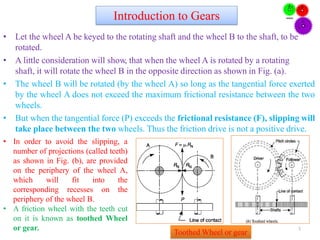
• Let the wheel A be keyed to the rotating shaft and the wheel B to the shaft, to be
rotated.
• A little consideration will show, that when the wheel A is rotated by a rotating
shaft, it will rotate the wheel B in the opposite direction as shown in Fig. (a).
• The wheel B will be rotated (by the wheel A) so long as the tangential force exerted
by the wheel A does not exceed the maximum frictional resistance between the two
wheels.
• But when the tangential force (P) exceeds the frictional resistance (F), slipping will
take place between the two wheels. Thus the friction drive is not a positive drive.
• In order to avoid the slipping, a
number of projections (called teeth)
as shown in Fig. (b), are provided
on the periphery of the wheel A,
which will fit into the
corresponding recesses on the
periphery of the wheel B.
• A friction wheel with the teeth cut
on it is known as toothed Wheel
or gear. 3
Introduction to Gears
Toothed Wheel or gear
SPUR GEAR
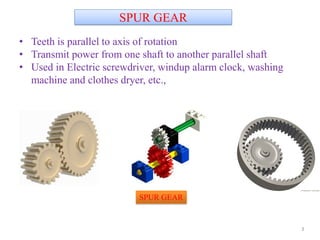
• Teeth is parallel to axis of rotation
• Transmit power from one shaft to another parallel shaft
• Used in Electric screwdriver, windup alarm clock, washing
machine and clothes dryer, etc.,
3
SPUR GEAR
Helical Gear
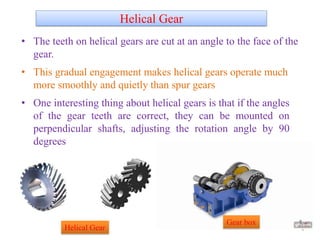
• The teeth on helical gears are cut at an angle to the face of the
gear.
• This gradual engagement makes helical gears operate much
more smoothly and quietly than spur gears
• One interesting thing about helical gears is that if the angles
of the gear teeth are correct, they can be mounted on
perpendicular shafts, adjusting the rotation angle by 90
degrees
4Helical Gear
Gear box
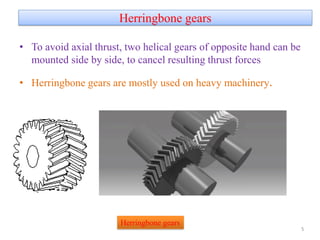
Herringbone gears
• To avoid axial thrust, two helical gears of opposite hand can be
mounted side by side, to cancel resulting thrust forces
• Herringbone gears are mostly used on heavy machinery.
5
Herringbone gears
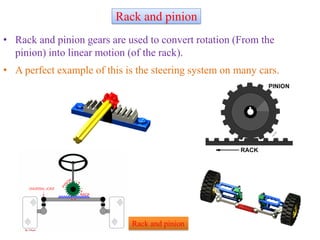
• Rack and pinion gears are used to convert rotation (From the
pinion) into linear motion (of the rack).
• A perfect example of this is the steering system on many cars.
6
Rack and pinion
Rack and pinion
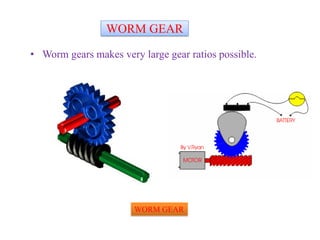
WORM GEAR
• Worm gears makes very large gear ratios possible.
WORM GEAR
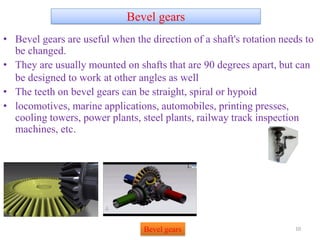
Bevel gears
• Bevel gears are useful when the direction of a shaft's rotation needs to
be changed.
• They are usually mounted on shafts that are 90 degrees apart, but can
be designed to work at other angles as well
• The teeth on bevel gears can be straight, spiral or hypoid
• locomotives, marine applications, automobiles, printing presses,
cooling towers, power plants, steel plants, railway track inspection
machines, etc.
10Bevel gears
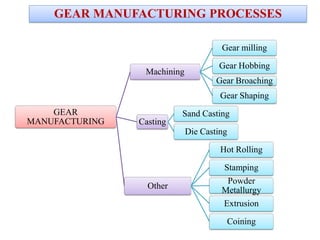
GEAR MANUFACTURING PROCESSES
GEAR
MANUFACTURING
Machining
Gear milling
Gear Hobbing
Gear Broaching
Gear Shaping
Casting
Sand Casting
Die Casting
Other
Hot Rolling
Stamping
Powder
Metallurgy
Extrusion
Coining
GearManufacturing
Processes
Gear Generating
process
Form milling
Gear hobbing
Gear broaching
Gear Shaping
Gear finishing
operations
Gear grinding
Gear Shaving
Gear Burnishing
Gear Honing and
lapping
Gear Manufacturing Processes
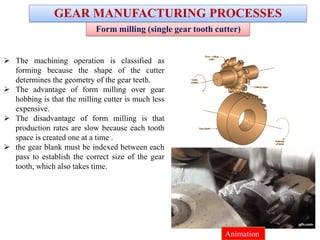
Form milling (single gear tooth cutter)
 The machining operation is classified as
forming because the shape of the cutter
determines the geometry of the gear teeth.
 The advantage of form milling over gear
hobbing is that the milling cutter is much less
expensive.
 The disadvantage of form milling is that
production rates are slow because each tooth
space is created one at a time .
 the gear blank must be indexed between each
pass to establish the correct size of the gear
tooth, which also takes time.
GEAR MANUFACTURING PROCESSES
Animation
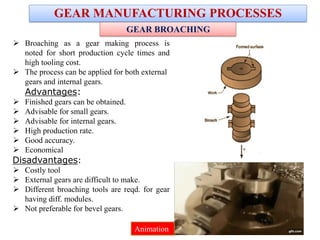
GEAR MANUFACTURING PROCESSES
 Broaching as a gear making process is
noted for short production cycle times and
high tooling cost.
 The process can be applied for both external
gears and internal gears.
Advantages:
 Finished gears can be obtained.
 Advisable for small gears.
 Advisable for internal gears.
 High production rate.
 Good accuracy.
 Economical
Disadvantages:
 Costly tool
 External gears are difficult to make.
 Different broaching tools are reqd. for gear
having diff. modules.
 Not preferable for bevel gears.
GEAR BROACHING
Animation
GEAR MANUFACTURING PROCESSES
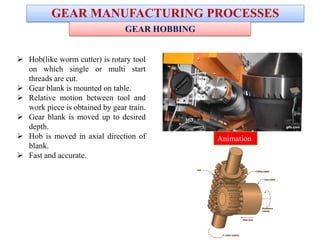
 Hob(like worm cutter) is rotary tool
on which single or multi start
threads are cut.
 Gear blank is mounted on table.
 Relative motion between tool and
work piece is obtained by gear train.
 Gear blank is moved up to desired
depth.
 Hob is moved in axial direction of
blank.
 Fast and accurate.
GEAR HOBBING
Animation
GEAR MANUFACTURING PROCESSES
GEAR SHAPING
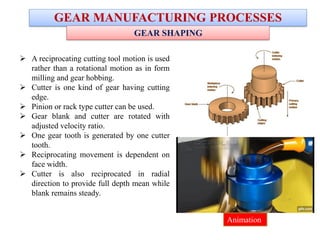
 A reciprocating cutting tool motion is used
rather than a rotational motion as in form
milling and gear hobbing.
 Cutter is one kind of gear having cutting
edge.
 Pinion or rack type cutter can be used.
 Gear blank and cutter are rotated with
adjusted velocity ratio.
 One gear tooth is generated by one cutter
tooth.
 Reciprocating movement is dependent on
face width.
 Cutter is also reciprocated in radial
direction to provide full depth mean while
blank remains steady.
Animation
GEAR MANUFACTURING PROCESSES
GEAR SHAPING
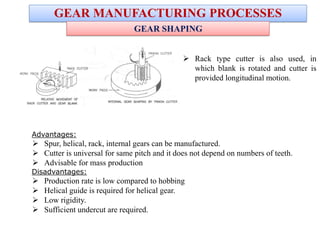
 Rack type cutter is also used, in
which blank is rotated and cutter is
provided longitudinal motion.
Advantages:
 Spur, helical, rack, internal gears can be manufactured.
 Cutter is universal for same pitch and it does not depend on numbers of teeth.
 Advisable for mass production
Disadvantages:
 Production rate is low compared to hobbing
 Helical guide is required for helical gear.
 Low rigidity.
 Sufficient undercut are required.
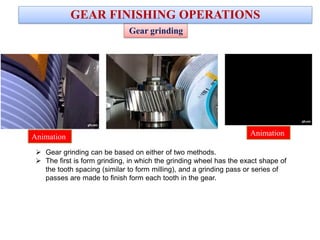
 Gear grinding can be based on either of two methods.
 The first is form grinding, in which the grinding wheel has the exact shape of
the tooth spacing (similar to form milling), and a grinding pass or series of
passes are made to finish form each tooth in the gear.
Gear grinding
GEAR FINISHING OPERATIONS
AnimationAnimation
Gear Shaving
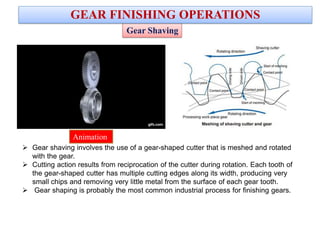
 Gear shaving involves the use of a gear-shaped cutter that is meshed and rotated
with the gear.
 Cutting action results from reciprocation of the cutter during rotation. Each tooth of
the gear-shaped cutter has multiple cutting edges along its width, producing very
small chips and removing very little metal from the surface of each gear tooth.
 Gear shaping is probably the most common industrial process for finishing gears.
GEAR FINISHING OPERATIONS
Animation
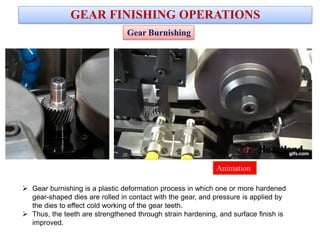
 Gear burnishing is a plastic deformation process in which one or more hardened
gear-shaped dies are rolled in contact with the gear, and pressure is applied by
the dies to effect cold working of the gear teeth.
 Thus, the teeth are strengthened through strain hardening, and surface finish is
improved.
Gear Burnishing
GEAR FINISHING OPERATIONS
Animation
 Honing and lapping are two finishing processes that can be adapted to gear finishing using very
fine abrasives.
 The tools in both processes usually possess the geometry of a gear that meshes with the gear to
be processed.
 Gear lapping uses a cast iron tool (other metals are sometimes substituted), and the cutting action
is accomplished by the lapping compound containing abrasives.
Gear Honing and lapping
Gear Lapping
GEAR FINISHING OPERATIONS
Animation
Gear Honing and lapping
GEAR FINISHING OPERATIONS
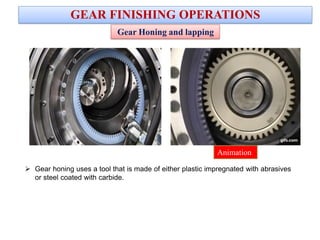
 Gear honing uses a tool that is made of either plastic impregnated with abrasives
or steel coated with carbide.
Animation

10 gear manufacturing process

  • 1.
  • 2.
    • Let thewheel A be keyed to the rotating shaft and the wheel B to the shaft, to be rotated. • A little consideration will show, that when the wheel A is rotated by a rotating shaft, it will rotate the wheel B in the opposite direction as shown in Fig. (a). • The wheel B will be rotated (by the wheel A) so long as the tangential force exerted by the wheel A does not exceed the maximum frictional resistance between the two wheels. • But when the tangential force (P) exceeds the frictional resistance (F), slipping will take place between the two wheels. Thus the friction drive is not a positive drive. • In order to avoid the slipping, a number of projections (called teeth) as shown in Fig. (b), are provided on the periphery of the wheel A, which will fit into the corresponding recesses on the periphery of the wheel B. • A friction wheel with the teeth cut on it is known as toothed Wheel or gear. 3 Introduction to Gears Toothed Wheel or gear
  • 3.
    SPUR GEAR • Teethis parallel to axis of rotation • Transmit power from one shaft to another parallel shaft • Used in Electric screwdriver, windup alarm clock, washing machine and clothes dryer, etc., 3 SPUR GEAR
  • 4.
    Helical Gear • Theteeth on helical gears are cut at an angle to the face of the gear. • This gradual engagement makes helical gears operate much more smoothly and quietly than spur gears • One interesting thing about helical gears is that if the angles of the gear teeth are correct, they can be mounted on perpendicular shafts, adjusting the rotation angle by 90 degrees 4Helical Gear Gear box
  • 5.
    Herringbone gears • Toavoid axial thrust, two helical gears of opposite hand can be mounted side by side, to cancel resulting thrust forces • Herringbone gears are mostly used on heavy machinery. 5 Herringbone gears
  • 6.
    • Rack andpinion gears are used to convert rotation (From the pinion) into linear motion (of the rack). • A perfect example of this is the steering system on many cars. 6 Rack and pinion Rack and pinion
  • 7.
    WORM GEAR • Wormgears makes very large gear ratios possible. WORM GEAR
  • 8.
    Bevel gears • Bevelgears are useful when the direction of a shaft's rotation needs to be changed. • They are usually mounted on shafts that are 90 degrees apart, but can be designed to work at other angles as well • The teeth on bevel gears can be straight, spiral or hypoid • locomotives, marine applications, automobiles, printing presses, cooling towers, power plants, steel plants, railway track inspection machines, etc. 10Bevel gears
  • 9.
  • 10.
    GEAR MANUFACTURING PROCESSES GEAR MANUFACTURING Machining Gearmilling Gear Hobbing Gear Broaching Gear Shaping Casting Sand Casting Die Casting Other Hot Rolling Stamping Powder Metallurgy Extrusion Coining
  • 11.
    GearManufacturing Processes Gear Generating process Form milling Gearhobbing Gear broaching Gear Shaping Gear finishing operations Gear grinding Gear Shaving Gear Burnishing Gear Honing and lapping Gear Manufacturing Processes
  • 12.
    Form milling (singlegear tooth cutter)  The machining operation is classified as forming because the shape of the cutter determines the geometry of the gear teeth.  The advantage of form milling over gear hobbing is that the milling cutter is much less expensive.  The disadvantage of form milling is that production rates are slow because each tooth space is created one at a time .  the gear blank must be indexed between each pass to establish the correct size of the gear tooth, which also takes time. GEAR MANUFACTURING PROCESSES Animation
  • 13.
    GEAR MANUFACTURING PROCESSES Broaching as a gear making process is noted for short production cycle times and high tooling cost.  The process can be applied for both external gears and internal gears. Advantages:  Finished gears can be obtained.  Advisable for small gears.  Advisable for internal gears.  High production rate.  Good accuracy.  Economical Disadvantages:  Costly tool  External gears are difficult to make.  Different broaching tools are reqd. for gear having diff. modules.  Not preferable for bevel gears. GEAR BROACHING Animation
  • 14.
    GEAR MANUFACTURING PROCESSES Hob(like worm cutter) is rotary tool on which single or multi start threads are cut.  Gear blank is mounted on table.  Relative motion between tool and work piece is obtained by gear train.  Gear blank is moved up to desired depth.  Hob is moved in axial direction of blank.  Fast and accurate. GEAR HOBBING Animation
  • 15.
    GEAR MANUFACTURING PROCESSES GEARSHAPING  A reciprocating cutting tool motion is used rather than a rotational motion as in form milling and gear hobbing.  Cutter is one kind of gear having cutting edge.  Pinion or rack type cutter can be used.  Gear blank and cutter are rotated with adjusted velocity ratio.  One gear tooth is generated by one cutter tooth.  Reciprocating movement is dependent on face width.  Cutter is also reciprocated in radial direction to provide full depth mean while blank remains steady. Animation
  • 16.
    GEAR MANUFACTURING PROCESSES GEARSHAPING  Rack type cutter is also used, in which blank is rotated and cutter is provided longitudinal motion. Advantages:  Spur, helical, rack, internal gears can be manufactured.  Cutter is universal for same pitch and it does not depend on numbers of teeth.  Advisable for mass production Disadvantages:  Production rate is low compared to hobbing  Helical guide is required for helical gear.  Low rigidity.  Sufficient undercut are required.
  • 17.
     Gear grindingcan be based on either of two methods.  The first is form grinding, in which the grinding wheel has the exact shape of the tooth spacing (similar to form milling), and a grinding pass or series of passes are made to finish form each tooth in the gear. Gear grinding GEAR FINISHING OPERATIONS AnimationAnimation
  • 18.
    Gear Shaving  Gearshaving involves the use of a gear-shaped cutter that is meshed and rotated with the gear.  Cutting action results from reciprocation of the cutter during rotation. Each tooth of the gear-shaped cutter has multiple cutting edges along its width, producing very small chips and removing very little metal from the surface of each gear tooth.  Gear shaping is probably the most common industrial process for finishing gears. GEAR FINISHING OPERATIONS Animation
  • 19.
     Gear burnishingis a plastic deformation process in which one or more hardened gear-shaped dies are rolled in contact with the gear, and pressure is applied by the dies to effect cold working of the gear teeth.  Thus, the teeth are strengthened through strain hardening, and surface finish is improved. Gear Burnishing GEAR FINISHING OPERATIONS Animation
  • 20.
     Honing andlapping are two finishing processes that can be adapted to gear finishing using very fine abrasives.  The tools in both processes usually possess the geometry of a gear that meshes with the gear to be processed.  Gear lapping uses a cast iron tool (other metals are sometimes substituted), and the cutting action is accomplished by the lapping compound containing abrasives. Gear Honing and lapping Gear Lapping GEAR FINISHING OPERATIONS Animation
  • 21.
    Gear Honing andlapping GEAR FINISHING OPERATIONS  Gear honing uses a tool that is made of either plastic impregnated with abrasives or steel coated with carbide. Animation