GEARS MANUFACTURING
by
Messina annick
Contents
1. What is a gear?
2. Generals applications of gears
3. Types of gears
4. Methods of gears manufacturing
5. Preforming
6. Producing gears teeth by machining
7. Finishing of gears teeth
1. What is a gear?
Gears can be defined as devices used to transmit power and motion. Theirs
characteristics are :
- Number of teeth (Z): (Z1/Z2=N2/N1)
- Module m
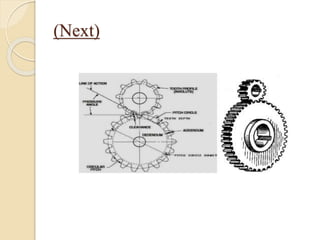
- Pitch circle diameter (PCD): pcd= mZ/cosΘ. It is the curve intersecting
pitch surface of revolution.
- Addendum a: is the height by which a tooth projects beyond the pitch circle
or pitch line; is the radial distance between the pitch circle and the
addendum circle.
- Dedendum b: is the depth of tooth space below the pitch circle or the pitch
line ;also it is the radial distance between the pitch circle and the pitch root
circle.
- Clearance c: is the amount by which the dedendum in a given gear exceeds
the addendum of its mating gear.
- Backlash: is the amount by which the width of a tooth space exceeds the
thickness of the engaging tooth on the pitch circles.
(Next)
2. Generals applications of gears
Gears of various type, size and material are widely used in
several machines and systems requiring positive and stepped drive.
The major applications are:
• Speed gear box, feed gear box and some other kinematic units
of machine tools.
• Speed drives in textile, jute and similar machineries
• Gear boxes of automobiles.
• Speed and / or feed drives of several metal forming machines.
 Machineries for mining, tea processing etc.
• Large and heavy duty gear boxes used in cement industries,
sugar industries, cranes, conveyors etc.
• Precision equipment, clocks and watches.
• Industrial robots and toys.
3. Types of gears
Gears can be classified according to:
a) Configuration: internal and external gears.
b) Axes of transmission: straight tooth and helical tooth(spur gear,
single helical, double helical).
c) Pattern of motion: rotation to rotation(wheel types gears), rotation
to translation or vice versa(rack pinion).
4. Methods of gears manufacturing
Manufacture of gears needs several processing operations in
sequential stages depending upon the material and type of the gears and
quality desired. Those stages generally are:
⎯ preforming the blank without or with teeth
⎯ Annealing of the blank, if required, as in case of forged or cast steels
⎯ Preparation of the gear blank to the required dimensions by
machining
⎯ producing teeth or finishing the preformed teeth by machining
⎯ Full or surface hardening of the machined gear (teeth), if required
⎯ Finishing teeth, if required, by shaving, grinding etc.
⎯ Inspection of the finished gears.
5. Preforming
Casting
Gear blanks and even gears along with teeth requiring substantial to little
machining or finishing are produced by various casting processes.
a) Sand casting
The blanks of large cast iron gears, if required to be made one or few pieces, are
produced by sand casting. Then the blank is prepared to appropriate dimensions and the
teeth are produced by machining that cast preform. Complete gears with teeth can also be
directly produced by such casting and used at low speed in machineries like farm
machinery and hand operated devices where gear accuracy and finish are not that much
required.
b) Metal mould casting
Medium size steel gears with limited accuracy and finish are often made in single
or few pieces by metal mould casting. Such unfinished gears are used in several agro-
industries. For general and precision use the cast preforms are properly machined.
(Next)
c) Die casting
Large lot or mass production of small gears of low melting point alloys of
Al, Zn, Cu, Mg etc. are done mainly by die casting. Such reasonably accurate
gears are directly or after little further finishing are used under light load and
moderate speeds, for example in instruments, camera, toys.
d) Investment casting
This near-net-shape method is used for producing small to medium size
gears of exotic materials with high accuracy and surface finish hardly requiring
further finishing. These relatively costly gears are generally used under heavy
loads and stresses.
e) Mould casting
Small gears in batches are also often produced by this process. The quality
provided by this process lies in between that of sand casting and investment
casting.
.
(Next)
f) Centrifugal casting
The solid blanks or the outer rims (without teeth) of worm wheels
made of cast iron, phosphor bronze or even steel are preferably
preformed by centrifugal casting. The performs are machined to form
the gear blank of proper size. Then the teeth are developed by
machining. There are many more casting methods like: rolling, powder
metallurgy, blanking in press tool, plastic moulding, extrusion process,
wire EDM(Electro discharge Machining ).
6. Producing gears teeth by
machining
Gear teeth are produced by machining based on:
 Forming : where the profile of the teeth are obtained as the replica of the form of the
cutting tool (edge); e.g., milling, broaching etc.
 Generation : where the complicated tooth profile are provided by much simpler form
cutting tool (edges) through rolling type tool work motions, e.g., hobbing, gear shaping
etc.
a- Milling
Gear teeth can be produced by both disc and end mill type form milling cutter as Production
of gear teeth by form milling are characterised by:
 use of HSS form milling cutters
 use of ordinary milling machines
 low production rate for
 need of indexing after machining each tooth gap
 slow speed and feed
 low accuracy and surface finish
 inventory problem
 due to need of a set of eight cutters for each module
(Next)
b- Parallel multiple teeth shaping
In principle, it is similar to ordinary shaping but all the tooth gaps are made
simultaneously, without requiring indexing, by a set of radially infeeding single
point form tools as indicated. This old process was highly productive but became
almost obsolete for very high initial and running costs.
c- Broaching
Teeth of small internal and external spur gears; straight or single helical, of
relatively softer materials are produced in large quantity by this process. How
external teeth are produced by a broaching in one pass. This method leads to very
high productivity and quality but cost of machine and broach are very high.
f- Hobbing
The tool-work are the HSS or carbide cutter having teeth like gear milling cutter
and the gear blank apparently interact like a pair of worm and worm wheel. The hob
(cutter) looks and behaves like a single or multiple start worms. Having lesser
number (only three) of tool – work motions, hobbing machines are much more rigid,
strong and productive than gear shaping machine. But hobbing provides lesser
accuracy and finish and is used only for cutting straight or helical teeth (single) of
external spur gears and worm wheels.
7.Finishing of gears teeth
For smooth running, good performance and long service life, the
gears need
• To be accurate in dimensions and forms
• To have high surface finish and
• To be hard and wear resistive at their tooth flanks
Which are achieved by some gear teeth finishing work after near
accurate preforming and machining. Small gears made by cold rolling
generally do not require further finishing. If a rolled gear needs further
surface hardening only then little finishing by grinding and / or lapping
is done after hardening. Gears produced to near-net-shape by die
casting, powder metallurgy, extrusion.

Gears Manufacturing

  • 1.
  • 2.
    Contents 1. What isa gear? 2. Generals applications of gears 3. Types of gears 4. Methods of gears manufacturing 5. Preforming 6. Producing gears teeth by machining 7. Finishing of gears teeth
  • 3.
    1. What isa gear? Gears can be defined as devices used to transmit power and motion. Theirs characteristics are : - Number of teeth (Z): (Z1/Z2=N2/N1) - Module m - Pitch circle diameter (PCD): pcd= mZ/cosΘ. It is the curve intersecting pitch surface of revolution. - Addendum a: is the height by which a tooth projects beyond the pitch circle or pitch line; is the radial distance between the pitch circle and the addendum circle. - Dedendum b: is the depth of tooth space below the pitch circle or the pitch line ;also it is the radial distance between the pitch circle and the pitch root circle. - Clearance c: is the amount by which the dedendum in a given gear exceeds the addendum of its mating gear. - Backlash: is the amount by which the width of a tooth space exceeds the thickness of the engaging tooth on the pitch circles.
  • 4.
  • 5.
    2. Generals applicationsof gears Gears of various type, size and material are widely used in several machines and systems requiring positive and stepped drive. The major applications are: • Speed gear box, feed gear box and some other kinematic units of machine tools. • Speed drives in textile, jute and similar machineries • Gear boxes of automobiles. • Speed and / or feed drives of several metal forming machines.  Machineries for mining, tea processing etc. • Large and heavy duty gear boxes used in cement industries, sugar industries, cranes, conveyors etc. • Precision equipment, clocks and watches. • Industrial robots and toys.
  • 6.
    3. Types ofgears Gears can be classified according to: a) Configuration: internal and external gears. b) Axes of transmission: straight tooth and helical tooth(spur gear, single helical, double helical). c) Pattern of motion: rotation to rotation(wheel types gears), rotation to translation or vice versa(rack pinion).
  • 7.
    4. Methods ofgears manufacturing Manufacture of gears needs several processing operations in sequential stages depending upon the material and type of the gears and quality desired. Those stages generally are: ⎯ preforming the blank without or with teeth ⎯ Annealing of the blank, if required, as in case of forged or cast steels ⎯ Preparation of the gear blank to the required dimensions by machining ⎯ producing teeth or finishing the preformed teeth by machining ⎯ Full or surface hardening of the machined gear (teeth), if required ⎯ Finishing teeth, if required, by shaving, grinding etc. ⎯ Inspection of the finished gears.
  • 8.
    5. Preforming Casting Gear blanksand even gears along with teeth requiring substantial to little machining or finishing are produced by various casting processes. a) Sand casting The blanks of large cast iron gears, if required to be made one or few pieces, are produced by sand casting. Then the blank is prepared to appropriate dimensions and the teeth are produced by machining that cast preform. Complete gears with teeth can also be directly produced by such casting and used at low speed in machineries like farm machinery and hand operated devices where gear accuracy and finish are not that much required. b) Metal mould casting Medium size steel gears with limited accuracy and finish are often made in single or few pieces by metal mould casting. Such unfinished gears are used in several agro- industries. For general and precision use the cast preforms are properly machined.
  • 9.
    (Next) c) Die casting Largelot or mass production of small gears of low melting point alloys of Al, Zn, Cu, Mg etc. are done mainly by die casting. Such reasonably accurate gears are directly or after little further finishing are used under light load and moderate speeds, for example in instruments, camera, toys. d) Investment casting This near-net-shape method is used for producing small to medium size gears of exotic materials with high accuracy and surface finish hardly requiring further finishing. These relatively costly gears are generally used under heavy loads and stresses. e) Mould casting Small gears in batches are also often produced by this process. The quality provided by this process lies in between that of sand casting and investment casting. .
  • 10.
    (Next) f) Centrifugal casting Thesolid blanks or the outer rims (without teeth) of worm wheels made of cast iron, phosphor bronze or even steel are preferably preformed by centrifugal casting. The performs are machined to form the gear blank of proper size. Then the teeth are developed by machining. There are many more casting methods like: rolling, powder metallurgy, blanking in press tool, plastic moulding, extrusion process, wire EDM(Electro discharge Machining ).
  • 11.
    6. Producing gearsteeth by machining Gear teeth are produced by machining based on:  Forming : where the profile of the teeth are obtained as the replica of the form of the cutting tool (edge); e.g., milling, broaching etc.  Generation : where the complicated tooth profile are provided by much simpler form cutting tool (edges) through rolling type tool work motions, e.g., hobbing, gear shaping etc. a- Milling Gear teeth can be produced by both disc and end mill type form milling cutter as Production of gear teeth by form milling are characterised by:  use of HSS form milling cutters  use of ordinary milling machines  low production rate for  need of indexing after machining each tooth gap  slow speed and feed  low accuracy and surface finish  inventory problem  due to need of a set of eight cutters for each module
  • 12.
    (Next) b- Parallel multipleteeth shaping In principle, it is similar to ordinary shaping but all the tooth gaps are made simultaneously, without requiring indexing, by a set of radially infeeding single point form tools as indicated. This old process was highly productive but became almost obsolete for very high initial and running costs. c- Broaching Teeth of small internal and external spur gears; straight or single helical, of relatively softer materials are produced in large quantity by this process. How external teeth are produced by a broaching in one pass. This method leads to very high productivity and quality but cost of machine and broach are very high. f- Hobbing The tool-work are the HSS or carbide cutter having teeth like gear milling cutter and the gear blank apparently interact like a pair of worm and worm wheel. The hob (cutter) looks and behaves like a single or multiple start worms. Having lesser number (only three) of tool – work motions, hobbing machines are much more rigid, strong and productive than gear shaping machine. But hobbing provides lesser accuracy and finish and is used only for cutting straight or helical teeth (single) of external spur gears and worm wheels.
  • 13.
    7.Finishing of gearsteeth For smooth running, good performance and long service life, the gears need • To be accurate in dimensions and forms • To have high surface finish and • To be hard and wear resistive at their tooth flanks Which are achieved by some gear teeth finishing work after near accurate preforming and machining. Small gears made by cold rolling generally do not require further finishing. If a rolled gear needs further surface hardening only then little finishing by grinding and / or lapping is done after hardening. Gears produced to near-net-shape by die casting, powder metallurgy, extrusion.