Standard Operating
Procedure in
Pharmaceutical
Industries
Prepared by: Simran Kukreja
Guided by: Dr. Ajazuddin (Professor)
Product Development Laboratory
Rungta College of Pharmaceutical Sciences
and Research, Bhilai, C.G., 490023
Email: simrankukreja.pharmacy@gmail.com
1
CONTENT
2
1. Standard Operating Procedure
- Introduction
- Objectives
- Benefits
- Types of SOP
- SOP Writing Style
- DO’s
- Don’ts
- SOP Content
- SOP Process
- SOP for Tablet Compression
2. Master Formula Record
- Content
INTRODUCTION
• Standard Operating Procedure is a set of step by step
written instructions intended to document how to
perform a routine activity.
• Back bone of pharmaceutical industry.
• Integral part of Quality assurance(QA).
• Provides details of appropriate quality, cost and time
constraints.
SOP - AIM FOR QUALITY
3
OBJECTIVES
• To maintain the quality control and quality assurance.
• To serve as a training document for teaching users
about the process for which the SOP was written.
• To facilitate consistent conformance to quality system
requirements and to support data quality.
• To provide guidelines for accurate and timely data
collection.
• Uniformity of performance.
4
Contd…
• Efficiency and quality output.
• Reduce miscommunication and failure to comply
with industry regulations.
• To carry out operations correctly and always in
same manner.
5
BENEFITS
• Provides information to perform job properly.
• To provide people with all safety, health, environmental
and operational information necessary to perform the
job properly.
• Serves as a training document for users.
• Minimizes variation and promotes quality. Steps can be
reviewed in accident variations.
• Also provide, consistency(very important).
6
Contd..
• Useful tool for training new members of staff.
• SOP assist to ensure that GMP is followed and
achieved at all times.
• SOP’s help to assure the quality and consistency of the
services, and thus minimize harm to the patient.
7
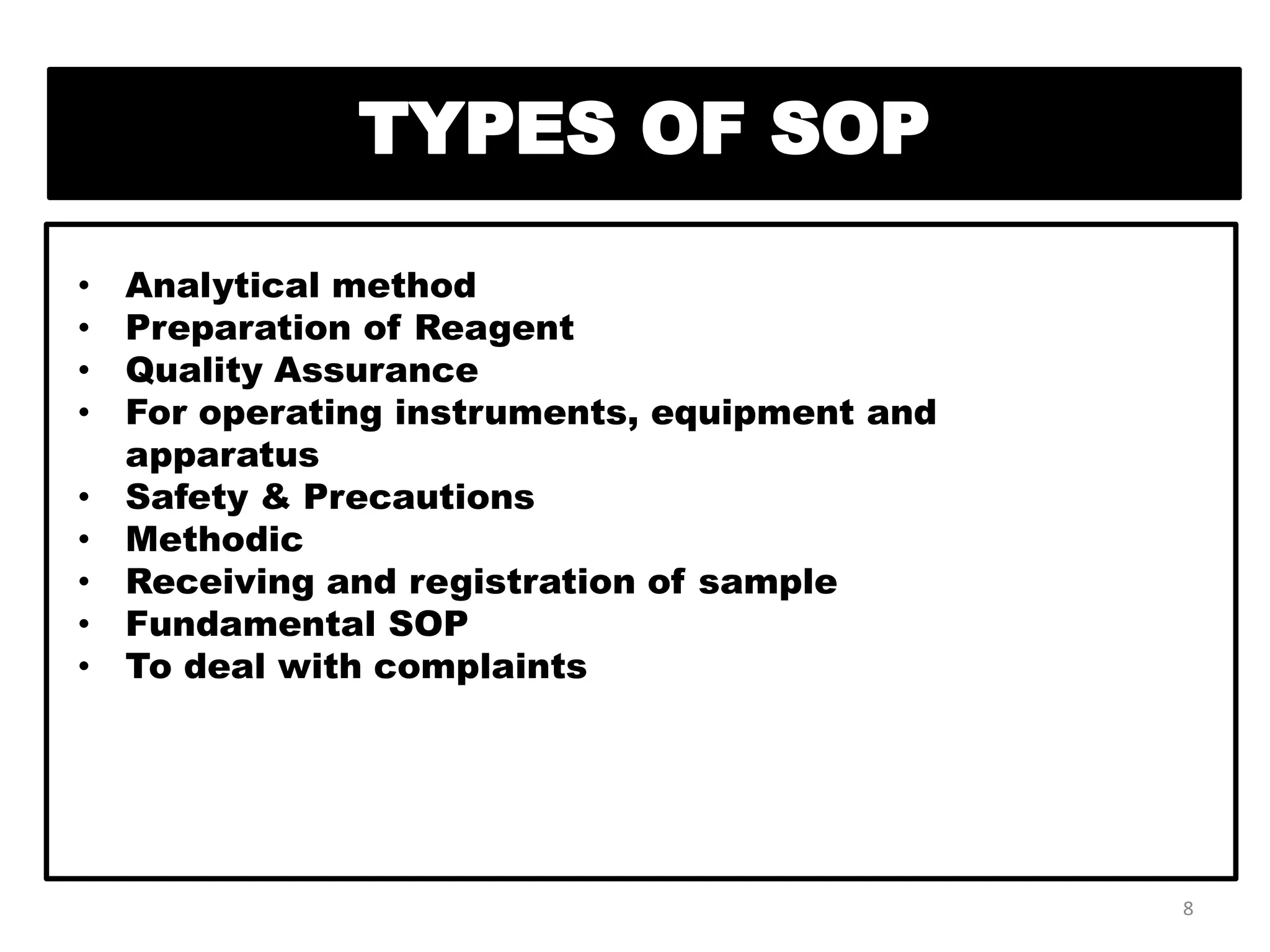
TYPES OF SOP
• Analytical method
• Preparation of Reagent
• Quality Assurance
• For operating instruments, equipment and
apparatus
• Safety & Precautions
• Methodic
• Receiving and registration of sample
• Fundamental SOP
• To deal with complaints
8
SOP WRITING STYLE
.
• SOP’s shall be written in a concise, step by step, easy to read
follow format.
• Information should not be complicated. The active voice, and
present verb tense should be used.
• Should be simple and short.
• Routine procedures that are short and require few decisions
can be written using simple steps format.
• Long procedures consisting of more than 10 steps, should be
written along with graphical format or hierarchical steps.
• Procedures that require many decisions should be written along
with flowchart.
9
DO’s
• Write in present tense. Don’t use past tense, condition of
future tense unless you have good reason to do so.
• Avoid ambiguity and be concise.
• Reduce the word count where possible without changing
the meaning of the text.
• Keep the words short and get to point.
• Highlight exceptions. Use a symbol to flag that this is an
exception and how to handle it.
•Highlight warnings and use a larger or a warning icon.
10
DON’Ts
• Introduce acronyms without explaining what it means.
• Don’t use the word “ may “, “ if possible” as it implies
that the user can do something under conditions. Instead
be positive and tell them what to do.
11
CONTENT OF SOP
• Company name and pagination
• Title
• Identification
• Review and approval
• Purpose
• Scope
• Responsibility
• Procedure
12
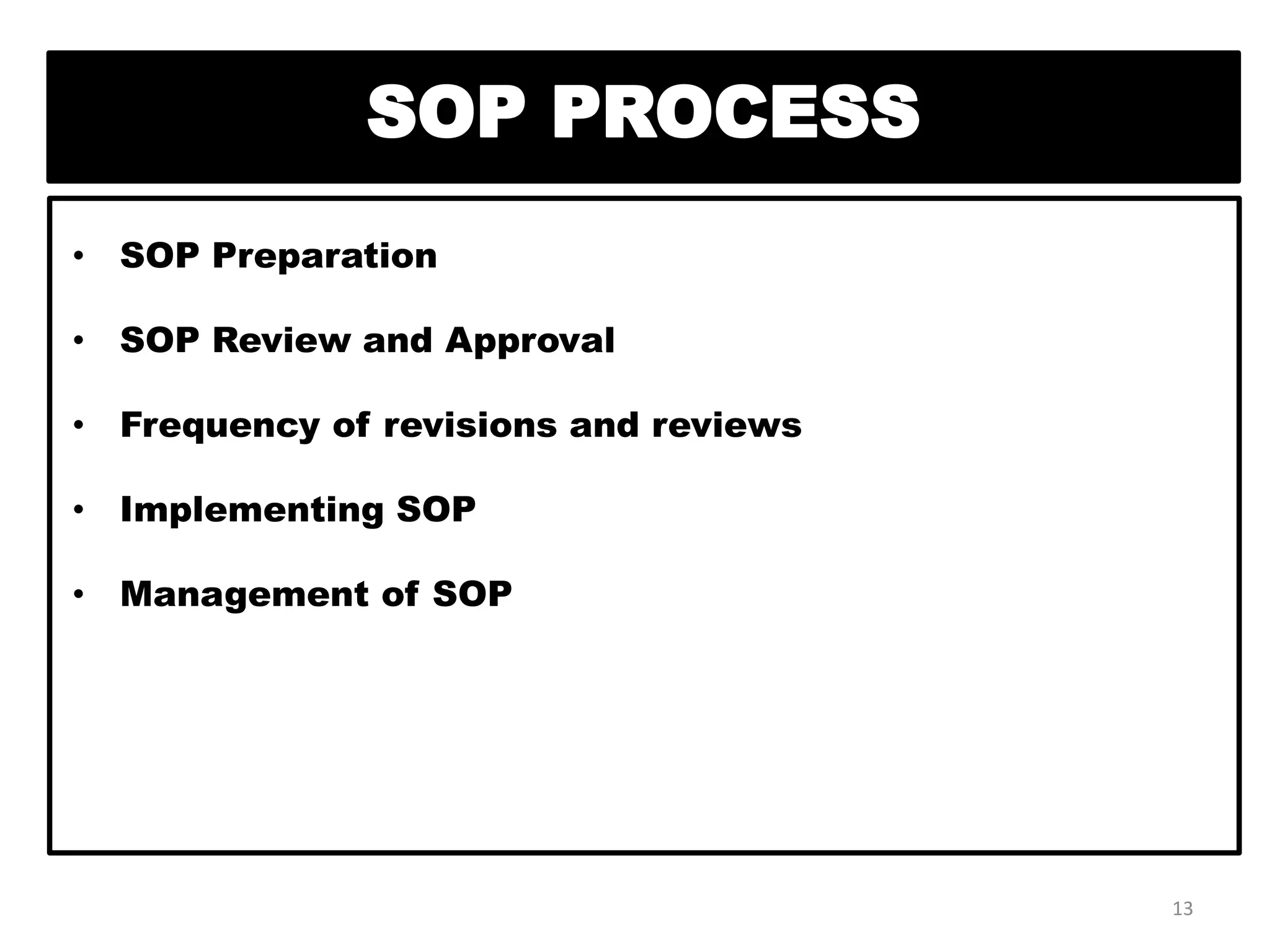
SOP PROCESS
• SOP Preparation
• SOP Review and Approval
• Frequency of revisions and reviews
• Implementing SOP
• Management of SOP
13
14
SOP - TABLET COMPRESSION
• Clean the compression machine as per respective SOP.
• Make sure that the compression area has been clean
properly.
• Clean the dust extractors, its pipes, racks, door frames
and return filters of Air Handling Unit.
• Check it visually for intactness and absence of leakage.
• Intimate quality control department to collect swab
samples as per requirements.
• After receiving the approval from QC department put
‘’cleaned label” to all equipments.
•
15
Contd…
• Clean with 70% isopropyl alcohol before taking
clearance from QC department.
• As compression of product is to be started, remove the
‘cleaned status’ and affix label to the machine along with
product name & Batch details.
• Issue the punch set suitable for the compression as per
SOP.
• Set the compression machine as per SOP and check the
setting of machine.
• Set the machine as per tablet parameters given in BMR.
16
Contd..
• Destroy the tablets of first few rotations before starting
the machine for the compression of batch as per SOP.
• Collect the tablets generated during machine setting in a
container. Keep it label & pack.
• Stop the compression as the material in the hopper
reaches the lowest level.
• Clean all the containers from outside & transfer it to
store with label having all batch details.
• Remove the punch sets and clean it as per the SOP.
17
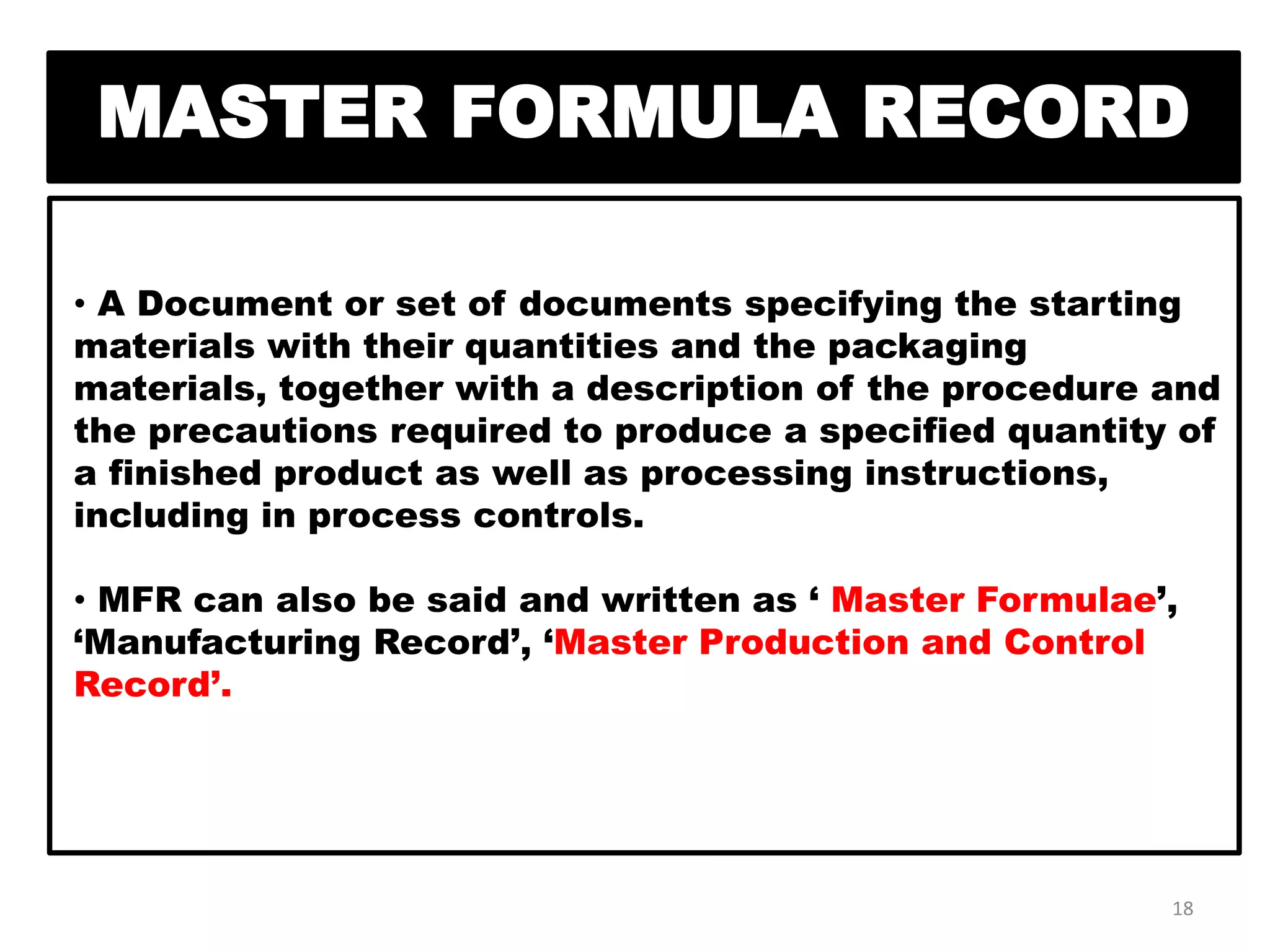
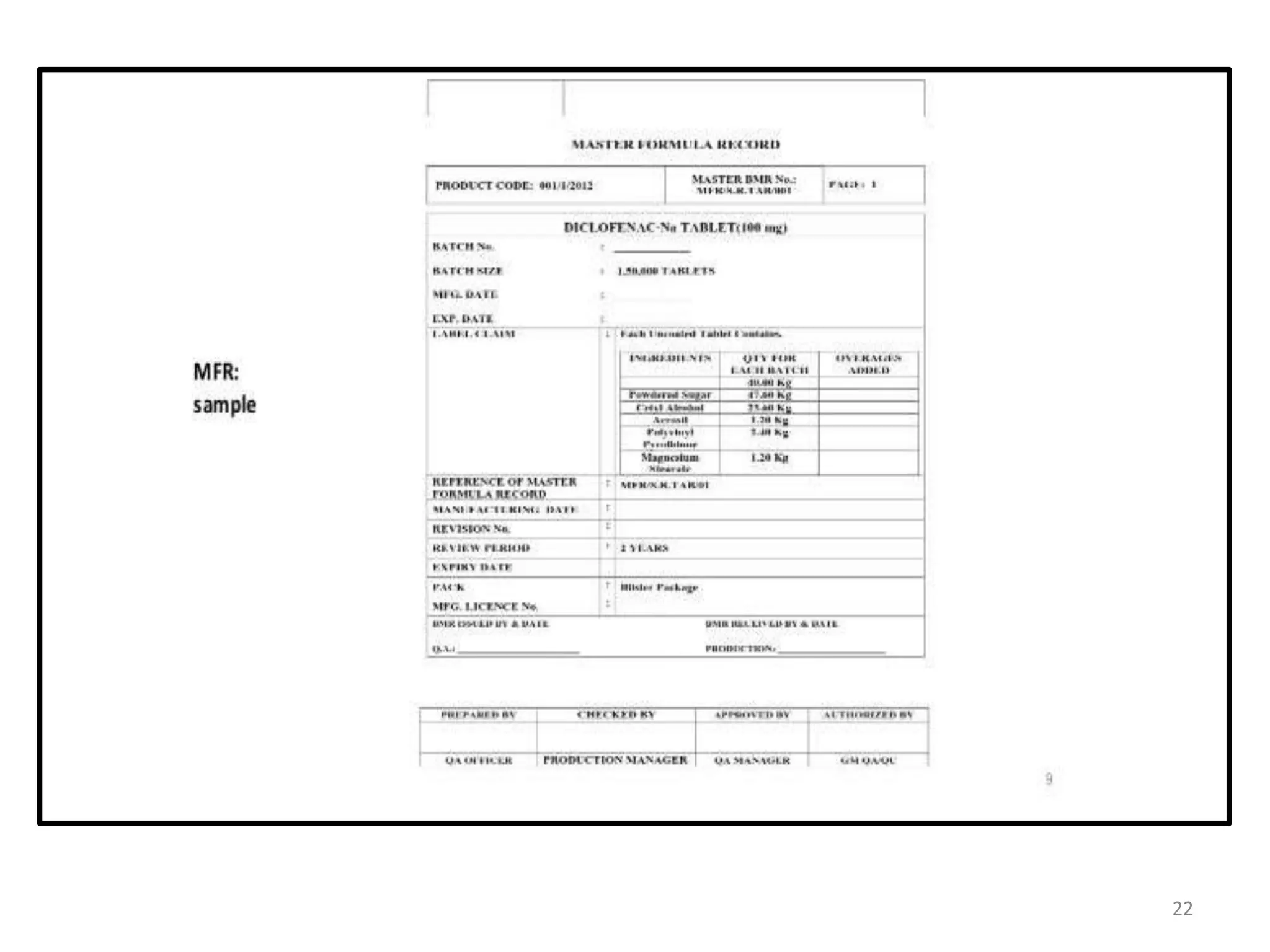
MASTER FORMULA RECORD
• A Document or set of documents specifying the starting
materials with their quantities and the packaging
materials, together with a description of the procedure and
the precautions required to produce a specified quantity of
a finished product as well as processing instructions,
including in process controls.
• MFR can also be said and written as ‘ Master Formulae’,
‘Manufacturing Record’, ‘Master Production and Control
Record’.
18
It includes
• Batch Manufacturing Records(BMR)
• Batch packing record(BPR).
• Intermediate/ packing material/ finished product
specifications.
• Specimen of printed packaging material.
• All documents of “ Master Formula Record” should be
stamped as “ Master Copy” in green at the non text
side(back side).
19
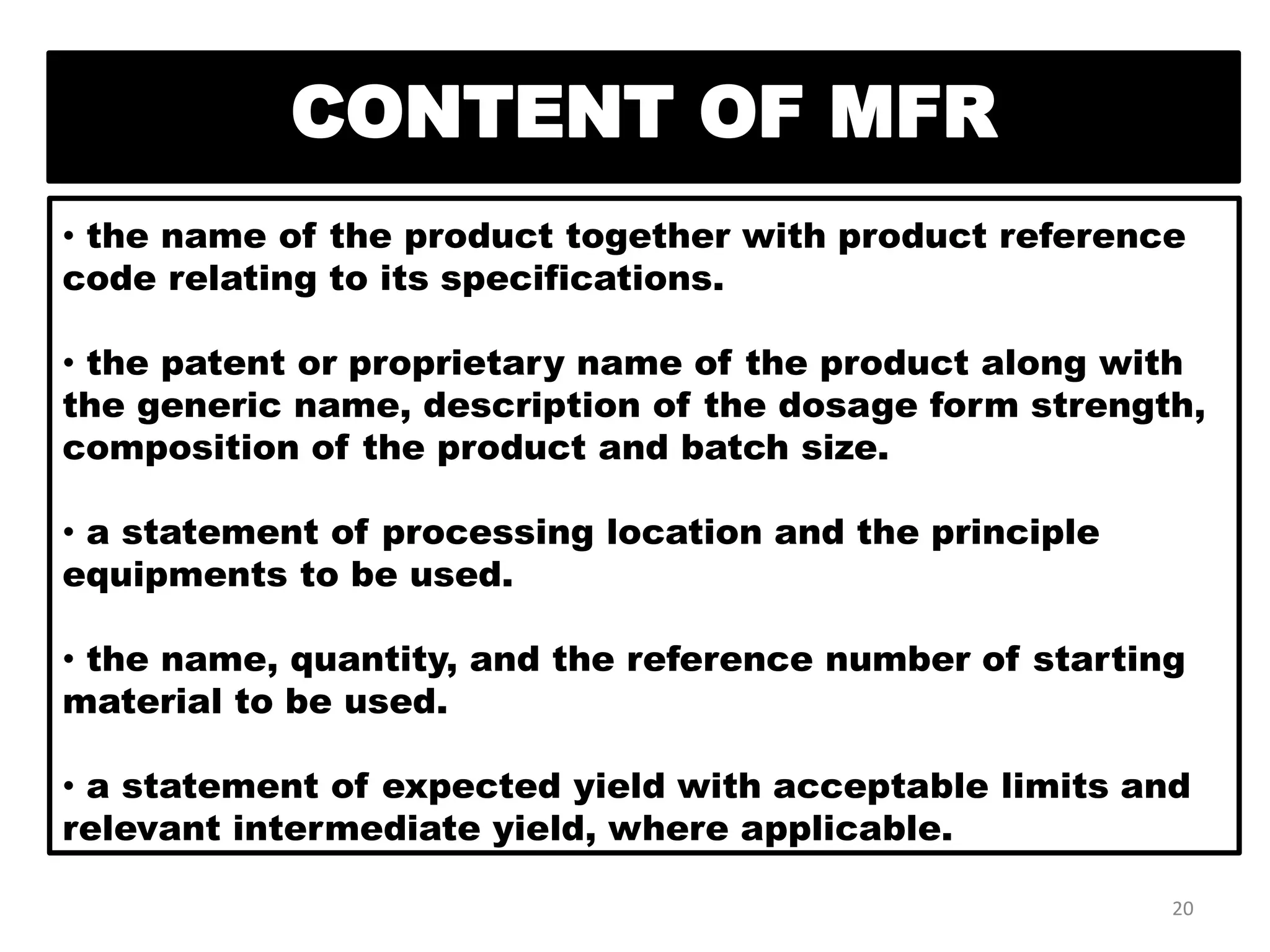
CONTENT OF MFR
• the name of the product together with product reference
code relating to its specifications.
• the patent or proprietary name of the product along with
the generic name, description of the dosage form strength,
composition of the product and batch size.
• a statement of processing location and the principle
equipments to be used.
• the name, quantity, and the reference number of starting
material to be used.
• a statement of expected yield with acceptable limits and
relevant intermediate yield, where applicable.
20
Contd..
• the methods, or reference to the method, to be used for
preparing the critical equipments including cleaning,
assembling, calibrating, sterilizing.
• detailed step wise processing instructions and the time
for each step.
• the instructions for in process control with their limits.
• the requirements for storage conditions of the products,
including the container, labeling and special storage
conditions where applicable.
• any special precaution to be observed and packing
details and specimens label.
21
22
23

Standard operating procedure in pharmaceutical industries,SOP,MFR,Master Formula Record, how to write SOP, Sop Content, MFR Content

  • 1.
    Standard Operating Procedure in Pharmaceutical Industries Preparedby: Simran Kukreja Guided by: Dr. Ajazuddin (Professor) Product Development Laboratory Rungta College of Pharmaceutical Sciences and Research, Bhilai, C.G., 490023 Email: simrankukreja.pharmacy@gmail.com 1
  • 2.
    CONTENT 2 1. Standard OperatingProcedure - Introduction - Objectives - Benefits - Types of SOP - SOP Writing Style - DO’s - Don’ts - SOP Content - SOP Process - SOP for Tablet Compression 2. Master Formula Record - Content
  • 3.
    INTRODUCTION • Standard OperatingProcedure is a set of step by step written instructions intended to document how to perform a routine activity. • Back bone of pharmaceutical industry. • Integral part of Quality assurance(QA). • Provides details of appropriate quality, cost and time constraints. SOP - AIM FOR QUALITY 3
  • 4.
    OBJECTIVES • To maintainthe quality control and quality assurance. • To serve as a training document for teaching users about the process for which the SOP was written. • To facilitate consistent conformance to quality system requirements and to support data quality. • To provide guidelines for accurate and timely data collection. • Uniformity of performance. 4
  • 5.
    Contd… • Efficiency andquality output. • Reduce miscommunication and failure to comply with industry regulations. • To carry out operations correctly and always in same manner. 5
  • 6.
    BENEFITS • Provides informationto perform job properly. • To provide people with all safety, health, environmental and operational information necessary to perform the job properly. • Serves as a training document for users. • Minimizes variation and promotes quality. Steps can be reviewed in accident variations. • Also provide, consistency(very important). 6
  • 7.
    Contd.. • Useful toolfor training new members of staff. • SOP assist to ensure that GMP is followed and achieved at all times. • SOP’s help to assure the quality and consistency of the services, and thus minimize harm to the patient. 7
  • 8.
    TYPES OF SOP •Analytical method • Preparation of Reagent • Quality Assurance • For operating instruments, equipment and apparatus • Safety & Precautions • Methodic • Receiving and registration of sample • Fundamental SOP • To deal with complaints 8
  • 9.
    SOP WRITING STYLE . •SOP’s shall be written in a concise, step by step, easy to read follow format. • Information should not be complicated. The active voice, and present verb tense should be used. • Should be simple and short. • Routine procedures that are short and require few decisions can be written using simple steps format. • Long procedures consisting of more than 10 steps, should be written along with graphical format or hierarchical steps. • Procedures that require many decisions should be written along with flowchart. 9
  • 10.
    DO’s • Write inpresent tense. Don’t use past tense, condition of future tense unless you have good reason to do so. • Avoid ambiguity and be concise. • Reduce the word count where possible without changing the meaning of the text. • Keep the words short and get to point. • Highlight exceptions. Use a symbol to flag that this is an exception and how to handle it. •Highlight warnings and use a larger or a warning icon. 10
  • 11.
    DON’Ts • Introduce acronymswithout explaining what it means. • Don’t use the word “ may “, “ if possible” as it implies that the user can do something under conditions. Instead be positive and tell them what to do. 11
  • 12.
    CONTENT OF SOP •Company name and pagination • Title • Identification • Review and approval • Purpose • Scope • Responsibility • Procedure 12
  • 13.
    SOP PROCESS • SOPPreparation • SOP Review and Approval • Frequency of revisions and reviews • Implementing SOP • Management of SOP 13
  • 14.
  • 15.
    SOP - TABLETCOMPRESSION • Clean the compression machine as per respective SOP. • Make sure that the compression area has been clean properly. • Clean the dust extractors, its pipes, racks, door frames and return filters of Air Handling Unit. • Check it visually for intactness and absence of leakage. • Intimate quality control department to collect swab samples as per requirements. • After receiving the approval from QC department put ‘’cleaned label” to all equipments. • 15
  • 16.
    Contd… • Clean with70% isopropyl alcohol before taking clearance from QC department. • As compression of product is to be started, remove the ‘cleaned status’ and affix label to the machine along with product name & Batch details. • Issue the punch set suitable for the compression as per SOP. • Set the compression machine as per SOP and check the setting of machine. • Set the machine as per tablet parameters given in BMR. 16
  • 17.
    Contd.. • Destroy thetablets of first few rotations before starting the machine for the compression of batch as per SOP. • Collect the tablets generated during machine setting in a container. Keep it label & pack. • Stop the compression as the material in the hopper reaches the lowest level. • Clean all the containers from outside & transfer it to store with label having all batch details. • Remove the punch sets and clean it as per the SOP. 17
  • 18.
    MASTER FORMULA RECORD •A Document or set of documents specifying the starting materials with their quantities and the packaging materials, together with a description of the procedure and the precautions required to produce a specified quantity of a finished product as well as processing instructions, including in process controls. • MFR can also be said and written as ‘ Master Formulae’, ‘Manufacturing Record’, ‘Master Production and Control Record’. 18
  • 19.
    It includes • BatchManufacturing Records(BMR) • Batch packing record(BPR). • Intermediate/ packing material/ finished product specifications. • Specimen of printed packaging material. • All documents of “ Master Formula Record” should be stamped as “ Master Copy” in green at the non text side(back side). 19
  • 20.
    CONTENT OF MFR •the name of the product together with product reference code relating to its specifications. • the patent or proprietary name of the product along with the generic name, description of the dosage form strength, composition of the product and batch size. • a statement of processing location and the principle equipments to be used. • the name, quantity, and the reference number of starting material to be used. • a statement of expected yield with acceptable limits and relevant intermediate yield, where applicable. 20
  • 21.
    Contd.. • the methods,or reference to the method, to be used for preparing the critical equipments including cleaning, assembling, calibrating, sterilizing. • detailed step wise processing instructions and the time for each step. • the instructions for in process control with their limits. • the requirements for storage conditions of the products, including the container, labeling and special storage conditions where applicable. • any special precaution to be observed and packing details and specimens label. 21
  • 22.
  • 23.