 Documentation is a process that involves systematic
interaction of people, events and documents (meaningful
data in the form of paper, CD , computer file) to create the
records of the organization.
Documentation provides both:
 Information on when, where, who, why, & how to complete
tasks.
 Evidence providing that the tasks have been completed as
they should be.
 Clearly written documentation prevents errors that may
arise in casually written communication.
 It provides assurance that quality related activities are
carried out exactly the way they have been planned and
approved.
 The achievement of conformity and quality
improvement.
Purpose of documentation:
 To ensure that there are specifications for all materials
and methods of manufacture and control.
 Employees know what to do.
 Responsibilities and authorities are identified.
 Ensure that authorized persons have all information
necessary for release.
 Forms the basis for improvement.
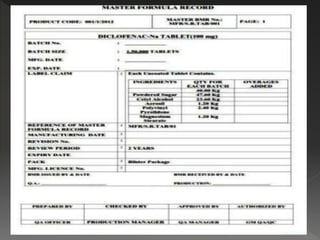
 Master Formula Record (MFR) is a master document for
any pharmaceutical product.
 MFR contains all information about the manufacturing
process for the product.
 MFR is prepared by the research and development
team of the company.
 MFR is used as reference standard for preparing batch
manufacturing record (BMR) by manufacturing units.
 MFR is also called Master Manufacturing Record,
Master Production Record.
 Definition
“A document or set of documents specifying the starting
materials with their quantities and the packaging
materials, together with a description of the procedures
and precautions required to produce a specified
quantity of a finished product as well as the processing
instructions, including the in-process controls.”
 MFR plays an important role in consistency for each
batch manufacturing.
MFR should include -
Product Details :
 Name, logo and address of the manufacturing
company.
 Dosage form name.
 Brand name.
 Generic name.
 Product code
 Label claim of all ingredients
 Product description
 Shelf life
 Storage conditions
 MFR number and date
 Supersede MFR number and date
 Effective batch number
 Authorization by the production and quality assurance head
 Batch size
 Pack size and packing style
 Flow Chart: Steps of the manufacturing process to be
monitored. Flowchart of the material movement from
dispensing to the final product to stores.
 Equipment: Create a list of all required equipment and
machines required in the manufacturing process
with their Quantity
 Special instructions: Write down the precautions special
instructions to follow during the product manufacturing and
packing and these should also be added in the batch
manufacturing formula.
 Calculations: Include the calculation steps of all active
materials to get the 100% of the active material. The
calculation shall be done using water or LOD to get
100% potency.
 Manufacturing Process: Write all steps in all stages of
the manufacturing process. All process steps like sifting,
milling, lubricating, granulation, compression and
coating should be written in detail including the process
time and yield. It also include atmospheric conditions as
temperature, humidity, and storage conditions for every
step.
 Packing Process: List of all packing materials with their
quantity is written. Line clearance, reconciliation of printed
and unprinted packing materials should be included in
details.
 Yield: Include the theoretical, actual yield and acceptance
limit of the batch.
We can’t ignore Master formula record at any level. Once
Master Formula Record is prepared, it is transferred to
previous staff to new staff. It is followed as standard for
processing a batch. Master Formula record is consider as
standard for making a Batch Manufacturing Record.
SOP for preparation of the Master Formula
Record:
RESPONSIBLE DEPARTMENTS:
 Primary Responsibility:
F&D and Production Department
 Secondary Responsibility:
Quality Assurance Department
 Accountability:
Head-Quality Assurance shall be responsible for
implementation of SOP.
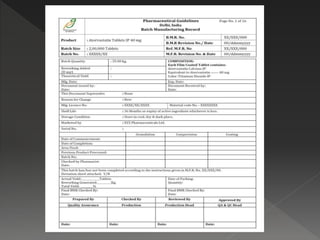
 Batch manufacturing record is a written document from
the batch that is prepared during the pharmaceutical
manufacturing process. It contains actual data of the
batch manufacturing process step by step.
 All stages are included in the BMR from issuance of raw
material to the final packaging.
 A good batch manufacturing record format should
contain following parts.
1) Batch record:
FIRST PAGE – batch number, batch size, composition,
MFR referred the weight of the batch, shelf life, storage
conditions, manufacturing license number,
manufacturing date, date of starting and date of
completion.
2) General instructions for manufacturing:
Health and safety instructions to the operators and the
manufacturing chemist are written those should be
followed during the manufacturing process regarding the
material and equipment used during manufacturing.
3)Equipment cleaning record:
Checklist of cleaning of instruments is prepared, those are
used in the manufacturing of the batch including the
previous product, batch and date of cleaning, cleaning of
the equipment should be checked by quality assurance.
4) Bill of materials:
List of the raw materials with their quantity and weight
should be verified by quality assurance department. If
tablet is coated then coating material should be
included.
5) manufacturing process:
Manufacturing procedure should be written step by step
in easy language. Milling, sifting, drying, lubrication,
compression, coating and packing having all instructions
with process time should be written. After completion of
each step, tablet must be checked for compliance of the
specifications for that step. Result must be attached with
the batch manufacturing record.
6) Yield :
Yield of batch should be calculated at the end of each
step to calculate process loss. Final yield should be
calculated at the end of the manufacturing that should not
be less than 99.00%
7) Abbreviations:
List of the abbreviations used in the document should be
made to understand the BMR easily.
8) History of changes:
At the end, the document should have a list of the
changes in the document including the revision number
and the date of the change.
 What are SOP’s?
Standard operating procedure is a set of written documents
that describes how to perform a routine operations within
your company.
A set of compulsory instructions or steps which is written so
that other individuals can follow to complete the job safely.
Reasons for having SOPs:
 To provide people with all the safety, health, environmental
and operational information.
 To ensure that processes continue uninterrupted and
completed on prescribed schedule and maintain quality of
process and product.
 To ensure that no failures occur in any processes.
 To ensure that approved procedures are followed in
compliance with company and government regulations.
 To serve as historical record of the whole process which
is done and have a basis of that when the process is
changed.
 Provide training and guidance for new staff.
 TYPES OF SOPs
1) Technical sop
2) Administrative sop
3) Master sop:
In addition to the various SOPs that are required, the
company has to first make an sop that defines how the
various SOPs will be made i.e. what kind of information,
structure and numbering system will be included in
various SOPs.
When do you use SOPs?
 Every day
 During an audit
 Orienting new staff
 Annual training
Why are SOPs are important?
 Describe how to perform routine activities
 Provide training aid
 Guide and standardize working procedure
 Ensure quality and integrity of data generated
 Provide an auditing tool
 Consistency
 Written documentation of proper procedure
 Toolbox for staff
 Documentation of staff training
 Keep language simple
 Short steps
 Use a direct instruction
 Indicate time scales
 Refer to other SOPs rather than re-write instructions
 Include flow charts, diagrams and/or photos if these
describe something better than words
 Avoid making it too long
 stepwise instructions are best.
 Level of detail is important
 Explain acronyms
 Avoid unnecessary specification
 Tenses should be used correctly.
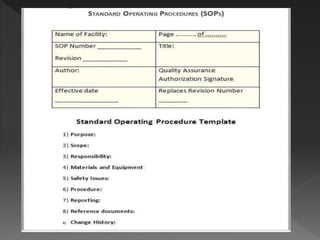
 What to include in SOPs?
 A title – short and to the point
 purpose
 Edition number
 Issue date – when did it come into use
 Scope
 Responsibility
 Applicable documents
 Safety considerations
 An introduction
 Preliminary operations
 Procedure
 Calculations
 Materials & Equipment
 Author – who to speak to if you have questions
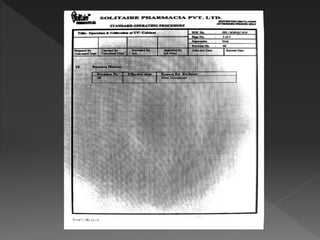
 Title: It should be brief and direct. It identifies purpose
of sop.
 Purpose : it restates sop title. It can also be used to
expand the purpose of procedure.
 Scope: scope of an sop describes what the sop does
and does not apply TO. One has to consider to what
and to whom the procedure applies and when it is to be
applied for writing scope of sops.
 Responsibility: it declares who is responsible for
performing the operations. Eg: department name,
individual within department.
 Reference and applicable documents: They may refer
to origin of procedure. It Describes the documents and
information that should be known and familiar before
reading and operating this SOP. Eg: journal reference for
analytical assay.
 Safety considerations: these should appear in all sops.
These include physical safety issues, Biological
contaminations issues, Chemical hazards, cleanup of
any spills that could occur during a procedure should
also be describe.
 Introduction/ procedural principle: it is an optional
part of sops. It helps technicians and reviewers to
understand the fundamental principles of the assay.
 Preliminary operations: it includes any operations that
should be completed before actual procedure is
initiated. Eg: in an assay preliminary operations might
be
A) preparations of sample
B) calibration of equipments
C) material checklist to ensure availability of all materials
required to complete the work.
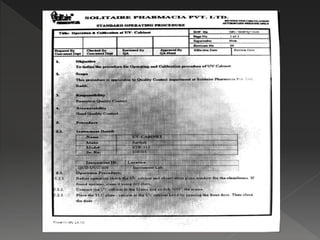
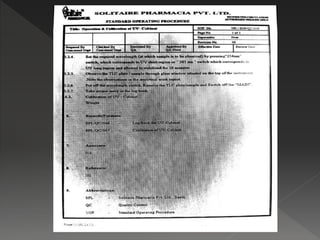
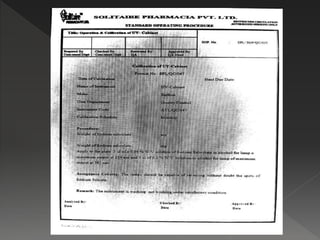
Procedures: this is main part of SOPs that explains step
by step how to perform particular task. It may also
include diagrams for easy understanding of the
instructions.
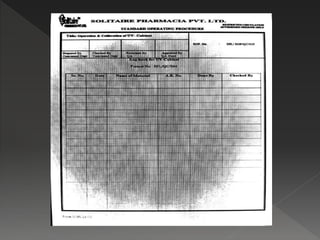
 Calculations: this section of sop should explain
how to calculate a final result. Examples can be
included to illustrate.
 All records including original data, lab notebook should
be retained for at least one year after the expiry date of
the batch.
 Master documents should be properly secured against
theft loss.
 Record may be retained on microfiche.
 Paper or film record should be stored to a restricted
access area
 All documents should be stored in the department in
such a fashion that their retrieval is easy.
 For this purpose following system may be adopted:
 A total list of documents should be made:
-The name of the document
-Location of availability
-Person to be contacted for retrieval.
 Any document on demand should be made available to
the demanding authority in reasonable period of time.
 Completed B.P.C.R. must always be kept under lock
and key under the control of QA department.
 Retrieval of any M.P.C.R. and the important documents
should be possible only on proper authorization of QA
department.
Book: Lachman lieberman's The theory and practice of Industrial
Pharmacy
 https://www.google.com/search?ei=mkOmXNT7HsWZmgfKoqHIB
Q&q=batch+manufacturing+record+pharmaguideline&oq=batch&gs
_l=psy-
ab.1.1.35i39l2j0i67l8.3796.7802..12211...1.0..4.804.4151.0j5j1j6-
4......0....1..gws-wiz.....6..0i71j0i131j0i131i67.qyv1Zjh45UY
 https://manoxblog.com/2018/05/29/sample-of-batch-manufacturing-
record-bmr-atorvastatin-pdf-download/
 https://www.google.com/url?sa=i&source=images&cd=&ved=2ahU
KEwi4qOnOgLfhAhVEg-
YKHfH4DEkQjRx6BAgBEAU&url=http%3A%2F%2Ftemplatelab.co
m%2Fsop-templates%2F&psig=AOvVaw2ppXFZmlCRVaCyZ-
MLliKz&ust=1554486763978547
 https://studylib.net/doc/6944080/sop---webnode
THANK YOU…

Documentation

  • 2.
     Documentation isa process that involves systematic interaction of people, events and documents (meaningful data in the form of paper, CD , computer file) to create the records of the organization. Documentation provides both:  Information on when, where, who, why, & how to complete tasks.  Evidence providing that the tasks have been completed as they should be.
  • 3.
     Clearly writtendocumentation prevents errors that may arise in casually written communication.  It provides assurance that quality related activities are carried out exactly the way they have been planned and approved.  The achievement of conformity and quality improvement. Purpose of documentation:  To ensure that there are specifications for all materials and methods of manufacture and control.  Employees know what to do.  Responsibilities and authorities are identified.
  • 4.
     Ensure thatauthorized persons have all information necessary for release.  Forms the basis for improvement.
  • 5.
     Master FormulaRecord (MFR) is a master document for any pharmaceutical product.  MFR contains all information about the manufacturing process for the product.  MFR is prepared by the research and development team of the company.  MFR is used as reference standard for preparing batch manufacturing record (BMR) by manufacturing units.  MFR is also called Master Manufacturing Record, Master Production Record.
  • 6.
     Definition “A documentor set of documents specifying the starting materials with their quantities and the packaging materials, together with a description of the procedures and precautions required to produce a specified quantity of a finished product as well as the processing instructions, including the in-process controls.”  MFR plays an important role in consistency for each batch manufacturing.
  • 7.
    MFR should include- Product Details :  Name, logo and address of the manufacturing company.  Dosage form name.  Brand name.  Generic name.  Product code  Label claim of all ingredients  Product description
  • 8.
     Shelf life Storage conditions  MFR number and date  Supersede MFR number and date  Effective batch number  Authorization by the production and quality assurance head  Batch size  Pack size and packing style
  • 9.
     Flow Chart:Steps of the manufacturing process to be monitored. Flowchart of the material movement from dispensing to the final product to stores.  Equipment: Create a list of all required equipment and machines required in the manufacturing process with their Quantity  Special instructions: Write down the precautions special instructions to follow during the product manufacturing and packing and these should also be added in the batch manufacturing formula.
  • 10.
     Calculations: Includethe calculation steps of all active materials to get the 100% of the active material. The calculation shall be done using water or LOD to get 100% potency.  Manufacturing Process: Write all steps in all stages of the manufacturing process. All process steps like sifting, milling, lubricating, granulation, compression and coating should be written in detail including the process time and yield. It also include atmospheric conditions as temperature, humidity, and storage conditions for every step.
  • 11.
     Packing Process:List of all packing materials with their quantity is written. Line clearance, reconciliation of printed and unprinted packing materials should be included in details.  Yield: Include the theoretical, actual yield and acceptance limit of the batch. We can’t ignore Master formula record at any level. Once Master Formula Record is prepared, it is transferred to previous staff to new staff. It is followed as standard for processing a batch. Master Formula record is consider as standard for making a Batch Manufacturing Record.
  • 12.
    SOP for preparationof the Master Formula Record: RESPONSIBLE DEPARTMENTS:  Primary Responsibility: F&D and Production Department  Secondary Responsibility: Quality Assurance Department  Accountability: Head-Quality Assurance shall be responsible for implementation of SOP.
  • 14.
     Batch manufacturingrecord is a written document from the batch that is prepared during the pharmaceutical manufacturing process. It contains actual data of the batch manufacturing process step by step.  All stages are included in the BMR from issuance of raw material to the final packaging.  A good batch manufacturing record format should contain following parts. 1) Batch record: FIRST PAGE – batch number, batch size, composition, MFR referred the weight of the batch, shelf life, storage conditions, manufacturing license number, manufacturing date, date of starting and date of completion.
  • 15.
    2) General instructionsfor manufacturing: Health and safety instructions to the operators and the manufacturing chemist are written those should be followed during the manufacturing process regarding the material and equipment used during manufacturing. 3)Equipment cleaning record: Checklist of cleaning of instruments is prepared, those are used in the manufacturing of the batch including the previous product, batch and date of cleaning, cleaning of the equipment should be checked by quality assurance.
  • 16.
    4) Bill ofmaterials: List of the raw materials with their quantity and weight should be verified by quality assurance department. If tablet is coated then coating material should be included. 5) manufacturing process: Manufacturing procedure should be written step by step in easy language. Milling, sifting, drying, lubrication, compression, coating and packing having all instructions with process time should be written. After completion of each step, tablet must be checked for compliance of the specifications for that step. Result must be attached with the batch manufacturing record.
  • 17.
    6) Yield : Yieldof batch should be calculated at the end of each step to calculate process loss. Final yield should be calculated at the end of the manufacturing that should not be less than 99.00% 7) Abbreviations: List of the abbreviations used in the document should be made to understand the BMR easily. 8) History of changes: At the end, the document should have a list of the changes in the document including the revision number and the date of the change.
  • 19.
     What areSOP’s? Standard operating procedure is a set of written documents that describes how to perform a routine operations within your company. A set of compulsory instructions or steps which is written so that other individuals can follow to complete the job safely. Reasons for having SOPs:  To provide people with all the safety, health, environmental and operational information.  To ensure that processes continue uninterrupted and completed on prescribed schedule and maintain quality of process and product.
  • 20.
     To ensurethat no failures occur in any processes.  To ensure that approved procedures are followed in compliance with company and government regulations.  To serve as historical record of the whole process which is done and have a basis of that when the process is changed.  Provide training and guidance for new staff.
  • 21.
     TYPES OFSOPs 1) Technical sop 2) Administrative sop 3) Master sop: In addition to the various SOPs that are required, the company has to first make an sop that defines how the various SOPs will be made i.e. what kind of information, structure and numbering system will be included in various SOPs.
  • 22.
    When do youuse SOPs?  Every day  During an audit  Orienting new staff  Annual training
  • 23.
    Why are SOPsare important?  Describe how to perform routine activities  Provide training aid  Guide and standardize working procedure  Ensure quality and integrity of data generated  Provide an auditing tool  Consistency  Written documentation of proper procedure  Toolbox for staff  Documentation of staff training
  • 24.
     Keep languagesimple  Short steps  Use a direct instruction  Indicate time scales  Refer to other SOPs rather than re-write instructions  Include flow charts, diagrams and/or photos if these describe something better than words  Avoid making it too long  stepwise instructions are best.  Level of detail is important  Explain acronyms  Avoid unnecessary specification  Tenses should be used correctly.
  • 25.
     What toinclude in SOPs?  A title – short and to the point  purpose  Edition number  Issue date – when did it come into use  Scope  Responsibility  Applicable documents  Safety considerations  An introduction  Preliminary operations  Procedure  Calculations  Materials & Equipment  Author – who to speak to if you have questions
  • 26.
     Title: Itshould be brief and direct. It identifies purpose of sop.  Purpose : it restates sop title. It can also be used to expand the purpose of procedure.  Scope: scope of an sop describes what the sop does and does not apply TO. One has to consider to what and to whom the procedure applies and when it is to be applied for writing scope of sops.  Responsibility: it declares who is responsible for performing the operations. Eg: department name, individual within department.
  • 27.
     Reference andapplicable documents: They may refer to origin of procedure. It Describes the documents and information that should be known and familiar before reading and operating this SOP. Eg: journal reference for analytical assay.  Safety considerations: these should appear in all sops. These include physical safety issues, Biological contaminations issues, Chemical hazards, cleanup of any spills that could occur during a procedure should also be describe.  Introduction/ procedural principle: it is an optional part of sops. It helps technicians and reviewers to understand the fundamental principles of the assay.
  • 28.
     Preliminary operations:it includes any operations that should be completed before actual procedure is initiated. Eg: in an assay preliminary operations might be A) preparations of sample B) calibration of equipments C) material checklist to ensure availability of all materials required to complete the work. Procedures: this is main part of SOPs that explains step by step how to perform particular task. It may also include diagrams for easy understanding of the instructions.
  • 29.
     Calculations: thissection of sop should explain how to calculate a final result. Examples can be included to illustrate.
  • 36.
     All recordsincluding original data, lab notebook should be retained for at least one year after the expiry date of the batch.  Master documents should be properly secured against theft loss.  Record may be retained on microfiche.  Paper or film record should be stored to a restricted access area  All documents should be stored in the department in such a fashion that their retrieval is easy.
  • 37.
     For thispurpose following system may be adopted:  A total list of documents should be made: -The name of the document -Location of availability -Person to be contacted for retrieval.  Any document on demand should be made available to the demanding authority in reasonable period of time.  Completed B.P.C.R. must always be kept under lock and key under the control of QA department.  Retrieval of any M.P.C.R. and the important documents should be possible only on proper authorization of QA department.
  • 38.
    Book: Lachman lieberman'sThe theory and practice of Industrial Pharmacy  https://www.google.com/search?ei=mkOmXNT7HsWZmgfKoqHIB Q&q=batch+manufacturing+record+pharmaguideline&oq=batch&gs _l=psy- ab.1.1.35i39l2j0i67l8.3796.7802..12211...1.0..4.804.4151.0j5j1j6- 4......0....1..gws-wiz.....6..0i71j0i131j0i131i67.qyv1Zjh45UY  https://manoxblog.com/2018/05/29/sample-of-batch-manufacturing- record-bmr-atorvastatin-pdf-download/  https://www.google.com/url?sa=i&source=images&cd=&ved=2ahU KEwi4qOnOgLfhAhVEg- YKHfH4DEkQjRx6BAgBEAU&url=http%3A%2F%2Ftemplatelab.co m%2Fsop-templates%2F&psig=AOvVaw2ppXFZmlCRVaCyZ- MLliKz&ust=1554486763978547  https://studylib.net/doc/6944080/sop---webnode
  • 39.