Standard operating procedure in pharmaceutical industries
Presented by
Ms. Rashmi Nasare
M. Pharm 1nd yr
Under the supervision of
Dr. Sheelpriya Walde
Professor
1
contents
 Introduction
 Aim of SOP
 Objectives
 Benefit
 Purpose
 SOP writing style
 SOP format
 Do’s
 Don’ts
 General format for SOP
 SOP Process
 What kind of SOP needed?
 Types of SOP
 SOP Content
 SOP Development 2
Introduction
 Definition:-
Standard operating procedure is a step by
step procedure or directions as established by a
quality square industry involved in facility producing
,testing or research.
 A standard operating procedure does not required
or need Explaination or publication because it is
standard.
 SOP is the set of step by step written instructions
intended to document how to perform routinely.
 They are the back bone of pharmaceutical
industry. 3
Continued….
 They are the back bone of pharmaceutical industry.
 Integral part of QUALITY ASSURANCE (QA).
 Provides details of appropriate quality, cost & time
constraints.
 Standard operating is an also part of CGMP & GDP
(Good documentation practices).
4
Aims of the sop
 Create the culture where quality objectives are
transparent & well understand.
 To achieve quality output.
 To achieve uniformity of performance.
 To achieve uniformity of quality.
5
OBJECTIVES
 To maintain the quality control & quality assurance.
 To serve as a training document for teaching users
about the process for which the SOP was written.
 To facilitate consistent conformance to quality
system requirements & to support data quality.
 To provide guidelines for accurate & timely data
collection.
 Reduce miscommunication & failure to comply with
industry regulation.
 To carry out operations correctively & always in
same manner. 6
benefits
 To provide people with all safety, health,
environmental & operational information necessary
to perform the job properly.
 Serves as a training document for users.
 Minimizes variation & promotes quality. Steps can be
reviewed in accident variations.
 Useful tool for training new members of staff.
 SOP assist to ensure that GMP is followed & achieved
at all times.
 SOP’s help to assure the quality & consistency of the
services, & thus minimize harm to the patient. 7
Purpose of sop
 Describe how to perform routine activities
 Provide & training aid
 Guide & standardize working procedures
 Ensure quality & integrity of data
generated/information captured
 Reconstructions/repeatability
 Provide an auditing tool
8
SOP writing style
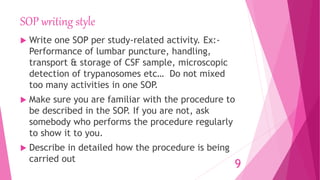
 Write one SOP per study-related activity. Ex:-
Performance of lumbar puncture, handling,
transport & storage of CSF sample, microscopic
detection of trypanosomes etc… Do not mixed
too many activities in one SOP
.
 Make sure you are familiar with the procedure to
be described in the SOP. If you are not, ask
somebody who performs the procedure regularly
to show it to you.
 Describe in detailed how the procedure is being
carried out
9
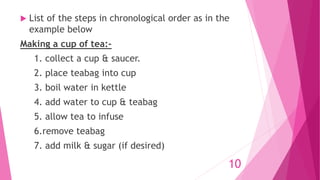
 List of the steps in chronological order as in the
example below
Making a cup of tea:-
1. collect a cup & saucer.
2. place teabag into cup
3. boil water in kettle
4. add water to cup & teabag
5. allow tea to infuse
6.remove teabag
7. add milk & sugar (if desired)
10
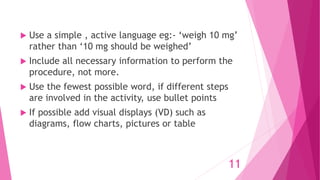
 Use a simple , active language eg:- ‘weigh 10 mg’
rather than ‘10 mg should be weighed’
 Include all necessary information to perform the
procedure, not more.
 Use the fewest possible word, if different steps
are involved in the activity, use bullet points
 If possible add visual displays (VD) such as
diagrams, flow charts, pictures or table
11
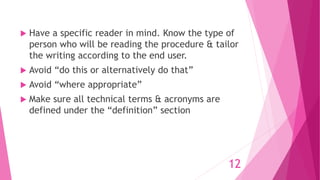
 Have a specific reader in mind. Know the type of
person who will be reading the procedure & tailor
the writing according to the end user.
 Avoid “do this or alternatively do that”
 Avoid “where appropriate”
 Make sure all technical terms & acronyms are
defined under the “definition” section
12
SOP format
 Each SOP format should have a unique identifier
which include:-
 The number of the work package under which the
SOP is being developed
 An acronym referring to the type of the procedure
(LAB; for laboratory SOP, DOC; for SOP related to
documentation management, CLIN; for clinical
SOP, DATA ; for SOP related to data management,
QUAL; for SOP related to Quality assurance (QA) &
Quality control (QC)
 The number of the SOP
13
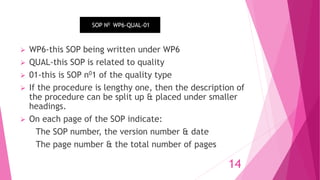
 WP6-this SOP being written under WP6
 QUAL-this SOP is related to quality
 01-this is SOP n01 of the quality type
 If the procedure is lengthy one, then the description of
the procedure can be split up & placed under smaller
headings.
 On each page of the SOP indicate:
The SOP number, the version number & date
The page number & the total number of pages
SOP N0 WP6-QUAL-01
14
 Write in present tense. don’t use past tense,
condition of future tense unless you have good
reason to do so.
 Avoid ambiguity & be concise.
 Reduce the word count where possible without
changing the meaning of the text.
 Highlights exceptions. Use a symbol to flag that
this is an exceptions & how to handle it.
 Highlight warnings & use a longer or a warning
icon. 15
Don’ts
 Introduce acronyms without explaining what it
means.
 Don’t use the word “may”, “ if possible” as it
implies that the user can do something under
conditions. Instead be positive & tell them what
to do.
16
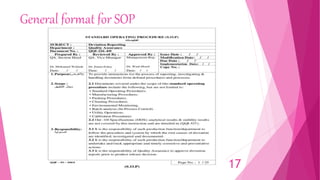
General format for SOP
17
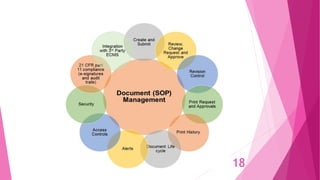
18
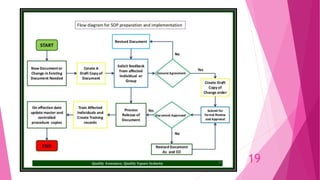
19
Persons having authorization may include:-
 Nominee of local staff, expert in his own field &
familiar with GMP
 General manager (Production)
 General manager (Quality Control)
 General manager (Quality Assurance)
 Nominee of management (may be technical
director)
20
Sop process
 Sop Preparation
 Sop Review & Approval
 Frequency of revisions & reviews
 Implementing SOP
 Management of SOP
21
Sop preparation
should be written by individual knowledge with the activity &
subject matter experts.
 Those who will perform job
 Those who will perform maintenance on equipment
involved in an SOP
 Technical initiator
 Safety personnel
 Engineers or others who design equipment & process
 Environmental personnel
 Equipment manufacturers
22
SOP review & approval
Review factors & criteria are:-
 Adherence to standard
 Consistency & traceability
 Readability, comprehensibility,& general understandability
 Technical adequacy & feasibility of approach
 Degree of completeness
 Testability of requirements
 Use of appropriate requirement, design, or coding
techniques
 Appropriate level of details
23
SOP Revisions
Routine revision:-
 At the end of the review period by HOD concerned
to the particular SOP will review & revise if
required.
 If there is no changes then HOD just gives the
review report that this SOP doesn’t require review
& continue the same for the next review project.
24
Implementing SOP
 The most important step for SOP in working area,
train or retain the user.
 While training the user, trainer should share the
reason WHY,SOP must performed correctly.
People are much more to follow when they
understand importance of procedure.
25
Management of SOP
 There should be the record for issue &
distribution of the SOP’s.
 It is the responsibility of the process owner to
 Ensure that SOP’s are current.
 Distributes SOP’s.
 Eliminate obsolete SOP’s.
 Continuously improve the system.
 Ensure that SOP’s meet their quality requirement
& are user friendly.
26
What kind of SOPs are needed?
 Routine instrument maintenance?
 Glassware washing?
 QAU?
 Computer?
 SOP for SOPs?
 Analytical method?
 Specific procedure for initial research project?
27
Types of SOP
 SOP’s may be written for any repetitive TECHNICAL activity,
as well as for any administrative or functional programmatic
procedure, that is being followed within an organization.
 The types of SOP’s are:
1)Technical SOP:-focuses more on technical activities such as
how to collect a laboratory sample & how to fix the R2 engine.
2) Administrative/fundamental programmatic SOP:-highlights
on the administrative process such as reviewing contract
documentation & determining organizational training needs.
28
Reasons for having SOP’s
 To provide people with all the safety, health,
environmental & operational information.
 To ensure that no failure occur in any processes.
 To ensure that approved procedures are followed in
compliance with company & government regulations.
 To serve as an historical record of the hole process
which is done & have a basis of that when the process
is changed.
 Provide training & guidance for new staff.
29
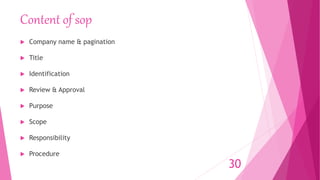
Content of sop
 Company name & pagination
 Title
 Identification
 Review & Approval
 Purpose
 Scope
 Responsibility
 Procedure
30
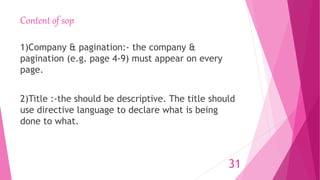
Content of sop
1)Company & pagination:- the company &
pagination (e.g. page 4-9) must appear on every
page.
2)Title :-the should be descriptive. The title should
use directive language to declare what is being
done to what.
31
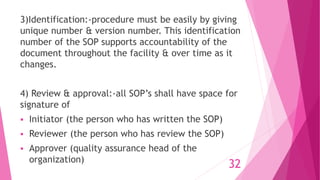
3)Identification:-procedure must be easily by giving
unique number & version number. This identification
number of the SOP supports accountability of the
document throughout the facility & over time as it
changes.
4) Review & approval:-all SOP’s shall have space for
signature of
 Initiator (the person who has written the SOP)
 Reviewer (the person who has review the SOP)
 Approver (quality assurance head of the
organization)
32
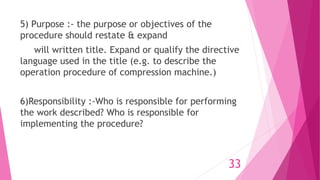
5) Purpose :- the purpose or objectives of the
procedure should restate & expand
will written title. Expand or qualify the directive
language used in the title (e.g. to describe the
operation procedure of compression machine.)
6)Responsibility :-Who is responsible for performing
the work described? Who is responsible for
implementing the procedure?
33
7) Scope:- The scope should provide limits into the use
procedure.
 Where is the SOP to be used & where is not applicable,
e.g. Area, process, department, stage?
 Who is the sop for & aimed at, e.g. Operator, manager,
QA person?
 Are there any specific limitations or expectation that
need to be called out?
8) Procedure:- described the procedure in a step by step,
chronological manner. Use active verbs & direct
statements. 34
How to use SOP’s
 Manager use SOPs to communicate to staff & explain how
to perform certain company operations.
 Employees can use SOPs for reference when learning to
complete certain tasks according to established
protocols.
 Regulatory agencies, such as the food & drug
administration, use SOPs when determining whether a
company’s processes meet agency standards.
 Section of fundamental principles can be include :
 Preliminary steps that must be done before beginning of
actual procedure.
 Safety consideration.
 The chronological instructions.
 Calculations. 35
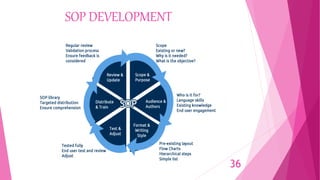
SOP DEVELOPMENT
36
Master batch record
 Master batch record, also known as Master
Production Records.
 Dietary supplements manufacturing facilities are
required to create these documents & keep them
on file, but what exactly is the FDA looking for in a
Master Batch Record.
 Master batch record contains all information about
the manufacturing process for the product.
 Master batch is prepared by the research &
development team of the company.
 MBR is used as reference standard for preparing
batch manufacturing record by manufacturing
units. 37
Master batch record Should include-
Product details:-
o Name, logo & address of the manufacturing company.
o Dosage form name.
o Brand name.
o Generic name.
o Product code
o Label claim of all ingredients
o Product description
o Batch size
o Pack size & packing style
o Manufacturing process 38
o Shelf life
o Storage condition
o MBR number & date
o Supersede MBR number & date
o Effective batch number
o Authorization by the production & quality assurance
o Head
o Flowchart
o Equipment
o Special instructions
o Calculation
o Packing process
o Yield 39
Batch manufacturing record
 Batch manufacturing record (BMR) here “BMR” stands for
batch manufacturing record.
 This is one type of document which is produce & batch
specific document which gives entire picture of
manufacturing history of each batch of every product.
 The “batch manufacturing record” is the necessary quality
& GMP documentation for tracing the complete cycle of
manufacturing batch or lot.
 The batch manufacturing record should be checked before
issuance to assure that it is the correct & a legible
accurate reproduction of the appropriate master
production instruction.
40
Batch manufacturing record includes following things which
is based on master formula record.
 Name of product
 Trade name
 Specification of raw material
 Name of raw material
 Specification of container, closure & packing
material
 Name of items
 Weighment sheet
 Dispensing instruction
 List of equipment & machinery 41
 Packaging requirement
 Packaging instructions
 Precaution to be taken
 Finished product specification
 Expiry date
 Review due on.
42
Conclusion
 SOP’s serve as fundamental means of communication for
all levels of the organization.
 Not only do they involve employees departmentally, but
they also allow management & employees to gain a cross-
functional view of organization.
 This approach encourages employees to think about how
process change may affect other functional areas.
 It shall be noted that the best written SOP’s will fail if
they are not followed.
 A good system forces employee to think through processes
& examine how procedure might affect product,
personnel, production, & equipment.
43
reference
1) ISOP journal of pharmacy €-ISSN:-2250-3013,(P)-ISSN:2319-
4219 www.isophr.org volume 5,issue 1 (January 2015),pp:-29-
36
2)http://www.pharmainfo.net/reviews/SOP
3)http://www.werum.com
4)http://m.authorstream.com/presentation/gosaimadhuri-
1561524-BMR
5)http://www.slideshare.net/mobile/simran4/SOP
6)Quality assurance book by D H Shah 2nd edition pg. no.2-6
7) SOP Guideline book by D H Shah 4th edition pg. no2-10
44
45
Thank you

soppresentation-191116160454.pdf

  • 1.
    Standard operating procedurein pharmaceutical industries Presented by Ms. Rashmi Nasare M. Pharm 1nd yr Under the supervision of Dr. Sheelpriya Walde Professor 1
  • 2.
    contents  Introduction  Aimof SOP  Objectives  Benefit  Purpose  SOP writing style  SOP format  Do’s  Don’ts  General format for SOP  SOP Process  What kind of SOP needed?  Types of SOP  SOP Content  SOP Development 2
  • 3.
    Introduction  Definition:- Standard operatingprocedure is a step by step procedure or directions as established by a quality square industry involved in facility producing ,testing or research.  A standard operating procedure does not required or need Explaination or publication because it is standard.  SOP is the set of step by step written instructions intended to document how to perform routinely.  They are the back bone of pharmaceutical industry. 3
  • 4.
    Continued….  They arethe back bone of pharmaceutical industry.  Integral part of QUALITY ASSURANCE (QA).  Provides details of appropriate quality, cost & time constraints.  Standard operating is an also part of CGMP & GDP (Good documentation practices). 4
  • 5.
    Aims of thesop  Create the culture where quality objectives are transparent & well understand.  To achieve quality output.  To achieve uniformity of performance.  To achieve uniformity of quality. 5
  • 6.
    OBJECTIVES  To maintainthe quality control & quality assurance.  To serve as a training document for teaching users about the process for which the SOP was written.  To facilitate consistent conformance to quality system requirements & to support data quality.  To provide guidelines for accurate & timely data collection.  Reduce miscommunication & failure to comply with industry regulation.  To carry out operations correctively & always in same manner. 6
  • 7.
    benefits  To providepeople with all safety, health, environmental & operational information necessary to perform the job properly.  Serves as a training document for users.  Minimizes variation & promotes quality. Steps can be reviewed in accident variations.  Useful tool for training new members of staff.  SOP assist to ensure that GMP is followed & achieved at all times.  SOP’s help to assure the quality & consistency of the services, & thus minimize harm to the patient. 7
  • 8.
    Purpose of sop Describe how to perform routine activities  Provide & training aid  Guide & standardize working procedures  Ensure quality & integrity of data generated/information captured  Reconstructions/repeatability  Provide an auditing tool 8
  • 9.
    SOP writing style Write one SOP per study-related activity. Ex:- Performance of lumbar puncture, handling, transport & storage of CSF sample, microscopic detection of trypanosomes etc… Do not mixed too many activities in one SOP .  Make sure you are familiar with the procedure to be described in the SOP. If you are not, ask somebody who performs the procedure regularly to show it to you.  Describe in detailed how the procedure is being carried out 9
  • 10.
     List ofthe steps in chronological order as in the example below Making a cup of tea:- 1. collect a cup & saucer. 2. place teabag into cup 3. boil water in kettle 4. add water to cup & teabag 5. allow tea to infuse 6.remove teabag 7. add milk & sugar (if desired) 10
  • 11.
     Use asimple , active language eg:- ‘weigh 10 mg’ rather than ‘10 mg should be weighed’  Include all necessary information to perform the procedure, not more.  Use the fewest possible word, if different steps are involved in the activity, use bullet points  If possible add visual displays (VD) such as diagrams, flow charts, pictures or table 11
  • 12.
     Have aspecific reader in mind. Know the type of person who will be reading the procedure & tailor the writing according to the end user.  Avoid “do this or alternatively do that”  Avoid “where appropriate”  Make sure all technical terms & acronyms are defined under the “definition” section 12
  • 13.
    SOP format  EachSOP format should have a unique identifier which include:-  The number of the work package under which the SOP is being developed  An acronym referring to the type of the procedure (LAB; for laboratory SOP, DOC; for SOP related to documentation management, CLIN; for clinical SOP, DATA ; for SOP related to data management, QUAL; for SOP related to Quality assurance (QA) & Quality control (QC)  The number of the SOP 13
  • 14.
     WP6-this SOPbeing written under WP6  QUAL-this SOP is related to quality  01-this is SOP n01 of the quality type  If the procedure is lengthy one, then the description of the procedure can be split up & placed under smaller headings.  On each page of the SOP indicate: The SOP number, the version number & date The page number & the total number of pages SOP N0 WP6-QUAL-01 14
  • 15.
     Write inpresent tense. don’t use past tense, condition of future tense unless you have good reason to do so.  Avoid ambiguity & be concise.  Reduce the word count where possible without changing the meaning of the text.  Highlights exceptions. Use a symbol to flag that this is an exceptions & how to handle it.  Highlight warnings & use a longer or a warning icon. 15
  • 16.
    Don’ts  Introduce acronymswithout explaining what it means.  Don’t use the word “may”, “ if possible” as it implies that the user can do something under conditions. Instead be positive & tell them what to do. 16
  • 17.
  • 18.
  • 19.
  • 20.
    Persons having authorizationmay include:-  Nominee of local staff, expert in his own field & familiar with GMP  General manager (Production)  General manager (Quality Control)  General manager (Quality Assurance)  Nominee of management (may be technical director) 20
  • 21.
    Sop process  SopPreparation  Sop Review & Approval  Frequency of revisions & reviews  Implementing SOP  Management of SOP 21
  • 22.
    Sop preparation should bewritten by individual knowledge with the activity & subject matter experts.  Those who will perform job  Those who will perform maintenance on equipment involved in an SOP  Technical initiator  Safety personnel  Engineers or others who design equipment & process  Environmental personnel  Equipment manufacturers 22
  • 23.
    SOP review &approval Review factors & criteria are:-  Adherence to standard  Consistency & traceability  Readability, comprehensibility,& general understandability  Technical adequacy & feasibility of approach  Degree of completeness  Testability of requirements  Use of appropriate requirement, design, or coding techniques  Appropriate level of details 23
  • 24.
    SOP Revisions Routine revision:- At the end of the review period by HOD concerned to the particular SOP will review & revise if required.  If there is no changes then HOD just gives the review report that this SOP doesn’t require review & continue the same for the next review project. 24
  • 25.
    Implementing SOP  Themost important step for SOP in working area, train or retain the user.  While training the user, trainer should share the reason WHY,SOP must performed correctly. People are much more to follow when they understand importance of procedure. 25
  • 26.
    Management of SOP There should be the record for issue & distribution of the SOP’s.  It is the responsibility of the process owner to  Ensure that SOP’s are current.  Distributes SOP’s.  Eliminate obsolete SOP’s.  Continuously improve the system.  Ensure that SOP’s meet their quality requirement & are user friendly. 26
  • 27.
    What kind ofSOPs are needed?  Routine instrument maintenance?  Glassware washing?  QAU?  Computer?  SOP for SOPs?  Analytical method?  Specific procedure for initial research project? 27
  • 28.
    Types of SOP SOP’s may be written for any repetitive TECHNICAL activity, as well as for any administrative or functional programmatic procedure, that is being followed within an organization.  The types of SOP’s are: 1)Technical SOP:-focuses more on technical activities such as how to collect a laboratory sample & how to fix the R2 engine. 2) Administrative/fundamental programmatic SOP:-highlights on the administrative process such as reviewing contract documentation & determining organizational training needs. 28
  • 29.
    Reasons for havingSOP’s  To provide people with all the safety, health, environmental & operational information.  To ensure that no failure occur in any processes.  To ensure that approved procedures are followed in compliance with company & government regulations.  To serve as an historical record of the hole process which is done & have a basis of that when the process is changed.  Provide training & guidance for new staff. 29
  • 30.
    Content of sop Company name & pagination  Title  Identification  Review & Approval  Purpose  Scope  Responsibility  Procedure 30
  • 31.
    Content of sop 1)Company& pagination:- the company & pagination (e.g. page 4-9) must appear on every page. 2)Title :-the should be descriptive. The title should use directive language to declare what is being done to what. 31
  • 32.
    3)Identification:-procedure must beeasily by giving unique number & version number. This identification number of the SOP supports accountability of the document throughout the facility & over time as it changes. 4) Review & approval:-all SOP’s shall have space for signature of  Initiator (the person who has written the SOP)  Reviewer (the person who has review the SOP)  Approver (quality assurance head of the organization) 32
  • 33.
    5) Purpose :-the purpose or objectives of the procedure should restate & expand will written title. Expand or qualify the directive language used in the title (e.g. to describe the operation procedure of compression machine.) 6)Responsibility :-Who is responsible for performing the work described? Who is responsible for implementing the procedure? 33
  • 34.
    7) Scope:- Thescope should provide limits into the use procedure.  Where is the SOP to be used & where is not applicable, e.g. Area, process, department, stage?  Who is the sop for & aimed at, e.g. Operator, manager, QA person?  Are there any specific limitations or expectation that need to be called out? 8) Procedure:- described the procedure in a step by step, chronological manner. Use active verbs & direct statements. 34
  • 35.
    How to useSOP’s  Manager use SOPs to communicate to staff & explain how to perform certain company operations.  Employees can use SOPs for reference when learning to complete certain tasks according to established protocols.  Regulatory agencies, such as the food & drug administration, use SOPs when determining whether a company’s processes meet agency standards.  Section of fundamental principles can be include :  Preliminary steps that must be done before beginning of actual procedure.  Safety consideration.  The chronological instructions.  Calculations. 35
  • 36.
  • 37.
    Master batch record Master batch record, also known as Master Production Records.  Dietary supplements manufacturing facilities are required to create these documents & keep them on file, but what exactly is the FDA looking for in a Master Batch Record.  Master batch record contains all information about the manufacturing process for the product.  Master batch is prepared by the research & development team of the company.  MBR is used as reference standard for preparing batch manufacturing record by manufacturing units. 37
  • 38.
    Master batch recordShould include- Product details:- o Name, logo & address of the manufacturing company. o Dosage form name. o Brand name. o Generic name. o Product code o Label claim of all ingredients o Product description o Batch size o Pack size & packing style o Manufacturing process 38
  • 39.
    o Shelf life oStorage condition o MBR number & date o Supersede MBR number & date o Effective batch number o Authorization by the production & quality assurance o Head o Flowchart o Equipment o Special instructions o Calculation o Packing process o Yield 39
  • 40.
    Batch manufacturing record Batch manufacturing record (BMR) here “BMR” stands for batch manufacturing record.  This is one type of document which is produce & batch specific document which gives entire picture of manufacturing history of each batch of every product.  The “batch manufacturing record” is the necessary quality & GMP documentation for tracing the complete cycle of manufacturing batch or lot.  The batch manufacturing record should be checked before issuance to assure that it is the correct & a legible accurate reproduction of the appropriate master production instruction. 40
  • 41.
    Batch manufacturing recordincludes following things which is based on master formula record.  Name of product  Trade name  Specification of raw material  Name of raw material  Specification of container, closure & packing material  Name of items  Weighment sheet  Dispensing instruction  List of equipment & machinery 41
  • 42.
     Packaging requirement Packaging instructions  Precaution to be taken  Finished product specification  Expiry date  Review due on. 42
  • 43.
    Conclusion  SOP’s serveas fundamental means of communication for all levels of the organization.  Not only do they involve employees departmentally, but they also allow management & employees to gain a cross- functional view of organization.  This approach encourages employees to think about how process change may affect other functional areas.  It shall be noted that the best written SOP’s will fail if they are not followed.  A good system forces employee to think through processes & examine how procedure might affect product, personnel, production, & equipment. 43
  • 44.
    reference 1) ISOP journalof pharmacy €-ISSN:-2250-3013,(P)-ISSN:2319- 4219 www.isophr.org volume 5,issue 1 (January 2015),pp:-29- 36 2)http://www.pharmainfo.net/reviews/SOP 3)http://www.werum.com 4)http://m.authorstream.com/presentation/gosaimadhuri- 1561524-BMR 5)http://www.slideshare.net/mobile/simran4/SOP 6)Quality assurance book by D H Shah 2nd edition pg. no.2-6 7) SOP Guideline book by D H Shah 4th edition pg. no2-10 44
  • 45.