11
Research Support &
Regulatory Affairs
Quality Assurance Unit
WRITING STANDARD
OPERATING PROCEDURES
(SOPs)
22
WHAT IS AN SOP?
33
WHY WRITE SOPs?
44
55
GOALS
• Define what is an SOP
• State reasons for writing SOPs
• Describe the different formats for SOPs
• Describe how to write an SOP
66
WHAT IS AN SOP?
77
WHAT IS AN SOP?
Standard operating procedures are a set of
instructions having the force of a directive, covering
those features of operations that lend themselves to
a definite or standardized procedure without loss of
effectiveness.
en.wikipedia.org/wiki/Standard_Operating_Procedures
88
WHAT IS AN SOP?
An SOP is a set of instructions or steps someone
follows to complete a job safely, with no adverse
impact on the environment (and which meets
regulatory compliance standards), and in a way that
maximizes operational and production requirements.
Kenneth A. Friedman, PhD
Department of Journalism and Communication
Lehigh University, Bethlehem, PA
99
WHAT IS AN SOP?
An SOP is a set of written instructions that document
a routine or repetitive activity.
EPA Quality System
Frequent Questions – Standard
Operating Procedures (SOPs)
www.epa.gov/quality/faq7.html
1010
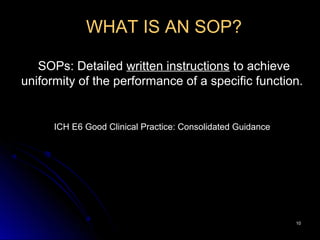
WHAT IS AN SOP?
SOPs: Detailed written instructions to achieve
uniformity of the performance of a specific function.
ICH E6 Good Clinical Practice: Consolidated Guidance
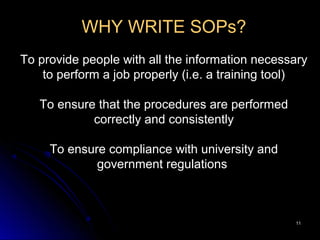
1111
WHY WRITE SOPs?
To provide people with all the information necessary
to perform a job properly (i.e. a training tool)
To ensure that the procedures are performed
correctly and consistently
To ensure compliance with university and
government regulations
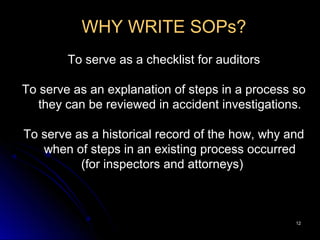
1212
WHY WRITE SOPs?
To serve as a checklist for auditors
To serve as an explanation of steps in a process so
they can be reviewed in accident investigations.
To serve as a historical record of the how, why and
when of steps in an existing process occurred
(for inspectors and attorneys)
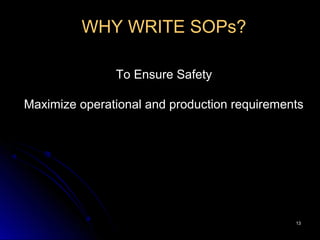
1313
WHY WRITE SOPs?
To Ensure Safety
Maximize operational and production requirements
1414
WHY WRITE SOPs?
To Ensure Consistent Training
To Ensure Correct and Consistent Performance
To Ensure Regulatory Compliance
1515
WHY WRITE SOPs?
To Ensure Consistent Training
To Ensure Correct and Consistent Performance
To Ensure Regulatory Compliance
Just Because It Makes Good Sense
1616
WHY WRITE SOPs?
Because historically many have not exercised good
sense and failed to provide adequate training and
consistency in performance, product or process
failures have resulted in harm to animals, research
subjects and patients.
1717
WHY WRITE SOPs?
The FDA Has Placed Us In An Environment of
Regulatory Compliance!!!!
1818
WHY WRITE SOPs?
Most regulatory and accrediting agencies require that
those who perform procedures have the education,
experience and training to do so.
1919
WHY WRITE SOPs?
SOPs are the foundation of training!
2020
REGULATORY REQUIREMENTS
Good Manufacturing Practice
21 CFR 211.100
There shall be written procedures for production and
process control designed to assure that the drug
products have the identity, strength, quality, and
purity they purport or are represented to possess.
2121
REGULATORY REQUIREMENTS
Good Laboratory Practice
21 CFR 58.81(a)
A testing facility shall have standard operating
procedures in writing setting forth nonclinical
laboratory study methods that management is
satisfied are adequate to insure the quality and
integrity of the data generated in the course of a
study.
2222
REGULATORY REQUIREMENTS
Good Tissue Practice
21 CFR 1271.180
You must establish and maintain procedures
appropriate to meet core CGTP requirements for all
steps that you perform in the manufacture of
HCT/Ps. You must design these procedures to
prevent circumstances that increase the risk of the
introduction, transmission, or spread of
communicable diseases through the use of HCT/Ps.
2323
REGULATORY REQUIREMENTS
ICH Guidance For Industry
E6 Good Clinical Practice: Consolidated Guidance
Principles of ICH GCP § 2.13
Systems with procedures that assure the quality of
every aspect of the trial should be implemented.
2424
FOCUS OF FDA INSPECTIONS
BIORESEARCH MONITORING
BIMO
Compliance Program Guidance Manual
Chapter 45 – Biological Drug Products
Inspection of Biological Drug Products (CBER)
7345.848
2525
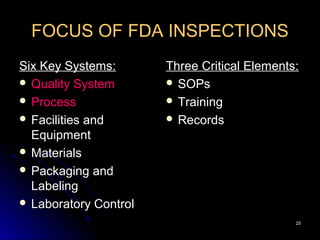
FOCUS OF FDA INSPECTIONS
Six Key Systems:Six Key Systems:
 Quality SystemQuality System
 ProcessProcess
 Facilities andFacilities and
EquipmentEquipment
 MaterialsMaterials
 Packaging andPackaging and
LabelingLabeling
 Laboratory ControlLaboratory Control
Three Critical Elements:Three Critical Elements:
 SOPsSOPs
 TrainingTraining
 RecordsRecords
2626
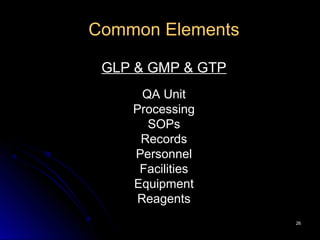
Common Elements
GLP & GMP & GTP
QA Unit
Processing
SOPs
Records
Personnel
Facilities
Equipment
Reagents
2727
REGULATORY REQUIREMENTS
Strive to create a culture of compliance
2828
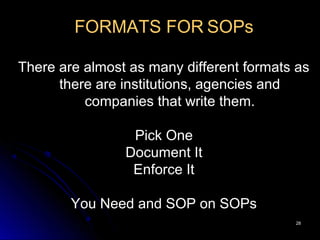
FORMATS FOR SOPs
There are almost as many different formats as
there are institutions, agencies and
companies that write them.
Pick One
Document It
Enforce It
You Need and SOP on SOPs
2929
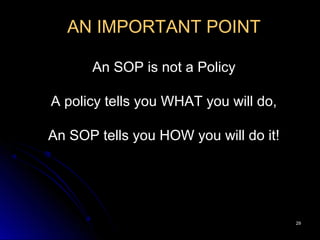
AN IMPORTANT POINT
An SOP is not a Policy
A policy tells you WHAT you will do,
An SOP tells you HOW you will do it!
3030
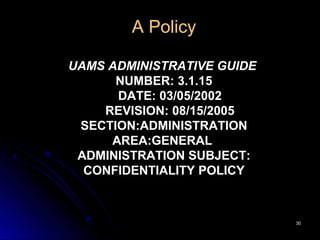
A Policy
UAMS ADMINISTRATIVE GUIDE
NUMBER: 3.1.15
DATE: 03/05/2002
REVISION: 08/15/2005
SECTION:ADMINISTRATION
AREA:GENERAL
ADMINISTRATION SUBJECT:
CONFIDENTIALITY POLICY
3131
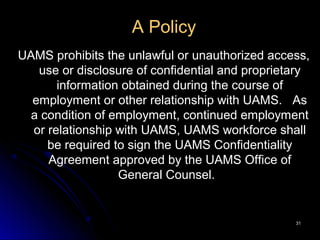
A Policy
UAMS prohibits the unlawful or unauthorized access,
use or disclosure of confidential and proprietary
information obtained during the course of
employment or other relationship with UAMS. As
a condition of employment, continued employment
or relationship with UAMS, UAMS workforce shall
be required to sign the UAMS Confidentiality
Agreement approved by the UAMS Office of
General Counsel.
3232
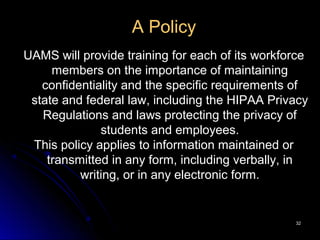
A Policy
UAMS will provide training for each of its workforce
members on the importance of maintaining
confidentiality and the specific requirements of
state and federal law, including the HIPAA Privacy
Regulations and laws protecting the privacy of
students and employees.
This policy applies to information maintained or
transmitted in any form, including verbally, in
writing, or in any electronic form.
3333
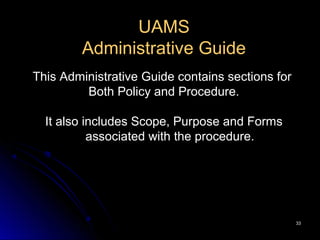
UAMS
Administrative Guide
This Administrative Guide contains sections for
Both Policy and Procedure.
It also includes Scope, Purpose and Forms
associated with the procedure.
3434
SOP FORMATS
THREE MAJOR TYPES
Standard List
Outlined List
Playscript
3535
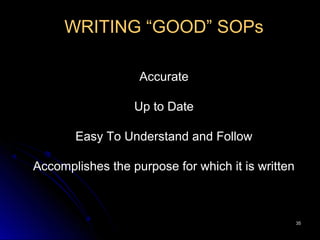
WRITING “GOOD” SOPs
Accurate
Up to Date
Easy To Understand and Follow
Accomplishes the purpose for which it is written
3636
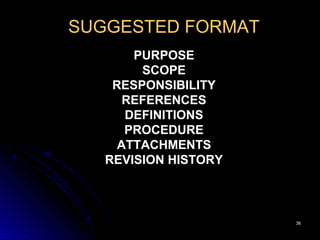
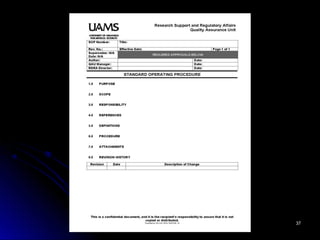
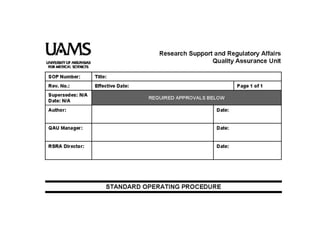
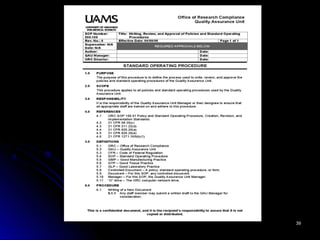
SUGGESTED FORMAT
PURPOSE
SCOPE
RESPONSIBILITY
REFERENCES
DEFINITIONS
PROCEDURE
ATTACHMENTS
REVISION HISTORY
3737
3838
3939
4040
4141
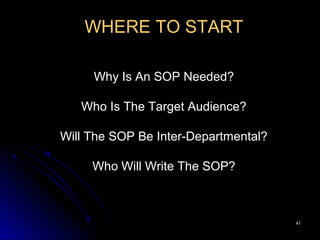
WHERE TO START
Why Is An SOP Needed?
Who Is The Target Audience?
Will The SOP Be Inter-Departmental?
Who Will Write The SOP?
4242
WHERE TO START
Just Get Something On Paper
(Writers Block)
Use A Flow Chart
4343
TITLE
This must describe in sufficient detail the focus of the
SOP so that anyone can tell from the title the
content of the SOP when searching a list of SOPs
This More Important Than You Think!
4444
PURPOSE
What You Want To Accomplish
This often will duplicate the title of the SOP:
Title: Writing, Review and Approval of Standard
Operating Procedures
The Purpose of this procedure is to define the
process used to write, review and approve standard
operating procedures of the Quality Assurance Unit
or
To define the process used to write, review and
approve standard operating procedures of the
Quality Assurance Unit
4545
SCOPE
The scope defines the area to which the SOP
applies:
This procedure applies to all policies and procedures
used by the Quality Assurance Unit
4646
RESPONSIBILITY
This states who has responsibility for training and
execution of the SOP:
It is the responsibility of the Quality Assurance
Manager or designee to assure that all Quality
Assurance Specialists are trained on and comply
with this standard operating procedure
4747
RESPONSIBILITY
You may want to include other statements in the
responsibility section as suggested by your
accrediting body.
You must state this in your SOP on SOPs
4848
REFERENCES
List all references that serve as the basis for the SOP
Do not list regulations, text books, standards, or
articles, etc. without reference to sections or page
numbers!
4949
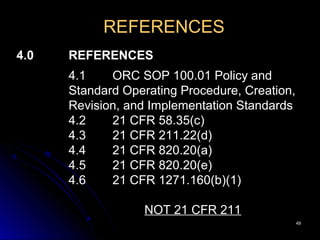
REFERENCES
4.0 REFERENCES
4.1 ORC SOP 100.01 Policy and
Standard Operating Procedure, Creation,
Revision, and Implementation Standards
4.2 21 CFR 58.35(c)
4.3 21 CFR 211.22(d)
4.4 21 CFR 820.20(a)
4.5 21 CFR 820.20(e)
4.6 21 CFR 1271.160(b)(1)
NOT 21 CFR 211
5050
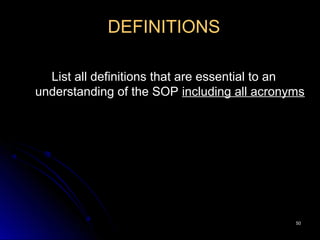
DEFINITIONS
List all definitions that are essential to an
understanding of the SOP including all acronyms
5151
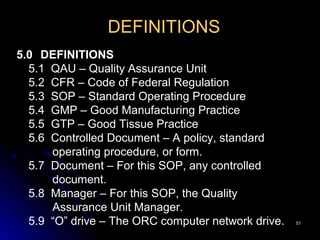
DEFINITIONS
5.0 DEFINITIONS
5.1 QAU – Quality Assurance Unit
5.2 CFR – Code of Federal Regulation
5.3 SOP – Standard Operating Procedure
5.4 GMP – Good Manufacturing Practice
5.5 GTP – Good Tissue Practice
5.6 Controlled Document – A policy, standard
operating procedure, or form.
5.7 Document – For this SOP, any controlled
document.
5.8 Manager – For this SOP, the Quality
Assurance Unit Manager.
5.9 “O” drive – The ORC computer network drive.
5252
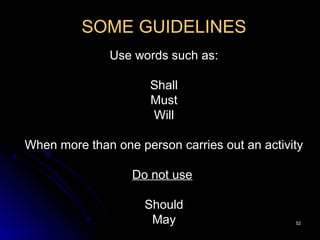
SOME GUIDELINES
Use words such as:
Shall
Must
Will
When more than one person carries out an activity
Do not use
Should
May
5353
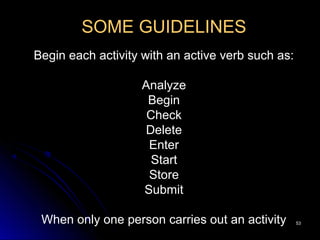
SOME GUIDELINES
Begin each activity with an active verb such as:
Analyze
Begin
Check
Delete
Enter
Start
Store
Submit
When only one person carries out an activity
5454
SOME GUIDELINES
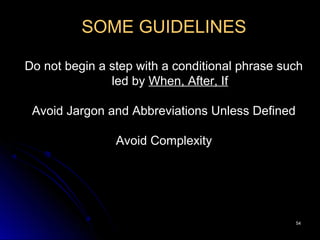
Do not begin a step with a conditional phrase such
led by When, After, If
Avoid Jargon and Abbreviations Unless Defined
Avoid Complexity
5555
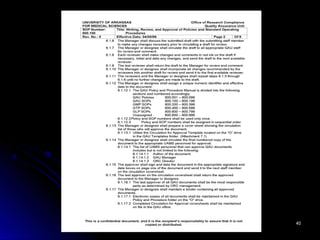
PROCEDURE
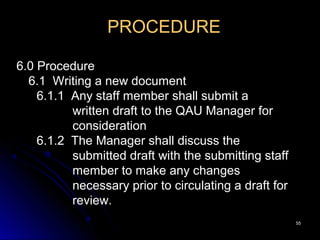
6.0 Procedure
6.1 Writing a new document
6.1.1 Any staff member shall submit a
written draft to the QAU Manager for
consideration
6.1.2 The Manager shall discuss the
submitted draft with the submitting staff
member to make any changes
necessary prior to circulating a draft for
review.
5656
PROCEDURE
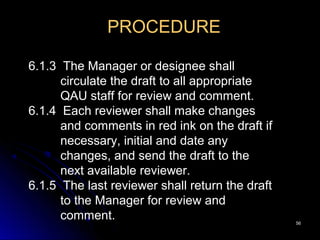
6.1.3 The Manager or designee shall
circulate the draft to all appropriate
QAU staff for review and comment.
6.1.4 Each reviewer shall make changes
and comments in red ink on the draft if
necessary, initial and date any
changes, and send the draft to the
next available reviewer.
6.1.5 The last reviewer shall return the draft
to the Manager for review and
comment.
5757
ATTACHMENTS
Any forms, logs or other documents that are
essential to the execution of the SOP and
mentioned in the SOP shall be
attached to the SOP
5858
ATTACHMENTS
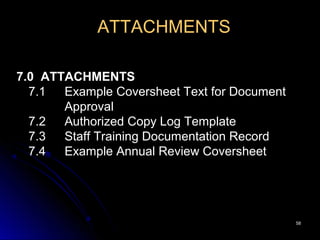
7.0 ATTACHMENTS
7.1 Example Coversheet Text for Document
Approval
7.2 Authorized Copy Log Template
7.3 Staff Training Documentation Record
7.4 Example Annual Review Coversheet
5959
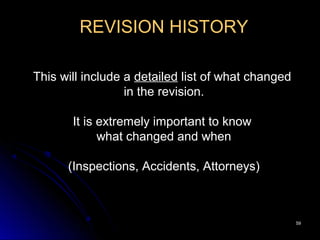
REVISION HISTORY
This will include a detailed list of what changed
in the revision.
It is extremely important to know
what changed and when
(Inspections, Accidents, Attorneys)
6060
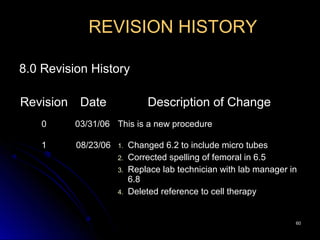
RevisionRevision DateDate Description of ChangeDescription of Change
00 03/31/0603/31/06 This is a new procedureThis is a new procedure
11 08/23/0608/23/06 1.1. Changed 6.2 to include micro tubesChanged 6.2 to include micro tubes
2.2. Corrected spelling of femoral in 6.5Corrected spelling of femoral in 6.5
3.3. Replace lab technician with lab manager inReplace lab technician with lab manager in
6.86.8
4.4. Deleted reference to cell therapyDeleted reference to cell therapy
8.0 Revision History
REVISION HISTORY
6161
QUESTIONS?

How to make sop

  • 1.
    11 Research Support & RegulatoryAffairs Quality Assurance Unit WRITING STANDARD OPERATING PROCEDURES (SOPs)
  • 2.
  • 3.
  • 4.
  • 5.
    55 GOALS • Define whatis an SOP • State reasons for writing SOPs • Describe the different formats for SOPs • Describe how to write an SOP
  • 6.
  • 7.
    77 WHAT IS ANSOP? Standard operating procedures are a set of instructions having the force of a directive, covering those features of operations that lend themselves to a definite or standardized procedure without loss of effectiveness. en.wikipedia.org/wiki/Standard_Operating_Procedures
  • 8.
    88 WHAT IS ANSOP? An SOP is a set of instructions or steps someone follows to complete a job safely, with no adverse impact on the environment (and which meets regulatory compliance standards), and in a way that maximizes operational and production requirements. Kenneth A. Friedman, PhD Department of Journalism and Communication Lehigh University, Bethlehem, PA
  • 9.
    99 WHAT IS ANSOP? An SOP is a set of written instructions that document a routine or repetitive activity. EPA Quality System Frequent Questions – Standard Operating Procedures (SOPs) www.epa.gov/quality/faq7.html
  • 10.
    1010 WHAT IS ANSOP? SOPs: Detailed written instructions to achieve uniformity of the performance of a specific function. ICH E6 Good Clinical Practice: Consolidated Guidance
  • 11.
    1111 WHY WRITE SOPs? Toprovide people with all the information necessary to perform a job properly (i.e. a training tool) To ensure that the procedures are performed correctly and consistently To ensure compliance with university and government regulations
  • 12.
    1212 WHY WRITE SOPs? Toserve as a checklist for auditors To serve as an explanation of steps in a process so they can be reviewed in accident investigations. To serve as a historical record of the how, why and when of steps in an existing process occurred (for inspectors and attorneys)
  • 13.
    1313 WHY WRITE SOPs? ToEnsure Safety Maximize operational and production requirements
  • 14.
    1414 WHY WRITE SOPs? ToEnsure Consistent Training To Ensure Correct and Consistent Performance To Ensure Regulatory Compliance
  • 15.
    1515 WHY WRITE SOPs? ToEnsure Consistent Training To Ensure Correct and Consistent Performance To Ensure Regulatory Compliance Just Because It Makes Good Sense
  • 16.
    1616 WHY WRITE SOPs? Becausehistorically many have not exercised good sense and failed to provide adequate training and consistency in performance, product or process failures have resulted in harm to animals, research subjects and patients.
  • 17.
    1717 WHY WRITE SOPs? TheFDA Has Placed Us In An Environment of Regulatory Compliance!!!!
  • 18.
    1818 WHY WRITE SOPs? Mostregulatory and accrediting agencies require that those who perform procedures have the education, experience and training to do so.
  • 19.
    1919 WHY WRITE SOPs? SOPsare the foundation of training!
  • 20.
    2020 REGULATORY REQUIREMENTS Good ManufacturingPractice 21 CFR 211.100 There shall be written procedures for production and process control designed to assure that the drug products have the identity, strength, quality, and purity they purport or are represented to possess.
  • 21.
    2121 REGULATORY REQUIREMENTS Good LaboratoryPractice 21 CFR 58.81(a) A testing facility shall have standard operating procedures in writing setting forth nonclinical laboratory study methods that management is satisfied are adequate to insure the quality and integrity of the data generated in the course of a study.
  • 22.
    2222 REGULATORY REQUIREMENTS Good TissuePractice 21 CFR 1271.180 You must establish and maintain procedures appropriate to meet core CGTP requirements for all steps that you perform in the manufacture of HCT/Ps. You must design these procedures to prevent circumstances that increase the risk of the introduction, transmission, or spread of communicable diseases through the use of HCT/Ps.
  • 23.
    2323 REGULATORY REQUIREMENTS ICH GuidanceFor Industry E6 Good Clinical Practice: Consolidated Guidance Principles of ICH GCP § 2.13 Systems with procedures that assure the quality of every aspect of the trial should be implemented.
  • 24.
    2424 FOCUS OF FDAINSPECTIONS BIORESEARCH MONITORING BIMO Compliance Program Guidance Manual Chapter 45 – Biological Drug Products Inspection of Biological Drug Products (CBER) 7345.848
  • 25.
    2525 FOCUS OF FDAINSPECTIONS Six Key Systems:Six Key Systems:  Quality SystemQuality System  ProcessProcess  Facilities andFacilities and EquipmentEquipment  MaterialsMaterials  Packaging andPackaging and LabelingLabeling  Laboratory ControlLaboratory Control Three Critical Elements:Three Critical Elements:  SOPsSOPs  TrainingTraining  RecordsRecords
  • 26.
    2626 Common Elements GLP &GMP & GTP QA Unit Processing SOPs Records Personnel Facilities Equipment Reagents
  • 27.
    2727 REGULATORY REQUIREMENTS Strive tocreate a culture of compliance
  • 28.
    2828 FORMATS FOR SOPs Thereare almost as many different formats as there are institutions, agencies and companies that write them. Pick One Document It Enforce It You Need and SOP on SOPs
  • 29.
    2929 AN IMPORTANT POINT AnSOP is not a Policy A policy tells you WHAT you will do, An SOP tells you HOW you will do it!
  • 30.
    3030 A Policy UAMS ADMINISTRATIVEGUIDE NUMBER: 3.1.15 DATE: 03/05/2002 REVISION: 08/15/2005 SECTION:ADMINISTRATION AREA:GENERAL ADMINISTRATION SUBJECT: CONFIDENTIALITY POLICY
  • 31.
    3131 A Policy UAMS prohibitsthe unlawful or unauthorized access, use or disclosure of confidential and proprietary information obtained during the course of employment or other relationship with UAMS. As a condition of employment, continued employment or relationship with UAMS, UAMS workforce shall be required to sign the UAMS Confidentiality Agreement approved by the UAMS Office of General Counsel.
  • 32.
    3232 A Policy UAMS willprovide training for each of its workforce members on the importance of maintaining confidentiality and the specific requirements of state and federal law, including the HIPAA Privacy Regulations and laws protecting the privacy of students and employees. This policy applies to information maintained or transmitted in any form, including verbally, in writing, or in any electronic form.
  • 33.
    3333 UAMS Administrative Guide This AdministrativeGuide contains sections for Both Policy and Procedure. It also includes Scope, Purpose and Forms associated with the procedure.
  • 34.
    3434 SOP FORMATS THREE MAJORTYPES Standard List Outlined List Playscript
  • 35.
    3535 WRITING “GOOD” SOPs Accurate Upto Date Easy To Understand and Follow Accomplishes the purpose for which it is written
  • 36.
  • 37.
  • 38.
  • 39.
  • 40.
  • 41.
    4141 WHERE TO START WhyIs An SOP Needed? Who Is The Target Audience? Will The SOP Be Inter-Departmental? Who Will Write The SOP?
  • 42.
    4242 WHERE TO START JustGet Something On Paper (Writers Block) Use A Flow Chart
  • 43.
    4343 TITLE This must describein sufficient detail the focus of the SOP so that anyone can tell from the title the content of the SOP when searching a list of SOPs This More Important Than You Think!
  • 44.
    4444 PURPOSE What You WantTo Accomplish This often will duplicate the title of the SOP: Title: Writing, Review and Approval of Standard Operating Procedures The Purpose of this procedure is to define the process used to write, review and approve standard operating procedures of the Quality Assurance Unit or To define the process used to write, review and approve standard operating procedures of the Quality Assurance Unit
  • 45.
    4545 SCOPE The scope definesthe area to which the SOP applies: This procedure applies to all policies and procedures used by the Quality Assurance Unit
  • 46.
    4646 RESPONSIBILITY This states whohas responsibility for training and execution of the SOP: It is the responsibility of the Quality Assurance Manager or designee to assure that all Quality Assurance Specialists are trained on and comply with this standard operating procedure
  • 47.
    4747 RESPONSIBILITY You may wantto include other statements in the responsibility section as suggested by your accrediting body. You must state this in your SOP on SOPs
  • 48.
    4848 REFERENCES List all referencesthat serve as the basis for the SOP Do not list regulations, text books, standards, or articles, etc. without reference to sections or page numbers!
  • 49.
    4949 REFERENCES 4.0 REFERENCES 4.1 ORCSOP 100.01 Policy and Standard Operating Procedure, Creation, Revision, and Implementation Standards 4.2 21 CFR 58.35(c) 4.3 21 CFR 211.22(d) 4.4 21 CFR 820.20(a) 4.5 21 CFR 820.20(e) 4.6 21 CFR 1271.160(b)(1) NOT 21 CFR 211
  • 50.
    5050 DEFINITIONS List all definitionsthat are essential to an understanding of the SOP including all acronyms
  • 51.
    5151 DEFINITIONS 5.0 DEFINITIONS 5.1 QAU– Quality Assurance Unit 5.2 CFR – Code of Federal Regulation 5.3 SOP – Standard Operating Procedure 5.4 GMP – Good Manufacturing Practice 5.5 GTP – Good Tissue Practice 5.6 Controlled Document – A policy, standard operating procedure, or form. 5.7 Document – For this SOP, any controlled document. 5.8 Manager – For this SOP, the Quality Assurance Unit Manager. 5.9 “O” drive – The ORC computer network drive.
  • 52.
    5252 SOME GUIDELINES Use wordssuch as: Shall Must Will When more than one person carries out an activity Do not use Should May
  • 53.
    5353 SOME GUIDELINES Begin eachactivity with an active verb such as: Analyze Begin Check Delete Enter Start Store Submit When only one person carries out an activity
  • 54.
    5454 SOME GUIDELINES Do notbegin a step with a conditional phrase such led by When, After, If Avoid Jargon and Abbreviations Unless Defined Avoid Complexity
  • 55.
    5555 PROCEDURE 6.0 Procedure 6.1 Writinga new document 6.1.1 Any staff member shall submit a written draft to the QAU Manager for consideration 6.1.2 The Manager shall discuss the submitted draft with the submitting staff member to make any changes necessary prior to circulating a draft for review.
  • 56.
    5656 PROCEDURE 6.1.3 The Manageror designee shall circulate the draft to all appropriate QAU staff for review and comment. 6.1.4 Each reviewer shall make changes and comments in red ink on the draft if necessary, initial and date any changes, and send the draft to the next available reviewer. 6.1.5 The last reviewer shall return the draft to the Manager for review and comment.
  • 57.
    5757 ATTACHMENTS Any forms, logsor other documents that are essential to the execution of the SOP and mentioned in the SOP shall be attached to the SOP
  • 58.
    5858 ATTACHMENTS 7.0 ATTACHMENTS 7.1 ExampleCoversheet Text for Document Approval 7.2 Authorized Copy Log Template 7.3 Staff Training Documentation Record 7.4 Example Annual Review Coversheet
  • 59.
    5959 REVISION HISTORY This willinclude a detailed list of what changed in the revision. It is extremely important to know what changed and when (Inspections, Accidents, Attorneys)
  • 60.
    6060 RevisionRevision DateDate Descriptionof ChangeDescription of Change 00 03/31/0603/31/06 This is a new procedureThis is a new procedure 11 08/23/0608/23/06 1.1. Changed 6.2 to include micro tubesChanged 6.2 to include micro tubes 2.2. Corrected spelling of femoral in 6.5Corrected spelling of femoral in 6.5 3.3. Replace lab technician with lab manager inReplace lab technician with lab manager in 6.86.8 4.4. Deleted reference to cell therapyDeleted reference to cell therapy 8.0 Revision History REVISION HISTORY
  • 61.