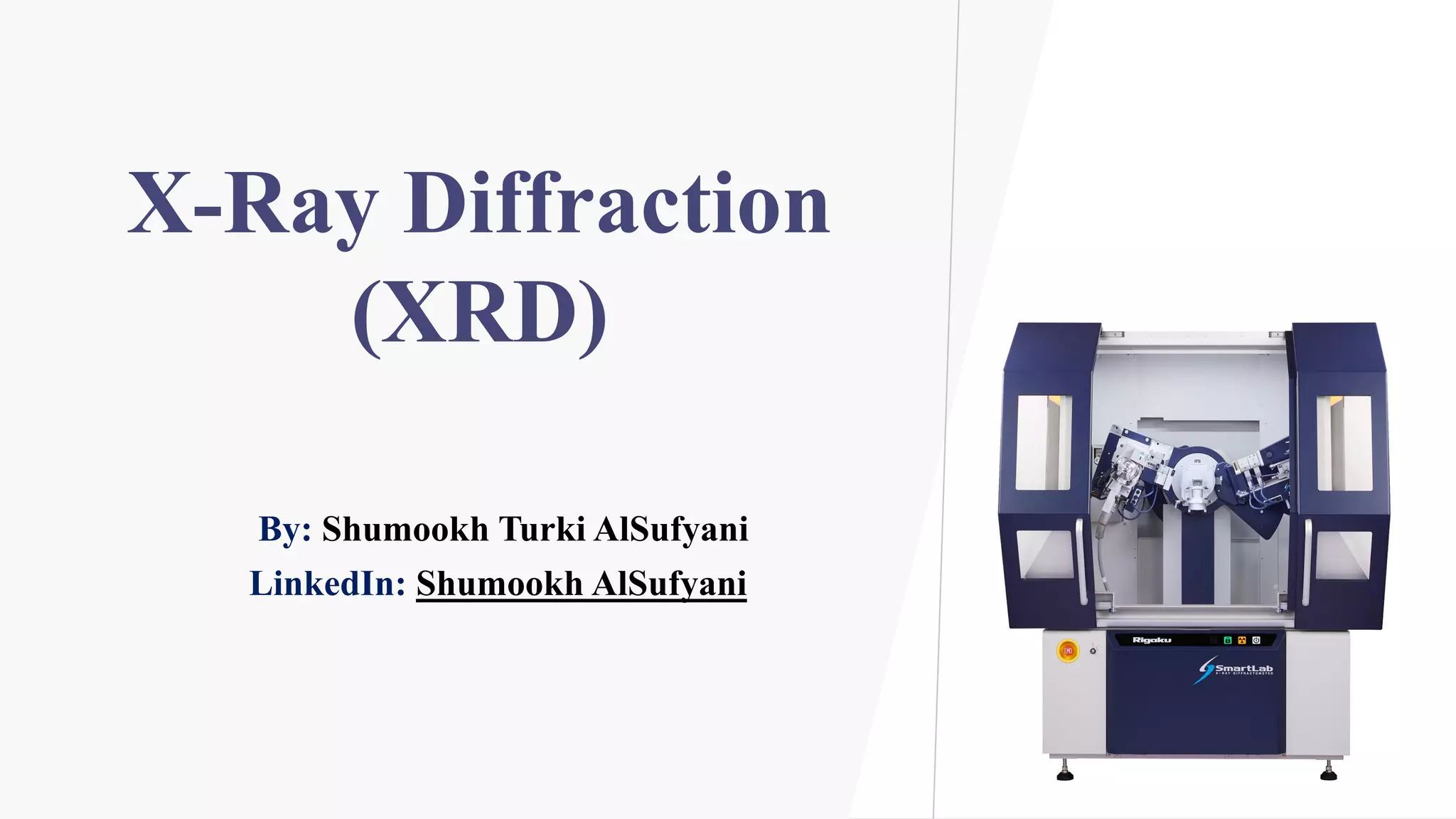
X-Ray Diffraction
(XRD)
By: Shumookh Turki AlSufyani
LinkedIn: Shumookh AlSufyani
➢ Introduction
➢ X-Ray Diffraction
➢ Basics of Crystallography
➢ Crystals & Diffraction of X-ray
➢ XRD Techniques
➢ X-Ray Diffractometer
➢ Application Of X-Ray Diffraction
Contents:
Introduction:
c
Introduction
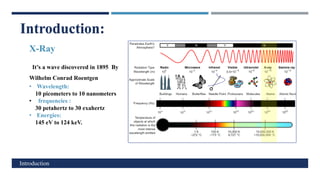
X-Ray
It’s a wave discovered in 1895 By
Wilhelm Conrad Roentgen
• Wavelength:
10 picometers to 10 nanometers
• frequencies :
30 petahertz to 30 exahertz
• Energies:
145 eV to 124 keV.
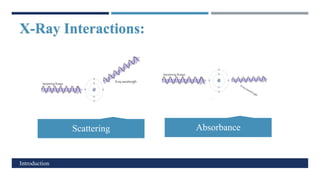
X-Ray Interactions:
c
Introduction
Scattering Absorbance
c
X-Ray Diffraction (XRD)
X-Ray Diffraction (XRD):
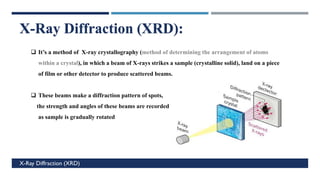
❑ It’s a method of X-ray crystallography (method of determining the arrangement of atoms
within a crystal), in which a beam of X-rays strikes a sample (crystalline solid), land on a piece
of film or other detector to produce scattered beams.
❑ These beams make a diffraction pattern of spots,
the strength and angles of these beams are recorded
as sample is gradually rotated
c
Basics of Crystallography
Basics of Crystallography:
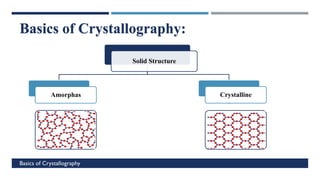
Solid Structure
Amorphas Crystalline
c
Basics of Crystallography
Basics of Crystallography:
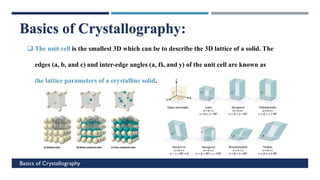
❑ The unit cell is the smallest 3D which can be to describe the 3D lattice of a solid. The
edges (a, b, and c) and inter-edge angles (a, ẞ, and y) of the unit cell are known as
the lattice parameters of a crystalline solid.
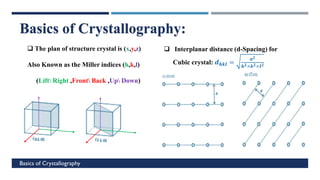
❑ Interplanar distance (d-Spacing) for
Cubic crystal: 𝒅𝒉𝒌𝑰 =
𝒂𝟐
𝒉𝟐×𝒌𝟐×𝑰𝟐
c
Basics of Crystallography
Basics of Crystallography:
❑ The plan of structure crystal is (x,y,z)
Also Known as the Miller indices (h,k,l)
(Lift Right ,Front Back ,Up Down)
c
Crystals & Diffraction of X-ray
Crystals & Diffraction of X-ray:
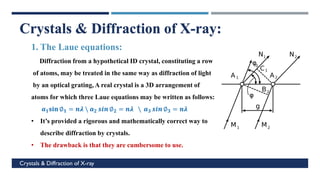
1. The Laue equations:
Diffraction from a hypothetical ID crystal, constituting a row
of atoms, may be treated in the same way as diffraction of light
by an optical grating, A real crystal is a 3D arrangement of
atoms for which three Laue equations may be written as follows:
𝒂𝟏𝐬𝐢𝐧 ∅𝟏 = 𝒏𝝀  𝒂𝟐 𝒔𝒊𝒏 ∅𝟐 = 𝒏𝝀  𝒂𝟑 𝒔𝒊𝒏 ∅𝟑 = 𝒏𝝀
• It’s provided a rigorous and mathematically correct way to
describe diffraction by crystals.
• The drawback is that they are cumbersome to use.
c
Crystals & Diffraction of X-ray
Crystals & Diffraction of X-ray:
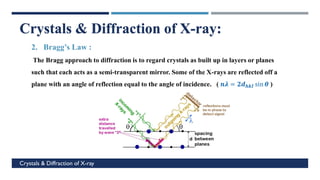
2. Bragg’s Law :
The Bragg approach to diffraction is to regard crystals as built up in layers or planes
such that each acts as a semi-transparent mirror. Some of the X-rays are reflected off a
plane with an angle of reflection equal to the angle of incidence. ( 𝒏𝝀 = 𝟐𝒅𝒉𝒌𝑰 sin 𝜽 )
c
XRD Techniques
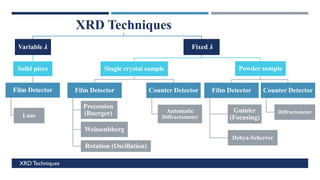
XRD Techniques
Variable 𝝀
Solid piece
Film Detector
Laue
Fixed 𝝀
Single crystal sample
Film Detector
Precession
(Buerger)
Weissenbberg
Rotation (Oscillation)
Counter Detector
Automatic
Diffractometer
Powder sample
Film Detector
Guinier
(Focusing)
Debya-Scherrer
Counter Detector
Diffractometer
c
X-Ray Diffractometer :
X-Ray Diffractometer
❑ It’s an instrument for studying crystalline materials by measurement of the way in which they
diffract (Scatter) x-ray of known wavelength.
Component of an
X-Ray
Diffractometer
X-ray Source
Specimen (sample)
X-ray Detector
c
X-Ray Diffractometer
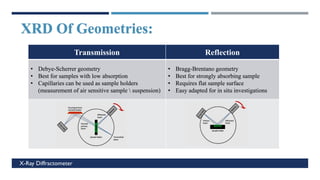
XRD Of Geometries:
Reflection
Transmission
• Bragg-Brentano geometry
• Best for strongly absorbing sample
• Requires flat sample surface
• Easy adapted for in situ investigations
• Debye-Scherrer geometry
• Best for samples with low absorption
• Capillaries can be used as sample holders
(measurement of air sensitive sample  suspension)
c
X-Ray Diffractometer :
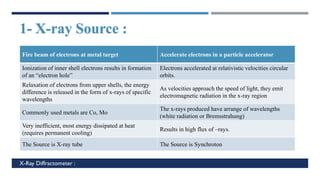
1- X-ray Source :
Accelerate electrons in a particle accelerator
Fire beam of electrons at metal target
Electrons accelerated at relativistic velocities circular
orbits.
Ionization of inner shell electrons results in formation
of an “electron hole”
As velocities approach the speed of light, they emit
electromagnetic radiation in the x-ray region
Relaxation of electrons from upper shells, the energy
difference is released in the form of x-rays of specific
wavelengths
The x-rays produced have arrange of wavelengths
(white radiation or Bremsstrahung)
Commonly used metals are Co, Mo
Results in high flux of –rays.
Very inefficient, most energy dissipated at heat
(requires permanent cooling)
The Source is Synchroton
The Source is X-ray tube
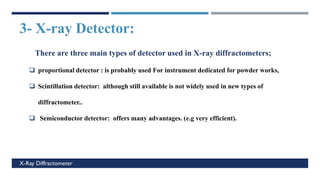
3- X-ray Detector:
c
X-Ray Diffractometer
There are three main types of detector used in X-ray diffractometers;
❑ proportional detector : is probably used For instrument dedicated for powder works,
❑ Scintillation detector: although still available is not widely used in new types of
diffractometer..
❑ Semiconductor detector: offers many advantages. (e.g very efficient).
c
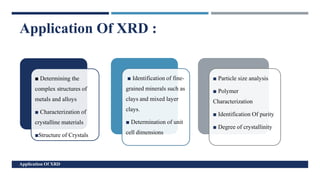
■ Determining the
complex structures of
metals and alloys
■ Characterization of
crystalline materials
■Structure of Crystals
■ Identification of fine-
grained minerals such as
clays and mixed layer
clays.
■ Determination of unit
cell dimensions
■ Particle size analysis
■ Polymer
Characterization
■ Identification Of purity
■ Degree of crystallinity
Application Of XRD :
Application Of XRD
• https://en.wikipedia.org/wiki/X-ray
• Solid State Chemistry and it’s Applications, Anthony R. West. (2014), (2nd Edition- Student Edition).UK.
Department of Materials Science and Engineering
• Advances in neutron radiography and tomography, M Strobl, I Manke, N Kardjilov, A Hilger, M Dawson and
J Banhart. (2009), J. Phys. D: Appl. Phys. doi:10.1088/0022-3727/42/24/243001
References:

XRD.pdf

  • 1.
    X-Ray Diffraction (XRD) By: ShumookhTurki AlSufyani LinkedIn: Shumookh AlSufyani
  • 2.
    ➢ Introduction ➢ X-RayDiffraction ➢ Basics of Crystallography ➢ Crystals & Diffraction of X-ray ➢ XRD Techniques ➢ X-Ray Diffractometer ➢ Application Of X-Ray Diffraction Contents:
  • 3.
    Introduction: c Introduction X-Ray It’s a wavediscovered in 1895 By Wilhelm Conrad Roentgen • Wavelength: 10 picometers to 10 nanometers • frequencies : 30 petahertz to 30 exahertz • Energies: 145 eV to 124 keV.
  • 4.
  • 5.
    c X-Ray Diffraction (XRD) X-RayDiffraction (XRD): ❑ It’s a method of X-ray crystallography (method of determining the arrangement of atoms within a crystal), in which a beam of X-rays strikes a sample (crystalline solid), land on a piece of film or other detector to produce scattered beams. ❑ These beams make a diffraction pattern of spots, the strength and angles of these beams are recorded as sample is gradually rotated
  • 6.
    c Basics of Crystallography Basicsof Crystallography: Solid Structure Amorphas Crystalline
  • 7.
    c Basics of Crystallography Basicsof Crystallography: ❑ The unit cell is the smallest 3D which can be to describe the 3D lattice of a solid. The edges (a, b, and c) and inter-edge angles (a, ẞ, and y) of the unit cell are known as the lattice parameters of a crystalline solid.
  • 8.
    ❑ Interplanar distance(d-Spacing) for Cubic crystal: 𝒅𝒉𝒌𝑰 = 𝒂𝟐 𝒉𝟐×𝒌𝟐×𝑰𝟐 c Basics of Crystallography Basics of Crystallography: ❑ The plan of structure crystal is (x,y,z) Also Known as the Miller indices (h,k,l) (Lift Right ,Front Back ,Up Down)
  • 9.
    c Crystals & Diffractionof X-ray Crystals & Diffraction of X-ray: 1. The Laue equations: Diffraction from a hypothetical ID crystal, constituting a row of atoms, may be treated in the same way as diffraction of light by an optical grating, A real crystal is a 3D arrangement of atoms for which three Laue equations may be written as follows: 𝒂𝟏𝐬𝐢𝐧 ∅𝟏 = 𝒏𝝀 𝒂𝟐 𝒔𝒊𝒏 ∅𝟐 = 𝒏𝝀 𝒂𝟑 𝒔𝒊𝒏 ∅𝟑 = 𝒏𝝀 • It’s provided a rigorous and mathematically correct way to describe diffraction by crystals. • The drawback is that they are cumbersome to use.
  • 10.
    c Crystals & Diffractionof X-ray Crystals & Diffraction of X-ray: 2. Bragg’s Law : The Bragg approach to diffraction is to regard crystals as built up in layers or planes such that each acts as a semi-transparent mirror. Some of the X-rays are reflected off a plane with an angle of reflection equal to the angle of incidence. ( 𝒏𝝀 = 𝟐𝒅𝒉𝒌𝑰 sin 𝜽 )
  • 11.
    c XRD Techniques XRD Techniques Variable𝝀 Solid piece Film Detector Laue Fixed 𝝀 Single crystal sample Film Detector Precession (Buerger) Weissenbberg Rotation (Oscillation) Counter Detector Automatic Diffractometer Powder sample Film Detector Guinier (Focusing) Debya-Scherrer Counter Detector Diffractometer
  • 12.
    c X-Ray Diffractometer : X-RayDiffractometer ❑ It’s an instrument for studying crystalline materials by measurement of the way in which they diffract (Scatter) x-ray of known wavelength. Component of an X-Ray Diffractometer X-ray Source Specimen (sample) X-ray Detector
  • 13.
    c X-Ray Diffractometer XRD OfGeometries: Reflection Transmission • Bragg-Brentano geometry • Best for strongly absorbing sample • Requires flat sample surface • Easy adapted for in situ investigations • Debye-Scherrer geometry • Best for samples with low absorption • Capillaries can be used as sample holders (measurement of air sensitive sample suspension)
  • 14.
    c X-Ray Diffractometer : 1-X-ray Source : Accelerate electrons in a particle accelerator Fire beam of electrons at metal target Electrons accelerated at relativistic velocities circular orbits. Ionization of inner shell electrons results in formation of an “electron hole” As velocities approach the speed of light, they emit electromagnetic radiation in the x-ray region Relaxation of electrons from upper shells, the energy difference is released in the form of x-rays of specific wavelengths The x-rays produced have arrange of wavelengths (white radiation or Bremsstrahung) Commonly used metals are Co, Mo Results in high flux of –rays. Very inefficient, most energy dissipated at heat (requires permanent cooling) The Source is Synchroton The Source is X-ray tube
  • 15.
    3- X-ray Detector: c X-RayDiffractometer There are three main types of detector used in X-ray diffractometers; ❑ proportional detector : is probably used For instrument dedicated for powder works, ❑ Scintillation detector: although still available is not widely used in new types of diffractometer.. ❑ Semiconductor detector: offers many advantages. (e.g very efficient).
  • 16.
    c ■ Determining the complexstructures of metals and alloys ■ Characterization of crystalline materials ■Structure of Crystals ■ Identification of fine- grained minerals such as clays and mixed layer clays. ■ Determination of unit cell dimensions ■ Particle size analysis ■ Polymer Characterization ■ Identification Of purity ■ Degree of crystallinity Application Of XRD : Application Of XRD
  • 17.
    • https://en.wikipedia.org/wiki/X-ray • SolidState Chemistry and it’s Applications, Anthony R. West. (2014), (2nd Edition- Student Edition).UK. Department of Materials Science and Engineering • Advances in neutron radiography and tomography, M Strobl, I Manke, N Kardjilov, A Hilger, M Dawson and J Banhart. (2009), J. Phys. D: Appl. Phys. doi:10.1088/0022-3727/42/24/243001 References: