RATIONALITY TYPE IN EVALUATION TECHNIQUES
IN THE FIELD OF URBAN AND REGIONAL
PLANNING
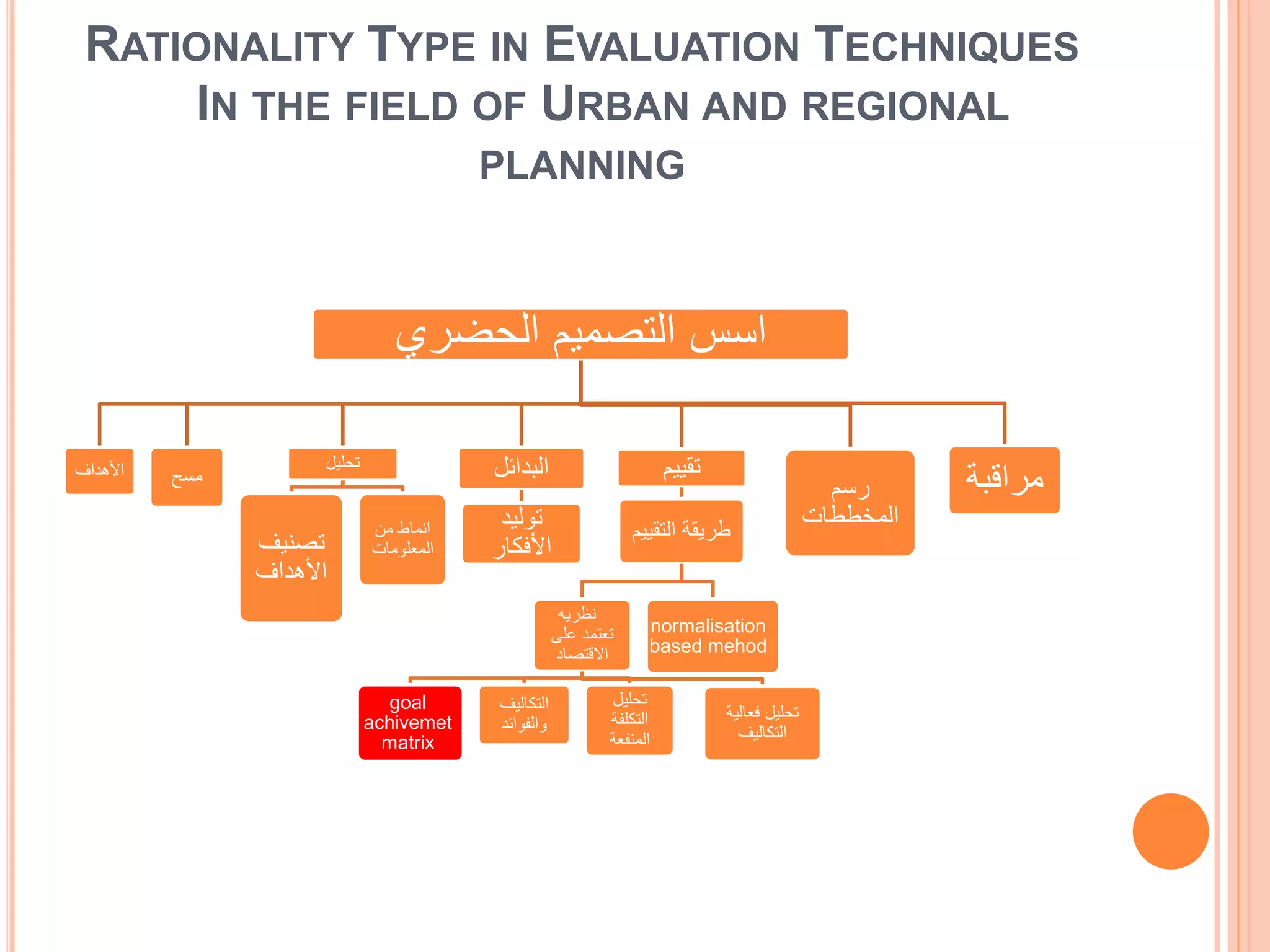
‫اسس‬‫الحضري‬ ‫التصميم‬
‫األهداف‬ ‫مسح‬
‫تحليل‬
‫تصنيف‬
‫األهداف‬
‫ا‬‫نم‬‫ا‬‫من‬ ‫ط‬
‫المعلومات‬
‫البد‬‫ائل‬
‫توليد‬
‫األفكار‬
‫تقييم‬
‫التقي‬ ‫طريقة‬‫يم‬
‫نظريه‬
‫على‬ ‫تعتمد‬
‫االقتصاد‬
goal
achivemet
matrix
‫التكاليف‬
‫والفوائد‬
‫تحليل‬
‫التكلفة‬
‫المنفعة‬
‫فعالية‬ ‫تحليل‬
‫التكاليف‬
normalisation
based mehod
‫رسم‬
‫ال‬‫م‬‫خطط‬‫ات‬
‫مراقبة‬
RATIONALITY TYPE IN EVALUATION TECHNIQUES
IN THE FIELD OF URBAN AND REGIONAL
PLANNING
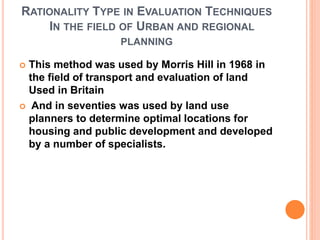
 This method was used by Morris Hill in 1968 in
the field of transport and evaluation of land
Used in Britain
 And in seventies was used by land use
planners to determine optimal locations for
housing and public development and developed
by a number of specialists.
RATIONALITY TYPE IN EVALUATION TECHNIQUES
IN THE FIELD OF URBAN AND REGIONAL
PLANNING
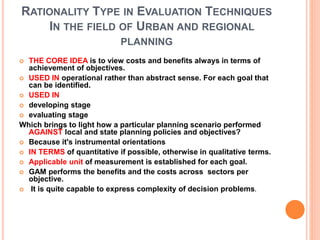
 THE CORE IDEA is to view costs and benefits always in terms of
achievement of objectives.
 USED IN operational rather than abstract sense. For each goal that
can be identified.
 USED IN
 developing stage
 evaluating stage
Which brings to light how a particular planning scenario performed
AGAINST local and state planning policies and objectives?
 Because it's instrumental orientations
 IN TERMS of quantitative if possible, otherwise in qualitative terms.
 Applicable unit of measurement is established for each goal.
 GAM performs the benefits and the costs across sectors per
objective.
 It is quite capable to express complexity of decision problems.
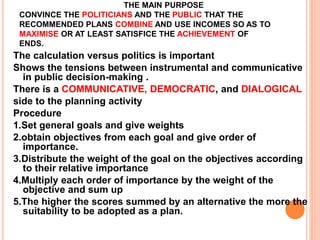
THE MAIN PURPOSE
CONVINCE THE POLITICIANS AND THE PUBLIC THAT THE
RECOMMENDED PLANS COMBINE AND USE INCOMES SO AS TO
MAXIMISE OR AT LEAST SATISFICE THE ACHIEVEMENT OF
ENDS.
The calculation versus politics is important
Shows the tensions between instrumental and communicative
in public decision-making .
There is a COMMUNICATIVE, DEMOCRATIC, and DIALOGICAL
side to the planning activity
Procedure
1.Set general goals and give weights
2.obtain objectives from each goal and give order of
importance.
3.Distribute the weight of the goal on the objectives according
to their relative importance
4.Multiply each order of importance by the weight of the
objective and sum up
5.The higher the scores summed by an alternative the more the
suitability to be adopted as a plan.
RATIONALITY TYPE IN EVALUATION TECHNIQUES
IN THE FIELD OF URBAN AND REGIONAL
PLANNING
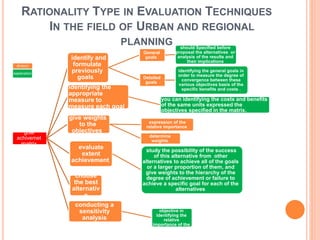
goal
achivemet
matrix
- identify and
formulate
previously
goals
General
goals
should Specified before
proposal the alternatives or
analysis of the results and
their implications
Detailed
goals
identifying the general goals in
order to measure the degree of
convergence between these
various objectives basis of the
specific benefits and costs .identifying the
appropriate
measure to
measure each goal
you can identifying the costs and benefits
of the same units expressed the
objectives specified in the matrix.
give weights
to the
objectives
expression of the
relative importance
determine
weights
evaluate
extent
achievement
study the possibility of the success
of this alternative from other
alternatives to achieve all of the goals
or a larger proportion of them, and
give weights to the hierarchy of the
degree of achievement or failure to
achieve a specific goal for each of the
alternatives.
choose
the best
alternativ
e
conducting a
sensitivity
analysis
give a more
objective in
identifying the
relative
importance of the
goals
division
explanation
goal
achivemet
matrix
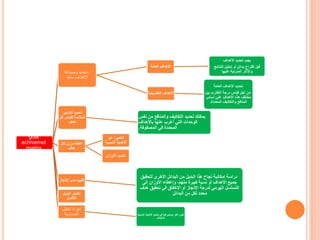
-‫وصياغة‬ ‫تحديد‬
‫سابقا‬ ‫األهداف‬
‫العامة‬ ‫األهداف‬
‫األهداف‬ ‫تحديد‬ ‫يجب‬
‫للنتائ‬ ‫تحليل‬ ‫أو‬ ‫بدائل‬ ‫اقتراح‬ ‫قبل‬‫ج‬
‫عليها‬ ‫المترتبة‬ ‫واآلثار‬
‫التفصي‬ ‫األهداف‬‫لية‬
‫العامة‬ ‫األهداف‬ ‫تحديد‬
‫بي‬ ‫التقارب‬ ‫درجة‬ ‫قياس‬ ‫أجل‬ ‫من‬‫ن‬
‫األهداف‬ ‫هذه‬ ‫مختلف‬‫علئ‬‫أساس‬
‫المحددة‬ ‫والتكاليف‬ ‫المنافع‬.
‫التدابير‬ ‫تحديد‬
‫ك‬ ‫لقياس‬ ‫المالئمة‬‫ل‬
‫هدف‬
‫ن‬ ‫من‬ ‫والمنافع‬ ‫التكاليف‬ ‫تحديد‬ ‫يمكنك‬‫فس‬
‫باألهداف‬ ‫عنها‬ ‫أعرب‬ ‫التي‬ ‫الوحدات‬
‫المصفوفة‬ ‫في‬ ‫المحددة‬.
‫لكل‬ ‫وزن‬ ‫اعطاء‬
‫هدف‬
‫ال‬‫عن‬ ‫تعبيرا‬
‫النسبية‬ ‫األهمية‬
‫األوزان‬ ‫تحديد‬
‫اإلنج‬ ‫مدى‬ ‫تقييم‬‫از‬
‫لتحقي‬ ‫األخرى‬ ‫البدائل‬ ‫من‬ ‫البديل‬ ‫هذا‬ ‫نجاح‬ ‫إمكانية‬ ‫دراسة‬‫ق‬
‫إلى‬ ‫األوزان‬ ‫وإعطاء‬ ،‫منهم‬ ‫كبيرة‬ ‫نسبة‬ ‫أو‬ ‫األهداف‬ ‫جميع‬
‫هد‬ ‫تحقيق‬ ‫في‬ ‫اإلخفاق‬ ‫أو‬ ‫اإلنجاز‬ ‫لدرجة‬ ‫الهرمي‬ ‫التسلسل‬‫ف‬
‫البدائل‬ ‫من‬ ‫لكل‬ ‫محدد‬.‫البديل‬ ‫اختيار‬
‫األفضل‬
‫تحليل‬ ‫إجراء‬
‫الحساسية‬ ‫نكون‬‫النس‬ ‫األهمية‬ ‫تحديد‬ ‫في‬ ‫موضوعية‬ ‫أكثر‬‫بية‬
‫لألهداف‬
RATIONALITY TYPE IN EVALUATION TECHNIQUES
IN THE FIELD OF URBAN AND REGIONAL
PLANNING
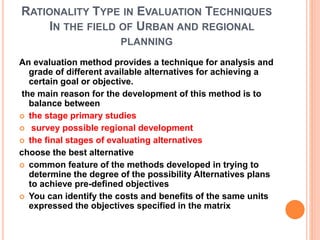
An evaluation method provides a technique for analysis and
grade of different available alternatives for achieving a
certain goal or objective.
the main reason for the development of this method is to
balance between
 the stage primary studies
 survey possible regional development
 the final stages of evaluating alternatives
choose the best alternative
 common feature of the methods developed in trying to
determine the degree of the possibility Alternatives plans
to achieve pre-defined objectives
 You can identify the costs and benefits of the same units
expressed the objectives specified in the matrix
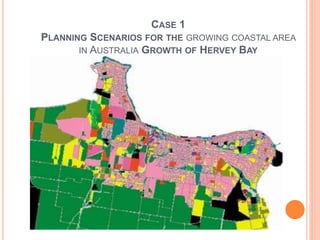
CASE 1
PLANNING SCENARIOS FOR THE GROWING COASTAL AREA
IN AUSTRALIA GROWTH OF HERVEY BAY
CASE 1
PLANNING SCENARIOS FOR THE GROWING COASTAL AREA
IN AUSTRALIA GROWTH OF HERVEY BAY
 Area 2,340 square kilometers for Hervey Bay
 Hervey includes North Fraser Island. (World Heritage
area) 1,010 square kilometers.
 Urban settlement began in the 1870s as Residential
 The area developed an economy on agriculture (sugar
cane)
 Tourism with the world heritage
 whale watching
 Today the economy dependent upon
 the tourism industry
 Settlement driven by retirees.
 strong population growth
 high unemployment rate close to 20% in 1999
CASE 1
PLANNING SCENARIOS FOR THE GROWING COASTAL AREA
IN AUSTRALIA GROWTH OF HERVEY BAY
What they want
 support the growth of the area
 Provide a balanced socio-economic climate.
 Future development that protects the environmental
quality of the area which consistent with
1. tourism industry
2. Sustainable development perspective.
3. The environmental issues and the costs of urban
expansion.
Special case
 Special big area owned to Business persons he use it as
1. Building holiday homes,
2. Hotels
3. Guest houses
CASE 1
PLANNING SCENARIOS FOR THE GROWING COASTAL AREA
IN AUSTRALIA GROWTH OF HERVEY BAY
HOW CAN
1. Demographic (a particular sector of a population)
2. Socio-economic
3. Land-use
4. Physical and environmental
Information models may be used to efficiently plan for future
urban growth?
 A case study approach is undertaken using WHAT-IF planning
scenarios for a rapidly called Hervey Bay.
 The town and surrounding area require CAREFUL planning of future
urban growth between competing land-uses.
 This includes predictions and tactical planning for land-use change
based on
1. projections from existing trends,
2. optimizing socio-economic output,
CASE 1
PLANNING SCENARIOS FOR THE GROWING COASTAL AREA
IN AUSTRALIA GROWTH OF HERVEY BAY
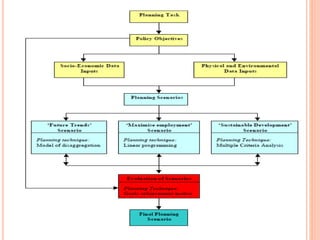
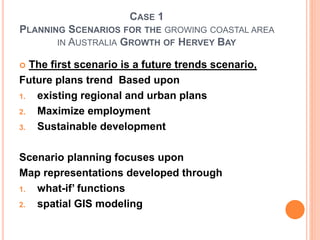
 The first scenario is a future trends scenario,
Future plans trend Based upon
1. existing regional and urban plans
2. Maximize employment
3. Sustainable development
Scenario planning focuses upon
Map representations developed through
1. what-if’ functions
2. spatial GIS modeling
CASE 1
PLANNING SCENARIOS FOR THE GROWING COASTAL AREA
IN AUSTRALIA GROWTH OF HERVEY BAY
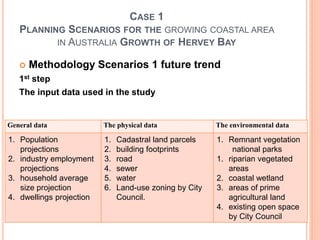
 Methodology Scenarios 1 future trend
1st step
The input data used in the study
The environmental dataThe physical dataGeneral data
1. Remnant vegetation
national parks
1. riparian vegetated
areas
2. coastal wetland
3. areas of prime
agricultural land
4. existing open space
by City Council
1. Cadastral land parcels
2. building footprints
3. road
4. sewer
5. water
6. Land-use zoning by City
Council.
1. Population
projections
2. industry employment
projections
3. household average
size projection
4. dwellings projection
CASE 1
PLANNING SCENARIOS FOR THE GROWING COASTAL AREA
IN AUSTRALIA GROWTH OF HERVEY BAY
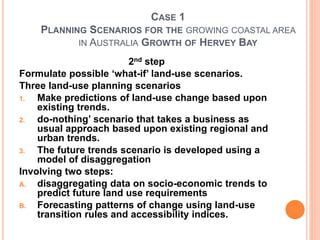
2nd step
Formulate possible ‘what-if’ land-use scenarios.
Three land-use planning scenarios
1. Make predictions of land-use change based upon
existing trends.
2. do-nothing’ scenario that takes a business as
usual approach based upon existing regional and
urban trends.
3. The future trends scenario is developed using a
model of disaggregation
Involving two steps:
A. disaggregating data on socio-economic trends to
predict future land use requirements
B. Forecasting patterns of change using land-use
transition rules and accessibility indices.
CASE 1
PLANNING SCENARIOS FOR THE GROWING COASTAL AREA
IN AUSTRALIA GROWTH OF HERVEY BAY
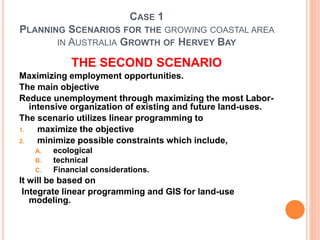
THE SECOND SCENARIO
Maximizing employment opportunities.
The main objective
Reduce unemployment through maximizing the most Labor-
intensive organization of existing and future land-uses.
The scenario utilizes linear programming to
1. maximize the objective
2. minimize possible constraints which include,
A. ecological
B. technical
C. Financial considerations.
It will be based on
Integrate linear programming and GIS for land-use
modeling.
CASE 1
PLANNING SCENARIOS FOR THE GROWING COASTAL AREA
IN AUSTRALIA GROWTH OF HERVEY BAY
THE THIRD SCENARIO
 Sustainable development
 Takes into account areas of both environmental
and economic significance, allows trade-offs to
occur between these sometimes conflicting
areas.
 Use What-if?’
 Collaborative planning support system
development’ scenario for Hervey Bay will be
implemented using the What-if? PSS in
collaboration with the Wide Bay202 project team
and the Hervey Bay City Council planning
division
CASE 1
PLANNING SCENARIOS FOR THE GROWING COASTAL AREA
IN AUSTRALIA GROWTH OF HERVEY BAY
 The evaluation of each of the three land-use scenarios is
undertaken using the core objectives
 These objectives are used in evaluating the efficiency of each
proposed land-use scenario.
They tried many techniques like
COST BENEFIT ANALYSIS (CBA)
It is a limited technique,
1. Because all costs and benefits are expressed mainly in financial terms, it fails to
incorporate intangible items in the actual calculations of a study area
2. Not ability to handle equity considerations
planning balance sheets (PBS)
1. Lack of reference to community objectives
THE DECISION WAS TO USE THE GOALS-ACHIEVEMENT
MATRIX
(GAM) EVALUATION
Disadvantag
es
AdvantagesobjectiveTechniqueScenario
Top-downGood yard
stick
Make predictions of
land use change
based on existing
socio-economic
trend
Disaggregatio
n equations,
Accessibility
Index
future trends
scenario
Top-downProven
Management
Decision
technique
establish
the optimal land-
allocation for each
of the competing
land-uses within the
Shire of Hervey
Bay
Linear
programming,
Accessibility
Index
Maximizing
employment
opportunities.
Limited
Real
World
Application
Bottom-up,
flexible
takes into account
areas of both
environmental and
economic
significance and
allows trade-offs to
occur between
Multiple
Criteria
Analysis
(WLC)
Sustainable
development
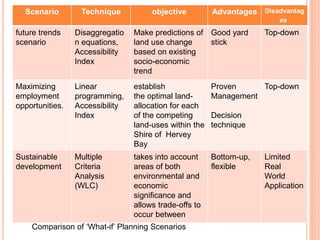
Comparison of ‘What-if’ Planning Scenarios
CASE 1
PLANNING SCENARIOS FOR THE GROWING COASTAL AREA
IN AUSTRALIA GROWTH OF HERVEY BAY
 The planning issues for Hervey Bay are
 to support the growth of the area
 to provide a balanced socio-economic climate.
 Future development that protects the
environmental quality of the area is
1. consistent with the tourism industry
2. consistent with desirable from a sustainable
development perspective.
 The framework developed to evaluate planning
techniques and future growth scenario are
sensitive to environmental issues and costs of
urban expansion
CASE 1
PLANNING SCENARIOS FOR THE GROWING COASTAL AREA
IN AUSTRALIA GROWTH OF HERVEY BAY
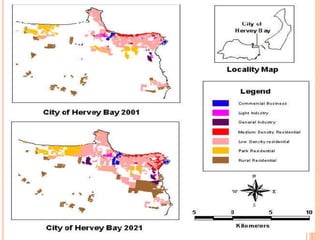
Model of Disaggregation ( (‫تقسيم‬ Technique
 A regional analysis shows future grow in the next TWENTY YEARS
.
 There are patterns of land-use change
 Depend on predictions of future expansion from existing trends.
1. Regional POPULATION growth
2. Regional EMPLOYMENT growth
by industry sector
To achieve it they used model of disaggregation.
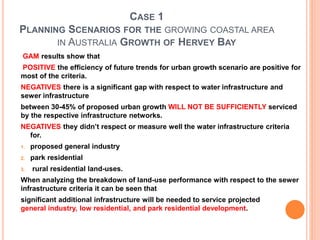
 The model involves two steps:
 1. land-use requirements analysis to predict the future demand of
land required for particular land-uses,
 2. land-use allocation(distribution) model that uses transition rules
and spatial analysis to predict the pattern of land-use change.
Allocation‫استخدام‬ ‫في‬ ‫التغير‬ ‫نمط‬ ‫للتنبؤ‬ ‫المكاني‬ ‫والتحليل‬ ‫التحول‬ ‫قواعد‬ ‫يستخدم‬ ‫نموذج‬‫األراضي‬.
CASE 1
PLANNING SCENARIOS FOR THE GROWING COASTAL AREA
IN AUSTRALIA GROWTH OF HERVEY BAY
Land-use Requirement Analysis
The main inputs.
 regional population
 employment growth
which will be disaggregated and related to land-uses.
1. PARAMETERIZE the demand for land in terms of population-
employment and existing land usage,
2. Extrapolate(estimate) this to future demands.
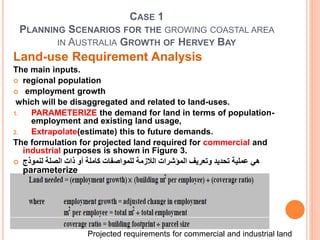
The formulation for projected land required for commercial and
industrial purposes is shown in Figure 3.
 ‫لنموذج‬ ‫الصلة‬ ‫ذات‬ ‫أو‬ ‫كاملة‬ ‫للمواصفات‬ ‫الالزمة‬ ‫المؤشرات‬ ‫وتعريف‬ ‫تحديد‬ ‫عملية‬ ‫هي‬
parameterize
Projected requirements for commercial and industrial land
CASE 1
PLANNING SCENARIOS FOR THE GROWING COASTAL AREA
IN AUSTRALIA GROWTH OF HERVEY BAY
 THE COMPONENT OF THE MODEL which deals with the
 number of additional dwelling units required to accommodate the
predicted increase in population requires regional datasets including;
population projections
household projections
average household size.
Disaggregated data required in calculating additional residential land is based
upon average residential land parcel size.
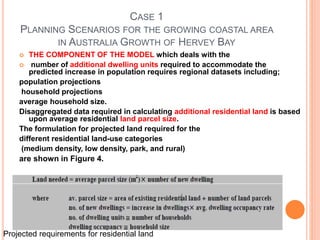
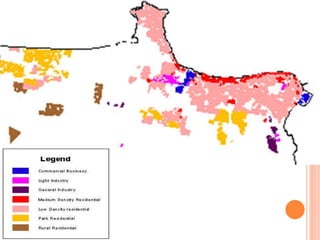
The formulation for projected land required for the
different residential land-use categories
(medium density, low density, park, and rural)
are shown in Figure 4.
Projected requirements for residential land
CASE 1
PLANNING SCENARIOS FOR THE GROWING COASTAL AREA
IN AUSTRALIA GROWTH OF HERVEY BAY
Regional data used in this part of the model includes.
 projected employment growth figures by industry sector.
 disaggregated inputs in the formulation of the commercial
and industry land formulation is
 Land parcel and building footprint data provide important.
 A GIS is used to calculate the average coverage ratio for
each of the industrial and commercial land-use
categories. Combined with the industry sector growth
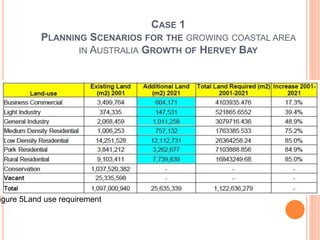
figure components, the total additional land required for
industrial and commercial land-use has thus been
determined – See Figure 5
igure 5Land use requirement
CASE 1
PLANNING SCENARIOS FOR THE GROWING COASTAL AREA
IN AUSTRALIA GROWTH OF HERVEY BAY
CASE 1
PLANNING SCENARIOS FOR THE GROWING COASTAL AREA
IN AUSTRALIA GROWTH OF HERVEY BAY
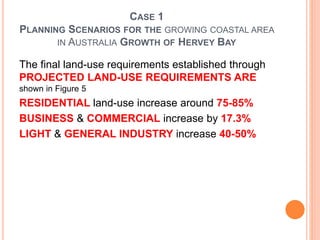
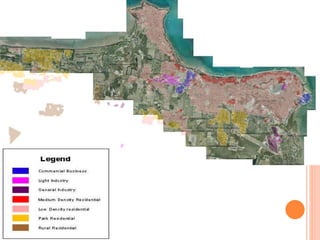
The final land-use requirements established through
PROJECTED LAND-USE REQUIREMENTS ARE
shown in Figure 5
RESIDENTIAL land-use increase around 75-85%
BUSINESS & COMMERCIAL increase by 17.3%
LIGHT & GENERAL INDUSTRY increase 40-50%
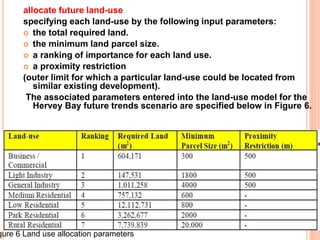
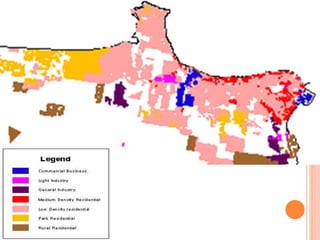
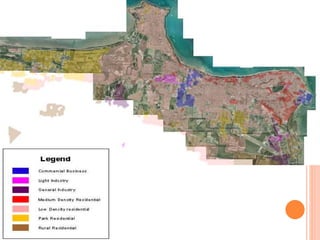
allocate future land-use
specifying each land-use by the following input parameters:
 the total required land.
 the minimum land parcel size.
 a ranking of importance for each land use.
 a proximity restriction
(outer limit for which a particular land-use could be located from
similar existing development).
The associated parameters entered into the land-use model for the
Hervey Bay future trends scenario are specified below in Figure 6.
gure 6 Land use allocation parameters
CASE 1
PLANNING SCENARIOS FOR THE GROWING COASTAL AREA
IN AUSTRALIA GROWTH OF HERVEY BAY
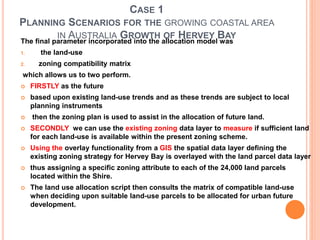
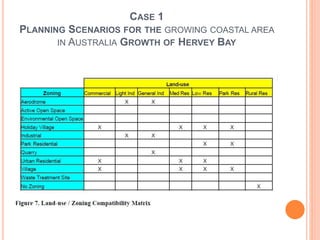
The final parameter incorporated into the allocation model was
1. the land-use
2. zoning compatibility matrix
which allows us to two perform.
 FIRSTLY as the future
 based upon existing land-use trends and as these trends are subject to local
planning instruments
 then the zoning plan is used to assist in the allocation of future land.
 SECONDLY we can use the existing zoning data layer to measure if sufficient land
for each land-use is available within the present zoning scheme.
 Using the overlay functionality from a GIS the spatial data layer defining the
existing zoning strategy for Hervey Bay is overlayed with the land parcel data layer
 thus assigning a specific zoning attribute to each of the 24,000 land parcels
located within the Shire.
 The land use allocation script then consults the matrix of compatible land-use
when deciding upon suitable land-use parcels to be allocated for urban future
development.
CASE 1
PLANNING SCENARIOS FOR THE GROWING COASTAL AREA
IN AUSTRALIA GROWTH OF HERVEY BAY
CASE 1
PLANNING SCENARIOS FOR THE GROWING COASTAL AREA
IN AUSTRALIA GROWTH OF HERVEY BAY
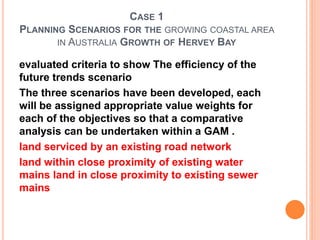
evaluated criteria to show The efficiency of the
future trends scenario
The three scenarios have been developed, each
will be assigned appropriate value weights for
each of the objectives so that a comparative
analysis can be undertaken within a GAM .
land serviced by an existing road network
land within close proximity of existing water
mains land in close proximity to existing sewer
mains
CASE 1
PLANNING SCENARIOS FOR THE GROWING COASTAL AREA
IN AUSTRALIA GROWTH OF HERVEY BAY
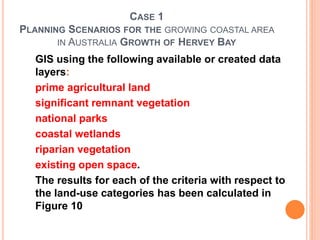
GIS using the following available or created data
layers:
prime agricultural land
significant remnant vegetation
national parks
coastal wetlands
riparian vegetation
existing open space.
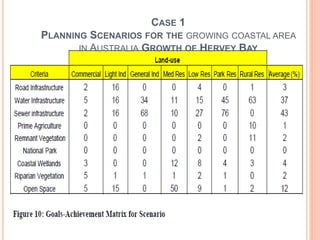
The results for each of the criteria with respect to
the land-use categories has been calculated in
Figure 10
CASE 1
PLANNING SCENARIOS FOR THE GROWING COASTAL AREA
IN AUSTRALIA GROWTH OF HERVEY BAY
CASE 1
PLANNING SCENARIOS FOR THE GROWING COASTAL AREA
IN AUSTRALIA GROWTH OF HERVEY BAY
GAM results show that
POSITIVE the efficiency of future trends for urban growth scenario are positive for
most of the criteria.
NEGATIVES there is a significant gap with respect to water infrastructure and
sewer infrastructure
between 30-45% of proposed urban growth WILL NOT BE SUFFICIENTLY serviced
by the respective infrastructure networks.
NEGATIVES they didn’t respect or measure well the water infrastructure criteria
for.
1. proposed general industry
2. park residential
3. rural residential land-uses.
When analyzing the breakdown of land-use performance with respect to the sewer
infrastructure criteria it can be seen that
significant additional infrastructure will be needed to service projected
general industry, low residential, and park residential development.
CONFLICTS ARE BROUGHT TO LIGHT. THESE PROBLEMS CAN THEN
BE ADDRESSED THROUGH APPROPRIATE PLANNING AND DECISION-
MAKING BODIES THROUGH THE FORMULATION AND IMPLEMENTATION
OF SUITABLE POLICIES AND PLANS.
 CONCLUSIONS
focused upon the development of a methodology for investigating how
demographic (socio-economic)
land-use (physical and environmental)
information models be used to efficiently plan for future urban growth?
So far A FUTURE TRENDS SCENARIO has been formulated for Hervey Bay,
based upon a model of disaggregation which used
transition rules
accessibility index
GIS spatial processing functionality.
Preliminary evaluation of the scenario has been undertaken using a GAM
planning technique. Further work to be undertaken will concentrate on the
calibration of the model of disaggregation technique, and the development of
the ‘maximize employment’ and ‘sustainable development’ scenarios. Once
the final two scenarios have been developed a comparative analysis will be
undertaken to investigate the strengths and weaknesses of all three scenario
and the efficiency of the planning techniques employed to formulate each
scenario.
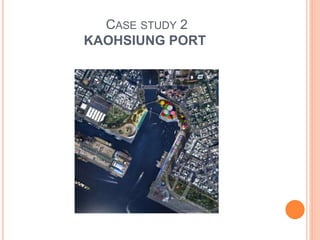
CASE STUDY 2
CASE STUDY 2
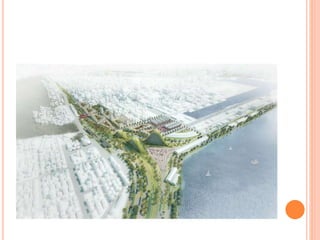
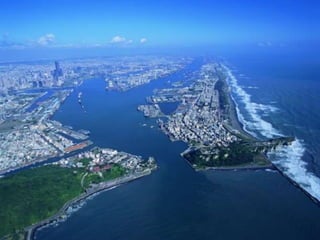
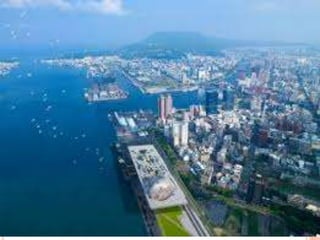
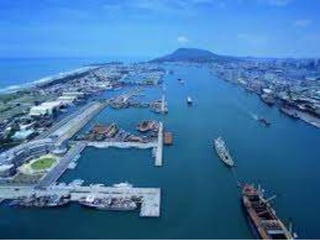
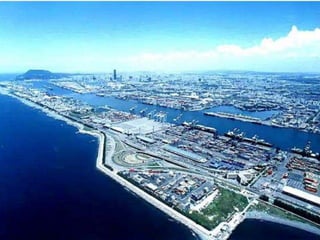
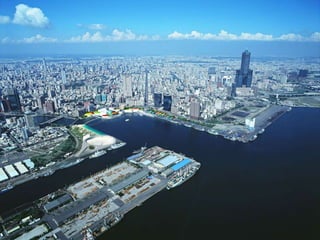
KAOHSIUNG PORT
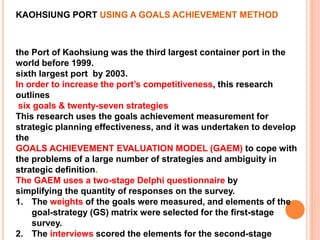
KAOHSIUNG PORT USING A GOALS ACHIEVEMENT METHOD
the Port of Kaohsiung was the third largest container port in the
world before 1999.
sixth largest port by 2003.
In order to increase the port’s competitiveness, this research
outlines
six goals & twenty-seven strategies
This research uses the goals achievement measurement for
strategic planning effectiveness, and it was undertaken to develop
the
GOALS ACHIEVEMENT EVALUATION MODEL (GAEM) to cope with
the problems of a large number of strategies and ambiguity in
strategic definition.
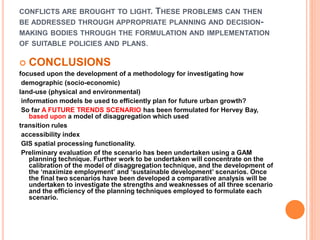
The GAEM uses a two-stage Delphi questionnaire by
simplifying the quantity of responses on the survey.
1. The weights of the goals were measured, and elements of the
goal-strategy (GS) matrix were selected for the first-stage
survey.
2. The interviews scored the elements for the second-stage
METHODOLOGY:
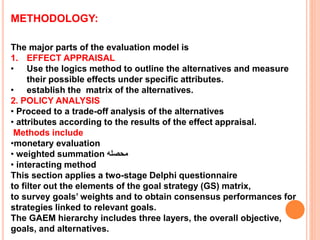
The major parts of the evaluation model is
1. EFFECT APPRAISAL
• Use the logics method to outline the alternatives and measure
their possible effects under specific attributes.
• establish the matrix of the alternatives.
2. POLICY ANALYSIS
• Proceed to a trade-off analysis of the alternatives
• attributes according to the results of the effect appraisal.
Methods include
•monetary evaluation
• weighted summation ‫محصله‬
• interacting method
This section applies a two-stage Delphi questionnaire
to filter out the elements of the goal strategy (GS) matrix,
to survey goals’ weights and to obtain consensus performances for
strategies linked to relevant goals.
The GAEM hierarchy includes three layers, the overall objective,
goals, and alternatives.
1. CONSTRUCT AN INITIAL GS MATRIX.
Given m number of goals G = (g1, ..., gi, ..., gm) (m≥ 2) ,n number of
strategies S = (s1,..., sj, ..., sn) (n ≥ 2).
The elements of relation among goals and strategies are
shown in the GS matrix A = [aij]
2. UNDERTAKE THE FIRST DELPHI QUESTIONNAIRE SURVEY.
The questionnaire survey in this stage includes two sorts of data in the
GS matrix, i.e., m number of
goal’s weights W = [w1, ..., wi, ..., wm] (m ≥ 2), and the
relationship between the goal and strategy judged by q number of
interviewees. The interviewees need to decide if the strategy j can or
cannot reach goal i. If the interviewee f thinks that j strategy can achieve
i goal, then matrix element aij f (f = 1, 2, ..., q) gets one
point
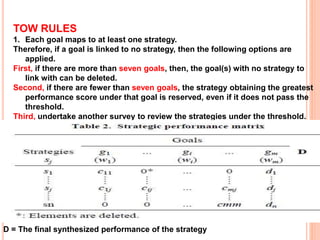
TOW RULES
1. Each goal maps to at least one strategy.
Therefore, if a goal is linked to no strategy, then the following options are
applied.
First, if there are more than seven goals, then, the goal(s) with no strategy to
link with can be deleted.
Second, if there are fewer than seven goals, the strategy obtaining the greatest
performance score under that goal is reserved, even if it does not pass the
threshold.
Third, undertake another survey to review the strategies under the threshold.
2. If a certain strategy does not pass the threshold for all goals, then this
strategy can be deleted.
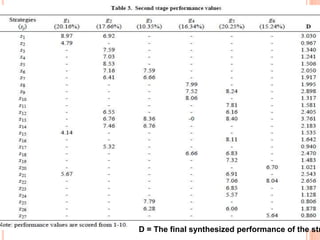
D = The final synthesized performance of the strategy
GOALS
Kaohsiung’s in the new world of the Southern Taiwan reprecent
the marine and cultural capital city of.
OBJECTIVE is to establish
A highly competitive port city with sustainable development
Having a high and sustainable quality of life
Sets up six developmental goals as follows:
g1: Achieving integration of all relevant resources of the
port’s organization.
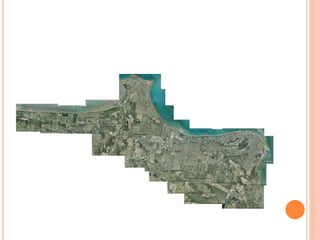
g2: Achieving the effective and efficient usage of the
port’s land between the port and the city.
g3: High quality of the software and hardware for the old
wharves.
g4: High quality inland transportation connecting the port
and the interior of Taiwan.
g5: Achieving a global logistics management system.
g6: Achieving a modern metropolis with a sustainable
operation, and an economy based on knowledge and
technology.
In order to formulate the developmental strategies, seven issues are taken
from the current condition of Kaohsiung, including
1)port redevelopment and urban renewal,
2) the multi-functional international trade and
logistics park,
3) integrated land-use planning
4) issues of transportation,
5) diversification and financial perspective
6) knowledge-based economy and sustainable
development,
7) integration in organization.
By surveying experts and professionals, we received twelve copies of valid
questionnaires. The results
from the GAEM operation are shown in Table. In the first stage of
questionnaire survey, goals in response to strategies are as follow.
D = The final synthesized performance of the str
The weight of goal g1, re-engineering of the
organizational system of the municipality and the
port, is 20.16%.
The weight of g2 effective use of municipal and port
land, is 17.66%.
The weight of g3 enhancing the software and
hardware of the old wharves is 10.35%.
The weight of g4 enhancing transportation in the
municipality and the port, is 16.34%.
The weight of g5 enhancing the competitiveness of
Kaohsiung, is 20.25%
making it the highest goal.
The weight of g6 creating a modern metropolis
with sustainable development
and a knowledge-based economy, is 15.24%.
The superior strategies include the following nine.
Strategy s1: incorporate the development project and urban plan of the port.
Strategy s6: develop the Chizin Peninsula similar to the Santosa project in Singapore
with a redevelopment cultural, recreational and leisure facilities, including
natural ecology and historical sites.
Strategy s9: speed up and strengthen the traffic link between the Process Export Zone
and the container terminals.
Strategy s12: review the supply and demand situation of the domestic fisheries, and
relocate the fishery operations to other exclusive zones or other dedicated fishery ports.
Strategy s13: promotion of the redevelopment of the old wharves, while international
logistics should be re-defined as an economic investment on a national and international
level.
Strategy s14: integrate the redevelopment of the old wharves with the
urban renewal projects, covering the overall planning, general consultancy, facility
planning, master development entity, development and operational consideration.
Strategy s18: adopt Kaohsiung’s strength of airport and seaport by enhancing the
functions of the sea-air reprocessing and transshipment services
Strategy s21: the city government invests internationally combining Port Bureau,
carriers, major business clients and intelligent service suppliers, as part of their
investment portfolio.
Strategy s22: integrate the current maritime network, MTNet, Port-Net, and Trade-VAN
into a navigation, port, tariff information system.
Those are nine superior strategies in order of superiority, having consensus among the
interviewees
CONCLUSIONS
The integrated relative weights of the goals for all of the resources of the port
of Kaohsiung by questionnaire are as follows.
Weight of g5, enhancing the competitiveness of Kaohsiung, is 20.25% the
highest goal.
Weight of g1, re-engineering of the organizational system of the municipality
and the port, is 20.16%.
The weight of g2, effective use of municipal and port land, is 17.66%.
Weight of g4, enhancing the transportation for both the municipality and the
port, is 16.34%.
Weight of g6, creating a modern metropolis with sustainable development
and a knowledge- based economy, is 15.24%.
The weight of g3, to enhance the software and hardware of the old wharves,
is 10.35%. From this empirical study, there are six superior strategies for
resource integration by the port of Kaohsiung, as follows:
1. Promote the integration of the redevelopment of the old wharves through
urban planning;
2. 2. reinforce the existing ODA’s function;
3. 3. speed up the improvement of the traffic link between the Process
Export Zone and the container terminals;
4. 4. integrate the current maritime network and make it a navigation-port-
tariff information system;
5. 5. invest overseas;
6. 6. use Kaohsiung’s strength of airport and seaport to enhance its
Goal achivement matrix

Goal achivement matrix

  • 1.
    RATIONALITY TYPE INEVALUATION TECHNIQUES IN THE FIELD OF URBAN AND REGIONAL PLANNING ‫اسس‬‫الحضري‬ ‫التصميم‬ ‫األهداف‬ ‫مسح‬ ‫تحليل‬ ‫تصنيف‬ ‫األهداف‬ ‫ا‬‫نم‬‫ا‬‫من‬ ‫ط‬ ‫المعلومات‬ ‫البد‬‫ائل‬ ‫توليد‬ ‫األفكار‬ ‫تقييم‬ ‫التقي‬ ‫طريقة‬‫يم‬ ‫نظريه‬ ‫على‬ ‫تعتمد‬ ‫االقتصاد‬ goal achivemet matrix ‫التكاليف‬ ‫والفوائد‬ ‫تحليل‬ ‫التكلفة‬ ‫المنفعة‬ ‫فعالية‬ ‫تحليل‬ ‫التكاليف‬ normalisation based mehod ‫رسم‬ ‫ال‬‫م‬‫خطط‬‫ات‬ ‫مراقبة‬
  • 2.
    RATIONALITY TYPE INEVALUATION TECHNIQUES IN THE FIELD OF URBAN AND REGIONAL PLANNING  This method was used by Morris Hill in 1968 in the field of transport and evaluation of land Used in Britain  And in seventies was used by land use planners to determine optimal locations for housing and public development and developed by a number of specialists.
  • 3.
    RATIONALITY TYPE INEVALUATION TECHNIQUES IN THE FIELD OF URBAN AND REGIONAL PLANNING  THE CORE IDEA is to view costs and benefits always in terms of achievement of objectives.  USED IN operational rather than abstract sense. For each goal that can be identified.  USED IN  developing stage  evaluating stage Which brings to light how a particular planning scenario performed AGAINST local and state planning policies and objectives?  Because it's instrumental orientations  IN TERMS of quantitative if possible, otherwise in qualitative terms.  Applicable unit of measurement is established for each goal.  GAM performs the benefits and the costs across sectors per objective.  It is quite capable to express complexity of decision problems.
  • 4.
    THE MAIN PURPOSE CONVINCETHE POLITICIANS AND THE PUBLIC THAT THE RECOMMENDED PLANS COMBINE AND USE INCOMES SO AS TO MAXIMISE OR AT LEAST SATISFICE THE ACHIEVEMENT OF ENDS. The calculation versus politics is important Shows the tensions between instrumental and communicative in public decision-making . There is a COMMUNICATIVE, DEMOCRATIC, and DIALOGICAL side to the planning activity Procedure 1.Set general goals and give weights 2.obtain objectives from each goal and give order of importance. 3.Distribute the weight of the goal on the objectives according to their relative importance 4.Multiply each order of importance by the weight of the objective and sum up 5.The higher the scores summed by an alternative the more the suitability to be adopted as a plan.
  • 5.
    RATIONALITY TYPE INEVALUATION TECHNIQUES IN THE FIELD OF URBAN AND REGIONAL PLANNING goal achivemet matrix - identify and formulate previously goals General goals should Specified before proposal the alternatives or analysis of the results and their implications Detailed goals identifying the general goals in order to measure the degree of convergence between these various objectives basis of the specific benefits and costs .identifying the appropriate measure to measure each goal you can identifying the costs and benefits of the same units expressed the objectives specified in the matrix. give weights to the objectives expression of the relative importance determine weights evaluate extent achievement study the possibility of the success of this alternative from other alternatives to achieve all of the goals or a larger proportion of them, and give weights to the hierarchy of the degree of achievement or failure to achieve a specific goal for each of the alternatives. choose the best alternativ e conducting a sensitivity analysis give a more objective in identifying the relative importance of the goals division explanation
  • 6.
    goal achivemet matrix -‫وصياغة‬ ‫تحديد‬ ‫سابقا‬ ‫األهداف‬ ‫العامة‬‫األهداف‬ ‫األهداف‬ ‫تحديد‬ ‫يجب‬ ‫للنتائ‬ ‫تحليل‬ ‫أو‬ ‫بدائل‬ ‫اقتراح‬ ‫قبل‬‫ج‬ ‫عليها‬ ‫المترتبة‬ ‫واآلثار‬ ‫التفصي‬ ‫األهداف‬‫لية‬ ‫العامة‬ ‫األهداف‬ ‫تحديد‬ ‫بي‬ ‫التقارب‬ ‫درجة‬ ‫قياس‬ ‫أجل‬ ‫من‬‫ن‬ ‫األهداف‬ ‫هذه‬ ‫مختلف‬‫علئ‬‫أساس‬ ‫المحددة‬ ‫والتكاليف‬ ‫المنافع‬. ‫التدابير‬ ‫تحديد‬ ‫ك‬ ‫لقياس‬ ‫المالئمة‬‫ل‬ ‫هدف‬ ‫ن‬ ‫من‬ ‫والمنافع‬ ‫التكاليف‬ ‫تحديد‬ ‫يمكنك‬‫فس‬ ‫باألهداف‬ ‫عنها‬ ‫أعرب‬ ‫التي‬ ‫الوحدات‬ ‫المصفوفة‬ ‫في‬ ‫المحددة‬. ‫لكل‬ ‫وزن‬ ‫اعطاء‬ ‫هدف‬ ‫ال‬‫عن‬ ‫تعبيرا‬ ‫النسبية‬ ‫األهمية‬ ‫األوزان‬ ‫تحديد‬ ‫اإلنج‬ ‫مدى‬ ‫تقييم‬‫از‬ ‫لتحقي‬ ‫األخرى‬ ‫البدائل‬ ‫من‬ ‫البديل‬ ‫هذا‬ ‫نجاح‬ ‫إمكانية‬ ‫دراسة‬‫ق‬ ‫إلى‬ ‫األوزان‬ ‫وإعطاء‬ ،‫منهم‬ ‫كبيرة‬ ‫نسبة‬ ‫أو‬ ‫األهداف‬ ‫جميع‬ ‫هد‬ ‫تحقيق‬ ‫في‬ ‫اإلخفاق‬ ‫أو‬ ‫اإلنجاز‬ ‫لدرجة‬ ‫الهرمي‬ ‫التسلسل‬‫ف‬ ‫البدائل‬ ‫من‬ ‫لكل‬ ‫محدد‬.‫البديل‬ ‫اختيار‬ ‫األفضل‬ ‫تحليل‬ ‫إجراء‬ ‫الحساسية‬ ‫نكون‬‫النس‬ ‫األهمية‬ ‫تحديد‬ ‫في‬ ‫موضوعية‬ ‫أكثر‬‫بية‬ ‫لألهداف‬
  • 7.
    RATIONALITY TYPE INEVALUATION TECHNIQUES IN THE FIELD OF URBAN AND REGIONAL PLANNING An evaluation method provides a technique for analysis and grade of different available alternatives for achieving a certain goal or objective. the main reason for the development of this method is to balance between  the stage primary studies  survey possible regional development  the final stages of evaluating alternatives choose the best alternative  common feature of the methods developed in trying to determine the degree of the possibility Alternatives plans to achieve pre-defined objectives  You can identify the costs and benefits of the same units expressed the objectives specified in the matrix
  • 8.
    CASE 1 PLANNING SCENARIOSFOR THE GROWING COASTAL AREA IN AUSTRALIA GROWTH OF HERVEY BAY
  • 9.
    CASE 1 PLANNING SCENARIOSFOR THE GROWING COASTAL AREA IN AUSTRALIA GROWTH OF HERVEY BAY  Area 2,340 square kilometers for Hervey Bay  Hervey includes North Fraser Island. (World Heritage area) 1,010 square kilometers.  Urban settlement began in the 1870s as Residential  The area developed an economy on agriculture (sugar cane)  Tourism with the world heritage  whale watching  Today the economy dependent upon  the tourism industry  Settlement driven by retirees.  strong population growth  high unemployment rate close to 20% in 1999
  • 10.
    CASE 1 PLANNING SCENARIOSFOR THE GROWING COASTAL AREA IN AUSTRALIA GROWTH OF HERVEY BAY What they want  support the growth of the area  Provide a balanced socio-economic climate.  Future development that protects the environmental quality of the area which consistent with 1. tourism industry 2. Sustainable development perspective. 3. The environmental issues and the costs of urban expansion. Special case  Special big area owned to Business persons he use it as 1. Building holiday homes, 2. Hotels 3. Guest houses
  • 11.
    CASE 1 PLANNING SCENARIOSFOR THE GROWING COASTAL AREA IN AUSTRALIA GROWTH OF HERVEY BAY HOW CAN 1. Demographic (a particular sector of a population) 2. Socio-economic 3. Land-use 4. Physical and environmental Information models may be used to efficiently plan for future urban growth?  A case study approach is undertaken using WHAT-IF planning scenarios for a rapidly called Hervey Bay.  The town and surrounding area require CAREFUL planning of future urban growth between competing land-uses.  This includes predictions and tactical planning for land-use change based on 1. projections from existing trends, 2. optimizing socio-economic output,
  • 13.
    CASE 1 PLANNING SCENARIOSFOR THE GROWING COASTAL AREA IN AUSTRALIA GROWTH OF HERVEY BAY  The first scenario is a future trends scenario, Future plans trend Based upon 1. existing regional and urban plans 2. Maximize employment 3. Sustainable development Scenario planning focuses upon Map representations developed through 1. what-if’ functions 2. spatial GIS modeling
  • 14.
    CASE 1 PLANNING SCENARIOSFOR THE GROWING COASTAL AREA IN AUSTRALIA GROWTH OF HERVEY BAY  Methodology Scenarios 1 future trend 1st step The input data used in the study The environmental dataThe physical dataGeneral data 1. Remnant vegetation national parks 1. riparian vegetated areas 2. coastal wetland 3. areas of prime agricultural land 4. existing open space by City Council 1. Cadastral land parcels 2. building footprints 3. road 4. sewer 5. water 6. Land-use zoning by City Council. 1. Population projections 2. industry employment projections 3. household average size projection 4. dwellings projection
  • 15.
    CASE 1 PLANNING SCENARIOSFOR THE GROWING COASTAL AREA IN AUSTRALIA GROWTH OF HERVEY BAY 2nd step Formulate possible ‘what-if’ land-use scenarios. Three land-use planning scenarios 1. Make predictions of land-use change based upon existing trends. 2. do-nothing’ scenario that takes a business as usual approach based upon existing regional and urban trends. 3. The future trends scenario is developed using a model of disaggregation Involving two steps: A. disaggregating data on socio-economic trends to predict future land use requirements B. Forecasting patterns of change using land-use transition rules and accessibility indices.
  • 16.
    CASE 1 PLANNING SCENARIOSFOR THE GROWING COASTAL AREA IN AUSTRALIA GROWTH OF HERVEY BAY THE SECOND SCENARIO Maximizing employment opportunities. The main objective Reduce unemployment through maximizing the most Labor- intensive organization of existing and future land-uses. The scenario utilizes linear programming to 1. maximize the objective 2. minimize possible constraints which include, A. ecological B. technical C. Financial considerations. It will be based on Integrate linear programming and GIS for land-use modeling.
  • 17.
    CASE 1 PLANNING SCENARIOSFOR THE GROWING COASTAL AREA IN AUSTRALIA GROWTH OF HERVEY BAY THE THIRD SCENARIO  Sustainable development  Takes into account areas of both environmental and economic significance, allows trade-offs to occur between these sometimes conflicting areas.  Use What-if?’  Collaborative planning support system development’ scenario for Hervey Bay will be implemented using the What-if? PSS in collaboration with the Wide Bay202 project team and the Hervey Bay City Council planning division
  • 18.
    CASE 1 PLANNING SCENARIOSFOR THE GROWING COASTAL AREA IN AUSTRALIA GROWTH OF HERVEY BAY  The evaluation of each of the three land-use scenarios is undertaken using the core objectives  These objectives are used in evaluating the efficiency of each proposed land-use scenario. They tried many techniques like COST BENEFIT ANALYSIS (CBA) It is a limited technique, 1. Because all costs and benefits are expressed mainly in financial terms, it fails to incorporate intangible items in the actual calculations of a study area 2. Not ability to handle equity considerations planning balance sheets (PBS) 1. Lack of reference to community objectives THE DECISION WAS TO USE THE GOALS-ACHIEVEMENT MATRIX (GAM) EVALUATION
  • 19.
    Disadvantag es AdvantagesobjectiveTechniqueScenario Top-downGood yard stick Make predictionsof land use change based on existing socio-economic trend Disaggregatio n equations, Accessibility Index future trends scenario Top-downProven Management Decision technique establish the optimal land- allocation for each of the competing land-uses within the Shire of Hervey Bay Linear programming, Accessibility Index Maximizing employment opportunities. Limited Real World Application Bottom-up, flexible takes into account areas of both environmental and economic significance and allows trade-offs to occur between Multiple Criteria Analysis (WLC) Sustainable development Comparison of ‘What-if’ Planning Scenarios
  • 20.
    CASE 1 PLANNING SCENARIOSFOR THE GROWING COASTAL AREA IN AUSTRALIA GROWTH OF HERVEY BAY  The planning issues for Hervey Bay are  to support the growth of the area  to provide a balanced socio-economic climate.  Future development that protects the environmental quality of the area is 1. consistent with the tourism industry 2. consistent with desirable from a sustainable development perspective.  The framework developed to evaluate planning techniques and future growth scenario are sensitive to environmental issues and costs of urban expansion
  • 21.
    CASE 1 PLANNING SCENARIOSFOR THE GROWING COASTAL AREA IN AUSTRALIA GROWTH OF HERVEY BAY Model of Disaggregation ( (‫تقسيم‬ Technique  A regional analysis shows future grow in the next TWENTY YEARS .  There are patterns of land-use change  Depend on predictions of future expansion from existing trends. 1. Regional POPULATION growth 2. Regional EMPLOYMENT growth by industry sector To achieve it they used model of disaggregation.  The model involves two steps:  1. land-use requirements analysis to predict the future demand of land required for particular land-uses,  2. land-use allocation(distribution) model that uses transition rules and spatial analysis to predict the pattern of land-use change. Allocation‫استخدام‬ ‫في‬ ‫التغير‬ ‫نمط‬ ‫للتنبؤ‬ ‫المكاني‬ ‫والتحليل‬ ‫التحول‬ ‫قواعد‬ ‫يستخدم‬ ‫نموذج‬‫األراضي‬.
  • 22.
    CASE 1 PLANNING SCENARIOSFOR THE GROWING COASTAL AREA IN AUSTRALIA GROWTH OF HERVEY BAY Land-use Requirement Analysis The main inputs.  regional population  employment growth which will be disaggregated and related to land-uses. 1. PARAMETERIZE the demand for land in terms of population- employment and existing land usage, 2. Extrapolate(estimate) this to future demands. The formulation for projected land required for commercial and industrial purposes is shown in Figure 3.  ‫لنموذج‬ ‫الصلة‬ ‫ذات‬ ‫أو‬ ‫كاملة‬ ‫للمواصفات‬ ‫الالزمة‬ ‫المؤشرات‬ ‫وتعريف‬ ‫تحديد‬ ‫عملية‬ ‫هي‬ parameterize Projected requirements for commercial and industrial land
  • 23.
    CASE 1 PLANNING SCENARIOSFOR THE GROWING COASTAL AREA IN AUSTRALIA GROWTH OF HERVEY BAY  THE COMPONENT OF THE MODEL which deals with the  number of additional dwelling units required to accommodate the predicted increase in population requires regional datasets including; population projections household projections average household size. Disaggregated data required in calculating additional residential land is based upon average residential land parcel size. The formulation for projected land required for the different residential land-use categories (medium density, low density, park, and rural) are shown in Figure 4. Projected requirements for residential land
  • 24.
    CASE 1 PLANNING SCENARIOSFOR THE GROWING COASTAL AREA IN AUSTRALIA GROWTH OF HERVEY BAY Regional data used in this part of the model includes.  projected employment growth figures by industry sector.  disaggregated inputs in the formulation of the commercial and industry land formulation is  Land parcel and building footprint data provide important.  A GIS is used to calculate the average coverage ratio for each of the industrial and commercial land-use categories. Combined with the industry sector growth figure components, the total additional land required for industrial and commercial land-use has thus been determined – See Figure 5
  • 25.
    igure 5Land userequirement CASE 1 PLANNING SCENARIOS FOR THE GROWING COASTAL AREA IN AUSTRALIA GROWTH OF HERVEY BAY
  • 27.
    CASE 1 PLANNING SCENARIOSFOR THE GROWING COASTAL AREA IN AUSTRALIA GROWTH OF HERVEY BAY The final land-use requirements established through PROJECTED LAND-USE REQUIREMENTS ARE shown in Figure 5 RESIDENTIAL land-use increase around 75-85% BUSINESS & COMMERCIAL increase by 17.3% LIGHT & GENERAL INDUSTRY increase 40-50%
  • 28.
    allocate future land-use specifyingeach land-use by the following input parameters:  the total required land.  the minimum land parcel size.  a ranking of importance for each land use.  a proximity restriction (outer limit for which a particular land-use could be located from similar existing development). The associated parameters entered into the land-use model for the Hervey Bay future trends scenario are specified below in Figure 6. gure 6 Land use allocation parameters
  • 29.
    CASE 1 PLANNING SCENARIOSFOR THE GROWING COASTAL AREA IN AUSTRALIA GROWTH OF HERVEY BAY The final parameter incorporated into the allocation model was 1. the land-use 2. zoning compatibility matrix which allows us to two perform.  FIRSTLY as the future  based upon existing land-use trends and as these trends are subject to local planning instruments  then the zoning plan is used to assist in the allocation of future land.  SECONDLY we can use the existing zoning data layer to measure if sufficient land for each land-use is available within the present zoning scheme.  Using the overlay functionality from a GIS the spatial data layer defining the existing zoning strategy for Hervey Bay is overlayed with the land parcel data layer  thus assigning a specific zoning attribute to each of the 24,000 land parcels located within the Shire.  The land use allocation script then consults the matrix of compatible land-use when deciding upon suitable land-use parcels to be allocated for urban future development.
  • 30.
    CASE 1 PLANNING SCENARIOSFOR THE GROWING COASTAL AREA IN AUSTRALIA GROWTH OF HERVEY BAY
  • 31.
    CASE 1 PLANNING SCENARIOSFOR THE GROWING COASTAL AREA IN AUSTRALIA GROWTH OF HERVEY BAY evaluated criteria to show The efficiency of the future trends scenario The three scenarios have been developed, each will be assigned appropriate value weights for each of the objectives so that a comparative analysis can be undertaken within a GAM . land serviced by an existing road network land within close proximity of existing water mains land in close proximity to existing sewer mains
  • 32.
    CASE 1 PLANNING SCENARIOSFOR THE GROWING COASTAL AREA IN AUSTRALIA GROWTH OF HERVEY BAY GIS using the following available or created data layers: prime agricultural land significant remnant vegetation national parks coastal wetlands riparian vegetation existing open space. The results for each of the criteria with respect to the land-use categories has been calculated in Figure 10
  • 33.
    CASE 1 PLANNING SCENARIOSFOR THE GROWING COASTAL AREA IN AUSTRALIA GROWTH OF HERVEY BAY
  • 34.
    CASE 1 PLANNING SCENARIOSFOR THE GROWING COASTAL AREA IN AUSTRALIA GROWTH OF HERVEY BAY GAM results show that POSITIVE the efficiency of future trends for urban growth scenario are positive for most of the criteria. NEGATIVES there is a significant gap with respect to water infrastructure and sewer infrastructure between 30-45% of proposed urban growth WILL NOT BE SUFFICIENTLY serviced by the respective infrastructure networks. NEGATIVES they didn’t respect or measure well the water infrastructure criteria for. 1. proposed general industry 2. park residential 3. rural residential land-uses. When analyzing the breakdown of land-use performance with respect to the sewer infrastructure criteria it can be seen that significant additional infrastructure will be needed to service projected general industry, low residential, and park residential development.
  • 35.
    CONFLICTS ARE BROUGHTTO LIGHT. THESE PROBLEMS CAN THEN BE ADDRESSED THROUGH APPROPRIATE PLANNING AND DECISION- MAKING BODIES THROUGH THE FORMULATION AND IMPLEMENTATION OF SUITABLE POLICIES AND PLANS.  CONCLUSIONS focused upon the development of a methodology for investigating how demographic (socio-economic) land-use (physical and environmental) information models be used to efficiently plan for future urban growth? So far A FUTURE TRENDS SCENARIO has been formulated for Hervey Bay, based upon a model of disaggregation which used transition rules accessibility index GIS spatial processing functionality. Preliminary evaluation of the scenario has been undertaken using a GAM planning technique. Further work to be undertaken will concentrate on the calibration of the model of disaggregation technique, and the development of the ‘maximize employment’ and ‘sustainable development’ scenarios. Once the final two scenarios have been developed a comparative analysis will be undertaken to investigate the strengths and weaknesses of all three scenario and the efficiency of the planning techniques employed to formulate each scenario.
  • 41.
  • 42.
  • 51.
    KAOHSIUNG PORT USINGA GOALS ACHIEVEMENT METHOD the Port of Kaohsiung was the third largest container port in the world before 1999. sixth largest port by 2003. In order to increase the port’s competitiveness, this research outlines six goals & twenty-seven strategies This research uses the goals achievement measurement for strategic planning effectiveness, and it was undertaken to develop the GOALS ACHIEVEMENT EVALUATION MODEL (GAEM) to cope with the problems of a large number of strategies and ambiguity in strategic definition. The GAEM uses a two-stage Delphi questionnaire by simplifying the quantity of responses on the survey. 1. The weights of the goals were measured, and elements of the goal-strategy (GS) matrix were selected for the first-stage survey. 2. The interviews scored the elements for the second-stage
  • 52.
    METHODOLOGY: The major partsof the evaluation model is 1. EFFECT APPRAISAL • Use the logics method to outline the alternatives and measure their possible effects under specific attributes. • establish the matrix of the alternatives. 2. POLICY ANALYSIS • Proceed to a trade-off analysis of the alternatives • attributes according to the results of the effect appraisal. Methods include •monetary evaluation • weighted summation ‫محصله‬ • interacting method This section applies a two-stage Delphi questionnaire to filter out the elements of the goal strategy (GS) matrix, to survey goals’ weights and to obtain consensus performances for strategies linked to relevant goals. The GAEM hierarchy includes three layers, the overall objective, goals, and alternatives.
  • 53.
    1. CONSTRUCT ANINITIAL GS MATRIX. Given m number of goals G = (g1, ..., gi, ..., gm) (m≥ 2) ,n number of strategies S = (s1,..., sj, ..., sn) (n ≥ 2). The elements of relation among goals and strategies are shown in the GS matrix A = [aij] 2. UNDERTAKE THE FIRST DELPHI QUESTIONNAIRE SURVEY. The questionnaire survey in this stage includes two sorts of data in the GS matrix, i.e., m number of goal’s weights W = [w1, ..., wi, ..., wm] (m ≥ 2), and the relationship between the goal and strategy judged by q number of interviewees. The interviewees need to decide if the strategy j can or cannot reach goal i. If the interviewee f thinks that j strategy can achieve i goal, then matrix element aij f (f = 1, 2, ..., q) gets one point
  • 54.
    TOW RULES 1. Eachgoal maps to at least one strategy. Therefore, if a goal is linked to no strategy, then the following options are applied. First, if there are more than seven goals, then, the goal(s) with no strategy to link with can be deleted. Second, if there are fewer than seven goals, the strategy obtaining the greatest performance score under that goal is reserved, even if it does not pass the threshold. Third, undertake another survey to review the strategies under the threshold. 2. If a certain strategy does not pass the threshold for all goals, then this strategy can be deleted. D = The final synthesized performance of the strategy
  • 56.
    GOALS Kaohsiung’s in thenew world of the Southern Taiwan reprecent the marine and cultural capital city of. OBJECTIVE is to establish A highly competitive port city with sustainable development Having a high and sustainable quality of life Sets up six developmental goals as follows: g1: Achieving integration of all relevant resources of the port’s organization. g2: Achieving the effective and efficient usage of the port’s land between the port and the city. g3: High quality of the software and hardware for the old wharves. g4: High quality inland transportation connecting the port and the interior of Taiwan. g5: Achieving a global logistics management system. g6: Achieving a modern metropolis with a sustainable operation, and an economy based on knowledge and technology.
  • 57.
    In order toformulate the developmental strategies, seven issues are taken from the current condition of Kaohsiung, including 1)port redevelopment and urban renewal, 2) the multi-functional international trade and logistics park, 3) integrated land-use planning 4) issues of transportation, 5) diversification and financial perspective 6) knowledge-based economy and sustainable development, 7) integration in organization. By surveying experts and professionals, we received twelve copies of valid questionnaires. The results from the GAEM operation are shown in Table. In the first stage of questionnaire survey, goals in response to strategies are as follow.
  • 58.
    D = Thefinal synthesized performance of the str
  • 59.
    The weight ofgoal g1, re-engineering of the organizational system of the municipality and the port, is 20.16%. The weight of g2 effective use of municipal and port land, is 17.66%. The weight of g3 enhancing the software and hardware of the old wharves is 10.35%. The weight of g4 enhancing transportation in the municipality and the port, is 16.34%. The weight of g5 enhancing the competitiveness of Kaohsiung, is 20.25% making it the highest goal. The weight of g6 creating a modern metropolis with sustainable development and a knowledge-based economy, is 15.24%.
  • 60.
    The superior strategiesinclude the following nine. Strategy s1: incorporate the development project and urban plan of the port. Strategy s6: develop the Chizin Peninsula similar to the Santosa project in Singapore with a redevelopment cultural, recreational and leisure facilities, including natural ecology and historical sites. Strategy s9: speed up and strengthen the traffic link between the Process Export Zone and the container terminals. Strategy s12: review the supply and demand situation of the domestic fisheries, and relocate the fishery operations to other exclusive zones or other dedicated fishery ports. Strategy s13: promotion of the redevelopment of the old wharves, while international logistics should be re-defined as an economic investment on a national and international level. Strategy s14: integrate the redevelopment of the old wharves with the urban renewal projects, covering the overall planning, general consultancy, facility planning, master development entity, development and operational consideration. Strategy s18: adopt Kaohsiung’s strength of airport and seaport by enhancing the functions of the sea-air reprocessing and transshipment services Strategy s21: the city government invests internationally combining Port Bureau, carriers, major business clients and intelligent service suppliers, as part of their investment portfolio. Strategy s22: integrate the current maritime network, MTNet, Port-Net, and Trade-VAN into a navigation, port, tariff information system. Those are nine superior strategies in order of superiority, having consensus among the interviewees
  • 62.
    CONCLUSIONS The integrated relativeweights of the goals for all of the resources of the port of Kaohsiung by questionnaire are as follows. Weight of g5, enhancing the competitiveness of Kaohsiung, is 20.25% the highest goal. Weight of g1, re-engineering of the organizational system of the municipality and the port, is 20.16%. The weight of g2, effective use of municipal and port land, is 17.66%. Weight of g4, enhancing the transportation for both the municipality and the port, is 16.34%. Weight of g6, creating a modern metropolis with sustainable development and a knowledge- based economy, is 15.24%. The weight of g3, to enhance the software and hardware of the old wharves, is 10.35%. From this empirical study, there are six superior strategies for resource integration by the port of Kaohsiung, as follows: 1. Promote the integration of the redevelopment of the old wharves through urban planning; 2. 2. reinforce the existing ODA’s function; 3. 3. speed up the improvement of the traffic link between the Process Export Zone and the container terminals; 4. 4. integrate the current maritime network and make it a navigation-port- tariff information system; 5. 5. invest overseas; 6. 6. use Kaohsiung’s strength of airport and seaport to enhance its

Editor's Notes

  • #24 Projected requirements for commercial and industrial land