Strategic Planning in England Some Reflections from my Experience Will Fieldhouse January 2011
What’s This About? Lessons from my work on Regional Planning and Regional Strategies over last ten years About process, ways of working, and “strategic issues” May be relevant to whatever planning system we may have in the future?
What  This is  Not  About Eric Pickles CALA Homes “ Local Growth” White Paper Localism Bill Government Offices This is a personal view, not a Government view
What I mean by ….. “ Strategic ” = wider area than local authority “ Spatial ” = about places, but not just “development and use of land” “ Plan ” = document setting out desired outcomes and means of achieving them
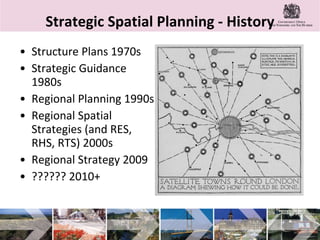
Strategic Spatial Planning - History Structure Plans 1970s Strategic Guidance 1980s Regional Planning 1990s Regional Spatial Strategies (and RES, RHS, RTS) 2000s Regional Strategy 2009 ?????? 2010+
Lessons learned What I’ve learned from regional strategy work about Process / procedures Ways of working Strategic issues (housing, economy, infrastructure, etc) But first ………
Some General Stuff Sustainable development Joining things up (“integration”) Outcomes Delivery
Sustainable Development What makes Development “Sustainable”? The Lorax may ask How many Thneeds do we really all need? What about the Truffalo Trees and Bar-ba-Loots? So a strategic planner should consider Long term, strategic view Environmental, social and economic evidence and impacts / outcomes
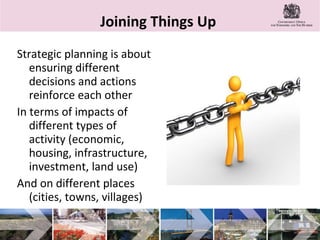
Joining Things Up  Strategic planning is about ensuring different decisions and actions reinforce each other  In terms of impacts of different types of activity (economic, housing, infrastructure, investment, land use) And on different places (cities, towns, villages)
Outcomes  A strategy needs to be very clear about what you want to achieve  And express this in measurable ways This may be about homes, the economy, transport, places
Delivery And the strategy needs to be clear about who needs to do what to achieve the outcomes But not details about projects and money Need support from key delivery agencies
Preparing a Strategy Statutory process – not necessary, but has benefits? Government Guidance – too much? SA / SEA / HRA – make it useful not just bureacracy Independent Examination – useful, but could be streamlined Timetable – 3 years possible, and reasonable?
Ways of Working Need people with capacity and expertise Importance of working together Effective project management Engagement with stakeholders And wider public
Strategic Issues Vision Roles of places Economy Housing Transport Environment
Vision Motherhood and Apple Pie is nice of course. But make your Vision Long term and ambitious (but realistic) Spatially specific (about places) Quantified/quantifiable Linked to clear outcomes
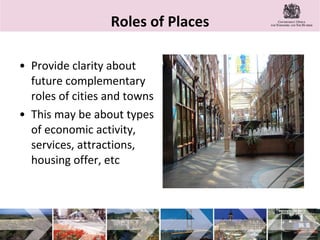
Roles of Places Provide clarity about future complementary roles of cities and towns This may be about types of economic activity, services, attractions, housing offer, etc
Economy Be clear about things with big impact Plan for the economy, not “employment land” Understand sectors, markets, supply chains Identify areas of significant economic change Be enabling, not prescriptive
Housing Understand housing markets and areas Be clear about where new housing should be (but “targets”?) But also existing homes Regeneration v. market pressures
Transport Identify significant priorities for management and investment Need to link these to roles of places, where people will live and work Avoid wish lists
Other potentially “strategic” Issues Energy generation and distribution Waste management Minerals supply Green Belt
Essential ingredients  Recipe for Mom’s apple pie: Picture Ingredients / quantities Instructions Similarly, an effective strategy should include: Diagram / map Clear outcomes Resources Who needs to do what
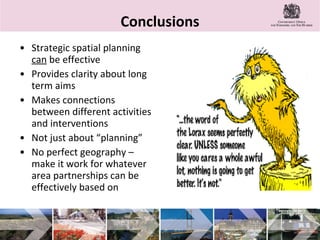
Conclusions Strategic spatial planning  can  be effective  Provides clarity about long term aims Makes connections between different activities and interventions Not just about “planning” No perfect geography – make it work for whatever area partnerships can be effectively based on
Strategic Planning Will Return

Strategic Spatial Planning WFJan2011

  • 1.
    Strategic Planning inEngland Some Reflections from my Experience Will Fieldhouse January 2011
  • 2.
    What’s This About?Lessons from my work on Regional Planning and Regional Strategies over last ten years About process, ways of working, and “strategic issues” May be relevant to whatever planning system we may have in the future?
  • 3.
    What Thisis Not About Eric Pickles CALA Homes “ Local Growth” White Paper Localism Bill Government Offices This is a personal view, not a Government view
  • 4.
    What I meanby ….. “ Strategic ” = wider area than local authority “ Spatial ” = about places, but not just “development and use of land” “ Plan ” = document setting out desired outcomes and means of achieving them
  • 5.
    Strategic Spatial Planning- History Structure Plans 1970s Strategic Guidance 1980s Regional Planning 1990s Regional Spatial Strategies (and RES, RHS, RTS) 2000s Regional Strategy 2009 ?????? 2010+
  • 6.
    Lessons learned WhatI’ve learned from regional strategy work about Process / procedures Ways of working Strategic issues (housing, economy, infrastructure, etc) But first ………
  • 7.
    Some General StuffSustainable development Joining things up (“integration”) Outcomes Delivery
  • 8.
    Sustainable Development Whatmakes Development “Sustainable”? The Lorax may ask How many Thneeds do we really all need? What about the Truffalo Trees and Bar-ba-Loots? So a strategic planner should consider Long term, strategic view Environmental, social and economic evidence and impacts / outcomes
  • 9.
    Joining Things Up Strategic planning is about ensuring different decisions and actions reinforce each other In terms of impacts of different types of activity (economic, housing, infrastructure, investment, land use) And on different places (cities, towns, villages)
  • 10.
    Outcomes Astrategy needs to be very clear about what you want to achieve And express this in measurable ways This may be about homes, the economy, transport, places
  • 11.
    Delivery And thestrategy needs to be clear about who needs to do what to achieve the outcomes But not details about projects and money Need support from key delivery agencies
  • 12.
    Preparing a StrategyStatutory process – not necessary, but has benefits? Government Guidance – too much? SA / SEA / HRA – make it useful not just bureacracy Independent Examination – useful, but could be streamlined Timetable – 3 years possible, and reasonable?
  • 13.
    Ways of WorkingNeed people with capacity and expertise Importance of working together Effective project management Engagement with stakeholders And wider public
  • 14.
    Strategic Issues VisionRoles of places Economy Housing Transport Environment
  • 15.
    Vision Motherhood andApple Pie is nice of course. But make your Vision Long term and ambitious (but realistic) Spatially specific (about places) Quantified/quantifiable Linked to clear outcomes
  • 16.
    Roles of PlacesProvide clarity about future complementary roles of cities and towns This may be about types of economic activity, services, attractions, housing offer, etc
  • 17.
    Economy Be clearabout things with big impact Plan for the economy, not “employment land” Understand sectors, markets, supply chains Identify areas of significant economic change Be enabling, not prescriptive
  • 18.
    Housing Understand housingmarkets and areas Be clear about where new housing should be (but “targets”?) But also existing homes Regeneration v. market pressures
  • 19.
    Transport Identify significantpriorities for management and investment Need to link these to roles of places, where people will live and work Avoid wish lists
  • 20.
    Other potentially “strategic”Issues Energy generation and distribution Waste management Minerals supply Green Belt
  • 21.
    Essential ingredients Recipe for Mom’s apple pie: Picture Ingredients / quantities Instructions Similarly, an effective strategy should include: Diagram / map Clear outcomes Resources Who needs to do what
  • 22.
    Conclusions Strategic spatialplanning can be effective Provides clarity about long term aims Makes connections between different activities and interventions Not just about “planning” No perfect geography – make it work for whatever area partnerships can be effectively based on
  • 23.