1
Introduction To GIS
Eng Mahmoud S. Elwakeil
FCI – GIS Lab
Presents
1/11/2015
What is a GIS?
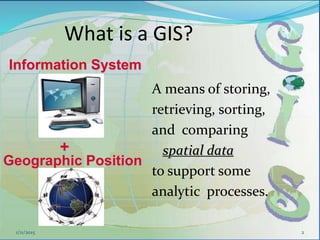
A means of storing,
retrieving, sorting,
and comparing
spatial data
to support some
analytic processes.
+
Information System
Geographic Position
1/11/2015 2
Geographic Information System:
 A GIS consists of a database, map,
information, and a computer-based link
between them.
 GIS is a collection of computer hardware, software,
and geographic data for capturing, managing,
analyzing, and displaying all forms of
geographically referenced information.
31/11/2015
What is a GIS?
4
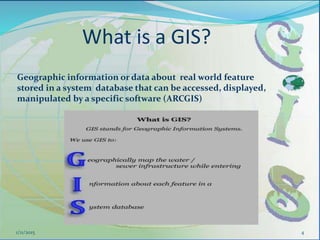
Geographic information or data about real world feature
stored in a system database that can be accessed, displayed,
manipulated by a specific software (ARCGIS)
1/11/2015
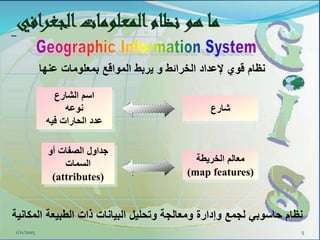
‫الجغرافي‬‫المعلومات‬‫نظام‬ ‫هو‬ ‫ما‬
‫يربط‬ ‫و‬ ‫الخرائط‬ ‫إلعداد‬ ‫قوي‬ ‫نظام‬‫المواقع‬‫عنها‬ ‫بمعلومات‬
‫المكانية‬ ‫الطبيعة‬ ‫ذات‬ ‫البيانات‬ ‫وتحليل‬ ‫ومعالجة‬ ‫وإدارة‬ ‫لجمع‬ ‫حاسوبي‬ ‫نظام‬
‫شارع‬
‫الشارع‬ ‫اسم‬
‫نوعه‬
‫عدد‬‫الحارات‬‫فيه‬
‫الخريطة‬ ‫معالم‬
(map features)
‫أو‬ ‫الصفات‬ ‫جداول‬
‫السمات‬
(attributes)
1/11/2015 5
6
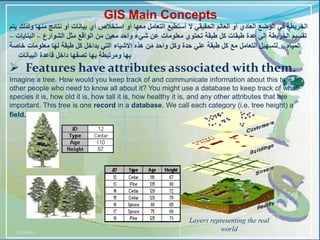
GIS Main Concepts
‫الحقيقي‬ ‫العالم‬ ‫أو‬ ‫العادي‬ ‫الوضع‬ ‫في‬ ‫الخريطة‬‫أي‬ ‫استخالص‬ ‫أو‬ ‫معها‬ ‫التعامل‬ ‫أستطيع‬ ‫ال‬‫يتم‬ ‫ولذلك‬ ‫منها‬ ‫نتائج‬ ‫أو‬ ‫بيانات‬
‫الشوارع‬ ‫مثل‬ ‫الواقع‬ ‫من‬ ‫معين‬ ‫واحد‬ ‫شيء‬ ‫عن‬ ‫معلومات‬ ‫تحتوي‬ ‫طبقة‬ ‫كل‬ ‫طبقات‬ ‫عدة‬ ‫الي‬ ‫الخريطة‬ ‫تقسيم‬–‫البنايات‬–
‫المياه‬...‫خاصة‬ ‫معلومات‬ ‫لها‬ ‫طبقة‬ ‫كل‬ ‫بداخل‬ ‫التي‬ ‫االشياء‬ ‫هذه‬ ‫من‬ ‫واحد‬ ‫وكل‬ ‫حدة‬ ‫علي‬ ‫طبقة‬ ‫كل‬ ‫مع‬ ‫التعامل‬ ‫لتسهيل‬
‫البيانات‬ ‫قاعدة‬ ‫داخل‬ ‫تصفها‬ ‫بها‬ ‫ومرتبطة‬ ‫بها‬
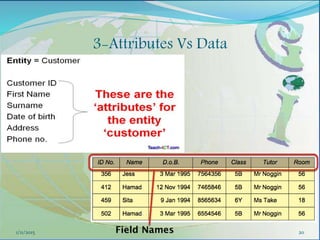
 Features have attributes associated with them.
Imagine a tree. How would you keep track of and communicate information about this tree to
other people who need to know all about it? You might use a database to keep track of what
species it is, how old it is, how tall it is, how healthy it is, and any other attributes that are
important. This tree is one record in a database. We call each category (i.e. tree height) a
field.
Layers representing the real
world1/11/2015
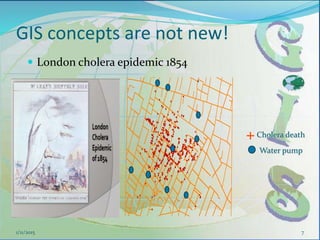
GIS concepts are not new!
 London cholera epidemic 1854
7
Cholera death
Water pump
+
1/11/2015
What GIS used for ?
 local government activities estimated to be geographically based
 (streets, water supply, sewers), garbage collection, land ownership and
valuation, public safety (fire and police) ‫واطفاء‬ ‫والبوليس‬ ‫والنظافة‬ ‫والصرف‬ ‫المياه‬ ‫شبكات‬
‫الحرائق‬
 natural resource management ‫الطبيعية‬ ‫الثروات‬ ‫إدارة‬
 highways and transportation ‫جديدة‬ ‫طرق‬ ‫انشاء‬ ‫عند‬ ‫والنقل‬ ‫السريعة‬ ‫الطرق‬ ‫شبكات‬ ‫في‬ ‫تستخدم‬
 scientific research employs GIS
 geography, geology, botany ‫وعلم‬ ‫والجيولوجيا‬ ‫الجغرافيا‬‫النبات‬
 sociology, economics, political science ‫والعلوم‬ ‫واالقتصاد‬ ‫االجتماع‬ ‫علم‬‫السياسية‬
 Military and defense
 Battlefield management ‫للتمركز‬ ‫للجيش‬ ‫األنسب‬ ‫المكان‬ ‫واختيار‬ ‫العدو‬ ‫تمركز‬ ‫أماكن‬ ‫بمعرفة‬ ‫الحرب‬ ‫ساحة‬ ‫ادارة‬
‫فيه‬
1/11/2015 8
 businesses use GIS for a very wide array of applications
 retail site selection & customer analysis ‫طبقا‬ ‫مشروع‬ ‫إلقامة‬ ‫األنسب‬ ‫الموقع‬ ‫اختيار‬
‫معينة‬ ‫لمواصفات‬
 natural resource exploration (petroleum, etc.) ‫الطبيعية‬ ‫الثروات‬ ‫علي‬ ‫التنقيب‬
 precision agriculture ‫الصناعية‬ ‫واألقمار‬ ‫التكنولوجيا‬ ‫على‬ ‫تعتمد‬ ‫زراعة‬ ‫هي‬ ‫الدقيقة‬ ‫الزراعة‬
‫العالمي‬ ‫التموضع‬ ‫ونظام‬( GPS) ‫بالعملية‬ ‫المتعلقة‬ ‫المختلفة‬ ‫المتغيرات‬ ‫لفهم‬ ‫الجغرافية‬ ‫المعلومات‬ ‫وأنظمة‬
‫وكمياته‬ ‫الحصاد‬ ‫بفترات‬ ‫والتنبؤ‬ ،‫واألسمدة‬ ،‫المناسبة‬ ‫الري‬ ‫كميات‬ ‫تحديد‬ ‫مثل‬ ،‫الزراعية‬.
 logistics: vehicle tracking & routing ‫والتوجيه‬ ‫المركبات‬ ‫تعقب‬
 ‫وايها‬ ‫تاكسي‬ ‫كل‬ ‫موقع‬ ‫تحديد‬ ‫في‬ ‫اس‬ ‫آي‬ ‫جي‬ ‫ال‬ ‫استخدام‬ ‫علي‬ ‫قائم‬ ‫أمريكا‬ ‫في‬ ‫التاكسي‬ ‫شبكة‬ ‫نظام‬
‫اليه‬ ‫ليرسله‬ ‫المتصل‬ ‫للعميل‬ ‫االقرب‬
 civil engineering and construction ‫النشاء‬ ‫مكان‬ ‫افضل‬ ‫ايجاد‬ ‫في‬ ‫واالنشاء‬ ‫المدنية‬ ‫الهندسة‬
‫الطبيعية‬ ‫والتغيرات‬ ‫والصخور‬ ‫التربة‬ ‫لنوع‬ ‫طبقا‬ ‫سكنية‬ ‫مدينة‬
1/11/2015 9
What Is GIS used for ? Cont.
GIS Applications
The major areas of GIS application
10
 Local Government
 Public works/infrastructure management (roads, water, sewer)
 Planning and environmental management
 property records and appraisal
 Real Estate and Marketing ‫والتسويق‬ ‫العقارات‬
 Retail site selection, site evaluation ‫الموقع‬ ‫وتقييم‬ ‫اختبار‬
 Public safety and defense
 Crime analysis, fire prevention, emergency management, military/defense
 Natural resource exploration/extraction ‫عن‬ ‫التنقيب‬–‫الطبيعية‬ ‫الموارد‬ ‫استخراج‬
 Petroleum, minerals, quarrying ‫والمعادن‬ ‫البترول‬‫والمحاجر‬
 Transportation
 Airline route planning, transportation planning/modeling
 Public health and epidemiology ‫وعلم‬ ‫العامة‬ ‫الصحة‬‫األوبئة‬
1/11/2015
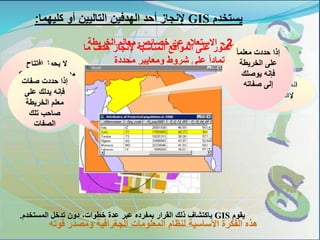
1-‫ما‬ ‫هدف‬ ‫إلنجاز‬ ‫المناسبة‬ ‫المواقع‬ ‫على‬ ‫العثور‬
‫محددة‬ ‫ومعايير‬ ‫شروط‬ ‫على‬ ً‫ا‬‫اعتماد‬
‫يقوم‬GIS‫المستخدم‬ ‫تدخل‬ ‫دون‬ ،‫خطوات‬ ‫عدة‬ ‫عبر‬ ‫بمفرده‬ ‫القرار‬ ‫ذلك‬ ‫باكتشاف‬.
‫افتتاح‬ ‫يجوز‬ ‫ال‬
‫الموقع‬ ‫في‬ ‫مدرسة‬C
‫المدرسة‬ ‫ألن‬A‫ال‬
‫بالمساف‬ ‫عنها‬ ‫تبعد‬‫ة‬
‫المطلوبة‬
‫الموقع‬B‫مناسب‬
‫مدرسة‬ ‫إلفتتاح‬
‫يستخدم‬GIS‫كليهما‬ ‫أو‬ ‫التاليين‬ ‫الهدفين‬ ‫أحد‬ ‫إلنجاز‬:
‫قوته‬ ‫ومصدر‬ ‫الجغرافية‬ ‫المعلومات‬ ‫لنظام‬ ‫األساسية‬ ‫الفكرة‬ ‫هذه‬
2-‫الخريطة‬ ‫معالم‬ ‫خصائص‬ ‫عن‬ ‫االستعالم‬
ً‫ا‬‫معلم‬ ‫حددت‬ ‫إذا‬
‫الخريطة‬ ‫على‬
‫يوصلك‬ ‫فإنه‬
‫صفاته‬ ‫إلى‬‫صفات‬ ‫حددت‬ ‫إذا‬
‫على‬ ‫يدلك‬ ‫فإنه‬
‫الخريطة‬ ‫معلم‬
‫تلك‬ ‫صاحب‬
‫الصفات‬
Examples of Applied GIS
12
 Civil Engineering/Utility
 Locating underground facilities
 Designing alignment for freeways, transit
 Coordination of infrastructure maintenance
 Business
 Demographic Analysis
 Market Penetration/ Share Analysis
 Site Selection
 Education Administration
 Attendance Area Maintenance
 Enrollment Projections
 School Bus Routing
 Real Estate
 Neighborhood land prices
 Traffic Impact Analysis
 Determination of Highest and Best Use
 Health Care
 Epidemiology
 Needs Analysis
 Service Inventory
 Urban Planning, Management &
Policy
 Zoning, subdivision planning
 Land acquisition
 Economic development
 Code enforcement
 Housing renovation programs
 Emergency response
 Crime analysis
 Tax assessment
 Environmental Sciences
 Monitoring environmental risk
 Modeling stormwater runoff
 Management of watersheds, floodplains,
wetlands, forests, aquifers
 Environmental Impact Analysis
 Hazardous or toxic facility siting
 Groundwater modeling and
contamination tracking
 Political Science
 Redistricting
 Analysis of election results
 Predictive modeling
1/11/2015
What GIS Applications Do:
 Map Production ‫الخرائط‬ ‫انتاج‬
 Calculation of Areas, Distances, Route
Lengths‫والطرق‬ ‫والمسافات‬ ‫المساحات‬ ‫حساب‬
 Measurement Of Slope, Aspect, View Shed ‫والمرتفعات‬ ‫المنحدرات‬ ‫قياس‬
 Logistics: Route Planning, Vehicle Tracking, Traffic Management
 ‫تخطيط‬‫المرور‬ ‫وادارة‬ ‫الطرق‬
 By Tying Data to Maps, ‫معينة‬ ‫لمعايير‬ ‫طبقا‬ ‫استخراجها‬ ‫وامكانية‬ ‫بالخرائط‬ ‫البيانات‬ ‫ربط‬
 provides answers to spatial queries (how many elderly in Richardson live
further than 10 minutes at rush hour from ambulance service?)
 ‫المكانية‬ ‫االستفسارات‬ ‫على‬ ‫إجابات‬ ‫يقدم‬(‫ريتشاردسون‬ ‫في‬ ‫المسنين‬ ‫عدد‬‫أبعد‬ ‫المقيم‬‫من‬10‫في‬ ‫دقيقة‬
‫اإلسعاف؟‬ ‫خدمة‬ ‫من‬ ‫الذروة‬ ‫ساعة‬)
 perform complex spatial modelling (what if scenarios for transportation
planning, disaster planning, resource management, utility design)
1/11/2015 13
manage, analyze, communicate
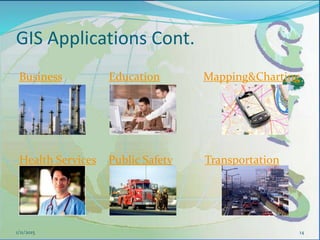
GIS Applications Cont.
Business Education Mapping&Charting

Health Services Public Safety Transportation
141/11/2015
Business :
 e-Map Application for Easy Access to Road Data and Images
 Store Site Selection System
 Land for Education Foundation Property Database Query and
Management System
Health:
Environmental Pollution Control GIS
Public Safety :
Incident Command System of Fire Bureau
Disaster Prevention Area Planning (Volcanoes – Earthquake - Floods)
151/11/2015
Who uses GIS?
 International organizations
 UN HABITAT, The World Bank, UNEP, FAO, WHO, etc.
 Private industry
 Transport, Real Estate, Insurance, etc.
 Government
 Ministries of Environment, Housing, Agriculture, etc.
 Local Authorities, Cities, Municipalities, etc.
 Provincial Agencies for Planning, Parks, Transportation, etc.
 Non-profit organizations/NGO’s
 World Resources Institute, ICMA, etc.
 Academic and Research Institutions
 Smithsonian Institution, CIESIN, etc.
1/11/2015 16
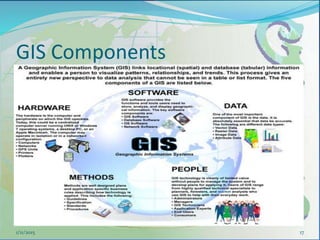
GIS Components
171/11/2015
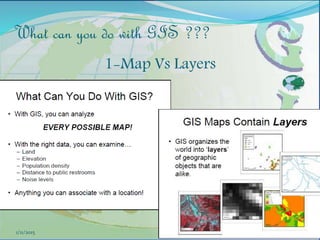
What can you do with GIS ???
18
1-Map Vs Layers
1/11/2015
19
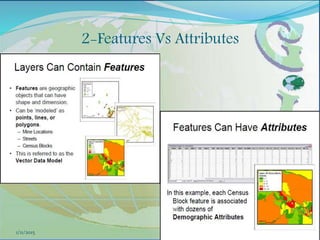
2-Features Vs Attributes
1/11/2015
20
3-Attributes Vs Data
1/11/2015
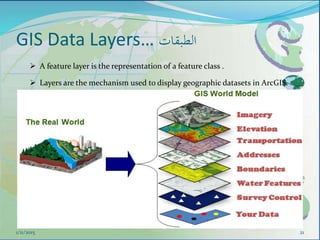
GIS Data Layers… ‫الطبقات‬
21
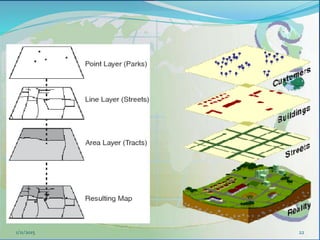
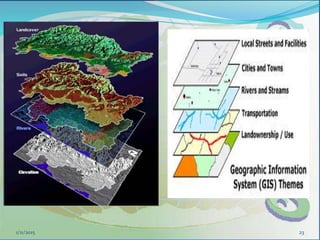
 A feature layer is the representation of a feature class .
 Layers are the mechanism used to display geographic datasets in ArcGIS.
1/11/2015
221/11/2015
231/11/2015
GIS Input and Output
GIS Input
1- Spatial Data (Location - Border)
2- Non Spatial Data –Descriptive Data
GIS Output
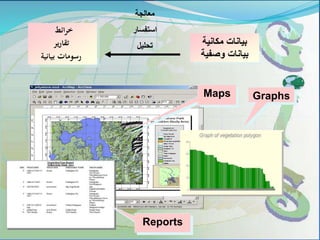
1-Map
2-Report
3-Graph – 3D Movie
1/11/2015 24
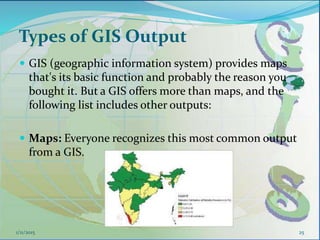
Types of GIS Output
 GIS (geographic information system) provides maps
that's its basic function and probably the reason you
bought it. But a GIS offers more than maps, and the
following list includes other outputs:
 Maps: Everyone recognizes this most common output
from a GIS.
251/11/2015
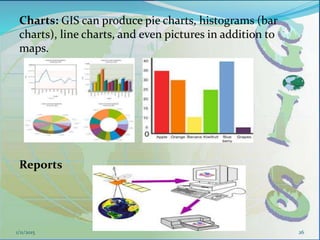
Charts: GIS can produce pie charts, histograms (bar
charts), line charts, and even pictures in addition to
maps.
Reports
1/11/2015 26
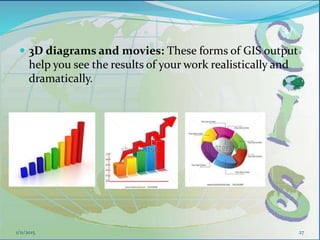
 3D diagrams and movies: These forms of GIS output
help you see the results of your work realistically and
dramatically.
1/11/2015 27
‫ائط‬‫ر‬‫خ‬
‫ير‬‫ر‬‫تقا‬
‫بيانية‬ ‫رسومات‬
Maps Graphs
Reports
‫مكانية‬ ‫بيانات‬
‫وصفية‬ ‫بيانات‬
‫معالجة‬
‫استفسار‬
‫تحليل‬
GIS DATA TYPES
Spatial Data & Non Spatial Data
29
1-Spatial Data ‫المكانية‬ ‫البيانات‬(‫والحدود‬ ‫الموقع‬)
 It is the data or information that identifies the
geographic location of features and boundaries on Earth .
 Also known as geospatial data or geographic information.
 Spatial data is usually stored as coordinates and
topology. Also it is data that can be mapped. Spatial data
is often accessed, manipulated or analyzed through
Geographic Information Systems (GIS).
1/11/2015
GIS DATA TYPES Cont.
2-Non Spatial(Descriptive)Data ‫الوصفية‬ ‫البيانات‬
30
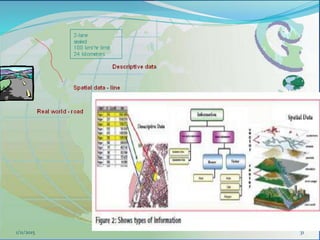
 Refer to the properties of spatial entities or features.
 information about a geographic feature in a GIS,
usually stored in a table and linked to the feature by a
unique identifier. For example, attributes of a river might
include its name & length, area & height of a building.
 It is also called Attribute data , Characteristic data &
Tabular and Descriptive data
1/11/2015
311/11/2015
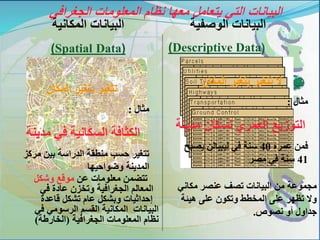
‫المكانية‬ ‫البيانات‬
(DataSpatial)
‫البيانات‬‫الوصفية‬
(Descriptive Data)
‫مكاني‬ ‫عنصر‬ ‫تصف‬ ‫البيانات‬ ‫من‬ ‫مجموعة‬
‫هيئة‬ ‫على‬ ‫وتكون‬ ‫المخطط‬ ‫على‬ ‫تظهر‬ ‫وال‬
‫نصوص‬ ‫أو‬ ‫جداول‬.
‫عن‬ ‫معلومات‬ ‫تتضمن‬‫وشكل‬ ‫موقع‬
‫في‬ ‫عادة‬ ‫وتخزن‬ ‫الجغرافية‬ ‫المعالم‬
‫قاعدة‬ ‫تشكل‬ ‫عام‬ ‫وبشكل‬ ‫إحداثيات‬
‫في‬ ‫الرسومي‬ ‫القسم‬ ‫المكانية‬ ‫البيانات‬
‫الجغرافية‬ ‫المعلومات‬ ‫نظام‬(‫الخارطة‬)
‫المكان‬ ‫بتغير‬ ‫تتغير‬ ‫ال‬
‫مثال‬:
‫مدينة‬ ‫لسكان‬ ‫العمري‬ ‫التوزيع‬
‫عمره‬ ‫فمن‬40‫في‬ ‫سنة‬‫ليبيا‬‫لن‬‫يصبح‬
41‫مصر‬ ‫في‬ ‫سنة‬
‫المكان‬ ‫بتغير‬ ‫تتغير‬
‫مثال‬:
‫مدينة‬ ‫في‬ ‫السكانية‬ ‫الكثافة‬
‫مركز‬ ‫بين‬ ‫الدراسة‬ ‫منطقة‬ ‫حسب‬ ‫تتغير‬
‫وضواحيها‬ ‫المدينة‬
‫الجغرافي‬ ‫المعلومات‬ ‫نظام‬ ‫معها‬ ‫يتعامل‬ ‫التي‬ ‫البيانات‬
GIS Data models
A data model in geographic information systems is
a mathematical construct for representing
geographic objects or surfaces as data.
1-Vector data model
2-Raster data model
331/11/2015
1-Vector Data Model
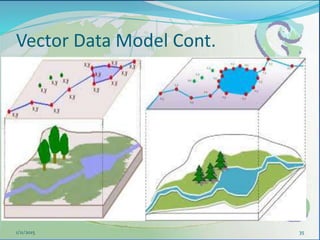
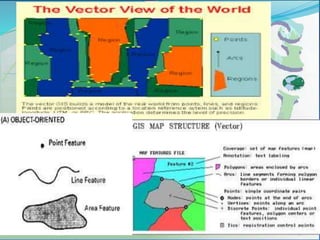
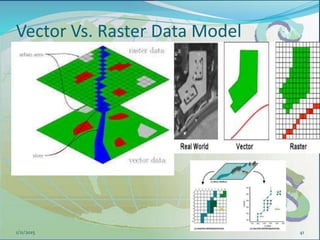
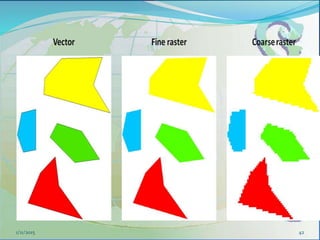
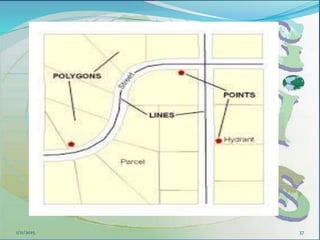
 vector data model: A representation of the world
using points, lines, and polygons. Vector models are
useful for storing data that has discrete boundaries,
such as country borders, land parcels, and streets.
341/11/2015
Vector Data Model Cont.
351/11/2015
1/11/2015 36
371/11/2015
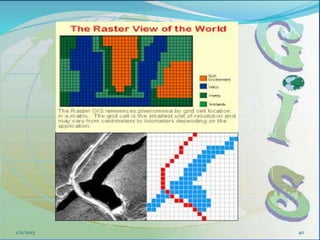
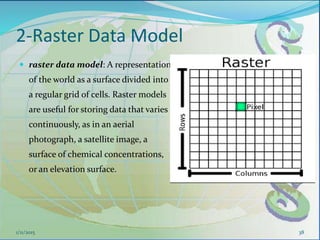
2-Raster Data Model
 raster data model: A representation
of the world as a surface divided into
a regular grid of cells. Raster models
are useful for storing data that varies
continuously, as in an aerial
photograph, a satellite image, a
surface of chemical concentrations,
or an elevation surface.
381/11/2015
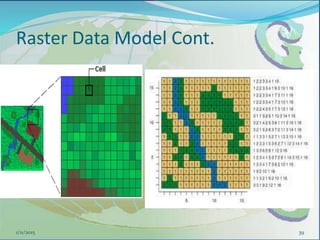
Raster Data Model Cont.
391/11/2015
401/11/2015
41
Vector Vs. Raster Data Model
1/11/2015
421/11/2015
VECTOR MODEL
Advantages
1. It has a relatively compact data structure so storage requirements are less.
2. Features can be accurately located.
3. Very small features can be shown and all features can be accurately drawn.
4. Data about individual features can easily be retrieved for updating or
correction.
43
Disadvantages
1. It has a more complex data structure.
2. Overlay operations are difficult to implement.
3. Data capture can be very slow.
4. Area or polygon analyses are difficult.
1/11/2015
Advantages
1. It has a simple data structure.
2. Area and polygon analysis is simple.
3. Overlaying and merging are easily performed.
4. The technology is cheap and in the future it will have greater cost
advantages.
Disadvantages
1. The sheer volume of data to be stored and handled can be very high.
2. There can be a serious loss of detail with larger pixel sizes (poor
resolution).
44
RASTER MODEL
1/11/2015
Introduction to ARCGIS
45
 ArcGIS is a geographic information system(GIS) for working with
maps and geographic information. It is used for: creating and using
maps; compiling geographic data; analyzing mapped information;
sharing and discovering geographic information; using maps and
geographic information in a range of applications; and managing
geographic information in a database.
 ArcGIS Desktop is the primary product used by GIS professionals to
compile, use, and manage geographic information. It includes
comprehensive professional GIS applications that support a number
of GIS tasks, including mapping, data compilation,
analysis, geodatabase management,
and geographic information sharing.
1/11/2015
Map Creation and Interactive Visualization
46
 Visually model and spatially analyze a process or workflow.
 Create interactive maps from file, database
 Create street-level maps that incorporate GPS locations.
 View CAD data or satellite images
 Generate reports and charts.
1/11/2015
ArcGIS Applications Description
•ArcMap:
ArcMap allows the user to display and query maps, create
quality hardcopy maps and perform many spatial analysis tasks.
ArcMap provides an easy transition from viewing a map to
editing its spatial features.
•ArcCatalog:
ArcCatalog allows the user to easily access and
manage geographic data that is stored in folders on local disks
or relational databases that are available on the user's network.
Data can be copied, moved, deleted, and quickly viewed
before it is added to a map.
471/11/2015
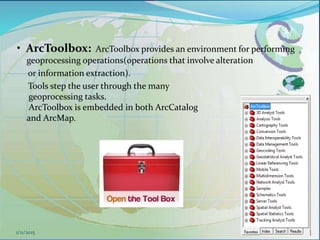
• ArcToolbox: ArcToolbox provides an environment for performing
geoprocessing operations(operations that involve alteration
or information extraction).
Tools step the user through the many
geoprocessing tasks.
ArcToolbox is embedded in both ArcCatalog
and ArcMap.
481/11/2015
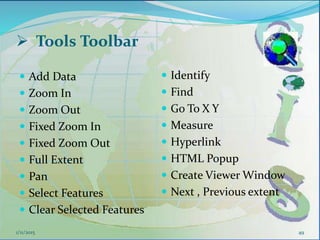
 Tools Toolbar
 Add Data
 Zoom In
 Zoom Out
 Fixed Zoom In
 Fixed Zoom Out
 Full Extent
 Pan
 Select Features
 Clear Selected Features
49
 Identify
 Find
 Go To X Y
 Measure
 Hyperlink
 HTML Popup
 Create Viewer Window
 Next , Previous extent
1/11/2015
 Standard Toolbar
 New Map File
 Open
 Save
 Print
 Cut
 Copy
 Paste
 Undo
 Redo
1/11/2015 50
 Export Map as Image(jpg – png – gif – pdf - bmp)
1/11/2015 51
 Menu bar
Arc Toolbox
 Clip
 Select
 Split
 Table Select
 Erase
 Identity
 Intersect
 Union
 Symmetric Difference
 Buffer
 Near
52
 Point Distance
 Add X,Y Coordinates
 Feature To Point
 Feature To Line
 Feature To Polygon
 Append
 Merge
 Join
 Dissolve
 Network Analyst Tools
1/11/2015
Arc Toolbox Cont.
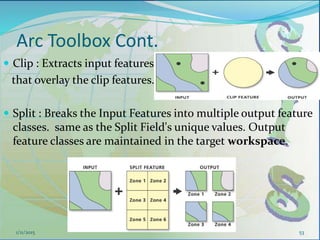
 Clip : Extracts input features
that overlay the clip features.
 Split : Breaks the Input Features into multiple output feature
classes. same as the Split Field's unique values. Output
feature classes are maintained in the target workspace.
531/11/2015
 Select : Extracts features from an input feature
class or input feature layer and stores them in a new
output feature class. The output feature class may be
created with a subset of features based on a Structured
Query Language (SQL) expression.
 Table Select : Extracts selected table records or
features from an input table or table view and stores
them in a new output table.
 Erase :
1/11/2015 54
551/11/2015

Introduction To GIS

  • 1.
    1 Introduction To GIS EngMahmoud S. Elwakeil FCI – GIS Lab Presents 1/11/2015
  • 2.
    What is aGIS? A means of storing, retrieving, sorting, and comparing spatial data to support some analytic processes. + Information System Geographic Position 1/11/2015 2
  • 3.
    Geographic Information System: A GIS consists of a database, map, information, and a computer-based link between them.  GIS is a collection of computer hardware, software, and geographic data for capturing, managing, analyzing, and displaying all forms of geographically referenced information. 31/11/2015
  • 4.
    What is aGIS? 4 Geographic information or data about real world feature stored in a system database that can be accessed, displayed, manipulated by a specific software (ARCGIS) 1/11/2015
  • 5.
    ‫الجغرافي‬‫المعلومات‬‫نظام‬ ‫هو‬ ‫ما‬ ‫يربط‬‫و‬ ‫الخرائط‬ ‫إلعداد‬ ‫قوي‬ ‫نظام‬‫المواقع‬‫عنها‬ ‫بمعلومات‬ ‫المكانية‬ ‫الطبيعة‬ ‫ذات‬ ‫البيانات‬ ‫وتحليل‬ ‫ومعالجة‬ ‫وإدارة‬ ‫لجمع‬ ‫حاسوبي‬ ‫نظام‬ ‫شارع‬ ‫الشارع‬ ‫اسم‬ ‫نوعه‬ ‫عدد‬‫الحارات‬‫فيه‬ ‫الخريطة‬ ‫معالم‬ (map features) ‫أو‬ ‫الصفات‬ ‫جداول‬ ‫السمات‬ (attributes) 1/11/2015 5
  • 6.
    6 GIS Main Concepts ‫الحقيقي‬‫العالم‬ ‫أو‬ ‫العادي‬ ‫الوضع‬ ‫في‬ ‫الخريطة‬‫أي‬ ‫استخالص‬ ‫أو‬ ‫معها‬ ‫التعامل‬ ‫أستطيع‬ ‫ال‬‫يتم‬ ‫ولذلك‬ ‫منها‬ ‫نتائج‬ ‫أو‬ ‫بيانات‬ ‫الشوارع‬ ‫مثل‬ ‫الواقع‬ ‫من‬ ‫معين‬ ‫واحد‬ ‫شيء‬ ‫عن‬ ‫معلومات‬ ‫تحتوي‬ ‫طبقة‬ ‫كل‬ ‫طبقات‬ ‫عدة‬ ‫الي‬ ‫الخريطة‬ ‫تقسيم‬–‫البنايات‬– ‫المياه‬...‫خاصة‬ ‫معلومات‬ ‫لها‬ ‫طبقة‬ ‫كل‬ ‫بداخل‬ ‫التي‬ ‫االشياء‬ ‫هذه‬ ‫من‬ ‫واحد‬ ‫وكل‬ ‫حدة‬ ‫علي‬ ‫طبقة‬ ‫كل‬ ‫مع‬ ‫التعامل‬ ‫لتسهيل‬ ‫البيانات‬ ‫قاعدة‬ ‫داخل‬ ‫تصفها‬ ‫بها‬ ‫ومرتبطة‬ ‫بها‬  Features have attributes associated with them. Imagine a tree. How would you keep track of and communicate information about this tree to other people who need to know all about it? You might use a database to keep track of what species it is, how old it is, how tall it is, how healthy it is, and any other attributes that are important. This tree is one record in a database. We call each category (i.e. tree height) a field. Layers representing the real world1/11/2015
  • 7.
    GIS concepts arenot new!  London cholera epidemic 1854 7 Cholera death Water pump + 1/11/2015
  • 8.
    What GIS usedfor ?  local government activities estimated to be geographically based  (streets, water supply, sewers), garbage collection, land ownership and valuation, public safety (fire and police) ‫واطفاء‬ ‫والبوليس‬ ‫والنظافة‬ ‫والصرف‬ ‫المياه‬ ‫شبكات‬ ‫الحرائق‬  natural resource management ‫الطبيعية‬ ‫الثروات‬ ‫إدارة‬  highways and transportation ‫جديدة‬ ‫طرق‬ ‫انشاء‬ ‫عند‬ ‫والنقل‬ ‫السريعة‬ ‫الطرق‬ ‫شبكات‬ ‫في‬ ‫تستخدم‬  scientific research employs GIS  geography, geology, botany ‫وعلم‬ ‫والجيولوجيا‬ ‫الجغرافيا‬‫النبات‬  sociology, economics, political science ‫والعلوم‬ ‫واالقتصاد‬ ‫االجتماع‬ ‫علم‬‫السياسية‬  Military and defense  Battlefield management ‫للتمركز‬ ‫للجيش‬ ‫األنسب‬ ‫المكان‬ ‫واختيار‬ ‫العدو‬ ‫تمركز‬ ‫أماكن‬ ‫بمعرفة‬ ‫الحرب‬ ‫ساحة‬ ‫ادارة‬ ‫فيه‬ 1/11/2015 8
  • 9.
     businesses useGIS for a very wide array of applications  retail site selection & customer analysis ‫طبقا‬ ‫مشروع‬ ‫إلقامة‬ ‫األنسب‬ ‫الموقع‬ ‫اختيار‬ ‫معينة‬ ‫لمواصفات‬  natural resource exploration (petroleum, etc.) ‫الطبيعية‬ ‫الثروات‬ ‫علي‬ ‫التنقيب‬  precision agriculture ‫الصناعية‬ ‫واألقمار‬ ‫التكنولوجيا‬ ‫على‬ ‫تعتمد‬ ‫زراعة‬ ‫هي‬ ‫الدقيقة‬ ‫الزراعة‬ ‫العالمي‬ ‫التموضع‬ ‫ونظام‬( GPS) ‫بالعملية‬ ‫المتعلقة‬ ‫المختلفة‬ ‫المتغيرات‬ ‫لفهم‬ ‫الجغرافية‬ ‫المعلومات‬ ‫وأنظمة‬ ‫وكمياته‬ ‫الحصاد‬ ‫بفترات‬ ‫والتنبؤ‬ ،‫واألسمدة‬ ،‫المناسبة‬ ‫الري‬ ‫كميات‬ ‫تحديد‬ ‫مثل‬ ،‫الزراعية‬.  logistics: vehicle tracking & routing ‫والتوجيه‬ ‫المركبات‬ ‫تعقب‬  ‫وايها‬ ‫تاكسي‬ ‫كل‬ ‫موقع‬ ‫تحديد‬ ‫في‬ ‫اس‬ ‫آي‬ ‫جي‬ ‫ال‬ ‫استخدام‬ ‫علي‬ ‫قائم‬ ‫أمريكا‬ ‫في‬ ‫التاكسي‬ ‫شبكة‬ ‫نظام‬ ‫اليه‬ ‫ليرسله‬ ‫المتصل‬ ‫للعميل‬ ‫االقرب‬  civil engineering and construction ‫النشاء‬ ‫مكان‬ ‫افضل‬ ‫ايجاد‬ ‫في‬ ‫واالنشاء‬ ‫المدنية‬ ‫الهندسة‬ ‫الطبيعية‬ ‫والتغيرات‬ ‫والصخور‬ ‫التربة‬ ‫لنوع‬ ‫طبقا‬ ‫سكنية‬ ‫مدينة‬ 1/11/2015 9 What Is GIS used for ? Cont.
  • 10.
    GIS Applications The majorareas of GIS application 10  Local Government  Public works/infrastructure management (roads, water, sewer)  Planning and environmental management  property records and appraisal  Real Estate and Marketing ‫والتسويق‬ ‫العقارات‬  Retail site selection, site evaluation ‫الموقع‬ ‫وتقييم‬ ‫اختبار‬  Public safety and defense  Crime analysis, fire prevention, emergency management, military/defense  Natural resource exploration/extraction ‫عن‬ ‫التنقيب‬–‫الطبيعية‬ ‫الموارد‬ ‫استخراج‬  Petroleum, minerals, quarrying ‫والمعادن‬ ‫البترول‬‫والمحاجر‬  Transportation  Airline route planning, transportation planning/modeling  Public health and epidemiology ‫وعلم‬ ‫العامة‬ ‫الصحة‬‫األوبئة‬ 1/11/2015
  • 11.
    1-‫ما‬ ‫هدف‬ ‫إلنجاز‬‫المناسبة‬ ‫المواقع‬ ‫على‬ ‫العثور‬ ‫محددة‬ ‫ومعايير‬ ‫شروط‬ ‫على‬ ً‫ا‬‫اعتماد‬ ‫يقوم‬GIS‫المستخدم‬ ‫تدخل‬ ‫دون‬ ،‫خطوات‬ ‫عدة‬ ‫عبر‬ ‫بمفرده‬ ‫القرار‬ ‫ذلك‬ ‫باكتشاف‬. ‫افتتاح‬ ‫يجوز‬ ‫ال‬ ‫الموقع‬ ‫في‬ ‫مدرسة‬C ‫المدرسة‬ ‫ألن‬A‫ال‬ ‫بالمساف‬ ‫عنها‬ ‫تبعد‬‫ة‬ ‫المطلوبة‬ ‫الموقع‬B‫مناسب‬ ‫مدرسة‬ ‫إلفتتاح‬ ‫يستخدم‬GIS‫كليهما‬ ‫أو‬ ‫التاليين‬ ‫الهدفين‬ ‫أحد‬ ‫إلنجاز‬: ‫قوته‬ ‫ومصدر‬ ‫الجغرافية‬ ‫المعلومات‬ ‫لنظام‬ ‫األساسية‬ ‫الفكرة‬ ‫هذه‬ 2-‫الخريطة‬ ‫معالم‬ ‫خصائص‬ ‫عن‬ ‫االستعالم‬ ً‫ا‬‫معلم‬ ‫حددت‬ ‫إذا‬ ‫الخريطة‬ ‫على‬ ‫يوصلك‬ ‫فإنه‬ ‫صفاته‬ ‫إلى‬‫صفات‬ ‫حددت‬ ‫إذا‬ ‫على‬ ‫يدلك‬ ‫فإنه‬ ‫الخريطة‬ ‫معلم‬ ‫تلك‬ ‫صاحب‬ ‫الصفات‬
  • 12.
    Examples of AppliedGIS 12  Civil Engineering/Utility  Locating underground facilities  Designing alignment for freeways, transit  Coordination of infrastructure maintenance  Business  Demographic Analysis  Market Penetration/ Share Analysis  Site Selection  Education Administration  Attendance Area Maintenance  Enrollment Projections  School Bus Routing  Real Estate  Neighborhood land prices  Traffic Impact Analysis  Determination of Highest and Best Use  Health Care  Epidemiology  Needs Analysis  Service Inventory  Urban Planning, Management & Policy  Zoning, subdivision planning  Land acquisition  Economic development  Code enforcement  Housing renovation programs  Emergency response  Crime analysis  Tax assessment  Environmental Sciences  Monitoring environmental risk  Modeling stormwater runoff  Management of watersheds, floodplains, wetlands, forests, aquifers  Environmental Impact Analysis  Hazardous or toxic facility siting  Groundwater modeling and contamination tracking  Political Science  Redistricting  Analysis of election results  Predictive modeling 1/11/2015
  • 13.
    What GIS ApplicationsDo:  Map Production ‫الخرائط‬ ‫انتاج‬  Calculation of Areas, Distances, Route Lengths‫والطرق‬ ‫والمسافات‬ ‫المساحات‬ ‫حساب‬  Measurement Of Slope, Aspect, View Shed ‫والمرتفعات‬ ‫المنحدرات‬ ‫قياس‬  Logistics: Route Planning, Vehicle Tracking, Traffic Management  ‫تخطيط‬‫المرور‬ ‫وادارة‬ ‫الطرق‬  By Tying Data to Maps, ‫معينة‬ ‫لمعايير‬ ‫طبقا‬ ‫استخراجها‬ ‫وامكانية‬ ‫بالخرائط‬ ‫البيانات‬ ‫ربط‬  provides answers to spatial queries (how many elderly in Richardson live further than 10 minutes at rush hour from ambulance service?)  ‫المكانية‬ ‫االستفسارات‬ ‫على‬ ‫إجابات‬ ‫يقدم‬(‫ريتشاردسون‬ ‫في‬ ‫المسنين‬ ‫عدد‬‫أبعد‬ ‫المقيم‬‫من‬10‫في‬ ‫دقيقة‬ ‫اإلسعاف؟‬ ‫خدمة‬ ‫من‬ ‫الذروة‬ ‫ساعة‬)  perform complex spatial modelling (what if scenarios for transportation planning, disaster planning, resource management, utility design) 1/11/2015 13 manage, analyze, communicate
  • 14.
    GIS Applications Cont. BusinessEducation Mapping&Charting  Health Services Public Safety Transportation 141/11/2015
  • 15.
    Business :  e-MapApplication for Easy Access to Road Data and Images  Store Site Selection System  Land for Education Foundation Property Database Query and Management System Health: Environmental Pollution Control GIS Public Safety : Incident Command System of Fire Bureau Disaster Prevention Area Planning (Volcanoes – Earthquake - Floods) 151/11/2015
  • 16.
    Who uses GIS? International organizations  UN HABITAT, The World Bank, UNEP, FAO, WHO, etc.  Private industry  Transport, Real Estate, Insurance, etc.  Government  Ministries of Environment, Housing, Agriculture, etc.  Local Authorities, Cities, Municipalities, etc.  Provincial Agencies for Planning, Parks, Transportation, etc.  Non-profit organizations/NGO’s  World Resources Institute, ICMA, etc.  Academic and Research Institutions  Smithsonian Institution, CIESIN, etc. 1/11/2015 16
  • 17.
  • 18.
    What can youdo with GIS ??? 18 1-Map Vs Layers 1/11/2015
  • 19.
  • 20.
  • 21.
    GIS Data Layers…‫الطبقات‬ 21  A feature layer is the representation of a feature class .  Layers are the mechanism used to display geographic datasets in ArcGIS. 1/11/2015
  • 22.
  • 23.
  • 24.
    GIS Input andOutput GIS Input 1- Spatial Data (Location - Border) 2- Non Spatial Data –Descriptive Data GIS Output 1-Map 2-Report 3-Graph – 3D Movie 1/11/2015 24
  • 25.
    Types of GISOutput  GIS (geographic information system) provides maps that's its basic function and probably the reason you bought it. But a GIS offers more than maps, and the following list includes other outputs:  Maps: Everyone recognizes this most common output from a GIS. 251/11/2015
  • 26.
    Charts: GIS canproduce pie charts, histograms (bar charts), line charts, and even pictures in addition to maps. Reports 1/11/2015 26
  • 27.
     3D diagramsand movies: These forms of GIS output help you see the results of your work realistically and dramatically. 1/11/2015 27
  • 28.
    ‫ائط‬‫ر‬‫خ‬ ‫ير‬‫ر‬‫تقا‬ ‫بيانية‬ ‫رسومات‬ Maps Graphs Reports ‫مكانية‬‫بيانات‬ ‫وصفية‬ ‫بيانات‬ ‫معالجة‬ ‫استفسار‬ ‫تحليل‬
  • 29.
    GIS DATA TYPES SpatialData & Non Spatial Data 29 1-Spatial Data ‫المكانية‬ ‫البيانات‬(‫والحدود‬ ‫الموقع‬)  It is the data or information that identifies the geographic location of features and boundaries on Earth .  Also known as geospatial data or geographic information.  Spatial data is usually stored as coordinates and topology. Also it is data that can be mapped. Spatial data is often accessed, manipulated or analyzed through Geographic Information Systems (GIS). 1/11/2015
  • 30.
    GIS DATA TYPESCont. 2-Non Spatial(Descriptive)Data ‫الوصفية‬ ‫البيانات‬ 30  Refer to the properties of spatial entities or features.  information about a geographic feature in a GIS, usually stored in a table and linked to the feature by a unique identifier. For example, attributes of a river might include its name & length, area & height of a building.  It is also called Attribute data , Characteristic data & Tabular and Descriptive data 1/11/2015
  • 31.
  • 32.
    ‫المكانية‬ ‫البيانات‬ (DataSpatial) ‫البيانات‬‫الوصفية‬ (Descriptive Data) ‫مكاني‬‫عنصر‬ ‫تصف‬ ‫البيانات‬ ‫من‬ ‫مجموعة‬ ‫هيئة‬ ‫على‬ ‫وتكون‬ ‫المخطط‬ ‫على‬ ‫تظهر‬ ‫وال‬ ‫نصوص‬ ‫أو‬ ‫جداول‬. ‫عن‬ ‫معلومات‬ ‫تتضمن‬‫وشكل‬ ‫موقع‬ ‫في‬ ‫عادة‬ ‫وتخزن‬ ‫الجغرافية‬ ‫المعالم‬ ‫قاعدة‬ ‫تشكل‬ ‫عام‬ ‫وبشكل‬ ‫إحداثيات‬ ‫في‬ ‫الرسومي‬ ‫القسم‬ ‫المكانية‬ ‫البيانات‬ ‫الجغرافية‬ ‫المعلومات‬ ‫نظام‬(‫الخارطة‬) ‫المكان‬ ‫بتغير‬ ‫تتغير‬ ‫ال‬ ‫مثال‬: ‫مدينة‬ ‫لسكان‬ ‫العمري‬ ‫التوزيع‬ ‫عمره‬ ‫فمن‬40‫في‬ ‫سنة‬‫ليبيا‬‫لن‬‫يصبح‬ 41‫مصر‬ ‫في‬ ‫سنة‬ ‫المكان‬ ‫بتغير‬ ‫تتغير‬ ‫مثال‬: ‫مدينة‬ ‫في‬ ‫السكانية‬ ‫الكثافة‬ ‫مركز‬ ‫بين‬ ‫الدراسة‬ ‫منطقة‬ ‫حسب‬ ‫تتغير‬ ‫وضواحيها‬ ‫المدينة‬ ‫الجغرافي‬ ‫المعلومات‬ ‫نظام‬ ‫معها‬ ‫يتعامل‬ ‫التي‬ ‫البيانات‬
  • 33.
    GIS Data models Adata model in geographic information systems is a mathematical construct for representing geographic objects or surfaces as data. 1-Vector data model 2-Raster data model 331/11/2015
  • 34.
    1-Vector Data Model vector data model: A representation of the world using points, lines, and polygons. Vector models are useful for storing data that has discrete boundaries, such as country borders, land parcels, and streets. 341/11/2015
  • 35.
    Vector Data ModelCont. 351/11/2015
  • 36.
  • 37.
  • 38.
    2-Raster Data Model raster data model: A representation of the world as a surface divided into a regular grid of cells. Raster models are useful for storing data that varies continuously, as in an aerial photograph, a satellite image, a surface of chemical concentrations, or an elevation surface. 381/11/2015
  • 39.
    Raster Data ModelCont. 391/11/2015
  • 40.
  • 41.
    41 Vector Vs. RasterData Model 1/11/2015
  • 42.
  • 43.
    VECTOR MODEL Advantages 1. Ithas a relatively compact data structure so storage requirements are less. 2. Features can be accurately located. 3. Very small features can be shown and all features can be accurately drawn. 4. Data about individual features can easily be retrieved for updating or correction. 43 Disadvantages 1. It has a more complex data structure. 2. Overlay operations are difficult to implement. 3. Data capture can be very slow. 4. Area or polygon analyses are difficult. 1/11/2015
  • 44.
    Advantages 1. It hasa simple data structure. 2. Area and polygon analysis is simple. 3. Overlaying and merging are easily performed. 4. The technology is cheap and in the future it will have greater cost advantages. Disadvantages 1. The sheer volume of data to be stored and handled can be very high. 2. There can be a serious loss of detail with larger pixel sizes (poor resolution). 44 RASTER MODEL 1/11/2015
  • 45.
    Introduction to ARCGIS 45 ArcGIS is a geographic information system(GIS) for working with maps and geographic information. It is used for: creating and using maps; compiling geographic data; analyzing mapped information; sharing and discovering geographic information; using maps and geographic information in a range of applications; and managing geographic information in a database.  ArcGIS Desktop is the primary product used by GIS professionals to compile, use, and manage geographic information. It includes comprehensive professional GIS applications that support a number of GIS tasks, including mapping, data compilation, analysis, geodatabase management, and geographic information sharing. 1/11/2015
  • 46.
    Map Creation andInteractive Visualization 46  Visually model and spatially analyze a process or workflow.  Create interactive maps from file, database  Create street-level maps that incorporate GPS locations.  View CAD data or satellite images  Generate reports and charts. 1/11/2015
  • 47.
    ArcGIS Applications Description •ArcMap: ArcMapallows the user to display and query maps, create quality hardcopy maps and perform many spatial analysis tasks. ArcMap provides an easy transition from viewing a map to editing its spatial features. •ArcCatalog: ArcCatalog allows the user to easily access and manage geographic data that is stored in folders on local disks or relational databases that are available on the user's network. Data can be copied, moved, deleted, and quickly viewed before it is added to a map. 471/11/2015
  • 48.
    • ArcToolbox: ArcToolboxprovides an environment for performing geoprocessing operations(operations that involve alteration or information extraction). Tools step the user through the many geoprocessing tasks. ArcToolbox is embedded in both ArcCatalog and ArcMap. 481/11/2015
  • 49.
     Tools Toolbar Add Data  Zoom In  Zoom Out  Fixed Zoom In  Fixed Zoom Out  Full Extent  Pan  Select Features  Clear Selected Features 49  Identify  Find  Go To X Y  Measure  Hyperlink  HTML Popup  Create Viewer Window  Next , Previous extent 1/11/2015
  • 50.
     Standard Toolbar New Map File  Open  Save  Print  Cut  Copy  Paste  Undo  Redo 1/11/2015 50
  • 51.
     Export Mapas Image(jpg – png – gif – pdf - bmp) 1/11/2015 51  Menu bar
  • 52.
    Arc Toolbox  Clip Select  Split  Table Select  Erase  Identity  Intersect  Union  Symmetric Difference  Buffer  Near 52  Point Distance  Add X,Y Coordinates  Feature To Point  Feature To Line  Feature To Polygon  Append  Merge  Join  Dissolve  Network Analyst Tools 1/11/2015
  • 53.
    Arc Toolbox Cont. Clip : Extracts input features that overlay the clip features.  Split : Breaks the Input Features into multiple output feature classes. same as the Split Field's unique values. Output feature classes are maintained in the target workspace. 531/11/2015
  • 54.
     Select :Extracts features from an input feature class or input feature layer and stores them in a new output feature class. The output feature class may be created with a subset of features based on a Structured Query Language (SQL) expression.  Table Select : Extracts selected table records or features from an input table or table view and stores them in a new output table.  Erase : 1/11/2015 54
  • 55.