GEOMETRIC MODELING
The mathematical description of the geometry of an object
using a software is called as geometric modeling
There are three basic methods
Wire – Frame Modeling
Surface modeling
Solid modeling
WIRE FRAME MODELING
This is one of the most popular and commonly used
method of geometric modeling.
In construction of wire frame model, the edges of an
object are presented as lines.
Wire frame model is used for following representations
2D Representation
Orthographic views representation
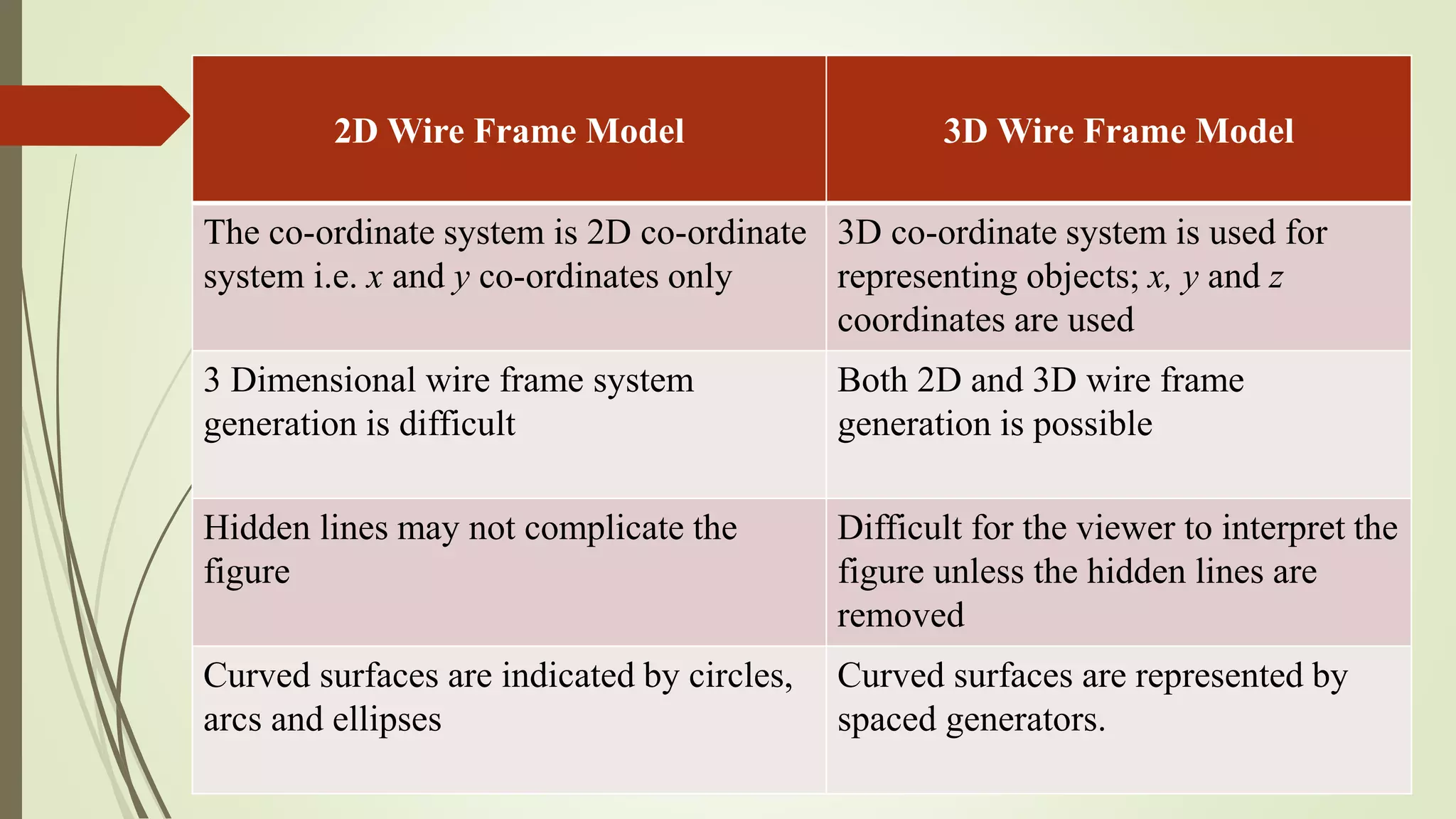
2D Wire Frame Model 3D Wire Frame Model
The co-ordinate system is 2D co-ordinate
system i.e. x and y co-ordinates only
3D co-ordinate system is used for
representing objects; x, y and z
coordinates are used
3 Dimensional wire frame system
generation is difficult
Both 2D and 3D wire frame
generation is possible
Hidden lines may not complicate the
figure
Difficult for the viewer to interpret the
figure unless the hidden lines are
removed
Curved surfaces are indicated by circles,
arcs and ellipses
Curved surfaces are represented by
spaced generators.
DRAWBACK OF WIRE FRAME MODEL
Lack of clarity
When part geometry is complex and in case of 3D wire
frame systems, the hidden lines causes the image to be
confusing to the viewer.
During the surface definition, there might be confusing.
By eliminating hidden lines, some clarity can be obtained.
SURFACE MODELING
The techniques of representation of objects (or) components by
surface is called surface modeling.
Objects can be clearly interpreted by the user.
Main draw back here is that, no data is available about the
interior of solid.
Application is modeling car bodies, ships, aerospace structure,
dies, etc.
TECHNIQUES AVAILABLE FOR SURFACE
MODELING
Surface patch
Coons patch
Bicubic patch
Bezier surfaces
B-spline surfaces
NURBS (Non-Uniform Rational B-Splines)
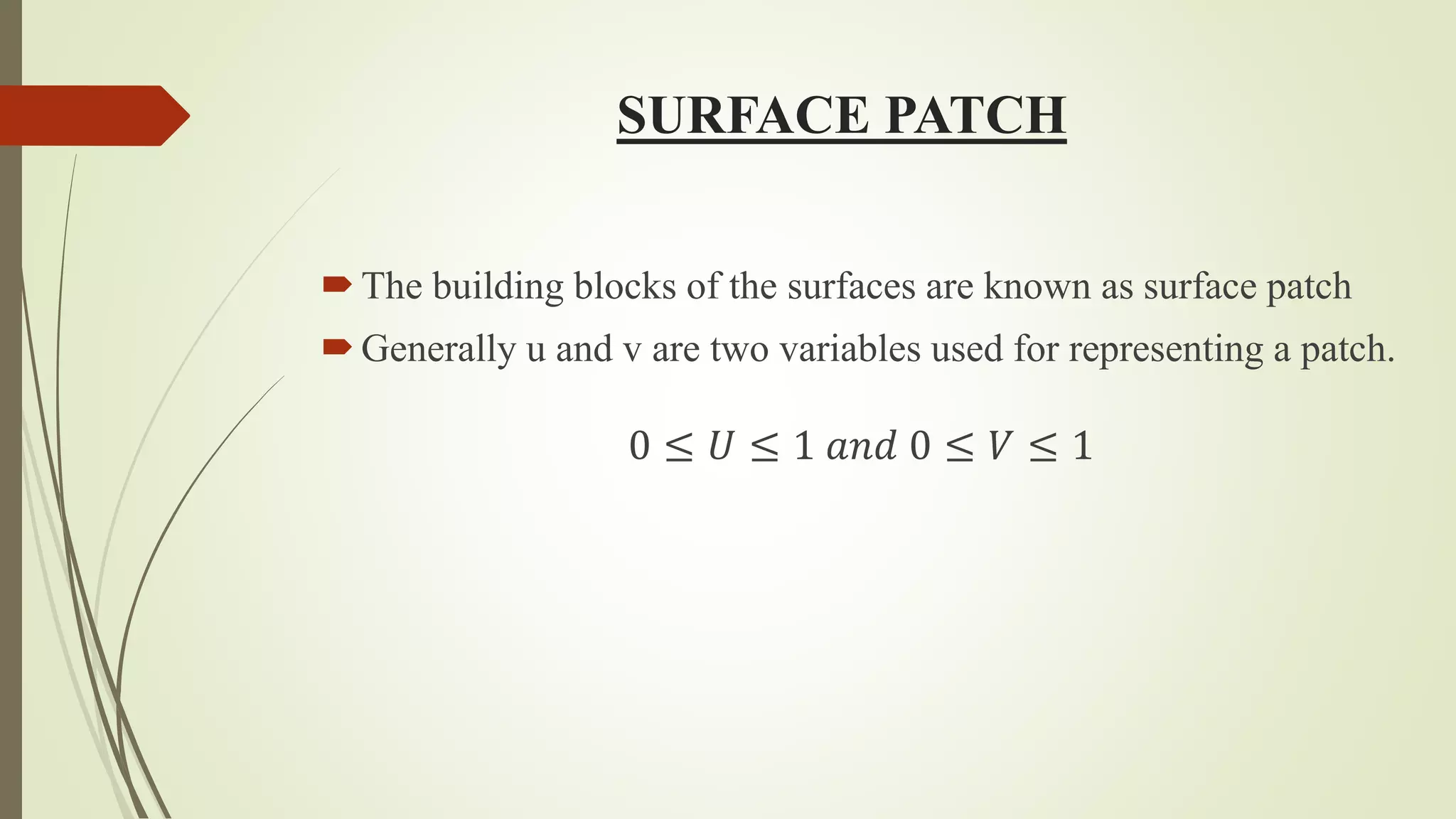
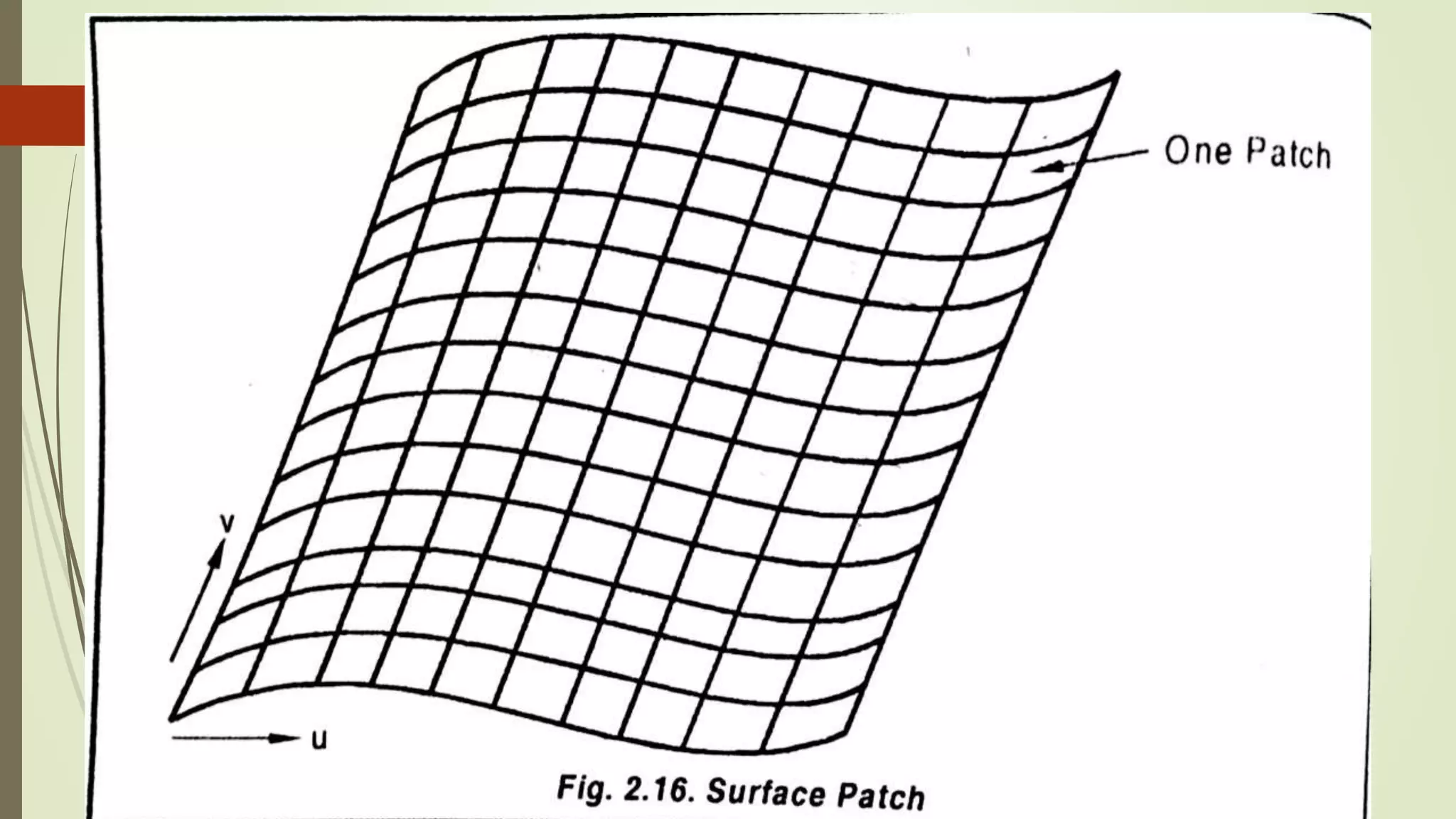
SURFACE PATCH
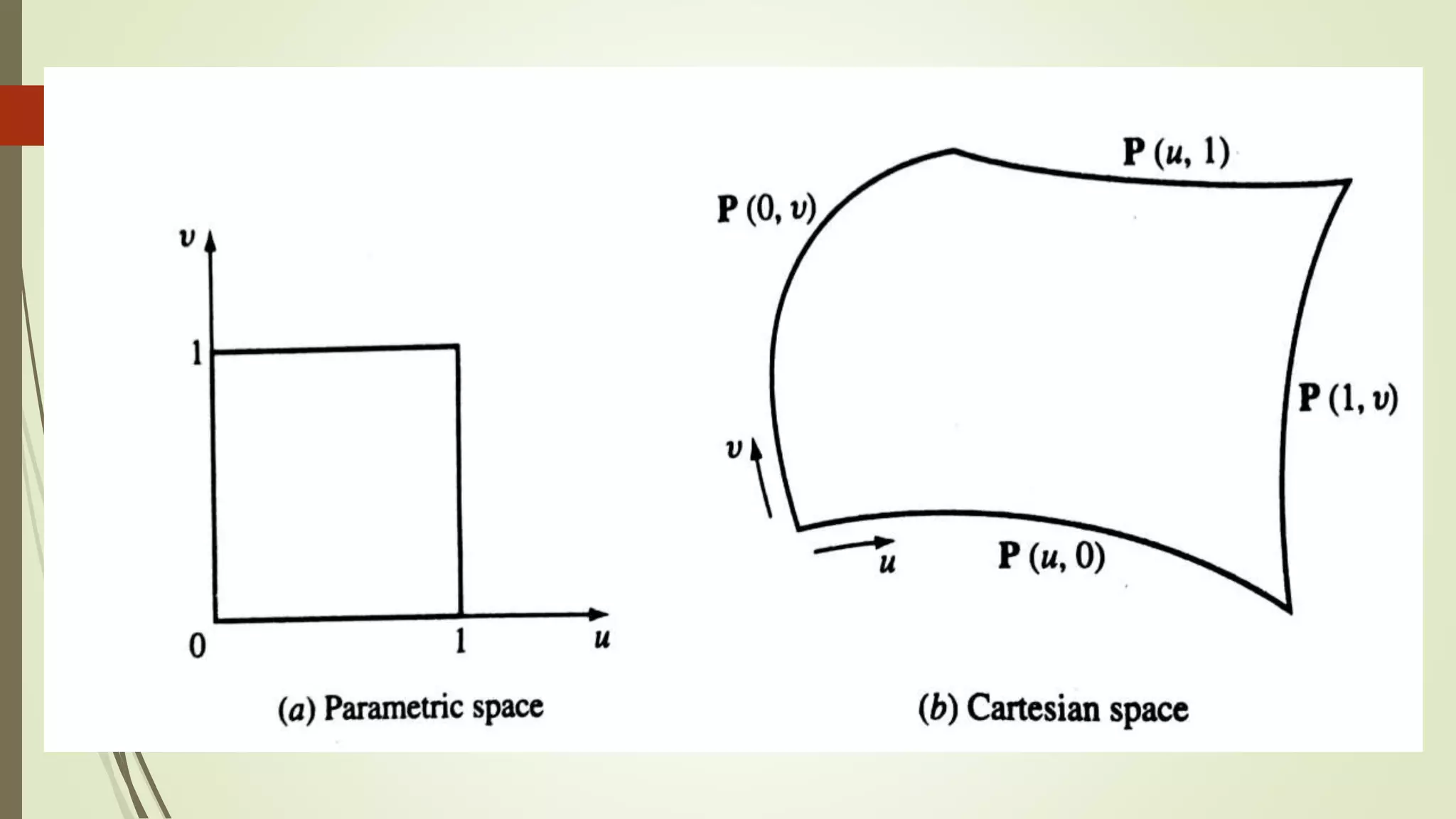
The building blocks of the surfaces are known as surface patch
Generally u and v are two variables used for representing a patch.
0 ≤ 𝑈 ≤ 1 𝑎𝑛𝑑 0 ≤ 𝑉 ≤ 1
COONS PATCH
Coons surface batch is a form of “transfinite interpolation”,
which indicates that the coons scheme interpolates to an
infinite number of data points.
Coons patch is particularly useful in blending four prescribed
intersecting curves which forms a closed boundary.
In practice, coons surface can be used to create windshield
designs for cars and skyline windows for houses.
BEZIER SURFACE
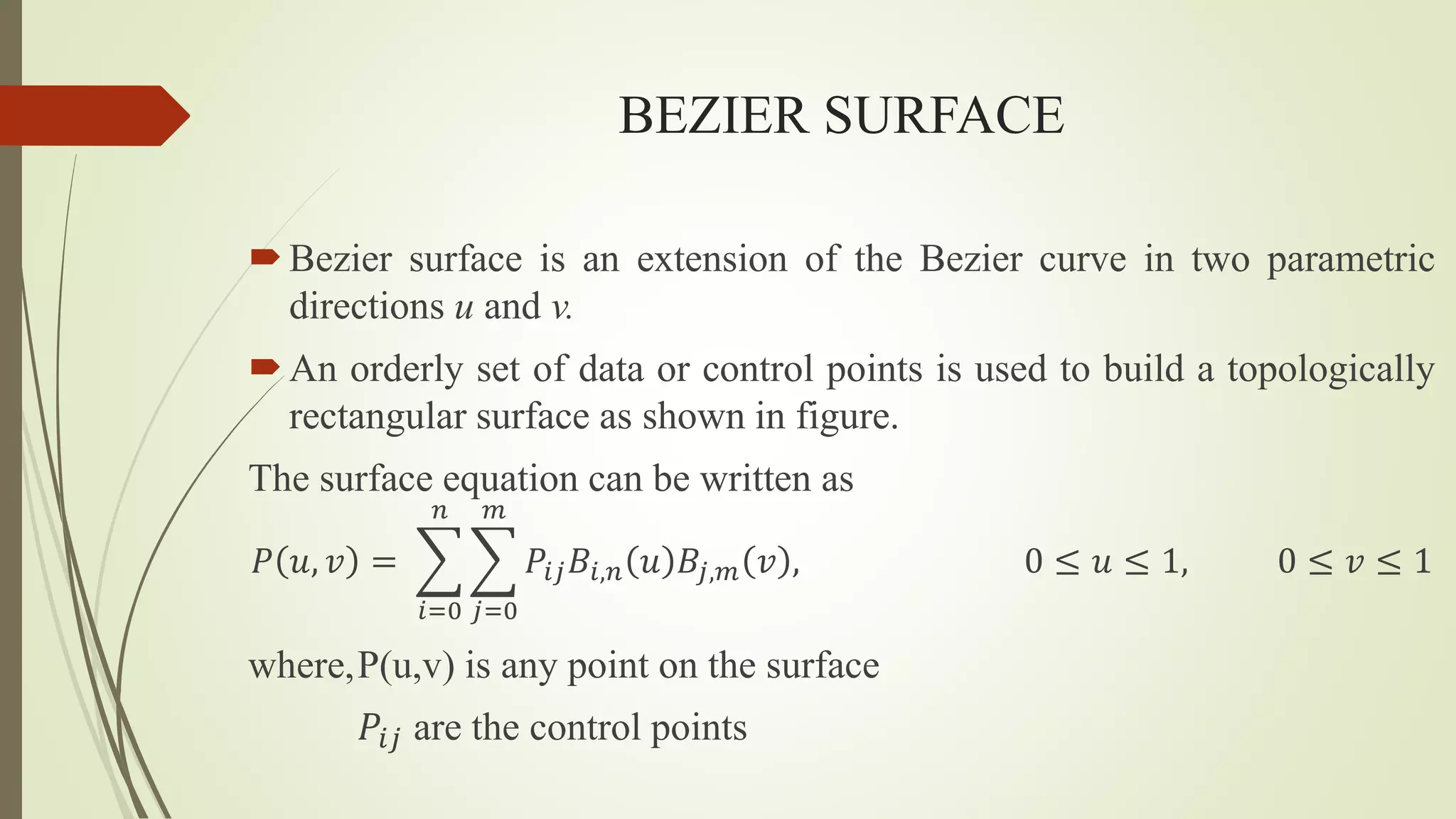
Bezier surface is an extension of the Bezier curve in two parametric
directions u and v.
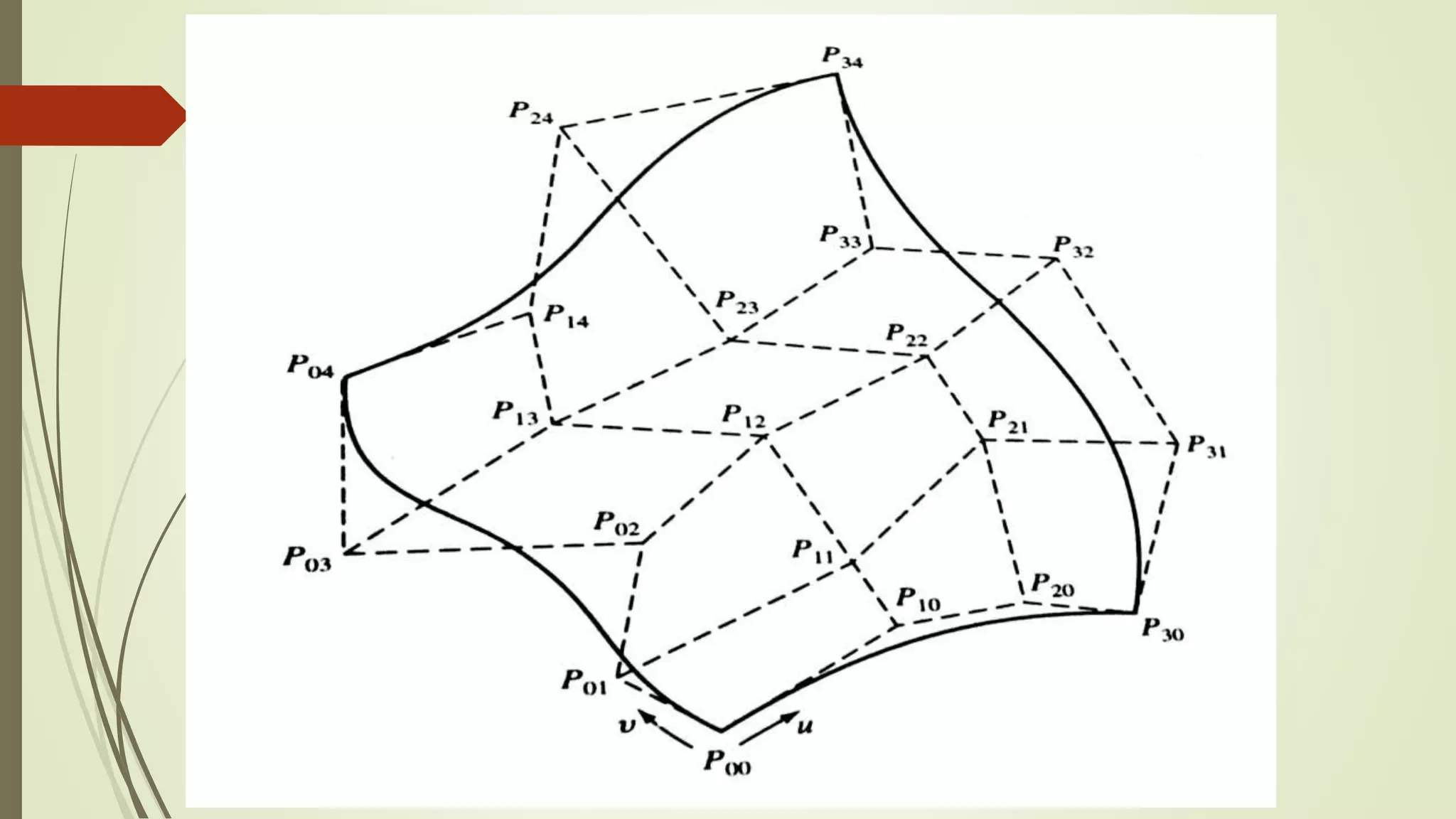
An orderly set of data or control points is used to build a topologically
rectangular surface as shown in figure.
The surface equation can be written as
𝑃 𝑢, 𝑣 =
𝑖=0
𝑛
𝑗=0
𝑚
𝑃𝑖𝑗𝐵𝑖,𝑛 𝑢 𝐵𝑗,𝑚 𝑣 , 0 ≤ 𝑢 ≤ 1, 0 ≤ 𝑣 ≤ 1
where,P(u,v) is any point on the surface
𝑃𝑖𝑗 are the control points
B-SPLINE SURFACE
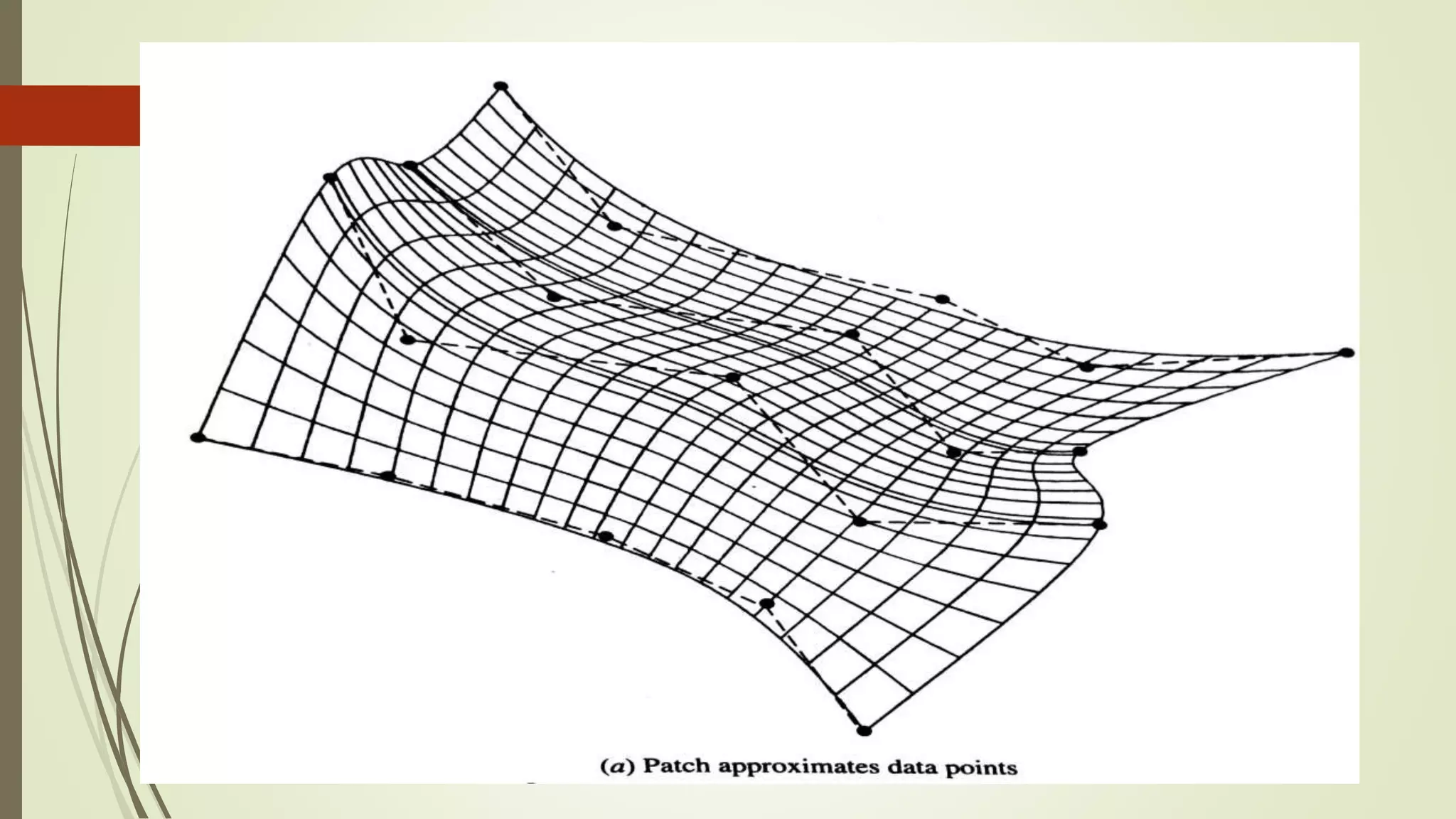
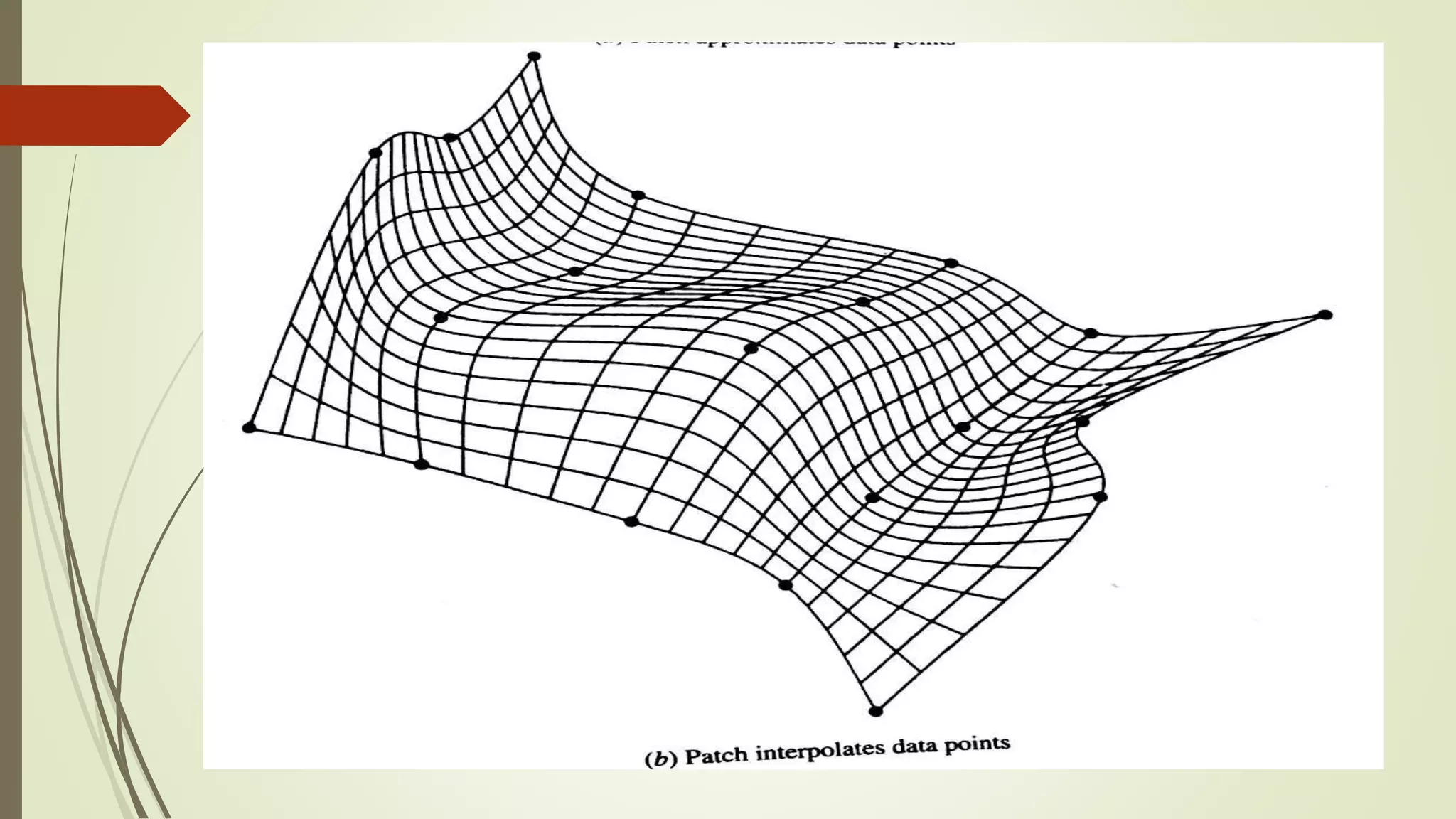
B - Spline surface is an extension of the B - Spline curve. A
rectangle set of data points creates the surface.
A B – Spline surface can approximate or interpolate the
vertices of the polyhedron as shown in figure.
B – Spline surface equation is defined by
𝑃 𝑢, 𝑣 =
𝑖=0
𝑛
𝑗=0
𝑚
𝑃𝑖𝑗 𝑁𝑖,𝑘 𝑢 𝑁𝑗,𝑙 𝑣 , 0 ≤ 𝑢 ≤ 1, 0 ≤ 𝑣 ≤ 1
where,P(u,v) is any point on the surface
𝑃𝑖𝑗 are the control points
SOLID MODELING
Solid modeling is one of the most effective geometric
modeling method. In this approach, models are displayed as
solids to viewer, there by eliminating any chance of
misinterpretation.
In solid modeling , to make the object more realistic.
SOLID MODELING TECHNIQUES
 Half – space Method
 Boundary representation Method
 Constructive Solid Geometry (CSG)
 Analytical Solid Geometry (ASM)
 Primitive instancing
 Sweep representation
 Spatial portioning representation
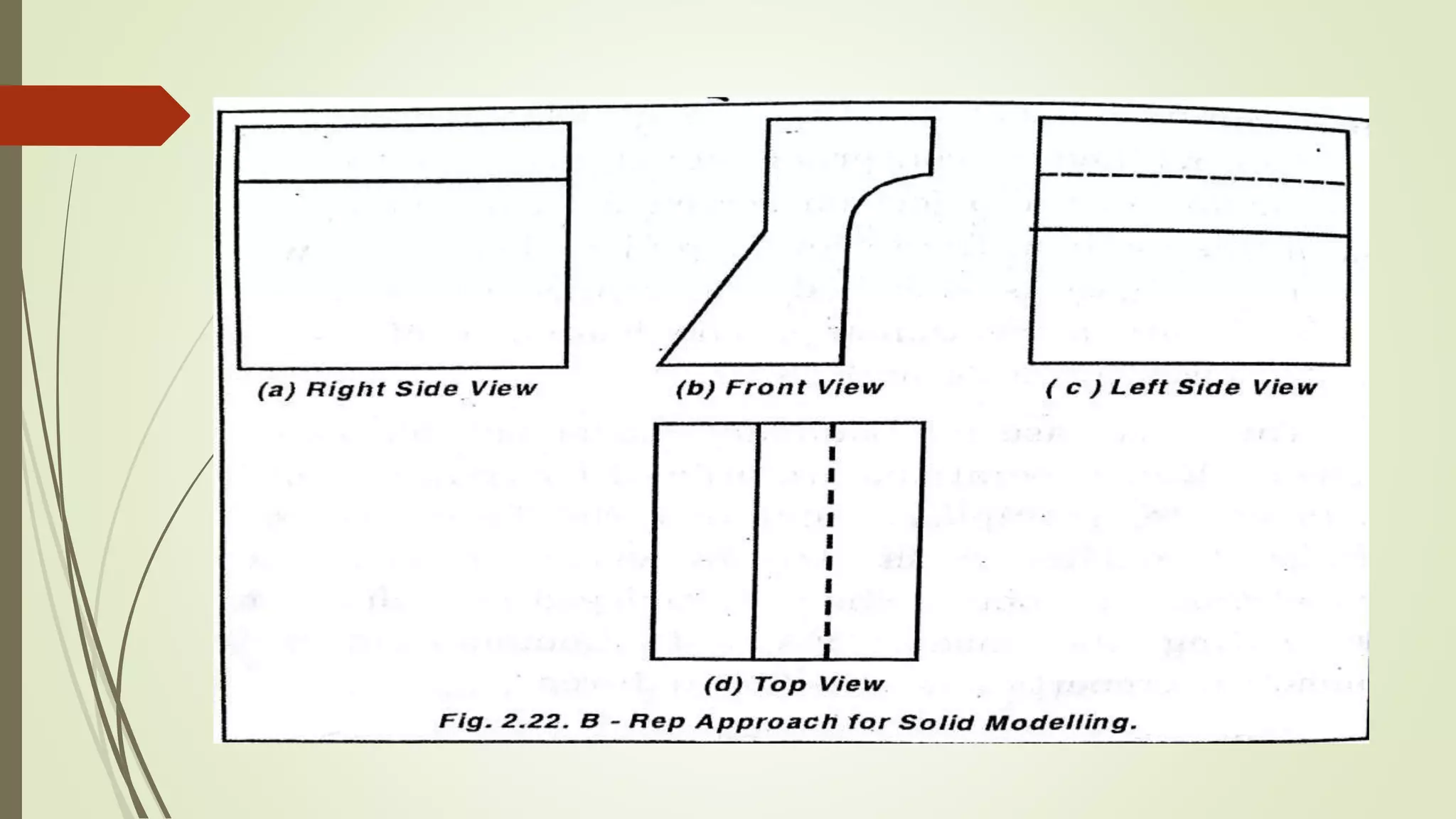
Boundary representation Method
Boundary representation is one of the most popular and widely
used schemes to create solid models of physical objects.
In this method, front view, top view, bottom view, side view of
an object is sketched and connected by means of lines to create
a relationship.
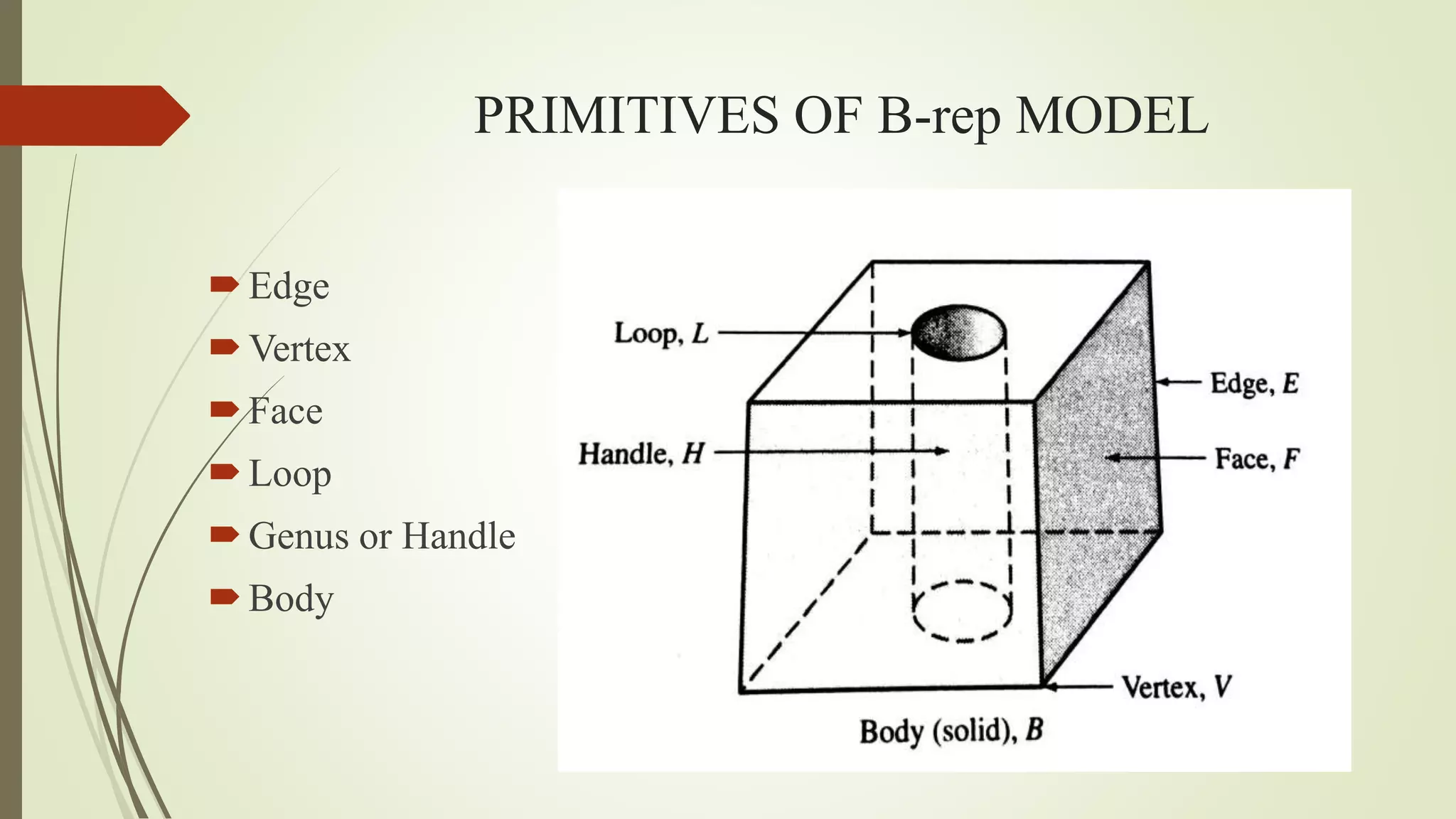
PRIMITIVES OF B-rep MODEL
Edge
Vertex
Face
Loop
Genus or Handle
Body
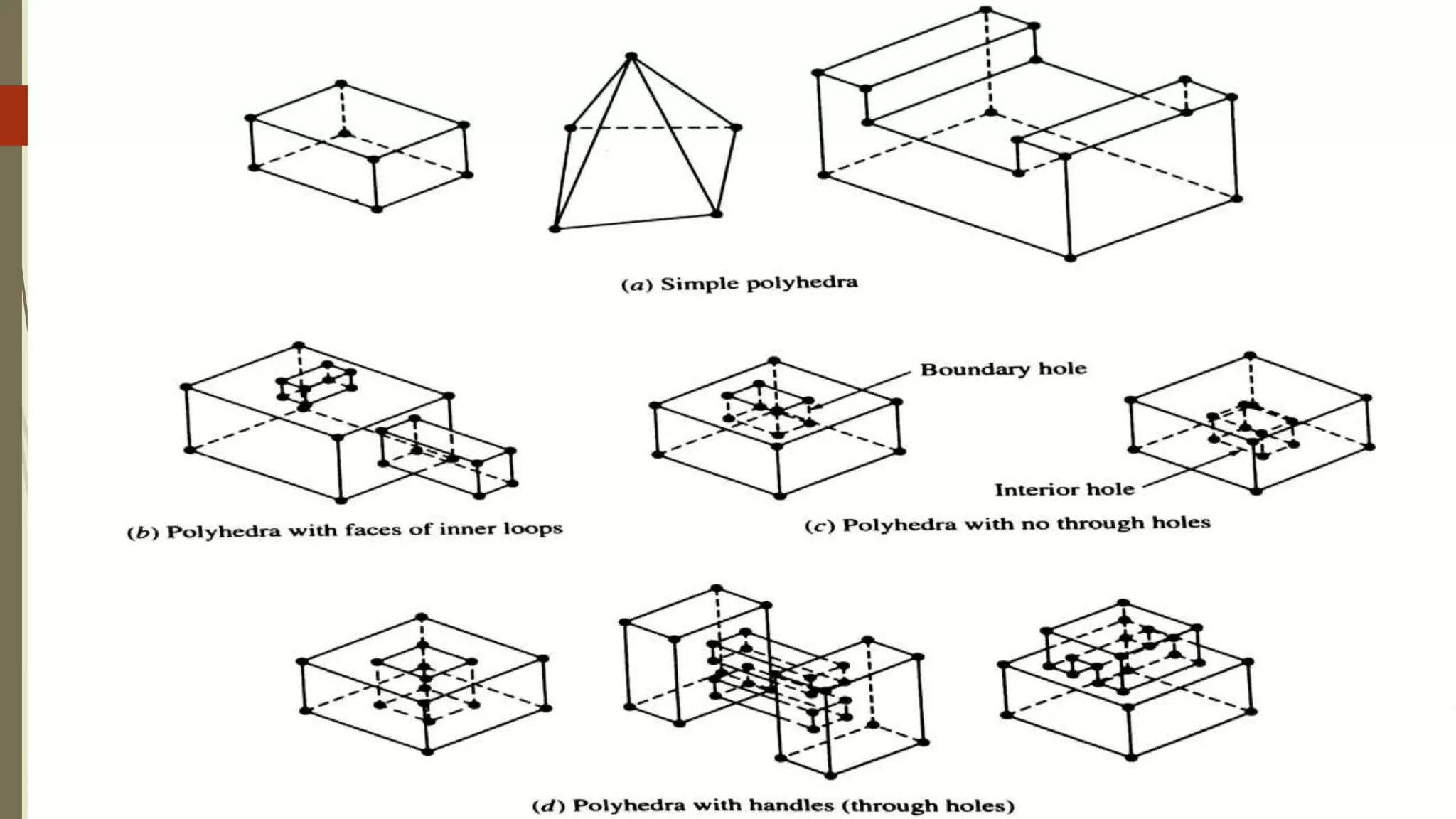
POLYHEDRAL OBJECT
Simple polyhedra
Polyhedra with faces of inner loops
Polyhedra with no through hole
Polyhedra with through holes
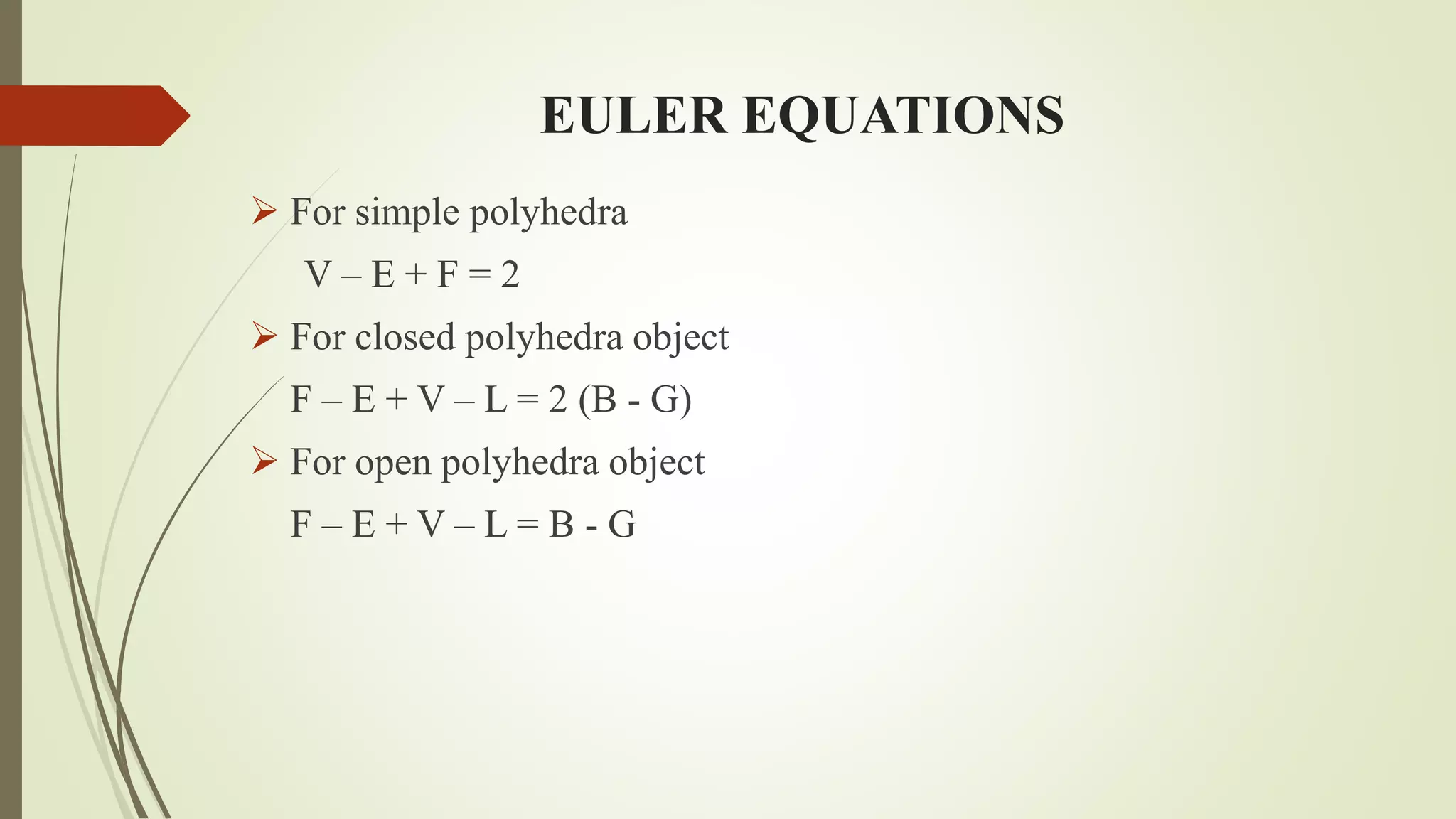
EULER EQUATIONS
 For simple polyhedra
V – E + F = 2
 For closed polyhedra object
F – E + V – L = 2 (B - G)
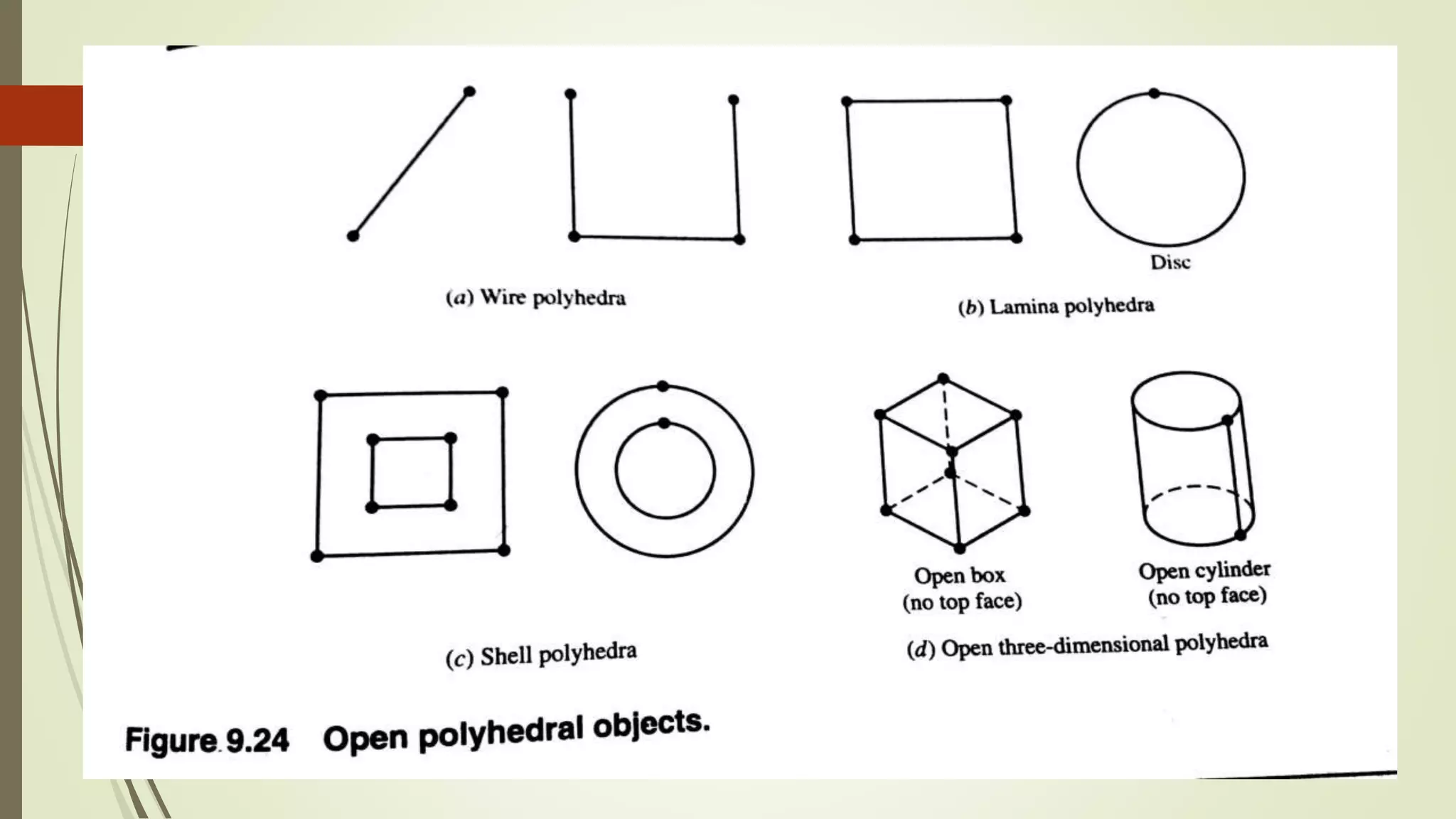
 For open polyhedra object
F – E + V – L = B - G
ADVANTAGES OF B-rep
This method is very powerful for creating complex shapes
solid models.
B-rep model can be easily converted into wire frame model
system.
B-rep system stores an explicit definition of the model
boundaries.
B-rep system is very much compatible with other systems.
DISADVANTAGES OF B-rep
This requires more storage space.
This concept cannot be applied for tool path generation.
CONSTRUCTIVE SOLID GEOMETRY (CSG)
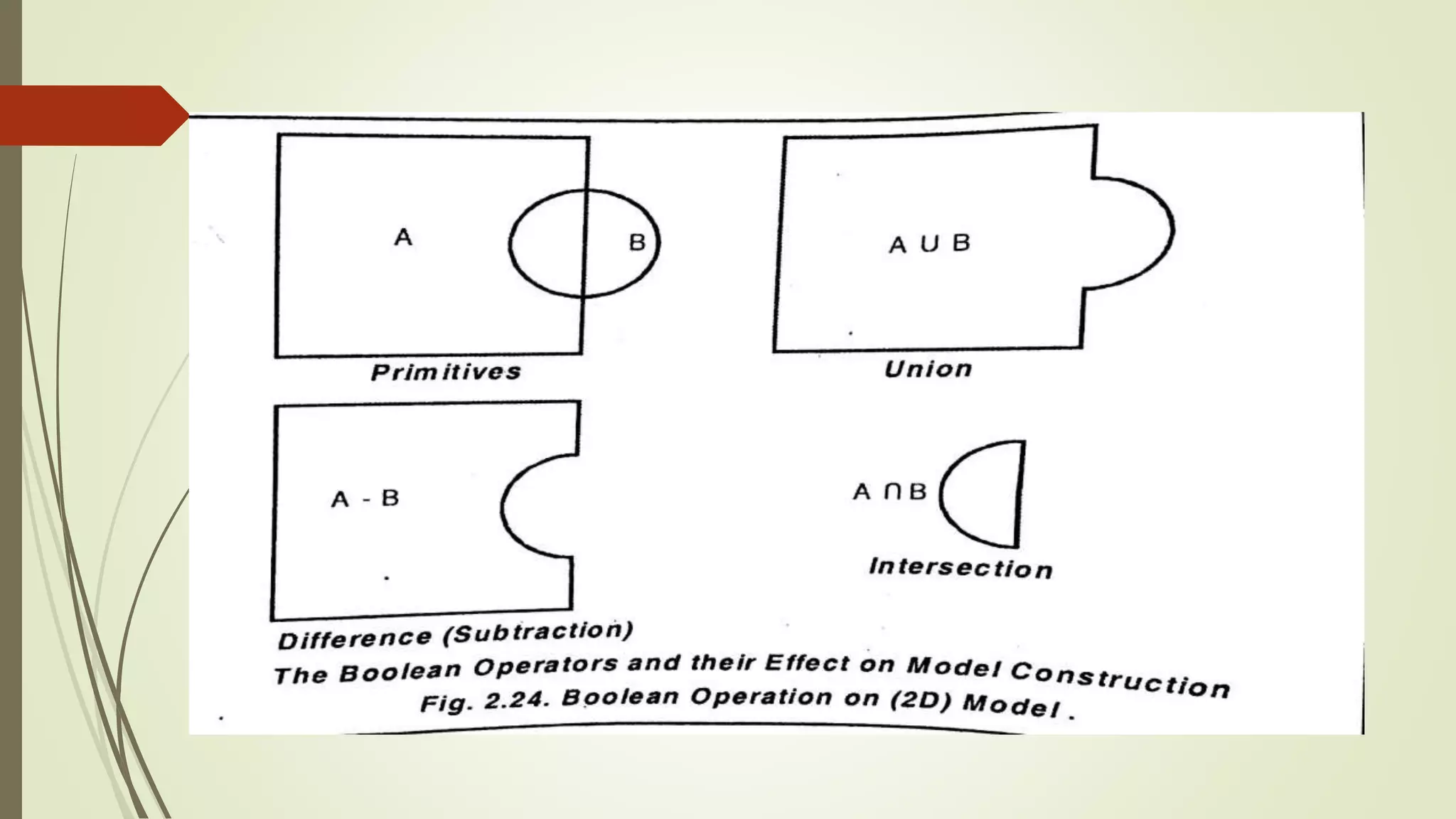
This method is also known as C-rep. In this method, solid
graphic primitives are employed for constructing the model.
The solid primitives include cubes, spheres, cylinders,
rectangle blocks and pyramids.
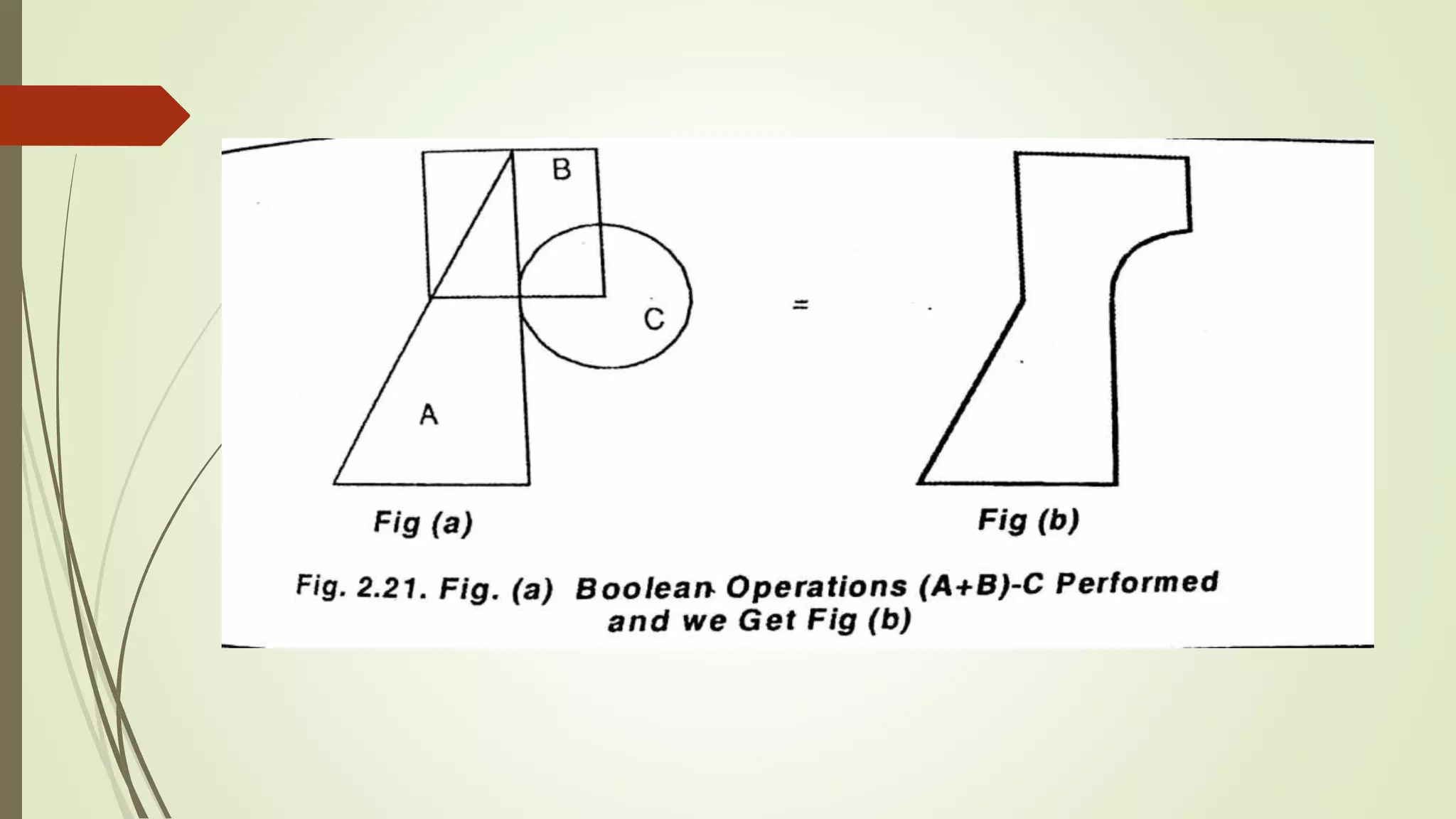
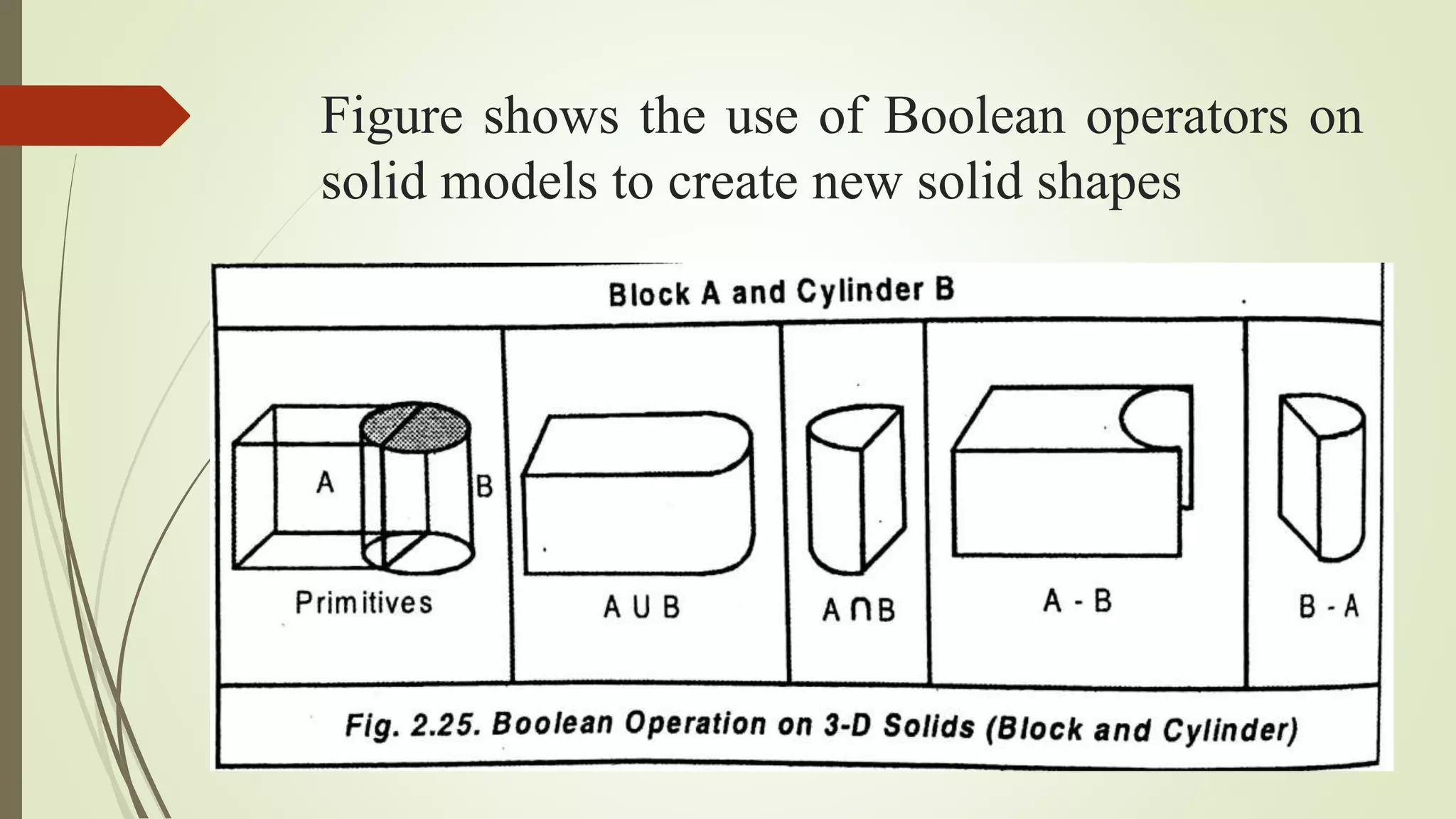
Figure shows the use of Boolean operators on
solid models to create new solid shapes
CSG MODEL
The constructive solid model uses building block approach
The physical objects can be divided into set of elements and
combined in order to form an object.
ADVANTAGES OF CSG
This requires less storage space
This method is advantageous in the initial creation of solid
models. Using Boolean operations, it is easy to construct solid
models precisely.
DISADVANTAGES OF CSG
This method involves more computational work for creating a
solid model
For complicated solid geometry, in this method is not
appropriate

Geometric modeling

  • 1.
    GEOMETRIC MODELING The mathematicaldescription of the geometry of an object using a software is called as geometric modeling There are three basic methods Wire – Frame Modeling Surface modeling Solid modeling
  • 2.
    WIRE FRAME MODELING Thisis one of the most popular and commonly used method of geometric modeling. In construction of wire frame model, the edges of an object are presented as lines. Wire frame model is used for following representations 2D Representation Orthographic views representation
  • 3.
    2D Wire FrameModel 3D Wire Frame Model The co-ordinate system is 2D co-ordinate system i.e. x and y co-ordinates only 3D co-ordinate system is used for representing objects; x, y and z coordinates are used 3 Dimensional wire frame system generation is difficult Both 2D and 3D wire frame generation is possible Hidden lines may not complicate the figure Difficult for the viewer to interpret the figure unless the hidden lines are removed Curved surfaces are indicated by circles, arcs and ellipses Curved surfaces are represented by spaced generators.
  • 4.
    DRAWBACK OF WIREFRAME MODEL Lack of clarity When part geometry is complex and in case of 3D wire frame systems, the hidden lines causes the image to be confusing to the viewer. During the surface definition, there might be confusing. By eliminating hidden lines, some clarity can be obtained.
  • 5.
    SURFACE MODELING The techniquesof representation of objects (or) components by surface is called surface modeling. Objects can be clearly interpreted by the user. Main draw back here is that, no data is available about the interior of solid. Application is modeling car bodies, ships, aerospace structure, dies, etc.
  • 6.
    TECHNIQUES AVAILABLE FORSURFACE MODELING Surface patch Coons patch Bicubic patch Bezier surfaces B-spline surfaces NURBS (Non-Uniform Rational B-Splines)
  • 7.
    SURFACE PATCH The buildingblocks of the surfaces are known as surface patch Generally u and v are two variables used for representing a patch. 0 ≤ 𝑈 ≤ 1 𝑎𝑛𝑑 0 ≤ 𝑉 ≤ 1
  • 9.
    COONS PATCH Coons surfacebatch is a form of “transfinite interpolation”, which indicates that the coons scheme interpolates to an infinite number of data points. Coons patch is particularly useful in blending four prescribed intersecting curves which forms a closed boundary. In practice, coons surface can be used to create windshield designs for cars and skyline windows for houses.
  • 11.
    BEZIER SURFACE Bezier surfaceis an extension of the Bezier curve in two parametric directions u and v. An orderly set of data or control points is used to build a topologically rectangular surface as shown in figure. The surface equation can be written as 𝑃 𝑢, 𝑣 = 𝑖=0 𝑛 𝑗=0 𝑚 𝑃𝑖𝑗𝐵𝑖,𝑛 𝑢 𝐵𝑗,𝑚 𝑣 , 0 ≤ 𝑢 ≤ 1, 0 ≤ 𝑣 ≤ 1 where,P(u,v) is any point on the surface 𝑃𝑖𝑗 are the control points
  • 13.
    B-SPLINE SURFACE B -Spline surface is an extension of the B - Spline curve. A rectangle set of data points creates the surface. A B – Spline surface can approximate or interpolate the vertices of the polyhedron as shown in figure. B – Spline surface equation is defined by 𝑃 𝑢, 𝑣 = 𝑖=0 𝑛 𝑗=0 𝑚 𝑃𝑖𝑗 𝑁𝑖,𝑘 𝑢 𝑁𝑗,𝑙 𝑣 , 0 ≤ 𝑢 ≤ 1, 0 ≤ 𝑣 ≤ 1 where,P(u,v) is any point on the surface 𝑃𝑖𝑗 are the control points
  • 16.
    SOLID MODELING Solid modelingis one of the most effective geometric modeling method. In this approach, models are displayed as solids to viewer, there by eliminating any chance of misinterpretation. In solid modeling , to make the object more realistic.
  • 17.
    SOLID MODELING TECHNIQUES Half – space Method  Boundary representation Method  Constructive Solid Geometry (CSG)  Analytical Solid Geometry (ASM)  Primitive instancing  Sweep representation  Spatial portioning representation
  • 18.
    Boundary representation Method Boundaryrepresentation is one of the most popular and widely used schemes to create solid models of physical objects. In this method, front view, top view, bottom view, side view of an object is sketched and connected by means of lines to create a relationship.
  • 19.
    PRIMITIVES OF B-repMODEL Edge Vertex Face Loop Genus or Handle Body
  • 20.
    POLYHEDRAL OBJECT Simple polyhedra Polyhedrawith faces of inner loops Polyhedra with no through hole Polyhedra with through holes
  • 22.
    EULER EQUATIONS  Forsimple polyhedra V – E + F = 2  For closed polyhedra object F – E + V – L = 2 (B - G)  For open polyhedra object F – E + V – L = B - G
  • 26.
    ADVANTAGES OF B-rep Thismethod is very powerful for creating complex shapes solid models. B-rep model can be easily converted into wire frame model system. B-rep system stores an explicit definition of the model boundaries. B-rep system is very much compatible with other systems.
  • 27.
    DISADVANTAGES OF B-rep Thisrequires more storage space. This concept cannot be applied for tool path generation.
  • 28.
    CONSTRUCTIVE SOLID GEOMETRY(CSG) This method is also known as C-rep. In this method, solid graphic primitives are employed for constructing the model. The solid primitives include cubes, spheres, cylinders, rectangle blocks and pyramids.
  • 30.
    Figure shows theuse of Boolean operators on solid models to create new solid shapes
  • 31.
    CSG MODEL The constructivesolid model uses building block approach The physical objects can be divided into set of elements and combined in order to form an object.
  • 32.
    ADVANTAGES OF CSG Thisrequires less storage space This method is advantageous in the initial creation of solid models. Using Boolean operations, it is easy to construct solid models precisely.
  • 33.
    DISADVANTAGES OF CSG Thismethod involves more computational work for creating a solid model For complicated solid geometry, in this method is not appropriate