LECT-3
Coordinates system & Geometric
Modeling
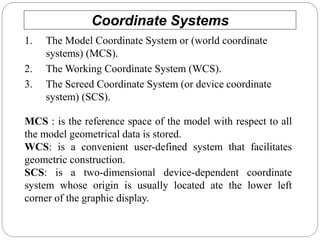
Coordinate Systems
1. The Model Coordinate System or (world coordinate
systems) (MCS).
2. The Working Coordinate System (WCS).
3. The Screed Coordinate System (or device coordinate
system) (SCS).
MCS : is the reference space of the model with respect to all
the model geometrical data is stored.
WCS: is a convenient user-defined system that facilitates
geometric construction.
SCS: is a two-dimensional device-dependent coordinate
system whose origin is usually located ate the lower left
corner of the graphic display.
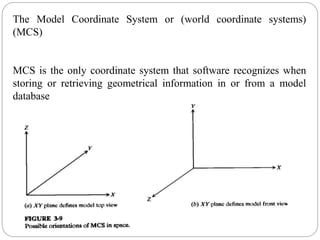
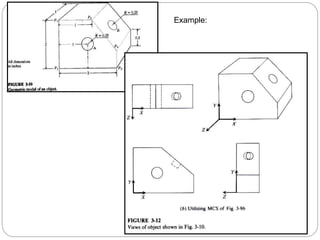
The Model Coordinate System or (world coordinate systems)
(MCS)
MCS is the only coordinate system that software recognizes when
storing or retrieving geometrical information in or from a model
database
Example:
Geometric Modeling
Geometric modelling refers to a set of techniques
concerned mainly with developing efficient
representations of geometric aspects of a design.
Therefore, geometric modelling is a fundamental part
of all CAD tools.
Geometric modeling is the basic of many
applications such as:
Mass property calculations.
Mechanism analysis.
Finite-element modelling.
NC programming.
Requirements of geometric modelling include:
• Completeness of the part representation.
• The modelling method should be easy to use by designers.
• Rendering capabilities (which means how fast the entities
can be accessed and displayed by the computer).
Geometric Modeling Approaches
The basic geometric modelling approaches available to
designers on CAD/CAM systems are:
1. Wire-frame modeling.
2. Surface modeling.
3. Solid modeling.
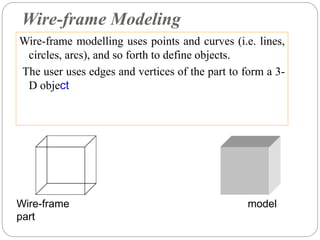
Wire-frame Modeling
Wire-frame modelling uses points and curves (i.e. lines,
circles, arcs), and so forth to define objects.
The user uses edges and vertices of the part to form a 3-
D object
Wire-frame model
part
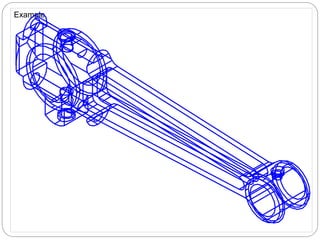
Example
Surface Modeling
Surface modeling is more sophisticated than wireframe
modeling in that it defines not only the edges of a 3D
object, but also its surfaces.
In surface modeling, objects are defined by their bounding
faces.

Cad lecture-3

  • 1.
    LECT-3 Coordinates system &Geometric Modeling
  • 2.
    Coordinate Systems 1. TheModel Coordinate System or (world coordinate systems) (MCS). 2. The Working Coordinate System (WCS). 3. The Screed Coordinate System (or device coordinate system) (SCS). MCS : is the reference space of the model with respect to all the model geometrical data is stored. WCS: is a convenient user-defined system that facilitates geometric construction. SCS: is a two-dimensional device-dependent coordinate system whose origin is usually located ate the lower left corner of the graphic display.
  • 3.
    The Model CoordinateSystem or (world coordinate systems) (MCS) MCS is the only coordinate system that software recognizes when storing or retrieving geometrical information in or from a model database
  • 4.
  • 5.
    Geometric Modeling Geometric modellingrefers to a set of techniques concerned mainly with developing efficient representations of geometric aspects of a design. Therefore, geometric modelling is a fundamental part of all CAD tools.
  • 6.
    Geometric modeling isthe basic of many applications such as: Mass property calculations. Mechanism analysis. Finite-element modelling. NC programming. Requirements of geometric modelling include: • Completeness of the part representation. • The modelling method should be easy to use by designers. • Rendering capabilities (which means how fast the entities can be accessed and displayed by the computer).
  • 7.
    Geometric Modeling Approaches Thebasic geometric modelling approaches available to designers on CAD/CAM systems are: 1. Wire-frame modeling. 2. Surface modeling. 3. Solid modeling.
  • 8.
    Wire-frame Modeling Wire-frame modellinguses points and curves (i.e. lines, circles, arcs), and so forth to define objects. The user uses edges and vertices of the part to form a 3- D object Wire-frame model part
  • 9.
  • 10.
    Surface Modeling Surface modelingis more sophisticated than wireframe modeling in that it defines not only the edges of a 3D object, but also its surfaces. In surface modeling, objects are defined by their bounding faces.