I express my heartful gratitude to MADAM MANIKA
DAS KOTOKI, HOD and s/t of DEPT. OF BIOTECHNOLOGY,
DARRANG COLLEGE, TEZPUR for giving me an opportunity to
present this presentation on “SPECTROPHOTOMETRY”
and helping me to collect and organize the presentation
data. I sincerely hope tat the knowledge provided by her
will be beneficial in my future life.
   Quantitative measurement of the reflection or
    transmission properties of a material as a function of
    wavelength.
   A part of BIO-INSTRUMENTATION
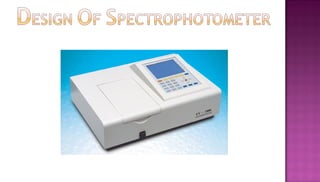
   Involves the use of SPECTROPHOTOMETER
   It is a photometer that can measure intensity as a
    function of the light source wavelength.
   It is commonly used for the measurement of
    transmittance or reflectance of solutions, transparent
    or opaque solids, or gases.
   Also designed to measure the diffusivity on any of the
    listed light ranges that usually cover around 200nm -
    2500nm using different controls and calibrations.
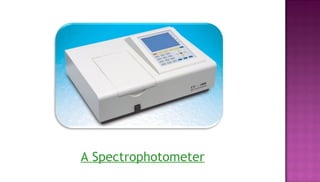
A Spectrophotometer
Works upon the following principles-
Beer’s Law
Lambert’s Law
Beer-Lambert’s Law
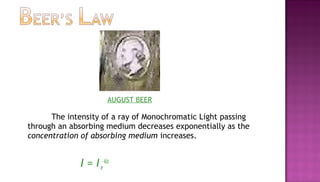
AUGUST BEER

      The intensity of a ray of Monochromatic Light passing
through an absorbing medium decreases exponentially as the
concentration of absorbing medium increases.


              I = I e-klc
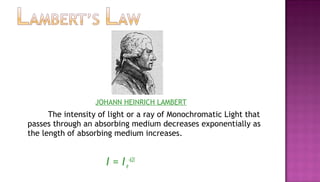
JOHANN HEINRICH LAMBERT
      The intensity of light or a ray of Monochromatic Light that
passes through an absorbing medium decreases exponentially as
the length of absorbing medium increases.


                     I = I e-k2l
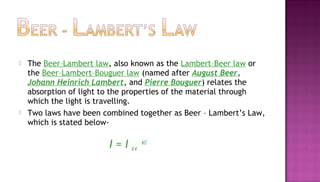
   The Beer–Lambert law, also known as the Lambert–Beer law or
    the Beer–Lambert–Bouguer law (named after August Beer,
    Johann Heinrich Lambert, and Pierre Bouguer) relates the
    absorption of light to the properties of the material through
    which the light is travelling.
   Two laws have been combined together as Beer – Lambert’s Law,
    which is stated below-

                        I=I   oe
                                   -kcl
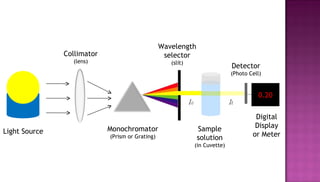
Wavelength
               Collimator                         selector
                 (lens)                             (slit)
                                                                            Detector
                                                                            (Photo Cell)


                                                                                      0.20

                                                                                     Digital
                            Monochromator                     Sample                 Display
Light Source                                                                        or Meter
                            (Prism or Grating)                solution
                                                             (in Cuvette)
Five types of Spectrophotometer according to the range and
type of light used-
   UV-Vis absorption spectrophotometer (UV-Vis)

   FT-IR absorption/transmission spectrophotometer (FTIR)
   Atomic absorption spectrophotometer (AAS)

   Atomic fluorescence spectrophotometer (AFS)

   X-ray fluorescence spectrophotometer (XFS)

   Two types according to the number of beams used-
   Single Beam Spectrophotometer

   Double Beam Spectrophotometer
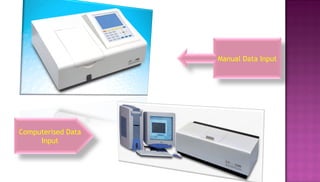
Manual Data Input


Computerised Data
     Input
The use of spectrophotometers spans various scientific fields,
such as-
   Physics

   Materials Science
   Chemistry

   Biochemistry

   Molecular Biology

   Also used in industries including semiconductors, laser and
optical manufacturing, printing and forensic examination, as well
in laboratories for the study of chemical substances.
Basic concept of analytical technique spectrophotometry

Basic concept of analytical technique spectrophotometry

  • 2.
    I express myheartful gratitude to MADAM MANIKA DAS KOTOKI, HOD and s/t of DEPT. OF BIOTECHNOLOGY, DARRANG COLLEGE, TEZPUR for giving me an opportunity to present this presentation on “SPECTROPHOTOMETRY” and helping me to collect and organize the presentation data. I sincerely hope tat the knowledge provided by her will be beneficial in my future life.
  • 4.
    Quantitative measurement of the reflection or transmission properties of a material as a function of wavelength.  A part of BIO-INSTRUMENTATION  Involves the use of SPECTROPHOTOMETER
  • 5.
    It is a photometer that can measure intensity as a function of the light source wavelength.  It is commonly used for the measurement of transmittance or reflectance of solutions, transparent or opaque solids, or gases.  Also designed to measure the diffusivity on any of the listed light ranges that usually cover around 200nm - 2500nm using different controls and calibrations.
  • 6.
  • 7.
    Works upon thefollowing principles- Beer’s Law Lambert’s Law Beer-Lambert’s Law
  • 8.
    AUGUST BEER The intensity of a ray of Monochromatic Light passing through an absorbing medium decreases exponentially as the concentration of absorbing medium increases. I = I e-klc
  • 9.
    JOHANN HEINRICH LAMBERT The intensity of light or a ray of Monochromatic Light that passes through an absorbing medium decreases exponentially as the length of absorbing medium increases. I = I e-k2l
  • 10.
    The Beer–Lambert law, also known as the Lambert–Beer law or the Beer–Lambert–Bouguer law (named after August Beer, Johann Heinrich Lambert, and Pierre Bouguer) relates the absorption of light to the properties of the material through which the light is travelling.  Two laws have been combined together as Beer – Lambert’s Law, which is stated below- I=I oe -kcl
  • 12.
    Wavelength Collimator selector (lens) (slit) Detector (Photo Cell) 0.20 Digital Monochromator Sample Display Light Source or Meter (Prism or Grating) solution (in Cuvette)
  • 13.
    Five types ofSpectrophotometer according to the range and type of light used- UV-Vis absorption spectrophotometer (UV-Vis) FT-IR absorption/transmission spectrophotometer (FTIR) Atomic absorption spectrophotometer (AAS) Atomic fluorescence spectrophotometer (AFS) X-ray fluorescence spectrophotometer (XFS) Two types according to the number of beams used- Single Beam Spectrophotometer Double Beam Spectrophotometer
  • 14.
  • 15.
    The use ofspectrophotometers spans various scientific fields, such as- Physics Materials Science Chemistry Biochemistry Molecular Biology Also used in industries including semiconductors, laser and optical manufacturing, printing and forensic examination, as well in laboratories for the study of chemical substances.