1
20 2018/12/21
n
• ~2013.3, PhD@ ,
• 2013.4~2016.3, @IBM
• 2016.4~2017.8, @ ERATO, NII
• 2017.9~, @ ,
n
•
ECML’11
AISTATS’15,17
•
AISTATS’18
AAAI’17,18
ongoing
2
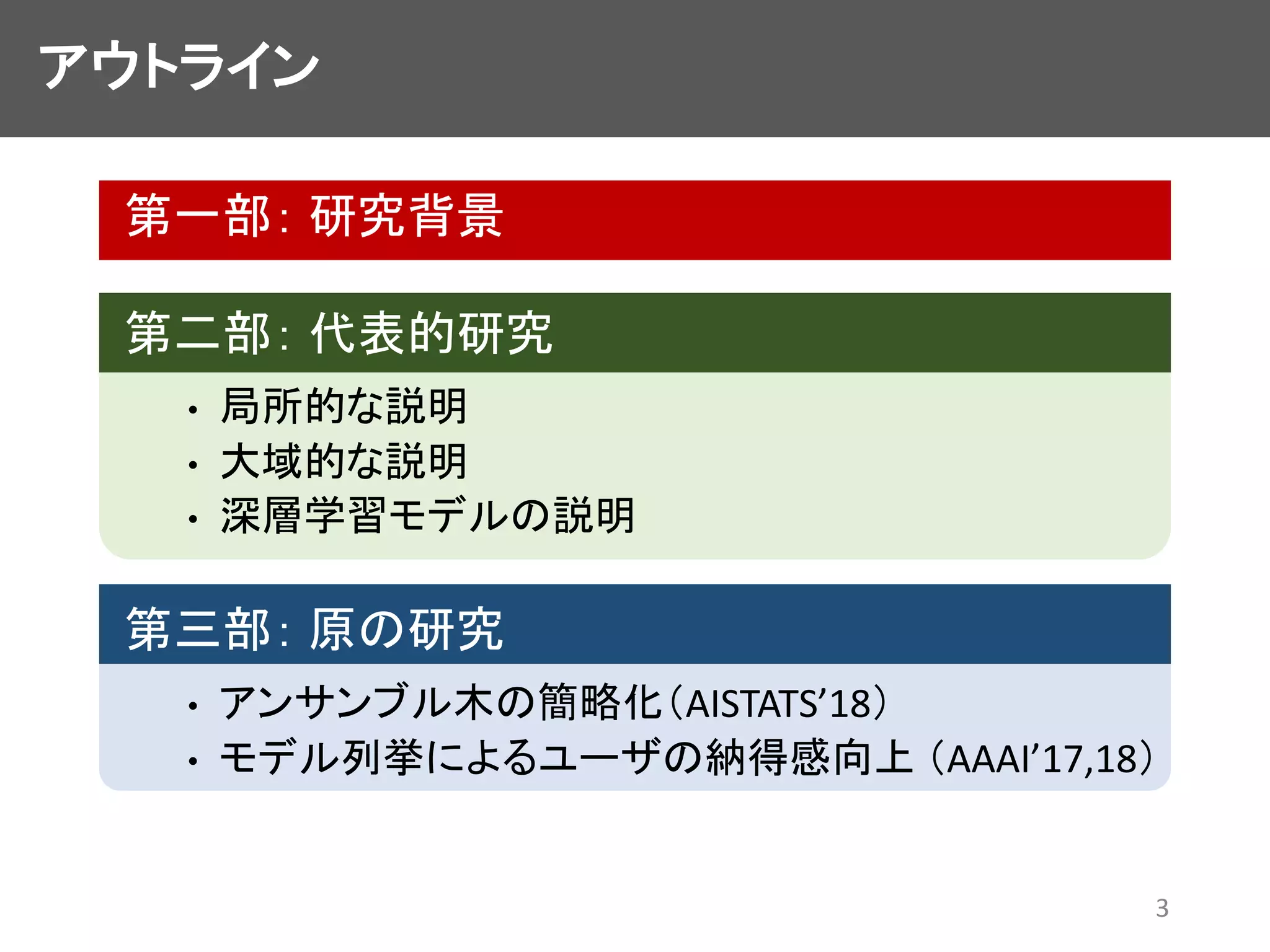
•
•
•
• AISTATS’18
• AAAI’17,18
3
AI
n
•
n
•
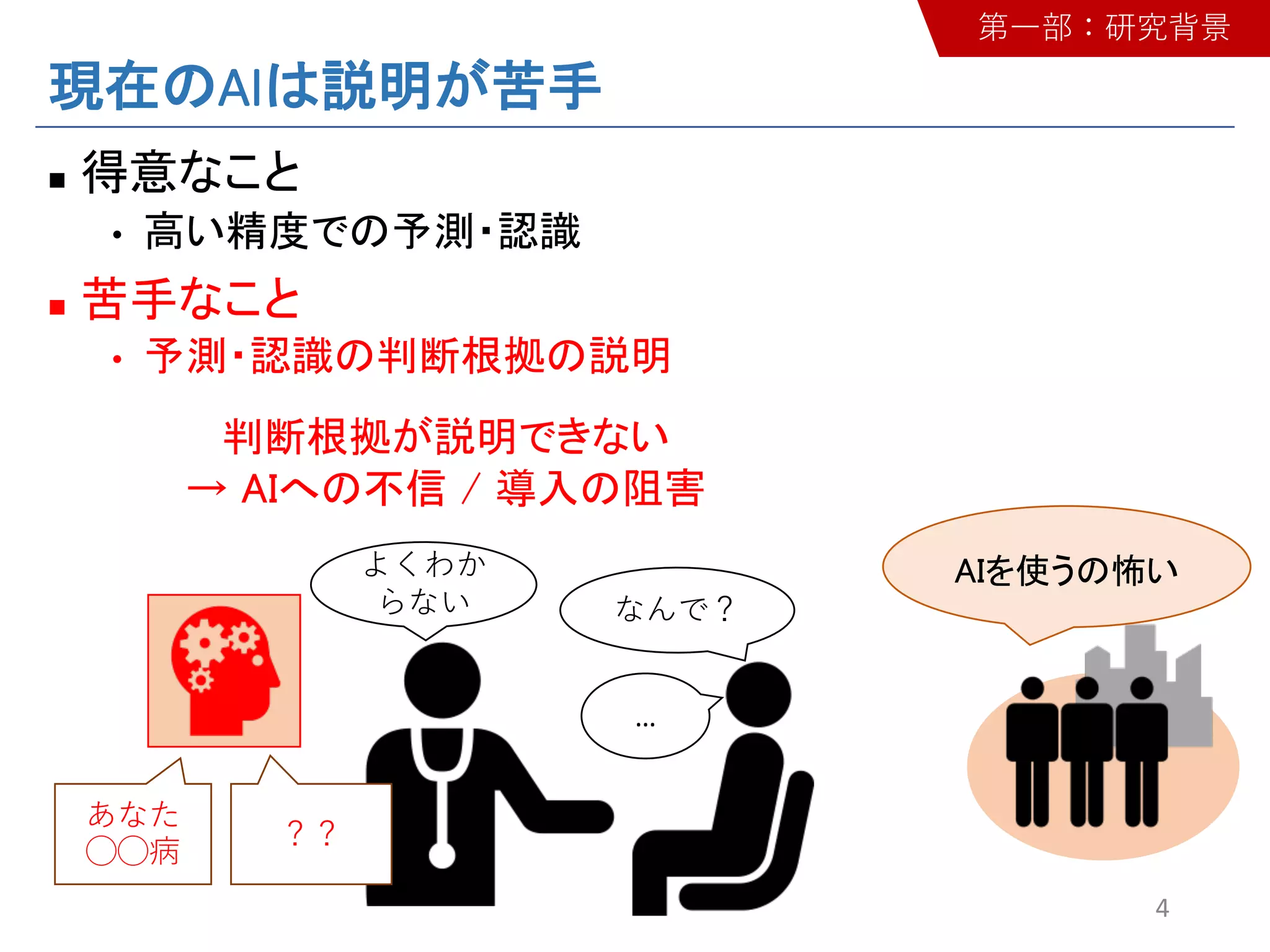
4
…
AI
n
•
n
•
5
XX
XX
AI
n
• AI
AI
AI AI
n
• AI
•
n
6
n
•
•
• AI
•
•
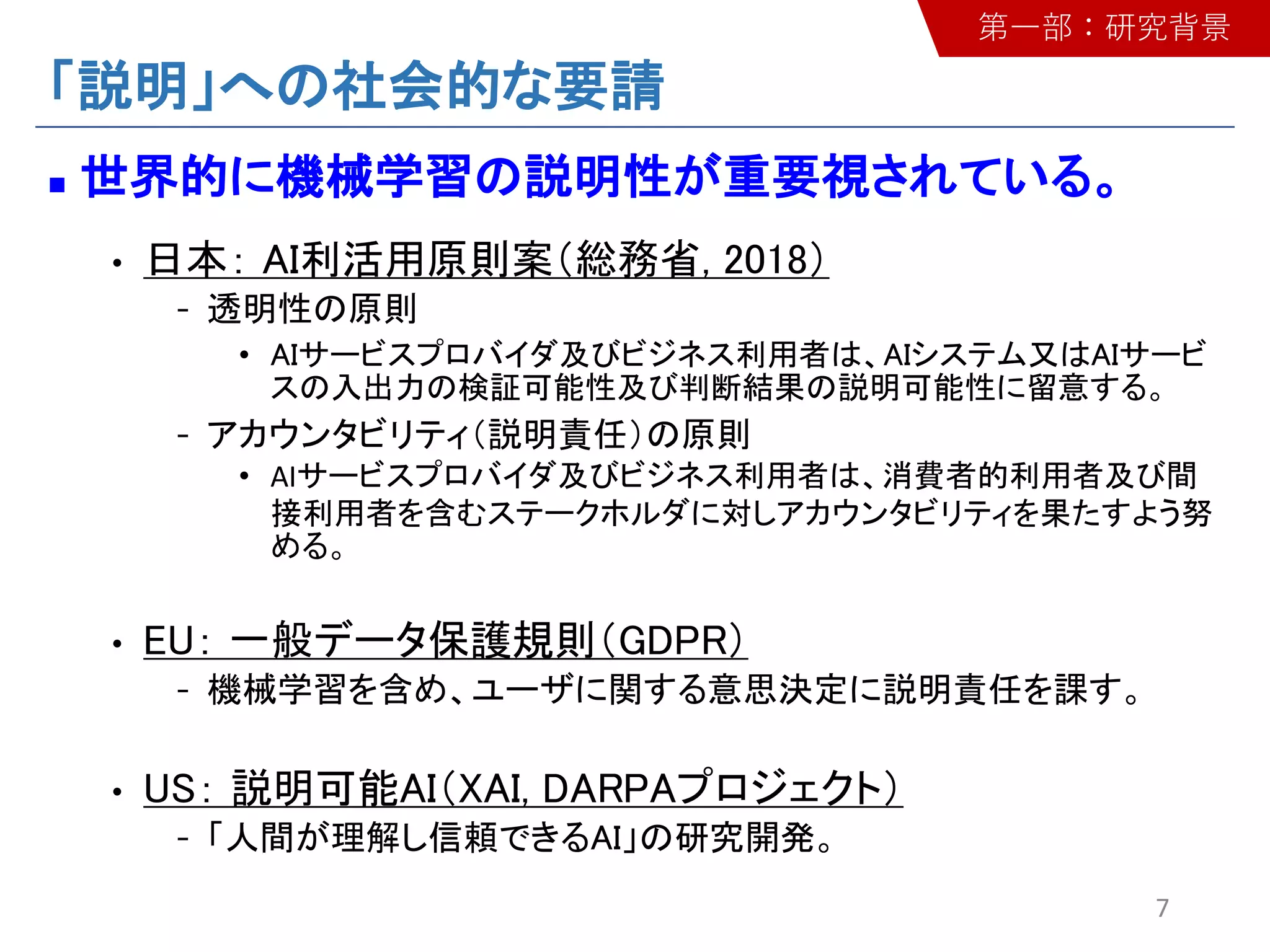
7
8
EU GDPR
n GDPR-22
1. The data subject shall have the right not to be subject to a decision based
solely on automated processing, including profiling, which produces legal
effects concerning him or her or similarly significantly affects him or her.
2. Paragraph 1 shall not apply if the decision: is necessary for entering into, or
performance of, a contract between the data subject and a data controller; is
authorised by Union or Member State law to which the controller is subject
and which also lays down suitable measures to safeguard the data subject’s
rights and freedoms and legitimate interests; or is based on the data subject’s
explicit consent.
3. In the cases referred to in points (a) and (c) of paragraph 2, the data controller
shall implement suitable measures to safeguard the data subject’s rights and
freedoms and legitimate interests, at least the right to obtain human
intervention on the part of the controller, to express his or her point of view
and to contest the decision.
4. Decisions referred to in paragraph 2 shall not be based on special categories of
personal data referred to in Article 9(2)1), unless point (a) or (g) of Article 9(2)
applies and suitable measures to safeguard the data subject’s rights and
freedoms and legitimate interests are in place.
9
n 2016
• ICML, NIPS
n
• , ,
Vol.33, No.3, pages 366--369, 2018.
• , Qiita
10
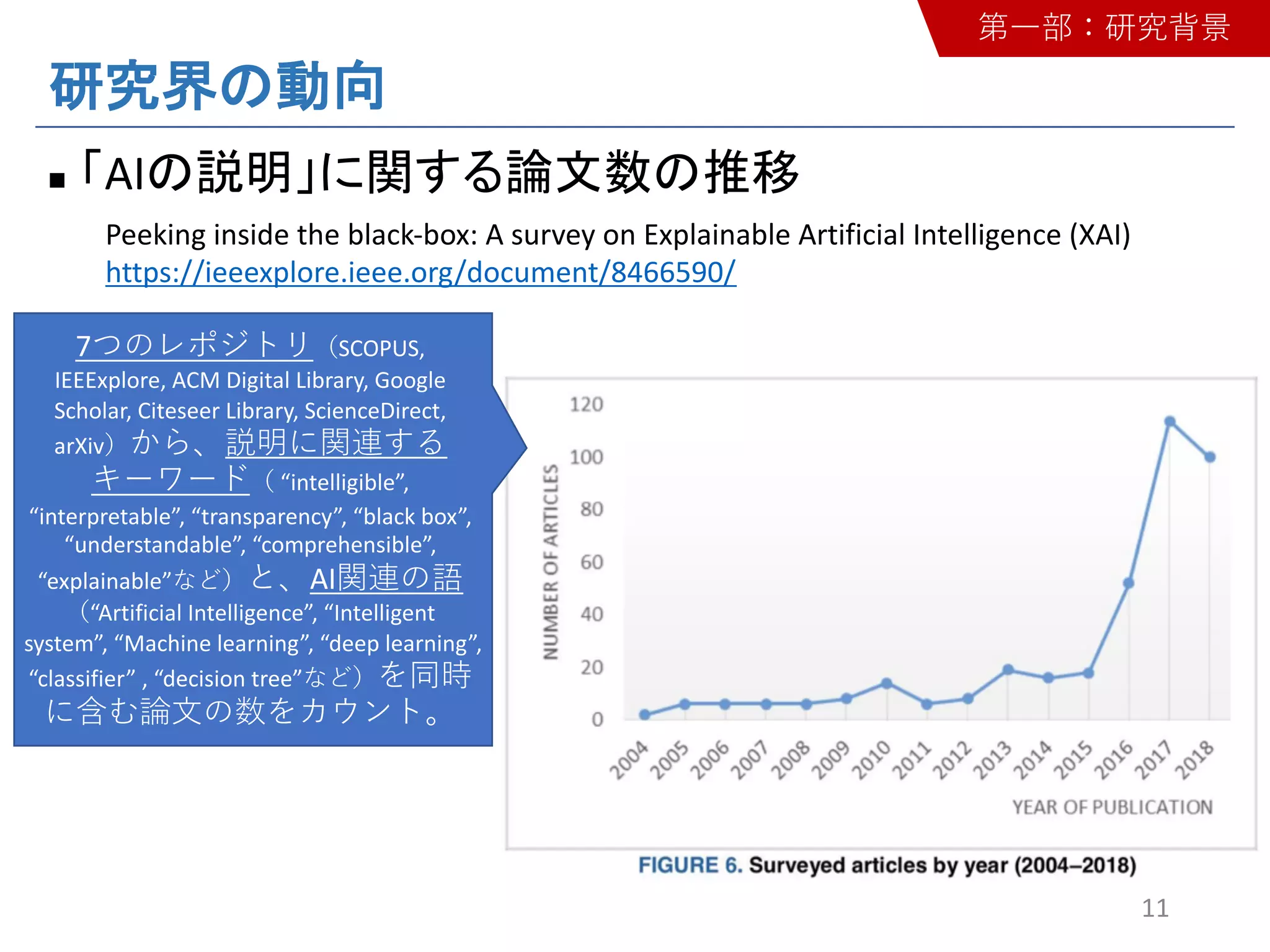
n AI
11
Peeking inside the black-box: A survey on Explainable Artificial Intelligence (XAI)
https://ieeexplore.ieee.org/document/8466590/
7 SCOPUS,
IEEExplore, ACM Digital Library, Google
Scholar, Citeseer Library, ScienceDirect,
arXiv
“intelligible”,
“interpretable”, “transparency”, “black box”,
“understandable”, “comprehensible”,
“explainable” AI
“Artificial Intelligence”, “Intelligent
system”, “Machine learning”, “deep learning”,
“classifier” , “decision tree”
•
•
•
• AISTATS’18
• AAAI’17,18
12
n
•
n
• 1.
• 2.
• 3.
• 4.
• …
13
n
n /
•
n
•
•
n “ ”
•
14
1.
•
2.
•
3.
•
15
n
n Why Should I Trust You?: Explaining the Predictions of
Any Classifier, KDD'16 [Python LIME; R LIME]
n A Unified Approach to Interpreting Model Predictions,
NIPS'17 [Python SHAP]
n Anchors: High-Precision Model-Agnostic Explanations,
AAAI'18 [Python Anchor]
n Understanding Black-box Predictions via Influence
Functions, ICML’17 [Python influence-release]
16
n
n Born Again Trees
n Making Tree Ensembles Interpretable: A Bayesian Model
Selection Approach, AISTATS'18 [Python defragTrees]
17
n
n [Python+Tensorflow
saliency; DeepExplain]
• Striving for Simplicity: The All Convolutional Net
(GuidedBackprop)
• On Pixel-Wise Explanations for Non-Linear Classifier Decisions
by Layer-Wise Relevance Propagation (Epsilon-LRP)
• Axiomatic Attribution for Deep Networks (IntegratedGrad)
• SmoothGrad: Removing Noise by Adding Noise (SmoothGrad)
• Learning Important Features Through Propagating Activation
Differences (DeepLIFT)
18
19
n
n Why Should I Trust You?: Explaining the Predictions of
Any Classifier, KDD'16 [Python LIME; R LIME]
n A Unified Approach to Interpreting Model Predictions,
NIPS'17 [Python SHAP]
n Anchors: High-Precision Model-Agnostic Explanations,
AAAI'18 [Python Anchor]
n Understanding Black-box Predictions via Influence
Functions, ICML’17 [Python influence-release]
20
n
n
• LIME, SHAP, Anchor
n
• influence
21
LIME
n Why Should I Trust You?: Explaining the Predictions of
Any Classifier, KDD'16 [Python LIME; R LIME]
•
•
22
LIME
23
LIME
n 2
• One-Hot
•
n LIME
• Adult One-Hot
24
LIME
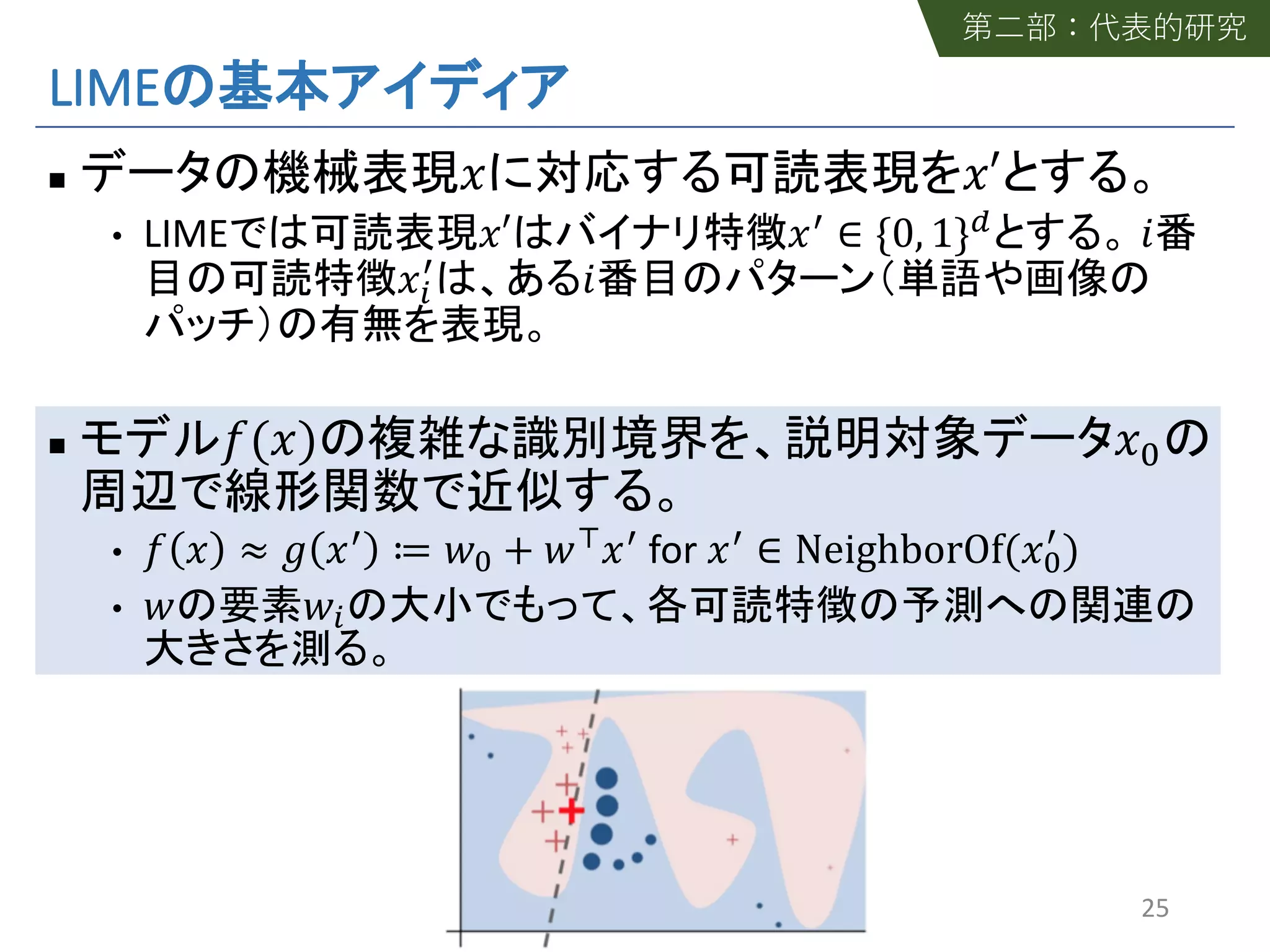
n ! !′
• LIME !′ !# ∈ {0, 1}* +
!,
#
+
n -(!) !0
• - ! ≈ 2 !# ≔ 40 + 46!# for !# ∈ NeighborOf(!0
#
)
• 4 4,
25
LIME
n !(#) #%
• ! # ≈ ' #( ≔ *% + *,#( for #( ∈ NeighborOf(#%
(
)
n *
• min
:
∑ <,<> ∈? @AB
C ! C − ' C( E
s.t. * % ≤ G
* %
@AB
C #%
H #%
26
LIME
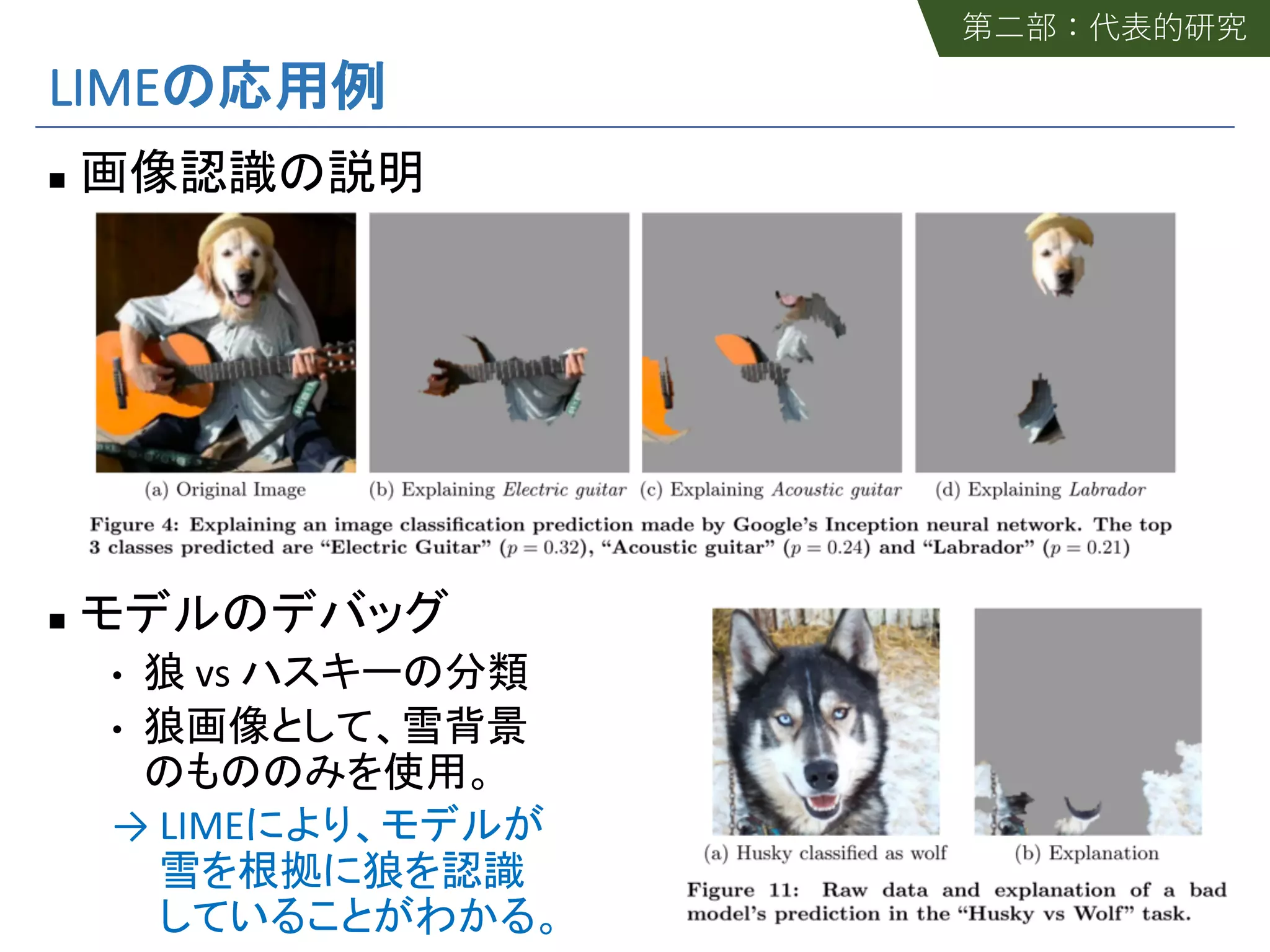
n
n
• vs
•
→ LIME
27
SHAP
n A Unified Approach to Interpreting Model Predictions,
NIPS'17 [Python SHAP]
•
• LIME
28
SHAP
n 1
n 2
29
SHAP
n SHAP LIME
• Adult One-Hot
n . “ ”
SHAP “ ”
30
SHAP
n SHAP = LIME
• ! "# = %& + %("# = %& + ∑* %*"*
#
3
n 1. + " = ! "#
•
31
SHAP
n SHAP = LIME
• ! "# = %& + %("# = %& + ∑* %*"*
#
3
n 2. "*
#
= 0 ⇒ %* = 0
•
32
SHAP
n SHAP = LIME
• ! "# = %& + %("# = %& + ∑* %*"*
#
3
n 3. + " = +, "# + +′
+,
# "# − +,
# "# ∖ 0 ≥ +, "# − +, "# ∖ 0 ⇒ %* +# ≥ %* +
• + +′ "*
#
+′ +
+# "*
#
+
33
SHAP
n SHAP = LIME
• ! "# = %& + %("# = %& + ∑* %*"*
#
SHAP
n 3
• %* = ∑+⊆-.
+ ! 01 + 12 !
0!
(4- 5 − 4-(5 ∖ 8))
• Shapley Value
34
SHAP
n LIME
• min
$
∑&∈( ) * +, * − . *
/
• ) * =
123
1 456678 & & (1 2|&|)
n
• Linear SHAP:
• Tree SHAP:
• Deep SHAP: DeepLIFT
35
Anchor
n Anchors: High-Precision Model-Agnostic Explanations,
AAAI'18 [Python Anchor]
•
36
Anchor
37
Anchor
n Anchor LIME
• Adult One-Hot
n
• Anchor +
38
Anchor
n “ +
•
39
Anchor
n !
• " ! ! " = 1
n %(⋅ |!) !
n ! =Anchor
• Anchor ! * " +
,- * ! 1. / 0. 1 ≥ +, ! " = 1
Anchor ! "
40
Anchor
n !" # $ 1& ' (& ) ≥ +
• 1 − -
Pr !" # $ 1& ' (& ) ≥ + ≥ 1 − -
41
Anchor
n ! =
!
• !
• max
%
&' ( [!(+)] s.t. Pr &' + ! 11 ( 21 3 ≥ 5 ≥ 1 − 7
n 1.
n 2.
• Pr &' + ! 11 ( 21 3 ≥ 5 1 − 7 !
42
n
n
• LIME, SHAP, Anchor
n
• influence
43
influence
n Understanding Black-box Predictions via Influence
Functions, ICML’17 [Python influence-release]
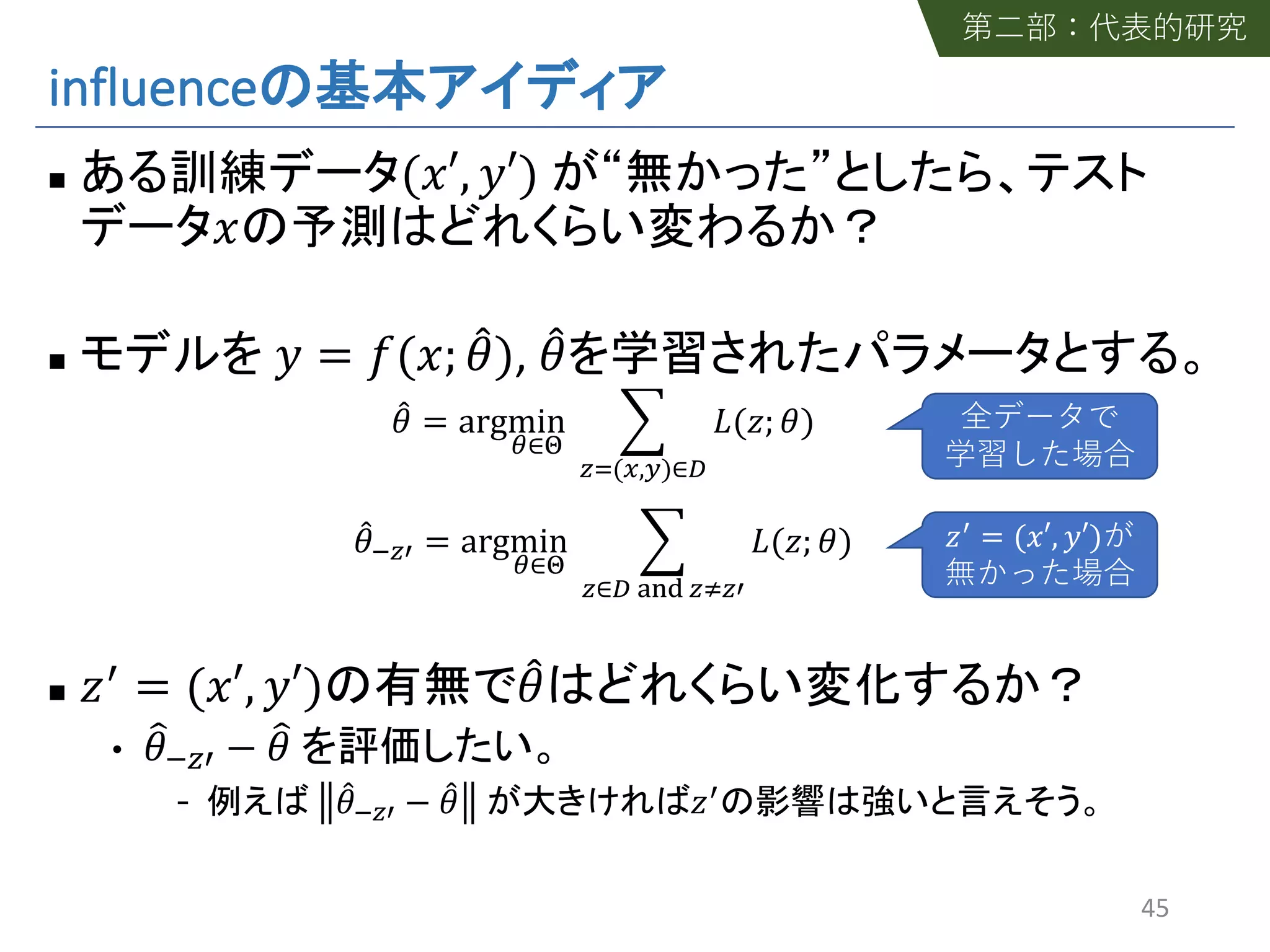
n ("′, %′)
"
44
influence
n ("′, %′)
"
n % = (("; *+), *+
*+ = argmin
2∈4
5
67(8,9)∈:
;(<; +)
*+=6> = argmin
2∈4
5
6∈: ?@A 6B6>
;(<; +)
n <> = ("′, %′) *+
• C+=6> − C+
*+=6> − *+ <>
45
<>
= ("′, %′)
influence
n !" = (%′, (′) *+
• ,+-." − ,+
*+-." − *+ !"
n
• !" = (%′, (′) ,+-."
•
n influence
• ,+-." − ,+
,+-." − ,+ ≈ −
1
2
345
-6
78(!"; ,+)
46
influence
n Data Poisoning
•
•
47
influence
n
•
48
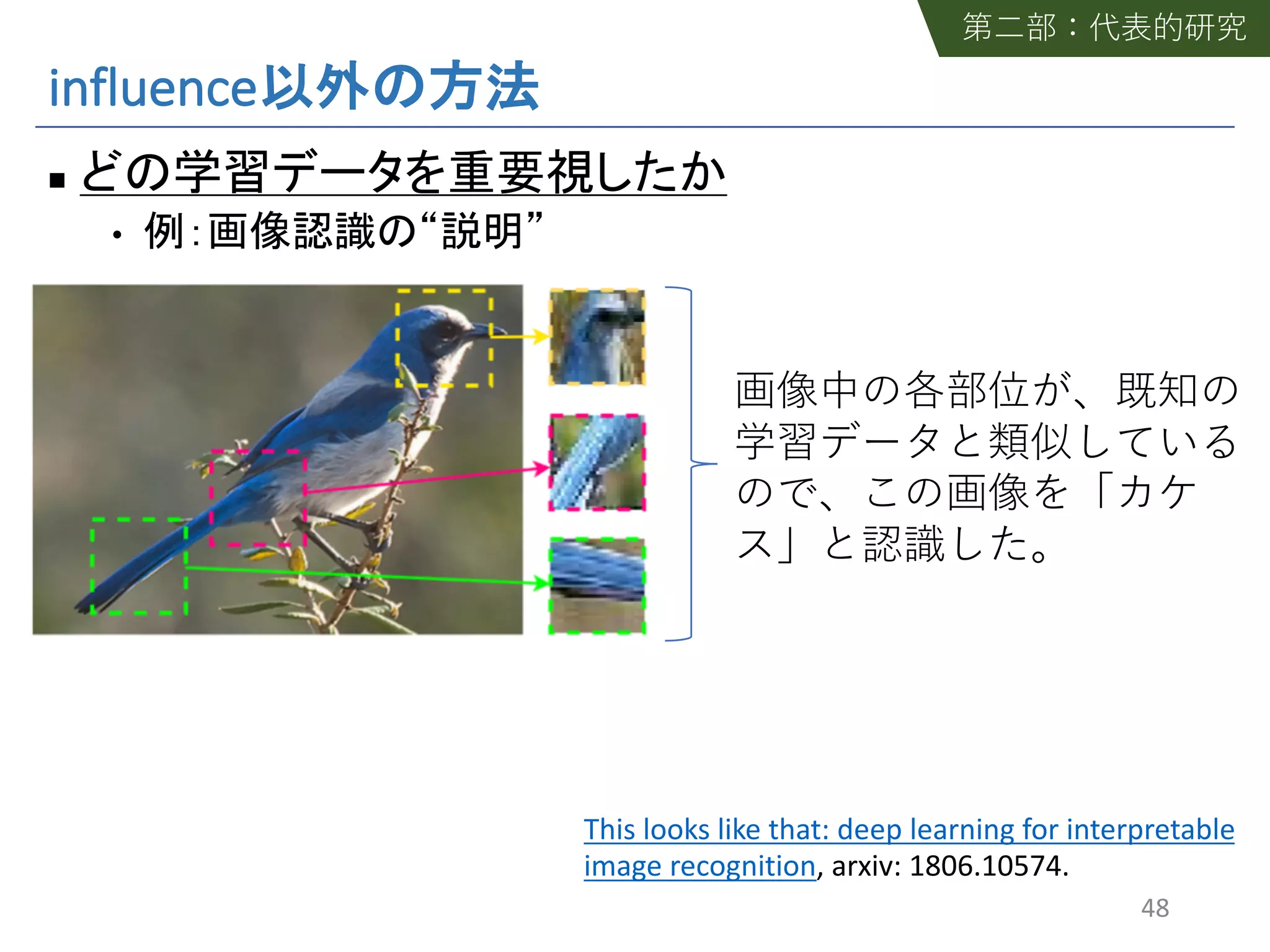
This looks like that: deep learning for interpretable
image recognition, arxiv: 1806.10574.
n
n
• LIME
• SHAP
• Anchor
n
• influence
49
n
• Interpretable Predictions of Tree-based Ensembles
via Actionable Feature Tweaking, KDD’17
•
50
30 200
20 200
30 300
⭕
⭕
…
…
n
• Generating Visual Explanations, ECCV‘16
•
51
52
n
n Born Again Trees
n Making Tree Ensembles Interpretable: A Bayesian Model
Selection Approach, AISTATS'18 [Python defragTrees]
53
BATrees
n Born Again Trees
•
•
n
• !
!
•
54
n
• BATrees
• defragTrees RandomForest
55
56
n
n [Python+Tensorflow
saliency; DeepExplain]
• Striving for Simplicity: The All Convolutional Net
(GuidedBackprop)
• On Pixel-Wise Explanations for Non-Linear Classifier Decisions
by Layer-Wise Relevance Propagation (Epsilon-LRP)
• Axiomatic Attribution for Deep Networks (IntegratedGrad)
• SmoothGrad: Removing Noise by Adding Noise (SmoothGrad)
• Learning Important Features Through Propagating Activation
Differences (DeepLIFT)
57
n
•
58
DNN
n
•
59
DNN
n
•
60
DNN
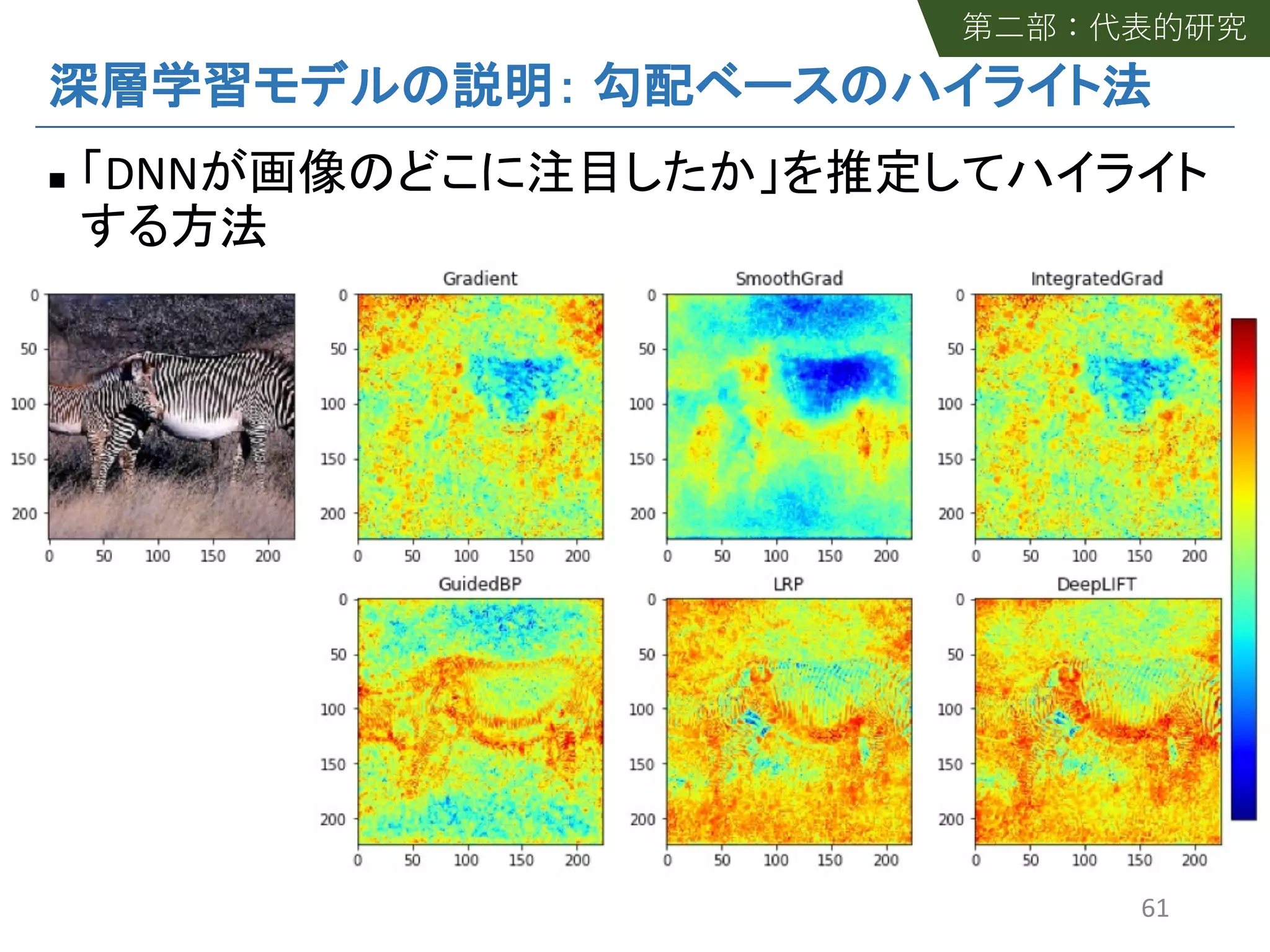
n DNN
61
n
•
→
•
→
62
n ! = # $
n $
n [Simonyan et al., arXiv’14]
$%
&' (
&()
•
→ →
*+ ,
*,-
→
•
→ →
&' (
&()
→
63
n [Simonyan et al., arXiv’14]
!"
#$ %
#%&
n
• GuidedBP [Springenberg et al., arXiv’14]
back propagation
• LRP [Bach et al., PloS ONE’15]
• IntegratedGrad [Sundararajan et al., arXiv’17]
• SmoothGrad [Smilkov et al., arXiv’17]
• DeepLIFT [Shrikumar et al., ICML’17]
64
n
n
[Python+Tensorflow saliency; DeepExplain]
• Striving for Simplicity: The All Convolutional Net
(GuidedBackprop)
• On Pixel-Wise Explanations for Non-Linear Classifier Decisions
by Layer-Wise Relevance Propagation (Epsilon-LRP)
• Axiomatic Attribution for Deep Networks (IntegratedGrad)
• SmoothGrad: Removing Noise by Adding Noise (SmoothGrad)
• Learning Important Features Through Propagating Activation
Differences (DeepLIFT)
65
•
•
•
• AISTATS’18
• AAAI’17,18
66
n AISTATS’18
•
n AAAI’17,18
•
67
defragTrees
n Making Tree Ensembles Interpretable: A Bayesian Model
Selection Approach, AISTATS'18 [Python defragTrees]
•
•
n
69
when
Relationship ≠ Not-in-family, Wife
Capital Gain < 7370
when
Relationship ≠ Not-in-family
Capital Gain >= 7370
when
Relationship ≠ Not-in-family, Unmarried
Capital Gain < 5095
Capital Loss < 2114
when
Relationship = Not-in-family
Country ≠ China, Peru
Capital Gain < 5095
when
Relationship ≠ Not-in-family
Country ≠ China
Capital Gain < 5095
when
Relationship ≠ Not-in-family
Capital Gain >= 7370
…
…
n
n
•
70
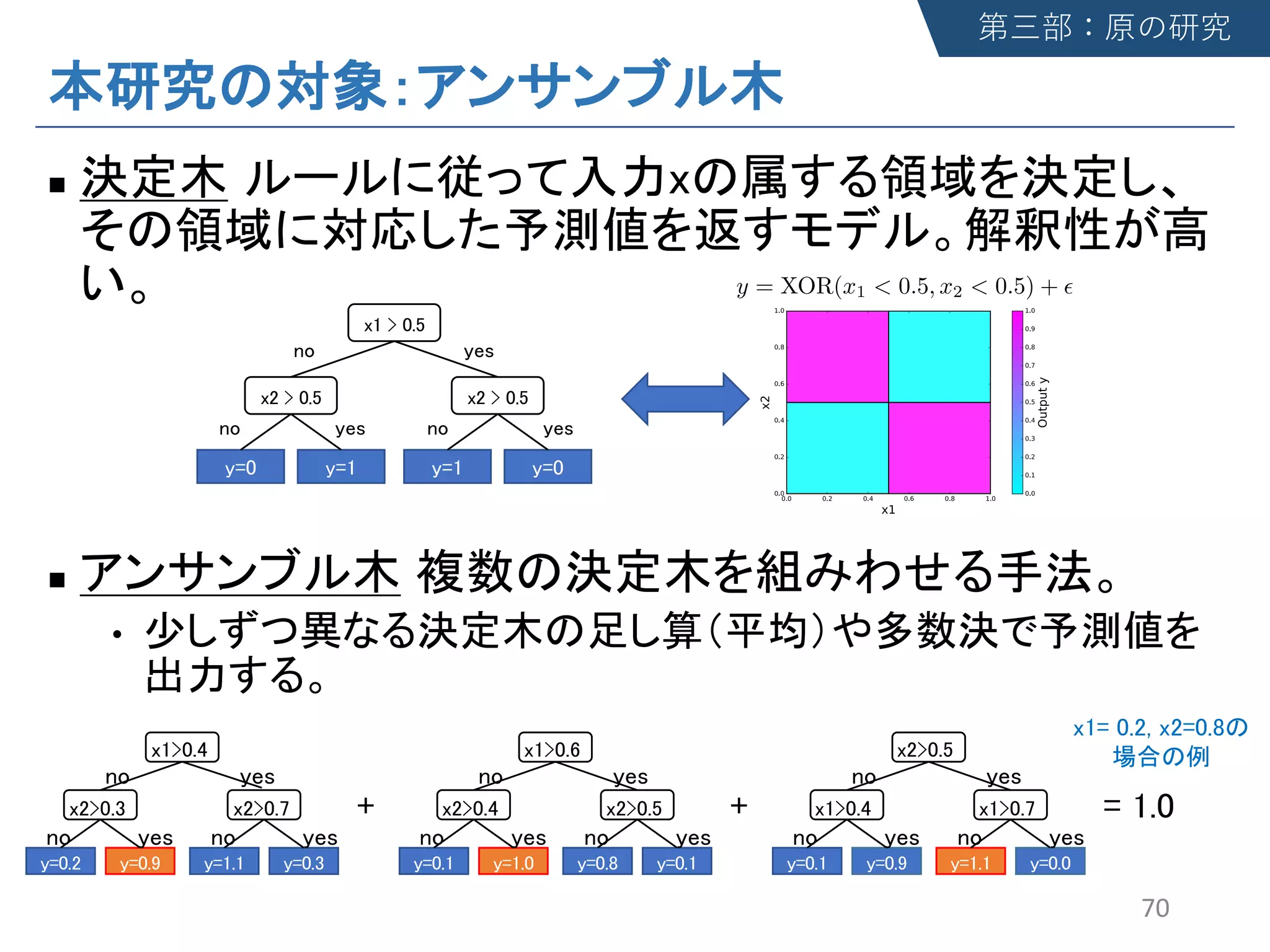
y = XOR(x1 < 0.5, x2 < 0.5) + ✏
n
n
71
2017 The State of Data Science & Machine LearningYour Year on Kaggle: Most Memorable
Community Stats from 2016
n
n
72
R
n
•
•
n
73
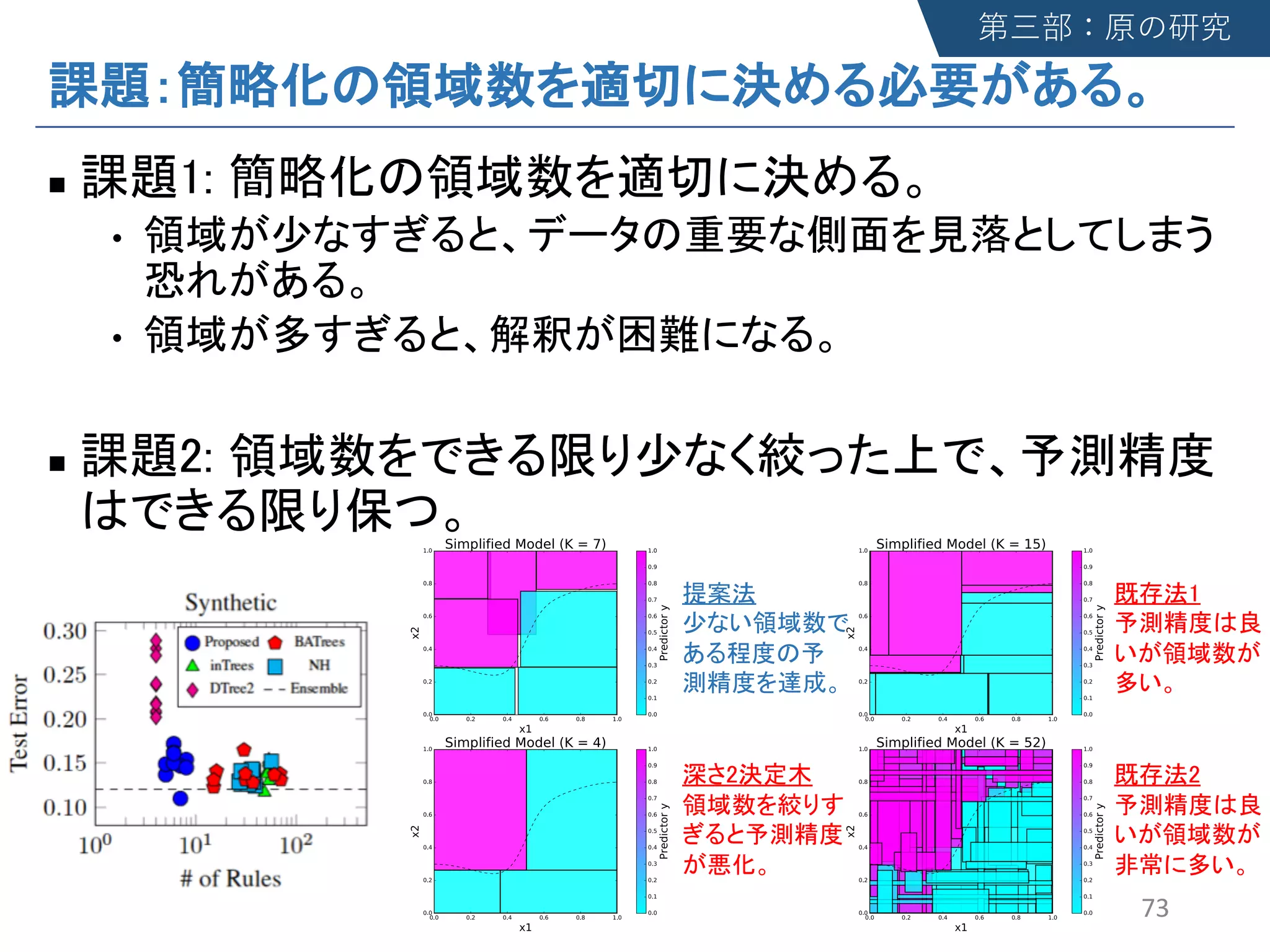
defragTrees
n 1.
• !" #, % &)
n 2. !"( #, % ))
• !"( #, % )) ≈ !"(#, %|&) ) ≪ &
!"( #, % ))
n
• )
• Factorized
Asymptotic Bayesian (FAB) Inference
74
&
)
n
n
•
•
•
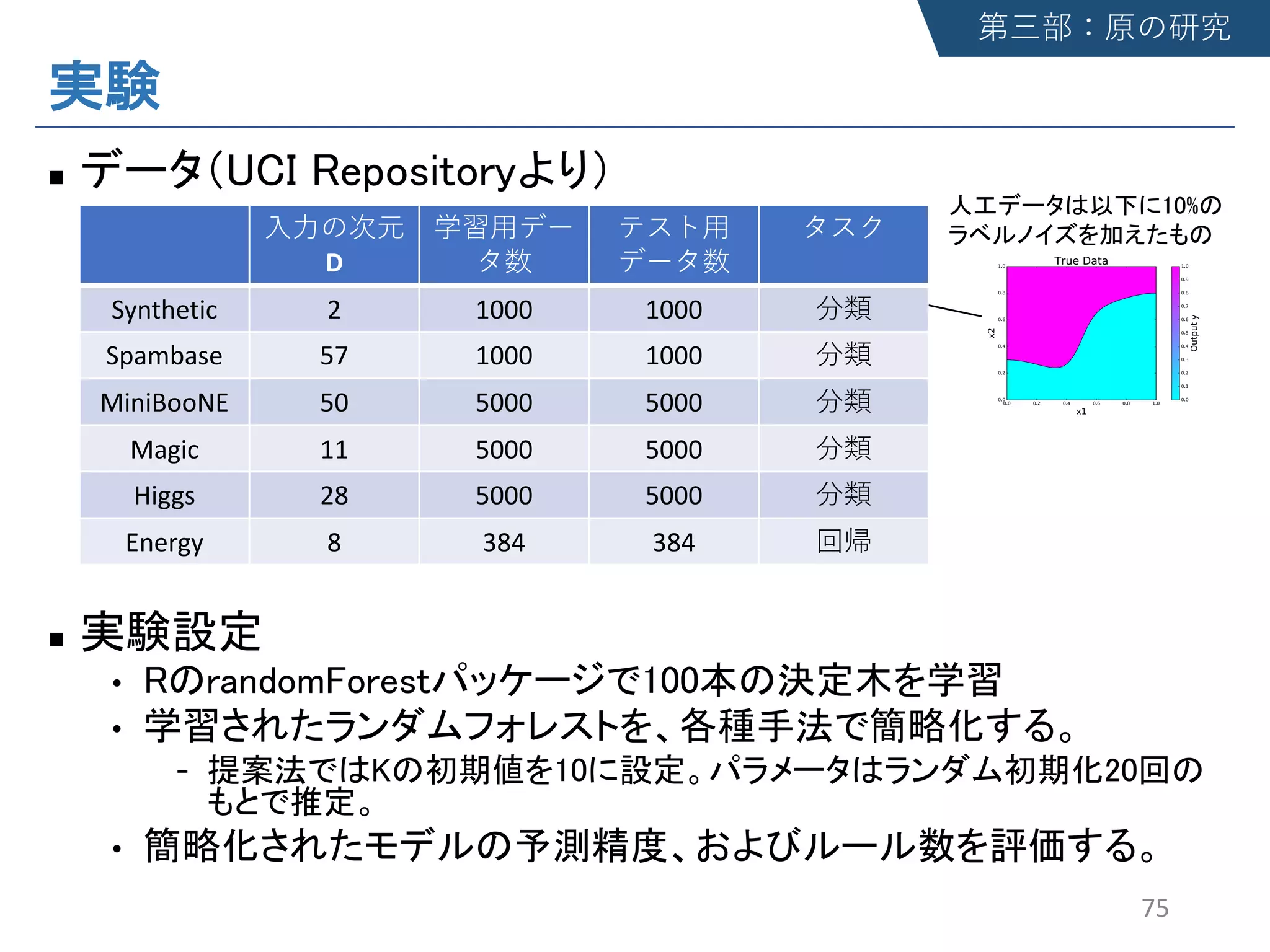
75
D
Synthetic 2 1000 1000
Spambase 57 1000 1000
MiniBooNE 50 5000 5000
Magic 11 5000 5000
Higgs 28 5000 5000
Energy 8 384 384
n
76
n
77
n
•
n
•
•
78
n AISTATS’18
•
n AAAI’17,18
•
79
n Enumerate Lasso Solu/ons for Feature Selec/on,
AAAI’17 [Python LassoVariants].
n Approximate and Exact Enumera/on of Rule Models,
AAAI'18.
→ NO!
n
•
82
n
• →
•
n
•
83
n
•
n
•
→
84
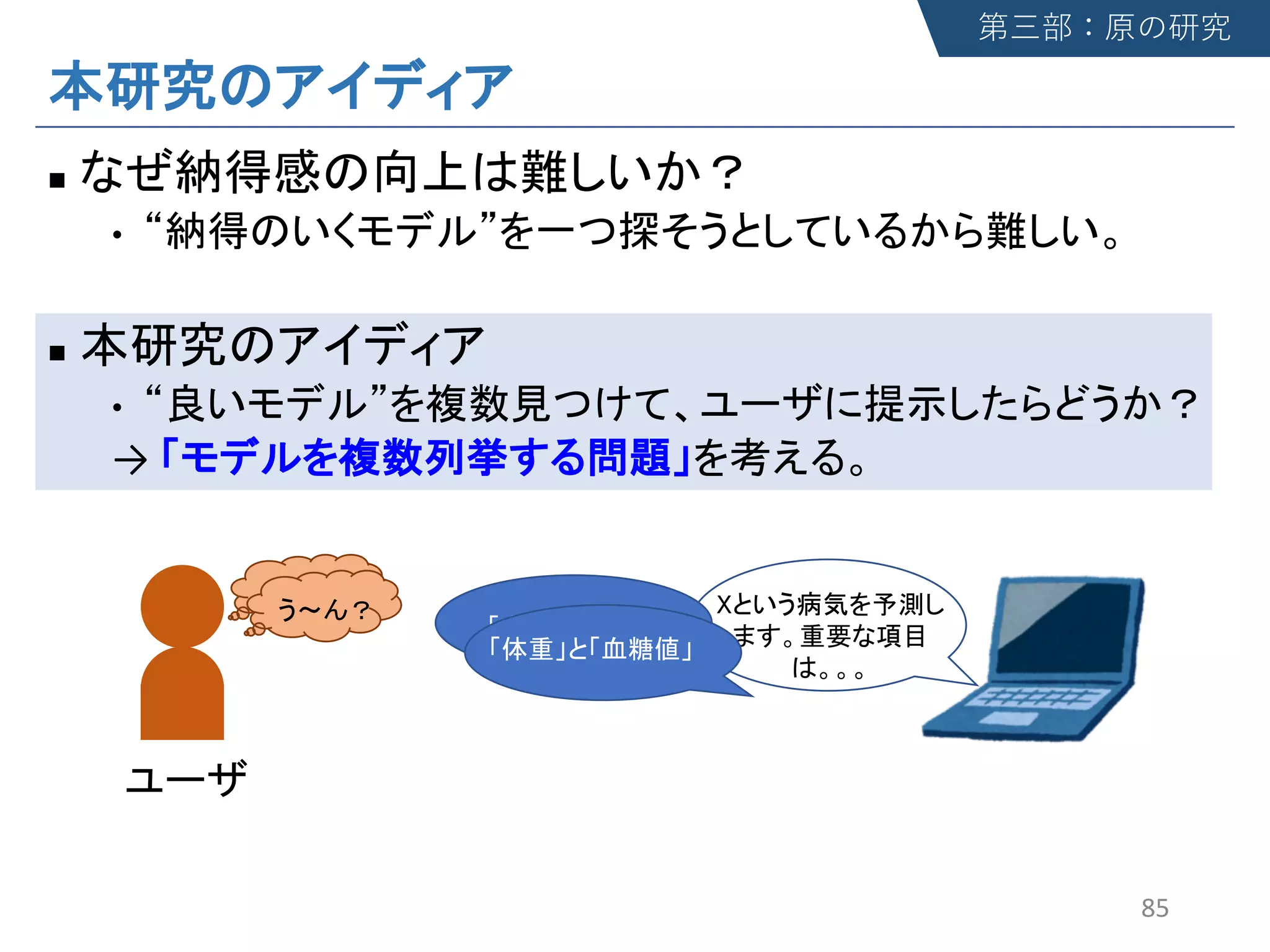
n
•
n
•
→
85
n
•
n
•
→
86
n
•
n
•
87
•
•
Lasso
Given: !", $" ∈ ℝ'×ℝ ) = 1, 2, … , .
Find: / ∈ ℝ' s.t. !"
0
/ ≈ $ () = 1, 2, … , .)
/
n
•
•
Lasso ℓ5
/∗ = argmin
=
1
2
>/ − $ @ + B / 5
• Lasso /∗ supp(/∗) = {) ∶ /"
∗
≠ 0}
Lasso
n
•
→ Lasso
n Lasso
•
→
n
Lasso
n ! ⊆ {$%, $', … , $)} Lasso
Lasso ! = min
3
%
'
45 − 7 ' + 9 5 % s.t. supp 5 ⊆ !
Lasso
! Lasso ! <
supp 5 = !
• 9
• 9
• $%, $', $= , $%, $', $> , $%, $>, $? , $%, $' , …
Lasso !
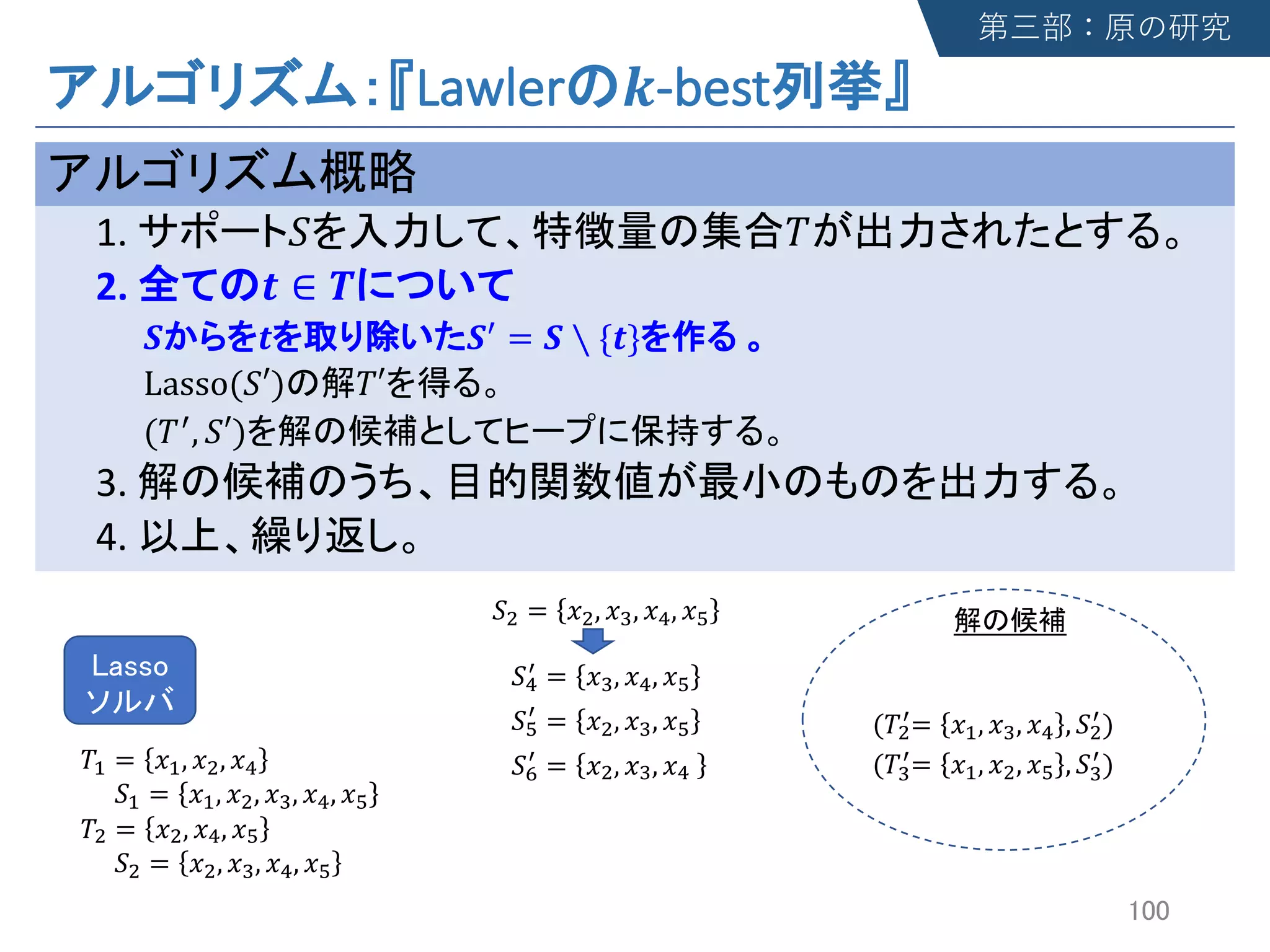
Lawler !-best
1. " #
2. $ ∈ #
" $ "& = " ∖ {$}
Lasso("′) #′
(#&, "′)
3.
4.
Lawler !-best
1. " #
2. $ ∈ &
' $ '( = ' ∖ {$}
Lasso('′) &′
(&(, '′)
3.
4.
& = 56, 57, 58
' = 56, 57, 59, 58, 5:
&6 = 56, 57, 58
'6 = 56, 57, 59, 58, 5:
Lawler !-best
1. " #
2. $ ∈ &
' $ '( = ' ∖ {$}
Lasso("′) #′
(#(, "′)
3.
4.
"5
( = 67, 68, 69, 6:
"7
( = 65, 68, 69, 6:
"8
(
= 65, 67, 68, 6:
"5 = 65, 67, 68, 69, 6:
#5 = 65, 67, 69
"5 = 65, 67, 68, 69, 6:
Lawler !-best
1. " #
2. $ ∈ &
" ' "( = " ∖ {'}
-.//0(2′) &′
(&(, 2′)
3.
4.
(#6
(= 78, 79, 7: , "6
()"6
( = 78, 7;, 79, 7:
"8
( = 76, 7;, 79, 7:
";
(
= 76, 78, 7;, 7:
"6 = 76, 78, 7;, 79, 7:
#6 = 76, 78, 79
"6 = 76, 78, 7;, 79, 7:
Lawler !-best
1. " #
2. $ ∈ &
" ' "( = " ∖ {'}
-.//0(2′) &′
(&(, 2′)
3.
4.
(#6
(= 78, 79, 7: , "6
()"6
( = 78, 7;, 79, 7:
"8
( = 76, 7;, 79, 7:
";
(
= 76, 78, 7;, 7:
"6 = 76, 78, 7;, 79, 7:
(#8
(= 76, 7;, 79 , "8
()
#6 = 76, 78, 79
"6 = 76, 78, 7;, 79, 7:
Lawler !-best
1. " #
2. $ ∈ &
" ' "( = " ∖ {'}
-.//0(2′) &′
(&(, 2′)
3.
4.
(#6
(= 78, 79, 7: , "6
()"6
( = 78, 7;, 79, 7:
"8
( = 76, 7;, 79, 7:
";
(
= 76, 78, 7;, 7:
"6 = 76, 78, 7;, 79, 7:
(#8
(= 76, 7;, 79 , "8
()
(#;
(= 76, 78, 7: , ";
()#6 = 76, 78, 79
"6 = 76, 78, 7;, 79, 7:
Lawler !-best
1. " #
2. $ ∈ #
" $ "& = " ∖ {$}
+,--.("′) #′
(#&, "′)
3.
4.
(#3
&= 45, 46, 47 , "3
&)
(#5
&= 43, 48, 46 , "5
&)
(#8
&= 43, 45, 47 , "8
&)
#5 = 45, 46, 47
"5 = 45, 48, 46, 47
#3 = 43, 45, 46
"3 = 43, 45, 48, 46, 47
Lawler !-best
1. " #
2. $ ∈ &
' $ '( = ' ∖ {$}
Lasso("′) #′
(#(, "′)
3.
4.
#5 = 65, 67, 68
"5 = 65, 67, 69, 68, 6:
(#7
(= 65, 69, 68 , "7
()
(#9
(= 65, 67, 6: , "9
()
#7 = 67, 68, 6:
"7 = 67, 69, 68, 6:
"8
( = 69, 68, 6:
":
(
= 67, 69, 6:
";
(
= 67, 69, 68
"7 = 67, 69, 68, 6:
Lasso % %
n
• %
• % Lasso
1.
n Thaliana gene expression data (Atwell et al. ’10):
• ! ∈ ℝ$%&%'( 2
• ) ∈ ℝ
• 134
2.
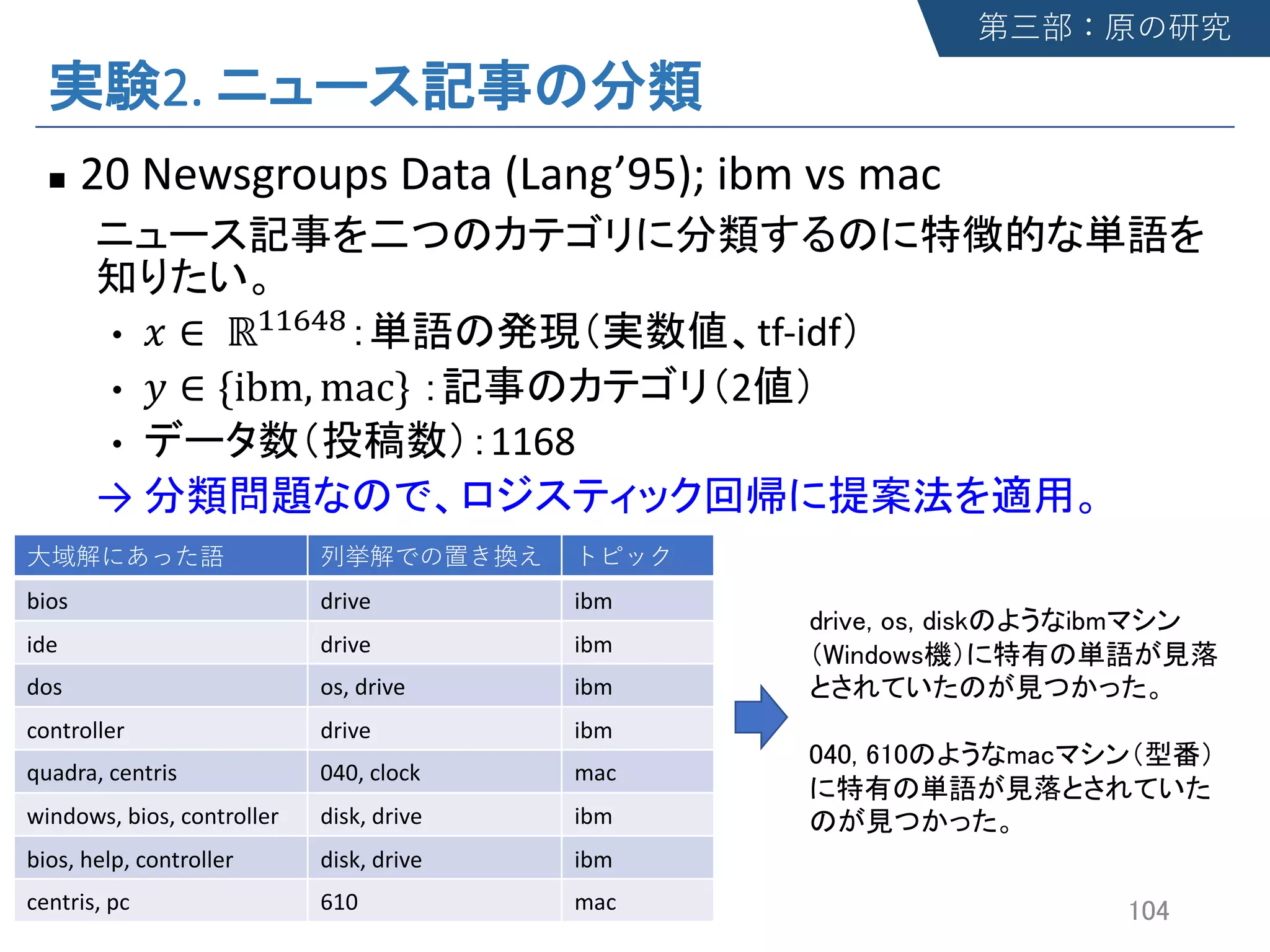
n 20 Newsgroups Data (Lang’95); ibm vs mac
• ! ∈ ℝ$$%&' tf-idf
• ( ∈ {ibm, mac} 2
• 1168
→
bios drive ibm
ide drive ibm
dos os, drive ibm
controller drive ibm
quadra, centris 040, clock mac
windows, bios, controller disk, drive ibm
bios, help, controller disk, drive ibm
centris, pc 610 mac
n
•
n Lasso
• Lawler !-best
n
•
•
•
•
•
• AISTATS’18
• AAAI’17,18
106
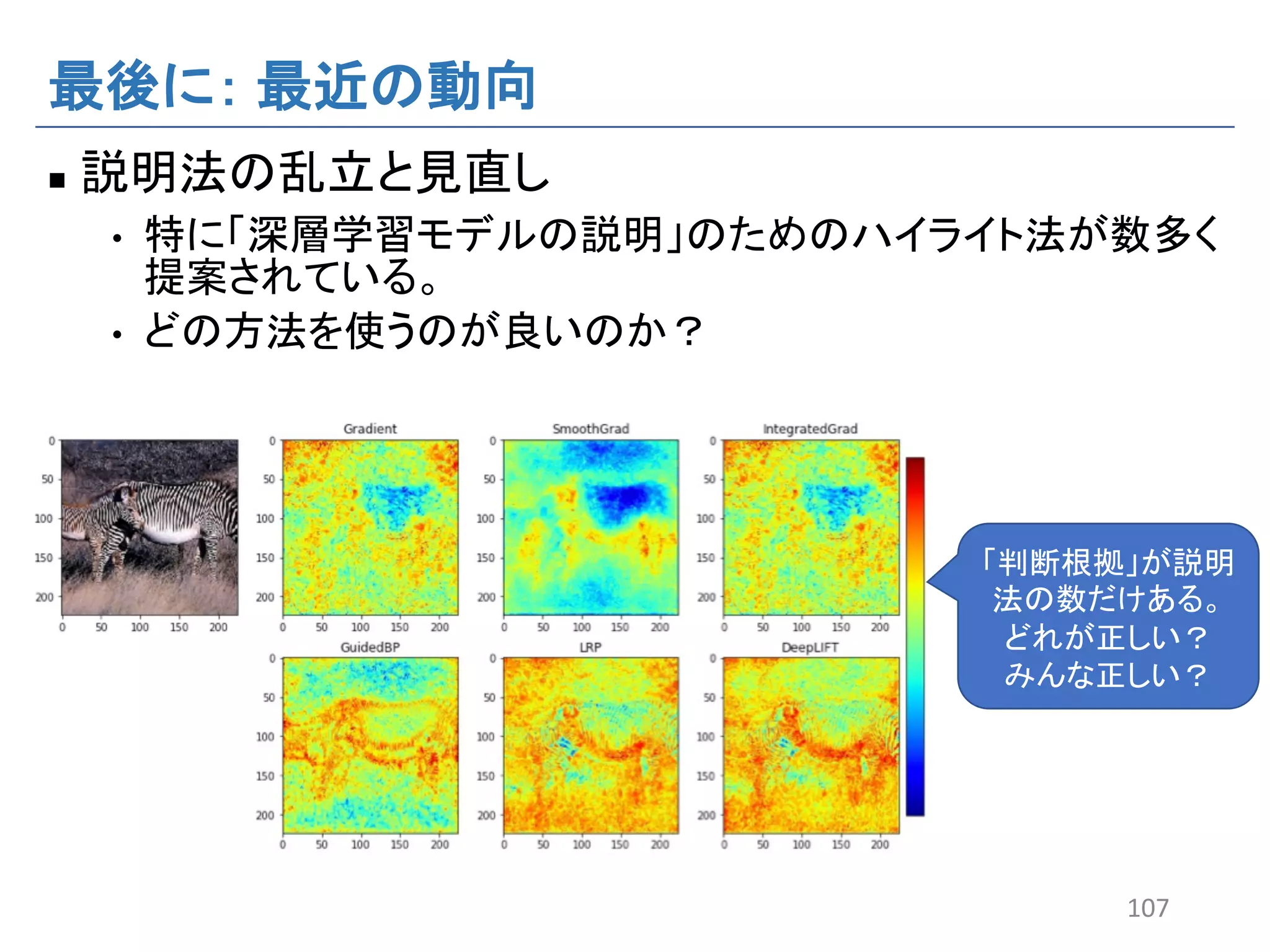
n
•
•
107
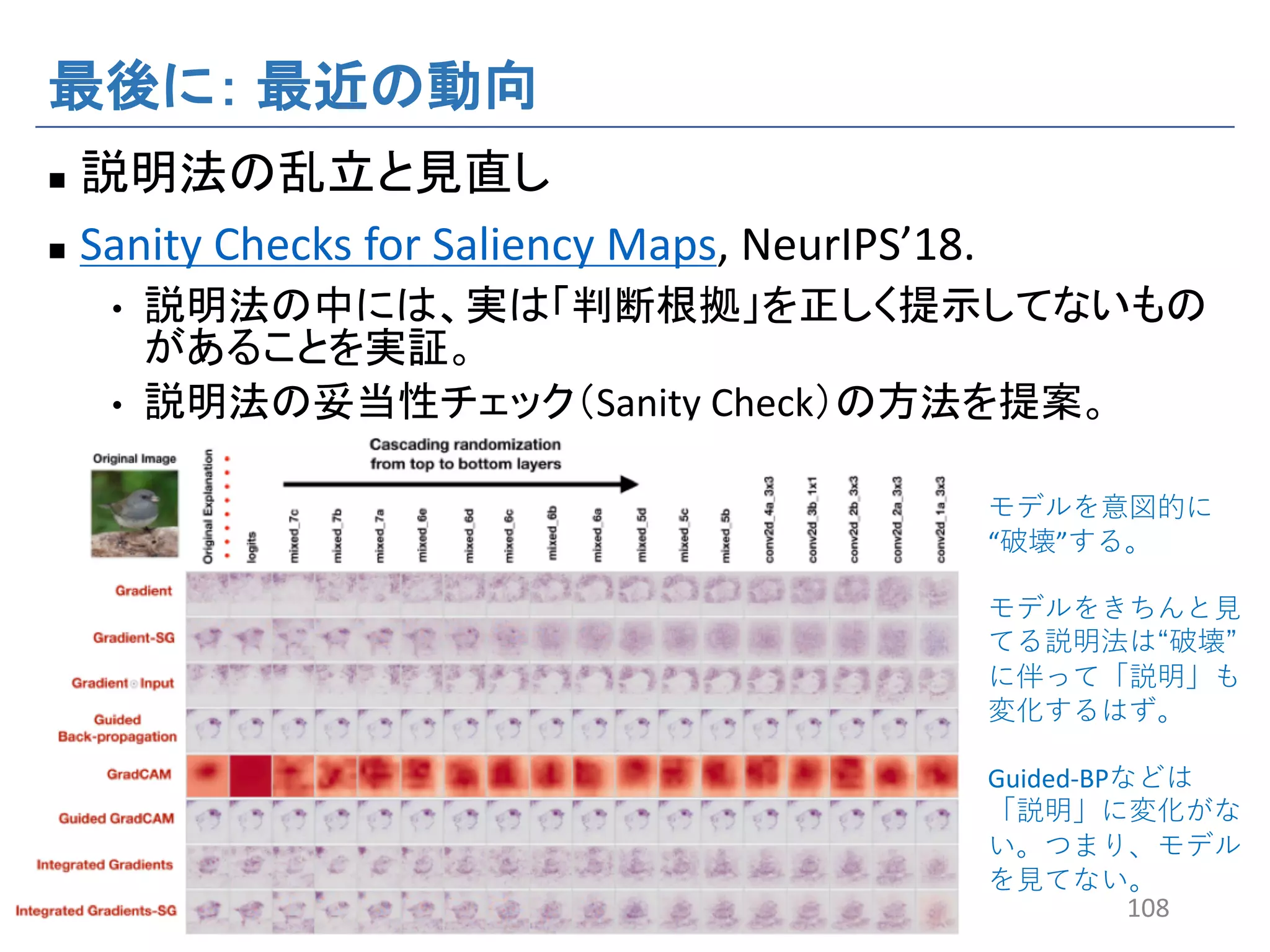
n
n Sanity Checks for Saliency Maps, NeurIPS’18.
•
• Sanity Check
108
“ ”
Guided-BP
n
•
•
•
n
• Please Stop Explaining Black Box Models for High-Stakes
Decisions, arXiv:1811.10154
109
n
•
•
n
•
110

機械学習モデルの判断根拠の説明

  • 1.
  • 2.
    n • ~2013.3, PhD@, • 2013.4~2016.3, @IBM • 2016.4~2017.8, @ ERATO, NII • 2017.9~, @ , n • ECML’11 AISTATS’15,17 • AISTATS’18 AAAI’17,18 ongoing 2
  • 3.
  • 4.
  • 5.
  • 6.
  • 7.
  • 8.
  • 9.
    EU GDPR n GDPR-22 1.The data subject shall have the right not to be subject to a decision based solely on automated processing, including profiling, which produces legal effects concerning him or her or similarly significantly affects him or her. 2. Paragraph 1 shall not apply if the decision: is necessary for entering into, or performance of, a contract between the data subject and a data controller; is authorised by Union or Member State law to which the controller is subject and which also lays down suitable measures to safeguard the data subject’s rights and freedoms and legitimate interests; or is based on the data subject’s explicit consent. 3. In the cases referred to in points (a) and (c) of paragraph 2, the data controller shall implement suitable measures to safeguard the data subject’s rights and freedoms and legitimate interests, at least the right to obtain human intervention on the part of the controller, to express his or her point of view and to contest the decision. 4. Decisions referred to in paragraph 2 shall not be based on special categories of personal data referred to in Article 9(2)1), unless point (a) or (g) of Article 9(2) applies and suitable measures to safeguard the data subject’s rights and freedoms and legitimate interests are in place. 9
  • 10.
    n 2016 • ICML,NIPS n • , , Vol.33, No.3, pages 366--369, 2018. • , Qiita 10
  • 11.
    n AI 11 Peeking insidethe black-box: A survey on Explainable Artificial Intelligence (XAI) https://ieeexplore.ieee.org/document/8466590/ 7 SCOPUS, IEEExplore, ACM Digital Library, Google Scholar, Citeseer Library, ScienceDirect, arXiv “intelligible”, “interpretable”, “transparency”, “black box”, “understandable”, “comprehensible”, “explainable” AI “Artificial Intelligence”, “Intelligent system”, “Machine learning”, “deep learning”, “classifier” , “decision tree”
  • 12.
  • 13.
    n • n • 1. • 2. •3. • 4. • … 13
  • 14.
  • 15.
  • 16.
    n n Why ShouldI Trust You?: Explaining the Predictions of Any Classifier, KDD'16 [Python LIME; R LIME] n A Unified Approach to Interpreting Model Predictions, NIPS'17 [Python SHAP] n Anchors: High-Precision Model-Agnostic Explanations, AAAI'18 [Python Anchor] n Understanding Black-box Predictions via Influence Functions, ICML’17 [Python influence-release] 16
  • 17.
    n n Born AgainTrees n Making Tree Ensembles Interpretable: A Bayesian Model Selection Approach, AISTATS'18 [Python defragTrees] 17
  • 18.
    n n [Python+Tensorflow saliency; DeepExplain] •Striving for Simplicity: The All Convolutional Net (GuidedBackprop) • On Pixel-Wise Explanations for Non-Linear Classifier Decisions by Layer-Wise Relevance Propagation (Epsilon-LRP) • Axiomatic Attribution for Deep Networks (IntegratedGrad) • SmoothGrad: Removing Noise by Adding Noise (SmoothGrad) • Learning Important Features Through Propagating Activation Differences (DeepLIFT) 18
  • 19.
  • 20.
    n n Why ShouldI Trust You?: Explaining the Predictions of Any Classifier, KDD'16 [Python LIME; R LIME] n A Unified Approach to Interpreting Model Predictions, NIPS'17 [Python SHAP] n Anchors: High-Precision Model-Agnostic Explanations, AAAI'18 [Python Anchor] n Understanding Black-box Predictions via Influence Functions, ICML’17 [Python influence-release] 20
  • 21.
    n n • LIME, SHAP,Anchor n • influence 21
  • 22.
    LIME n Why ShouldI Trust You?: Explaining the Predictions of Any Classifier, KDD'16 [Python LIME; R LIME] • • 22
  • 23.
  • 24.
    LIME n 2 • One-Hot • nLIME • Adult One-Hot 24
  • 25.
    LIME n ! !′ •LIME !′ !# ∈ {0, 1}* + !, # + n -(!) !0 • - ! ≈ 2 !# ≔ 40 + 46!# for !# ∈ NeighborOf(!0 # ) • 4 4, 25
  • 26.
    LIME n !(#) #% •! # ≈ ' #( ≔ *% + *,#( for #( ∈ NeighborOf(#% ( ) n * • min : ∑ <,<> ∈? @AB C ! C − ' C( E s.t. * % ≤ G * % @AB C #% H #% 26
  • 27.
  • 28.
    SHAP n A UnifiedApproach to Interpreting Model Predictions, NIPS'17 [Python SHAP] • • LIME 28
  • 29.
  • 30.
    SHAP n SHAP LIME •Adult One-Hot n . “ ” SHAP “ ” 30
  • 31.
    SHAP n SHAP =LIME • ! "# = %& + %("# = %& + ∑* %*"* # 3 n 1. + " = ! "# • 31
  • 32.
    SHAP n SHAP =LIME • ! "# = %& + %("# = %& + ∑* %*"* # 3 n 2. "* # = 0 ⇒ %* = 0 • 32
  • 33.
    SHAP n SHAP =LIME • ! "# = %& + %("# = %& + ∑* %*"* # 3 n 3. + " = +, "# + +′ +, # "# − +, # "# ∖ 0 ≥ +, "# − +, "# ∖ 0 ⇒ %* +# ≥ %* + • + +′ "* # +′ + +# "* # + 33
  • 34.
    SHAP n SHAP =LIME • ! "# = %& + %("# = %& + ∑* %*"* # SHAP n 3 • %* = ∑+⊆-. + ! 01 + 12 ! 0! (4- 5 − 4-(5 ∖ 8)) • Shapley Value 34
  • 35.
    SHAP n LIME • min $ ∑&∈() * +, * − . * / • ) * = 123 1 456678 & & (1 2|&|) n • Linear SHAP: • Tree SHAP: • Deep SHAP: DeepLIFT 35
  • 36.
    Anchor n Anchors: High-PrecisionModel-Agnostic Explanations, AAAI'18 [Python Anchor] • 36
  • 37.
  • 38.
    Anchor n Anchor LIME •Adult One-Hot n • Anchor + 38
  • 39.
  • 40.
    Anchor n ! • "! ! " = 1 n %(⋅ |!) ! n ! =Anchor • Anchor ! * " + ,- * ! 1. / 0. 1 ≥ +, ! " = 1 Anchor ! " 40
  • 41.
    Anchor n !" #$ 1& ' (& ) ≥ + • 1 − - Pr !" # $ 1& ' (& ) ≥ + ≥ 1 − - 41
  • 42.
    Anchor n ! = ! •! • max % &' ( [!(+)] s.t. Pr &' + ! 11 ( 21 3 ≥ 5 ≥ 1 − 7 n 1. n 2. • Pr &' + ! 11 ( 21 3 ≥ 5 1 − 7 ! 42
  • 43.
    n n • LIME, SHAP,Anchor n • influence 43
  • 44.
    influence n Understanding Black-boxPredictions via Influence Functions, ICML’17 [Python influence-release] n ("′, %′) " 44
  • 45.
    influence n ("′, %′) " n% = (("; *+), *+ *+ = argmin 2∈4 5 67(8,9)∈: ;(<; +) *+=6> = argmin 2∈4 5 6∈: ?@A 6B6> ;(<; +) n <> = ("′, %′) *+ • C+=6> − C+ *+=6> − *+ <> 45 <> = ("′, %′)
  • 46.
    influence n !" =(%′, (′) *+ • ,+-." − ,+ *+-." − *+ !" n • !" = (%′, (′) ,+-." • n influence • ,+-." − ,+ ,+-." − ,+ ≈ − 1 2 345 -6 78(!"; ,+) 46
  • 47.
  • 48.
    influence n • 48 This looks likethat: deep learning for interpretable image recognition, arxiv: 1806.10574.
  • 49.
    n n • LIME • SHAP •Anchor n • influence 49
  • 50.
    n • Interpretable Predictionsof Tree-based Ensembles via Actionable Feature Tweaking, KDD’17 • 50 30 200 20 200 30 300 ⭕ ⭕ … …
  • 51.
    n • Generating VisualExplanations, ECCV‘16 • 51
  • 52.
  • 53.
    n n Born AgainTrees n Making Tree Ensembles Interpretable: A Bayesian Model Selection Approach, AISTATS'18 [Python defragTrees] 53
  • 54.
    BATrees n Born AgainTrees • • n • ! ! • 54
  • 55.
  • 56.
  • 57.
    n n [Python+Tensorflow saliency; DeepExplain] •Striving for Simplicity: The All Convolutional Net (GuidedBackprop) • On Pixel-Wise Explanations for Non-Linear Classifier Decisions by Layer-Wise Relevance Propagation (Epsilon-LRP) • Axiomatic Attribution for Deep Networks (IntegratedGrad) • SmoothGrad: Removing Noise by Adding Noise (SmoothGrad) • Learning Important Features Through Propagating Activation Differences (DeepLIFT) 57
  • 58.
  • 59.
  • 60.
  • 61.
  • 62.
  • 63.
    n ! =# $ n $ n [Simonyan et al., arXiv’14] $% &' ( &() • → → *+ , *,- → • → → &' ( &() → 63
  • 64.
    n [Simonyan etal., arXiv’14] !" #$ % #%& n • GuidedBP [Springenberg et al., arXiv’14] back propagation • LRP [Bach et al., PloS ONE’15] • IntegratedGrad [Sundararajan et al., arXiv’17] • SmoothGrad [Smilkov et al., arXiv’17] • DeepLIFT [Shrikumar et al., ICML’17] 64
  • 65.
    n n [Python+Tensorflow saliency; DeepExplain] •Striving for Simplicity: The All Convolutional Net (GuidedBackprop) • On Pixel-Wise Explanations for Non-Linear Classifier Decisions by Layer-Wise Relevance Propagation (Epsilon-LRP) • Axiomatic Attribution for Deep Networks (IntegratedGrad) • SmoothGrad: Removing Noise by Adding Noise (SmoothGrad) • Learning Important Features Through Propagating Activation Differences (DeepLIFT) 65
  • 66.
  • 67.
  • 69.
    defragTrees n Making TreeEnsembles Interpretable: A Bayesian Model Selection Approach, AISTATS'18 [Python defragTrees] • • n 69 when Relationship ≠ Not-in-family, Wife Capital Gain < 7370 when Relationship ≠ Not-in-family Capital Gain >= 7370 when Relationship ≠ Not-in-family, Unmarried Capital Gain < 5095 Capital Loss < 2114 when Relationship = Not-in-family Country ≠ China, Peru Capital Gain < 5095 when Relationship ≠ Not-in-family Country ≠ China Capital Gain < 5095 when Relationship ≠ Not-in-family Capital Gain >= 7370 … …
  • 70.
    n n • 70 y = XOR(x1< 0.5, x2 < 0.5) + ✏
  • 71.
    n n 71 2017 The Stateof Data Science & Machine LearningYour Year on Kaggle: Most Memorable Community Stats from 2016
  • 72.
  • 73.
  • 74.
    defragTrees n 1. • !"#, % &) n 2. !"( #, % )) • !"( #, % )) ≈ !"(#, %|&) ) ≪ & !"( #, % )) n • ) • Factorized Asymptotic Bayesian (FAB) Inference 74 & )
  • 75.
    n n • • • 75 D Synthetic 2 10001000 Spambase 57 1000 1000 MiniBooNE 50 5000 5000 Magic 11 5000 5000 Higgs 28 5000 5000 Energy 8 384 384
  • 76.
  • 77.
  • 78.
  • 79.
  • 81.
    n Enumerate LassoSolu/ons for Feature Selec/on, AAAI’17 [Python LassoVariants]. n Approximate and Exact Enumera/on of Rule Models, AAAI'18.
  • 82.
  • 83.
  • 84.
  • 85.
  • 86.
  • 87.
  • 88.
  • 89.
    Lasso Given: !", $"∈ ℝ'×ℝ ) = 1, 2, … , . Find: / ∈ ℝ' s.t. !" 0 / ≈ $ () = 1, 2, … , .) / n • • Lasso ℓ5 /∗ = argmin = 1 2 >/ − $ @ + B / 5 • Lasso /∗ supp(/∗) = {) ∶ /" ∗ ≠ 0}
  • 90.
  • 92.
    Lasso n ! ⊆{$%, $', … , $)} Lasso Lasso ! = min 3 % ' 45 − 7 ' + 9 5 % s.t. supp 5 ⊆ ! Lasso ! Lasso ! < supp 5 = ! • 9 • 9 • $%, $', $= , $%, $', $> , $%, $>, $? , $%, $' , … Lasso !
  • 93.
    Lawler !-best 1. "# 2. $ ∈ # " $ "& = " ∖ {$} Lasso("′) #′ (#&, "′) 3. 4.
  • 94.
    Lawler !-best 1. "# 2. $ ∈ & ' $ '( = ' ∖ {$} Lasso('′) &′ (&(, '′) 3. 4. & = 56, 57, 58 ' = 56, 57, 59, 58, 5: &6 = 56, 57, 58 '6 = 56, 57, 59, 58, 5:
  • 95.
    Lawler !-best 1. "# 2. $ ∈ & ' $ '( = ' ∖ {$} Lasso("′) #′ (#(, "′) 3. 4. "5 ( = 67, 68, 69, 6: "7 ( = 65, 68, 69, 6: "8 ( = 65, 67, 68, 6: "5 = 65, 67, 68, 69, 6: #5 = 65, 67, 69 "5 = 65, 67, 68, 69, 6:
  • 96.
    Lawler !-best 1. "# 2. $ ∈ & " ' "( = " ∖ {'} -.//0(2′) &′ (&(, 2′) 3. 4. (#6 (= 78, 79, 7: , "6 ()"6 ( = 78, 7;, 79, 7: "8 ( = 76, 7;, 79, 7: "; ( = 76, 78, 7;, 7: "6 = 76, 78, 7;, 79, 7: #6 = 76, 78, 79 "6 = 76, 78, 7;, 79, 7:
  • 97.
    Lawler !-best 1. "# 2. $ ∈ & " ' "( = " ∖ {'} -.//0(2′) &′ (&(, 2′) 3. 4. (#6 (= 78, 79, 7: , "6 ()"6 ( = 78, 7;, 79, 7: "8 ( = 76, 7;, 79, 7: "; ( = 76, 78, 7;, 7: "6 = 76, 78, 7;, 79, 7: (#8 (= 76, 7;, 79 , "8 () #6 = 76, 78, 79 "6 = 76, 78, 7;, 79, 7:
  • 98.
    Lawler !-best 1. "# 2. $ ∈ & " ' "( = " ∖ {'} -.//0(2′) &′ (&(, 2′) 3. 4. (#6 (= 78, 79, 7: , "6 ()"6 ( = 78, 7;, 79, 7: "8 ( = 76, 7;, 79, 7: "; ( = 76, 78, 7;, 7: "6 = 76, 78, 7;, 79, 7: (#8 (= 76, 7;, 79 , "8 () (#; (= 76, 78, 7: , "; ()#6 = 76, 78, 79 "6 = 76, 78, 7;, 79, 7:
  • 99.
    Lawler !-best 1. "# 2. $ ∈ # " $ "& = " ∖ {$} +,--.("′) #′ (#&, "′) 3. 4. (#3 &= 45, 46, 47 , "3 &) (#5 &= 43, 48, 46 , "5 &) (#8 &= 43, 45, 47 , "8 &) #5 = 45, 46, 47 "5 = 45, 48, 46, 47 #3 = 43, 45, 46 "3 = 43, 45, 48, 46, 47
  • 100.
    Lawler !-best 1. "# 2. $ ∈ & ' $ '( = ' ∖ {$} Lasso("′) #′ (#(, "′) 3. 4. #5 = 65, 67, 68 "5 = 65, 67, 69, 68, 6: (#7 (= 65, 69, 68 , "7 () (#9 (= 65, 67, 6: , "9 () #7 = 67, 68, 6: "7 = 67, 69, 68, 6: "8 ( = 69, 68, 6: ": ( = 67, 69, 6: "; ( = 67, 69, 68 "7 = 67, 69, 68, 6:
  • 101.
    Lasso % % n •% • % Lasso
  • 103.
    1. n Thaliana geneexpression data (Atwell et al. ’10): • ! ∈ ℝ$%&%'( 2 • ) ∈ ℝ • 134
  • 104.
    2. n 20 NewsgroupsData (Lang’95); ibm vs mac • ! ∈ ℝ$$%&' tf-idf • ( ∈ {ibm, mac} 2 • 1168 → bios drive ibm ide drive ibm dos os, drive ibm controller drive ibm quadra, centris 040, clock mac windows, bios, controller disk, drive ibm bios, help, controller disk, drive ibm centris, pc 610 mac
  • 105.
    n • n Lasso • Lawler!-best n • •
  • 106.
  • 107.
  • 108.
    n n Sanity Checksfor Saliency Maps, NeurIPS’18. • • Sanity Check 108 “ ” Guided-BP
  • 109.
    n • • • n • Please StopExplaining Black Box Models for High-Stakes Decisions, arXiv:1811.10154 109
  • 110.